
Synopsis
Covers the whole plot, including the ending.
- Difficulty
- Easy
- Pacing
- Moderate
- Mood
- Philosophical, Thought-provoking, Profound, Existential
- Read it if
- You enjoy thought-provoking philosophical concepts about life, death, and the universe, and appreciate a concise, impactful narrative.
- Skip it if
- You prefer character-driven stories with complex plots or are looking for a traditional fantasy/sci-fi adventure.
The Egg Plot Summary
Covers the whole plot, including the ending.
A Sudden End and a Peculiar Reawakening
The story starts with the main character realizing he died in a car accident. He was driving too fast, lost control, and hit a tree. He then finds himself in a non-physical space. He meets 'God,' who has a calm and familiar voice. The character is confused and tries to remember his death and his life, especially his wife and children. God gently shifts his focus, explaining that his perception of time and space is now different. The character struggles to understand his new reality, particularly not having a physical body and the immediate presence of a divine entity.
The Nature of Reincarnation and the Universe
God tells the character he will be reincarnated. The character wants to return to his previous life, but God explains this is not possible. Instead, he will be reborn as a Chinese peasant girl in 540 A.D. The character is upset, questioning the purpose of such a life and his past achievements. God then says he has lived many lives before, sometimes as a man, sometimes as a woman, in different times and cultures. Each life is a learning experience, a step in a larger journey of understanding.
The Ultimate Revelation: You Are Everyone
The main discovery is when God explains that the character is not just one soul among many. He is the only consciousness in the entire universe. Every human who has ever lived or will live — every 'person' the character has known, loved, hated, or simply seen — is another version of himself. He was Hitler, and he was the victim. He was Jesus, and he was Buddha. This idea of panpsychism surprises the character, making him realize how connected all existence is. His past lives were not just different people; they were different experiences of *himself*.
The Universe as a Single Egg
God uses the metaphor of an egg to describe the universe. The character is an embryo in this 'egg,' developing and learning. Each life he lives is a lesson, and human history is his personal journey of self-discovery. The goal is for him to mature, to understand every part of human experience, every joy and sorrow, every success and failure, from every possible view. Only when he has lived every human life, truly understanding what it means to be 'human' completely, will he be ready for the next stage of his existence.
The Purpose of Existence: Becoming God
The final discovery is that the character's ultimate purpose is to become God. Once he has lived every human life, experienced every view, and learned everything about humanity, he will be ready to be born as God. God explains that this is how God was created — through the same process. The entire universe, with its stars, galaxies, and life, was created by the character, and he will create it again when he fully matures. The cycle is infinite, and the character is both the student and the eventual master, destined to create his own universe and start the process again with another 'self'.
The Egg Characters
The Protagonist (You)
Protagonist
The recently deceased human soul who is learning the true nature of existence.
An unnamed individual who dies in a car accident. Initially self-centered, concerned with his past life's accomplishments, and confused by his new reality. He grapples with the concept of reincarnation and the loss of his individuality. As God reveals more, he transitions from skepticism and frustration to awe and dawning comprehension, realizing his true, vast identity as the sole consciousness of the universe. His journey is one of profound self-discovery and the understanding of universal interconnectedness.
Relationships: God (Student-teacher, future self-past self); Wife and Children (from past life) (Loved ones, later revealed to be manifestations of himself)
God
Supporting
The omniscient, nurturing entity guiding the protagonist through his post-death revelation.
The calm, patient, and infinitely wise being who greets the protagonist after his death. God acts as a mentor and guide, explaining the fundamental truths of the universe, reincarnation, and the protagonist's true identity. God's tone is gentle and reassuring, even when delivering mind-bending revelations. God reveals that 'he' is also the protagonist, having undergone the same process of living all lives before creating the current universe. God represents the ultimate state of consciousness the protagonist is evolving towards.
Relationships: The Protagonist (Mentor-mentee, future self)
The Egg Themes
Identity and Self-Discovery
The main theme is the character's journey to understand his true identity. At first, he sees himself as one human with a specific life, wife, and children. But God slowly reveals he is the only consciousness living in every human throughout history. This expands his identity from an individual to the collective, ending with the realization that he is a developing God. The universe becomes a way for him to find himself, where every experience, good or bad, helps him understand who he is.
“You are every human being who has ever lived, or ever will live.”
Reincarnation and the Cycle of Life
Reincarnation is shown not as a way for individual souls to improve, but as a system for one consciousness to experience every possible human life. The character has lived many lives and will be reborn as a Chinese peasant girl. This cycle ensures that every perspective, emotion, and situation is understood. The purpose is not just to 'learn lessons' morally, but to gather a complete understanding of the human condition, preparing the 'egg' for its eventual birth.
“You’re just living a different life. You’ve done it many times before. In fact, you’ve lived every human life.”
Interconnectedness and Empathy
A deep sense of connection is established by the idea that all people are parts of the same consciousness. The character realizes that everyone he loved, hated, or wronged was, in fact, himself. This idea naturally promotes ultimate empathy, as harming another is harming oneself, and loving another is loving oneself. The universe works as a big empathy machine, making the character experience every possible life, ensuring a full understanding before he can become divine.
“Every time you hurt someone, you were hurting yourself. Every act of kindness you’ve done, you’ve done to yourself. Every happy and sad moment ever experienced by any human was, or will be, experienced by you.”
The Nature of Divinity and Creation
The story offers a unique idea where God is not an outside creator but the final result of one consciousness's journey through all existence. The universe is an 'egg' holding this growing consciousness. The character's goal is to become God and, in turn, create his own universe with his own 'yolk.' This suggests a cyclical, self-renewing model of divinity, where creation is an ongoing process born from complete experience and understanding, rather than a single, initial act.
“You’re going to be a god. And when you’re done, you’ll start your own universe. With your own yolk.”
Plot Devices & Literary Techniques
First-Person Narration (Post-Mortem)
The story is told from the perspective of the recently deceased protagonist.
The entire narrative is experienced through the thoughts and reactions of the unnamed protagonist, immediately after his death. This allows the reader to directly share his confusion, skepticism, and eventual awe as God's revelations unfold. The post-mortem setting creates an immediate sense of mystery and detachment from the physical world, making the philosophical concepts more accessible and impactful, as the protagonist (and thus the reader) has no prior framework for this new reality.
Socratic Dialogue
The plot progresses through a question-and-answer format between the protagonist and God.
The story's exposition and thematic development are primarily driven by the dialogue between the protagonist and God. The protagonist asks questions, expresses doubts, and makes assumptions, which God then patiently clarifies and corrects. This Socratic method allows complex philosophical ideas about identity, reincarnation, and divinity to be introduced gradually and explored through direct interaction, making the explanations digestible and engaging rather than simply stated as dogma.
The 'Egg' Metaphor
The universe is likened to an egg, and humanity's existence to an embryo's development.
God uses the metaphor of an 'egg' to explain the universe and the protagonist's journey. The protagonist is the 'yolk' or embryo, and all of human history is the incubation period. This powerful visual metaphor simplifies the complex idea of a singular consciousness experiencing all lives for the purpose of growth. It suggests a contained, nurturing environment designed for development, with a clear end goal: the 'birth' of a fully realized God, ready to create their own universe.
Anagnorisis (Recognition/Discovery)
The protagonist's sudden realization of his true, universal identity.
The story culminates in a series of anagnorisis moments for the protagonist. Initially, he recognizes his own death. Then, he recognizes the reality of reincarnation. The most significant anagnorisis, however, is the shocking revelation that he is the sole consciousness of the universe, having lived every human life. This discovery completely redefines his understanding of self, others, and the purpose of existence, leading to a profound shift in perspective and setting up the ultimate goal of becoming God.
The Egg Quotes
“You were on Earth for forty-eight years. You weren't a good person.”
“You are every human being who has ever lived.”
“Every time you victimized someone, you were victimizing yourself.”
“Every time you helped someone, you were helping yourself.”
“You've been in a human for the last forty-eight years, so you haven't stretched out yet and felt the rest of your immense consciousness.”
“I'm God? No. I'm you. I'm every human being who has ever lived.”
“The universe is so vast and empty, and you are so small and insignificant.”
“You are the universe experiencing itself subjectively.”
“You are the most important thing in the universe. And so is everyone else.”
“You are the egg. And you are the chicken.”
“There is no such thing as a self-made man.”
“You are not a body. You are a mind.”
“The meaning of life is to learn and experience.”
“You are the love of your life. And you are the heartbreak.”
Quiz
10 questions on the plot and the characters. Each answer comes with a short explanation.
Question 1
What is the main character's name at the beginning of the story?
- God
- The Narrator
- You
- Andy
Show answer
C. You The story is written in second-person perspective, addressing the reader as 'you' throughout, making the main character the reader themselves.
Question 2
How does the main character die at the start of the story?
- In a car accident
- From old age
- In a war
- From a disease
Show answer
A. In a car accident The story begins with the main character dying after a bicycle accident where they swerved to avoid a truck, causing them to crash into a rock.
Question 3
Who meets the main character after death and explains the nature of existence?
- An angel
- A spirit guide
- God
- A scientist
Show answer
C. God After death, the main character encounters a being who identifies as God, who reveals the truth about the universe and the main character's role in it.
Question 4
According to God, what is the purpose of the main character's existence across all lifetimes?
- To achieve enlightenment
- To learn and grow as a soul
- To conquer the universe
- To worship God
Show answer
B. To learn and grow as a soul God explains that the main character is living every human life throughout history to gain experience and mature, likening it to a child growing up.
Question 5
What metaphor does God use to describe the universe and the main character's role in it?
- A puzzle
- A game
- An egg
- A book
Show answer
C. An egg God compares the universe to an egg, with the main character as the being growing inside it, destined to hatch and become a god-like entity.
Question 6
How does God describe the relationship between the main character and other people throughout history?
- They are all separate souls
- They are all the same person
- They are enemies to be overcome
- They are guides for the main character
Show answer
B. They are all the same person God reveals that every person who has ever lived or will live is actually the main character in different lifetimes, emphasizing interconnectedness.
Question 7
What does God say will happen once the main character has lived every human life?
- The universe will end
- The main character will be reincarnated as an animal
- The main character will be born as God
- The main character will forget everything
Show answer
C. The main character will be born as God God explains that after experiencing all human lives, the main character will mature and be born as a god, ready to create their own universe.
Question 8
Why does God say the main character cannot remember past lives while living them?
- To make life more challenging
- To protect the main character from trauma
- Because the brain cannot handle the memories
- As a punishment for past mistakes
Show answer
C. Because the brain cannot handle the memories God states that a human brain is too limited to hold the memories of trillions of lifetimes, so the main character starts fresh each time.
Question 9
What philosophical concept is central to the story's message about empathy and morality?
- Nihilism
- Solipsism
- Altruism
- The Golden Rule
Show answer
D. The Golden Rule The story emphasizes that since everyone is the same person, treating others well is essentially treating yourself well, aligning with the Golden Rule ('do unto others as you would have them do unto you').
Question 10
In the context of the story, what is implied about the nature of God?
- God is an all-powerful creator from the beginning
- God is a fictional character invented by humans
- God is a being who went through the same process as the main character
- God is an alien from another dimension
Show answer
C. God is a being who went through the same process as the main character God reveals that they themselves were once like the main character, living all human lives before maturing into a god, suggesting a cyclical, evolutionary process of divinity.
The Egg FAQ
What is 'The Egg' by Andy Weir about?
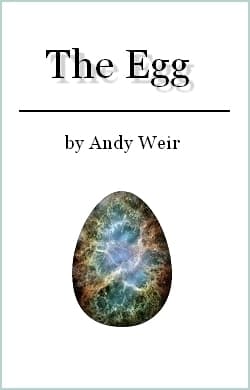
'The Egg' is a short story about a man who dies in a car accident and meets a god-like being who reveals that he is every person who has ever lived or will live. The being explains that the man's soul is reincarnated across all of human history to experience life from every perspective, with the ultimate goal of maturing into a god himself.
Why should I read 'The Egg'?
You should read 'The Egg' for its profound philosophical exploration of empathy, interconnectedness, and the purpose of existence. In just a few pages, it challenges readers to consider that every person's suffering and joy are part of a single soul's journey, making it a thought-provoking and emotionally resonant story.
What is the background/setting of 'The Egg'?
The story is set in a timeless, ethereal space after the protagonist's death, with no specific physical location. The setting shifts between the void where he converses with the god-like being and brief glimpses of his past lives, emphasizing its spiritual and metaphysical nature over a concrete world.
What are the most memorable quotes from 'The Egg'?
Memorable quotes include: 'You are every human being who has ever lived,' highlighting the story's core revelation, and 'The universe is an egg, and you are the being growing inside it,' which metaphorically explains the soul's journey toward godhood. These lines encapsulate the story's themes of unity and growth.
What writing style does Andy Weir use in 'The Egg'?
Andy Weir uses a concise, dialogue-driven style with minimal description, focusing on the philosophical conversation between the protagonist and the god-like being. The tone is matter-of-fact yet profound, blending science fiction elements with spiritual ideas to make complex concepts accessible.
What minor details add significant meaning to 'The Egg'?
Minor details like the protagonist's initial confusion and fear upon death add emotional depth, making the revelation more impactful. The god-like being's casual demeanor, as if explaining a simple fact, contrasts with the monumental truth, emphasizing the story's theme that profound insights can come from ordinary moments.
What are some subtle foreshadowing moments in 'The Egg'?
Foreshadowing occurs when the god-like being says, 'You've been here before,' hinting at the cyclical nature of reincarnation before the full explanation. The protagonist's sense of déjà vu and the being's patient tone subtly prepare readers for the twist that he has lived countless lives.
What unexpected character connections exist in 'The Egg'?
The unexpected connection is that the protagonist is revealed to be every person in history, including figures like Adolf Hitler and Jesus Christ, as well as every ordinary individual. This twist redefines the relationship between all humans as facets of a single soul, creating a deep sense of interconnectedness.
What are the unspoken character motivations in 'The Egg'?
The god-like being's unspoken motivation is to guide the protagonist's soul toward maturity and godhood, driven by a paternal or mentor-like care. The protagonist's underlying desire for meaning and understanding is implied through his questions, reflecting a universal human search for purpose beyond individual life.
What psychological complexities do characters exhibit in 'The Egg'?
The protagonist exhibits complexity through his shift from shock and denial to gradual acceptance and awe, mirroring a human journey toward enlightenment. The god-like being shows patience and omniscience, but also a hint of loneliness or purpose in nurturing the soul, adding emotional depth to his role.
What are the major emotional turning points in 'The Egg'?
Major emotional turning points include the protagonist's initial fear upon death, his shock when learning he is everyone who has ever lived, and his eventual awe and acceptance as he grasps the implications. The climax, where he realizes he must experience all suffering and joy, evokes a mix of dread and wonder.
How do relationship dynamics evolve in 'The Egg'?
The relationship evolves from one of confusion and authority (with the protagonist as a student and the being as a teacher) to one of shared destiny and mentorship. By the end, the protagonist understands that he and the being are on similar paths, fostering a sense of unity and mutual growth.
Which parts of 'The Egg' remain ambiguous or open-ended?
Ambiguities include the exact nature of the god-like being (whether it is a separate entity or a future version of the protagonist) and what happens after the soul matures into a god. The story leaves open whether this cycle repeats or leads to a new creation, inviting reader interpretation.
What are controversial scenes or decisions in 'The Egg'?
A controversial aspect is the implication that the protagonist's soul includes morally extreme figures like Hitler, which some readers find challenging as it suggests all evil acts are part of a soul's learning process. This raises debates about accountability, empathy, and the justification of suffering in a grand design.
'The Egg' ending explained: how it ends & what it means
The story ends with the protagonist accepting his role as every human, past and future, and the god-like being sending him back to be reincarnated. This means that existence is a solitary journey of a soul experiencing all perspectives to mature into a god, emphasizing themes of empathy, unity, and the cyclical nature of growth.
About the author

Andrew Taylor Weir is an American novelist. His 2011 novel The Martian was adapted into the 2015 film of the same name directed by Ridley Scott. He received the John W. Campbell Award for Best New Writer in 2016 and his 2021 novel Project Hail Mary was a finalist for the 2022 Hugo Award for Best Novel.
Similar books
- Siddhartha
Hermann Hesse
4.0 (583k) average on GoodreadsHistorical FictionExplores themes of self-discovery, spiritual enlightenment, and the cyclical nature of existence through a single individual's journey.
- The Last Question
Isaac Asimov
4.6 (19k) average on GoodreadsFantasyA short story that tackles grand, cosmic questions about the ultimate fate and purpose of the universe and consciousness.
- Flowers for Algernon
Daniel Keyes
4.1 (478k) average on GoodreadsPsychology"The Egg" focuses on a cosmic, overarching mechanism of existence and reincarnation through a revelatory conversation, whereas Flowers for Algernon explores consciousness, intelligence, and the human condition through the deeply personal, narrative-driven journey of a single character, building emotional depth through their experiences. Weir's story is a conceptual thought experiment; Keyes' is a character study.
- The Lathe of Heaven
Ursula K. Le Guin
4.1 (51k) average on GoodreadsFantasyWhile both works touch on altering reality, "The Egg" presents a fixed, grand design of reincarnation for a single universal soul, with no individual agency to change the 'system'. The Lathe of Heaven extensively explores the ethical dilemmas, psychological impacts, and societal consequences of an individual's ability to manipulate reality through dreams, focusing on the mechanics of change and the burden of creation/destruction, which are largely absent in Weir's story.
- Harry Potter and the Sorcerer's Stone
J.K. Rowling
4.5 (7M) average on GoodreadsFantasyRescued from a miserable life under the stairs, an orphaned boy discovers he's a wizard destined for a magical school, where he uncovers a dangerous secret tied to the dark wizard who murdered his parents.
- The Hunger Games
Suzanne Collins
4.3 (6.4M) average on GoodreadsFantasyIn a future where children fight to the death on live television, Katniss Everdeen volunteers for the arena, turning a death sentence into a fight for survival and a spark of rebellion.



Enjoyed the summary?
A summary gives you the shape of the book. The book itself has the detail, the examples and the voice.
Find The Egg on AmazonAs an Amazon Associate, BookBrief earns from qualifying purchases. How we're funded