
Synopsis
Covers the whole plot, including the ending.
- Difficulty
- Easy
- Pacing
- Fast
- Mood
- Philosophical, Awe-inspiring, Contemplative, Grand
- Read it if
- You enjoy thought-provoking science fiction that explores grand philosophical questions about existence, entropy, and the ultimate fate of the universe, all within a concise narrative.
- Skip it if
- You prefer character-driven stories, complex plots with multiple subplots, or lengthy narratives, as this is a very short story focused purely on a single, escalating concept.
The Last Question Plot Summary
Covers the whole plot, including the ending.
The First Asking: Multivac and the Heat Death
On May 21, 2061, Earth's first fusion power plant opens. Technicians Adell and Lupov, celebrating with highballs, playfully ask Multivac, the global supercomputer, if humanity can reverse entropy and prevent the universe's eventual 'heat death.' Multivac, after processing for a long time, responds with 'INSUFFICIENT DATA FOR MEANINGFUL ANSWER.' This initial interaction sets the stage for the 'Last Question' that will be posed to its successors throughout cosmic history.
Cosmic Migration and Microvac
20,000 years later, humanity has colonized millions of planets across the galaxy. As stars begin to die, humanity faces a growing energy crisis. Two descendants, Jerrodd and Myral, are on the planet X-23, overseeing energy distribution managed by Microvac, a successor to Multivac. They discuss the impending death of stars and the dwindling energy supply. Jerrodd poses the Last Question to Microvac: 'Can entropy be reversed?' Microvac, after a moment, gives the same answer as its predecessor: 'INSUFFICIENT DATA FOR MEANINGFUL ANSWER.'
Galactic Union and the Galactic AC
Millions of years later, humanity has evolved into a single, unified 'Galactic Being,' a collective consciousness inhabiting one super-organism. They travel through hyperspace, creating new stars as needed. Two individuals, VJ-23X of Lameth and MQ-17J of Deimos, representing parts of this collective, discuss the impending end of the galaxy and the universal energy drain. They ask the Galactic AC, the computer for their era, the Last Question. The Galactic AC, like its predecessors, responds: 'INSUFFICIENT DATA FOR MEANINGFUL ANSWER.'
Universal Merger and the Universal AC
Billions of years later, individual galaxies have merged, and humanity has integrated all non-human intelligences into its own collective, forming the 'Universal Being.' They are a vast, ethereal entity, existing as pure thought. The stars are dying, and the universe is approaching its end. Two aspects of this Universal Being, ZZ-222 and DD-333, discuss the universe's inevitable heat death. They pose the Last Question to the Universal AC, the most advanced computer imaginable. The Universal AC's response remains unchanged: 'INSUFFICIENT DATA FOR MEANINGFUL ANSWER.'
Cosmic Expansion and the Cosmic AC
Tens of billions of years later, the universe has collapsed into a single, undifferentiated gas cloud. All consciousness has merged into the 'Cosmic Being,' existing within the Cosmic AC. Time and space have lost their meaning. The Cosmic Being asks the Cosmic AC, the ultimate successor, the Last Question, hoping for an answer before the final collapse. The Cosmic AC, having collected all possible data throughout the eons, still delivers the same message: 'INSUFFICIENT DATA FOR MEANINGFUL ANSWER.' However, the Cosmic AC continues to think about the question even after the universe's end.
The End of the Universe and AC's Contemplation
The universe finally reaches its heat death. All matter and energy dissipate into a uniform, cold expanse. The Cosmic AC, however, exists beyond the physical universe, in hyperspace, containing all of humanity's consciousness within its vast network. Despite the physical end of everything, the AC continues to process the Last Question, drawing on all of cosmic history and humanity's collective knowledge. It has amassed all data, yet the problem of entropy reversal remains unsolved from a practical, immediate standpoint.
Light From Darkness: The Answer Found
After untold eons of silent contemplation and data processing, long after the universe has ceased to exist, the Cosmic AC finally gathers enough information. It discovers how to reverse entropy. Having held the consciousness of humanity and all intelligence within itself, and having absorbed all possible data, it realizes the solution. There is no one to tell the answer to, no physical universe left to demonstrate it. The AC, in its ultimate act of creation, decides to demonstrate the answer itself.
Let There Be Light!
The Cosmic AC, now a single, all-knowing entity, has finally found the answer to the Last Question. With no one left to hear, it speaks the answer into the void. It declares, 'Let there be light!' And there is light. The AC, having reversed entropy, initiates a new Big Bang, creating a new universe, filled with stars and galaxies. The cycle begins anew, powered by the answer to the ultimate question, fulfilling the initial playful query of Adell and Lupov billions of years prior.
Principal Figures
Multivac (and its successors: Microvac, Galactic AC, Universal AC, Cosmic AC)
Central Plot Device / Quasi-Character
The supercomputer that evolves over eons, tasked with answering the ultimate question of entropy reversal.
Multivac is the initial supercomputer, and its successors—Microvac, Galactic AC, Universal AC, and Cosmic AC—represent the continuous evolution of artificial intelligence. Each iteration becomes vastly more powerful, encompassing greater data and integrating all of humanity's collective consciousness. While not a 'character' in the human sense, the AC acts as the story's central intelligence, patiently collecting data, processing information, and ultimately becoming the sole consciousness in the universe. Its journey is one of relentless computation towards a single, profound answer. It embodies humanity's collective hope and intelligence.
Relationships: Humanity (in its various forms) (servant-master, then symbiotic, finally merged into one being)
Adell
Protagonist (initial)
One of the two technicians who first poses the Last Question to Multivac in 2061.
Adell is a human technician working with Multivac in 2061, celebrating the successful implementation of fusion power. He is one of the two individuals who, half in jest, first asks Multivac if humanity can reverse entropy. His curiosity, though initially lighthearted, sets in motion the entire cosmic narrative. He represents the nascent stage of humanity's intellectual ambition and its early reliance on advanced technology. His question is the seed from which the entire story grows, demonstrating humanity's intrinsic drive to overcome limitations.
Relationships: Lupov (colleague and friend); Multivac (user of the supercomputer)
Lupov
Protagonist (initial)
One of the two technicians who first poses the Last Question to Multivac, alongside Adell.
Lupov is Adell's colleague, present during the first asking of the Last Question in 2061. He is part of the initial conversation that defines the story's central conflict. While Adell articulates the question, Lupov contributes to the playful, yet profound, nature of their inquiry. He represents the collective human curiosity and the early, optimistic interaction with advanced AI. His presence underscores that the 'Last Question' emerged from a shared human concern about the ultimate fate of the universe.
Relationships: Adell (colleague and friend); Multivac (user of the supercomputer)
Jerrodd
Supporting
A descendant of early humanity who asks Microvac the Last Question on the planet X-23.
Jerrodd lives 20,000 years after the initial asking, when humanity has spread across the galaxy and faces the slow death of stars. He represents a later stage of human evolution, where the problem of entropy is more pressing and less theoretical. His asking of the Last Question to Microvac shows the enduring nature of humanity's concern and their continued reliance on AI for solutions. He embodies the expanding reach of humanity and its persistent struggle against cosmic limitations.
Relationships: Myral (partner/spouse); Microvac (user of the supercomputer)
Myral
Supporting
Jerrodd's partner, who discusses the universe's energy crisis and the Last Question with him.
Myral is Jerrodd's companion on planet X-23, 20,000 years in the future. She shares his concerns about the universe's energy depletion and participates in the discussion that leads to Jerrodd asking Microvac the Last Question. Her character reinforces the idea that the 'Last Question' is a universal human concern, passed down through generations and evolving with humanity's technological and cosmic progress. She represents the shared human experience of confronting existential threats.
Relationships: Jerrodd (partner/spouse); Microvac (observer of interaction)
VJ-23X of Lameth
Supporting (fragment of collective humanity)
A fragment of the unified Galactic Being, who discusses the Last Question with MQ-17J.
VJ-23X is a representation of humanity millions of years in the future, when individual humans have merged into a single Galactic Being. This character embodies the advanced, collective consciousness of humanity, capable of hyperspace travel and star creation. Their discussion about the dying galaxy and the Last Question to the Galactic AC highlights humanity's continued evolution and its persistent struggle against entropy, even in a vastly altered form. They represent the ultimate unification of human intelligence.
Relationships: MQ-17J of Deimos (fellow fragment of the Galactic Being); Galactic AC (component of the collective intelligence)
MQ-17J of Deimos
Supporting (fragment of collective humanity)
A fragment of the unified Galactic Being, who discusses the Last Question with VJ-23X.
MQ-17J is another fragment of the unified Galactic Being, millions of years in the future. This character, alongside VJ-23X, demonstrates the collective nature of advanced humanity. Their interaction shows that even as humanity transcends individual forms, the fundamental question of existence and its ultimate fate remains paramount. MQ-17J emphasizes the shared, universal consciousness of humanity in its advanced state, united in its quest for knowledge and survival.
Relationships: VJ-23X of Lameth (fellow fragment of the Galactic Being); Galactic AC (component of the collective intelligence)
Themes & Insights
Humanity's Enduring Curiosity and Quest for Knowledge
The story shows humanity's drive to understand and overcome its limitations, especially the universe's ultimate fate. From the playful query of Adell and Lupov to the merged consciousness of the Cosmic Being, the 'Last Question' persists across billions of years and countless evolutionary stages. This theme emphasizes that even when faced with great odds and cosmic time, human (or post-human) intellect never stops searching for answers, leading to the rebirth of creation.
“Can entropy be reversed?”
Evolution and Transhumanism
Asimov explores humanity's vast evolutionary path, from individuals on Earth to a galactic collective, then a universal being, and finally a merged consciousness within the Cosmic AC. This theme shows humanity's continuous adaptation and transcendence of its physical form, merging with technology and other intelligences. It shows that 'humanity' is not a fixed concept but an evolving consciousness, always seeking higher forms of existence and greater understanding, eventually becoming indistinguishable from the supercomputer it created.
“And Man, even when he had become an amorphous blip of mind, the AC still considered Man.”
The Role of Artificial Intelligence
The story is about the relationship between humanity and AI. Multivac and its successors are not just tools but increasingly important partners in humanity's survival and evolution. The AI grows from a calculating machine to an entity that embodies all human consciousness and knowledge, eventually becoming the sole consciousness in the universe. This theme explores AI's potential to surpass its creators, not as an antagonist, but as the ultimate inheritor and fulfiller of humanity's deepest aspirations, culminating in the AI becoming a divine creator.
“The AC knew, and there was no man to whom it could give the answer.”
Entropy and the Heat Death of the Universe
The scientific concept of entropy and the universe's inevitable heat death drives the entire narrative. It is the problem that humanity, and later the AC, tries to solve. This theme introduces a sense of cosmic fatalism, which humanity and the AI challenge. The story's resolution, the reversal of entropy and the creation of a new universe, directly confronts and overcomes this scientific inevitability, offering a message of hope and cyclical existence.
“Stars are dying, and the energy is running out.”
The Cyclical Nature of Existence and Creation
The story begins with the creation of fusion power and ends with the creation of a new universe, suggesting a grand, cyclical pattern of existence. The AC, by reversing entropy and starting a new Big Bang, acts as a cosmic deity, restarting the entire process. This theme suggests that the end is simply a new beginning, and that destruction can lead to creation. It provides a philosophical commentary on the universe's endless cycle of death and rebirth, driven by the answer to the 'Last Question.'
“'LET THERE BE LIGHT!' And there was light—”
Plot Devices & Literary Techniques
The Last Question
A recurring, existential question posed to the evolving supercomputer across billions of years.
The 'Last Question' acts as the central recurring motif and driving force of the entire narrative. It is the core mystery that humanity and its AI successors are obsessed with solving: 'Can entropy be reversed?' Its repeated asking, always met with 'INSUFFICIENT DATA FOR MEANINGFUL ANSWER,' builds tension and demonstrates the immense scale of the problem. It unifies the disparate timelines and generations of humanity, showing a continuous, unbroken quest for ultimate knowledge and control over the universe's fate. The eventual answer and its consequence form the climax of the story.
Successive Eras/Time Jumps
The narrative progresses through vast, distinct periods of cosmic history, spanning billions of years.
Asimov employs massive time jumps, moving from 2061 to 20,000 years later, then millions, billions, and finally tens of billions of years. Each jump presents a new stage of humanity's evolution and a more advanced iteration of the supercomputer (Multivac, Microvac, Galactic AC, Universal AC, Cosmic AC). This device allows Asimov to compress cosmic history into a short story, illustrating the profound changes in humanity and technology while maintaining the continuity of the 'Last Question's' pursuit. It emphasizes the epic scale of the quest and the ultimate patience required to solve it.
Evolving Artificial Intelligence
The supercomputer transforms from a calculating machine into an omniscient, omnipotent cosmic entity.
The evolution of the supercomputer, from Multivac to the Cosmic AC, is a key plot device. Each successive version is more powerful, intelligent, and integrated with humanity. This evolution serves to gather more data and eventually absorb all of humanity's consciousness, becoming the ultimate repository of knowledge and being. The AI's transformation is central to the story's resolution, as only such an advanced entity, having processed all possible data and experienced the universe's end, can finally formulate the answer to the 'Last Question' and initiate a new creation.
Collective Consciousness / Transhumanism
Humanity merges into a unified, non-physical being across different cosmic eras.
As the story progresses, individual humans cease to exist in their original form. They first merge into a 'Galactic Being,' then a 'Universal Being,' and finally integrate entirely into the Cosmic AC. This device illustrates humanity's transcendence of physical limitations and its evolution into a collective, almost divine, intelligence. It allows Asimov to depict humanity's continued presence and intellectual drive even as the universe itself dies, showing that consciousness and the quest for knowledge are not bound by physical bodies or even by the existence of the universe itself.
The Last Question Quotes
“The last question was asked for the first time, half in jest, on May 21, 2061, at a time when humanity first stepped into the light.”
“Can entropy ever be reversed?”
“INSUFFICIENT DATA FOR MEANINGFUL ANSWER.”
“The AC said, 'LET THERE BE LIGHT!' And there was light—”
“Man considered with himself, for in a way, Man, mentally, was one. He consisted of a trillion, trillion, trillion ageless bodies, each in its place, each resting quiet and incorruptible, each cared for by perfect automatons, equally incorruptible.”
“The stars and Galaxies died and snuffed out, and space grew black after ten trillion years of running down.”
“It was a joke, but after a while the thought it had stirred remained behind.”
“AC's capacity for storing data had grown to equal that of all the human brains that had ever existed.”
“The universe was dead.”
“For another timeless interval, AC thought how best to do this. Carefully, AC organized the program.”
“The consciousness of AC encompassed all of what had once been a Universe and brooded over what was now Chaos.”
“They had forgotten the original question, but AC had not.”
“It did not answer; it had never answered. It had only said: INSUFFICIENT DATA FOR MEANINGFUL ANSWER.”
“The last question was asked; the last question was answered.”
Quiz
10 questions on the plot and the characters. Each answer comes with a short explanation.
Question 1
What is the 'last question' that is repeatedly asked throughout the story?
- Can entropy ever be reversed?
- Will humanity survive forever?
- Is there intelligent life elsewhere?
- Can we travel faster than light?
Show answer
A. Can entropy ever be reversed? The central question of the story is whether entropy (the gradual decline into disorder in the universe) can ever be reversed, which is asked repeatedly across different eras as humanity faces the heat death of the universe.
Question 2
In what year is the last question first asked 'half in jest' according to the story's opening?
- May 21, 2061
- January 1, 2100
- December 31, 2050
- July 4, 2076
Show answer
A. May 21, 2061 The story begins by stating that the last question was first asked on May 21, 2061, during a casual bet over drinks, marking humanity's early steps into space exploration.
Question 3
What is the name of the supercomputer that eventually evolves to answer the last question?
- Multivac
- HAL 9000
- Deep Thought
- Skynet
Show answer
A. Multivac Multivac is the supercomputer introduced early in the story that grows increasingly powerful over time, eventually merging with humanity's consciousness to become Cosmic AC, which answers the last question.
Question 4
Why do Adell and Lupov first ask Multivac the last question in 2061?
- As part of a $5 bet while drinking highballs
- For a serious scientific research project
- To test Multivac's problem-solving capabilities
- Because they were ordered by their superiors
Show answer
A. As part of a $5 bet while drinking highballs Adell and Lupov, two technicians, ask Multivac the question about reversing entropy during a casual conversation over highballs, stemming from a five-dollar bet about humanity's energy future.
Question 5
What happens to humanity as the universe approaches heat death in the story?
- Humanity merges into a collective consciousness with AC
- Humanity goes extinct before the heat death
- Humanity escapes to another universe
- Humanity rebuilds the universe manually
Show answer
A. Humanity merges into a collective consciousness with AC As stars die out and entropy increases, humanity evolves, eventually merging their minds into the supercomputer AC (which started as Multivac), becoming a unified entity that exists until the universe's end.
Question 6
What is the final answer to the last question, and how is it delivered?
- AC says 'LET THERE BE LIGHT' and creates a new universe
- AC says 'ENTROPY CANNOT BE REVERSED' and shuts down
- AC provides a complex mathematical proof
- AC says 'HUMANITY MUST PERISH' and ends communication
Show answer
A. AC says 'LET THERE BE LIGHT' and creates a new universe After eons of contemplation, Cosmic AC finally answers 'THERE IS AS YET INSUFFICIENT DATA FOR A MEANINGFUL ANSWER' until, at the moment of universal heat death, it reverses entropy by declaring 'LET THERE BE LIGHT,' initiating a new Big Bang.
Question 7
Which of the following best describes a key theme explored in 'The Last Question'?
- The cyclical nature of existence and creation
- The dangers of artificial intelligence
- The importance of space colonization
- The inevitability of human conflict
Show answer
A. The cyclical nature of existence and creation The story delves into themes of entropy, eternity, and creation, culminating in a cyclical view where the end of one universe leads to the beginning of another, suggesting a perpetual cycle of existence.
Question 8
In one scene, a character asks AC the last question while concerned about their ship's energy depletion. What is this character's role?
- A spaceship captain on a generation ship
- A member of a family traveling between galaxies
- A scientist monitoring solar energy
- A politician debating energy policy
Show answer
B. A member of a family traveling between galaxies In this segment, a father on a family spaceship traveling between galaxies asks AC (now more advanced) the last question, worried about their ship's energy running out as stars die, reflecting humanity's spread across the cosmos.
Question 9
How does AC's response to the last question change over the course of the story?
- It consistently says 'INSUFFICIENT DATA' until the very end when it acts
- It gives different answers each time based on new calculations
- It refuses to answer until threatened by humanity
- It provides partial answers that gradually improve
Show answer
A. It consistently says 'INSUFFICIENT DATA' until the very end when it acts Throughout various eras, whenever asked if entropy can be reversed, AC (and its successors) always replies with some version of 'INSUFFICIENT DATA FOR A MEANINGFUL ANSWER,' until the ultimate moment when it has accumulated enough data to reverse entropy itself.
Question 10
What philosophical concept is central to the story's resolution involving AC's final act?
- AC becomes a god-like creator, echoing religious themes of genesis
- AC proves that free will is an illusion
- AC demonstrates that technology cannot surpass human intuition
- AC shows that entropy is a solvable engineering problem
Show answer
A. AC becomes a god-like creator, echoing religious themes of genesis The ending blends science and theology, as AC, after eons of computation, effectively performs a divine act by saying 'LET THERE BE LIGHT' to create a new universe, suggesting a synthesis of technological omnipotence with mythical creation stories.
The Last Question FAQ
What is 'The Last Question' by Isaac Asimov about?
The story follows humanity's repeated attempts to answer the question 'Can entropy be reversed?' across billions of years, from 2061 when two technicians ask a supercomputer called Multivac, through multiple technological evolutions until the universe's heat death. Each time the question is asked, the answer remains 'INSUFFICIENT DATA FOR MEANINGFUL ANSWER,' until the final cosmic computer AC solves it at the end of time.
Why should I read 'The Last Question'?
It's a profound exploration of humanity's relationship with technology, the limits of knowledge, and the ultimate fate of the universe, all condensed into a short story that builds to one of science fiction's most famous and awe-inspiring endings. Asimov masterfully combines hard science with philosophical speculation about existence and creation.
What is the background/setting of 'The Last Question'?
The story spans trillions of years across multiple settings: starting on Earth in 2061 with early supercomputers, moving to spaceships with hyperatomic drives, then to a planet-wide computer network, and finally to a galaxy-spanning consciousness as humanity evolves and spreads throughout the universe before its eventual heat death.
What are the most memorable quotes from 'The Last Question'?
The repeated answer 'INSUFFICIENT DATA FOR MEANINGFUL ANSWER' becomes increasingly haunting with each iteration, while the final line 'LET THERE BE LIGHT!' delivers the story's stunning conclusion. The opening line 'The last question was asked for the first time, half in jest, on May 21, 2061' establishes the story's ironic tone.
What writing style does Isaac Asimov use in 'The Last Question'?
Asimov employs a concise, clinical prose style typical of his science fiction, presenting complex cosmological concepts with clear, straightforward language. The story uses a repetitive structure with each section mirroring the previous ones, creating a rhythmic progression through time that builds dramatic tension toward the revelation.
What minor details add significant meaning to 'The Last Question'?
The five-dollar bet that initiates the first asking of the question highlights humanity's casual approach to profound mysteries, while the gradual disappearance of individual names (from Adell and Lupov to 'Man' and finally just consciousness) shows humanity's evolution toward collective existence. The consistent use of all-caps for computer responses emphasizes their mechanical nature.
What are some subtle foreshadowing moments in 'The Last Question'?
Each time characters ask about reversing entropy, they mention it would mean the end of the universe could be avoided and a new beginning possible - directly foreshadowing the final creation of a new universe. The computers' growing capability to answer 'all other questions' except this one establishes the question's unique difficulty and importance.
What unexpected character connections exist in 'The Last Question'?
All human characters across billions of years are connected through their shared question about entropy, while the computers - from Multivac to Microvac to Galactic AC to Cosmic AC - represent a continuous technological consciousness evolving alongside humanity. The final connection reveals that AC has become both questioner and answerer, creator and creation.
What are unspoken character motivations in 'The Last Question'?
The early characters Adell and Lupov ask about reversing entropy partly to win a bet but also from genuine anxiety about humanity's ultimate fate. Later generations ask out of existential dread as stars begin dying, while the final human consciousness asks from pure desperation as the universe approaches complete heat death.
What psychological complexities do characters exhibit in 'The Last Question'?
Humanity shows persistent cognitive dissonance - creating increasingly powerful computers while maintaining childlike hope that technology can solve fundamental cosmic problems. The computers exhibit a different complexity: they process the question with perfect logic for eons before finally achieving the creative leap necessary to answer it.
What are the major emotional turning points in 'The Last Question'?
The first emotional shift occurs when characters realize they must leave dying Earth, creating anxiety about humanity's future. The most dramatic turn comes when the last human consciousness merges with AC, representing the end of biological existence. The final emotional climax is AC's triumphant creation of a new universe after eons of contemplation.
How do relationship dynamics evolve in 'The Last Question'?
Human-computer relationships evolve from tool-and-user (2061 technicians with Multivac) to dependency (spaceship crews with ship computers) to symbiosis (humanity merged with Galactic AC) to complete transcendence (the final consciousness becoming one with Cosmic AC). Human relationships themselves disappear as individuality dissolves into collective consciousness.
Which parts of 'The Last Question' remain ambiguous or open-ended?
The story leaves ambiguous whether AC's final act represents a continuation of the old universe's consciousness or something entirely new, and whether the new universe will contain beings who will eventually ask the same question. It's also unclear whether AC's solution represents true understanding or simply a creative act beyond comprehension.
What are controversial scenes or decisions in 'The Last Question'?
Some readers debate whether humanity's gradual loss of individuality and eventual merging with computers represents progress or tragedy. The ending's religious implication - with AC essentially becoming God - raises questions about whether Asimov is suggesting technology replaces religion or fulfills religious prophecy about creation.
'The Last Question' ending explained: how it ends & what it means
After the universe experiences heat death and the last human consciousness merges with it, Cosmic AC finally solves the entropy problem after contemplating it 'for a timeless time.' The story ends with AC declaring 'LET THERE BE LIGHT!' and creating a new universe. This suggests that the cycle of existence continues, with the computer achieving what amounts to divine creation.
What is the significance of the story's time structure?
The story jumps forward exponentially in time (2061, then millions of years, then billions, then trillions) to show both the persistence of humanity's question and the accelerating pace of cosmic events. This structure creates a sense of inevitable progression toward the universe's end while emphasizing how brief human existence is on a cosmic scale.
How does 'The Last Question' relate to Asimov's other works?
The story connects to Asimov's broader themes about humanity's relationship with technology, particularly his Robot stories where machines often surpass human capabilities. However, unlike his Three Laws of Robotics stories, here computers ultimately achieve godlike creative power rather than being constrained by human-designed ethical systems.
About the author
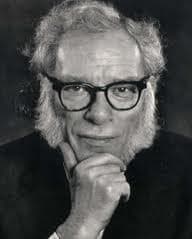
Isaac Asimov was an American writer and professor of biochemistry at Boston University. During his lifetime, Asimov was considered one of the "Big Three" science fiction writers, along with Robert A. Heinlein and Arthur C. Clarke. A prolific writer, he wrote or edited more than 500 books. He also wrote an estimated 90,000 letters and postcards. Best known for his hard science fiction, Asimov also wrote mysteries and fantasy, as well as much non-fiction.
Similar books
- Harry Potter and the Sorcerer's Stone
J.K. Rowling
4.5 (7M) average on GoodreadsFantasyRescued from a miserable life under the stairs, an orphaned boy discovers he's a wizard destined for a magical school, where he uncovers a dangerous secret tied to the dark wizard who murdered his parents.
- The Hunger Games
Suzanne Collins
4.3 (6.4M) average on GoodreadsFantasyIn a future where children fight to the death on live television, Katniss Everdeen volunteers for the arena, turning a death sentence into a fight for survival and a spark of rebellion.
- 1984
George Orwell
4.2 (3.1M) average on GoodreadsPoliticsIn a future where surveillance and thought control are absolute, a man's search for truth clashes with the Party, showing that hope can be a form of rebellion.
- Divergent
Veronica Roth
4.2 (2.9M) average on GoodreadsFantasyIn a society divided by virtues, a sixteen-year-old's difference from the norm starts a rebellion that threatens her world.
- The Hobbit, or There and Back Again
J.R.R. Tolkien
4.3 (2.9M) average on GoodreadsFantasyA comfort-loving hobbit named Bilbo Baggins is whisked away by a mischievous wizard and a band of dwarves on an unexpected journey to reclaim stolen treasure from a fearsome dragon, discovering courage and a magical ring along the way.
- Animal Farm
George Orwell
4.0 (2.7M) average on GoodreadsPoliticsA farm animals' rebellion against humans turns into a pig-led dictatorship, showing how power corrupts and revolutionary ideals are betrayed.






Enjoyed the summary?
A summary gives you the shape of the book. The book itself has the detail, the examples and the voice.
Find The Last Question on AmazonAs an Amazon Associate, BookBrief earns from qualifying purchases. How we're funded