
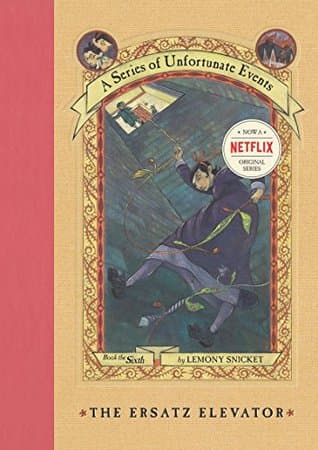
Synopsis
Covers the whole plot, including the ending.
- Difficulty
- Medium
- Pacing
- Moderate
- Mood
- Melancholy, Mysterious, Witty, Darkly Humorous
- Read it if
- You enjoy dark humor, mysteries, and a unique narrative voice, and don't mind a lack of happy endings.
- Skip it if
- You prefer lighthearted stories, straightforward plots, or characters who consistently succeed.
The Ersatz Elevator Plot Summary
Covers the whole plot, including the ending.
The Arrival at 667 Dark Avenue
After another problem at Prufrock Preparatory School, Mr. Poe drives the Baudelaire orphans—Violet, Klaus, and Sunny—to their new guardian's home: 667 Dark Avenue. The building has no light, and the elevator seems broken. A doorman explains that residents fear light and only use stairs. The Baudelaires, always clever, start to navigate the dark, wondering about their new guardian and the strange rules of this gloomy place. They hope this new home will finally protect them from Count Olaf and help them learn about their parents' secret group.
Meeting Jerome and Esmé Squalor
The Baudelaires reach the penthouse and meet their new guardians, Jerome and Esmé Squalor. Jerome is a kind, caring man who genuinely wants to help the children. However, Esmé Squalor, the city's sixth most important financial advisor and a fashion expert, cares only about what's 'in' and 'out.' She likes 'in' things, which include darkness, minimalism, and pinstripes. The children quickly realize that while Jerome is good-hearted, Esmé's priorities are shallow and based on fashion trends, making her a poor protector.
The Ersatz Elevator
While looking around their new home, Violet, Klaus, and Sunny become suspicious of the 'broken' elevator. They notice Esmé uses it often, even though she says it's out of order. Klaus, using his reading knowledge, thinks the elevator shaft might be a trick. Violet, using her inventing skills, finds a way to investigate. They learn the elevator isn't broken but is an 'Ersatz Elevator'—a fake car hiding a secret passage to an unknown place. This discovery immediately makes them suspicious of Esmé and the building, suggesting a larger conspiracy.
The Auction at Veblen Hall
Esmé, who loves all things 'in,' announces they must attend an 'in' auction at Veblen Hall. She plans to bid on Lot 49, which she calls 'incredibly in.' The Baudelaires reluctantly go with her, feeling uneasy. At the auction, they are shocked to see Count Olaf disguised as an 'in' auctioneer named Gunther, wearing a ridiculous pinstripe suit and a monocle. They also see his hook-handed henchman and the white-faced women. The orphans try to warn Jerome, but he dismisses their concerns, saying their fears are just imagination, which frustrates them.
The Quagmires' Return
While investigating the Ersatz Elevator, the Baudelaires hear muffled calls for help from the bottom of the shaft. To their surprise and relief, they find the Quagmire triplets—Duncan and Isadora—alive and trapped in a cage. The Quagmires explain that Count Olaf kidnapped them after their parents died and their home was destroyed. They reveal Olaf is interested in 'V.F.D.' and 'Quagmire Quagmires'—their notebooks with important information. This reunion is bittersweet; the children are happy to find their friends but now share a dangerous situation.
A Plan to Rescue the Quagmires
With the Quagmires trapped, the Baudelaires make a plan. Violet uses her inventing skills, Klaus his knowledge, and Sunny her sharp teeth and climbing abilities. They decide to create a distraction during the auction. Violet plans to make a grappling hook from household items, while Klaus will research how to open the cage. Sunny's role is important for tight spaces. Their goal is to free the Quagmires and get their notebooks, hoping the V.F.D. information will help them understand their parents' past and the fire that destroyed their home, all while avoiding Olaf.
The Parsley Soda Deception
To distract Esmé and 'Gunther' (Count Olaf), the Baudelaires write a cryptic note, supposedly from 'V.F.D.,' asking them to meet at the penthouse for a 'parsley soda' to discuss Lot 49. They leave the note where Esmé will find it. The plan works, and Esmé, eager for any secret, takes Olaf to the penthouse. This diversion gives the Baudelaires time to carry out their rescue mission. They hope to free the Quagmires and escape before Olaf realizes he's been tricked, knowing their lives depend on this deception.
The Escape Attempt and Betrayal
The Baudelaires reach the Quagmires in the elevator shaft. Violet works on a grappling hook, Klaus tries to pick the lock, and Sunny attempts to chew through the bars. Just as they make progress, Esmé and Count Olaf return, having realized the trick. Esmé shows her true loyalty by helping Olaf. She kicks the Baudelaires into the shaft with the Quagmires, but before they can be secured, Olaf's hook-handed henchman appears and snatches the Quagmires out of the shaft. The Baudelaires are left behind, separated from their friends again and facing a difficult future.
Jerome's Intervention and Esmé's True Colors
Jerome Squalor, finally understanding 'Gunther's' true identity and Esmé's involvement, tries to help the Baudelaires. He is horrified by Esmé's actions and her lack of concern for the children's safety. However, Esmé openly declares her loyalty to Count Olaf, showing her villainous nature and complete lack of empathy. She brags about her role in the plan, especially her idea to sell the Quagmires to Olaf as an 'in' deal. Jerome, heartbroken and overwhelmed, cannot stop them as Olaf and Esmé escape with the Quagmire triplets.
A Failed Rescue and a New Lead
Count Olaf and Esmé Squalor escape Veblen Hall with the Quagmires, leaving the Baudelaires without their friends and without a safe home. Jerome, upset, offers to care for the Baudelaires, but they refuse, knowing it would only endanger him. As Olaf and Esmé drive away, the Baudelaires notice a small detail: a taxi cab with 'V.F.D.' on its license plate. This puzzling clue renews their hope and gives them a new lead in their search for the truth about their parents and the mysterious organization, pointing them toward their next unfortunate adventure.
Principal Figures
Violet Baudelaire
Protagonist
The eldest Baudelaire, an inventive and resourceful young girl.
Violet is the eldest of the Baudelaire orphans, known for her extraordinary inventive skills. When deep in thought, she ties her hair up with a ribbon. She is protective of her siblings and often devises ingenious solutions to their problems. Despite the constant misfortune, she remains determined and hopeful, always looking for practical ways to overcome obstacles. Her intelligence and quick thinking are invaluable in their continuous struggle against Count Olaf and his schemes.
Relationships: Klaus Baudelaire (Younger brother, intellectual partner); Sunny Baudelaire (Younger sister, protective bond); Jerome Squalor (Temporary guardian, kind but ineffective); Esmé Squalor (Temporary guardian, antagonist, betrayer); Count Olaf (Arch-nemesis, murderer of parents)
Klaus Baudelaire
Protagonist
The middle Baudelaire, a brilliant and observant reader.
Klaus is the middle Baudelaire orphan, distinguished by his love for books and remarkable photographic memory. He can recall vast amounts of information, making him the family's primary researcher and strategist. He often notices subtle details that others miss, and his knowledge proves crucial in deciphering clues and understanding complex situations. His intellect is a vital asset in the Baudelaires' fight against Count Olaf, though he sometimes struggles with the emotional toll of their misfortunes.
Relationships: Violet Baudelaire (Older sister, intellectual partner); Sunny Baudelaire (Younger sister, protective bond); Jerome Squalor (Temporary guardian, kind but ineffective); Esmé Squalor (Temporary guardian, antagonist, betrayer); Count Olaf (Arch-nemesis, murderer of parents)
Sunny Baudelaire
Protagonist
The youngest Baudelaire, a baby with sharp teeth and an evolving vocabulary.
Sunny is the youngest Baudelaire, a baby with four unusually sharp teeth that she uses for biting and climbing. Her vocabulary is limited to mostly single, often cryptic, words that her siblings usually understand. Despite her age, she is incredibly brave, resourceful, and contributes significantly to the orphans' survival with her unique skills and surprising strength. As the series progresses, her communication skills slowly improve, allowing her to express more complex thoughts.
Relationships: Violet Baudelaire (Older sister, protective bond); Klaus Baudelaire (Older brother, protective bond); Jerome Squalor (Temporary guardian, kind but ineffective); Esmé Squalor (Temporary guardian, antagonist, betrayer); Count Olaf (Arch-nemesis, murderer of parents)
Count Olaf
Antagonist
The relentless villain pursuing the Baudelaire fortune.
Count Olaf is the Baudelaires' arch-nemesis, a greedy and cruel man determined to seize their enormous inheritance. He is a master of disguise, appearing in various ridiculous costumes, but is always recognizable by his single, tattooed eye on his left ankle. In 'The Ersatz Elevator,' he masquerades as 'Gunther,' a fashionable auctioneer. He is utterly devoid of empathy, willing to commit any crime, including kidnapping and murder, to achieve his nefarious goals. His constant pursuit is the driving force behind the Baudelaires' misfortunes.
Relationships: Violet Baudelaire (Arch-nemesis); Klaus Baudelaire (Arch-nemesis); Sunny Baudelaire (Arch-nemesis); Esmé Squalor (Ally and romantic interest); Hook-handed Man (Henchman)
Jerome Squalor
Supporting
The kind but timid guardian of the Baudelaires.
Jerome Squalor is the Baudelaires' new guardian, a gentle, compassionate, and well-meaning man. He is genuinely fond of the children and wants to provide them with a safe and happy home. However, he is also extremely timid and easily manipulated, particularly by his wife, Esmé. He detests arguments and confrontation, which makes him ineffective in protecting the children from Esmé's and Count Olaf's schemes. Despite his good intentions, his passivity often leads to further misfortune for the orphans.
Relationships: Violet Baudelaire (Temporary guardian, kind to); Klaus Baudelaire (Temporary guardian, kind to); Sunny Baudelaire (Temporary guardian, kind to); Esmé Squalor (Wife, eventually divorces); Mr. Poe (Acquaintance)
Esmé Squalor
Antagonist
The fashion-obsessed guardian who allies with Count Olaf.
Esmé Gigi Geniveve Squalor is Jerome's wife and the city's sixth most important financial advisor. She is obsessively concerned with being 'in' and 'out' and dictates her life, and the lives of those around her, by the latest fashion trends. Initially appearing as a peculiar but harmless guardian, she quickly reveals her true, villainous nature, aligning herself with Count Olaf. Her superficiality and vanity make her a dangerous and unpredictable antagonist, willing to betray anyone to maintain her 'in' status and benefit from Olaf's schemes.
Relationships: Jerome Squalor (Husband, manipulates and eventually betrays); Count Olaf (Ally and romantic interest); Violet Baudelaire (Temporary guardian, antagonist); Klaus Baudelaire (Temporary guardian, antagonist); Sunny Baudelaire (Temporary guardian, antagonist)
Duncan Quagmire
Supporting
One of the Quagmire triplets, a journalist-in-training.
Duncan Quagmire is one of the Quagmire triplets, a friend of the Baudelaires from Prufrock Prep. He is an aspiring journalist and meticulously records observations in his commonplace book. He is intelligent and shares a bond of shared misfortune with the Baudelaires, as his own parents also perished in a fire, and his triplet, Quigley, is presumed dead. Duncan is brave and resourceful, always eager to help uncover mysteries, particularly those related to the V.F.D. organization.
Relationships: Isadora Quagmire (Sister); Violet Baudelaire (Friend); Klaus Baudelaire (Friend); Sunny Baudelaire (Friend)
Isadora Quagmire
Supporting
One of the Quagmire triplets, a poet.
Isadora Quagmire is Duncan's sister and the other surviving Quagmire triplet. She is a talented poet who expresses her observations and feelings through couplets and poetry, often recording them in her commonplace book. Like Duncan, she is a loyal friend to the Baudelaires and shares a similar tragic past. She is intelligent and perceptive, often offering insights that complement her brother's more factual observations. She is brave and resilient despite being a prisoner.
Relationships: Duncan Quagmire (Brother); Violet Baudelaire (Friend); Klaus Baudelaire (Friend); Sunny Baudelaire (Friend)
Mr. Poe
Supporting
The well-meaning but incompetent banker in charge of the Baudelaire fortune.
Mr. Poe is the executor of the Baudelaire fortune and is responsible for finding suitable guardians for the orphans. He is well-meaning but utterly incompetent, constantly coughing, and frequently fails to recognize Count Olaf's obvious disguises. His bureaucratic mindset and inability to listen to the children's concerns repeatedly place them in perilous situations. He symbolizes the adult world's failure to protect vulnerable children.
Relationships: Violet Baudelaire (Legal guardian/executor); Klaus Baudelaire (Legal guardian/executor); Sunny Baudelaire (Legal guardian/executor)
Themes & Insights
The Dangers of Superficiality
The novel criticizes superficiality through Esmé Squalor, whose life is controlled by what is 'in' and 'out.' This obsession makes her ignore real kindness and morals, causing her to betray Jerome and join Count Olaf just to 'be in.' Her focus on looks over substance directly endangers the Baudelaires and Quagmires. This shows how shallow values can lead to great evil. The dark, minimalist apartment and the 'in' auction further highlight how a society focused on trends can overlook real suffering and danger.
“What's 'in' and what's 'out' is a matter of such importance, it can literally determine a person's fate.”
Adult Incompetence vs. Child Resourcefulness
A repeated idea in the series, this book clearly contrasts kind but useless adults with clever, self-reliant children. Mr. Poe again fails to protect the Baudelaires, while Jerome Squalor's kindness is weakened by his shyness. Violet's inventions, Klaus's research, and Sunny's unique skills lead to finding the Ersatz Elevator and trying to rescue the Quagmires. The children's ability to think and act is constantly against the adults' blindness and inability to believe or help them. This emphasizes the orphans' isolation and strength.
“The Baudelaire orphans were accustomed to adults ignoring their pleas, but it did not make them any less disheartened.”
The Nature of Deception and Disguise
Deception is central to the plot, mainly through Count Olaf's disguise as Gunther, the 'in' auctioneer. The 'Ersatz Elevator' itself is a physical example of deception, looking like one thing but hiding another. Esmé Squalor's initial appearance as a quirky guardian changes to her true, villainous alliance with Olaf. The Baudelaires also use deception with the 'parsley soda' note to create a distraction. This theme shows how appearances can fool people and how villains exploit trust, forcing the children to always question what is real and what is a carefully built lie.
“It is a sad but true fact that sometimes the most dangerous people are the ones who look the most harmless.”
The Importance of Friendship and Alliance
The reunion with Duncan and Isadora Quagmire highlights how important friendship and mutual support are when facing hardship. The Baudelaires' joy at finding their friends alive, and their immediate, desperate efforts to save them, show the strength of their bond. The Quagmires, with their own search for V.F.D., represent a shared struggle and a possible alliance against evil. Their common experiences and knowledge offer comfort and strength, proving that even in the darkest times, unity can provide a hint of hope and purpose.
“Even in the darkest times, knowing you are not alone can be a powerful comfort.”
Plot Devices & Literary Techniques
The Ersatz Elevator
A fake elevator concealing a secret passage.
The Ersatz Elevator is a literal and metaphorical symbol of deception. It appears to be a broken elevator but is actually a cleverly disguised shaft leading to a hidden area. This device creates suspense and provides the means for the Quagmire triplets to be secretly imprisoned. It also serves as a critical plot point, allowing the Baudelaires to discover their friends and providing a setting for a tense rescue attempt. Its very existence highlights the secretive and deceptive nature of the villains and the building itself, forcing the children to look beyond surface appearances.
Count Olaf's Disguise ('Gunther')
A ridiculous but effective costume used by the antagonist.
Count Olaf's disguise as 'Gunther,' the 'in' auctioneer, is a classic plot device in the series. It allows Olaf to infiltrate the Baudelaires' lives under the noses of incompetent adults like Mr. Poe and Jerome. The disguise is intentionally absurd, with pinstripes and a monocle, yet it is 'fashionable' enough to fool Esmé. This device emphasizes the theme of adult incompetence and the dangers of superficiality, as only the children see through the flimsy facade. It also creates dramatic irony, as the reader is aware of Olaf's true identity while the characters are not.
The Quagmire Quagmires (Commonplace Books)
Notebooks containing vital information about V.F.D.
The Quagmire Quagmires are the commonplace books belonging to Duncan and Isadora Quagmire. These notebooks serve as a crucial plot device, containing cryptic information and notes about V.F.D. that the Quagmire parents were investigating. They are a MacGuffin, driving both Olaf's pursuit of the Quagmires and the Baudelaires' desire to rescue their friends and uncover the truth. The notebooks represent a link to the Baudelaires' past and a potential key to understanding the larger mystery of the secret organization, providing a clear goal and motivation for the children.
The 'In' and 'Out' Obsession
A social trend dictating Esmé Squalor's actions.
Esmé Squalor's obsession with what is 'in' and 'out' functions as a significant plot device. It explains her peculiar behaviors, her choice of residence, and ultimately her alliance with Count Olaf. This device satirizes the superficiality of high society and acts as a motivating factor for Esmé's villainy; she betrays Jerome and the Baudelaires simply because it is 'in' to do so. It also provides a cover for Olaf's 'Gunther' disguise and the 'in' auction, allowing him to operate openly. This obsession creates a bizarre, yet dangerous, world for the Baudelaires to navigate.
The Ersatz Elevator Quotes
“The world is a vast and mysterious place, and sometimes the most important things are hidden in plain sight.”
“It is a sad but true fact that some people are so intent on their own plans that they will not let a little thing like another person's misery get in their way.”
“A good education is a safeguard against the worst aspects of the world.”
“Just because something is important to you, does not mean it is important to everyone else.”
“There are some things that cannot be bought with money, and one of them is genuine kindness.”
“It is often the most ordinary things that contain the most extraordinary secrets.”
“The best way to keep a secret is to pretend there isn't one.”
“Sometimes, the only way to get out of a difficult situation is to pretend you're not in one.”
“Fashion is a cruel mistress, and often leads people to make very poor decisions.”
“Even in the darkest of times, hope can be found in the most unexpected places.”
“When you are in a desperate situation, you sometimes have to do desperate things.”
“It is a curious thing, but the more you try to hide something, the more obvious it becomes.”
“The greatest dangers are often those we cannot see, or choose not to see.”
“A disguise is only as good as the person wearing it, and the people it is meant to deceive.”
Quiz
10 questions on the plot and the characters. Each answer comes with a short explanation.
Question 1
What is the name of the building where the Baudelaire orphans are sent to live with their new guardians, Jerome and Esmé Squalor?
- The House of Horrors
- 667 Dark Avenue
- The Squalor Estate
- The Penthouse Paradise
Show answer
B. 667 Dark Avenue The Baudelaire orphans are sent to live at 667 Dark Avenue, a very fashionable address, with Jerome and Esmé Squalor.
Question 2
What unusual beverage do the Squalors serve their guests, including the Baudelaires?
- Beetroot juice
- Parsley soda
- Rhubarb tea
- Pickle milkshake
Show answer
B. Parsley soda Esmé Squalor, obsessed with what's 'in' and 'out', serves parsley soda as a fashionable drink, much to the Baudelaires' distaste.
Question 3
Who is the 'in' auctioneer that Count Olaf disguises himself as in 'The Ersatz Elevator'?
- Gunther
- Georgina
- Gustav
- Gregory
Show answer
A. Gunther Count Olaf disguises himself as Gunther, a supposedly 'in' foreign auctioneer with an unfortunate accent, to infiltrate the Squalors' fashionable world.
Question 4
What is the primary function of the 'ersatz elevator' in the Squalors' penthouse?
- It is a secret passage to the building's basement.
- It provides access to a hidden library.
- It leads to a luxurious rooftop garden.
- It is a malfunctioning regular elevator.
Show answer
A. It is a secret passage to the building's basement. The 'ersatz elevator' is a fake elevator shaft that conceals a dark, empty space leading down to the building's basement, which serves as a secret passage for Olaf and his associates.
Question 5
What item, considered 'out' by Esmé Squalor, do the Baudelaires discover that leads them to suspect Gunther's true identity?
- Pointy shoes
- A striped suit
- A monocle
- Boots
Show answer
D. Boots Esmé insists that boots are 'out', but Gunther, despite his 'in' fashion, wears boots, which Klaus notices is suspicious and a clue to his disguise.
Question 6
What are the initials 'V.F.D.' initially mistaken for by the Baudelaires in this book, before they understand their true significance?
- Very Fancy Dinner
- Volunteer Fire Department
- Verdict Fashionable Dress
- Veritably Fashionable Drapes
Show answer
D. Veritably Fashionable Drapes Esmé Squalor, being obsessed with fashion, mistakes the 'V.F.D.' initials, which are actually a crucial secret organization, for a brand of 'Veritably Fashionable Drapes'.
Question 7
Who are the two children trapped in the bottom of the ersatz elevator shaft, whom the Baudelaires try to rescue?
- The Snicket triplets
- The Quagmire triplets
- The Poe twins
- The Widdershins siblings
Show answer
B. The Quagmire triplets The Baudelaires find the Quagmire triplets, Isadora and Duncan (their brother Quigley is presumed dead), trapped in a cage at the bottom of the ersatz elevator shaft, having been kidnapped by Count Olaf.
Question 8
What specific item is Count Olaf planning to auction off that is actually a disguised container for the Quagmire triplets?
- A 'very in' wardrobe
- A 'fashionable' birdcage
- A 'truly chic' statue
- Lot 49, a 'dark' sculpture
Show answer
D. Lot 49, a 'dark' sculpture Count Olaf, as Gunther, plans to auction Lot 49, described as a 'dark' sculpture, which is actually the cage containing the Quagmire triplets, to transport them away undetected.
Question 9
What is Jerome Squalor's defining characteristic that makes him an ineffective guardian for the Baudelaires?
- He is excessively cruel and manipulative.
- He is too timid and easily intimidated by Esmé and Olaf.
- He is constantly preoccupied with his legal career.
- He is secretly working with Count Olaf.
Show answer
B. He is too timid and easily intimidated by Esmé and Olaf. Jerome Squalor is a kind man but is characterized by his extreme timidity and reluctance to stand up to Esmé or any form of conflict, making him unable to protect the Baudelaires from Olaf's schemes.
Question 10
How do the Baudelaire orphans ultimately escape 667 Dark Avenue after the auction, and what clue do they leave behind?
- They use a secret tunnel and leave a note.
- They climb out a window and leave a red herring.
- They ride the ersatz elevator to safety and leave a map.
- They are rescued by Mr. Poe and leave a coded message.
Show answer
B. They climb out a window and leave a red herring. After the auction, the Baudelaires escape by climbing out of a penthouse window onto the side of the building and leave a literal red herring (a fish) in Esmé's apartment to mislead Olaf.
The Ersatz Elevator FAQ
What is the basic premise of 'The Ersatz Elevator' regarding the Baudelaire orphans' guardian?
After escaping the Village of Fowl Devotees, the Baudelaire orphans are placed with their new guardians, Jerome and Esmé Squalor, in their penthouse apartment on the 66th floor of a very fashionable building. Jerome is kind but ineffectual, while Esmé is obsessed with being 'in' and fashionable, making their living situation initially seem luxurious but ultimately unstable.
Who are Jerome and Esmé Squalor, and what role do they play in the orphans' lives?
Jerome Squalor is a gentle, well-meaning man who genuinely cares for the orphans but is too timid to stand up to his wife or Count Olaf. Esmé Squalor is a powerful financial advisor and the city's sixth most important person, but her true obsession is with being 'in' and fashionable, which makes her a dangerous and easily manipulated guardian for the Baudelaires.
How does Count Olaf infiltrate the Squalors' home in this book?
Count Olaf disguises himself as Günther, a foreign auctioneer with an absurd accent and ill-fitting clothes that Esmé finds 'out' but tolerates for his supposed auctioneering skills. He quickly becomes Esmé's business partner and an unwelcome presence for the Baudelaires, who immediately recognize his true identity despite his poor disguise.
What is the significance of the 'in' and 'out' fashion trends in the story?
The 'in' and 'out' fashion trends dictate nearly every aspect of Esmé Squalor's life, from her apartment decor to her choice of friends and even her perception of justice. This obsession is a central theme, highlighting the superficiality of high society and providing a convenient cover for Count Olaf's schemes, as Esmé prioritizes trends over the orphans' safety.
What is the 'Ersatz Elevator' itself, and what secret does it conceal?
The 'Ersatz Elevator' is a fake elevator shaft in the Squalors' penthouse building, which is actually a darkened staircase. It is kept 'out' of use by Esmé and serves as a secret passageway for Count Olaf and his associates, ultimately leading to a hidden room where the Quagmires are imprisoned, disguised as the 'in' fashionable dark.
What role do the Quagmire triplets play in 'The Ersatz Elevator'?
The Quagmire triplets, Duncan and Isadora, are discovered to be imprisoned in the Ersatz Elevator shaft, having been kidnapped by Count Olaf. They provide the Baudelaires with crucial information about V.F.D. and the 'incredibly important something' that Count Olaf is after, reinforcing their shared plight and the ongoing mystery.
What are the three mysterious initials mentioned in the book's description, and what do they hint at?
The three mysterious initials are V.F.D., which the Quagmires whisper to the Baudelaires. These initials hint at a much larger, secret organization that is central to the entire series, suggesting a hidden world of volunteers and villains beyond the orphans' immediate misfortunes and beginning to unravel the overarching conspiracy.
How does the parsley soda serve as a 'red herring' or a clue?
The parsley soda is a seemingly innocuous, yet extremely 'in' beverage served by Esmé. It functions as a red herring by distracting the orphans and readers with its strangeness, but it also indirectly highlights Esmé's superficiality and her willingness to embrace anything fashionable, even if it's unpleasant, making her more susceptible to Olaf's 'in' schemes.
What is the significance of the 66th floor and the penthouse apartment?
The 66th floor and the penthouse apartment symbolize the height of fashionable society and the illusion of safety and luxury. The height also makes escape difficult and emphasizes the orphans' isolation. The 'in' nature of living so high up masks the dark secrets and dangers lurking within the building itself, particularly the hidden elevator shaft.
How does Esmé Squalor's obsession with being 'in' reflect a psychological flaw?
Esmé's obsession with being 'in' reflects a profound psychological insecurity and a desperate need for external validation. She lacks genuine values and moral compass, allowing her to be easily manipulated by fashion trends and, consequently, by Count Olaf, who exploits her superficiality to achieve his nefarious goals, rather than prioritizing the children's well-being.
Analyze Jerome Squalor's character from a psychological perspective. What are his strengths and weaknesses?
Jerome Squalor is psychologically defined by his passivity and aversion to conflict, stemming from a desire to avoid 'unpleasantness.' While he possesses genuine empathy and kindness towards the orphans, his inability to stand up to Esmé or Count Olaf renders him ineffectual as a protector, making his good intentions ultimately insufficient to save the children from harm.
How do the Baudelaire orphans cope with the constant deception and betrayal in this book?
The Baudelaire orphans cope by relying on their individual strengths and their unbreakable bond. Violet's inventiveness, Klaus's research skills, and Sunny's biting and unique communication allow them to see through disguises and formulate escape plans. Their shared experience of loss and their mutual support system are crucial for navigating the constant deception and betrayal they face.
What psychological impact does the revelation of the Quagmires' imprisonment have on the Baudelaires?
The revelation of the Quagmires' imprisonment provides the Baudelaires with a renewed sense of purpose and urgency, shifting their focus from merely escaping to also rescuing their friends. It reinforces their understanding that they are not alone in their suffering and strengthens their resolve to uncover the truth behind V.F.D., pushing them further into the mystery.
Is Esmé Squalor truly evil, or is she merely misguided by her obsession with fashion?
Esmé Squalor appears to be more than merely misguided; her actions demonstrate a clear lack of empathy and a willingness to actively participate in the suffering of others for her own gain or social standing. While her initial motivation might be superficial, her deliberate choices to aid Count Olaf and imprison the Quagmires reveal a deeper, more malicious intent.
How does 'The Ersatz Elevator' contribute to the overarching themes of the series, such as the nature of evil and the importance of knowledge?
'The Ersatz Elevator' deepens the series' themes by showcasing how superficiality and obsession can be just as dangerous as overt malice, exemplified by Esmé. It highlights the importance of knowledge (Klaus's research) and ingenuity (Violet's inventions) in discerning truth from deception, and introduces the significant mystery of V.F.D., suggesting a larger battle between good and evil.
What is the significance of the 'darkened staircase' in the context of the series' narrative style?
The 'darkened staircase' is significant as it embodies Lemony Snicket's narrative style of obscuring information and warning readers away from unpleasant truths. It literally hides a secret, much like the narrator often hints at information without fully revealing it, forcing the reader to piece together clues and confront uncomfortable realities, mirroring the orphans' own investigative efforts.
Could Jerome Squalor have done more to protect the orphans, or was his fate inevitable given his personality?
While Jerome's personality made him susceptible, he could have done more. His inaction and fear of 'unpleasantness' directly led to the orphans' continued suffering and his own eventual abandonment. His fate serves as a tragic lesson that good intentions are insufficient without the courage to act, suggesting a choice rather than pure inevitability.
How does the concept of 'fashion' in this book serve as a critique of societal values?
The concept of 'fashion' in 'The Ersatz Elevator' serves as a sharp critique of societal values, exposing how superficial trends can dictate behavior, blind people to genuine danger, and even excuse cruelty. Esmé's obsession with being 'in' symbolizes a society that prioritizes appearances and fleeting popularity over morality, empathy, and the well-being of others.
About the author
Lemony Snicket is the pen name of author Daniel Handler, known for his children's books featuring dark humor and whimsical storytelling. His series "A Series of Unfortunate Events" includes titles such as The Bad Beginning, The Reptile Room, The Wide Window, The Miserable Mill, The Austere Academy, and The Ersatz Elevator, which follow the misadventures of the Baudelaire orphans. Snicket's work has garnered a significant following and has been adapted into various media, including films and television.
Similar books
- The Mysterious Benedict Society
Trenton Lee Stewart
4.2 (123k) average on GoodreadsFantasyFeatures clever orphans solving mysteries with a unique adult guardian figure.
- Coraline
Neil Gaiman
4.0 (23k) average on GoodreadsFantasyDark, whimsical tone with children facing a sinister, fashionable villain.
- A Wrinkle in Time
Madeleine L'Engle
4.0 (1.1M) average on GoodreadsFantasyChildren on a quest, facing strange adults and uncovering hidden truths.
- Harry Potter and the Sorcerer's Stone
J.K. Rowling
4.5 (7M) average on GoodreadsFantasyRescued from a miserable life under the stairs, an orphaned boy discovers he's a wizard destined for a magical school, where he uncovers a dangerous secret tied to the dark wizard who murdered his parents.
- The Hunger Games
Suzanne Collins
4.3 (6.4M) average on GoodreadsFantasyIn a future where children fight to the death on live television, Katniss Everdeen volunteers for the arena, turning a death sentence into a fight for survival and a spark of rebellion.
- 1984
George Orwell
4.2 (3.1M) average on GoodreadsPoliticsIn a future where surveillance and thought control are absolute, a man's search for truth clashes with the Party, showing that hope can be a form of rebellion.






Enjoyed the summary?
A summary gives you the shape of the book. The book itself has the detail, the examples and the voice.
Find The Ersatz Elevator on AmazonAs an Amazon Associate, BookBrief earns from qualifying purchases. How we're funded