
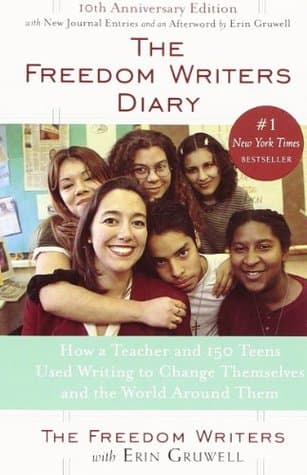
Core Idea
- Difficulty
- Easy
- Read it if
- You are an educator seeking inspiration, a student of social justice, or anyone interested in the power of empathy, personal storytelling, and the profound impact one dedicated individual can have on the lives of marginalized youth.
- Skip it if
- You are looking for a purely academic treatise on educational theory or prefer books without significant emotional depth and personal narratives.
Key Takeaways from The Freedom Writers Diary
Empathy as a Catalyst for Connection
Connecting through shared human experience transcends superficial differences.
The Freedom Writers Diary shows how empathy can connect people. At first, Erin Gruwell's students were divided by gang ties, racial tensions, and loneliness. By introducing books like Anne Frank's diary and Zlata's Diary, Gruwell did more than teach history. She gave her students ways to see their own experiences of trauma, injustice, and strength reflected in others. This shared storytelling, through reading and writing diaries, helped them feel like a common humanity. It let students move past their old ideas and see the shared pain and hope that connected them. Empathy became the base for a supportive learning community where real understanding could grow.
“Before, I didn't care about anyone else. Now I see that we all have stories, and some of them are just like mine.”
In the book: The students' initial inability to comprehend the Holocaust or connect it to their own lives, contrasted with their later profound identification with Anne Frank's fear and isolation after reading her diary. The 'Toast for Change' where students shared their personal stories and struggles, realizing they weren't alone.
Try this: Cultivate empathy in any group setting by encouraging personal storytelling and active listening. Introduce diverse narratives that allow individuals to see themselves and others reflected, fostering understanding and challenging stereotypes. Create a safe space for vulnerability.
Related ideas: empathy, storytelling, connection
The Power of Personal Narrative
Giving voice to individual experiences validates existence and fosters healing.
The Freedom Writers' change came from writing personal diaries. For many of these students, their lives were unseen, their struggles unheard, and their identities overlooked. Gruwell's simple act of giving them notebooks and encouraging them to write freely, without judgment, created a safe place for their thoughts and feelings. This process let them deal with trauma, express anger, state their hopes, and ultimately tell their own stories. The diaries became a record of their existence, a sign of their strength, and a tool for self-discovery and healing. It showed that their stories had value and deserved to be told.
“Writing in our diaries, it was like finally someone was listening, and it made us feel like we mattered.”
In the book: Students' diary entries detailing experiences with domestic violence, gang warfare, racism, and poverty. The contrast between their initial guardedness and their later willingness to share profound personal stories within the diary format.
Try this: Encourage journaling or reflective writing in educational or personal development contexts. Provide safe, non-judgmental spaces for individuals to document their experiences. Recognize and value personal narratives as essential components of identity and learning.
Related ideas: personal-narrative, journaling, self-discovery
Teacher as a Revolutionary Guide
An unconventional teacher can ignite profound change in challenging environments.
Erin Gruwell shows the power of a dedicated, different teacher. Facing a classroom called 'unteachable,' she did not follow old methods or accept low expectations. Her approach was new: she listened, she supported, and she used her own money and time to create an environment where her students felt seen and valued. She bought them books and supplies, and took extra jobs to pay for field trips. Gruwell did more than her job. She was a mentor, an advocate, and a strong believer in their potential. She proved that a teacher's commitment and new ideas can change students' lives, especially for those society had given up on.
“I didn't want to just teach them English; I wanted to teach them how to live, how to believe in themselves.”
In the book: Gruwell's decision to buy new books for her students when the school wouldn't provide them, her multiple part-time jobs to fund activities, and her persistent belief in their ability to graduate and attend college despite their backgrounds.
Try this: For educators, this highlights the importance of creativity, persistence, and a student-centered approach, even when facing systemic limitations. For leaders, it shows the impact of empowering individuals to challenge the status quo and invest deeply in their constituents.
Related ideas: educational-reform, mentorship, teacher-impact
Beyond the Classroom Walls
Experiential learning and real-world connections deepen understanding and broaden horizons.
The Freedom Writers' journey went beyond their classroom. Gruwell understood that for her students, abstract ideas of tolerance and history needed to be real. By arranging for Miep Gies, Anne Frank's protector, to visit, and by organizing trips to the Museum of Tolerance, she gave her students direct experiences. These encounters made historical figures real people. They made the lessons of the Holocaust and other genocides personal and important. This learning helped them understand the results of intolerance. It inspired the students to advocate for change. This shows that real education often happens when lessons connect directly to the outside world.
“Meeting Miep Gies, it wasn't just history anymore. It was real. It was her life, and it changed how I saw everything.”
In the book: The fundraising efforts to bring Miep Gies to California, the trip to the Museum of Tolerance, and the students' subsequent shift from passive learners to active participants in promoting tolerance.
Try this: Integrate field trips, guest speakers, and community projects into educational programs. Seek opportunities to connect theoretical knowledge with practical, real-world applications. Create memorable experiences that solidify learning and inspire action.
Related ideas: experiential-learning, real-world-education, tolerance-education
Challenging Systemic Limitations
Overcoming institutional obstacles requires persistence and a belief in potential.
The story shows the significant barriers Erin Gruwell and her students faced. The school system first called the students 'at-risk' and 'unteachable,' putting them in a remedial class with few resources. Gruwell faced doubts and resistance from colleagues and administrators who questioned her methods and the students' potential. The book reveals the biases and limits within educational institutions that can continue cycles of disadvantage. However, Gruwell's belief in her students, along with her strong advocacy and willingness to challenge the normal way, helped them overcome these limits. This shows that systemic barriers can be overcome with effort and a refusal to accept predicted failures.
“They told us we were failures, that we'd never amount to anything. But Ms. G never let us believe it.”
In the book: The initial placement of the students in a 'remedial' class, the lack of funding for new books, the resistance from other teachers and administrators, and Gruwell's fight to keep her students together for all four years of high school.
Try this: Identify and challenge institutional biases and low expectations. Advocate for equitable resources and opportunities for marginalized groups. Foster a culture of high expectations and belief in potential, even when facing entrenched systems.
Related ideas: systemic-inequality, educational-equity, advocacy
The Family We Choose
Creating a supportive community can replace broken or absent familial structures.
Many of the Freedom Writers came from broken homes, experienced violence, or lacked family support. The classroom, with Gruwell, became a family—a safe place, accepting, and supportive. Students, initially hostile and alone, began to see each other as fellow survivors and friends. The shared vulnerability of their diary entries and their shared goal for a better future created strong bonds of friendship and loyalty. This 'chosen family' gave them the emotional support many lacked at home. This shows the impact a strong, supportive community can have on well-being and success, especially for those facing challenges.
“This class, these people, they became my real family. The ones who understood me, no matter what.”
In the book: Students' diary entries describing abusive home lives or lack of parental involvement, contrasted with their expressions of belonging and support within the Freedom Writers class. The 'Toast for Change' ceremony where students openly shared their struggles and found solidarity.
Try this: In any group or team, actively foster a sense of belonging, trust, and mutual support. Encourage shared vulnerability and celebrate individual and collective achievements. Recognize the importance of community in providing emotional resilience and stability.
Related ideas: community-building, belonging, support-systems
Redefining Success
Success is not just academic achievement, but personal growth and self-actualization.
For the Freedom Writers, success was not just about passing tests; it was about changing their lives. Many started with a negative outlook, expecting to drop out, join gangs, or go to jail. Gruwell's idea of success included personal growth, emotional healing, and believing in a future beyond their current situation. All 150 Freedom Writers graduated high school and went to college. This is a big achievement. Equally important is their journey from anger and hopelessness to empathy, self-respect, and active citizenship. The book redefines educational success as a process that helps people overcome challenges, find their voice, and pursue their potential, no matter where they start.
“Graduating, going to college... that was unthinkable before. Now it's our future.”
In the book: The students' initial low academic performance and behavioral issues, contrasted with their collective graduation and pursuit of higher education. Their transformation from individuals prone to violence and prejudice to advocates for tolerance.
Try this: Broaden the metrics of success beyond traditional academic or professional achievements to include personal development, emotional intelligence, and social contribution. Celebrate small victories and acknowledge the journey of growth.
Related ideas: personal-growth, self-actualization, holistic-education
The Legacy of Tolerance
Understanding and embracing diversity is a continuous, active responsibility.
The Freedom Writers' journey shows the need for tolerance education. Their classroom first reflected societal prejudice, with racial and gang tensions. Through learning about the Holocaust, the civil rights movement, and their own stories, students learned that intolerance comes from not knowing and from fear. Their change into 'Freedom Writers' — like the Freedom Riders — shows their commitment to fighting prejudice. The book shows that tolerance is not just accepting; it is an active effort to understand, respect, and celebrate differences, and to stand up against injustice. This legacy continues through their foundation, supporting future students and sharing their message.
“We learned that hatred isn't something you're born with. It's something you learn, and you can unlearn it too.”
In the book: The initial racial caricature incident that sparked Gruwell's intervention, the students' subsequent 'Read-a-thon for Tolerance,' and their ongoing work through the Tolerance Education Foundation.
Try this: Actively seek out diverse perspectives and engage in cross-cultural dialogues. Challenge personal biases and confront instances of prejudice. Support initiatives that promote understanding and respect among different groups.
Related ideas: tolerance, anti-racism, diversity-inclusion
Finding Your Voice for Change
Even marginalized voices can inspire widespread societal impact.
The Freedom Writers Diary is more than a collection of personal stories. It shows the collective power of marginalized voices. At first dismissed and silenced, these students found their voice through writing and, importantly, through publishing their diaries. Their honest accounts connected with many people. This shows that real experiences, no matter how humble, can inspire empathy and social change. Their journey from 'unteachable' kids to published authors and advocates proves that when given a platform, those often overlooked can become agents of change, challenging ideas and inspiring hope globally. Their story is a reminder that every voice can have an impact.
“We were just kids from Long Beach, but our stories, they went everywhere. They showed people that we mattered.”
In the book: The publication of the diary, its widespread recognition, appearances on national television, and the subsequent feature film. The creation of the Tolerance Education Foundation funded by their book proceeds.
Try this: Provide platforms and amplify the voices of marginalized communities. Encourage individuals to share their authentic stories. Recognize that impactful change can originate from unexpected places and individuals.
Related ideas: social-change, empowerment, voice-amplification
The Freedom Writers Diary Quotes
“I am not a teacher, but an awakener.”
“We are all ordinary people. But even an ordinary secretary or a housewife or a teenager can, within their own small ways, turn on a small light in a dark room.”
“Tolerance is giving to every other human being every right that you claim for yourself.”
“I have learned that courage is not the absence of fear, but the triumph over it.”
“The only way to make sense out of change is to plunge into it, move with it, and join the dance.”
“Our lives begin to end the day we become silent about things that matter.”
“You can't change the past, but you can change the future.”
“Education is the most powerful weapon which you can use to change the world.”
“We are the authors of our own lives. We write our own destinies.”
“Hate is too great a burden to bear. It injures the hater more than it injures the hated.”
“The diary became a place where we could be honest without fear of judgment.”
“Sometimes the smallest step in the right direction ends up being the biggest step of your life.”
“We are not defined by our mistakes, but by how we rise after falling.”
“Freedom is not just about breaking chains, but about building bridges.”
Quiz
10 questions on the main ideas. Each answer comes with a short explanation.
Question 1
What event prompted Erin Gruwell to connect her students' experiences to the Holocaust?
- A student's essay about gang violence
- An intercepted note with a racial caricature
- A fight breaking out in her classroom
- A student's diary entry about discrimination
Show answer
B. An intercepted note with a racial caricature The book describes how Erin Gruwell intercepted a note with an ugly racial caricature among her students, which led her to angrily explain that such prejudice was what led to the Holocaust, though her students initially didn't understand the connection.
Question 2
Which two diaries did the Freedom Writers use as primary guides for their journey?
- The Diary of Anne Frank and Night by Elie Wiesel
- Zlata's Diary and The Diary of a Young Girl by Anne Frank
- The Freedom Riders' diaries and Anne Frank's diary
- Erin Gruwell's personal diary and Zlata's Diary
Show answer
B. Zlata's Diary and The Diary of a Young Girl by Anne Frank The students used 'Anne Frank: The Diary of a Young Girl' and 'Zlata's Diary: A Child's Life in Sarajevo' as key texts to draw parallels to their own lives and learn about intolerance.
Question 3
How did the Freedom Writers raise funds to bring Miep Gies to visit them?
- By selling homemade crafts at school events
- Through a 'Read-a-thon for Tolerance'
- By applying for a government grant
- Through donations from local businesses only
Show answer
B. Through a 'Read-a-thon for Tolerance' The book mentions that the students organized a 'Read-a-thon for Tolerance' to raise money, which allowed them to bring Miep Gies, who sheltered Anne Frank's family, to California.
Question 4
What did the students dub themselves, and why?
- The Freedom Fighters, after civil rights activists
- The Tolerance Writers, to promote understanding
- The Freedom Writers, in homage to the Freedom Riders
- The Diary Keepers, inspired by Anne Frank
Show answer
C. The Freedom Writers, in homage to the Freedom Riders The students called themselves the 'Freedom Writers' as a tribute to the civil rights activists known as 'The Freedom Riders,' symbolizing their own fight against intolerance through writing.
Question 5
What was a key outcome of the Freedom Writers' educational journey?
- All 150 students graduated high school and are attending college
- They won a national writing competition
- Erin Gruwell was promoted to principal of Wilson High
- The school district adopted their curriculum statewide
Show answer
A. All 150 students graduated high school and are attending college The book highlights that all 150 Freedom Writers graduated from high school and are now attending college, showcasing the transformative impact of their work.
Question 6
How does the book structure its content?
- Solely through Erin Gruwell's first-person narrative
- As a collection of diary entries from students with narrative by Gruwell
- As a series of interviews with the students and teachers
- Through fictionalized stories based on real events
Show answer
B. As a collection of diary entries from students with narrative by Gruwell The book combines powerful entries from the students' own diaries with narrative text by Erin Gruwell, providing multiple perspectives on their experiences.
Question 7
What organization benefits from the authors' proceeds of this book?
- The Freedom Writers Foundation
- The Tolerance Education Foundation
- Wilson High School's scholarship fund
- The Anne Frank House museum
Show answer
B. The Tolerance Education Foundation Proceeds from the book are donated to The Tolerance Education Foundation, which was set up to pay for the Freedom Writers' college tuition.
Question 8
What did Miep Gies declare about Erin Gruwell's students during her visit?
- That they were the future leaders of America
- That they should continue writing diaries
- That they were 'the real heroes'
- That they reminded her of Anne Frank
Show answer
C. That they were 'the real heroes' Miep Gies, who sheltered Anne Frank's family, visited the students and declared that they were 'the real heroes,' recognizing their courage in facing intolerance.
Question 9
What broader theme does the book emphasize through the students' use of diaries?
- The importance of academic excellence in urban schools
- How writing can empower marginalized youth to overcome adversity
- The role of technology in modern education
- The necessity of strict discipline in classrooms
Show answer
B. How writing can empower marginalized youth to overcome adversity The book underscores that by writing in diaries, the students found a voice to express their struggles, draw parallels to historical figures like Anne Frank, and transform their lives, highlighting writing as a tool for empowerment.
Question 10
How did the Freedom Writers' project gain national recognition?
- Through a viral social media campaign started by the students
- By winning a prestigious educational award from the government
- Via media appearances on shows like 'Prime Time Live' and coverage in People magazine
- Through a bestselling book published before their diaries
Show answer
C. Via media appearances on shows like 'Prime Time Live' and coverage in People magazine Their efforts led to appearances on 'Prime Time Live' and 'All Things Considered,' coverage in People magazine, and a meeting with the U.S. Secretary of Education, showcasing widespread recognition.
The Freedom Writers Diary FAQ
What is The Freedom Writers Diary about?
The Freedom Writers Diary is a non-fiction book that chronicles the experiences of teacher Erin Gruwell and her at-risk high school students in Long Beach, California. Through diary entries and narrative, it documents how they overcame racial tensions and educational challenges by studying books like Anne Frank's diary, fostering tolerance, and transforming their lives through writing.
Does The Freedom Writers Diary have a movie adaptation?
Yes, The Freedom Writers Diary was adapted into the 2007 major motion picture 'Freedom Writers,' starring Hilary Swank as Erin Gruwell. The film dramatizes the students' journey from being labeled 'unteachable' to becoming inspired writers and graduates, highlighting the teacher's innovative methods and the power of education.
What is the 'Read-a-thon for Tolerance' in the book?
The 'Read-a-thon for Tolerance' was a fundraising event organized by Erin Gruwell and her students to promote understanding and finance educational opportunities. It helped bring Miep Gies, who sheltered Anne Frank's family, to visit the class, symbolizing their commitment to learning from history and combating intolerance.
How is The Freedom Writers Diary different from other teacher-student memoirs?
Unlike many memoirs, The Freedom Writers Diary uniquely combines entries from multiple students' diaries with Erin Gruwell's narrative, offering diverse perspectives on urban education and social issues. It emphasizes real-time, collaborative learning through literature and writing, leading to tangible outcomes like college attendance and public recognition.
Does the book's approach to teaching work for at-risk students?
Yes, the book demonstrates that Erin Gruwell's approach, which focuses on empathy, relevant literature, and personal writing, effectively engaged at-risk students. All 150 Freedom Writers graduated high school and attended college, showing that tailored, inclusive education can overcome barriers and inspire academic success.
What role do Anne Frank and Zlata's Diary play in the story?
Anne Frank: The Diary of a Young Girl and Zlata's Diary: A Child's Life in Sarajevo serve as key guides for the students, helping them draw parallels between historical events of intolerance and their own lives. These books foster discussions on resilience, human rights, and the power of diary-writing to process trauma and hope.
How does The Freedom Writers Diary compare to Educated by Tara Westover?
While both are memoirs about overcoming educational obstacles, The Freedom Writers Diary focuses on a collective classroom experience in an urban setting, driven by a teacher's intervention. In contrast, Educated is an individual's journey from isolation to academia, highlighting self-directed learning and family dynamics, making them complementary but distinct narratives.
What is the Tolerance Education Foundation mentioned in the book?
The Tolerance Education Foundation is an organization set up with proceeds from The Freedom Writers Diary to fund the college tuition of the Freedom Writers students. It reflects the book's mission to promote understanding and provide practical support for education, extending its impact beyond the classroom into long-term opportunities.
Does the book offer practical tips for educators?
Yes, The Freedom Writers Diary provides practical insights for educators, such as using relatable literature to connect with students, encouraging diary-writing for self-expression, and organizing community projects like fundraisers. It shows how fostering a safe, inclusive environment can transform student engagement and outcomes.
What happened to the Freedom Writers students after the book?
After the events in the book, all 150 Freedom Writers graduated from high school and went on to attend college, with many achieving further success. Erin Gruwell became a visiting professor, and some Freedom Writers joined her classes, continuing the legacy of education and tolerance promoted in their diaries.
About the author

Erin Gruwell is an American educator and author known for her work in promoting educational equity and social justice. She is best known for "The Freedom Writers Diary," which chronicles the experiences of her students in an innovative writing program. Gruwell's efforts have inspired a movement that emphasizes the power of storytelling in transforming lives.
Similar books
- Educated
Tara Westover
4.5 (796k) average on GoodreadsBiographyA memoir highlighting the profound impact of education on an individual's journey to self-discovery and breaking free from oppressive circumstances.
- Dangerous Minds
LouAnne Johnson
3.9 (1k) average on GoodreadsBiographyWhile both books feature dedicated teachers in challenging urban schools, 'The Freedom Writers Diary' provides a more authentic and less sensationalized account by centering student voices directly through diary entries. 'Dangerous Minds' leans more into the 'savior teacher' trope with less direct student narration.
- The Diary of a Young Girl
Anne Frank
4.2 (2.7M) average on GoodreadsBiographyDuring the Nazi occupation, a teenage girl's diary, written from a secret annex, shares observations on humanity, hope, and the wait for freedom.
- Eat, Pray, Love
Elizabeth Gilbert
3.6 (1.5M) average on GoodreadsLifestyleA heartbroken writer leaves her conventional life for a year-long global search for pleasure in Italy, spiritual devotion in India, and unexpected love and balance in Bali.
- Night
Elie Wiesel
4.3 (970k) average on GoodreadsBiographyIn the darkness of Auschwitz and Buchenwald, a teenage Elie Wiesel faces the extermination of his family, the loss of his faith, and the lasting scars of humanity's deepest cruelty.
- Steve Jobs
Walter Isaacson
4.1 (957k) average on GoodreadsBusinessSteve Jobs was a visionary who fused creativity and technology to revolutionize six industries and shape our digital world.





Enjoyed the summary?
A summary gives you the shape of the book. The book itself has the detail, the examples and the voice.
Find The Freedom Writers Diary on AmazonAs an Amazon Associate, BookBrief earns from qualifying purchases. How we're funded