
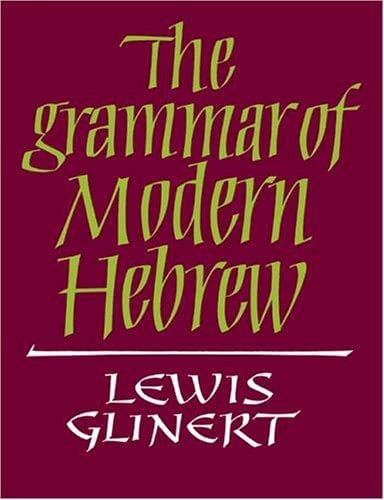
Core Idea
- Difficulty
- Hard
- Read it if
- You are a serious student of Modern Hebrew, a linguist interested in Semitic languages, or a learner looking for a detailed, academically sound yet practical guide to Hebrew grammar. This book is ideal for those who want to understand not just 'what' but 'why' certain grammatical structures exist in Hebrew.
- Skip it if
- You are a complete beginner looking for a simple phrasebook or a very light introduction to conversational Hebrew. This book assumes some foundational knowledge or a willingness to delve deep into linguistic structures. It is not designed for casual learners or those seeking only a tourist's grasp of the language.
Key Takeaways from The Grammar of Modern Hebrew
A Living Language: Historical Layers
Modern Hebrew is a unique blend of ancient roots and contemporary innovation.
Modern Hebrew, while a revitalized language, is not a tabula rasa. Its grammar is profoundly influenced by historical layers, primarily Biblical Hebrew (Tanakh) and Mishnaic Hebrew (Rabbinic literature). This manifests in its morphology, syntax, and lexicon. For instance, the Binyanim (verb conjugations) are ancient, but their usage and semantic nuances have evolved. The language constantly negotiates between preserving historical forms and developing new ones, reflecting an ongoing tension between tradition and modernity. Understanding these historical strata is crucial for grasping the 'why' behind many grammatical rules and exceptions, as well as for appreciating the language's resilience and adaptability.
“Modern Hebrew is not merely a revival but a dynamic continuum, drawing deeply from its biblical and Mishnaic past while rapidly adapting to the demands of contemporary life.”
In the book: Glinert extensively details the etymological roots of lexical items and grammatical constructions, tracing their evolution from Biblical and Mishnaic sources to modern usage, such as the persistence of certain dual forms or construct state patterns.
Try this: When learning new vocabulary or grammatical structures, try to identify their historical roots. This can aid memorization and provide deeper insight into their meaning and usage, rather than simply memorizing them in isolation.
Related ideas: biblical-hebrew, mishnaic-hebrew, language-revival, historical-linguistics
The Binyanim System: Core of Verb Conjugation
Mastering the seven Binyanim is fundamental to understanding Hebrew verbs.
The Binyanim (building blocks) are seven verb patterns that categorize almost all Hebrew verbs. Each Binyan (singular) indicates not just conjugation but also a specific semantic relationship, such as active, passive, reflexive, causative, or intensive. For example, the root ש.ב.ר (sh.b.r) means 'to break.' In Pa'al (active simple), it's שָׁבַר (shavar - he broke); in Pi'el (intensive/causative), it's שִׁבֵּר (shibber - he smashed/broke into pieces); in Hif'il (causative), it's הִשְׁבִּיר (hishbir - he caused to break); and in Nif'al (passive), it's נִשְׁבַּר (nishbar - it was broken). Understanding the core meaning of each Binyan allows for logical deduction of verb meanings and forms, significantly reducing the need for rote memorization of every single verb form.
“The Binyanim constitute the central organizing principle of the Hebrew verbal system, each imparting a distinct semantic and grammatical nuance.”
In the book: Glinert dedicates significant chapters to the detailed morphology and semantics of each Binyan, providing extensive examples of root variations and their corresponding meanings across the patterns.
Try this: Instead of learning individual verbs, focus on learning common three-letter roots and how they behave across different Binyanim. Practice identifying the Binyan of new verbs to infer their meaning and grammatical function.
Related ideas: binyanim, verb-conjugation, morphology, root-system
Construct State: Noun-Noun Relationships
The Smikhut (construct state) is a unique way to express possession and modification.
The construct state (סמיכות - smikhut) is a grammatical construction where two or more nouns are linked to express a possessive or modifying relationship, similar to 'the house of the king' or 'a coffee cup' in English. The first noun (or nouns) undergoes a phonetic change (shortening of vowels, stress shift) and becomes 'bound' to the second noun, which remains in its absolute form. For example, בַּיִת (bayit - house) + מֶלֶךְ (melekh - king) becomes בֵּית מֶלֶךְ (beit melekh - king's house). This creates a single semantic unit. Adjectives modifying the entire phrase always agree with the second noun. This system is ancient and pervasive, distinguishing Hebrew from many Indo-European languages.
“The construct state, or smikhut, is a cornerstone of Hebrew nominal syntax, forming tightly bound semantic units that often defy direct translation.”
In the book: Glinert provides numerous tables illustrating the vowel and stress changes in nouns when they enter the construct state, along with syntactic rules for adjective placement and agreement.
Try this: Pay close attention to vowel changes when encountering noun phrases. Practice forming construct states with common nouns to internalize the patterns, as they are highly frequent in both spoken and written Hebrew.
Related ideas: smikhut, construct-state, nominal-syntax, noun-phrases
Pronouns and Pronominal Suffixes
Possession and direct/indirect objects are often expressed via suffixes.
Unlike English, where pronouns are standalone words, Hebrew frequently attaches pronominal suffixes directly to nouns, verbs, and prepositions. These suffixes indicate possession (on nouns, e.g., סוּסִי - susi - my horse), direct objects (on verbs, e.g., רָאִיתִי אוֹתוֹ - ra'iti oto - I saw him), and objects of prepositions (e.g., אֵלַי - elai - to me). This system is highly economical and creates compact expressions. The forms of these suffixes vary depending on the gender, number, and person of the pronoun, and the word they attach to. Mastering these suffixes is crucial for both comprehension and fluency, as they are ubiquitous in all forms of Hebrew.
“Pronominal suffixes are highly productive and integral to Hebrew grammar, encapsulating information about possession, direct objects, and even prepositions within single lexical units.”
In the book: Glinert dedicates sections to the paradigms of pronominal suffixes for nouns, verbs, and prepositions, explaining the phonetic changes and semantic roles of each.
Try this: When learning new nouns or prepositions, make an effort to learn their forms with common pronominal suffixes. This will help you recognize them quickly in natural speech and text, and express complex ideas concisely.
Related ideas: pronominal-suffixes, possession, direct-object, prepositional-phrases
Word Order: SVO and Beyond
While generally SVO, Hebrew exhibits flexibility influenced by historical and pragmatic factors.
Modern Hebrew is primarily an SVO (Subject-Verb-Object) language, similar to English. For example: הַיֶּלֶד אָכַל תַּפּוּחַ (Hayeled akhal tapuach - The boy ate an apple). However, it retains influences from Biblical Hebrew, which often used VSO (Verb-Subject-Object). This historical legacy, combined with pragmatic factors like emphasis or topic fronting, allows for more flexible word order than in strictly SVO languages. For instance, putting the object first can emphasize it. This flexibility adds richness and nuance to expression, though it can be challenging for learners accustomed to rigid word order. Understanding the default SVO and recognizing common deviations is key.
“While Modern Hebrew largely adheres to an SVO typology, the legacy of Biblical Hebrew and pragmatic considerations allow for significant deviations, particularly in literary or emphatic contexts.”
In the book: Glinert analyzes various sentence structures, contrasting typical SVO constructions with instances of VSO or OVS, and explaining the rhetorical or stylistic motivations behind such variations.
Try this: Start by mastering the basic SVO structure. As you advance, pay attention to deviations in texts and try to discern the emphasis or stylistic choice behind them, rather than assuming it's 'incorrect' grammar.
Related ideas: word-order, SVO, VSO, syntax, pragmatics
The Role of Prepositions: More Than Location
Hebrew prepositions are highly versatile, conveying complex grammatical relationships.
Hebrew prepositions are crucial and often carry more grammatical weight than their English counterparts. Beyond indicating location (e.g., עַל - al - on, בְּ - be - in), they are integral to expressing direct and indirect objects (e.g., אֶת - et for definite direct objects, לְ - le for indirect objects), temporal relationships (e.g., לִפְנֵי - lifnei - before), and are often part of fixed verbal expressions or idioms. Many verbs 'govern' specific prepositions, meaning a particular preposition must follow that verb to convey a certain meaning (e.g., לְחַכּוֹת לְ - lekhakot le - to wait for). Mastering these prepositional usages is essential, as incorrect choice can change or obscure meaning.
“Hebrew prepositions are not merely spatial markers but powerful grammatical tools, governing case, expressing temporal relations, and even serving as crucial components of verbal idioms.”
In the book: Glinert provides extensive lists of common prepositions, their various meanings, and their interaction with specific verbs and nouns, highlighting differences from English equivalents.
Try this: When learning new verbs, always try to learn the prepositions they commonly take. Don't assume direct translation from English; many Hebrew verbs require specific prepositions to complete their meaning.
Related ideas: prepositions, verbal-idioms, grammatical-relations, case-marking
Adjectives and Adverbs: Agreement is Key
Adjectives always agree with their nouns in gender, number, and definiteness.
In Hebrew, adjectives are not static; they must agree with the noun they modify in three aspects: gender (masculine/feminine), number (singular/plural), and definiteness (definite/indefinite). For example, יֶלֶד טוֹב (yeled tov - good boy) becomes יַלְדָּה טוֹבָה (yalda tova - good girl), יְלָדִים טוֹבִים (yeladim tovim - good boys), and הַיֶּלֶד הַטּוֹב (hayeled hatov - the good boy). This consistent agreement is a hallmark of Semitic languages. Adverbs, on the other hand, do not change form and typically modify verbs, adjectives, or other adverbs, often formed from adjectives by adding the suffix -ִית (-it) or through fixed expressions. Paying close attention to agreement is fundamental for grammatical correctness.
“Adjectival agreement in Hebrew is strict and pervasive, serving as a vital mechanism for maintaining clarity and cohesion within the nominal phrase.”
In the book: Glinert dedicates a chapter to adjectival agreement, providing comprehensive tables and examples illustrating the various forms adjectives take to match their nouns.
Try this: When forming noun-adjective phrases, always consciously check for gender, number, and definiteness agreement. This practice will help internalize the patterns and reduce common grammatical errors.
Related ideas: adjectival-agreement, gender, number, definiteness, adverbs
The Definite Article: הַ (Ha-)
The definite article performs multiple roles beyond simple 'the'.
The Hebrew definite article הַ- (ha-) is prefixed directly to the noun, and sometimes causes gemination (doubling) of the following consonant. Its primary function is to mark definiteness, similar to 'the' in English (e.g., סֵפֶר - sefer - a book; הַסֵּפֶר - hasefer - the book). However, its role extends further. It is also used with demonstrative adjectives (e.g., הַבַּיִת הַזֶּה - habayit hazeh - this house, literally 'the house the this') and can mark certain types of relative clauses, especially those without an explicit relative pronoun (e.g., הָאִישׁ הַבָּא - ha'ish haba - the man who is coming, literally 'the man the coming'). Understanding its varied applications is crucial for correct syntax and meaning.
“The definite article 'ha-' is a grammatical workhorse, not only marking definiteness but also participating in demonstrative constructions and even marking certain relative clauses.”
In the book: Glinert explains the phonetic rules for 'ha-' (e.g., changes before guttural letters) and provides examples of its use in simple definite phrases, demonstrative phrases, and relative clauses.
Try this: Always remember to attach 'ha-' directly to the noun and consider its potential phonetic impact. When seeing 'ha-' in a sentence, consider if it's marking simple definiteness, part of a demonstrative, or signaling a relative clause.
Related ideas: definite-article, ha-, definiteness, demonstratives, relative-clauses
Tense and Aspect: Nuances of Time
Hebrew verbs primarily express aspect, with tense often inferred from context.
Unlike English, which has a rich system of tenses (past, present, future, perfect, progressive), Hebrew's verbal system is often described as aspectual. The 'past' tense (עָבָר - avar) primarily indicates a completed action, while the 'future' tense (עָתִיד - atid) indicates an incomplete or prospective action. The 'present' tense (הוֹוֶה - hoveh) is actually a participle and describes ongoing actions or states. While Modern Hebrew has developed clearer temporal markers, the aspectual foundation remains. This means that context, adverbs of time, and pragmatic understanding are often crucial for discerning the precise temporal reference of a verb, especially in complex sentences.
“While Modern Hebrew possesses clear markers for past, present, and future, the underlying system is deeply rooted in aspect, emphasizing the completion or ongoing nature of an action.”
In the book: Glinert delves into the morphology of the past, present, and future forms, explaining their historical development and their primary aspectual functions, differentiating them from purely temporal English tenses.
Try this: When conjugating verbs, focus not just on 'when' the action happens, but also on whether it's completed, ongoing, or prospective. Use temporal adverbs (e.g., אֶתְמוֹל - etmol - yesterday, מָחָר - machar - tomorrow) to clarify tense where ambiguity might arise.
Related ideas: tense, aspect, verbal-system, participles, temporal-adverbs
The Grammar of Modern Hebrew Quotes
“Modern Hebrew is a fascinating case study in language revival, displaying both continuity with its ancient roots and radical innovation.”
“The verbal system of Hebrew, particularly the binyanim, is central to its grammar and often a point of challenge for learners.”
“While rooted in Biblical Hebrew, Modern Hebrew has undergone significant phonological and morphological shifts, influenced by various diaspora languages.”
“The definite article in Hebrew behaves somewhat differently from its English counterpart, often appearing with proper nouns or possessive constructions.”
“Noun gender, masculine and feminine, is pervasive in Hebrew and affects agreement in adjectives, verbs, and pronouns.”
“The construct state (smikhut) is a unique and elegant feature of Hebrew grammar, forming close semantic units between nouns.”
“Prepositions in Hebrew are often bound morphemes, attaching directly to nouns or pronouns, which can be initially confusing for non-native speakers.”
“The revival of Hebrew was not merely a linguistic act but a profound cultural and national project.”
“The syntax of Modern Hebrew, while largely Semitic, shows influences from Indo-European languages, particularly in sentence structure and subordination.”
“Vocalization (niqqud) plays a crucial role in disambiguating homographs and is essential for understanding the nuances of written Hebrew.”
“The imperative mood in Hebrew is closely linked to the future tense and often expresses commands or requests.”
“”
“”
Quiz
10 questions on the main ideas. Each answer comes with a short explanation.
Question 1
According to Glinert, which of the following best describes the historical development of Modern Hebrew?
- A direct, unbroken continuation of Biblical Hebrew.
- A complete invention with no historical linguistic roots.
- A revival and evolution of earlier Hebrew stages, influenced by other languages.
- A dialect of Arabic that acquired Hebrew vocabulary.
Show answer
C. A revival and evolution of earlier Hebrew stages, influenced by other languages. Glinert emphasizes that Modern Hebrew is a sophisticated revival and evolution, drawing from Biblical, Mishnaic, Medieval, and Enlightenment Hebrew, while also being shaped by contact languages.
Question 2
In Modern Hebrew, what is the primary function of the 'binyanim' system?
- To indicate the gender and number of nouns.
- To classify adjectives into different declension patterns.
- To derive verbs and express different semantic and syntactic roles (e.g., active, passive, causative).
- To mark the tense and aspect of verbs without changing the root.
Show answer
C. To derive verbs and express different semantic and syntactic roles (e.g., active, passive, causative). The binyanim (verb conjugations) are central to Hebrew morphology, indicating not just tense/person, but primarily the 'pattern' or 'voice' of a verb derived from a triliteral root, such as active, passive, reflexive, or causative.
Question 3
Which of the following statements about Hebrew word order, as discussed by Glinert, is most accurate for typical declarative sentences?
- It is strictly VSO (Verb-Subject-Object).
- It is predominantly SVO (Subject-Verb-Object).
- It is entirely free, with no preferred order.
- It is always OVS (Object-Verb-Subject).
Show answer
B. It is predominantly SVO (Subject-Verb-Object). While Biblical Hebrew often exhibited VSO, Glinert notes that Modern Hebrew has largely shifted to an SVO word order for declarative sentences, though VSO and other orders can occur for emphasis or specific constructions.
Question 4
What is the function of the 'smikhut' (construct state) in Modern Hebrew?
- To form the plural of nouns.
- To indicate possession or a close genitival relationship between two nouns.
- To create adverbs from adjectives.
- To mark the definite article on a noun.
Show answer
B. To indicate possession or a close genitival relationship between two nouns. Smikhut is a fundamental grammatical feature that links two or more nouns into a compound-like phrase, where the first noun (or nouns) is 'in construct' with the last, expressing a possessive or genitival relationship (e.g., 'beit sefer' - house of book = school).
Question 5
Glinert discusses the role of 'niqqud' (vowel points) in Modern Hebrew. What is their general status in everyday written Hebrew?
- They are always present and crucial for understanding.
- They are rarely used, except in specific contexts like poetry, children's books, or religious texts.
- They are used interchangeably with Latin script.
- They are optional but recommended for all formal writing.
Show answer
B. They are rarely used, except in specific contexts like poetry, children's books, or religious texts. Modern Hebrew is typically written 'unpointed' (without niqqud). Readers infer vowels from context and morphological patterns. Niqqud is reserved for specific pedagogical, religious, or literary purposes.
Question 6
Which of the following is NOT considered one of the primary 'triliteral roots' (shoresh) patterns in Hebrew morphology?
- Verbs (Po'al, Pi'el, Hitpa'el, etc.)
- Nouns and adjectives derived from verb roots.
- Prepositions and conjunctions.
- Words with missing or weak root letters (e.g., 'hollow' or 'pe-nun' roots).
Show answer
C. Prepositions and conjunctions. While prepositions and conjunctions are parts of speech, they generally do not derive from the triliteral root system in the same way verbs, nouns, and adjectives do. The root system is primarily for lexical items with semantic content.
Question 7
Glinert discusses the phenomenon of 'gender agreement' in Modern Hebrew. Which of the following must agree in gender with the noun they modify?
- Verbs in all tenses.
- Adjectives and demonstratives.
- Prepositions.
- Adverbs.
Show answer
B. Adjectives and demonstratives. Adjectives (e.g., 'gadol' - big) and demonstratives (e.g., 'ze' - this) must agree in both gender and number with the noun they modify. Verbs agree in gender and number with their subject in some tenses but not all.
Question 8
What is a key difference Glinert highlights between the use of the definite article (ה-, ha-) in Modern Hebrew compared to English 'the'?
- In Hebrew, 'ha-' is only used for proper nouns.
- In Hebrew, 'ha-' can be prefixed to adjectives in the definite construct state.
- In Hebrew, 'ha-' is often repeated on both the noun and its modifying adjective within a definite noun phrase.
- In Hebrew, 'ha-' is optional and often omitted in spoken language.
Show answer
C. In Hebrew, 'ha-' is often repeated on both the noun and its modifying adjective within a definite noun phrase. A distinctive feature of Hebrew is that when a definite noun is modified by an adjective, the definite article 'ha-' must appear on both the noun and the adjective (e.g., 'ha-sefer ha-gadol' - the book the big = the big book).
Question 9
Glinert dedicates significant attention to 'prepositions with pronominal suffixes'. What do these forms indicate?
- The tense of the verb immediately following the preposition.
- That the preposition is functioning as an adverb.
- That the object of the preposition is a pronoun, with the suffix indicating its person, gender, and number.
- A special emphatic form of the preposition.
Show answer
C. That the object of the preposition is a pronoun, with the suffix indicating its person, gender, and number. Many Hebrew prepositions (e.g., 'le-', 'al', 'im') combine directly with pronominal suffixes to form single words, where the suffix acts as the object of the preposition (e.g., 'li' - to me, 'aleha' - on her, 'itchem' - with you (pl.m.)).
Question 10
According to Glinert, what is the role of loanwords in Modern Hebrew, particularly from English?
- They are strictly avoided by purists and rarely integrated into the language.
- They are a significant and growing component, especially in technical, scientific, and popular culture domains.
- They are primarily limited to religious terminology.
- They only exist as calques (loan translations), not direct borrowings.
Show answer
B. They are a significant and growing component, especially in technical, scientific, and popular culture domains. Glinert acknowledges the substantial influence of loanwords, particularly from English, in modern spoken and written Hebrew, reflecting contemporary global and cultural trends, especially in fields like technology, business, and youth culture.
The Grammar of Modern Hebrew FAQ
What is 'The Grammar of Modern Hebrew' by Lewis Glinert primarily about?
This book offers a comprehensive and detailed analysis of the grammatical structures of modern spoken and written Hebrew. It delves into syntax, morphology, and semantics, providing a thorough understanding of how the language functions in contemporary usage.
Who is the target audience for this grammar book?
The book is designed for advanced students of Hebrew, linguists, and scholars interested in Semitic languages or language typology. While comprehensive, it assumes a foundational understanding of Hebrew and linguistic concepts, making it less suitable for absolute beginners.
Does the book focus more on biblical or modern Hebrew?
As the title suggests, the primary focus is on Modern Hebrew, as spoken and written in contemporary Israel. While it may occasionally draw comparisons or mention historical developments, its core analysis pertains to the current state of the language.
How does Glinert's approach compare to other Hebrew grammars?
Glinert's grammar is often praised for its depth, linguistic sophistication, and extensive use of authentic examples from modern Hebrew media and literature. It provides a more analytical and theoretical perspective compared to many introductory or pedagogically-oriented grammars.
Does 'The Grammar of Modern Hebrew' include exercises or practice materials?
No, this book is primarily a descriptive and analytical grammar, not a textbook with exercises. Its purpose is to explain the intricacies of Hebrew grammar rather than to provide practice for language learners. It's a reference and study guide.
What specific grammatical concepts are covered in detail?
The book covers a wide range of concepts including verbal conjugations (binyanim), noun and adjective morphology, syntax of complex sentences, negation, interrogatives, and various discourse features. It provides nuanced explanations of seemingly simple structures.
Is this book suitable for self-study for someone with intermediate Hebrew?
While an intermediate learner could certainly benefit from its insights, the book's density and linguistic terminology might make it challenging for self-study without guidance. It's best utilized as a reference or a deep dive for those with solid grammatical foundations.
Does the book address differences between formal and informal Hebrew?
Yes, Glinert often highlights the distinctions between formal, literary Hebrew and colloquial, everyday speech. This attention to register is a valuable aspect, providing readers with a more realistic understanding of language usage.
Is 'The Grammar of Modern Hebrew' considered a standard reference work in the field?
Absolutely. It is widely regarded as one of the most authoritative and comprehensive grammars of Modern Hebrew available in English, frequently cited by scholars and linguists working on the language.
Similar books
- The Diary of a Young Girl
Anne Frank
4.2 (2.7M) average on GoodreadsBiographyDuring the Nazi occupation, a teenage girl's diary, written from a secret annex, shares observations on humanity, hope, and the wait for freedom.
- Twisted 1. Twisted love
Ana Huang
3.7 (1.7M) average on GoodreadsA quiet billionaire with a difficult past finds his guarded heart opening to the woman he must protect, but their growing passion uncovers dangerous secrets and a shared, traumatic history.
- Eat, Pray, Love
Elizabeth Gilbert
3.6 (1.5M) average on GoodreadsLifestyleA heartbroken writer leaves her conventional life for a year-long global search for pleasure in Italy, spiritual devotion in India, and unexpected love and balance in Bali.
- Night
Elie Wiesel
4.3 (970k) average on GoodreadsBiographyIn the darkness of Auschwitz and Buchenwald, a teenage Elie Wiesel faces the extermination of his family, the loss of his faith, and the lasting scars of humanity's deepest cruelty.
- Steve Jobs
Walter Isaacson
4.1 (957k) average on GoodreadsBusinessSteve Jobs was a visionary who fused creativity and technology to revolutionize six industries and shape our digital world.
- The Glass Castle
Jeannette Walls
4.3 (903k) average on GoodreadsBiographyJeannette Walls's memoir describes her unusual childhood with brilliant, free-spirited parents whose poverty-stricken life shaped her independence and love despite family problems.






Enjoyed the summary?
A summary gives you the shape of the book. The book itself has the detail, the examples and the voice.
Find The Grammar of Modern Hebrew on AmazonAs an Amazon Associate, BookBrief earns from qualifying purchases. How we're funded