
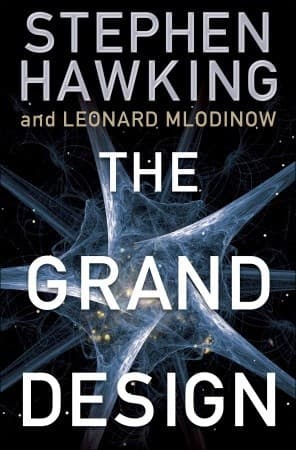
Core Idea
- Difficulty
- Medium
- Read it if
- You are curious about how modern physics, particularly M-theory and quantum mechanics, attempts to explain the origin and nature of the universe without invoking a creator, and are open to challenging traditional philosophical and religious views on existence.
- Skip it if
- You are looking for a deep dive into the mathematical intricacies of M-theory, prefer a philosophical exploration that doesn't dismiss metaphysics, or are uncomfortable with a purely scientific, deterministic view of creation that explicitly disavows a divine role.
Key Takeaways from The Grand Design
Model-Dependent Realism
Our perception of reality is shaped by the models we use to understand it.
Hawking and Mlodinow argue that there is no objective reality independent of our minds and the models we create to interpret sensory data. Instead, what we see as 'real' is simply the most effective model for making predictions and understanding our observations. This 'model-dependent realism' means that different models, even if they seem to contradict each other, can both be valid if they accurately describe a particular set of phenomena. The concept challenges the idea of a single, objective reality, suggesting that our understanding is limited by our cognitive frameworks and scientific tools. This perspective shifts the philosophical goal from seeking ultimate truth to finding the most useful and consistent descriptions of the universe.
“There is no model-independent test of reality. It is an illusion to think that there is.”
In the book: The authors illustrate this with the example of different models for the solar system – Ptolemy's geocentric model and Copernicus's heliocentric model. While the heliocentric model is simpler and more accurate, Ptolemy's model could still make accurate predictions for a long time, demonstrating that a 'wrong' model can still be useful within its domain.
Try this: Recognize that 'truth' is often relative to the framework of understanding. When encountering conflicting perspectives, instead of immediately dismissing one, evaluate which model offers the most predictive power and internal consistency for the specific context. This encourages intellectual humility and a more nuanced approach to knowledge acquisition.
Related ideas: model-dependent-realism, scientific-models, epistemology
The Quantum Multiverse
The universe is not unique; an infinite number of universes exist, each with different laws.
The book suggests a multiverse, an infinite collection of universes, each possibly governed by different physical laws. This idea comes from quantum theory, particularly the concept of 'sum over histories,' where every possible history of the universe exists at the same time. The authors argue that our specific universe, with its physical constants suitable for life, is not a miracle but simply one outcome among many. This explanation for our existence removes the need for a divine creator, as the sheer number of universes makes it statistically likely that at least one would have the right conditions for life. It redefines our place in the cosmos.
“Because there is a law like gravity, the universe can and will create itself from nothing.”
In the book: The 'sum over histories' formulation of quantum mechanics, pioneered by Richard Feynman, suggests that a particle takes every possible path between two points, with probabilities assigned to each. Applied to the universe, this implies an infinite branching of possibilities, leading to a multiverse.
Try this: Embrace the idea that our universe is just one possibility, fostering a sense of both wonder and humility. This perspective can inform discussions on the anthropic principle, encouraging us to look for scientific explanations for cosmic fine-tuning rather than defaulting to supernatural ones.
Related ideas: multiverse, quantum-mechanics, anthropic-principle
Gravity as the Creator
Gravity, not a divine being, is the ultimate force responsible for the universe's spontaneous creation.
Hawking and Mlodinow make a bold claim: the universe, including space and time, could have spontaneously created itself from nothing due to the basic laws of physics, especially gravity. They explain that the positive energy of matter is exactly balanced by the negative gravitational potential energy, meaning the total energy of the universe can be zero. This allows for creation without breaking energy conservation. This 'self-creation' mechanism, driven by quantum fluctuations and gravity, removes the traditional role of a divine creator in starting the universe. It is a powerful argument for a purely scientific cosmology, challenging centuries of religious thought.
“Because there is a law like gravity, the universe can and will create itself from nothing.”
In the book: The authors refer to the concept of 'negative gravitational energy' balancing the positive energy of matter. If you want to lift a book, you expend energy. This energy becomes positive potential energy in the book. If you drop the book, gravity does work, and this work is stored as negative gravitational potential energy. In a closed universe, the total energy can be zero, allowing for spontaneous creation.
Try this: When considering the origin of the universe, prioritize scientific explanations that rely on known physical laws. Challenge assumptions that require an external agent for creation, and explore how fundamental forces like gravity can lead to complex phenomena from seemingly simple beginnings.
Related ideas: cosmic-origin, gravity, quantum-fluctuations, creation-from-nothing
Top-Down Cosmology
Our observations in the present determine the universe's past, not the other way around.
The book introduces 'top-down cosmology,' a new way of thinking. Instead of the past determining the present, quantum mechanics suggests that observing in the present actually 'selects' a specific history for the universe from all possible histories. This means the past is not a fixed reality but a product of our current interactions and measurements. This concept challenges linear cause and effect and suggests a deep connection between the observer and the observed, extending even to the very beginning of the universe. It is an idea that changes our understanding of time and history.
“The past, like the future, is indefinite and exists only as a spectrum of possibilities.”
In the book: The 'sum over histories' approach implies that a particle doesn't follow a single path, but rather all possible paths. Similarly, the universe doesn't have a single past. It's only by observing the universe *now* that we effectively 'choose' one of the many possible pasts that could have led to our present state.
Try this: Rethink the deterministic view of history. Understand that our current scientific inquiries and observations are not merely uncovering a pre-existing past, but actively contributing to its definition within the framework of quantum reality. This encourages a more dynamic and interactive view of scientific discovery.
Related ideas: top-down-cosmology, quantum-history, observer-effect, causality
The End of Philosophy?
Science has usurped philosophy's role in answering fundamental questions about existence.
Hawking and Mlodinow provocatively declare the death of philosophy, arguing that science, particularly physics, has become the main field for answering the deepest questions about the universe's origin, nature, and our place in it. They contend that traditional philosophical approaches, lacking evidence and predictive power, are no longer able to address these complex questions. This statement is a direct challenge to centuries of intellectual tradition, positioning science as the ultimate source of truth and meaning. While controversial, it highlights the great progress of scientific understanding in areas once only within philosophy's domain.
“Philosophy is dead. Philosophy has not kept up with modern developments in science, particularly physics.”
In the book: The book itself provides the evidence: it uses advanced physics concepts like quantum mechanics, M-theory, and cosmology to address questions like 'Why is there something rather than nothing?' and 'What is the nature of reality?' – questions traditionally tackled by philosophers.
Try this: Engage with scientific literature and theories when grappling with fundamental existential questions. While philosophy still offers valuable frameworks for ethics and meaning, acknowledge the growing capacity of science to provide concrete, testable answers to ontological and cosmological inquiries.
Related ideas: philosophy-of-science, scientific-determinism, epistemology
M-Theory: The Theory of Everything
M-theory is the leading candidate for a unified theory describing all fundamental forces.
The authors present M-theory as the most promising 'Theory of Everything,' able to unify all basic forces of nature, including gravity, into one framework. M-theory suggests that our universe exists in 11 dimensions, with some curled up and others extended. It includes various string theories and supergravity, offering a possible solution to the problem of combining general relativity with quantum mechanics. If confirmed, M-theory would represent the highest point of human scientific achievement, providing a complete description of reality and fulfilling Einstein's lifelong quest for a unified field theory.
“M-theory is the only candidate for a complete theory of the universe.”
In the book: The book details M-theory's ability to incorporate all five consistent superstring theories and 11-dimensional supergravity into a single framework, suggesting it is a more fundamental theory from which others arise as approximations.
Try this: Stay informed about developments in theoretical physics, particularly in areas like string theory and M-theory, as they represent the cutting edge of our understanding of the universe. Recognize the profound implications such a theory would have on our understanding of reality, space, and time.
Related ideas: m-theory, string-theory, theory-of-everything, quantum-gravity
Fine-Tuning is an Illusion
The apparent 'fine-tuning' of our universe is a consequence of the multiverse, not design.
The 'fine-tuning problem' refers to the observation that the basic constants of physics seem perfectly set for life. Many see this as evidence for intelligent design. However, Hawking and Mlodinow argue that this apparent fine-tuning is an illusion. In a multiverse, where countless universes exist with different physical laws, it is statistically certain that at least one universe would have the precise conditions for life. We simply find ourselves in that particular universe because it is the only one where we could exist. This natural explanation removes the need for a divine architect, providing a scientific alternative to a creationist viewpoint.
“It is not necessary to invoke God to light the blue touch paper and set the universe going.”
In the book: The authors explain that if the cosmological constant were slightly different, the universe would either collapse too quickly or expand too fast for stars and galaxies to form. In the multiverse, these conditions are just one outcome among many, and we observe them because we exist.
Try this: Approach arguments for intelligent design with critical skepticism. Consider whether a multiverse hypothesis or other naturalistic explanations can account for observed cosmic phenomena, rather than immediately attributing them to supernatural intervention.
Related ideas: fine-tuning-problem, anthropic-principle, multiverse, intelligent-design
Our Origins in Quantum Fluctuations
We are products of random quantum events in the very early universe.
The book states that the universe, and life itself, came from quantum fluctuations in the early universe. These small, spontaneous energy variations, allowed by the Heisenberg Uncertainty Principle, could have been the starting points from which the vast structures of the cosmos, including galaxies, stars, and life, emerged. This perspective means our existence is not the result of a grand plan or divine intervention, but rather a consequence of basic, probabilistic quantum events. It places our origins firmly in physics, emphasizing the inherent randomness and self-organizing ability of the universe.
“We are ourselves the product of quantum fluctuations in the very early universe.”
In the book: The cosmic microwave background radiation exhibits tiny temperature fluctuations, which are believed to be the imprints of quantum fluctuations in the very early universe, later amplified by cosmic inflation to form the seeds of large-scale structures.
Try this: Appreciate the deep connection between the microscopic quantum world and the macroscopic universe. Understand that complex order can arise from random, fundamental processes, fostering a scientific awe for the universe's self-organizing capabilities.
Related ideas: quantum-fluctuations, cosmic-inflation, origin-of-life, heisenberg-uncertainty-principle
The Grand Design Quotes
“M-theory is the only candidate for a complete theory of the universe.”
“Because there is a law such as gravity, the universe can and will create itself from nothing.”
“It is not necessary to invoke God to light the blue touch paper and set the universe going.”
“The universe has a multitude of possible histories, each with its own probability.”
“We are just an advanced breed of monkeys on a minor planet of a very average star. But we can understand the universe. That makes us something very special.”
“Philosophy is dead. Philosophy has not kept up with modern developments in science, particularly physics.”
“The human brain is a magnificent machine, but it is not perfect.”
“We live in a universe governed by laws that are consistent and predictable.”
“The universe did not have just one beginning, but many possible beginnings.”
“The laws of nature are not just a collection of rules; they are the rules that govern existence itself.”
“Reality is not a single, objective truth, but rather a collection of observer-dependent realities.”
“The future is not predetermined, but rather unfolds as a consequence of the laws of nature and our choices.”
“What is the nature of reality? Where did all this come from? Did the universe need a creator? Most of us don't spend our time worrying about these questions, but most of us are also happy to leave them to the philosophers.”
“Observations not only disturb what has to be measured, they produce it.”
Quiz
10 questions on the main ideas. Each answer comes with a short explanation.
Question 1
According to 'The Grand Design', what theory suggests that the cosmos does not have just a single existence or history, but rather that every possible history of the universe exists simultaneously?
- General Relativity
- String Theory
- Quantum Theory
- Chaos Theory
Show answer
C. Quantum Theory The book explicitly states that 'according to quantum theory, the cosmos does not have just a single existence or history, but rather that every possible history of the universe exists simultaneously.'
Question 2
What concept do Hawking and Mlodinow propose as the best we can hope to find regarding the conventional concept of reality?
- Objective reality
- Model-dependent reality
- Subjective reality
- Absolute reality
Show answer
B. Model-dependent reality The authors question the conventional concept of reality, posing a 'model-dependent' theory of reality as the best we can hope to find.
Question 3
What is the name of the unified theory that Hawking and Mlodinow present as the only viable candidate for a complete 'theory of everything'?
- Grand Unified Theory (GUT)
- M-theory
- Quantum Loop Gravity
- Standard Model
Show answer
B. M-theory The book concludes with an assessment of 'M-theory, an explanation of the laws governing us and our universe that is currently the only viable candidate for a complete 'theory of everything.'
Question 4
How do Hawking and Mlodinow explain the origin of ourselves within the context of the early universe?
- Through divine intervention
- As a result of gravitational collapse
- As products of quantum fluctuations
- From pre-existing cosmic dust
Show answer
C. As products of quantum fluctuations The authors explain that 'we ourselves are the product of quantum fluctuations in the very early universe'.
Question 5
What is the implication of the 'top-down' approach to cosmology described in the book regarding the past?
- The past is fixed and unchangeable.
- The past creates us.
- We create history by observing it, rather than history creating us.
- The past is irrelevant to our present existence.
Show answer
C. We create history by observing it, rather than history creating us. The 'top-down' approach to cosmology would say that 'the fact that the past takes no definite form means that we create history by observing it, rather than that history creates us.'
Question 6
The idea of the 'multiverse' is presented as a prediction of which theory?
- Chaos theory
- Relativity theory
- Quantum theory
- Evolutionary theory
Show answer
C. Quantum theory The authors 'show how quantum theory predicts the 'multiverse'—the idea that ours is just one of many universes that appeared spontaneously out of nothing.'
Question 7
According to the book, what specific phenomenon does the idea of every possible history of the universe existing simultaneously call into question?
- The existence of black holes
- The speed of light
- The very notion of cause and effect
- The expansion of the universe
Show answer
C. The very notion of cause and effect When the idea of every possible history of the universe existing simultaneously is 'applied to the universe as a whole, this idea calls into question the very notion of cause and effect.'
Question 8
What is the primary implication of the universe's laws being 'finely tuned' as discussed in the book?
- It proves the existence of a benevolent creator.
- It suggests that the universe must be static and unchanging.
- It raises the question of whether this is evidence of a benevolent creator or if science offers another explanation.
- It means human life is an accidental anomaly.
Show answer
C. It raises the question of whether this is evidence of a benevolent creator or if science offers another explanation. The book asks: 'is the apparent “grand design” of our universe evidence of a benevolent creator who set things in motion—or does science offer another explanation?' This fine-tuning is central to that philosophical debate.
Question 9
How do Hawking and Mlodinow characterize the traditional roles of philosophy, science, and theology in addressing fundamental questions about the universe's origins?
- They believe these fields are entirely separate and should not interact.
- They argue that these questions, once the province of philosophy, now occupy territory where scientists, philosophers, and theologians meet—if only to disagree.
- They state that science has definitively replaced philosophy and theology in these discussions.
- They propose that theology holds the ultimate answers to these questions.
Show answer
B. They argue that these questions, once the province of philosophy, now occupy territory where scientists, philosophers, and theologians meet—if only to disagree. The text states: 'The most fundamental questions about the origins of the universe and of life itself, once the province of philosophy, now occupy the territory where scientists, philosophers, and theologians meet—if only to disagree.'
Question 10
If M-theory is confirmed, what would it represent, according to the authors?
- The final disproof of all religious beliefs.
- A complete understanding of human consciousness.
- The unified theory that Einstein was looking for, and the ultimate triumph of human reason.
- Proof that the universe is infinitely expanding.
Show answer
C. The unified theory that Einstein was looking for, and the ultimate triumph of human reason. Regarding M-theory, the authors write: 'If confirmed, they write, it will be the unified theory that Einstein was looking for, and the ultimate triumph of human reason.'
The Grand Design FAQ
What is the main argument of 'The Grand Design'?
'The Grand Design' argues that the universe's existence and apparent 'grand design' can be explained by modern science, particularly quantum theory and M-theory, without the need for a divine creator. It posits that the universe spontaneously arose from nothing and that our reality is model-dependent.
Does 'The Grand Design' claim that God does not exist?
While the book doesn't explicitly state God does not exist, it presents scientific explanations for the universe's origin and fine-tuning that remove the necessity for a creator. It proposes that M-theory offers a complete 'theory of everything' that leaves no room for divine intervention.
What is 'model-dependent realism' as discussed in the book?
Model-dependent realism is the idea that our perception and understanding of reality are shaped by the theoretical models we use to interpret sensory data. The book suggests there isn't one absolute reality, but rather multiple realities defined by different successful models, and we cannot know reality independent of a model.
How does 'The Grand Design' explain the origin of the universe?
The book explains that the universe could have spontaneously created itself from nothing, as predicted by quantum mechanics. It suggests that our universe is just one of many in a 'multiverse,' each potentially with different laws, arising from quantum fluctuations.
What is 'M-theory' and why is it important in the book?
M-theory is presented as the leading candidate for a 'theory of everything,' unifying all the fundamental forces of nature. It's crucial because the authors suggest it provides the ultimate scientific explanation for the universe's existence and laws, potentially fulfilling Einstein's dream of a unified theory.
How does this book differ from traditional philosophical or theological views on creation?
'The Grand Design' differs significantly by shifting the discussion of the universe's origins from philosophy and theology to science. It offers explanations rooted in quantum physics and cosmology, challenging the idea of a benevolent creator as the primary cause for existence and the universe's design.
Does 'The Grand Design' suggest free will is an illusion?
The book touches on the implications of a deterministic universe where the laws of physics govern everything, which could be interpreted as questioning the traditional concept of free will. However, it primarily focuses on the physical laws governing the universe rather than a direct refutation of human agency.
Is 'The Grand Design' accessible to readers without a science background?
Yes, 'The Grand Design' is written in nontechnical language, aiming to make complex scientific concepts understandable to a general audience. While the ideas are profound, Hawking and Mlodinow strive for clarity and simplicity.
How does the 'top-down' approach to cosmology work?
The 'top-down' approach to cosmology suggests that the universe doesn't have a single, definite past but rather all possible histories exist simultaneously. Our observation of the present determines which of these histories becomes 'real,' meaning we create history by observing it, rather than history creating us.
About the author

Stephen Hawking was a theoretical physicist and cosmologist known for his work on black holes and the nature of the universe. His notable books include "A Brief History of Time," which explores complex scientific concepts for a general audience, "The Grand Design," which discusses the origins of the universe, and "A Briefer History of Time," a more accessible version of his earlier work. He also authored "My Brief History," an autobiographical account of his life and career.
Similar books
- A Brief History of Time
Stephen Hawking
4.2 (303k) average on GoodreadsHistoryExplores fundamental questions about the universe's origin and destiny from a physics perspective, though 'The Grand Design' is more assertive in its philosophical conclusions.
- The Diary of a Young Girl
Anne Frank
4.2 (2.7M) average on GoodreadsBiographyDuring the Nazi occupation, a teenage girl's diary, written from a secret annex, shares observations on humanity, hope, and the wait for freedom.
- Night
Elie Wiesel
4.3 (970k) average on GoodreadsBiographyIn the darkness of Auschwitz and Buchenwald, a teenage Elie Wiesel faces the extermination of his family, the loss of his faith, and the lasting scars of humanity's deepest cruelty.
- Steve Jobs
Walter Isaacson
4.1 (957k) average on GoodreadsBusinessSteve Jobs was a visionary who fused creativity and technology to revolutionize six industries and shape our digital world.
- Unbroken: A World War II Story of Survival, Resilience and Redemption
Laura Hillenbrand
4.4 (767k) average on GoodreadsBiographyLouis Zamperini's incredible World War II odyssey transforms him from a rebellious youth and Olympic runner into a survivor of a plane crash, shark-infested waters, and brutal Japanese POW camps, only to find redemption through forgiveness.
- The Immortal Life of Henrietta Lacks
Rebecca Skloot
4.1 (587k) average on GoodreadsBiographyA poor Southern tobacco farmer's unwitting contribution of 'immortal' cells starts a journey through scientific breakthroughs, medical ethics, and her family's decades-long fight for recognition and understanding.





Enjoyed the summary?
A summary gives you the shape of the book. The book itself has the detail, the examples and the voice.
Find The Grand Design on AmazonAs an Amazon Associate, BookBrief earns from qualifying purchases. How we're funded