
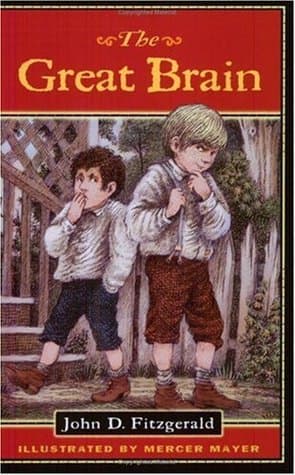
Synopsis
Covers the whole plot, including the ending.
- Difficulty
- Easy
- Pacing
- Moderate
- Mood
- Humorous, Nostalgic, Witty, Lighthearted
- Read it if
- You enjoy classic children's stories about clever, mischievous characters, historical settings, and episodic adventures.
- Skip it if
- You prefer fast-paced, plot-driven narratives with deep character development or dislike stories where the protagonist is often manipulative.
The Great Brain Plot Summary
Covers the whole plot, including the ending.
The Great Brain at Work
The story introduces Tom D. Fitzgerald, known as the 'Great Brain,' a ten-year-old boy in the Mormon town of Adenville, Utah, in the late 1800s. His younger brother, J.D., narrates the book, detailing Tom's intelligence and his knack for creating plans that make him money while often solving community problems. J.D. explains how Tom often outsmarts adults and children, always finding a way to benefit himself. The first few chapters establish Tom's reputation and J.D.'s impressed, if sometimes annoyed, admiration for his brother's cleverness, setting the scene for the adventures that follow.
The Mystery of the Missing Bikes
When several boys' bicycles go missing in Adenville, including J.D.'s friend Frankie's, the town is upset. The adults are confused, but Tom, the Great Brain, sees a chance to act. He announces he will solve the mystery for a fee. After gathering clues and watching the town's children, Tom figures out that older boys, jealous of the younger kids' bikes, hid them. He sets a trap, causing the culprits to show themselves, and recovers the bikes. Tom collects his reward, showing his detective skills and his constant desire for profit.
Saving the Jenkins Boys from Skeleton Cave
The Jenkins boys, two mischievous brothers, get lost and trapped in Skeleton Cave, a dangerous local place. A search party is formed, but their efforts fail. Panic spreads through Adenville. Tom, the Great Brain, steps forward with a plan. He uses his knowledge of the cave's layout, along with ropes and signals, to guide the rescue team. He charges a large fee for his help, but his plan works, and the boys are brought out safely, confirming Tom's reputation as a problem-solver, even in dangerous situations.
The Case of the Missing Pants
One boy, Wendell, has his new Sunday pants stolen from the school cloakroom, upsetting him greatly. The principal cannot find the thief. Tom, the Great Brain, takes on the case, again for a fee. He announces he knows who stole the pants and will give the thief a chance to return them anonymously. He places a large, empty box in the classroom and says the pants will appear inside. Using this psychological tactic, the guilty party, a bully named Sammy, is pressured into returning the pants, showing Tom's insight into human behavior.
Peg-leg Andy and the Secret Treasure
Peg-leg Andy, an old prospector known for his rough manner and wooden leg, tells Tom he forgot where he buried his life savings. The old man is desperate. Tom agrees to help, but only if Andy signs a contract promising him a large part of the recovered money. Through careful questions and watching Andy's habits, Tom figures out the likely spot for the treasure. He finds the buried money, ensuring Andy's financial security while, of course, collecting his agreed-upon share, to Andy's initial annoyance but eventual relief.
The Great Brain and the New Kid, Basil
A new boy named Basil arrives in Adenville. He is quiet, well-dressed, and at first struggles to make friends, becoming a target for bullies. Tom sees a chance. He 'hires' Basil to be his assistant, paying him a small wage to help with his plans, such as organizing games or collecting fees. This arrangement gives Basil a purpose and a connection, helping him gain confidence and acceptance among the other children. While Tom profits from his plans, Basil benefits from fitting in and feeling better about himself, showing a rare, though still self-serving, act of kindness from Tom.
The Christmas Money Scheme
As Christmas nears, the children of Adenville regret their lack of money for presents. Tom, always thinking of business, proposes a solution. He starts a 'Christmas savings' plan, where children can bring him small amounts of money they earn from chores, and he promises to invest it for them, returning it with interest just before Christmas. Many children join, trusting Tom's business sense. He uses the pooled money for small, quick investments or trades, returning a profit to the children (and himself), ensuring everyone has money for gifts.
The School Election Fraud
During a school election for class president, Tom gets involved in a plan to fix the results. He supports a less popular candidate, but through a series of clever manipulations, including convincing voters their votes are secret despite an open ballot system, he manages to change the outcome. While the specific details of his methods are not fully revealed, the episode shows Tom's understanding of human psychology and his willingness to use it. He ultimately exposes the unfairness of the original voting system and how easily it could be manipulated, even if through his own actions.
The Fight with the Bully
A new, bigger boy named Butch, known for bullying, arrives in Adenville and challenges Tom to a fight. Tom, who avoids physical fights, accepts the challenge but makes a plan. He uses psychological tactics and some tricks, convincing Butch he has a secret, unbeatable move. On the day of the fight, Tom's reputation and confident manner, combined with a few well-placed feints, make Butch back down without a punch. Tom again proves that intelligence can win over strength, further cementing his untouchable status.
The Great Brain's Bicycle Business
Seeing the growing popularity of bicycles and the limited number in Adenville, Tom, the Great Brain, decides to profit from the trend. He convinces his father to help him get a few bicycles, which he then rents out to other children for an hourly fee. He also offers repair services for a price. His business quickly grows, as he is the only one offering such a service. This venture shows Tom's business spirit and his ability to find and fill a market need, consistently making a profit through his cleverness.
The Great Brain Characters
Tom D. Fitzgerald (The Great Brain)
Protagonist
A ten-year-old genius with an unmatched talent for schemes and profit.
Tom is the titular 'Great Brain,' a brilliant, cunning, and often manipulative ten-year-old boy living in Adenville, Utah. He possesses an extraordinary intellect, a sharp business mind, and an uncanny ability to understand and exploit human nature. While his primary motivation is often financial gain, his schemes frequently result in solutions to community problems or personal dilemmas, making him a complex figure. He is confident, resourceful, and rarely fails to achieve his objectives.
Relationships: J.D. Fitzgerald (Younger brother and admiring, sometimes exasperated, narrator.); Papa (Father, respected but often outsmarted by Tom.); Mama (Mother, often disapproving of Tom's schemes but tolerant.); Basil (Initially a client, later a friend and assistant.)
J.D. Fitzgerald
Narrator/Supporting
Tom's younger brother, who idolizes and chronicles his older brother's exploits.
J.D. is the younger brother of Tom and the first-person narrator of the stories. He is typically seven or eight years old, impressionable, and deeply admires Tom's intelligence, even when he is a victim of his brother's schemes. J.D. often serves as Tom's assistant or confidant, providing an innocent perspective on Tom's morally ambiguous actions. He is observant and his detailed recollections form the basis of the book's narrative, offering insight into Tom's character and the community of Adenville.
Relationships: Tom D. Fitzgerald (Older brother, idolized and the subject of his narration.); Papa (Father.); Mama (Mother.)
Papa (Mr. Fitzgerald)
Supporting
Tom and J.D.'s stern but fair father, a respected figure in Adenville.
Papa is the head of the Fitzgerald household, a strict but loving father who tries to instill good values in his sons. He is a respected member of the community, often serving as a moral compass or a figure of authority. While he is proud of Tom's intelligence, he often disapproves of his money-making schemes and tries to curb his more mercenary tendencies. Despite his efforts, Tom frequently manages to outmaneuver him, often to Papa's grudging amusement or exasperation.
Relationships: Tom D. Fitzgerald (Son, whose cleverness he admires but whose ethics he often questions.); J.D. Fitzgerald (Son.); Mama (Wife.)
Mama (Mrs. Fitzgerald)
Supporting
Tom and J.D.'s kind and nurturing mother, often concerned about Tom's ethics.
Mama is the nurturing and compassionate mother of Tom and J.D. She is often the voice of reason and morality in the household, more directly expressing her disapproval of Tom's manipulative tactics than Papa. She worries about Tom's character and tries to encourage him to use his intelligence for purely good purposes, without seeking personal gain. Despite her concerns, she loves her sons deeply and provides a warm and stable home environment.
Relationships: Tom D. Fitzgerald (Son, whose ethical choices she often questions.); J.D. Fitzgerald (Son.); Papa (Husband.)
Basil
Supporting
A shy new boy in Adenville who becomes Tom's assistant and friend.
Basil is a new arrival to Adenville, initially a quiet, well-dressed, and somewhat isolated boy who struggles to fit in and becomes a target for bullies. Tom, the Great Brain, takes him under his wing, not entirely out of altruism, but by 'hiring' Basil as his assistant. This arrangement gives Basil a purpose and a connection, allowing him to gain confidence and acceptance among the other children. He represents the positive, albeit indirect, impact of Tom's schemes on others.
Relationships: Tom D. Fitzgerald (Employer/mentor and friend.); J.D. Fitzgerald (Friend.)
Peg-leg Andy
Supporting
An old, gruff prospector with a hidden fortune.
Peg-leg Andy is an elderly, one-legged prospector, known for his cantankerous nature. He is a solitary figure who confides in Tom when he loses his buried life savings. Despite his initial reluctance to trust anyone, he ultimately relies on Tom's intelligence to recover his fortune. His story highlights Tom's ability to deal with adults and his contractual approach to problem-solving, even when dealing with the vulnerable.
Relationships: Tom D. Fitzgerald (Problem-solver/contractor.)
Butch
Antagonist/Mentioned
A bully who challenges Tom.
Butch is a larger, physically intimidating boy who attempts to bully the other children and challenges Tom to a fight. He represents physical force and direct confrontation, which Tom, the Great Brain, skillfully avoids by using his intellect and psychological tactics. Butch serves as a foil to Tom, demonstrating that brains can indeed triumph over brawn in Adenville.
Relationships: Tom D. Fitzgerald (Rival/opponent.)
Sammy
Supporting/Antagonist
A bully exposed by Tom's cleverness.
Sammy is one of the bullies in Adenville, specifically the one responsible for stealing Wendell's pants. He is a minor antagonist who highlights Tom's ability to use psychology to expose wrongdoers without resorting to direct accusation. His brief appearance reinforces Tom's reputation for solving mysteries and punishing misbehavior through clever means.
Relationships: Tom D. Fitzgerald (Detective/exposer.)
The Great Brain Themes
Ingenuity and Problem-Solving
The main theme is Tom's intelligence and his ability to create clever solutions for many problems, from lost children in a cave to stolen bicycles. Each chapter shows a different challenge the community or an individual faces, and Tom always steps forward with an unusual, but effective, plan. For instance, his rescue of the Jenkins boys from Skeleton Cave and his recovery of Peg-leg Andy's hidden savings show how his unique thinking allows him to solve problems that confuse adults. His methods are often complex and unexpected, showing the power of a sharp mind.
“My brother Tom was a Great Brain. He was always thinking, and he always knew how to make a profit.”
Morality and Ethics vs. Self-Interest
This theme looks at the tension between Tom's often self-serving reasons and the good results of his actions. While Tom almost always charges a fee or finds a way to profit from his solutions, his plans always help others. The book subtly asks if the 'ends justify the means.' Characters like Mama often worry about Tom's ethics, urging him to be less focused on money. However, Tom's actions, such as helping Basil fit into the community or recovering stolen items, often lead to good results for those involved, even if his main goal is personal gain. This unclear nature is a key part of his character.
“Mama always said that Tom should use his Great Brain for good, not just for making money.”
Childhood Entrepreneurship and Capitalism
The book clearly shows Tom's natural business sense and his understanding of basic capitalist ideas within a childhood setting. He identifies needs in his community (e.g., bicycle rentals, problem-solving services) and starts businesses to meet them, always aiming for a profit. His 'Christmas savings' plan and his bicycle rental business are good examples. This theme explores how being resourceful and having a keen eye for opportunity can lead to success, even at a young age, and how a small economy can work in a small town through one clever person's initiative.
“Tom knew that if people wanted something bad enough, they'd pay for it.”
The Power of Observation and Psychology
Tom's success relies heavily on his sharp observations and his understanding of human psychology. He can read people's motivations, fears, and desires, and he uses this insight to control situations to his advantage. His method for recovering Wendell's stolen pants, by creating a 'miracle box' to pressure the thief, is a perfect example. Similarly, his ability to outsmart the bully Butch without a physical fight shows his skill in psychological tactics. This theme highlights how understanding the human mind can be a more powerful tool than brute force or common problem-solving.
“Tom didn't need to fight with his fists; he fought with his brain.”
Plot Devices & Literary Techniques
First-Person Narration (J.D.)
The younger brother's perspective provides an admiring, yet sometimes critical, view of Tom.
The entire story is narrated by J.D., Tom's younger brother. This device allows for an intimate and often humorous portrayal of Tom's schemes, filtered through the eyes of someone who both idolizes and is occasionally exasperated by him. J.D.'s naive yet observant perspective makes Tom's extraordinary intellect seem even more remarkable and allows the reader to experience the awe and occasional frustration of living with a 'Great Brain.' It also lends a nostalgic, childlike charm to the historical setting of Adenville.
The 'Great Brain' Moniker
A recurring epithet that defines Tom's character and sets expectations.
The constant reference to Tom as 'The Great Brain' serves as both a character descriptor and a narrative device. It immediately establishes Tom's core identity and sets the reader's expectations for his intelligence and cunning. This moniker acts as a shorthand for his extraordinary abilities, reinforcing his reputation with each new anecdote. It also contributes to the book's slightly exaggerated, almost legendary, tone, fitting for a collection of tales about a remarkable childhood figure.
Contractual Agreements
Tom's habit of formalizing his problem-solving services with written agreements.
Tom frequently requires those seeking his help to enter into formal, often written, contracts that stipulate his payment or share of the profits. This device highlights his business acumen and his insistence on fair compensation for his intellectual labor. It also adds a layer of humor and irony, as a ten-year-old boy is seen negotiating and enforcing legally binding agreements, often with adults. This reinforces the theme of entrepreneurship and his unique, often mercenary, approach to helping others.
Episodic Structure
The story is told through a series of self-contained adventures or 'cases.'
The book is structured as a collection of distinct, self-contained episodes or chapters, each detailing a specific problem that Tom solves. While there is a consistent setting and cast of characters, each 'case' presents a new challenge, allowing for a fresh demonstration of Tom's ingenuity. This episodic nature makes the book highly accessible and engaging, as each chapter offers a complete narrative arc of problem, solution, and resolution, showcasing the versatility of the 'Great Brain.'
The Great Brain Quotes
“It was a wonderful thing, I thought, to have a big brother who knew all about things.”
“My father always said that there were two kinds of people in the world: those who did the work and those who took the credit.”
“The Great Brain always had a plan. He never just did things without thinking them out first.”
“Sometimes it seemed to me that grown-ups were a lot dumber than kids.”
“It was amazing how much money The Great Brain could make if he really put his mind to it.”
“Tom was always coming up with new ways to make money, and they were always legal, though sometimes barely.”
“The Great Brain was a genius, there was no doubt about it. But he was a genius who always looked out for himself first.”
“Most of the time, I didn't mind being fooled by The Great Brain, because he always made it interesting.”
“In our town, everyone knew everyone else's business, and mostly, they didn't mind.”
“The Great Brain could talk anyone into anything, if he tried hard enough.”
“It was funny how much trouble a little kid could get into without even trying.”
“My father said that a man's word was his bond, and he always kept his word.”
“The Great Brain taught me a lot of things, even if I didn't always realize it at the time.”
Quiz
10 questions on the plot and the characters. Each answer comes with a short explanation.
Question 1
What is the Great Brain's real name?
- J.D.
- Tom
- Andy
- Basil
Show answer
B. Tom The narrator's older brother, the Great Brain, is named Tom.
Question 2
What skill does the Great Brain famously possess that allows him to profit from various situations?
- Exceptional athletic ability
- A talent for invention and mechanics
- A silver tongue and a knack for turning a profit
- Unparalleled academic intelligence
Show answer
C. A silver tongue and a knack for turning a profit The Great Brain is described as a 'silver-tongued genius with a knack for turning a profit,' which is his primary method for getting ahead.
Question 3
In the chapter 'The Great Brain and the Skeleton Cave,' who gets lost, prompting the Great Brain to save the day?
- The Fitzgerald boys
- Peg-leg Andy and Basil
- The Jenkins boys
- The school teacher and her students
Show answer
C. The Jenkins boys The prompt specifically mentions, 'When the Jenkins boys get lost in Skeleton Cave, the Great Brain saves the day.'
Question 4
How does the Great Brain typically 'save the day' for people like Peg-leg Andy or Basil?
- By offering genuine, selfless help without expecting anything in return.
- By using his intelligence to solve their problems, often for a fee.
- By physically intervening in dangerous situations to protect them.
- By convincing adults to resolve the issues for the children.
Show answer
B. By using his intelligence to solve their problems, often for a fee. The book consistently shows the Great Brain solving problems for others, but always managing to 'line his pockets in the process,' indicating he charges for his services.
Question 5
What is the narrator's relationship to the Great Brain?
- He is the Great Brain's younger brother, J.D.
- He is the Great Brain's best friend.
- He is the Great Brain's school rival.
- He is the Great Brain's older cousin.
Show answer
A. He is the Great Brain's younger brother, J.D. The author, John D. Fitzgerald, writes the stories from the perspective of his younger self, J.D., who is Tom's younger brother.
Question 6
What is the primary motivation for the Great Brain's actions, even when helping others?
- A strong sense of community responsibility.
- To gain respect and admiration from adults.
- To acquire money or other forms of personal profit.
- To prove his intellectual superiority to his peers.
Show answer
C. To acquire money or other forms of personal profit. The description states, 'the Great Brain always manages to come out on top—and line his pockets in the process,' highlighting his profit-driven motivation.
Question 7
In one chapter, the Great Brain devises a scheme to sell 'secret' memberships to a club that offers no actual benefits. What does this demonstrate about his character?
- His desire to foster community and belonging among the children.
- His ability to manipulate others' desires for exclusivity and profit from it.
- His genuine interest in creating fun and imaginative games.
- His lack of understanding of social dynamics.
Show answer
B. His ability to manipulate others' desires for exclusivity and profit from it. This specific example from the book illustrates the Great Brain's talent for exploiting human nature (like the desire to belong or have secrets) for his own financial gain, even when the offering is valueless.
Question 8
What common historical setting or era is depicted in 'The Great Brain'?
- Colonial America
- The American Old West, late 19th/early 20th century
- Post-World War II 1950s
- The Roaring Twenties
Show answer
B. The American Old West, late 19th/early 20th century The book is set in a small Utah town around the turn of the 20th century, fitting the description of the American Old West in a historical fiction context.
Question 9
When Basil, the new kid, struggles to fit in, what is the Great Brain's solution, and what is its underlying nature?
- He genuinely befriends Basil and helps him without any ulterior motive.
- He organizes a 'popularity contest' for Basil to win, charging for votes.
- He teaches Basil how to fight to gain respect from the other boys.
- He convinces the teacher to give Basil special privileges to make him popular.
Show answer
B. He organizes a 'popularity contest' for Basil to win, charging for votes. In the 'Basil and the Great Brain' chapter, Tom orchestrates a scheme where he charges the other children to vote for Basil in a rigged popularity contest, ensuring Basil's victory while profiting himself.
Question 10
What does the dynamic between the narrator (J.D.) and the Great Brain (Tom) primarily highlight about their sibling relationship?
- J.D.'s constant resentment and attempts to undermine Tom's schemes.
- J.D.'s admiration and occasional frustration with Tom, often being a victim or accomplice in his schemes.
- Tom's consistent efforts to protect J.D. from the harsh realities of their town.
- A relationship of equals, where both brothers are equally cunning and inventive.
Show answer
B. J.D.'s admiration and occasional frustration with Tom, often being a victim or accomplice in his schemes. J.D. frequently recounts Tom's schemes with a mix of awe for his brilliance and exasperation at being outsmarted or used, often being involved in the schemes either willingly or unknowingly.
The Great Brain FAQ
What is the central premise of 'The Great Brain' and who is its main character?
'The Great Brain' centers on the escapades of Tom D. Fitzgerald, a ten-year-old boy in rural Utah during the late 19th century, renowned for his exceptional intelligence and cunning. He uses his 'great brain' to devise elaborate schemes, often for personal profit, while navigating the challenges and adventures of childhood in a small town.
Who is the narrator of the stories, and how does his perspective influence the reader's view of Tom?
The stories are narrated by Tom's younger brother, John D. Fitzgerald (J.D.), who often views Tom with a mixture of awe, admiration, and occasional exasperation. J.D.'s perspective highlights Tom's genius and charm, while also subtly exposing the manipulative and self-serving aspects of his brother's schemes, giving the reader a balanced, if sometimes biased, view.
What kind of historical setting does the book depict, and how does it impact the characters' lives?
The book is set in the late 19th century in the small Mormon town of Adenville, Utah. This historical context means limited technology, close-knit community ties, and a strong emphasis on self-reliance and ingenuity, which provides fertile ground for Tom's clever schemes and the simple, yet profound, adventures of childhood.
Can you describe one of Tom's most famous 'great brain' schemes from the book?
One memorable scheme involves Tom convincing the town's children to pay him to learn how to swim. He charges them for lessons, then merely pushes them into the water, relying on their natural instinct to survive. Despite the unconventional method, most children learn, and Tom profits handsomely.
How does Tom manage to rescue the Jenkins boys from Skeleton Cave?
When the Jenkins boys get lost in Skeleton Cave, Tom orchestrates their rescue by using his knowledge of the cave's layout and his ability to remain calm under pressure. He devises a plan that involves careful navigation and communication, ultimately guiding them to safety, though he likely found a way to be compensated for his heroic efforts.
What is the significance of the character Peg-leg Andy, and how does Tom interact with him?
Peg-leg Andy is a local outcast and a somewhat tragic figure, often targeted by bullies. Tom initially sees an opportunity to profit from Andy's situation, but in helping him, Tom also displays a surprising degree of genuine concern and protection. This interaction highlights the complex nature of Tom's character, blending self-interest with a nascent sense of justice.
How does Tom's relationship with Basil, the new kid, reveal more about Tom's character?
Basil, the new kid, is initially an easy target for Tom's schemes due to his unfamiliarity with the town's dynamics. However, Tom eventually takes Basil under his wing, demonstrating a protective instinct and even teaching him some of his tricks. This shows Tom's capacity for mentorship and a grudging loyalty, even if still rooted in his own strategic thinking.
Are there any recurring symbols or motifs in the book that underscore Tom's personality?
The motif of 'the deal' or 'the trade' is central to Tom's character, symbolizing his constant drive to negotiate and profit. Additionally, the recurring image of Tom's 'great brain' at work, often accompanied by his contemplative facial expressions, visually reinforces his intellectual prowess and strategic thinking, setting him apart from his peers.
How does Tom's family, particularly his parents, react to his constant scheming?
Tom's parents often react to his schemes with a mixture of amusement, exasperation, and pride. While they occasionally scold him for his more unscrupulous methods, they also recognize and are often impressed by his intelligence and resourcefulness. Their tolerance, and sometimes covert encouragement, allows Tom's 'great brain' to flourish.
What psychological traits define Tom D. Fitzgerald?
Tom is characterized by high intelligence, exceptional problem-solving skills, and a strong entrepreneurial spirit. He possesses a keen understanding of human nature, allowing him to manipulate situations and people for his benefit. He also exhibits confidence, charisma, and a relentless drive, bordering on opportunism.
How does Tom's 'great brain' function as both a gift and a potential flaw?
Tom's 'great brain' is a gift, enabling him to solve complex problems, innovate, and achieve success. However, it also presents a flaw, as his intelligence often leads him to prioritize personal gain over ethical considerations, sometimes causing him to exploit others or bend the rules. This dual nature makes him a complex and compelling character.
In what ways does Tom demonstrate empathy, despite his often self-serving actions?
While often driven by profit, Tom occasionally demonstrates empathy. He helps Peg-leg Andy not just for money but also out of a sense of justice, and he protects Basil from bullies. These instances suggest that beneath his calculating exterior, Tom possesses a developing moral compass and a capacity for genuine human connection.
How does the author use Tom's character to explore themes of childhood ingenuity and morality?
The author uses Tom to explore the boundaries of childhood ingenuity, showing how a clever mind can navigate and manipulate the world. Simultaneously, Tom's schemes raise questions about morality, prompting readers to consider where the line between cleverness and exploitation lies, and how those lines are drawn in childhood.
Is Tom a purely positive character, or is there a darker side to his genius?
Tom is not a purely positive character; his genius often has a darker side, as he frequently manipulates and exploits others for personal gain. While his actions are often framed humorously, they highlight a pragmatic, almost amoral, approach to achieving his goals, sparking debate about his ethical standing.
How does the book's portrayal of Tom reflect the values and challenges of its historical setting?
The book's portrayal of Tom reflects the values of self-reliance, resourcefulness, and entrepreneurial spirit prevalent in the late 19th-century American West. His challenges often stem from the lack of modern amenities and the reliance on community, which he adeptly leverages or circumvents with his clever schemes.
What is the primary message or moral, if any, that readers are meant to take away from Tom's adventures?
The book doesn't offer a single, clear moral but rather invites readers to ponder the complexities of human nature, the blurred lines between cleverness and cunning, and the development of character. It suggests that even self-serving actions can sometimes lead to positive outcomes, and that ingenuity, while powerful, requires ethical grounding.
Could Tom's 'great brain' be seen as a metaphor for something larger?
Tom's 'great brain' can be interpreted as a metaphor for the power of intellect and strategic thinking, especially in a world where physical strength or social status might otherwise dominate. It represents the ability to overcome obstacles and achieve success through mental prowess, even if sometimes through unconventional or morally ambiguous means.
How does J.D.'s narration shape the reader's judgment of Tom's actions?
J.D.'s narration, filled with admiration and a touch of naivete, often softens the impact of Tom's more morally questionable actions. His perspective allows the reader to view Tom's schemes through the lens of childhood adventure and brotherly affection, making it easier to forgive Tom's occasional unscrupulousness.
Similar books
- Pippi Longstocking
Astrid Lindgren
4.1 (168k) average on GoodreadsFantasyStars an unconventional, highly resourceful child who often outsmarts adults.
- Little House on the Prairie
Laura Ingalls Wilder
4.2 (256k) average on GoodreadsChildren'sBoth are historical fiction for children, but The Great Brain has a lighter, more humorous tone and less emphasis on the harsh realities and struggles of the historical period. Wilder's work is more deeply rooted in the challenges of survival and community building, offering a more grounded historical experience.
- Harry Potter and the Sorcerer's Stone
J.K. Rowling
4.5 (7M) average on GoodreadsFantasyRescued from a miserable life under the stairs, an orphaned boy discovers he's a wizard destined for a magical school, where he uncovers a dangerous secret tied to the dark wizard who murdered his parents.
- The Hobbit, or There and Back Again
J.R.R. Tolkien
4.3 (2.9M) average on GoodreadsFantasyA comfort-loving hobbit named Bilbo Baggins is whisked away by a mischievous wizard and a band of dwarves on an unexpected journey to reclaim stolen treasure from a fearsome dragon, discovering courage and a magical ring along the way.
- Harry Potter and the Goblet of Fire
J.K. Rowling
4.6 (2.6M) average on GoodreadsFantasyA bewildered Harry Potter, underage and thrust into a deadly Triwizard Tournament, must brave dragons, mermaids, and a resurgent dark magic to survive a year that will forever alter the wizarding world.
- Harry Potter and the Order of the Phoenix
J.K. Rowling
4.5 (2.5M) average on GoodreadsFantasyIn a year of oppressive secrets and the threat of Voldemort, Harry Potter and Dumbledore's Army secretly train for war, shown through Jim Kay and Neil Packer's dark illustrations.




Enjoyed the summary?
A summary gives you the shape of the book. The book itself has the detail, the examples and the voice.
Find The Great Brain on AmazonAs an Amazon Associate, BookBrief earns from qualifying purchases. How we're funded