
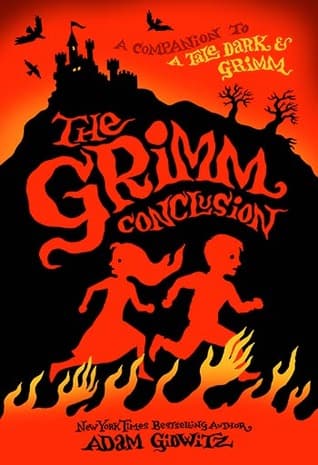
Synopsis
Covers the whole plot, including the ending.
- Difficulty
- Medium
- Pacing
- Fast
- Mood
- Eerie, Suspenseful, Humorous, Darkly Whimsical
- Read it if
- You love dark, twisted fairy tales, enjoy meta-narratives, and appreciate a blend of humor and genuine peril in children's fantasy.
- Skip it if
- You prefer lighthearted fairy tales, are sensitive to darker themes in children's literature, or dislike unreliable narrators.
The Grimm Conclusion Plot Summary
Covers the whole plot, including the ending.
A New Beginning, A Familiar Threat
After their adventures, Hansel and Gretel arrive at the School for Orphans and Lost Children in the Black Forest, a seemingly safe place run by Sister Maria. They quickly become friends with a boy named Johannes and get used to a routine of learning and chores. But their peace does not last. The narrator, Adam, reveals that the Shadow Man, their enemy, has been quietly influencing the school. Strange things begin to happen, such as Sister Maria showing unusual favor to Gretel and an unsettling feeling in the usually happy atmosphere. The children soon realize that even in this sanctuary, they are not safe from the dark forces after them.
The Juniper Tree's Dark Secret
The children's attention turns to Johannes, who tells them about a sad past with a wicked stepmother. As Hansel and Gretel investigate, they find out that Johannes's stepmother, a woman named Ilsa who sometimes visits the school, is a witch. Because of jealousy and a wish for Johannes's inheritance, she kills Johannes and bakes him into a stew, which she then serves to her unsuspecting husband. This act is like the tale of 'The Juniper Tree,' and the children are horrified to see such a dark fairy tale unfold. Johannes's spirit, now a bird, begins to sing a sad song that reveals the stepmother's crime.
The Bird's Revenge and the Stepmother's End
Johannes, now a bird, sits on the juniper tree outside the school and sings his sad story to his father. The father, upset, understands the truth about his wife. The bird then drops a millstone on Ilsa's head, killing her and turning her into a pillar of flame, like the end of the stepmother in 'The Juniper Tree.' Johannes is then brought back to life from the ashes, a living boy again, free from his stepmother's cruelty. This event affects Hansel and Gretel, showing them the harsh justice often found in fairy tales and the Shadow Man's direct dark magic on their world.
Gretel's Cinderella Story Begins
After the events with Johannes, Gretel is adopted by a rich, but cold, merchant named Herr Humperdinck. She is taken to his large house, where she meets his two vain and cruel daughters, Brunhilde and Hildegard, and their equally unpleasant mother. Gretel is immediately made a servant, forced to do hard chores and endure constant teasing and abuse. This new life is like the Cinderella tale, with Gretel finding herself in a familiar, but scary, situation of oppression and wanting freedom. Hansel, sad about their separation, promises to find her and rescue her.
Hansel's Desperate Search
Upset by Gretel's sudden adoption and the unfairness of her situation, Hansel, with the now living Johannes, sets out to find her. They walk through the Black Forest, meeting different magical creatures and facing many challenges. Their journey is dangerous, and they rely on their quick thinking and the kindness of strangers, as well as Johannes's unique view from his time as a bird. Hansel is determined to reunite with his sister, driven by their bond and the many dangers they have overcome together. The narrator notes how hard their quest is, showing the size and dangers of the world outside the school.
The Prince's Ball and Gretel's Escape
A royal ball is announced, and Herr Humperdinck's daughters are excited, hoping to win the Prince's love. Gretel, despite her wish to go, is forbidden. However, with help from a magical bird (Johannes's spirit or a similar magical being), she gets a beautiful gown and goes to the ball. She dances with the Prince, charming him, but must leave before midnight, leaving behind a golden slipper. The Prince, in love, searches for the maiden who fits the shoe. This allows Gretel to escape her cruel family, though her freedom is still uncertain and depends on the Prince finding her.
The Deception and the Birds' Revelation
The Prince arrives at Herr Humperdinck's house, determined to find the owner of the golden slipper. Brunhilde and Hildegard, at their mother's urging, cut off parts of their feet to fit into the slipper. The trick almost works, but a flock of magical birds, guided by Johannes's spirit and perhaps the Shadow Man's control, tells the Prince the truth. They sing a song showing the blood in the shoe, leading the Prince to Gretel, who is hiding. This moment of truth shows the stepsisters' cruelty and brings Gretel closer to her rightful place, though danger still exists.
The False Wedding and the Shadow Man's Scheme
Gretel is brought to the palace and is about to marry the Prince, to her delight and her former stepfamily's dismay. However, Hansel, having found his way to the palace with Johannes, feels that something is wrong. He finds out that the Prince is not truly in love with Gretel; the whole marriage is a trick planned by the Shadow Man. The Shadow Man means to use the royal wedding, a significant magical event, to get great power and bring his darkness to the world, turning the happy event into a ritual for his victory. Hansel realizes they have walked into a trap far bigger than they imagined.
Rumpelstiltskin's Bargain and the Truth Revealed
As the wedding nears, Hansel and Gretel, now together, look for a way to stop the Shadow Man. They meet Rumpelstiltskin, a mysterious and powerful magical being, who offers them a deal. For something valuable, Rumpelstiltskin reveals a shocking truth: the Shadow Man is not just an evil being, but all the negative, selfish desires and dark impulses of humanity itself. He specifically reveals that the Shadow Man is a part of the narrator, Adam's, own darker nature, separated long ago. This discovery adds a deep layer to their conflict, making it a battle against a universal darkness connected to their own storyteller.
The Narrator's Confession and the Ultimate Sacrifice
Overwhelmed by Rumpelstiltskin's revelation, the narrator, Adam, stops being his usual detached self and talks directly to Hansel and Gretel. He admits his deep connection to the Shadow Man, explaining that the Shadow Man is a part of him, a representation of his own unsolved fears and darkness that he had tried to separate and contain through stories. Adam reveals that the only way to defeat the Shadow Man permanently is for him to fully accept and take back his dark side, a process that will be very painful and might even mean his own end or change. He prepares for this sacrifice, telling Hansel and Gretel to continue their fight against the remaining darkness in the world.
The Final Confrontation and Adam's Reintegration
During the wedding ceremony, Hansel and Gretel confront the Shadow Man, using their courage and what they've learned to fight his illusions and dark magic. Meanwhile, Adam, the narrator, has a deep internal struggle. He actively engages with the Shadow Man, not as an outside enemy, but as a part of himself. This internal battle is shown as a painful, changing process where Adam slowly takes back and accepts his darker impulses, effectively bringing the Shadow Man back into his being. This act of bringing it back weakens the Shadow Man's outside form, allowing Hansel and Gretel to finally defeat the remaining magical effects.
A New Beginning, A World Transformed
With the Shadow Man brought back into Adam, the immediate magical threat goes away. The Prince, free from the Shadow Man's influence, understands his true feelings and the deception. Hansel and Gretel, changed by their journey, find a new purpose and a deeper understanding of the world. They choose to stay together, starting new adventures, not as victims of fate, but as active people shaping their own stories. The world still has challenges, but with the Shadow Man's influence lessened, hope for a more balanced existence appears, and the children are ready to face it with their new wisdom and bravery.
Principal Figures
Hansel
Protagonist
The brave, protective brother, always looking out for Gretel
Hansel is the older and more pragmatic of the two siblings. He is fiercely protective of Gretel, often taking on the role of the problem-solver and strategist. Throughout their journey, he demonstrates immense courage, loyalty, and a strong sense of justice. While sometimes impulsive, his actions are always driven by his love for his sister and his desire to keep them safe. He learns to trust his instincts and to question authority, even when it appears benevolent. His experiences harden him, but his core remains compassionate.
Relationships: Gretel (Younger sister, primary bond and motivation); Johannes (Friend and companion on his quest); Adam (Narrator) (The storyteller who guides and influences their journey)
Gretel
Protagonist
The clever, empathetic sister, grappling with her own destiny
Gretel is Hansel's younger sister, characterized by her quick wit, empathy, and remarkable resilience. She possesses a deep intuition and often sees things that Hansel misses. Despite enduring significant hardship, including her 'Cinderella' ordeal, she maintains a strong sense of self and an unwavering spirit. Her cleverness and resourcefulness are crucial in many difficult situations. She represents the often-victimized fairy tale heroine who ultimately finds her own agency and strength.
Relationships: Hansel (Older brother, primary bond and source of protection); Johannes (Friend and confidante); Herr Humperdinck and family (Adoptive family, cruel tormentors); The Prince (Brief romantic interest, part of the Shadow Man's scheme)
Adam (The Narrator)
Supporting/Meta-character
The self-aware, sometimes mischievous storyteller, revealed to be connected to the Shadow Man
Adam is the distinctive, meta-fictional narrator of the series. He is an omniscient, often humorous, and self-aware voice who frequently breaks the fourth wall, directly addressing the reader with warnings, philosophical musings, and even personal anecdotes. In this final book, his role becomes much more integral to the plot as it is revealed that the Shadow Man is a part of him, a manifestation of his own separated darkness. His journey is one of confronting his own inner demons and reintegrating the parts of himself he tried to suppress through storytelling.
Relationships: Hansel and Gretel (His 'protagonists,' whom he guides and often warns); The Shadow Man (His separated, darker self)
The Shadow Man
Antagonist
The pervasive, malevolent entity seeking to spread darkness and despair
The Shadow Man is the overarching antagonist of the series, a mysterious and terrifying entity that embodies the darker aspects of human nature: greed, envy, cruelty, and despair. He manipulates events from the shadows, twisting fairy tales to his own sinister ends and preying on the weak and vulnerable. He is not a physical being in the traditional sense, but rather a pervasive force that influences people and events. His ultimate goal is to gain enough power to fully manifest and plunge the world into eternal darkness. His true nature as a part of Adam's own psyche is the central revelation of the book.
Relationships: Adam (Narrator) (His origin, his separated 'other half')
Johannes
Supporting
A kind orphan boy who experiences a horrifying fairy tale transformation
Johannes is a kind and gentle orphan boy whom Hansel and Gretel befriend at the School for Orphans and Lost Children. He is initially portrayed as a victim of his wicked stepmother, mirroring the story of 'The Juniper Tree.' His transformation into a bird and subsequent resurrection are central to the early plot. He becomes a loyal friend and companion to Hansel, aiding him in his search for Gretel with his unique perspective and knowledge of the forest. He represents innocence corrupted and then restored through the harsh justice of the fairy tale world.
Relationships: Hansel (Friend and travel companion); Gretel (Friend); Ilsa (Stepmother) (His murderer and tormentor)
Sister Maria
Supporting
The initially kind headmistress of the orphanage, subtly influenced by the Shadow Man
Sister Maria is the headmistress of the School for Orphans and Lost Children. She initially appears as a benevolent and caring figure, providing a safe haven for the children. However, her character soon reveals a subtle shift, showing favoritism towards Gretel and making unsettling decisions, which is later understood to be due to the pervasive influence of the Shadow Man. She represents how even good people can be subtly corrupted by dark forces, making her a more complex figure than a simple villain.
Relationships: Hansel and Gretel (Her charges at the orphanage); The Shadow Man (The entity subtly influencing her actions)
Ilsa (Johannes's Stepmother)
Supporting/Antagonist
Johannes's wicked stepmother, mirroring the antagonist of 'The Juniper Tree'
Ilsa is Johannes's stepmother, a woman consumed by envy and greed. She murders Johannes to secure his inheritance and bakes him into a stew, a gruesome act directly from 'The Juniper Tree' fairy tale. She is a purely malevolent character, embodying the cruelest aspects of human nature. Her actions are a direct manifestation of the Shadow Man's influence, highlighting the dark potential within individuals when given to such impulses. Her violent end serves as a stark example of fairy tale justice.
Relationships: Johannes (Her stepson and victim); Johannes's Father (Her unwitting husband)
Herr Humperdinck and Family
Supporting/Antagonists
The wealthy but cruel family who adopt and torment Gretel
Herr Humperdinck is a wealthy merchant, but he and his wife and two daughters, Brunhilde and Hildegard, are cold, vain, and cruel. They adopt Gretel only to turn her into a servant and subject her to constant abuse and ridicule, mirroring the 'Cinderella' tale. They are driven by social climbing and superficiality. Their willingness to mutilate their own feet to deceive the Prince underscores their moral depravity and the corrupting influence of their desires, again subtly manipulated by the Shadow Man.
Relationships: Gretel (Their adopted servant and victim); The Prince (The object of their social ambition)
Rumpelstiltskin
Supporting
A mysterious magical being who reveals crucial truths
Rumpelstiltskin is a powerful and enigmatic magical creature whom Hansel and Gretel encounter. He is known for making bargains and possessing secret knowledge. In this story, he serves as a pivotal character, providing crucial information about the Shadow Man's true identity and connection to the narrator, Adam. His appearance highlights the deeper, more ancient magic at play in their world and the necessity of understanding hidden truths to overcome ultimate evil. He operates on his own terms, driven by ancient rules of magic.
Relationships: Hansel and Gretel (Recipients of his vital information)
The Prince
Supporting
The royal figure who falls for Gretel, initially manipulated by the Shadow Man
The Prince is the traditional fairy tale figure who hosts the ball and seeks the maiden who fits the golden slipper. He is initially portrayed as charming but somewhat naive, easily manipulated by the Shadow Man's scheme to use his wedding to Gretel as a source of power. He represents the potential for good that can be swayed by darkness, but ultimately, he comes to his senses and recognizes the truth. His role is to facilitate Gretel's escape from her cruel family and to serve as a pawn in the Shadow Man's larger plan.
Relationships: Gretel (His intended bride, initially due to manipulation); Herr Humperdinck and Family (Those seeking his favor)
Themes & Insights
The Nature of Good and Evil
The book explores the unclear line between good and evil, especially when it is revealed that the Shadow Man is a part of the narrator, Adam. It suggests that evil is not always an outside force but can come from hidden parts of oneself or dark human impulses. Characters like Sister Maria and the Prince, who start good, show how easily one can be influenced by negative forces, while the extreme cruelty of Ilsa and the Humperdinck family shows uncontrolled meanness. The ending suggests that true good involves recognizing and accepting one's own darkness rather than trying to separate it.
“For the Shadow Man, you see, is not just a monster. He is not just evil. He is all the parts of us that we wish we were not. All the parts of me that I wish I were not.”
Identity and Self-Discovery
Hansel and Gretel both experience journeys of self-discovery. Gretel, especially during her Cinderella experience, learns to be independent and recognize her own value regardless of her situation. Hansel learns to trust his instincts and become a more capable leader. Most importantly, the narrator, Adam, goes on a journey of self-discovery by facing his own connection to the Shadow Man. This theme shows that real strength comes from understanding and accepting all parts of oneself, including the difficult or dark ones.
“You must find your own way, children. For the stories are not just about what happens to you, but about who you become.”
The Power of Storytelling
Storytelling is a central theme, with the narrator, Adam, often commenting on fairy tales and their effects. The book shows how stories shape how we see things, offer lessons, and can even be directly controlled by bad forces (the Shadow Man twisting tales). The revelation that the Shadow Man is a part of the narrator shows the great power and responsibility of the storyteller, suggesting that the tales we tell (and the parts of ourselves we put into them) can have real consequences. The children's journey is presented as their own story being written.
“And that, dear reader, is the terrible power of stories. They can make you believe anything. They can even make you believe that a piece of you is not you at all.”
Justice and Consequences
The book, like the Grimm fairy tales it uses, shows a harsh and often brutal form of justice. Ilsa's death under the millstone and the stepsisters' self-harm and punishment are examples of justice for their wickedness. This theme reinforces the idea that actions have consequences, often severe ones, in the world of the stories. Even the Shadow Man eventually faces a form of justice through being brought back into Adam, suggesting that true resolution comes from facing and dealing with the source of harm, rather than just escaping it.
“For in the world of the stories, justice, when it comes, is rarely gentle. It is swift, and it is often bloody.”
Family and Loyalty
The strong bond between Hansel and Gretel remains a key part of the story. Their loyalty to each other drives much of the plot, especially Hansel's search for Gretel during her Cinderella experience. Even when separated and in great danger, their commitment to one another never wavers. This theme stands in contrast to the troubled and cruel 'families' they meet, such as Johannes's stepmother and Gretel's adoptive family, showing the importance of real family love and support as a source of strength against darkness.
“No matter what happens, Gretel, we'll always have each other. That's the one thing they can never take away.”
Plot Devices & Literary Techniques
Meta-Narration
A self-aware narrator who frequently breaks the fourth wall
The narrator, Adam, is a highly self-aware character who directly addresses the reader, comments on the storytelling process, and offers philosophical asides. This device creates a unique, intimate tone and allows for deeper thematic exploration, especially regarding the nature of stories and their impact. It also builds suspense and humor, making the reader complicit in the narrative's unfolding. In 'The Grimm Conclusion,' this device becomes central to the plot itself, as the narrator's identity is directly tied to the antagonist.
Fairy Tale Archetypes and Retellings
Classic fairy tales are woven into the plot, often with darker, more 'Grimm' interpretations
The book explicitly draws upon and retells classic Grimm fairy tales, such as 'The Juniper Tree' and 'Cinderella,' but often with their original, darker, and more gruesome elements restored or amplified. This device provides a familiar framework for the plot while subverting expectations, reminding readers of the often-brutal nature of traditional folk tales. It allows the author to explore themes of justice, cruelty, and transformation through recognizable narrative structures, making the fantastical elements feel both timeless and unsettlingly real within the story's world.
The Shadow Man as Internalized Evil
The primary antagonist is revealed to be a manifestation of the narrator's own repressed darkness
This is a pivotal plot device in 'The Grimm Conclusion.' The Shadow Man, previously an external, pervasive evil, is revealed to be a fragmented part of the narrator's (Adam's) own psyche – his repressed fears, dark impulses, and the negative aspects he tried to separate through storytelling. This device transforms the external conflict into an internal one, elevating the stakes and adding profound psychological depth. It suggests that true victory over evil requires confronting and integrating one's own inner darkness, rather than merely fighting an external force, making the resolution deeply personal for Adam.
Symbolism of Transformation
Characters and objects undergo literal or metaphorical changes, signifying deeper shifts
Transformation is a recurring motif and plot device. Johannes literally transforms into a bird and back, symbolizing innocence lost and regained, and the harsh, magical justice of the fairy tale world. Gretel's transformation from a scullery maid to a 'princess' at the ball symbolizes her journey from oppression to self-realization. The Shadow Man's manifestation and eventual reintegration into Adam represent the transformation of evil from an external entity to an internalized, accepted part of the self. These transformations drive the narrative and reflect the characters' evolving understanding of themselves and their world.
The Grimm Conclusion Quotes
“Not all stories have happy endings. And not all stories are about good versus evil. Sometimes, stories are just about people, trying to do the best they can.”
“Hansel and Gretel had learned that sometimes, the only way to save yourself was to save someone else.”
“The world was not a simple place. It was filled with good and bad, often mixed together in ways that were impossible to untangle.”
“Fear was a powerful thing. It could make you do terrible things, but it could also make you incredibly brave.”
“Sometimes, the only way to find your way home was to get lost first.”
“Even the darkest forests had clearings, and even the most terrifying monsters had weaknesses.”
“A true hero wasn't someone who was never afraid, but someone who kept going despite their fear.”
“Stories were like rivers. They flowed and changed, but their essence remained the same.”
“The greatest magic of all was the ability to believe in something, even when there was no proof.”
“Forgiveness wasn't about forgetting, but about choosing to let go of the anger.”
“Every ending was just a new beginning, if you knew how to look for it.”
“The truth was rarely simple, and often uncomfortable.”
“Sometimes, the most important battles were fought not with swords, but with words and understanding.”
“It wasn't enough to just survive. You had to live.”
Quiz
10 questions on the plot and the characters. Each answer comes with a short explanation.
Question 1
Which of the following classic fairy tales is NOT explicitly mentioned as being a basis for the stories in 'The Grimm Conclusion'?
- The Juniper Tree
- Rapunzel
- Cinderella (the real story)
- Rumpelstiltskin
Show answer
B. Rapunzel The book description specifically mentions 'The Juniper Tree,' 'the real story of Cinderella,' and 'Rumpelstiltskin' as inspirations. Rapunzel is not listed.
Question 2
What is the primary role of the narrator in 'The Grimm Conclusion'?
- A silent observer of the events
- A character directly involved in the plot
- An irreverent guide leading readers through the tales
- The main antagonist of the story
Show answer
C. An irreverent guide leading readers through the tales The description highlights Adam's 'brilliantly irreverent narrator' who 'leads readers through a fresh world of Grimm-inspired fairy tales.'
Question 3
How does 'The Grimm Conclusion' relate to the previous books in the series?
- It is a standalone story with no connection to previous events.
- It is the first book in a new trilogy.
- It is the final book in the series.
- It serves as a prequel to the entire series.
Show answer
C. It is the final book in the series. The book description clearly states, 'In the final book in the series...' indicating its place as the conclusion.
Question 4
What kind of landscapes and creatures can readers expect to encounter in 'The Grimm Conclusion'?
- Bright, cheerful, and friendly environments with cute animals.
- Eerie new landscapes and fear-inducing creatures.
- Modern cityscapes and everyday people.
- Ancient historical settings with realistic animals.
Show answer
B. Eerie new landscapes and fear-inducing creatures. The summary mentions 'eerie new landscapes and fear-inducing creatures,' which aligns with the tone of Grimm fairy tales.
Question 5
What is a central theme or experience Adam Gidwitz aims to deliver with this book?
- A purely educational historical account of fairy tales.
- A story that is sure to delight and frighten fans.
- A lighthearted comedy without any suspense.
- A philosophical treatise on the nature of good and evil.
Show answer
B. A story that is sure to delight and frighten fans. The description states that Gidwitz delivers 'a story sure to delight and frighten fans old and new,' indicating a blend of entertainment and suspense.
Question 6
Why is the narrator described as 'irreverent'?
- Because they are disrespectful towards the characters in the story.
- Because they often contradict the author's intentions.
- Because they likely offer humorous, perhaps slightly disrespectful or unconventional commentary on the dark tales.
- Because they use overly formal and serious language.
Show answer
C. Because they likely offer humorous, perhaps slightly disrespectful or unconventional commentary on the dark tales. An 'irreverent' narrator, especially in the context of dark fairy tales for a YA audience, suggests a voice that doesn't take itself too seriously, often injecting humor or modern commentary into the traditional, sometimes grim, narratives.
Question 7
What specific characteristic of the fairy tales in 'The Grimm Conclusion' is emphasized by the phrase 'the real story of Cinderella'?
- The focus on historical accuracy of ancient folklore.
- The inclusion of more modern, updated versions of the tales.
- The likely use of the darker, more gruesome, and less sanitized versions of the classic stories.
- The intention to create entirely original stories loosely based on the classics.
Show answer
C. The likely use of the darker, more gruesome, and less sanitized versions of the classic stories. The phrase 'the real story of Cinderella' implies that the book will delve into the original, often much darker and more violent, versions of the fairy tales, as opposed to the more widely known sanitized adaptations.
Question 8
Given the description, what might be a challenge for new readers picking up 'The Grimm Conclusion' without having read previous books?
- The stories might be too lighthearted and not engaging enough.
- They might miss out on character development or overarching plotlines established in prior installments, as it's the 'final book in the series.'
- The vocabulary might be too advanced for children and young adults.
- The book might be too short to provide a satisfying reading experience.
Show answer
B. They might miss out on character development or overarching plotlines established in prior installments, as it's the 'final book in the series.' As the 'final book in the series,' new readers might lack the context of previous events, character arcs, or world-building, which could diminish their understanding or enjoyment of the conclusion.
Question 9
How does the author, Adam Gidwitz, position himself in relation to the source material (Grimm fairy tales)?
- He aims to completely rewrite the tales with modern settings and characters.
- He faithfully retells the original Grimm tales without any modifications.
- He uses Grimm-inspired fairy tales, suggesting an adaptation or reinterpretation rather than a direct retelling.
- He only uses the titles of Grimm tales but creates entirely new plots.
Show answer
C. He uses Grimm-inspired fairy tales, suggesting an adaptation or reinterpretation rather than a direct retelling. The description states 'Grimm-inspired fairy tales,' which indicates that while the tales draw from the original Grimm stories, they are likely reinterpreted or adapted through Gidwitz's unique lens, rather than being simple retellings.
Question 10
What does the phrase 'widely praised and beloved by children, adults, and critics alike' suggest about the book's appeal?
- It is primarily targeted at a very niche audience with specific literary tastes.
- It has broad, cross-generational appeal, resonating with various age groups and literary reviewers.
- Its complexity makes it unsuitable for younger readers, despite being children's fiction.
- It is a controversial book that generates strong, divided opinions.
Show answer
B. It has broad, cross-generational appeal, resonating with various age groups and literary reviewers. The phrase indicates that the book's quality and themes transcend typical age categories, appealing to both children and adults, and earning critical acclaim, suggesting a broad and diverse readership.
The Grimm Conclusion FAQ
What is 'The Grimm Conclusion' about?
'The Grimm Conclusion' is the final book in the 'A Tale Dark and Grimm' series, following siblings Hansel and Gretel on their perilous journey to find a safe haven. They encounter a new set of dark, original Grimm fairy tales, including adaptations of 'The Juniper Tree' and 'Rumpelstiltskin', as they navigate a world filled with both wonder and terrifying creatures, ultimately seeking to understand their own destiny and the meaning of their adventures.
Why should I read 'The Grimm Conclusion'?
You should read 'The Grimm Conclusion' for its unique blend of dark fantasy, humor, and profound themes, wrapped in Adam Gidwitz's distinctive narrative voice. It offers a fresh, often gruesome, take on classic fairy tales while exploring complex ideas of good, evil, family, and self-discovery, appealing to both children and adults who appreciate stories that don't shy away from the darker aspects of life.
What is the background/setting of 'The Grimm Conclusion'?
The story is set in a fantastical, medieval-inspired landscape that is both familiar and unsettling, drawing heavily from the ambiance of original Grimm fairy tales. Hansel and Gretel travel through enchanted forests, desolate kingdoms, and treacherous mountains, encountering various magical beings and human characters, each location imbued with a sense of ancient history and lurking danger.
What are the most memorable quotes?
Memorable quotes often come from the narrator's direct addresses to the reader, such as warnings about impending horrors or philosophical musings. For instance, the narrator frequently reminds readers, 'Do not be alarmed, dear reader, but things are about to get much, much worse,' setting a darkly humorous tone, and moments of introspection from Hansel or Gretel about courage and loss also stand out.
What writing style does the author use?
Adam Gidwitz employs a distinctive, irreverent, and often darkly humorous writing style, characterized by a highly engaging omniscient narrator who frequently breaks the fourth wall. The language is rich with vivid descriptions, while maintaining an accessible tone for young readers, balancing moments of genuine terror with witty commentary and emotional depth.
What minor details add significant meaning?
The recurring motif of the children's worn-out shoes, representing their long and arduous journey, subtly emphasizes their perseverance and the toll their adventures have taken. Also, the specific details of the 'gifts' Hansel and Gretel receive in various tales, like the golden apple or the magical cloak, often have unexpected magical properties or symbolic weight that become crucial later.
What are some subtle foreshadowing moments?
Subtle foreshadowing appears in the narrator's ominous hints about future perils, often delivered with a wry tone, such as mentioning that 'this particular happy moment would not last.' Additionally, early encounters with seemingly minor characters or objects, like the witch's peculiar spinning wheel, often hint at their greater significance in later, darker adaptations of classic tales like 'Rumpelstiltskin'.
What unexpected character connections exist?
An unexpected connection is revealed between the seemingly disparate characters from various Grimm tales, suggesting a larger, interconnected magical world. For example, a character from one tale might be revealed to be the distant relative or a former acquaintance of a character from another, subtly weaving a complex tapestry of relationships that spans the entire series.
What are unspoken character motivations?
Hansel's unspoken motivation often revolves around his deep-seated need to protect Gretel, even at great personal cost, stemming from their traumatic past. Gretel, on the other hand, is driven by a quest for understanding and a desire to find a true 'home,' pushing her to confront uncomfortable truths and make difficult decisions about their shared future.
What psychological complexities do characters exhibit?
Hansel grapples with the psychological burden of past violence and his own capacity for darkness, often questioning if he is truly good despite his heroic actions. Gretel exhibits a complex blend of innocence and resilience, wrestling with the moral ambiguities of their journey and the harsh realities of the world, forcing her to mature rapidly and make difficult ethical choices.
What are the major emotional turning points?
A major emotional turning point occurs when Hansel and Gretel are separated, forcing them to confront their individual fears and strengths without the immediate comfort of the other. Another is the moment they uncover the true, often tragic, origins of some of the fairy tale characters they encounter, leading to a profound shift in their understanding of justice and mercy.
How do relationship dynamics evolve?
The relationship between Hansel and Gretel evolves from a dynamic of Hansel as the primary protector to one of more equal partnership, where Gretel's wisdom and resilience become just as crucial. Their bond is tested by separation, fear, and difficult choices, ultimately strengthening into a profound, unbreakable sibling love forged through shared trauma and triumphs.
Which parts remain ambiguous or open-ended?
Some aspects of the broader magical world's ultimate fate, beyond Hansel and Gretel's immediate story, remain somewhat ambiguous, leaving room for reader speculation. The precise nature of the narrator's existence and their relationship to the 'true' history of the Grimm tales also retain a degree of mystery, never fully explained but always intriguing.
What are controversial scenes or decisions?
The book includes scenes that are controversial for a children's book, such as adaptations of 'The Juniper Tree' which involves cannibalism, and the 'real' story of Cinderella, which is significantly darker and more violent than popular versions. Hansel and Gretel also make morally grey decisions, like leaving certain characters to their grim fates, which can spark debate about justice and retribution.
'The Grimm Conclusion' ending explained: how it ends & what it means
The ending sees Hansel and Gretel finally finding a form of peace and a new home, not necessarily by escaping the world of Grimm tales, but by understanding their place within it. They embrace their roles as protagonists of their own story, having learned profound lessons about courage, sacrifice, and the complex nature of good and evil. It signifies that true conclusions aren't always about happily-ever-afters, but about finding meaning and resilience in the ongoing journey of life, even with its inherent darkness.
About the author

Adam Gidwitz is a celebrated author of middle-grade fiction, renowned for his imaginative and often humorous retellings of classic tales. He gained significant recognition for his "Grimm Legacy" series, which includes "A Tale Dark & Grimm," "In a Glass Grimmly," and "The Grimm Conclusion." Gidwitz's work is praised for its clever wordplay and ability to engage young readers with complex narratives and dark humor.
Similar books
- Coraline
Neil Gaiman
4.0 (23k) average on GoodreadsFantasyDark children's fantasy with a focus on unsettling themes and a brave young protagonist.
- Stardust
Neil Gaiman
4.1 (359k) average on GoodreadsFantasyWhile Gaiman's 'Stardust' also draws heavily from fairy tale motifs, its target audience is typically older, allowing for a more sophisticated and less constrained engagement with its themes and darker elements. Gidwitz targets a younger, middle-grade audience, yet still manages to deliver an unvarnished and impactful fairy tale experience, navigating the balance of darkness and age-appropriateness differently.
- Harry Potter and the Sorcerer's Stone
J.K. Rowling
4.5 (7M) average on GoodreadsFantasyRescued from a miserable life under the stairs, an orphaned boy discovers he's a wizard destined for a magical school, where he uncovers a dangerous secret tied to the dark wizard who murdered his parents.
- The Hunger Games
Suzanne Collins
4.3 (6.4M) average on GoodreadsFantasyIn a future where children fight to the death on live television, Katniss Everdeen volunteers for the arena, turning a death sentence into a fight for survival and a spark of rebellion.
- 1984
George Orwell
4.2 (3.1M) average on GoodreadsPoliticsIn a future where surveillance and thought control are absolute, a man's search for truth clashes with the Party, showing that hope can be a form of rebellion.
- Divergent
Veronica Roth
4.2 (2.9M) average on GoodreadsFantasyIn a society divided by virtues, a sixteen-year-old's difference from the norm starts a rebellion that threatens her world.





Enjoyed the summary?
A summary gives you the shape of the book. The book itself has the detail, the examples and the voice.
Find The Grimm Conclusion on AmazonAs an Amazon Associate, BookBrief earns from qualifying purchases. How we're funded