
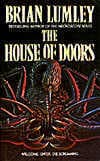
Synopsis
Covers the whole plot, including the ending.
- Difficulty
- Hard
- Pacing
- Fast
- Mood
- Terrifying, Desperate, Psychological, Intense, Cosmic Horror
- Read it if
- You enjoy cosmic horror, psychological thrillers, and survival stories with high stakes and a strong focus on confronting inner demons.
- Skip it if
- You dislike intense psychological horror, body horror, or stories where characters face constant, overwhelming threats.
The House of Doors Plot Summary
Covers the whole plot, including the ending.
The Thone's Ultimatum
The alien Thone, a technologically advanced and ruthless race, arrive on Earth planning conquest. Instead of immediate destruction, they give humanity an ultimatum. They reveal a giant, mysterious structure called the House of Doors, a labyrinth that can create the deepest fears and subconscious realities of those trapped inside. The Thone state that if a chosen group of humans can survive this 'test,' they will leave Earth. Failure means complete subjugation and likely annihilation of humankind. This chilling offer sets the stage for the desperate struggle, as the chosen occupants are forced into the alien device.
Initial Ingress and Disorientation
A diverse group of individuals, including scientists, military personnel, spies, and civilians, are abducted and find themselves confused within the House of Doors. The environment is immediately hostile and surreal, ignoring normal physics and logic. Initial attempts to communicate and understand are hindered by the strange surroundings and the psychological shock. They quickly realize the House is not static but a dynamic, changing entity that seems to respond to their thoughts and emotions. Panic and confusion are widespread as the group tries to understand the rules of their new prison and the true nature of the Thone's 'test.'
The Manifestation of Fears
As the group explores, they encounter the House's most dangerous feature: its ability to materialize their subconscious fears. One character might face a childhood monster, another a traumatic memory made real, and another a physical form of their professional failures. These manifestations are not illusions but real threats, capable of causing harm or death. The psychological toll is immense, forcing each person to confront their inner demons. This aspect of the House shows the Thone's deep understanding of human psychology, turning the test into a personal and often agonizing experience for each captive.
Forming Alliances and Factions
The extreme pressure of the House of Doors quickly divides the captive group. Some individuals, driven by training or natural leadership, try to organize and strategize, seeking common ground and safety in numbers. Others, giving in to fear and paranoia, become isolated or hostile, seeing fellow captives as rivals or threats. Scientists try to apply logic to the illogical, while military personnel try to impose order on chaos. These new alliances and factions are constantly tested by the House's psychological attacks and physical dangers, showing how fragile human cooperation is under stress and how different people cope.
Encounters with Alien Worlds
Beyond personal fears, the House of Doors also puts its captives in truly alien environments. They might pass through a 'door' and find themselves on a planet with multiple suns, in a gravity-defying city, or among plants and animals unlike anything on Earth. These shifts are disorienting and dangerous, forcing the group to adapt to vastly different physical laws and biological threats. These alien worlds are not just backdrops; they often present unique challenges, puzzles, or new predatory life, pushing the captives' physical and mental limits and showing the vast, unknown power of the Thone.
The Nature of the Thone's Test
As the ordeal continues, some of the more analytical minds among the captives, especially the scientists, start to understand the true nature of the Thone's 'test.' They believe the House is not just a torture chamber but a complex psychological and evolutionary crucible. The Thone are testing not just survival skills, but humanity's ability to adapt, endure, discover itself, and perhaps its collective will to overcome internal and external threats. This growing understanding, while terrifying, also provides a sense of purpose and direction, shifting the focus from mere escape to actively 'passing' the Thone's unique examination of the human spirit.
Sacrifice and Redemption
The constant pressures of the House lead to moments of sacrifice and difficult choices. Some characters, initially selfish, find redemption by prioritizing the group's survival over their own. Others, overwhelmed by the horrors, go mad or despair, becoming casualties of the House's psychological warfare. These acts of heroism and tragic losses strengthen bonds among the survivors and highlight individual struggles within the group ordeal. Each sacrifice, intentional or not, contributes to the group's slow, painful progress, showing the depths of human courage and vulnerability.
Unraveling the House's Logic
Through observation, experimentation, and intellect, some captives, often scientists or those with sharp analytical minds, begin to find patterns and 'rules' in the House's seemingly chaotic nature. They realize that fear manifestations are not random but often triggered by specific thoughts, emotions, or environmental cues. They start to experiment with mental discipline, group focus, and even manipulating their own subconscious to influence the House's behavior, hoping to navigate its complexities more effectively. This intellectual breakthrough offers a vital, though precarious, advantage against the House's overwhelming power.
The Collective Confrontation
A key realization dawns on the remaining captives: individual survival in the House is tied to a group effort. They understand that beating their 'inner demons' is not just about personal psychological battles, but about building mutual support, empathy, and shared purpose. The House seems to react differently to a united front, sometimes even weakening manifestations when faced with strong solidarity. This shift from individual struggle to a more communal approach marks a significant turning point, showing humanity's capacity for collective resilience and for overcoming internal divisions to face an external threat.
The Final Challenge
As the group shrinks and their understanding of the House grows, they approach what seems to be the final, most difficult challenge. This might involve a concentrated manifestation of their combined fears, a complex puzzle requiring all their knowledge, or a direct confrontation with a 'core' mechanism of the House itself. This climax tests every lesson learned, every bond formed, and every sacrifice made. It requires not just individual courage, but perfect coordination and unwavering belief in their collective ability to succeed. Earth's fate rests on this ultimate display of humanity's resilience and self-mastery.
Victory or Annihilation
After a difficult and terrifying struggle, the surviving captives either succeed or fail in their final challenge. If they succeed, the House of Doors begins to disappear or retract, and the Thone, keeping their word, start to withdraw from Earth, leaving humanity to rebuild and reflect on its ordeal. If they fail, the Thone's promise of withdrawal is broken, and the grim reality of Earth's conquest and likely extinction of humanity becomes real. The ending confirms the ultimate outcome of their journey, whether it is hard-won freedom or the tragic fulfillment of the alien invaders' initial threat.
The House of Doors Characters
Dr. Aris Thorne
Protagonist
A brilliant but cynical astrophysicist, initially focused on scientific understanding.
Dr. Aris Thorne is a leading astrophysicist, known for his sharp intellect and often detached, analytical approach to problems. Initially, he views the House of Doors as a scientific anomaly to be studied, rather than a personal threat. His cynicism stems from a lifetime of observing humanity's flaws, but deep down, he possesses a strong moral compass. He struggles with the irrationality of the House, constantly seeking logical explanations for its surreal horrors. His drive is to understand the Thone's technology and purpose, believing knowledge is the key to survival.
Relationships: Commander Eva Rostova (initial professional rivalry, evolving into mutual respect and strategic partnership); Various captives (scientific collaborator and reluctant leader)
Commander Eva Rostova
Supporting
A seasoned military leader, pragmatic and fiercely protective of her team.
Commander Eva Rostova is a highly trained military officer, accustomed to making tough decisions under pressure. Her primary drive is the survival of her people and the mission to save Earth. She is pragmatic, disciplined, and initially distrustful of the House's psychological nature, preferring direct action. Rostova struggles with the emotional and illogical threats presented by the House, which defy her combat training. She often clashes with Thorne over strategies, valuing immediate safety over abstract understanding, but her leadership provides crucial stability to the group.
Relationships: Dr. Aris Thorne (initial professional rivalry, evolving into mutual respect and strategic partnership); Various soldiers (leader and protector)
Sergeant Rex 'Bulldog' Miller
Supporting
A gruff, loyal soldier whose strength and courage are tested to their limits.
Sergeant Rex Miller, known as 'Bulldog,' is a career soldier, physically imposing and fiercely loyal. His strength and combat experience are invaluable in the early, more overtly dangerous sections of the House. However, his greatest challenge comes from the House's psychological attacks, which target his buried fears and past traumas, particularly those related to combat. He struggles to reconcile his image as a hardened warrior with the vulnerability the House forces upon him. His drive is to protect his comrades and prove his worth, even when facing internal demons.
Relationships: Commander Eva Rostova (subordinate and trusted soldier); Other captives (protector and occasional comic relief)
Dr. Lena Petrova
Supporting
A gentle psychologist whose empathy becomes a vital tool against the House.
Dr. Lena Petrova is a psychologist, initially overwhelmed by the horrors of the House. Her gentle nature and focus on human connection make her seem ill-suited for the brutal environment. However, her deep understanding of the human mind, particularly fear and trauma, proves to be an unexpected asset. She acts as a confidante and emotional anchor for many, helping them process the psychological attacks. Her drive is to heal and understand, and she works to help others navigate their internal landscapes, often providing insights that the more scientifically or militarily minded individuals miss.
Relationships: Dr. Aris Thorne (intellectual collaborator, offering psychological perspective); Various captives (therapist and emotional support)
The Thone (Collective)
Antagonist
The enigmatic alien race that created the House of Doors to test humanity.
The Thone are a highly advanced alien civilization, the architects of the House of Doors. Their true appearance and motivations remain largely shrouded in mystery, adding to their menacing aura. They are presented as utterly rational and devoid of human-like emotion, viewing humanity as either a potential threat or a resource to be exploited. Their 'test' is not born of cruelty for its own sake, but rather a cold, calculated assessment of humanity's worthiness to exist independently. Their drive is to expand their empire efficiently and logically, and the House is a tool in that grand strategy.
Relationships: Humanity (judges and potential conquerors)
The House of Doors
Antagonist
A sentient, reality-bending labyrinth designed to manifest fears and alien worlds.
The House of Doors is more than just a location; it functions as a primary antagonist. It is a vast, alien construct, seemingly sentient and capable of manipulating reality, space, and time within its confines. It manifests the deepest fears of its captives, conjures terrifying monsters, and transports them to bizarre alien landscapes. Its drive is to fulfill its programming: to test and break its inhabitants, pushing them to their absolute psychological and physical limits. It has no discernible 'personality' but operates with an insidious, adaptive intelligence that constantly seeks to exploit weaknesses.
Relationships: Captives (Humanity) (prison, test, and tormentor)
Mr. Chen
Supporting
A quiet, unassuming historian whose knowledge of ancient myths proves surprisingly useful.
Mr. Chen is an elderly historian, seemingly out of place among the scientists and soldiers. Initially, he appears frail and vulnerable. However, his vast knowledge of ancient myths, folklore, and human psychology, particularly regarding archetypal fears and heroic narratives, proves to be an unexpected asset. He often provides profound insights into the nature of the monsters and challenges, suggesting that humanity has faced similar 'demons' throughout history. His drive is to observe, understand, and quietly guide, offering a different kind of wisdom than the scientific or military approaches.
Relationships: Dr. Aris Thorne (unlikely intellectual partner, offering complementary perspectives); Dr. Lena Petrova (shared interest in human psychology and narrative)
Captain Anya Sharma
Supporting
A skilled pilot and engineer, focused on practical solutions and survival.
Captain Anya Sharma is a highly capable pilot and engineer, pragmatic and resourceful. She is driven by a desire to find practical, mechanical solutions to the problems presented by the House, often attempting to reverse-engineer or understand its physical mechanisms. Her technical skills are invaluable for navigating certain environmental hazards or deciphering alien technology within the House. She struggles with the House's more abstract, psychological threats, finding them frustratingly illogical. Her focus is always on the 'how' and 'what can we do now' of survival.
Relationships: Commander Eva Rostova (fellow military professional); Dr. Aris Thorne (collaborator on technical analysis of the House)
The House of Doors Themes
The Nature of Fear and the Subconscious
The House of Doors makes the deepest, most primal fears of its captives real, turning internal struggle into an external reality. This theme explores how fear can paralyze, change, and eventually be overcome. Characters must confront childhood traumas, professional failures, and existential dread in tangible forms, highlighting the psychological weight of their pasts. The story suggests that true victory is not just physical survival, but mastering one's mind and facing 'inner demons.' For example, a soldier might face a monstrous form of a past battlefield trauma, while a scientist might encounter a manifestation of their greatest intellectual failure, forcing them to accept these parts of themselves. This theme is central to the Thone's 'test,' as they are evaluating humanity's capacity for self-mastery.
“The greatest prison is not the walls that surround you, but the fears you carry within.”
Humanity's Resilience and Adaptability
Despite overwhelming odds and an alien environment designed to break them, the human captives show an amazing capacity for resilience. This theme highlights humanity's ability to adapt to impossible situations, both mentally and physically. It shows how people can find strength in unexpected places, learn from mistakes, and innovate under extreme pressure. The diverse skills of the group—scientific, military, psychological—initially seem separate but eventually come together as they learn to collaborate and use each other's strengths. This adaptability is exactly what the Thone are testing, looking for a species capable of evolving beyond its current limits.
“They built a cage of our nightmares, but forgot that a cornered animal fights with the fury of a god.”
The Importance of Cooperation and Unity
Initially, the captives are a diverse group, often driven by individual survival instincts or internal conflicts. However, the constant pressure of the House forces them to realize that their only hope is cooperation and unity. This theme explores how collective action, empathy, and mutual support are essential for overcoming seemingly impossible challenges. Characters must overcome personal biases, distrust, and internal divisions to work together, combining their knowledge and strengths. The House often punishes individualistic behavior, subtly guiding them toward a collective consciousness. This unity becomes a powerful weapon against the House's divisive tactics, showing that humanity's greatest strength is its ability to connect and support one another.
“Alone, we are echoes in a vast, empty hall. Together, we are a choir that can shatter the silence.”
The Ethics of Intervention and Judgment
The Thone's 'test' raises deep ethical questions about one species' right to judge and interfere with another's fate. This theme explores the morality of the Thone's actions, their cold, rational assessment of humanity, and whether their methods are justified, regardless of their ultimate goal. It also forces the human characters to reflect on their own species' worth. Are humanity's flaws too great to warrant independent existence, or does its capacity for growth, empathy, and resilience outweigh its destructive tendencies? The Thone represent an alien, utilitarian ethics, forcing humanity to confront its own values and justify its place in the cosmos.
“They judge us, but by what right? By what measure do they deem themselves superior arbiters of life?”
Plot Devices & Literary Techniques
The Sentient Labyrinth (The House of Doors)
A dynamically changing, reality-bending structure that adapts to its occupants.
The House of Doors is not a static setting but a central plot device. Its ability to shift its layout, manifest fears, and transport occupants to alien realities drives the narrative forward by constantly introducing new challenges and psychological pressures. It functions as a character in itself, an intelligent antagonist that learns and adapts to the captives' strategies, ensuring that no two encounters are ever quite the same. This constant unpredictability prevents complacency and forces characters to remain on edge, highlighting the Thone's advanced understanding of psychology and environmental manipulation.
Psychological Manifestation
The literal externalization of characters' inner fears and traumas.
This device is crucial to the plot, turning internal struggles into physical, tangible threats. Instead of merely dealing with abstract fear, characters must battle monstrous embodiments of their personal anxieties, past failures, or deepest regrets. This forces immediate, visceral confrontation with their inner demons, accelerating character development and revealing their hidden strengths and weaknesses. It also serves as the Thone's primary method of 'testing,' as the ability to overcome these manifestations signifies psychological resilience and self-mastery, which are key to their survival and the success of humanity's trial.
The Ultimatum/The Test
A clear, high-stakes challenge with binary outcomes for humanity's survival.
The Thone's ultimatum provides the overarching narrative drive and raises the stakes to an existential level. The entire plot revolves around the success or failure of the captives in the House of Doors, directly tying their individual struggles to the fate of the entire planet. This device creates immense pressure and a constant sense of urgency, ensuring that every decision and every survival attempt carries profound consequences. It also sets up a clear goal for the characters, even amidst the chaos, providing a framework for their efforts and a definitive measure of their progress.
Diverse Skill Set Ensemble
A group of captives with varied backgrounds and expertise.
The deliberate assembly of scientists, military personnel, psychologists, and civilians is a key plot device. It ensures that the group possesses a wide range of skills necessary to tackle the multi-faceted challenges of the House: scientific analysis for understanding its mechanisms, military prowess for direct threats, psychological insight for internal struggles, and even historical knowledge for interpreting archetypal fears. This diversity fosters both conflict and collaboration, demonstrating how different perspectives and abilities are crucial for holistic problem-solving in an alien, unpredictable environment.
The House of Doors Quotes
“The wind was a living thing, a hungry beast howling around the House of Doors, trying to pry its secrets open.”
“There are more ways than one to open a door, and some of them don't involve a key.”
“Fear is a powerful motivator, but it's a poor guide.”
“The universe is far vaster and stranger than any mortal mind can truly comprehend.”
“Some truths are best left undisturbed, for their awakening brings only madness.”
“Every door leads somewhere, but not every somewhere is a place you want to be.”
“The shadows here were not merely an absence of light; they were a presence, watchful and ancient.”
“What is real, and what is merely a reflection in the mirror of a mad god's dream?”
“There are echoes of old worlds here, whispering secrets to those who dare to listen.”
“The very air thrummed with forgotten power, a silent song only the truly sensitive could hear.”
“Courage isn't the absence of fear, but the will to act in spite of it.”
“Some paths, once trod, can never be untrod. The footprints remain, for good or ill.”
“The House of Doors doesn't merely contain worlds; it *is* a world, a nexus of infinite possibilities and horrors.”
Quiz
10 questions on the plot and the characters. Each answer comes with a short explanation.
Question 1
What is the primary objective of the Thone in planting the 'House of Doors' device on Earth?
- To study human psychology and fear responses.
- To test humanity's will to survive and potentially withdraw from Earth.
- To harvest human energy for their intergalactic travels.
- To eradicate all life on Earth through a slow, torturous process.
Show answer
B. To test humanity's will to survive and potentially withdraw from Earth. The House of Doors is presented as a test. If its captives survive, the Thone will withdraw from Earth and leave humanity in peace.
Question 2
What kind of entities or challenges do the prisoners primarily face within the House of Doors?
- Technological traps and advanced alien weaponry.
- Monsters and alien worlds ripped from their own subconscious fears.
- Other human prisoners who have turned hostile.
- Environmental hazards like extreme temperatures and lack of oxygen.
Show answer
B. Monsters and alien worlds ripped from their own subconscious fears. The description explicitly states that 'at every turn of the labyrinth the prisoners encounter alien world and terrifying monsters ripped from their own subconscious fears.'
Question 3
What is the ultimate condition for the Thone to leave Earth in peace?
- The captives must successfully map the entire labyrinth.
- A specific number of captives must survive the House of Doors.
- The captives must learn to communicate with the Thone.
- The captives must destroy the House of Doors from within.
Show answer
B. A specific number of captives must survive the House of Doors. The premise states: 'If its captives survive, the Thone will withdraw from Earth and leave us in peace.' The implication is that survival itself, rather than a specific action beyond enduring, is the key.
Question 4
The House of Doors is described as a 'test.' What core human attribute is this test designed to evaluate?
- Physical strength and endurance.
- Technological ingenuity and problem-solving skills.
- The ability to overcome internal fears and psychological demons.
- The capacity for collective action and leadership.
Show answer
C. The ability to overcome internal fears and psychological demons. The summary states: 'Only by defeating the demons within can these men and women escape the House of Doors and save the Earth,' directly linking survival to overcoming internal fears.
Question 5
Beyond being a 'maze,' what other functions or characteristics are attributed to the House of Doors?
- A communication hub and a historical archive.
- A torture chamber and a laboratory.
- A sanctuary and a training ground.
- A living organism and a power generator.
Show answer
B. A torture chamber and a laboratory. The description explicitly calls it 'Part maze, part torture chamber, part laboratory,' highlighting its multi-faceted, sinister nature.
Question 6
The captives inside the House of Doors are a diverse group. Which of the following professions/roles are mentioned as being among them?
- Soldiers, engineers, and artists.
- Scientists, spies, and innocent bystanders.
- Politicians, philosophers, and religious leaders.
- Farmers, doctors, and teachers.
Show answer
B. Scientists, spies, and innocent bystanders. The summary states: 'Trapped inside is a group of scientists, spies, and innocent bystanders,' indicating a mix of specialized individuals and ordinary people.
Question 7
What is the broader consequence for Earth if the captives fail to survive the House of Doors?
- Earth will be annexed by another alien race.
- The Thone will proceed with their plan to take over Earth.
- The House of Doors will expand to cover the entire planet.
- Humanity will be enslaved and forced to build more such devices.
Show answer
B. The Thone will proceed with their plan to take over Earth. The initial premise is that the Thone are 'Bent on taking over the Earth' and the test is a condition for them to 'withdraw.' Failure implies they will continue with their original invasion plan.
Question 8
The phrase 'defeating the demons within' is crucial to the prisoners' escape. What does this imply about the nature of the challenges in the House of Doors?
- The challenges are primarily psychological and require self-reflection.
- The challenges are literal demonic entities that must be exorcised.
- The challenges are internal conflicts among the prisoners themselves.
- The challenges are puzzles that require spiritual enlightenment to solve.
Show answer
A. The challenges are primarily psychological and require self-reflection. The 'demons within' directly relates to the 'terrifying monsters ripped from their own subconscious fears,' indicating a battle against their own internal struggles and psychological vulnerabilities.
Question 9
Given the description, what is the most likely reason the Thone designed the House of Doors to manifest 'monsters ripped from their own subconscious fears'?
- To gather data on human phobias for future weapons development.
- To identify individuals with strong mental fortitude capable of resisting alien influence.
- To provide a form of entertainment for the Thone observing the test.
- To intentionally drive the captives to insanity and despair.
Show answer
B. To identify individuals with strong mental fortitude capable of resisting alien influence. If the test is for humanity to prove its worth to avoid takeover, then overcoming deeply personal, psychological fears demonstrates a profound inner strength and resilience, which would be a key metric for the Thone to evaluate.
Question 10
The House of Doors is described as being 'part maze.' What does this characteristic primarily imply about the captives' experience?
- They will face a series of complex logical puzzles to progress.
- They will constantly be disoriented, lost, and searching for an exit.
- They will need to uncover hidden pathways and secret passages.
- They will encounter other prisoners around every corner.
Show answer
B. They will constantly be disoriented, lost, and searching for an exit. The core function of a maze is to disorient and challenge navigation, forcing participants to get lost and seek a way out, adding to the psychological pressure and difficulty of the survival test.
The House of Doors FAQ
What is the central premise of 'The House of Doors'?
The central premise involves the alien Thone planting a monstrous device, the House of Doors, on Earth. Inside, a diverse group of humans is trapped and forced to navigate a deadly labyrinth that manifests their deepest subconscious fears as tangible monsters and alien worlds. Their survival is Earth's only hope, as the Thone promise to withdraw if they succeed.
Who are the Thone, and what is their motivation for creating the House of Doors?
The Thone are a technologically advanced alien race bent on conquering Earth. They created the House of Doors not as a simple act of mercy, but as a test of humanity's collective strength and psychological resilience. They seek to understand if humanity is worthy of survival or if Earth is ripe for their takeover, making the test a strategic assessment rather than a benevolent gesture.
What kind of challenges do the captives face within the House of Doors?
The captives face a relentless series of challenges within the House of Doors, primarily encountering alien worlds and terrifying monsters that are direct manifestations of their own subconscious fears and anxieties. Beyond physical threats, they must also grapple with psychological torment, internal conflict, and the breakdown of trust among themselves, making the labyrinth a test of both body and mind.
Is the House of Doors a literal structure or something more abstract?
The House of Doors is presented as a literal, monstrous device planted on Earth's surface, acting as a physical labyrinth. However, its internal mechanics are highly abstract, manipulating perceptions and manifesting psychic energy into tangible realities. It functions as part maze, part torture chamber, and part laboratory, blurring the lines between physical confinement and psychological manipulation.
What is the ultimate consequence if the captives fail to survive the House of Doors?
If the captives fail to survive the House of Doors, the Thone will proceed with their invasion and takeover of Earth. Their failure would signify humanity's unworthiness in the eyes of the Thone, leading to the eradication or subjugation of the entire planet. The survival of this small group is therefore directly linked to the fate of all humanity.
How do the specific fears of individual characters manifest within the House of Doors?
The House of Doors meticulously crafts challenges based on each character's deepest fears. For instance, a scientist with a fear of isolation might find themselves in an endless, barren void, while a spy haunted by past failures could face monstrous versions of their betrayals. These manifestations are not generic but are tailored, often leading to deeply personal and terrifying encounters.
Are there any hidden connections between the different alien worlds encountered in the labyrinth?
While appearing disparate, the alien worlds encountered within the labyrinth are subtly interconnected by the underlying psychic energy of the captives and the Thone's design. They often serve as thematic bridges between different characters' fears, or sometimes, elements from one 'world' might subtly reappear in another, hinting at the Thone's overarching manipulation and the shared human subconscious.
Does the 'House of Doors' itself have a sentience or guiding intelligence beyond the Thone?
The House of Doors functions with a sophisticated, almost sentient intelligence, though it is ultimately a construct of the Thone. It can adapt, learn from its captives, and tailor its challenges with an eerie precision that suggests a guiding consciousness. While not truly alive in a biological sense, its operational autonomy makes it seem like a malevolent entity in its own right, beyond mere programming.
How do the Thone monitor and analyze the captives' progress and psychological states?
The Thone employ advanced technology embedded within the House of Doors to meticulously monitor every aspect of the captives' progress. They analyze physiological responses, observe behavioral patterns, and likely even tap into their psychic emanations to gauge psychological states and fears. This constant surveillance allows them to refine the test and gather comprehensive data on human resilience.
How does the extreme stress of the House of Doors impact the characters' decision-making and morality?
The extreme stress within the House of Doors profoundly erodes the characters' decision-making and moral compass. Under constant threat, some characters prioritize self-preservation, leading to betrayal and conflict, while others find unexpected reserves of courage and altruism. The pressure strips away societal veneers, revealing their true nature and often forcing impossible moral choices.
What psychological strategies do the characters employ to cope with their fears and the alien environments?
Characters employ various psychological strategies, from denial and repression to direct confrontation and rationalization. Some attempt to use their scientific or espionage training to analyze and overcome the threats, while others rely on sheer willpower, group cohesion, or even a descent into madness. The most successful strategies often involve confronting their internal demons head-on.
How does the 'group dynamic' among the diverse captives evolve under duress?
The group dynamic among the diverse captives undergoes significant evolution. Initially, there's often suspicion and conflict due to their varied backgrounds and agendas. As the trials intensify, some bonds of trust and cooperation form out of necessity, while other relationships fray or break down completely. The House of Doors acts as a crucible, forging some into a cohesive unit and breaking others apart.
In what ways do the characters' past traumas or unresolved issues resurface and become obstacles?
Characters' past traumas and unresolved issues resurface as direct and often monstrous obstacles within the House of Doors. A soldier's PTSD might manifest as an unstoppable enemy from a past battle, or a scientist's guilt over a failed experiment could become a terrifying, self-replicating entity. These internal conflicts are externalized, forcing characters to confront their inner demons to progress.
Is the Thone's 'test' truly fair, or is it designed for humanity to fail?
The fairness of the Thone's 'test' is highly debatable. While they offer a chance for survival, the design of the House of Doors, which exploits humanity's deepest fears and psychological vulnerabilities, suggests it's heavily rigged. It could be argued it's designed to push humanity to its absolute breaking point, making success an improbable, almost miraculous, outcome, rather than a truly equitable challenge.
What philosophical statement does the book make about the nature of fear and courage?
The book makes a profound philosophical statement about fear and courage, asserting that true courage isn't the absence of fear, but the willingness to confront it, especially when it stems from within. It suggests that our greatest monsters are often internal and that by understanding and overcoming our psychological demons, we unlock our true potential and ability to survive external threats.
Could the House of Doors be interpreted as a metaphor for humanity's collective subconscious?
Yes, the House of Doors can strongly be interpreted as a metaphor for humanity's collective subconscious, a dark repository of shared fears, anxieties, and hidden potential. The way it pulls from individual minds to create universal horrors suggests it's tapping into a deeper, shared psychological landscape, making the test not just about individual survival but about humanity's collective soul.
Does the book offer any hope for true understanding or peaceful coexistence with the Thone?
The book offers very little hope for true understanding or peaceful coexistence with the Thone. Their actions are driven by a cold, calculating desire for conquest, and the 'test' itself is a demonstration of their power and lack of empathy. While they promise to withdraw if successful, it's a conditional peace, not one built on mutual respect or understanding, leaving humanity in a vulnerable position.
What is the significance of the 'doors' in the title beyond their literal function?
Beyond their literal function as passageways in the labyrinth, the 'doors' in the title carry significant metaphorical weight. They represent choices, opportunities, and thresholds into new realities or psychological states. Each 'door' can lead to a deeper confrontation with self, a new level of terror, or potentially, a path to liberation, symbolizing the constant psychological and physical choices the characters face.
About the author

Brian Lumley is a prolific British author celebrated for his contributions to horror and dark fantasy fiction. He is best known for his 'Titus Crow' series and the standalone novel 'The House of Doors.' Lumley's work often explores cosmic horror and the supernatural, drawing inspiration from H.P. Lovecraft while forging his own distinct narrative voice.
Similar books
- Sphere
Michael Crichton
3.8 (167k) average on GoodreadsThrillerGroup of scientists in an enclosed, dangerous environment facing psychological and physical threats.
- Hyperion
Dan Simmons
4.2 (188k) average on GoodreadsFantasy"The House of Doors" shares with "Hyperion" a multi-protagonist structure facing an enigmatic, god-like entity and a series of perilous, often mind-bending challenges. However, Simmons' novel offers a more deeply interwoven character backstories and philosophical explorations, giving each pilgrim's tale a profound emotional weight that Lumley's narrative, while action-packed, sometimes lacks. Lumley prioritizes immediate survival and the visceral horror of the House, whereas Simmons builds a richer tapestry of individual and collective human experience against a cosmic backdrop.
- Annihilation
Jeff VanderMeer
4.0 (5k) average on GoodreadsFantasyBoth "The House of Doors" and "Annihilation" feature a group of characters entering a bizarre, transforming environment that actively challenges their perceptions and sanity. VanderMeer's novel, however, excels in its minimalist, atmospheric horror and unreliable narration, focusing more on the psychological breakdown and the alienness of the environment itself as a character. Lumley's approach is more direct and action-oriented, with clearly defined external threats and a greater emphasis on the 'game' aspect of the Thone's test, making it less ambiguous but also less subtly unsettling than VanderMeer's 'Area X'.
- Harry Potter and the Sorcerer's Stone
J.K. Rowling
4.5 (7M) average on GoodreadsFantasyRescued from a miserable life under the stairs, an orphaned boy discovers he's a wizard destined for a magical school, where he uncovers a dangerous secret tied to the dark wizard who murdered his parents.
- The Hunger Games
Suzanne Collins
4.3 (6.4M) average on GoodreadsFantasyIn a future where children fight to the death on live television, Katniss Everdeen volunteers for the arena, turning a death sentence into a fight for survival and a spark of rebellion.
- 1984
George Orwell
4.2 (3.1M) average on GoodreadsPoliticsIn a future where surveillance and thought control are absolute, a man's search for truth clashes with the Party, showing that hope can be a form of rebellion.



Enjoyed the summary?
A summary gives you the shape of the book. The book itself has the detail, the examples and the voice.
Find The House of Doors on AmazonAs an Amazon Associate, BookBrief earns from qualifying purchases. How we're funded