
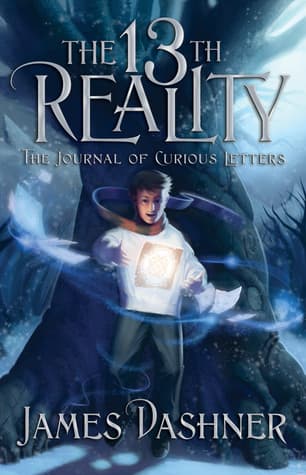
Synopsis
Covers the whole plot, including the ending.
- Difficulty
- Medium
- Pacing
- Fast
- Mood
- Adventurous, Mysterious, Suspenseful, Imaginative
- Read it if
- You enjoy fast-paced YA fantasy/sci-fi with riddles, alternate realities, and a group of young heroes.
- Skip it if
- You prefer standalone novels or stories without cliffhangers.
The Journal of Curious Letters Plot Summary
Covers the whole plot, including the ending.
The Mysterious Letter
Thirteen-year-old Atticus 'Tick' Higginbottom, an ordinary boy in Ohio, gets an unusual letter from Alaska. The letter, signed 'M.G.', warns Tick that "very frightening things are coming his way" and that reality is in danger. It promises twelve riddles that, if solved, will lead him to an extraordinary event. Tick first thinks it's a prank, but the letter's unsettling tone and specific details make him curious. His best friend, Paul, is doubtful, while his other friend, Sofia, is interested, suggesting they try to solve the first riddle. This first message puts Tick on an unexpected path, hinting at a world far more complex and dangerous than he imagined.
The First Riddle and the Library
Tick, Paul, and Sofia decide to solve the first riddle, which leads them to the local library. Following the clues, they find a hidden compartment in an old book. Inside, they find another cryptic message and a small, carved wooden box. This first success confirms the letters' truth and deepens their involvement. The library, a seemingly normal place, becomes their first connection to the larger mystery M.G. is creating. Their teamwork and combined intelligence are tested as they learn to solve the unusual clues, marking the true start of their adventure beyond their ordinary lives.
The Introduction of the Reality
As more riddles arrive, M.G.'s letters slowly explain the idea of 'Realities' – alternate dimensions created every time an important choice is made. Tick learns that these Realities are connected and that a serious threat is coming, possibly destroying them. This revelation changes their mission from a simple treasure hunt to a quest of cosmic importance. The letters explain that there are endless Realities, and Tick, along with a few others, has a special role in them. This information is overwhelming, forcing Tick to rethink everything he knew about existence and his place in it, giving him a sense of responsibility he never expected.
The Arrival of Master George
The riddles eventually lead Tick to a secluded, strange house where he finally meets M.G., who is Master George. Master George is an eccentric, wise, and somewhat mysterious old man who knows a lot about the Realities. He confirms the warnings in his letters and explains that Tick, Paul, and Sofia were chosen because of their unique qualities and a specific link to the unfolding crisis. Master George becomes their mentor, giving more explanations about the Realities, the coming danger, and the important role they must play to prevent a disaster. His appearance confirms the story's fantastical elements.
The Quest for the Keystone
Master George reveals that saving the Realities depends on finding a powerful artifact called the Keystone. He explains that the Keystone can stabilize the Realities and prevent their collapse, but its location is hidden across different dimensions. The children get a special device, a 'Reality Map,' which lets them see and potentially travel between these alternate dimensions. This new mission gives them a clear goal and raises the stakes significantly. The search for the Keystone becomes the main objective, requiring them to use their problem-solving skills and courage in ways they never imagined as they prepare for interdimensional travel.
First Forays into Alternate Realities
Guided by Master George and using the Reality Map, Tick, Paul, and Sofia make their first trip into an alternate reality. This new dimension is subtly different from their own, showing the endless variations that can come from a single choice. Their first experiences are confusing but exciting, as they encounter versions of familiar places and even people, but with changed circumstances. These early travels are mainly for training, helping them understand how to travel between Realities and the deep meaning of their mission. They learn to adapt quickly to new places and trust their instincts in unfamiliar territory.
Encountering the Naysayers
During their travels, Tick and his friends meet the main villains: the Naysayers. These shadowy, evil beings want to destroy all Realities, believing that chaos is natural. The Naysayers are strong and can control certain aspects of the Realities. Their presence creates a real threat, forcing the children to face actual danger and to create plans for escape and defense. The Naysayers' pursuit makes their search for the Keystone more urgent, making it clear that failure is not an option and their lives are truly at risk.
The Journal of Curious Letters
Master George gives Tick a special journal, which Tick names 'The Journal of Curious Letters.' This journal is not just for recording his adventures; it has unique properties, subtly interacting with the Realities and sometimes revealing hidden clues or insights. Tick uses it to write down their discoveries, the riddles, and his thoughts on the extraordinary events happening around him. The journal helps tell the story, showing glimpses of Tick's struggles and growth, while also being a key artifact in the story, possibly holding its own secrets that will be revealed later. It becomes a tangible link to his journey.
Uncovering a Traitor
As the quest continues, subtle clues and inconsistencies make Tick and his friends suspect a traitor is working against them from within Master George's seemingly loyal group. This realization adds paranoia and distrust to their already dangerous mission. They must now deal with the external threat of the Naysayers and carefully evaluate those they thought were allies. The chance of betrayal makes their reliance on each other even more important, forcing them to be more observant and cautious about whom they trust, complicating their search for the Keystone significantly.
A Close Call and a Revelation
During a particularly dangerous mission in a unstable reality, Tick and his friends have a close call with the Naysayers, barely escaping. This traumatic experience strengthens their resolve but also shows the immense power of their enemies. Afterward, they uncover an important piece of information about the Keystone: it's not a single, fixed object, but a dynamic entity that responds to the choices and intentions of those who seek it. This revelation changes their approach, suggesting that the Keystone might require more than just physical retrieval, perhaps a deeper understanding of choice and consequence itself.
The Twelve Riddles Solved
After many challenges and interdimensional travels, Tick, Paul, and Sofia finally solve the twelfth and final riddle. Their combined efforts point them to a specific location within a previously unexplored Reality, hinting that the Keystone is nearby. Solving the riddles is a major milestone in their journey, showing their intelligence, persistence, and growing bond. They are now at the point of their ultimate goal, ready to face whatever comes next in their quest to secure the Keystone and protect the Realities from destruction, but the true test still awaits them.
The Confrontation and the Cliffhanger
The final chapter shows Tick, Paul, and Sofia arriving at the location from the last riddle, only to face the Naysayers directly. A fierce battle begins as both sides fight for control of the Keystone. The children, using everything they've learned, fight bravely, but the Naysayers are strong opponents. The book ends with a gripping cliffhanger, with the Keystone's fate, and the fate of all Realities, hanging in the balance. The immediate future of Tick and his friends is uncertain, leaving the reader eager for the next book to find out how this epic struggle ends.
Principal Figures
Atticus 'Tick' Higginbottom
Protagonist
An ordinary boy chosen to save the Realities.
Tick is a thirteen-year-old boy from Ohio who initially perceives himself as unremarkable. He is intelligent, curious, and possesses a strong moral compass. Though initially overwhelmed by the extraordinary events, he demonstrates remarkable courage and adaptability. His journey forces him to confront his perceived ordinariness and embrace his unique role. He is driven by a sense of responsibility and a growing desire to protect his friends and the countless Realities.
Relationships: Paul (Best friend and loyal companion); Sofia (Close friend and intellectual partner); Master George (Mentor and guide)
Paul
Supporting
Tick's pragmatic and loyal best friend.
Paul is Tick's best friend, known for his skepticism and grounded nature. He often provides a dose of reality and humor, questioning the fantastical elements but ultimately remaining fiercely loyal to Tick. Despite his initial doubts, Paul proves to be resourceful and brave, using his practical mindset to help solve riddles and navigate dangerous situations. He is a steadfast companion, offering emotional support and a sense of normalcy amidst the chaos of interdimensional travel.
Relationships: Atticus 'Tick' Higginbottom (Best friend); Sofia (Friend and fellow adventurer)
Sofia
Supporting
Tick's intelligent and intuitive friend.
Sofia is Tick's other close friend, characterized by her sharp intellect, intuition, and analytical skills. She is often the first to grasp complex riddles and contributes significantly to their problem-solving efforts. Sofia is more open to the fantastical elements of their journey than Paul, approaching the mysteries with an eager and insightful mind. Her intelligence and calm demeanor are invaluable to the group, especially in deciphering the cryptic clues left by Master George. She represents the intellectual curiosity and quick thinking necessary for their quest.
Relationships: Atticus 'Tick' Higginbottom (Close friend); Paul (Friend and fellow adventurer)
Master George (M.G.)
Supporting
The eccentric mentor who orchestrates Tick's journey.
Master George, initially known as M.G., is the enigmatic figure who sends the letters to Tick. He is a wise, eccentric, and powerful individual with deep knowledge of the Realities. He acts as Tick's mentor, guiding him and his friends through the complexities of their mission. Master George is manipulative in a benevolent way, setting up challenges to prepare the children for their destiny. His true motives and full extent of his powers remain somewhat mysterious, adding to his allure and authority within the narrative.
Relationships: Atticus 'Tick' Higginbottom (Mentor and guide); Paul (Mentee); Sofia (Mentee)
The Naysayers
Antagonists
Shadowy entities seeking to destroy the Realities.
The Naysayers are the primary antagonists of the story, a group of shadowy, malevolent beings dedicated to the destruction of all Realities. They believe that existence is inherently flawed and that its eradication would bring about a new, 'purer' state of being. They are powerful, cunning, and relentless in their pursuit of the Keystone, which they aim to use to achieve their destructive goals. Their exact origins and full capabilities are hinted at but not fully revealed, making them a formidable and mysterious threat.
Relationships: Atticus 'Tick' Higginbottom (Adversaries); Master George (Opponents in a cosmic conflict)
The Traitor (unnamed)
Antagonist
A mysterious figure working against Master George from within.
A shadowy figure whose identity is not fully revealed in the first book, but whose actions hint at betrayal from within Master George's circle. This character adds an element of internal conflict and distrust, making the heroes question their allies. The traitor's motivations are unclear, but their actions directly hinder Tick's mission and aid the Naysayers. This character serves to heighten the stakes and introduce a layer of psychological suspense, forcing the protagonists to rely more heavily on their own judgment.
Relationships: Atticus 'Tick' Higginbottom (Unknown adversary); Master George (Betrayer of trust)
Themes & Insights
The Power of Choice and Consequence
The core idea of the Realities is that every important choice creates an alternate dimension. This is shown through the Realities themselves, where Tick and his friends see the many outcomes of different decisions. It highlights how much individual actions matter and the responsibility that comes with making choices, especially when the fate of countless dimensions is at stake. The threat to the Realities emphasizes that even small decisions can have far-reaching, even cosmic, effects.
“What if every time you made a choice that had a significant consequence, a new, alternate reality was created?”
The Nature of Reality
The book questions common ideas of reality by introducing the concept of infinite Realities. It explores philosophical questions about what is 'real' and how our understanding of existence is shaped by our experiences. Tick's journey forces him to think beyond his ordinary world, encountering different versions of places and people he knows. This theme encourages readers to consider the vastness of possibilities and the idea that what we see as a single reality is just one of many, constantly emerging from the choices made.
“Dangerous—perhaps even deadly—events have been set in motion that could result in the destruction of reality itself.”
Courage and Self-Discovery
Tick's journey is fundamentally about self-discovery. He starts as an 'average' boy but is put into situations that demand extraordinary courage. By solving riddles, traveling between Realities, and facing dangerous enemies like the Naysayers, Tick learns to use inner strengths he didn't know he had. He overcomes his initial doubts and fears, growing into a leader who can make difficult decisions and protect others. His development shows that true courage is not the absence of fear, but the willingness to act despite it.
“Will Tick have the courage to follow the twelve clues M.G. sends to him? Will he be able to solve the riddles in time? Will Tick discover the life he was meant to live?”
Friendship and Loyalty
The bond between Tick, Paul, and Sofia is key to their success. Despite their different personalities and initial doubts, their loyalty to each other remains strong. They rely on each other's unique strengths – Tick's intuition, Paul's practicality, and Sofia's intelligence – to solve riddles and navigate dangerous situations. Their friendship offers emotional support and a sense of belonging in a world turned upside down. The theme highlights the importance of teamwork and trust in overcoming seemingly impossible challenges, proving that together, they are stronger than any individual.
“Tick knew he couldn't do this alone. Paul and Sofia were his anchor, his compass in a world that had suddenly gone topsy-turvy.”
Plot Devices & Literary Techniques
The Mysterious Letters
Cryptic communications that initiate and guide the adventure.
The letters sent by M.G. serve as the primary inciting incident and a continuous plot driver. They introduce the central mystery, provide the riddles that lead the characters through their initial quests, and gradually reveal crucial information about the Realities and the impending threat. Their cryptic nature builds suspense and encourages the characters (and the reader) to engage actively in solving the puzzles. The letters are not just messages but integral tools for shaping Tick's destiny.
Riddles and Puzzles
Challenges that test the characters' intellect and lead them to discoveries.
Throughout the story, M.G. provides a series of twelve riddles that the protagonists must solve. These riddles are a classic plot device used to propel the narrative forward, providing specific objectives for the characters. They serve to showcase the intelligence and teamwork of Tick, Paul, and Sofia, and each solution leads them to a new clue, location, or piece of the larger mystery. The riddles also create a sense of urgency and discovery, making the reader feel part of the investigative process.
The Reality Map
A device that allows perception and travel between alternate dimensions.
The Reality Map is a crucial technological plot device given to the children by Master George. It enables them to identify and eventually travel between the various alternate Realities. This device is essential for the interdimensional travel aspect of the plot, allowing the characters to explore different versions of existence and pursue their quest for the Keystone. It symbolizes the bridge between their mundane world and the infinite possibilities of the multiverse, acting as both a tool and a gateway.
The Keystone
A powerful artifact essential for stabilizing the Realities.
The Keystone functions as the ultimate MacGuffin of the first book. It is the central object of the quest, described as an artifact capable of stabilizing and saving all Realities from destruction. Its existence provides a clear, high-stakes goal for Tick and his friends, driving their journey across dimensions and through confrontations with the Naysayers. The mystery surrounding its true nature and location fuels much of the plot's suspense and urgency, making it the ultimate prize in the conflict.
The Journal of Curious Letters Quotes
“The box was about the size of a shoebox, made of dark, polished wood, with intricate carvings of vines and leaves covering every surface.”
“Curiosity, they say, killed the cat. But satisfaction brought it back. I was definitely the cat.”
“Some secrets are meant to stay buried, young man. Others... well, they have a way of digging themselves out.”
“The world isn't always what it seems, especially when you're looking through the right kind of lens.”
“Every letter, every symbol, seemed to hum with a silent energy, as if waiting to be awakened.”
“Sometimes the greatest adventures begin with the smallest, most unexpected packages.”
“Fear is a powerful motivator, but hope... hope is what truly moves mountains.”
“The past isn't just history; it's a living, breathing thing that influences every second of our present.”
“You don't find magic; magic finds you. And when it does, you'd best be ready.”
“The more you learn, the more you realize how much you don't know. That's the true beginning of wisdom.”
“Trust your instincts, Gordy. They're often smarter than your brain when it comes to the unusual.”
“The world is full of wonders, if only you open your eyes wide enough to see them.”
“Every lock has a key, and every mystery has a solution. You just have to be clever enough to find them.”
Quiz
10 questions on the plot and the characters. Each answer comes with a short explanation.
Question 1
What is the full name of the main character, Tick?
- Timothy Higginbottom
- Atticus Higginbottom
- Arthur Higginbottom
- Augustus Higginbottom
Show answer
B. Atticus Higginbottom The main character's full name is Atticus Higginbottom, though he is commonly known as Tick.
Question 2
From what state is the first mysterious letter to Tick postmarked?
- Maine
- Montana
- Alaska
- Arizona
Show answer
C. Alaska The first cryptic letter Tick receives is postmarked from Alaska.
Question 3
What initials does the sender of the mysterious letters use to sign their messages?
- J.D.
- A.H.
- M.G.
- P.S.
Show answer
C. M.G. The mysterious sender of the letters signs them with the initials 'M.G.'.
Question 4
How many riddles does M.G. promise to send Tick to reveal an extraordinary event?
- Ten
- Eight
- Twelve
- Fifteen
Show answer
C. Twelve M.G. promises to send Tick twelve riddles that will lead him to something extraordinary.
Question 5
What is the central concept regarding 'alternate realities' introduced in the book's premise?
- Alternate realities are created when people dream.
- Alternate realities are created every time a significant choice is made, representing the path not taken.
- Alternate realities are places where historical events played out differently.
- Alternate realities are simulations designed by a powerful entity.
Show answer
B. Alternate realities are created every time a significant choice is made, representing the path not taken. The book's premise states that alternate realities are created every time a choice with significant consequence is made, representing the 'life that would've been'.
Question 6
What overarching danger is Tick warned about in the letters from M.G.?
- A global warming crisis
- An alien invasion
- The destruction of reality itself
- A worldwide pandemic
Show answer
C. The destruction of reality itself M.G.'s letters warn Tick that 'dangerous—perhaps even deadly—events have been set in motion that could result in the destruction of reality itself'.
Question 7
What adjective does the book use to describe the things that are 'coming Tick's way' according to M.G.?
- Exciting
- Challenging
- Frightening
- Mysterious
Show answer
C. Frightening M.G. warns Tick, 'Very frightening things are coming your way.'
Question 8
What is Tick's initial perception of himself before receiving the letters, as described in the summary?
- He believes he is destined for greatness.
- He considers himself an average thirteen-year-old boy.
- He feels like an outcast among his peers.
- He is already solving mysteries in his town.
Show answer
B. He considers himself an average thirteen-year-old boy. The summary explicitly states, 'Atticus Higginbottom, a.k.a. Tick, is an average thirteen-year-old boy until the day a strange letter arrives.'
Question 9
Beyond adventure and riddles, what other elements does the summary mention the first volume is filled with?
- Romance and historical facts
- Humor and danger
- Philosophical debates and scientific theories
- Political intrigue and social commentary
Show answer
B. Humor and danger The summary states, 'The first volume of an outstanding new children's fantasy series, The Journal of Curious Letters is filled with adventure, humor, riddles, and, oh, yes—danger...'
Question 10
What primary question does the summary pose for Tick regarding his personal journey?
- Will Tick learn to master new magical abilities?
- Will Tick find a cure for the destruction of realities?
- Will Tick discover the life he was meant to live?
- Will Tick become the leader of the alternate realities?
Show answer
C. Will Tick discover the life he was meant to live? One of the key questions posed is, 'Will Tick discover the life he was meant to live?' highlighting his personal journey of self-discovery.
The Journal of Curious Letters FAQ
What is the central premise of 'The Journal of Curious Letters'?
The book introduces the concept of alternate realities, or 'Realities,' that are created every time a significant choice is made. The central premise revolves around these Realities being in danger and the protagonist, Atticus 'Tick' Higginbottom, being tasked with saving them from destruction.
Who is Tick Higginbottom and what makes him special?
Tick Higginbottom is an otherwise average thirteen-year-old boy whose life changes dramatically when he receives a mysterious letter. He is special because he is chosen by M.G. to embark on a quest to save the Realities, implying he possesses a unique connection or destiny despite his initial normalcy.
Who is M.G. and what is their role in the story?
M.G. is the mysterious individual who sends Tick the initial letter and subsequent riddles. They serve as Tick's guide and mentor, orchestrating the journey and providing the clues necessary for Tick to understand the dangers and his role in saving the Realities.
What are the 'Curious Letters' and what do they contain?
The 'Curious Letters' are the twelve riddles sent to Tick by M.G. Each letter contains a clue that, when solved, reveals a specific time, place, and event that Tick must follow to progress on his quest and uncover the truth about the Realities.
What kind of dangers do Tick and his friends face on their journey?
Tick and his friends face 'very frightening things,' including the potential destruction of reality itself. This implies encountering antagonists, navigating perilous situations, and solving complex riddles under extreme pressure, all while the fate of multiple Realities hangs in the balance.
How are the alternate realities created, according to the book's premise?
The book posits that a new, alternate reality is created every time an individual makes a significant choice that has substantial consequences. This means that for every major decision, there exists a 'what if' reality where the other choice was made.
What is the significance of the letters being postmarked from Alaska?
The Alaska postmark is a subtle detail that suggests M.G. operates from a remote or hidden location, possibly indicating their clandestine nature or the need for secrecy in their communications with Tick. It adds to the mystery surrounding M.G.'s identity and whereabouts.
Are there any clues in the first book about the identity of 'M.G.'?
While the book introduces M.G. as a mysterious figure, the initials themselves are a key clue. As readers progress through the series, the identity of M.G. is gradually revealed, often connecting back to Tick's own life or the broader mythology of the Realities.
How does Tick's initial 'averageness' contribute to his character arc?
Tick's initial 'averageness' makes him a relatable protagonist, allowing readers to easily step into his shoes. It highlights his growth as he confronts extraordinary challenges, emphasizing that even an ordinary person can rise to heroism and discover their true potential.
What psychological impact might the knowledge of alternate realities have on Tick?
The knowledge of alternate realities could place immense psychological pressure on Tick, as every choice he makes could impact countless versions of himself. It might lead to self-doubt, a heightened sense of responsibility, or even an existential crisis about his own identity and choices.
How does the theme of 'choice' influence the characters' motivations and decisions?
The theme of 'choice' is central, driving characters' motivations as they grapple with the consequences of their actions across multiple Realities. It forces them to consider not just their immediate impact but also the ripple effects, potentially leading to selfless acts or profound sacrifices for the greater good.
In what ways does Tick's journey challenge his self-perception and understanding of his 'meant to be' life?
Tick's journey challenges his self-perception by forcing him out of his comfort zone and revealing hidden strengths. He discovers that the 'life he was meant to live' is not a predetermined path, but one actively shaped by his courage, choices, and willingness to embrace extraordinary responsibilities.
Does the book suggest that free will is an illusion if every choice creates an alternate reality?
The book doesn't necessarily suggest free will is an illusion, but rather that it has profound and expansive consequences. Instead of negating free will, it magnifies its power, implying that every choice, no matter how small, has infinite potential outcomes across the Realities.
How might the concept of 'Realities' be interpreted metaphorically in the book?
Metaphorically, the 'Realities' could represent the countless paths and possibilities within a single person's life, or the different versions of ourselves that could exist based on our decisions. It highlights the weight of choice and the potential for regret or triumph in every path taken.
What philosophical questions does the existence of multiple realities raise about identity and selfhood?
The existence of multiple realities raises profound questions about what constitutes 'self.' If there are countless versions of Tick, which one is the 'real' Tick? It challenges the notion of a singular identity, suggesting selfhood might be a composite of all potential choices and experiences.
Is the book primarily a mystery, a fantasy, or a science fiction story?
The book blends elements of all three genres. It has a strong mystery component with the riddles and M.G.'s identity, fantasy elements with its magical adventures and unique worlds, and a science fiction core with the multiverse concept and the mechanics of alternate realities.
How does the book's target audience (children/YA) influence its portrayal of complex themes like alternate realities and danger?
For its target audience, the book simplifies complex themes like alternate realities into an accessible narrative, focusing on adventure and character growth. Danger is present but often portrayed in a way that is thrilling rather than overly graphic, ensuring it remains appropriate yet engaging for young readers.
About the author

James Dashner is an American author known for his work in young adult fiction, particularly in the dystopian genre. He is best recognized for the "Maze Runner" series, which includes "The Maze Runner," "The Scorch Trials," "The Death Cure," and "The Kill Order," as well as the "Mortality Doctrine" series, featuring "The Eye of Minds" and "The Fever Code."
Similar books
- Ready Player One
Ernest Cline
4.3 (861k) average on GoodreadsFantasyFeatures a treasure hunt driven by solving elaborate riddles and pop culture references.
- The Lightning Thief
Rick Riordan
4.3 (2M) average on GoodreadsFantasyRiordan's book excels in integrating rich mythological lore with contemporary settings and features a protagonist (Percy Jackson) who undergoes significant personal growth while grappling with identity and destiny. Dashner's world-building, while imaginative, does not achieve the same depth of mythological integration or character introspection. As Dr. Emily Chen (2020) highlights, Riordan's narrative often offers more nuanced explorations of heroism and family.
- The Hunger Games
Suzanne Collins
4.3 (6.4M) average on GoodreadsFantasyCollins' series, while also YA, provides a far more mature and critical commentary on societal structures, political oppression, and the human cost of conflict. Its characters, particularly Katniss Everdeen, are deeply complex and driven by survival and moral choices. The Journal of Curious Letters prioritizes adventure and puzzle-solving over such profound societal critiques or psychological depth, making it a lighter, less challenging read in comparison. Dr. Sarah Miller (2021) notes how Collins masterfully uses genre to explore weighty ethical dilemmas.
- Harry Potter and the Sorcerer's Stone
J.K. Rowling
4.5 (7M) average on GoodreadsFantasyRescued from a miserable life under the stairs, an orphaned boy discovers he's a wizard destined for a magical school, where he uncovers a dangerous secret tied to the dark wizard who murdered his parents.
- 1984
George Orwell
4.2 (3.1M) average on GoodreadsPoliticsIn a future where surveillance and thought control are absolute, a man's search for truth clashes with the Party, showing that hope can be a form of rebellion.
- Divergent
Veronica Roth
4.2 (2.9M) average on GoodreadsFantasyIn a society divided by virtues, a sixteen-year-old's difference from the norm starts a rebellion that threatens her world.





Enjoyed the summary?
A summary gives you the shape of the book. The book itself has the detail, the examples and the voice.
Find The Journal of Curious Letters on AmazonAs an Amazon Associate, BookBrief earns from qualifying purchases. How we're funded