
Core Idea
- Difficulty
- Medium
- Read it if
- you're looking for the foundational myths and the thrilling, humorous beginnings of one of China's most beloved epic novels. It's perfect for those who enjoy tales of mischievous heroes, divine battles, and the initial assembly of an unlikely fellowship embarking on a spiritual quest.
- Skip it if
- you prefer modern, fast-paced fantasy without extensive allegorical or philosophical undertones, or if you're not interested in the detailed setup and character introductions of a classic epic.
Key Takeaways from The Journey to the West, Revised Edition, Volume 1
The Monkey King's Origin and Rebellion
Sun Wukong's birth from a stone and his early defiance of celestial authority.
Sun Wukong, the Monkey King, is not born but manifests from a mystical stone on the Mountain of Flowers and Fruit, imbued with cosmic energy. His early life is characterized by leadership among his monkey tribe and an insatiable quest for immortality and power. This pursuit leads him to study under the Patriarch Subodhi, where he learns advanced magical abilities, including the Seventy-two Earthly Transformations and cloud-soaring. His subsequent return to the mortal realm sees him acquire the Golden-Clasped, Wish-Granting Cudgel from the Dragon King and challenge the established order of the Jade Emperor's Celestial Court, ultimately leading to his initial defeat and imprisonment.
“Out of the stone there burst a stone egg, which, exposed to the wind, transformed itself into a stone monkey.”
In the book: Sun Wukong's birth from the stone, his tutelage under Patriarch Subodhi, and his acquisition of the Ruyi Jingu Bang.
Try this: Understand how a character's extraordinary origin story often foreshadows their significant role and disruptive potential within a narrative.
Related ideas: sun-wukong, stone-monkey, immortality-quest
Divine Intervention and Karmic Imprisonment
The Monkey King's hubris leads to his five-hundred-year confinement by Buddha.
Sun Wukong's escalating defiance of the Celestial Court culminates in a direct challenge to the authority of the Jade Emperor. Unable to subdue the Monkey King, the celestial deities appeal to the Buddha. The Buddha confronts Wukong, offering him a wager: if Wukong can leap out of his palm, he will be granted the Imperial Throne. Wukong, confident in his abilities, leaps to the ends of the universe, marking five pillars he believes represent the boundary. However, these pillars are revealed to be the Buddha's fingers, demonstrating the vastness of Buddha's power and Wukong's limited perception. As punishment for his arrogance, Wukong is trapped under the Five Elements Mountain for five centuries.
“You are nothing but a monkey. How dare you usurp the title of Great Sage, Equal to Heaven?”
In the book: The wager between Sun Wukong and Buddha, Wukong's attempt to leap out of Buddha's palm, and his subsequent imprisonment under the Five Elements Mountain.
Try this: Recognize the narrative device of divine judgment and the concept of karmic consequence for unchecked ambition and pride.
Related ideas: five-elements-mountain, buddha's-palm, celestial-court
Tripitaka's Sacred Mission
The Tang Monk's divine mandate to retrieve Buddhist scriptures from the West.
The Tang Emperor Taizong, after a journey to the underworld and a dream vision, seeks to atone for past sins and bring peace to his land. The Bodhisattva Guanyin, observing the suffering in the East, proposes a mission to retrieve the Mahayana Buddhist scriptures from the Western Heaven (India) to enlighten the Chinese people. The task falls to Xuanzang, a devout Buddhist monk known for his piety and sincerity, who is bestowed the name Tripitaka (Sanzang). This perilous pilgrimage, spanning vast distances and fraught with supernatural dangers, becomes the central quest of the narrative, symbolizing the spiritual journey towards enlightenment and the propagation of Buddhist teachings.
“Heaven has appointed me to go to the Western Heaven to fetch the true scriptures.”
In the book: Guanyin's commission of Tripitaka, the Emperor Taizong's role, and the stated purpose of bringing Buddhist scriptures back to China.
Try this: Understand how a seemingly simple quest can represent profound spiritual or philosophical objectives within a larger narrative framework.
Related ideas: tripitaka, tang-sanzang, buddhist-scriptures, guanyin
The Formation of the Pilgrim Team
Tripitaka's first disciple, Sun Wukong, is recruited under divine guidance.
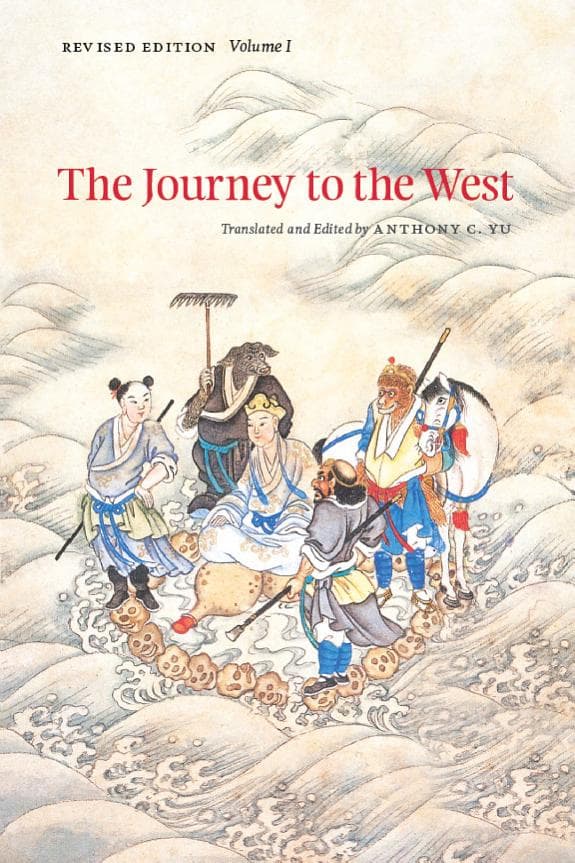
As Tripitaka embarks on his journey, Guanyin orchestrates the recruitment of his key disciples, each an immortal or demon destined for redemption. The first is Sun Wukong, released from his 500-year imprisonment under the Five Elements Mountain. Wukong, initially rebellious and reluctant, is bound by a golden fillet (the 'band of constraint') placed on his head by Guanyin, which Tripitaka can tighten with a magic spell, causing Wukong immense pain. This mechanism ensures Wukong's obedience and serves as a constant reminder of his past transgressions and his new commitment to the pilgrimage. His immense power and combat skills become indispensable for protecting the vulnerable monk.
“Go to the West with the Tang Monk to fetch the scriptures. You will be delivered from your suffering.”
In the book: Guanyin's intervention to release Sun Wukong, the placement of the golden fillet, and Wukong's reluctant acceptance of the pilgrimage.
Try this: Analyze how character flaws and past mistakes can be leveraged to create narrative tension and drive character development through forced collaboration.
Related ideas: golden-fillet, monkey-king-redemption, pilgrim-team
Pigsy's Introduction and Gluttony
Zhu Bajie, a former marshal, joins the quest, embodying human desires.
The second disciple to join Tripitaka is Zhu Bajie, or Pigsy. Formerly Marshal Tian Peng (Marshal of the Heavenly River) in the Celestial Court, he was banished to the mortal realm and cursed with a pig-like appearance for drunkenly molesting the moon goddess Chang'e. Bajie is characterized by his insatiable appetites for food, women, and comfort, often complaining about the hardships of the journey and attempting to abandon the mission. Despite his flaws, he possesses significant strength and fighting ability, particularly with his nine-pronged rake. His constant struggle with temptation and his human-like weaknesses provide comedic relief and highlight the challenges of self-discipline on the path to enlightenment.
“I am a pig demon, formerly the Marshal of the Heavenly River. I have been banished to the mortal world for my offense.”
In the book: Bajie's backstory as Marshal Tian Peng, his pig-like form, and his recurring complaints and desires for food and women.
Try this: Consider how characters embodying human vices or weaknesses can serve as foils, adding depth and relatability to a heroic quest.
Related ideas: zhu-bajie, marshal-tian-peng, gluttony
Sandy's Quiet Devotion
Sha Wujing, a banished general, becomes the steadfast and loyal third disciple.
Sha Wujing, or Sandy, is the third and final disciple to join Tripitaka. Formerly the Curtain-Lifting General in the Celestial Court, he was banished to the mortal world and transformed into a monstrous river demon for accidentally breaking a crystal goblet during a Peach Banquet. Unlike Wukong's rebelliousness or Bajie's gluttony, Sandy is characterized by his quiet loyalty, steadfastness, and diligence. He is often the peacemaker between his bickering brothers and diligently carries the luggage. His weapon is a magic staff, and he is a competent fighter. Sandy represents the virtues of perseverance and humility, embodying the steady, unwavering commitment required for a long and arduous spiritual journey.
“I was once the Curtain-Lifting General. I was banished for shattering a crystal goblet at the Peach Banquet.”
In the book: Sandy's backstory as the Curtain-Lifting General, his transformation into a river demon, and his role as the diligent carrier of burdens.
Try this: Recognize the importance of complementary character roles in a team, where quiet strength and loyalty are as vital as overt power.
Related ideas: sha-wujing, curtain-lifting-general, steadfastness
The White Dragon Horse
A banished dragon prince becomes Tripitaka's faithful steed.
Before the full pilgrim team is assembled, Tripitaka's original horse is eaten by a white dragon. This dragon is in fact the third son of the Dragon King of the West Sea, banished and sentenced to death for setting fire to his father's palace. Guanyin intervenes, saving the dragon and instructing him to await the Tang Monk. The dragon then transforms into a white horse, becoming Tripitaka's loyal steed for the remainder of the journey. The White Dragon Horse, also known as Ao Lie, occasionally transforms back into his dragon form to assist in battles, proving his worth beyond mere transportation. He symbolizes redemption through service and humility, shedding his royal pride to aid a greater cause.
“I am the third son of the Dragon King of the West Sea. I was sentenced to death for setting fire to the palace.”
In the book: The White Dragon eating Tripitaka's horse, Guanyin's intervention, and the dragon's transformation into the white steed.
Try this: Observe how even supporting characters can undergo significant transformations and contribute meaningfully to the overarching quest through acts of service.
Related ideas: white-dragon-horse, ao-lie, redemption-through-service
Trials and Tribulations as Spiritual Metaphors
Each challenge faced by the pilgrims represents an obstacle to enlightenment.
The journey is not merely a physical traverse but a series of spiritual tests. Each demon, monster, or natural obstacle encountered by the pilgrims symbolizes a particular human vice, delusion, or worldly attachment that must be overcome on the path to enlightenment. For instance, the seductions of the Spider Demons represent lust, the greed of certain kings symbolizes worldly power, and the pilgrims' own internal squabbles reflect ego and lack of harmony. Sun Wukong, with his immense power, often represents the active combat against these externalized inner demons, while Tripitaka's vulnerability and compassion represent the purity of intention and the need for faith. The resolution of each trial contributes to the spiritual growth of the entire team.
“Each calamity they suffered was a step closer to the ultimate goal.”
In the book: The numerous encounters with demons and obstacles, such as the Yellow Wind Monster, the White Bone Demon, and the Spider Demons, each testing a different aspect of the pilgrims' resolve.
Try this: Interpret challenges in life or narrative as opportunities for growth and self-mastery, rather than mere roadblocks.
Related ideas: spiritual-trials, enlightenment-path, inner-demons
The Power of Compassion and Faith
Tripitaka's unwavering belief and mercy guide the perilous journey.
Despite his physical vulnerability and frequent need for rescue, Tripitaka embodies the core tenets of Buddhist compassion and unwavering faith. He often insists on showing mercy even to seemingly irredeemable beings, a trait that frequently clashes with Wukong's more pragmatic and aggressive approach to problem-solving. While sometimes leading to further complications, Tripitaka's compassion is essential to the spiritual integrity of the quest. His constant recitation of sutras and his steadfast belief in the mission inspire his disciples and serve as a moral compass, reminding them of the ultimate purpose of their arduous journey. This emphasizes that true strength often lies in moral conviction rather than brute force.
“To save a life is better than building a seven-story pagoda.”
In the book: Tripitaka's repeated attempts to reason with demons, his forgiveness of those who harm him, and his unwavering commitment to the scripture retrieval.
Try this: Consider how empathy and conviction, even in the face of adversity, can be powerful driving forces for achieving long-term goals.
Related ideas: compassion, faith, mercy
The Journey to the West, Revised Edition, Volume 1 Quotes
“Before Heaven and Earth had been separated, chaos existed without form. A boundless, misty expanse, without beginning or end.”
“Born from a stone, he was a spirit-stone monkey. He understood the language of birds and beasts, and could transform himself at will.”
“The Peach of Immortality ripens every three thousand years, and eating it grants an additional three thousand years of life.”
“He leaped from the highest peak and descended into the waterfall's mouth, discovering a magnificent cave behind the curtain of water.”
“He learned the seventy-two earthly transformations, the Cloud-Somersault, and the art of immortality.”
“The Jade Emperor, observing from his golden palace, watched the monkey's antics with a mixture of amusement and growing concern.”
“Even though he had achieved immortality, he still feared the three calamities: thunder, fire, and wind.”
“He wielded the Golden-Hooped Rod, a weapon that could shrink to a needle or expand to touch the heavens.”
“To be called 'Great Sage, Equal to Heaven' was a title he cherished, though it was granted in an attempt to appease him.”
“He ate the peaches, drank the wine, and consumed the pills of immortality, making himself virtually indestructible.”
“The Buddha said, 'You cannot escape my palm, no matter how far you fly.'”
“Five hundred years under Five Elements Mountain was his punishment, a lesson in humility and patience.”
“The Great Tang Emperor, wishing to bring Buddhist scriptures to his land, sought a worthy pilgrim.”
Quiz
10 questions on the main ideas. Each answer comes with a short explanation.
Question 1
Which dynasty is mentioned as the period when Tripitaka's father, Chen Xuanzang, achieved the first place in the imperial examination?
- Tang Dynasty
- Song Dynasty
- Han Dynasty
- Ming Dynasty
Show answer
A. Tang Dynasty The story explicitly states that Chen Xuanzang, Tripitaka's father, achieved the first place in the imperial examination during the Tang Dynasty.
Question 2
What was the original family name of the Tang Monk, before he became a monk?
- Xuanzang
- Chen
- Jiang
- Liu
Show answer
B. Chen The Tang Monk's father was Chen Guangrui, and his mother was Miss Yin. Therefore, his original family name was Chen.
Question 3
Who was the official responsible for the murder of Chen Guangrui and the usurpation of his position and wife?
- Liu Hong
- Liang Jin
- Wang Zhi
- Zhang San
Show answer
A. Liu Hong Liu Hong was the boatman who murdered Chen Guangrui, threw him into the river, and then took his place and Miss Yin as his wife.
Question 4
What item did Miss Yin give her newborn son before casting him adrift on the river?
- A gold coin
- A letter of explanation
- A jade pendant
- A piece of cloth with her name
Show answer
B. A letter of explanation Miss Yin bit her finger, wrote a letter of explanation, and placed it on the baby's chest before setting him afloat.
Question 5
Who found the infant Xuanzang floating on the river?
- A fisherman
- A Buddhist monk from a nearby temple
- A kind-hearted merchant
- A local farmer
Show answer
B. A Buddhist monk from a nearby temple The infant was found by a monk named Elder Zhang from the Golden Mountain Temple.
Question 6
What was the name of the temple where Xuanzang grew up and became a monk?
- White Horse Temple
- Shaolin Temple
- Golden Mountain Temple
- Cloud Dwelling Temple
Show answer
C. Golden Mountain Temple Xuanzang was raised and became a monk at the Golden Mountain Temple.
Question 7
How did Xuanzang eventually learn about his true parentage?
- He overheard a conversation between the monks.
- The abbot of the temple revealed it to him when he was eighteen.
- He found a hidden letter in his belongings.
- His mother sought him out at the temple.
Show answer
B. The abbot of the temple revealed it to him when he was eighteen. When Xuanzang turned eighteen, the abbot of the Golden Mountain Temple, Elder Zhang, revealed his true parentage to him and gave him the letter his mother had written.
Question 8
What did Xuanzang do immediately after learning the truth about his parents?
- He went to the emperor to seek justice.
- He set out to find his mother and take revenge on Liu Hong.
- He devoted himself more intensely to Buddhist studies.
- He consulted with other senior monks for advice.
Show answer
B. He set out to find his mother and take revenge on Liu Hong. Upon learning the truth, Xuanzang immediately embarked on a journey to find his mother and avenge his father's death.
Question 9
Who helped Xuanzang's mother, Miss Yin, survive and send a message to her son?
- A sympathetic neighbor
- Her original family members
- Her servant
- An old woman who knew her family
Show answer
D. An old woman who knew her family Miss Yin, in her despair, met an old woman from her family's original village who recognized her and helped her by passing a message to Xuanzang.
Question 10
What was the ultimate fate of Liu Hong after Xuanzang's revenge was carried out?
- He was banished to a remote island.
- He was executed by the authorities.
- He committed suicide out of shame.
- He was forced to become a monk.
Show answer
B. He was executed by the authorities. After Xuanzang's identity was revealed and the truth brought to light, Liu Hong was captured and executed for his crimes.
The Journey to the West, Revised Edition, Volume 1 FAQ
What is 'The Journey to the West' about?
The Journey to the West is a classic Chinese novel recounting the pilgrimage of Tang Dynasty Buddhist monk Xuanzang to India to obtain sacred Buddhist scriptures. He is accompanied by three powerful disciples, Sun Wukong (the Monkey King), Zhu Bajie (Pigsy), and Sha Wujing (Sandy), along with a dragon prince who serves as his steed. Their journey is fraught with peril, as they encounter numerous demons and obstacles testing their faith and resolve.
Who are the main characters in Volume 1?
Volume 1 primarily introduces the origins and early adventures of Sun Wukong, the Monkey King, detailing his birth from a stone, his acquisition of supernatural powers, and his initial rebellion against Heaven. It also sets the stage for Xuanzang's divine mission and the eventual recruitment of Sun Wukong as his first disciple, laying the groundwork for the epic journey.
Is this book suitable for all ages?
While the story itself has broad appeal and is often adapted for children, the 'Revised Edition' of 'The Journey to the West' is a scholarly translation aimed at adult readers. It contains complex literary and philosophical themes, along with detailed mythological references, making it most suitable for mature audiences interested in classical Chinese literature.
What makes this 'Revised Edition' different from other translations?
The 'Revised Edition' by Anthony C. Yu is highly acclaimed for its meticulous scholarship, comprehensive annotations, and faithful translation of the original text's linguistic nuances and poetic elements. It often includes extensive introductions and notes that provide historical, cultural, and religious context, offering a deeper understanding than many abridged or less scholarly versions.
Do I need to read other volumes to understand Volume 1?
Volume 1 serves as an excellent starting point, establishing the main characters' backstories and the premise of the journey. While it is a complete narrative arc in itself, the full epic unfolds across subsequent volumes, so continuing the series will provide the complete story. However, Volume 1 can be enjoyed independently for its rich mythological tales.
What kind of mythical creatures and deities appear in the book?
The book features a vast pantheon of characters from Chinese mythology, including Jade Emperor, various Buddhas and Bodhisattvas, Taoist immortals, and a wide array of demons, monsters, and animal spirits. These beings often possess unique magical abilities and play crucial roles in either hindering or aiding the pilgrims on their quest.
Is 'The Journey to the West' based on a true story?
The core of the story is inspired by the historical pilgrimage of the Buddhist monk Xuanzang (602–664 AD) to India in the 7th century to collect Buddhist scriptures. However, the novel heavily fictionalizes his journey, incorporating elaborate myths, folklore, and supernatural elements that are entirely imaginative.
What themes are explored in 'The Journey to the West'?
Key themes include the pursuit of enlightenment, the struggle between good and evil, the nature of self-cultivation, and the importance of perseverance and faith. It also delves into Buddhist and Taoist philosophies, exploring concepts like karma, redemption, and the illusory nature of worldly attachments, often through allegorical narratives.
How long is 'The Journey to the West, Revised Edition, Volume 1'?
The length can vary slightly depending on the specific edition and publisher, but 'The Journey to the West, Revised Edition, Volume 1' typically runs between 500 to 600 pages. This substantial length allows for detailed narrative and extensive annotations provided by the translator.
Similar books
- The Diary of a Young Girl
Anne Frank
4.2 (2.7M) average on GoodreadsBiographyDuring the Nazi occupation, a teenage girl's diary, written from a secret annex, shares observations on humanity, hope, and the wait for freedom.
- Twisted 1. Twisted love
Ana Huang
3.7 (1.7M) average on GoodreadsA quiet billionaire with a difficult past finds his guarded heart opening to the woman he must protect, but their growing passion uncovers dangerous secrets and a shared, traumatic history.
- Eat, Pray, Love
Elizabeth Gilbert
3.6 (1.5M) average on GoodreadsLifestyleA heartbroken writer leaves her conventional life for a year-long global search for pleasure in Italy, spiritual devotion in India, and unexpected love and balance in Bali.
- Night
Elie Wiesel
4.3 (970k) average on GoodreadsBiographyIn the darkness of Auschwitz and Buchenwald, a teenage Elie Wiesel faces the extermination of his family, the loss of his faith, and the lasting scars of humanity's deepest cruelty.
- Steve Jobs
Walter Isaacson
4.1 (957k) average on GoodreadsBusinessSteve Jobs was a visionary who fused creativity and technology to revolutionize six industries and shape our digital world.
- The Glass Castle
Jeannette Walls
4.3 (903k) average on GoodreadsBiographyJeannette Walls's memoir describes her unusual childhood with brilliant, free-spirited parents whose poverty-stricken life shaped her independence and love despite family problems.






Enjoyed the summary?
A summary gives you the shape of the book. The book itself has the detail, the examples and the voice.
Find The Journey to the West, Revised Edition, Volume 1 on AmazonAs an Amazon Associate, BookBrief earns from qualifying purchases. How we're funded