
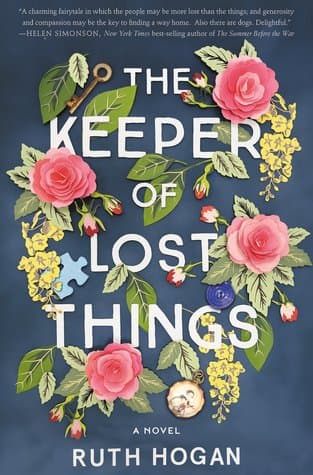
Synopsis
Covers the whole plot, including the ending.
- Difficulty
- Easy
- Pacing
- Moderate
- Mood
- Heartwarming, Charming, Hopeful, Quirky
- Read it if
- You enjoy heartwarming stories with a touch of magic, quirky characters, and a focus on human connection and redemption.
- Skip it if
- You prefer fast-paced thrillers or stories without any fantastical elements.
The Keeper of Lost Things Plot Summary
Covers the whole plot, including the ending.
The Bequest of a Lifetime
Anthony Peardew, an elderly author, spent the last forty years collecting lost objects. He felt guilty after losing a keepsake from his fiancée, Therese, on the day she died. He sorted these items and wrote stories for them, hoping to return them to their owners. As his health declines, Anthony leaves his estate, including his large house full of lost things, to his assistant, Laura. Laura, a kind but recently divorced woman who feels lost herself, is at first overwhelmed by the inheritance and Anthony's unusual life's work. She also finds that the house includes an unexpected resident: the ghost of Therese, who is particular about the house's upkeep.
Laura's New Life and Unexpected Allies
Laura moves into Anthony's eccentric mansion. She struggles with her recent divorce and her new responsibility. She soon meets Sunshine, the bright and quirky teenage daughter of the next-door neighbors. Sunshine has Down syndrome and senses emotions and connects with people well. Sunshine quickly befriends Laura and offers her unique views on the lost objects. Laura also meets Freddy, Anthony's kind gardener, and they feel an immediate connection. Together, these three form a bond as Laura slowly starts to take on her role as the new Keeper of Lost Things, understanding Anthony's notes and the stories behind the objects.
Eunice's Past and Present Loss
In a separate story, we meet Eunice, an elderly woman living in a care home. Decades earlier, as a young woman working in a publishing house, Eunice found a small, important object on a London street. This object, a silver four-leaf clover charm, became a treasured item, a symbol of hope and a promise she made to herself. Now, old and frail, Eunice has lost something truly precious: her husband, Bomber. She struggles with her memories. She carries a secret and a promise related to the charm she found years ago, which she believes holds the key to her past and her peace.
Unraveling Anthony's First Loss
As Laura goes through Anthony's collection, she focuses on the first lost item Anthony ever recorded: a silver four-leaf clover charm. Through Anthony's journals and Therese's ghost, Laura learns the tragic story of Therese's death and Anthony's regret over losing her charm that day. This personal loss started his lifelong mission. Laura understands that finding the owner of this charm is important, as it represents the start of Anthony's collection and, possibly, the way to bring peace to Anthony's memory and Therese's spirit.
Sunshine's Intuition and Freddy's Support
Sunshine helps Laura greatly in her mission. Her sensitivity allows her to 'feel' the stories and emotions tied to the lost objects, often giving clues Laura might miss. For example, Sunshine might sense sadness or a specific memory with an item. Freddy, the gardener, provides stability, helping with the large estate and offering Laura emotional support and companionship. Their growing bond helps Laura heal from her past pain and find purpose in her new life, forming a supportive group dedicated to Anthony's legacy.
The Search for the Charm's Owner
Inspired by Anthony's records and her desire to complete his mission, Laura, with Sunshine and Freddy's help, begins the task of reuniting the lost objects with their owners. They start with the silver four-leaf clover charm, which means so much to Anthony. They use the information Anthony gathered, including dates, locations, and descriptions of how items were lost. This involves research, detective work, and sometimes following their intuition, guided by Sunshine's insights, as they explore the histories within each object.
Eunice's Unburdening
Back in the care home, Eunice, increasingly frail, tells her nurse, Portia, about her past. She shares the story of the silver four-leaf clover charm she found as a young woman. She says she always meant to return it to its owner, a promise she made to herself, but never did. This confession helps Eunice, freeing her from a lifelong secret and quiet guilt. Her memories, though fragmented, give details that will connect her story to Anthony's collection and Laura's mission.
A Breakthrough Connection
Through research and luck, Laura finds a connection between the silver four-leaf clover charm in Anthony's collection and Eunice's past. Anthony's notes give a date and location that match Eunice's memories of finding the charm. Laura realizes that the charm, which Anthony thought belonged to Therese, was lost by a young man named Bomber, who was Therese's brother and Eunice's future husband. The charm was for Eunice, but Bomber lost it, and Therese found it before she died, leading to Anthony's misunderstanding and his life's work.
The Reunion and Redemption
Laura, with Sunshine and Freddy, travels to Eunice's care home, bringing the silver four-leaf clover charm. The reunion is moving. Eunice recognizes the charm instantly, and memories return, clarifying the long-held secret and the promise she made to herself. Returning the charm brings Eunice peace and closure, as she finally understands the full story. It also brings peace to Anthony's spirit and allows Therese's ghost to rest, as the misunderstanding about the charm is resolved.
New Beginnings and Lasting Connections
With the clover charm's mystery solved, Laura fully takes on her role as the new Keeper of Lost Things. Her life, once marked by loss and loneliness, is now full of purpose, friendship, and love. Her relationship with Freddy grows into a deep romance, and she finds a family with him and Sunshine. The house, once a place of sadness, becomes a home filled with warmth and new beginnings. Laura continues Anthony's mission, understanding that returning objects is not just about the items, but about connecting people and healing past hurts, finding joy in small, meaningful things.
Principal Figures
Laura
Protagonist
Anthony's assistant, who inherits his house and mission as the new Keeper of Lost Things.
Laura is a kind-hearted woman in her late thirties, recovering from a painful divorce. Initially feeling lost and overwhelmed, she gradually finds purpose and self-worth through her inherited mission. She is empathetic, meticulous, and possesses a quiet strength that allows her to navigate the eccentricities of Anthony's legacy and the challenges of her new life. Her journey is one of self-discovery, healing, and finding belonging.
Relationships: Anthony Peardew (Employer/Mentor); Sunshine (Friend/Confidante); Freddy (Love interest/Partner); Therese (Ghostly housemate/Past figure she helps bring peace to)
Anthony Peardew
Deceased Mentor/Catalyst
The original 'Keeper of Lost Things,' whose life was shaped by a profound loss.
Anthony is an elderly, reclusive author driven by a lifelong guilt over losing a keepsake from his fiancée, Therese, on the day of her death. He dedicates forty years to collecting and cataloging lost objects, writing stories for each, hoping to reunite them with their owners. Though deceased for most of the story, his meticulous records, journals, and the very house itself serve as his presence, guiding Laura's mission. He is a man of deep regret but also profound dedication.
Relationships: Therese (Deceased fiancée); Laura (Assistant/Successor); Freddy (Gardener)
Sunshine
Supporting
A quirky, intuitive teenager with Down syndrome and an extraordinary ability to sense emotions from objects.
Sunshine is the vibrant, empathetic teenage daughter of Laura's neighbors. She possesses a unique gift for sensing the emotions and stories embedded within the lost objects, often providing crucial clues and insights that help Laura in her mission. Her innocent wisdom, unwavering optimism, and directness are a constant source of joy and guidance for Laura, helping her to see the magic in the world and in herself. She forms a deep, sisterly bond with Laura.
Relationships: Laura (Close friend/Confidante); Freddy (Friend); Mr. and Mrs. Smith (Parents)
Freddy
Supporting/Love Interest
Anthony's rugged and kind gardener, who becomes Laura's love interest and partner in her mission.
Freddy is the practical, down-to-earth gardener who worked for Anthony and continues to tend the grounds for Laura. He is kind, patient, and quietly observant, offering Laura both practical help and emotional support. He represents stability and warmth, helping Laura to heal from her past heartbreaks and find new love. His grounded nature complements Laura's more introspective personality, and he becomes an integral part of her new life and the 'lost things' mission.
Relationships: Laura (Love interest/Partner); Anthony Peardew (Employer); Sunshine (Friend)
Eunice
Supporting
An elderly woman in a care home, whose past is inextricably linked to the first lost item.
Eunice is an elderly woman living in a care home, whose story unfolds in parallel with Laura's. As a young woman, she found a silver four-leaf clover charm, which became a treasured possession and a symbol of a promise she made to herself. She carries the weight of a secret and a quiet regret related to this charm. Her memories, though fragmented by age, are crucial to unlocking the central mystery of Anthony's first lost item and bringing closure to multiple lives.
Relationships: Bomber (Deceased husband); Portia (Nurse/Confidante); Laura (The person who brings her closure)
Therese
Supporting/Spectral Presence
Anthony's deceased fiancée, whose ghost haunts the house until her story is resolved.
Therese is Anthony's beloved fiancée, who died tragically and unexpectedly on the very day he lost her silver four-leaf clover charm. Her death and the lost charm became the catalyst for Anthony's lifelong obsession. Her ghost, particular and somewhat irritable, remains in the house, a lingering presence tied to the unresolved past. She yearns for peace, which can only be achieved once the truth about the charm and Anthony's guilt is understood.
Relationships: Anthony Peardew (Deceased fiancée); Laura (Unwitting housemate); Bomber (Brother)
Bomber
Mentioned
Eunice's deceased husband and Therese's brother, whose initial loss sets key events in motion.
Bomber is Eunice's beloved deceased husband and, unbeknownst to Anthony, Therese's brother. He is the true original owner of the silver four-leaf clover charm, which he intended to give to Eunice but lost. His loss of the charm, followed by Therese's discovery of it and subsequent death, created the misunderstanding that fueled Anthony's life mission. Though only appearing in flashbacks and memories, his actions are central to the plot's resolution.
Portia
Supporting
Eunice's kind and attentive nurse at the care home.
Portia is the compassionate nurse who cares for Eunice in the care home. She is patient and understanding, creating a safe space for Eunice to confide her long-held secrets and memories. Her gentle encouragement helps Eunice to unburden herself, making her an important link in the chain of events that leads to the charm's return. She represents the kindness and empathy found in unexpected places.
Relationships: Eunice (Patient/Confidante)
Themes & Insights
Loss and Grief
The novel explores different kinds of loss: the death of a loved one (Therese, Bomber), losing personal items, losing oneself after divorce (Laura), and losing memory in old age (Eunice). Anthony's life responds to grief and guilt over Therese's death. Laura's journey starts from personal loss, and returning lost objects often means facing the grief of their disappearance. The book suggests that accepting and dealing with loss helps healing.
“Perhaps the things we lose are not lost forever. Perhaps they are waiting for us to find them, to remember them, to reclaim a piece of ourselves.”
Finding Purpose and Belonging
Laura's journey shows her finding purpose after feeling 'lost.' She inherits Anthony's mission when her own life lacks direction. By connecting objects with owners, she discovers her worth and a sense of belonging in Anthony's home with her new friends, Sunshine and Freddy. Anthony himself found purpose, though born of guilt, in his collection. The lost objects represent people looking for their place in the world.
“She had been a lost thing herself for so long, drifting without anchor, and now, suddenly, she had a purpose, a compass.”
The Power of Objects and Stories
The book shows how everyday objects can hold great sentimental value, memories, and stories. They act as links to the past and to people. Anthony's collection is based on this, with each item having a detailed story. By returning these items, Laura gives back not just an object, but a piece of someone's history, a memory, or a resolution. The objects connect people and emotional truth.
“Every lost thing had a story, a whispered secret, a memory clinging to its edges.”
Interconnectedness and Fate
A strong theme in the novel is how different lives and events are connected, often by one lost object. The silver four-leaf clover charm connects Anthony, Therese, Eunice, and Bomber over decades. The novel suggests a gentle sense of fate or chance, where objects and people are drawn together, eventually finding their place. The connections are often surprising and satisfying, showing the unseen threads that link humanity.
“Sometimes, the smallest things held the greatest power to connect lives, to weave together the threads of fate.”
Healing and Redemption
Many characters seek healing or redemption. Anthony's life makes up for his perceived failure to Therese. Laura heals from her divorce and finds self-worth. Eunice finds peace by telling her secret about the charm. Returning lost things often helps both the giver and receiver heal, resolving past regrets and bringing closure. The novel offers a hopeful message about finding peace and moving forward.
“To find a lost thing was to heal a tiny wound in the fabric of the world, to mend a broken thread.”
Plot Devices & Literary Techniques
Dual Narrative/Parallel Storylines
Interweaving the present-day story of Laura with the past narrative of Eunice.
The novel uses a dual narrative structure, alternating between Laura's present-day experiences as the new Keeper of Lost Things and Eunice's past, particularly her finding of the silver four-leaf clover charm, and her present in the care home. This allows the reader to gradually piece together the overarching mystery and understand the profound connections between characters and events that span decades, building suspense and ultimately leading to a satisfying resolution.
The Collection of Lost Things
A physical manifestation of memory, regret, and connection.
Anthony's vast collection of lost objects serves as the central plot device. Each item is not merely an object but a repository of a story, a memory, and a connection to an owner. The collection drives Laura's mission, provides clues, and acts as a catalyst for her personal growth. It symbolizes the idea that nothing is truly lost forever and that every item, no matter how small, holds significance and can lead to profound discoveries.
The Ghost of Therese
A spectral presence representing unresolved grief and the past's lingering influence.
Therese's ghost, a somewhat particular and opinionated presence in Anthony's house, serves as a whimsical yet poignant plot device. She represents Anthony's unresolved grief and guilt, and her lingering presence signifies that the past is not truly laid to rest until its mysteries are resolved. Her interactions, though brief, add a touch of magical realism and serve as a constant reminder of the central mystery surrounding the silver four-leaf clover charm and the catalyst for Anthony's life's work.
Sunshine's Intuition
A magical realism element that aids in solving the mysteries of lost objects.
Sunshine's unique ability to 'feel' the stories and emotions embedded within the lost objects functions as a subtle element of magical realism. This intuition is not explicitly explained but is presented as a natural gift that allows her to offer crucial, often poetic, insights into the objects' histories. It serves as a plot device to move the narrative forward, providing breakthroughs that Laura's logical reasoning alone might miss, and highlights the idea that some connections are beyond rational explanation.
The Keeper of Lost Things Quotes
“Everyone has a story, and sometimes the smallest things hold the biggest secrets.”
“Lost things are loved things, and if you love something, you never really lose it.”
“Sometimes the things we lose find us when we need them most.”
“A life is made up of a million little stories, and every one of them matters.”
“You can't hurry love, but you can hurry tea.”
“The heart has a memory of its own, and it never forgets a kindness.”
“Lost things have a way of finding their way home, just like people.”
“Sometimes the bravest thing you can do is to let go.”
“A story isn't just about what happens; it's about what it means.”
“Love isn't always loud; sometimes it's in the quiet moments and the small gestures.”
“Every lost thing has a story, and every story has a soul.”
“Home isn't a place; it's a feeling of being found.”
“The past is never really past; it's just waiting to be remembered.”
“Kindness is a language that everyone understands.”
Quiz
10 questions on the plot and the characters. Each answer comes with a short explanation.
Question 1
What tragic event prompted Anthony Peardew to become the 'Keeper of Lost Things'?
- He lost his job and needed a new purpose
- He accidentally lost a keepsake from his fiancée Therese on the same day she died unexpectedly
- His house burned down, destroying all his possessions
- He found a lost object that led him to discover a family secret
Show answer
B. He accidentally lost a keepsake from his fiancée Therese on the same day she died unexpectedly Anthony's entire mission stems from his guilt over losing a keepsake from Therese on the very day she died. This dual loss—both the object and his beloved—drove him to collect and document lost items as a form of atonement.
Question 2
Who does Anthony bequeath his house and mission to as his successor?
- His neighbor Sunshine
- The gardener Freddy
- His assistant Laura
- His long-lost relative Eunice
Show answer
C. His assistant Laura Anthony chooses Laura, his assistant, to inherit his home and the responsibility of reuniting lost objects with their owners. Laura is herself 'lost' after a difficult divorce, making her a fitting heir to his life's work.
Question 3
What is the significance of the 'irritable ghost' in Anthony's mansion?
- It is the ghost of Anthony's fiancée Therese, who haunts the house
- It is a poltergeist that disrupts Laura's efforts to organize the lost objects
- It is one of the lost treasures Anthony collected, representing the supernatural element in the story
- It is a figment of Laura's imagination due to her emotional state
Show answer
C. It is one of the lost treasures Anthony collected, representing the supernatural element in the story The ghost is part of the collection of lost treasures Anthony leaves to Laura, adding a whimsical, supernatural layer to the novel. It reflects the book's theme that objects can hold more than just physical meaning.
Question 4
How does Laura's life begin to change after moving into Anthony's mansion?
- She becomes a famous writer by publishing Anthony's stories
- She finds friendship with Sunshine and a romantic interest in Freddy while working on Anthony's mission
- She discovers she is Anthony's long-lost daughter and inherits a fortune
- She opens a museum for the lost objects and becomes a public figure
Show answer
B. She finds friendship with Sunshine and a romantic interest in Freddy while working on Anthony's mission Laura forms meaningful connections with Sunshine (the neighbor's quirky daughter) and Freddy (the gardener), which help her heal from her divorce. These relationships, along with her new purpose, lift the 'dark cloud' engulfing her.
Question 5
What parallel storyline involves Eunice, and how does it connect to Anthony's?
- Eunice is Anthony's sister, and she helps him collect lost objects
- Eunice found a trinket years ago and kept it, but now faces a broken promise as her life nears its end
- Eunice is a thief who steals lost objects and sells them for profit
- Eunice is Laura's mother, and her past explains why Laura is drawn to lost things
Show answer
B. Eunice found a trinket years ago and kept it, but now faces a broken promise as her life nears its end Eunice's narrative runs parallel to Anthony's, involving a trinket she found and a promise she broke. Her story eventually intertwines with Anthony's through the lost objects, highlighting themes of loss and redemption.
Question 6
Which of the following best describes a central theme of the novel?
- The dangers of hoarding and materialism
- How lost objects can symbolize personal loss and the connections that heal us
- The importance of wealth and inheritance in shaping destiny
- A critique of modern society's disregard for history
Show answer
B. How lost objects can symbolize personal loss and the connections that heal us The book explores how physical objects represent emotional losses (like Anthony's keepsake or Eunice's trinket) and how reuniting them—or finding new connections—can lead to personal redemption and healing.
Question 7
What role does Sunshine play in Laura's journey?
- She is a psychic who communicates with the ghost in the mansion
- She is the neighbor's quirky daughter who becomes Laura's friend and helper in Anthony's mission
- She is a lost object expert who teaches Laura how to catalog the collection
- She is Freddy's sister who mediates Laura's romantic conflicts
Show answer
B. She is the neighbor's quirky daughter who becomes Laura's friend and helper in Anthony's mission Sunshine, described as 'quirky,' provides companionship and support to the lonely Laura. Her involvement helps Laura engage with Anthony's mission and integrate into the community.
Question 8
Why is Laura described as 'one of Anthony's lost things'?
- Because she physically lost an important object that Anthony later found
- Because she is emotionally lost after her divorce, much like the objects Anthony collects
- Because Anthony mistakenly identified her as the owner of a lost item
- Because she was abandoned as a child and Anthony took her in
Show answer
B. Because she is emotionally lost after her divorce, much like the objects Anthony collects Laura's personal state of being 'lost' due to her recent divorce mirrors the physical lost objects Anthony cares for. This metaphor underscores the novel's theme that people, like things, can be found and restored.
Question 9
What is the ultimate goal that Laura strives to achieve for Anthony and Eunice?
- To publish a bestselling book about their lives
- To reunite their lost objects with the owners, thereby providing redemption and laying their spirits to rest
- To prove that their lost items are worth a fortune at auction
- To organize a public exhibition of the lost objects to honor their memory
Show answer
B. To reunite their lost objects with the owners, thereby providing redemption and laying their spirits to rest Laura's mission is to fulfill Anthony's last wish by reconnecting the lost objects with their owners, which symbolizes resolving past regrets and achieving peace for both Anthony and Eunice.
Question 10
How does the novel structure the stories of the lost objects, such as the 'lime green plastic flower-shaped hair bobbles'?
- They are footnotes that provide comic relief without affecting the main plot
- They are standalone chapters that interrupt the narrative, unrelated to the characters
- They are vignettes with dates and locations that Anthony wrote, enriching the themes of loss and connection
- They are clues in a mystery that Laura must solve to find a hidden treasure
Show answer
C. They are vignettes with dates and locations that Anthony wrote, enriching the themes of loss and connection The lost objects are presented with brief descriptions (e.g., 'Found, on the playing field, Derrywood Park, 2nd September') and stories written by Anthony. These vignettes weave into the larger narrative, emphasizing how everyday items carry hidden histories and emotional weight.
The Keeper of Lost Things FAQ
What is 'The Keeper of Lost Things' about?
The novel follows Anthony Peardew, who collects lost objects after losing a keepsake from his fiancée Therese on the day she died. He bequeaths his mission to his assistant Laura, who, while recovering from divorce, moves into his mansion and works with friends like Sunshine and Freddy to reunite the objects with their owners, intertwining with Eunice's parallel story of a broken promise.
Why should I read 'The Keeper of Lost Things'?
It's a heartwarming blend of fantasy, romance, and magical realism that explores themes of loss, redemption, and human connection through charming characters and interwoven narratives. The story offers emotional depth with witty, wise prose and a satisfying resolution that ties together multiple lives.
What is the background/setting of 'The Keeper of Lost Things'?
Set primarily in Anthony's mansion in England, with scenes in places like Derrywood Park and Riveria Public Gardens where objects are found. The story spans decades, from Anthony's past with Therese to present-day events involving Laura and Eunice's life in London.
What are the most memorable quotes?
While specific quotes vary, themes include lines about lost objects holding 'magic and meaning' and Anthony's belief that 'every lost thing tells a story.' The novel emphasizes promises and connections, such as how rescuing objects helps 'lay spirits to rest.'
What writing style does the author use?
Ruth Hogan employs a charming, clever, and quietly moving style with multiple perspectives and timelines. The prose is witty and wise, blending realism with magical elements like the irritable ghost, creating a whimsical yet emotionally resonant tone.
What minor details add significant meaning?
Objects like the lime green plastic flower-shaped hair bobbles or bone china cup and saucer each have attached stories that reveal deeper human experiences. For example, the trinket Eunice finds on a London pavement symbolizes her lifelong promise and its tragic break.
What are some subtle foreshadowing moments?
Anthony's loss of Therese's keepsake foreshadows his lifelong mission and the novel's theme of redemption. Eunice keeping a trinket hints at her later loss of something precious, while Laura's initial loneliness as a 'lost thing' foreshadows her transformative journey.
What unexpected character connections exist?
Laura's connection to Anthony through his bequest ties her to Eunice's story, revealing how their lives intersect through lost objects. The irritable ghost in the mansion subtly links to unresolved pasts, and Sunshine and Freddy's roles help bridge these narratives.
What are unspoken character motivations?
Anthony is driven by guilt over Therese's death, using lost objects as a substitute for his loss. Laura seeks purpose post-divorce, unconsciously mirroring Anthony's need for redemption. Eunice's actions stem from a deep-seated promise that haunts her as she ages.
What psychological complexities do characters exhibit?
Anthony shows obsessive-compulsive tendencies in collecting objects to cope with grief. Laura displays resilience mixed with vulnerability as she rebuilds her life. Eunice grapples with regret and duty, highlighting how past decisions shape identity.
What are the major emotional turning points?
Key moments include Anthony bequeathing his mission to Laura, which sparks her transformation; Laura bonding with Sunshine and Freddy, lifting her 'dark cloud'; and Eunice confronting her broken promise, leading to a poignant resolution that connects all characters.
How do relationship dynamics evolve?
Laura evolves from isolated divorcee to a connected keeper, forming a found family with Sunshine and Freddy. Anthony's relationship with Therese haunts him but ultimately finds peace through Laura's efforts. Eunice's ties to her past are resolved through intergenerational connections.
Which parts remain ambiguous or open-ended?
The exact nature of the 'irritable ghost' is left mystical, and some object stories are implied rather than fully resolved. Eunice's specific lost item and promise details are revealed gradually, leaving room for interpretation about their full emotional impact.
What are controversial scenes or decisions?
Anthony's decision to hoard lost objects rather than seek professional help for his grief could be seen as unhealthy. Eunice breaking her promise raises ethical questions about duty versus personal circumstance, and Laura's rapid reliance on new relationships might be viewed as impulsive.
'The Keeper of Lost Things' ending explained: how it ends & what it means
Laura successfully reunites key lost objects, helping lay Anthony and Eunice's spirits to rest, symbolizing redemption and closure. The ending emphasizes that lost things—and people—can be found, with Laura finding herself through community, highlighting themes of healing and interconnectedness.
About the author

Ruth Hogan is a British author known for her fiction, particularly her debut novel, The Keeper of Lost Things. The book explores themes of loss and memory through the intertwined lives of its characters. Hogan's writing often blends elements of magical realism with poignant storytelling.
Similar books
- The Particular Sadness of Lemon Cake
Aimee Bender
3.2 (60k) average on GoodreadsLiterary FictionFeatures a unique magical realism element tied to emotions and objects.
- Garden Spells
Sarah Addison Allen
4.1 (87k) average on GoodreadsFantasyCombines a charming, whimsical atmosphere with a focus on family and community.
- The Silver Linings Playbook
Matthew Quick
4.0 (150k) average on GoodreadsPsychologyExplores characters overcoming personal struggles and finding unexpected connections.
- Eleanor Oliphant Is Completely Fine
Gail Honeyman
4.3 (708k) average on GoodreadsLiterary FictionBoth books explore themes of loneliness, trauma, and the search for connection through quirky protagonists. However, Honeyman's novel offers a more psychologically nuanced and realistic portrayal of mental health and social isolation, with less reliance on magical realism and a sharper, more challenging emotional journey. Hogan's book is gentler and more overtly optimistic.
- The Midnight Library
Matt Haig
Both novels feature fantastical elements to explore themes of regret, choices, and finding meaning in life. Haig's book, however, delves into more profound philosophical questions about existence and alternative lives, presenting a more complex and intellectually stimulating narrative. Hogan's approach is more focused on the specific emotional weight of lost items and personal connections, with a lighter touch on existentialism.
- Harry Potter and the Sorcerer's Stone
J.K. Rowling
4.5 (7M) average on GoodreadsFantasyRescued from a miserable life under the stairs, an orphaned boy discovers he's a wizard destined for a magical school, where he uncovers a dangerous secret tied to the dark wizard who murdered his parents.





Enjoyed the summary?
A summary gives you the shape of the book. The book itself has the detail, the examples and the voice.
Find The Keeper of Lost Things on AmazonAs an Amazon Associate, BookBrief earns from qualifying purchases. How we're funded