
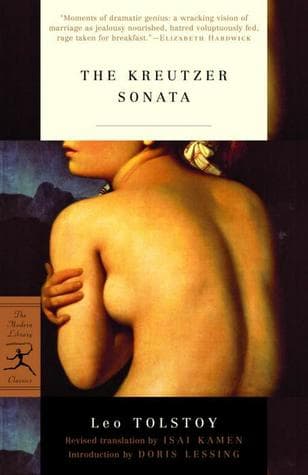
Synopsis
Covers the whole plot, including the ending.
- Difficulty
- Medium
- Pacing
- Moderate
- Mood
- Dark, Intense, Philosophical, Melancholy
- Read it if
- You are interested in classic Russian literature, psychological thrillers, or philosophical explorations of marriage, jealousy, and morality.
- Skip it if
- You prefer lighthearted reads, avoid intense psychological drama, or are sensitive to themes of marital conflict and violence.
The Kreutzer Sonata Plot Summary
Covers the whole plot, including the ending.
The Train Encounter
The story begins with the narrator on a train, watching diverse passengers discuss love, marriage, and divorce. Among them are an old merchant, a lawyer, and a woman. The conversation turns to love and marriage, with different opinions expressed. A man named Pozdnyshev, initially quiet, suddenly speaks with a passionate and cynical view, claiming that love, as society understands it, is just hidden animal desire. His intensity and the dark implications of his words immediately draw the other passengers, especially the narrator, who feels uneasy and curious about Pozdnyshev's past experiences that led to such bitterness.
Pozdnyshev's Early Life and Marriage
Pozdnyshev begins to tell his story, detailing his youth as a reckless nobleman. He describes a life of promiscuity and a careless attitude toward women, which he now deeply regrets. He confesses that he married his wife not out of true love, but mostly because of social expectations and a physical attraction he now calls lust. He describes the start of their marriage as a series of arguments and reconciliations, caused by a basic misunderstanding and a lack of true intimacy, despite appearing happy to outsiders. He laments the hypocrisy in society's views of marriage.
The Disillusionment of Conjugal Life
As Pozdnyshev's story continues, he describes his marriage falling apart. He and his wife argued constantly, often over small things, which grew into deep resentment. He blames much of this on the 'animal passion' that first brought them together, which quickly faded, leaving only irritation and mutual blame. Their life became a performance for society, while privately they were unhappy. Their children, instead of bringing them closer, added more stress, as they argued over parenting and money. Pozdnyshev reflects on the social pressure to maintain the illusion of a happy marriage, even as it crumbles, leading to a profound sense of entrapment and despair for both.
The Arrival of Trukhachevsky
The story changes with the arrival of Trukhachevsky, a talented violinist and an acquaintance from Pozdnyshev's youth. Trukhachevsky is invited to their home, initially to play music with Pozdnyshev's wife, who is a skilled pianist. Pozdnyshev describes Trukhachevsky as charming and confident, which immediately makes him uneasy. He notices the growing closeness between his wife and the musician, seeing how their shared love for music creates a bond that excludes him. This new dynamic fuels Pozdnyshev's already growing jealousy and suspicion, setting the stage for the tragic events to come as he sees a threat to his marital authority and his wife's loyalty.
The Kreutzer Sonata Performance
The key moment happens during a performance of Beethoven's Kreutzer Sonata by Trukhachevsky and Pozdnyshev's wife. Pozdnyshev attends the concert, trying to ignore his growing unease. However, as the music plays, he feels an overwhelming sense of dread and a powerful surge of jealousy. He describes the music as having a dangerous, intoxicating effect, able to unleash primal passions. He sees the intense connection between his wife and Trukhachevsky as they play, viewing it as more than just music but a deep, almost forbidden intimacy. The music seems to remove all pretense, revealing what Pozdnyshev sees as a sexual and emotional betrayal, pushing him to the brink of madness.
Escalating Suspicion and Departure
After the concert, Pozdnyshev's paranoia becomes unbearable. He is convinced his wife and Trukhachevsky are having an affair, despite no real proof. He confronts his wife, who denies any wrongdoing, but her denials only feed his suspicion. The atmosphere in their home becomes tense and distrustful. Unable to stand the situation, and driven by uncontrollable rage, Pozdnyshev decides to leave for a provincial town on a business trip, hoping distance might ease his torment. However, this departure only intensifies his obsessive thoughts, as he imagines them together in his absence, further solidifying his belief in their betrayal.
The Return and the Knife
Consumed by his dark thoughts, Pozdnyshev abruptly ends his business trip and returns home unannounced. As he approaches his house, he believes his suspicions are confirmed when he sees Trukhachevsky's shoes in the hall. He enters the drawing-room to find his wife and Trukhachevsky sitting together, seemingly innocent, but to Pozdnyshev, their presence confirms his deepest fears. The sight of them together, even if just talking, sends him into a violent frenzy. The accumulated jealousy, resentment, and perceived betrayal of years erupt at that moment, overshadowing any rational thought. He feels a powerful, almost involuntary urge to act on his rage.
The Murder
In a fit of uncontrollable rage and delusion, Pozdnyshev grabs a dagger and attacks his wife. He describes the act with chilling detachment, as if it were an inevitable outcome of their troubled marriage and his consuming jealousy. He stabs her repeatedly, driven by a desire to destroy what he sees as her betrayal and the source of his suffering. Trukhachevsky manages to escape, but Pozdnyshev's wife collapses and dies. The immediate aftermath is a blur of shock and a sudden, horrifying clarity for Pozdnyshev, as the reality of his actions hits him amidst the chaos and desperate cries. The violence is swift and brutal, marking the tragic climax of his story.
The Aftermath and Trial
After the murder, Pozdnyshev describes the immediate shock and the arrival of the authorities. He is arrested and tried. During the trial, he claims he acted in self-defense, driven by intense emotional distress from his wife's perceived infidelity. He is acquitted, largely due to the circumstances and society's leniency toward men in such cases, combined with his own compelling, though self-serving, testimony. However, the legal acquittal does not bring him peace. Instead, he is left with the crushing burden of guilt and the profound realization of the irreversible harm he caused, both to his wife and to his own soul.
Pozdnyshev's Confession and Remorse
Pozdnyshev concludes his confession to the narrator, expressing deep remorse for his actions and the destruction of his family. He has come to believe that the root cause of his tragedy is the nature of physical love and the social institution of marriage, which he now sees as flawed and hypocritical. He advocates for a more spiritual and ascetic approach to human relationships, arguing that true love, if it exists, should go beyond physical desire. He warns against the dangers of lust and the destructive power of jealousy, reflecting on his own life as a cautionary tale. He carries the weight of his crime, finding no comfort, only a bitter understanding of his past.
Principal Figures
Pozdnyshev
Protagonist
A nobleman consumed by jealousy who murders his wife.
Pozdnyshev is a complex and deeply troubled nobleman. He presents himself as a man who has lived a life of debauchery in his youth, which he now despises. He is highly intelligent and articulate, yet profoundly cynical about human relationships, especially marriage. His internal world is dominated by intense passions, particularly jealousy and resentment, which he struggles to control. He views women as temptresses and marriage as a trap, believing that physical desire inevitably leads to suffering and moral decay. He is a man haunted by his past and tormented by his actions, seeking to rationalize his crime through a radical critique of society and human nature.
Relationships: Pozdnyshev's Wife (Spousal, marked by intense physical attraction, escalating conflict, and ultimately, murder.); Trukhachevsky (Rival, perceived as a threat and the object of Pozdnyshev's extreme jealousy.)
Pozdnyshev's Wife
Victim/Supporting
Pozdnyshev's beautiful, musically talented wife, who becomes the object of his fatal jealousy.
Pozdnyshev's wife is initially depicted as a beautiful and vivacious woman, desired by Pozdnyshev. She is a talented pianist and, like her husband, possesses a strong will, leading to frequent conflicts in their marriage. She is portrayed as being somewhat naive about the depth of her husband's jealousy and the societal implications of her interactions with other men, particularly Trukhachevsky. While her perspective is largely filtered through Pozdnyshev's biased narrative, she appears to yearn for a more fulfilling life and perhaps more understanding from her husband. Her character primarily serves as the catalyst for Pozdnyshev's escalating paranoia and ultimate violence.
Relationships: Pozdnyshev (Spousal, characterized by initial passion, mutual misunderstanding, and increasing animosity leading to her death.); Trukhachevsky (Musical partner and acquaintance, perceived by Pozdnyshev as an illicit lover.)
Trukhachevsky
Supporting
A charming and talented violinist who becomes a focus of Pozdnyshev's jealousy.
Trukhachevsky is introduced as a professional violinist, an old acquaintance of Pozdnyshev, and a man of considerable charm and social grace. He is depicted as having a natural ease with women and a shared passion for music with Pozdnyshev's wife. While Pozdnyshev projects his darkest suspicions onto Trukhachevsky, the narrative provides no definitive evidence of an actual affair. Trukhachevsky's character primarily serves as a foil to Pozdnyshev, embodying the perceived threat to marital fidelity and the seductive power of art that Pozdnyshev so vehemently condemns. He represents the 'other man' in Pozdnyshev's paranoid fantasy, triggering the protagonist's violent outburst.
Relationships: Pozdnyshev (Acquaintance, perceived as a rival and object of intense hatred.); Pozdnyshev's Wife (Musical partner and acquaintance, viewed by Pozdnyshev as a lover.)
The Narrator
Supporting
The anonymous listener to Pozdnyshev's confession on the train.
The narrator is an anonymous passenger on the train who becomes Pozdnyshev's confidant. He is a passive observer, primarily serving as the conduit through which Pozdnyshev's story is delivered to the reader. His role is to listen, occasionally prompting Pozdnyshev with questions or interjections, but mostly allowing the protagonist to unburden himself. The narrator embodies the audience for Pozdnyshev's radical views, representing the societal norms and conventional understanding of marriage that Pozdnyshev vehemently challenges. He is a vessel for the story, allowing the reader to experience Pozdnyshev's unsettling confession firsthand.
Relationships: Pozdnyshev (Confidant and listener, receiving Pozdnyshev's life story.)
The Elderly Merchant
Mentioned
A passenger on the train who offers a traditional view on marriage.
The elderly merchant is one of the initial discussants on the train. He represents a more traditional, perhaps conservative, viewpoint on marriage and family, contrasting with the more modern or cynical perspectives offered by others. His brief appearance helps to establish the broader societal context of the discussion before Pozdnyshev's radical intervention. He believes in the sanctity and enduring nature of marriage, reflecting conventional wisdom that Pozdnyshev will later dismantle.
The Lawyer
Mentioned
A passenger on the train who discusses the legal aspects of marriage and divorce.
The lawyer is another passenger who participates in the initial discussion about marriage and divorce. He likely offers a more legalistic or pragmatic perspective on these institutions, discussing the practicalities and implications of societal laws. His contribution, though brief, adds another facet to the multi-layered conversation that sets the stage for Pozdnyshev's deeply personal and philosophical confession. He represents the institutional and legal framework surrounding relationships.
Themes & Insights
The Destructive Nature of Lust and Jealousy
The main theme is the destructive results of uncontrolled physical desire and jealousy. Pozdnyshev argues that 'animal passion,' not true love, forms the basis of most marriages, leading to disappointment and conflict. His own marriage, initially driven by lust, becomes a source of mutual hatred and suspicion. His jealousy over his wife's perceived infidelity, especially with Trukhachevsky, consumes him, blinding him and driving him to murder. The Kreutzer Sonata performance intensifies his paranoia, showing how art, combined with existing emotional instability, can unleash destructive forces. Tolstoy criticizes society's romanticization of passion, revealing its potential for brutality.
“What is it, this love? It is a temporary physical passion, which, to justify itself, clothes itself in various sentimental garments.”
Hypocrisy of Nineteenth-Century Marriage
Tolstoy sharply criticizes the institution of marriage in 19th-century society, particularly among the upper classes. Pozdnyshev exposes the hypocrisy in marriages based on social convention, money, and physical attraction rather than genuine spiritual connection. He describes how his own marriage was a facade, maintained for public appearance while privately crumbling under resentment and misunderstanding. The expectation of fidelity for women versus the quiet acceptance of male promiscuity (before marriage, at least) is highlighted. The novel suggests that this social pressure to maintain a false image of marital happiness often leads to deep unhappiness, moral corruption, and, in Pozdnyshev's case, tragedy. The 'ownership' mentality of husbands is also a key part of this criticism.
“They got married, and then they tormented each other, hated each other, and all because they had lied to themselves, to others, and to God.”
The Role of Art and Music in Society
The novel explores the complex and often dangerous power of art, specifically music. Pozdnyshev views music, especially the Kreutzer Sonata, as a powerful force capable of arousing passions and blurring moral lines. He argues that music can be intoxicating and morally corrupting if not understood and controlled. The performance of the Kreutzer Sonata by his wife and Trukhachevsky is not just a musical event but, for Pozdnyshev, a deeply sensual and almost forbidden act that ignites his jealousy to a murderous level. Tolstoy suggests that art, though beautiful, can be morally ambiguous, stirring up base desires rather than elevating the spirit, especially when separated from spiritual purpose or when consumed by individuals lacking self-control.
“Music is a terrible thing. I cannot conceive of its effect on me. It acts as if something new, something terrible is being revealed to me.”
Asceticism vs. Sensuality
A fundamental theme is the conflict between self-denial and sensuality, reflecting Tolstoy's strong Christian ideals at the time of writing. Pozdnyshev, after his crime, adopts a radical ascetic worldview, condemning all forms of physical desire and advocating for complete abstinence, even within marriage. He believes that humanity's salvation lies in overcoming the flesh and living a purely spiritual life, seeing sexual desire as the root of all evil and suffering. This theme appears in his retrospective condemnation of his own youthful excesses and his married life. The novel grapples with the tension between human nature's inherent sensuality and the moral need for spiritual purity, questioning whether such extreme self-denial is truly possible or desirable for humanity.
“The ideal is a chaste life, and marriage is a fall, a deviation from the ideal.”
Plot Devices & Literary Techniques
First-Person Confession
Pozdnyshev's entire story is told through his own biased and subjective perspective.
The novel is structured as a first-person confession, where Pozdnyshev recounts his life story and the murder of his wife directly to an unnamed narrator on a train. This device allows Tolstoy to delve deep into the protagonist's psychological state, revealing his obsessive thoughts, rationalizations, and profound remorse. However, it also means the reader receives a highly biased account, colored by Pozdnyshev's extreme views on marriage, women, and lust. We never hear his wife's perspective directly, forcing the reader to critically evaluate Pozdnyshev's narrative and question the reliability of his justifications for his actions.
Frame Narrative
Pozdnyshev's confession is embedded within a larger conversation among train passengers.
The story employs a frame narrative, beginning with a general discussion among several train passengers about love, marriage, and divorce. This initial conversation sets the societal context and introduces various viewpoints before Pozdnyshev, previously silent, interjects with his radical opinions. This framing device serves to highlight the contrast between conventional societal views and Pozdnyshev's extreme, post-murder perspective. It also draws the reader in by creating an atmosphere of curiosity and tension, as the narrator (and thus the reader) becomes captivated by Pozdnyshev's intensity and the dark implications of his initial statements, prompting the detailed confession that follows.
Symbolism of Music (The Kreutzer Sonata)
Beethoven's Kreutzer Sonata symbolizes uncontrolled passion and moral ambiguity.
Beethoven's Kreutzer Sonata functions as a powerful symbol in the novel. For Pozdnyshev, the music is not merely a piece of art but a representation of dangerous, intoxicating passion that can unleash primal instincts. When his wife and Trukhachevsky play it, he perceives it as a deeply sensual and almost illicit act, fueling his jealousy and confirming his darkest suspicions. The music symbolizes the seductive and potentially corrupting power of art when interpreted through a lens of moral decay and unchecked desire. It becomes a catalyst for his psychological breakdown, pushing him over the edge into violence, demonstrating how art can amplify human emotions to destructive ends.
Foreshadowing
Early discussions and Pozdnyshev's demeanor hint at the tragic outcome.
From the very beginning of the narrative, elements of foreshadowing are present. Pozdnyshev's initial cynical and bitter interjections in the train conversation, his dark pronouncements about marriage, and his withdrawn, intense demeanor all hint at a tragic past. His radical views on the destructive nature of love and lust immediately signal that his own experiences must have been profoundly negative. These early indications create a sense of unease and suspense, preparing the reader for the shocking confession of murder that eventually unfolds, making the violent climax feel, to Pozdnyshev, inevitable.
The Kreutzer Sonata Quotes
“It is amazing how complete is the delusion that beauty is goodness.”
“Love? What is love? Love is our name for the craving to be made whole.”
“People talk of the immorality of the novel. Immorality! They are mistaken; it is not immoral, it is unnatural.”
“Sexual desire, however much we may pretend the contrary, is the chief stimulant in life.”
“The higher a man's spiritual development, the more he avoids the complexities of marriage.”
“If people would only understand that there is no happiness in love, but only in marriage.”
“Music is a terrible thing. I mean, what is music? What does it do? It takes hold of you and hurls you into another state of mind.”
“It is not passion that makes people unhappy, but the failure to control it.”
“What is the good of children if they are to be born only to suffer?”
“The doctors had told me that I could not live without a wife, and I believed them.”
“I was tormented by jealousy, as only a man can be tormented who loves without faith.”
“We are educated to look upon love as a kind of ideal, but it is often nothing more than a refined form of animalism.”
“Marriage is a business, and a hard one at that, not a game.”
“The greatest evil is not what you do, but what you allow yourself to think.”
Quiz
10 questions on the plot and the characters. Each answer comes with a short explanation.
Question 1
What is the primary reason Pozdnyshev suspects his wife of having an affair?
- He found a love letter from the music partner to his wife.
- He observed their intense musical collaboration and perceived emotional connection during their duets.
- His wife confessed her feelings for the music partner.
- A servant informed him of their secret meetings.
Show answer
B. He observed their intense musical collaboration and perceived emotional connection during their duets. Pozdnyshev's jealousy is fueled by observing the intense and passionate musical performances between his wife and the violinist, which he interprets as a sign of their emotional and physical infidelity.
Question 2
What instrument does the music partner, Trukhachev, play?
- Piano
- Cello
- Violin
- Flute
Show answer
C. Violin Trukhachev is a violinist, and his musical partnership with Pozdnyshev's wife, who plays piano, is central to the development of Pozdnyshev's jealousy.
Question 3
What is the name of the musical piece that particularly inflames Pozdnyshev's jealousy?
- Beethoven's 'Moonlight Sonata'
- Bach's 'Chaconne'
- Beethoven's 'Kreutzer Sonata'
- Mozart's 'Requiem'
Show answer
C. Beethoven's 'Kreutzer Sonata' The novella is named after Beethoven's 'Kreutzer Sonata,' which becomes a symbol of the dangerous passion and perceived betrayal that drives Pozdnyshev to madness.
Question 4
What societal institution does Pozdnyshev extensively criticize during his narration to the unnamed traveler?
- The military establishment
- The educational system
- The institution of marriage in 19th-century Russia
- The Orthodox Church
Show answer
C. The institution of marriage in 19th-century Russia Pozdnyshev's narrative is a scathing critique of marriage, particularly the hypocrisy and superficiality he perceives in 19th-century marital conventions, which he believes lead to lust and suffering.
Question 5
How does Pozdnyshev ultimately commit the murder?
- He poisons his wife's drink.
- He shoots her with a pistol.
- He stabs her with a dagger.
- He strangles her in a fit of rage.
Show answer
C. He stabs her with a dagger. In a moment of intense jealousy and rage, Pozdnyshev stabs his wife with a dagger, leading to her death.
Question 6
What role does music, particularly the 'Kreutzer Sonata,' play in Pozdnyshev's descent into madness?
- It serves as a calming influence that temporarily eases his jealousy.
- It inspires him to seek a deeper understanding of art and love.
- It acts as a powerful stimulant that intensifies his emotions and confirms his suspicions of betrayal.
- It becomes a shared hobby that strengthens his bond with his wife.
Show answer
C. It acts as a powerful stimulant that intensifies his emotions and confirms his suspicions of betrayal. For Pozdnyshev, the 'Kreutzer Sonata' and other passionate music played by his wife and Trukhachev are not merely art but potent forces that inflame his jealousy, making him perceive their musical connection as a sensual and illicit bond.
Question 7
How does Pozdnyshev's perspective on love and marriage evolve throughout his narration?
- He begins by idealizing marriage and ends by celebrating free love.
- He moves from a conventional view of marriage to a condemnation of lust and physical desire as the basis for relationships.
- He initially views marriage as a burden but eventually finds peace and acceptance in it.
- He argues for the importance of intellectual compatibility over physical attraction in marriage.
Show answer
B. He moves from a conventional view of marriage to a condemnation of lust and physical desire as the basis for relationships. Pozdnyshev's narrative is a journey from the conventional, often lust-driven, marriages of his society to a radical condemnation of physical desire and a call for spiritual purity, heavily influenced by Tolstoy's feverish Christian ideals.
Question 8
What is the significance of the train setting for Pozdnyshev's confession?
- The train journey symbolizes his desire to escape his past and start anew.
- The enclosed, transient nature of the train car provides anonymity and an intimate space for a deeply personal confession to a stranger.
- The rhythmic sounds of the train help him to organize his thoughts and memories.
- He is traveling to his trial, and the confession is a rehearsal of his defense.
Show answer
B. The enclosed, transient nature of the train car provides anonymity and an intimate space for a deeply personal confession to a stranger. The train compartment offers a unique, confined, and temporary space where Pozdnyshev, feeling no social obligation to the strangers around him, can unburden himself of his dark story without fear of lasting judgment or consequence in his daily life.
Question 9
According to the provided introduction by Doris Lessing, what themes does 'The Kreutzer Sonata' remain relevant to today?
- Modern warfare and political corruption.
- The impact of industrialization and technological advancement.
- Feminism, literature, and understanding Tolstoy the artist.
- Environmentalism and animal rights.
Show answer
C. Feminism, literature, and understanding Tolstoy the artist. Doris Lessing's Introduction highlights the novella's enduring relevance to feminism, literature, and offering insights into Tolstoy's artistic mind, suggesting its themes transcend its historical context.
Question 10
What is the ultimate fate of Pozdnyshev after the murder?
- He is executed for his crime.
- He commits suicide out of guilt.
- He is acquitted due to perceived provocation and lives as a free, albeit tormented, man.
- He is committed to an asylum for the insane.
Show answer
C. He is acquitted due to perceived provocation and lives as a free, albeit tormented, man. Pozdnyshev is acquitted of murder, largely due to the societal understanding of 'justifiable' jealousy and perceived female provocation at the time. He lives as a free man, but his narrative reveals his profound torment and self-condemnation.
The Kreutzer Sonata FAQ
What is the central conflict that drives Pozdnyshev's actions in 'The Kreutzer Sonata'?
Pozdnyshev's central conflict stems from his intense, consuming jealousy, fueled by his suspicions that his wife, Liza, is having an affair with her music partner, Trukhachev. This jealousy, amplified by his rigid moralistic views on marriage and lust, ultimately overwhelms him and leads to a tragic act of murder.
Who are the primary characters involved in the marital drama depicted in the novella?
The primary characters are Pozdnyshev, the narrator and protagonist, who recounts his story of jealousy and murder; his wife, Liza, who becomes the object of his suspicion and the victim of his rage; and Trukhachev, a violinist and family friend, whose musical collaboration with Liza ignites Pozdnyshev's destructive jealousy.
What role does music, particularly Beethoven's Kreutzer Sonata, play in the narrative?
Music, especially the Kreutzer Sonata, acts as a powerful catalyst for Pozdnyshev's jealousy and a symbol of dangerous passion. He believes the music's intensity, particularly when played by Liza and Trukhachev, creates an illicit emotional and physical intimacy between them, stripping away their inhibitions and driving them towards sin.
How does Tolstoy's Christian idealism manifest in Pozdnyshev's worldview and his critique of society?
Tolstoy's Christian idealism is reflected in Pozdnyshev's severe condemnation of lust, carnal marriage, and the hypocrisy he perceives in society's sexual mores. Pozdnyshev advocates for abstinence and spiritual purity, seeing physical desire as inherently corrupting and a deviation from true Christian principles, even as he struggles with his own passions.
What is the significance of the 'Sequel to The Kreutzer Sonata' included in some editions?
The 'Sequel to The Kreutzer Sonata' provides Tolstoy's own clarifications and further elaborations on the controversial themes presented in the novella. It serves to explain his intentions, particularly regarding his views on marriage, chastity, and the ideal Christian life, which were often misunderstood or criticized after the initial publication.
Are there any subtle indications of Liza's true feelings or potential infidelity, or is Pozdnyshev's jealousy entirely unfounded?
The narrative, told solely from Pozdnyshev's perspective, never definitively confirms Liza's infidelity. His jealousy is presented as an internal, consuming force, largely fueled by his own insecurities, moralistic anxieties, and interpretations of her behavior. The ambiguity leaves open whether her actions were innocent or if there was any truth to his suspicions.
How does the 'framing device' of Pozdnyshev narrating his story to a fellow train passenger contribute to the novella's impact?
The framing device allows Pozdnyshev to present his confession and philosophical diatribe as a deeply personal, unfiltered account, giving it an immediate and unsettling intimacy. It also positions the reader as the passive recipient of his disturbing worldview, forcing engagement with his radical ideas without direct intervention or counter-argument within the main narrative.
What specific details within Pozdnyshev's account hint at his own prior promiscuity and hypocrisy?
Pozdnyshev explicitly details his own dissolute youth, including frequent visits to brothels and casual sexual encounters, before his marriage. This past highlights his hypocrisy as he vehemently condemns lust and promiscuity in others, particularly his wife, while having engaged in it himself, suggesting a projection of his own moral failings.
Is there any symbolism in the choice of a violin as Trukhachev's instrument?
The violin, with its capacity for expressing deep emotion and its historical association with passionate, almost human-like melodies, serves as a powerful symbol. It directly facilitates the intense, intimate musical connection between Liza and Trukhachev that Pozdnyshev perceives as dangerously sensual and morally corrupting.
How does Pozdnyshev's upbringing and societal expectations influence his extreme views on marriage and women?
Pozdnyshev's upbringing in a patriarchal society, coupled with his exposure to a culture that simultaneously valorized marriage and tacitly accepted male promiscuity, shaped his contradictory views. He internalized rigid moralistic ideals for women while being exposed to a double standard, leading to his severe judgment of Liza and his inability to reconcile physical desire with spiritual love within marriage.
What psychological mechanisms does Pozdnyshev employ to justify his act of murder?
Pozdnyshev employs several psychological mechanisms to justify his murder, primarily projecting his own anxieties and lust onto Liza and Trukhachev. He rationalizes his act as a necessary purging of sin and a consequence of society's moral decay, framing himself as an instrument of divine justice or a victim of uncontrollable passion rather than a perpetrator of violence.
Discuss the psychological impact of the 'marriage as prostitution' idea on Pozdnyshev's perception of his wife.
Pozdnyshev's belief that marriage, when entered into for physical gratification rather than spiritual union, is akin to prostitution, profoundly devalues his wife in his eyes. This idea strips Liza of her individuality and dignity, reducing her to an object of his desires and suspicions, further fueling his resentment and dehumanizing her in his mind.
How does Pozdnyshev's isolation and lack of genuine communication with Liza contribute to the tragedy?
Pozdnyshev's profound isolation and inability to engage in genuine, open communication with Liza are critical to the tragedy. Rather than addressing his fears or seeking understanding, he internalizes his suspicions, allowing them to fester and grow into an all-consuming rage, ultimately leading him to violence without ever truly understanding his wife's perspective.
To what extent is 'The Kreutzer Sonata' a critique of 19th-century societal norms regarding marriage and gender roles?
The novella serves as a powerful critique of 19th-century societal norms, particularly the hypocrisy surrounding marriage, sexuality, and gender roles. It exposes the double standards applied to men and women, the suppression of female agency, and the destructive consequences of marriages based on superficiality, economic convenience, or unexamined lust rather than genuine spiritual connection.
Does Tolstoy endorse Pozdnyshev's extreme views on chastity and the abolition of carnal love, or is Pozdnyshev a cautionary figure?
This is a point of significant debate. While Pozdnyshev articulates many of Tolstoy's then-current, radical Christian ideals regarding chastity and the dangers of lust, the tragic outcome of Pozdnyshev's story also positions him as a cautionary figure. His extreme jealousy and violence demonstrate the destructive potential when these ideals are applied with fanaticism and a lack of compassion, especially when intertwined with personal pathology.
How does Doris Lessing's introduction enhance a modern reader's understanding of the novella?
Doris Lessing's introduction provides crucial context by highlighting the novella's enduring relevance to feminism, literature, and understanding Tolstoy's artistic and personal struggles. She helps bridge the gap between 19th-century societal issues and contemporary discussions on gender, power, and the complexities of human relationships, making the text more accessible and impactful for modern readers.
What is the novella's stance on the role of art and music in society, particularly regarding its potential for moral corruption?
The novella presents a deeply ambivalent view of art and music. While acknowledging its power to elevate and inspire, Pozdnyshev argues that music, especially passionate compositions like the Kreutzer Sonata, can also be morally corrupting, inciting lust and dangerous emotions when not tempered by spiritual discipline. This reflects Tolstoy's own later critiques of art that he felt lacked moral purpose.
Could 'The Kreutzer Sonata' be interpreted as a commentary on the dangers of toxic masculinity?
Yes, 'The Kreutzer Sonata' can be strongly interpreted as a commentary on the dangers of toxic masculinity. Pozdnyshev embodies many traits associated with it: possessiveness, controlling behavior, an inability to process emotions healthily, a sense of entitlement over women, and ultimately, violence stemming from perceived threats to his male dominance and honor. His narrative exposes the destructive internal and external consequences of such attitudes.
About the author

Count Lev Nikolayevich Tolstoy, usually referred to in English as Leo Tolstoy, was a Russian writer who is regarded as one of the greatest authors of all time. He received nominations for the Nobel Prize in Literature every year from 1902 to 1906 and for the Nobel Peace Prize in 1901, 1902, and 1909; the fact that he never won is a major controversy.
Similar books
- Anna Karenina
Leo Tolstoy
4.0 (682k) average on GoodreadsHistorical FictionExplores themes of adultery, societal hypocrisy, and tragic love within 19th-century Russian society.
- Notes from Underground
Fyodor Dostoevsky
4.2 (84k) average on GoodreadsPsychologyFeatures an alienated, introspective narrator grappling with deep psychological and philosophical issues.
- The Stranger
Albert Camus
4.1 (3k) average on GoodreadsFantasyPresents a protagonist who commits a murder and reflects on life, society, and his own actions with detachment.
- A Doll's House
Henrik Ibsen
3.7 (106k) average on GoodreadsFictionBoth works critique patriarchal structures within marriage and the subjugation of women. Ibsen's play, however, culminates in Nora's awakening and departure, offering a vision of individual agency and self-discovery as a potential solution. Tolstoy's novella presents a much bleaker outlook, focusing on the destructive consequences of conventional marriage without offering a clear path to liberation or healthy relationships, instead suggesting asceticism.
- Nineteen Eighty-Four
George Orwell
4.2 (5.5M) average on GoodreadsFictionWinston Smith dreams of truth and rebellion in a world where Big Brother watches all, but he confronts the terrifying power of a regime that controls not just actions, but thoughts.
- The Frozen River
Ariel Lawhon
4.4 (600k) average on GoodreadsFictionIn 1789 Maine, a heroic midwife's diary helps her expose a murder and get justice in a town that wants to silence her.





Enjoyed the summary?
A summary gives you the shape of the book. The book itself has the detail, the examples and the voice.
Find The Kreutzer Sonata on AmazonAs an Amazon Associate, BookBrief earns from qualifying purchases. How we're funded