
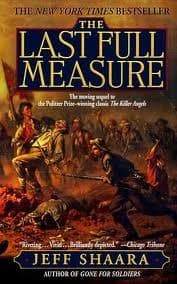
Synopsis
Covers the whole plot, including the ending.
- Difficulty
- Medium
- Pacing
- Moderate
- Mood
- Epic, Gritty, Reflective, Tragic
- Read it if
- You are a fan of historical military fiction, especially if you enjoyed 'The Killer Angels' or 'Gods and Generals', and want a detailed, character-driven account of the Civil War's final years.
- Skip it if
- You prefer fast-paced thrillers or are not interested in detailed historical accounts of military strategy and battle, or find multiple perspectives jarring.
The Last Full Measure Plot Summary
Covers the whole plot, including the ending.
Grant Takes Command
In March 1864, after the Union's costly victory at Gettysburg and continued frustration with Potomac Army leadership, President Abraham Lincoln appoints Major General Ulysses S. Grant as Lieutenant General and General-in-Chief of all Union armies. Grant, fresh from his successes in the Western Theater, arrives in Washington D.C. and immediately assesses the strategic situation. He meets with Lincoln and then with Major General George Meade, commander of the Army of the Potomac, to outline his aggressive new vision: a coordinated, relentless advance on all fronts to overwhelm the Confederacy. Grant's plan is to keep constant pressure on Robert E. Lee's Army of Northern Virginia, preventing them from maneuvering or reinforcing other Southern armies, essentially turning the war into a grind of attrition.
The Wilderness Campaign
In May 1864, Grant's offensive begins with the Battle of the Wilderness. The Union Army of the Potomac, under Grant's direct supervision, moves into the dense, tangled woods south of the Rapidan River, a terrain that negates their numerical superiority in artillery. Robert E. Lee, anticipating Grant's move, positions his Army of Northern Virginia to intercept. The battle quickly becomes a chaotic, blind struggle amidst burning underbrush, with heavy casualties on both sides. Despite the immense losses and the tactical stalemate, Grant, unlike his predecessors, refuses to retreat. Instead, he orders his army to disengage and march southward, aiming to outflank Lee and continue the offensive, a clear signal of his new, unyielding strategy.
Bloody Angle at Spotsylvania
Following the Wilderness, Grant continues his flanking maneuvers, leading to the Battle of Spotsylvania Court House. Lee, anticipating Grant's movements, entrenches his army in defensive positions. The fighting culminates in a horrific engagement at the 'Bloody Angle,' a salient in the Confederate lines known as the Mule Shoe. Union troops, including elements led by Colonel Joshua Chamberlain, launch a massive assault, resulting in hours of brutal, close-quarters combat in a driving rainstorm. The fighting is some of the most savage of the war, with men bayoneting and clubbing each other across earthworks. Though the Union eventually breaches parts of the line, the Confederates form new defenses, and the battle ends in another bloody stalemate, but Grant again refuses to withdraw.
Cold Harbor's Folly
After Spotsylvania, Grant again attempts to maneuver around Lee's flank, leading to the Battle of Cold Harbor in early June 1864. Lee's army has once more dug in, creating an almost impregnable line of trenches and earthworks. Overconfident and underestimating the strength of the Confederate defenses, Grant orders a direct frontal assault on June 3rd. The attack is a catastrophic failure, with thousands of Union soldiers mowed down in minutes by concentrated Confederate fire. The Union suffers an estimated 7,000 casualties in less than an hour, while Confederate losses are minimal. Grant later expressed regret for this decision, marking it as one of his greatest tactical errors, but he still holds the initiative.
The Siege of Petersburg Begins
Following the losses at Cold Harbor, Grant makes a bold strategic decision. Instead of continuing frontal assaults, he orchestrates a massive, skillful crossing of the James River, aiming to cut off Richmond's supply lines by capturing Petersburg, a key railway hub. However, initial Union attacks on Petersburg in mid-June are poorly coordinated and fail to break through the thinly held Confederate defenses. Realizing the strength of the Confederate works, Grant settles his army into a long siege. This marks a significant shift in the war in the East, moving from open-field battles to static trench warfare, a precursor to World War I, and signaling the beginning of the end for the Confederacy's ability to maneuver.
The Crater Disaster
During the siege of Petersburg, a unique plan is proposed by Pennsylvania coal miners in Ambrose Burnside's IX Corps: dig a tunnel under the Confederate lines and detonate explosives. The mine is successfully dug and filled with gunpowder. On July 30, 1864, the charge is detonated, creating a massive crater and a gap in the Confederate defenses. However, the subsequent Union assault is poorly executed; troops are ill-prepared, poorly led, and many simply pile into the crater itself, becoming trapped and easy targets for the regrouping Confederates. The attack turns into a bloody fiasco, with thousands of Union soldiers killed, wounded, or captured, further entrenching the stalemate around Petersburg and demoralizing Union troops.
Sherman's March to the Sea
While Grant's army is bogged down at Petersburg, Major General William Tecumseh Sherman, Grant's trusted subordinate, leads his Union armies on a devastating campaign through Georgia. After capturing Atlanta in September 1864, Sherman embarks on his 'March to the Sea' in November. His army cuts a wide swath of destruction from Atlanta to Savannah, destroying railroads, factories, and crops, and seizing supplies. This campaign of 'total war' is designed to break the Confederacy's economic and psychological capacity to fight, showing the Southern populace that their government cannot protect them. The march is a massive success, culminating in the capture of Savannah in December, significantly weakening the Confederacy.
Lee's Desperate Gamble
By early 1865, the situation for the Confederacy is dire. Petersburg is under siege, Richmond is isolated, and Sherman is advancing through the Carolinas. Robert E. Lee, knowing his army is dwindling and supplies are critically low, attempts a desperate offensive to break the Union lines at Petersburg. On March 25, 1865, Confederate forces launch a surprise attack on Fort Stedman, a key Union strongpoint. Initially, the Confederates achieve some success, breaching the Union perimeter. However, a swift and determined Union counterattack, combined with heavy artillery fire, quickly repels the assault. The attack fails, resulting in significant Confederate losses that Lee's army can ill afford, further weakening his already depleted forces.
The Breakthrough at Five Forks
Following the failed Fort Stedman attack, Grant launches a decisive offensive to break Lee's lines. On April 1, 1865, Major General Philip Sheridan's cavalry, reinforced by infantry, decisively defeats Confederate forces under Major General George Pickett at the Battle of Five Forks. This victory cuts off the last remaining supply line to Petersburg and Richmond, making both cities untenable. Lee recognizes the gravity of the situation and, with his lines shattered and his forces outflanked, orders the evacuation of Petersburg and Richmond on the night of April 2-3. The long siege is over, and the Confederate government is forced to flee its capital, signaling the impending collapse of the Confederacy.
The Retreat to Appomattox
After abandoning Petersburg and Richmond, Robert E. Lee's Army of Northern Virginia begins a desperate westward retreat, hoping to link up with General Joseph E. Johnston's forces in North Carolina and resupply his exhausted troops. However, Grant's Union armies, including Sheridan's cavalry, are in relentless pursuit, constantly harassing Lee's flanks and front. The Confederate soldiers, many starving and demoralized, are pushed to their limits. Skirmishes erupt daily, and Union forces manage to cut off several escape routes. Lee's options dwindle rapidly as his army shrinks through desertion and capture, and his men become increasingly surrounded and cut off from supplies.
Joshua Chamberlain's Last Stand
During the final days of Lee's retreat, Colonel Joshua Chamberlain, now a Brigadier General, finds himself in a critical position. His Union troops are tasked with blocking a desperate Confederate attempt to break through near Appomattox. In a final, desperate charge, elements of Lee's army, including units under Major General John B. Gordon, launch a fierce attack. Chamberlain's forces hold firm, engaging in heavy fighting that shows the final, brutal moments of the war. Despite the Confederates' courage, they are ultimately repelled by the overwhelming Union numbers and determined resistance. This engagement highlights Chamberlain's resolve and courage, marking his presence at the very end of the conflict.
Surrender at Appomattox
On April 9, 1865, completely surrounded and with no hope of escape or resupply, Robert E. Lee sends a message to Ulysses S. Grant requesting a meeting to discuss terms of surrender. The two generals meet at the McLean House in Appomattox Court House, Virginia. Grant, showing magnanimity and a desire for reconciliation, offers generous terms: Confederate soldiers would be paroled and allowed to return home, keeping their horses and sidearms. Officers could retain their swords. Lee accepts the terms, and the formal surrender of the Army of Northern Virginia takes place. This historic event effectively marks the end of the American Civil War, though scattered fighting continues for a short time.
The Aftermath and Farewell
Following the surrender at Appomattox, the Union Army, led by generals like Joshua Chamberlain, oversees the formal stacking of arms by the Confederate soldiers. In a poignant moment, Chamberlain orders his Union troops to salute the surrendering Confederates, a gesture of respect and a symbol of the war's conclusion and the beginning of the healing process. The Confederate soldiers, though defeated, march with dignity. The scene encapsulates the mixture of sorrow, relief, and the daunting task of rebuilding a fractured nation. The generals, both victorious and vanquished, reflect on the immense cost of the war and the future of a reunited America, understanding the historical significance of the moment.
The Last Full Measure Characters
Ulysses S. Grant
Protagonist
The relentless Union General-in-Chief who brings the war to its conclusion.
Grant is depicted as a pragmatic, determined, and often stoic military leader. He possesses an unwavering resolve, a clear strategic vision, and an almost brutal understanding of the nature of modern warfare, particularly the concept of attrition. Unlike previous Union commanders, he refuses to retreat after setbacks, instead constantly pressing the enemy. He is a man of simple tastes, often seen in a plain uniform, and is more comfortable in the field than in political circles. His focus is entirely on defeating Lee's army and ending the war, even at great cost.
Relationships: Robert E. Lee (Primary military adversary, respected opponent); Abraham Lincoln (Supportive commander-in-chief, trusted ally); William Tecumseh Sherman (Trusted subordinate and strategic partner)
Robert E. Lee
Antagonist
The brilliant but increasingly beleaguered Confederate General, fighting a losing battle.
Lee is portrayed as a dignified, deeply religious, and highly respected general, revered by his men. He is a master tactician, constantly seeking to outmaneuver his opponent, but he is acutely aware of the Confederacy's dwindling resources and manpower. He carries the heavy burden of his army's fate and the survival of the South. Despite his brilliance, he is forced into a defensive, attritional war he knows the Confederacy cannot win in the long term. His internal struggles with duty, faith, and the inevitable defeat are central to his character.
Relationships: Ulysses S. Grant (Primary military adversary, respected opponent); James Longstreet (Trusted corps commander, close advisor); A.P. Hill (Valued corps commander)
Joshua Chamberlain
Supporting
The academic-turned-heroic Union Brigadier General, embodying courage and humanity.
Chamberlain, the former college professor, continues to be a figure of moral fortitude and tactical bravery. He is depicted as deeply reflective, sensitive to the suffering of his men, yet capable of extraordinary leadership under fire. He carries the weight of command with a sense of duty and honor, always striving to protect his soldiers while fulfilling his objectives. His internal monologues often reflect on the nature of war, sacrifice, and the future of the nation. He is a symbol of the citizen-soldier who rises to the occasion.
Relationships: Ulysses S. Grant (Commander); Union Soldiers (Respected leader and protector of his men)
James Longstreet
Supporting
Lee's loyal and pragmatic 'Old War Horse,' advocating for defensive tactics.
Longstreet is Lee's most trusted corps commander, known for his stoic demeanor, strategic insights, and pragmatic approach to warfare. He is often portrayed as a voice of reason, advocating for defensive positions and maneuver warfare, sometimes clashing with the more aggressive tendencies of other Confederate generals. His loyalty to Lee is unwavering, despite his occasional disagreements on strategy. He is a seasoned veteran who understands the realities of attrition and the Confederacy's dwindling chances, often bearing the difficult truths.
Relationships: Robert E. Lee (Trusted corps commander and close advisor); A.P. Hill (Fellow corps commander, sometimes competitive)
Abraham Lincoln
Supporting
The President of the United States, seeking a decisive end to the war.
Lincoln is portrayed as a weary but determined leader, constantly navigating the political complexities of Washington while searching for a general who can deliver victory. He exhibits profound wisdom, patience, and a deep understanding of the human cost of the war. His interactions with Grant show his trust and willingness to give his chosen commander the freedom to act. He is the ultimate decision-maker, carrying the burden of the nation's future and the lives of its soldiers, always focused on preserving the Union.
Relationships: Ulysses S. Grant (Commander-in-chief, ultimate authority); Union Generals (Their political superior and strategic guide)
Philip Sheridan
Supporting
The aggressive Union cavalry commander instrumental in the final campaigns.
Sheridan is depicted as an energetic, aggressive, and highly effective cavalry commander. He embodies the new, relentless style of warfare favored by Grant, constantly pushing the enemy and exploiting weaknesses. His leadership is crucial in the final campaigns, particularly in the Shenandoah Valley and at Five Forks, where his decisive actions directly contribute to Lee's ultimate defeat. He is a man of action, focused on destroying the enemy's capacity to fight, and a key component of Grant's overall strategy of attrition.
Relationships: Ulysses S. Grant (Subordinate, trusted offensive commander)
A.P. Hill
Supporting
A fiery and courageous Confederate corps commander.
A.P. Hill is presented as a brave and often impetuous Confederate corps commander, known for his distinctive red battle shirt. He is fiercely loyal to Lee and willing to fight fiercely, but his health is deteriorating throughout the narrative, adding to the sense of the Confederacy's unraveling. His presence on the battlefield is significant in several key engagements, and his dedication to the cause is unwavering, even as the odds turn against the South. His eventual death underscores the immense personal cost of the war.
Relationships: Robert E. Lee (Corps commander, trusted subordinate); James Longstreet (Fellow corps commander)
William Tecumseh Sherman
Supporting
The Union General who implemented 'total war' in the Western Theater.
Sherman is portrayed as Grant's close confidant and a brilliant, if controversial, strategist. He is the architect of the devastating 'March to the Sea,' believing that breaking the South's will and capacity to fight is as important as defeating its armies in the field. He is a pragmatic and ruthless commander, willing to inflict hardship on the civilian population to shorten the war. His actions in the Western Theater are crucial in diverting Confederate resources and breaking Southern morale, directly supporting Grant's efforts in Virginia.
Relationships: Ulysses S. Grant (Trusted subordinate and strategic partner)
The Last Full Measure Themes
The Brutality of Attrition Warfare
The novel portrays the devastating human cost of Grant's strategy of attrition. Unlike earlier Civil War narratives that focused on grand maneuvers, *The Last Full Measure* emphasizes the relentless grind, the daily horrors of trench warfare, and the sheer volume of casualties. Scenes like the Bloody Angle at Spotsylvania, where men fight hand-to-hand for hours in the rain, or the catastrophic frontal assault at Cold Harbor, where thousands die in minutes, highlight the impersonal and gruesome nature of this new form of warfare. The descriptions of the wounded, the constant shelling, and the psychological toll on soldiers on both sides underscore that victory came at an immense and agonizing price.
“I can't spare the men, but I can't spare the time either. We must keep pressing.”
Leadership Under Pressure
The novel explores the immense pressure faced by both Union and Confederate commanders. Grant must contend with political interference, public opinion, and the immense casualties his strategy incurs, yet he remains resolute. Lee, on the other hand, faces the crushing reality of dwindling resources, desertion, and inevitable defeat, while trying to maintain the morale of his devoted but exhausted army. Their internal thoughts reveal their doubts, fears, and the heavy burden of responsibility for thousands of lives and the fate of their respective nations. The contrast between Grant's relentless drive and Lee's dignified resignation under impossible circumstances forms the core of this theme.
“My army is melting away. I have no more options. It is over.”
Duty vs. Despair
This theme is strong in the Confederate characters, particularly Robert E. Lee and his men. Despite facing overwhelming odds, starvation, and the clear signs of impending defeat, many Confederate soldiers and officers continue to fight out of a strong sense of duty, loyalty to their general, and belief in their cause. Lee himself embodies this struggle, knowing the war is lost but feeling bound by honor to continue until the very end. The novel contrasts this with the growing despair and exhaustion that leads to widespread desertion, highlighting the internal conflict within the Southern ranks as the war drags on. For the Union, duty is tied to preserving the nation, pushing through despite the horrific cost.
“There is nothing left but to go on. And if we must fall, then we will fall with honor.”
The Cost of Victory and Reconciliation
The novel concludes with the surrender at Appomattox, emphasizing not just the end of the fighting but the beginning of the long road to national reconciliation. The depiction of Joshua Chamberlain ordering his Union troops to salute the surrendering Confederates is a powerful symbol of this theme. While the Union achieves victory, the cost is staggering, both in lives and the deep scars left on the nation. The narrative suggests that true victory lies not just in military triumph but in the ability to heal and reunite. The generosity of Grant's surrender terms also reflects a forward-looking perspective, aiming to bind the wounds of war rather than deepen them.
“We are one country now. Let us not forget that.”
The Transformation of Warfare
The final years of the Civil War, as depicted in the book, show a significant shift in military strategy from maneuver-based campaigns to a more modern, total war approach. Grant's relentless pursuit and use of attrition, coupled with Sherman's devastating march through Georgia, demonstrate a willingness to target the enemy's infrastructure and civilian morale alongside its armies. The extensive use of trenches and fortifications around Petersburg also foreshadows the static, entrenched warfare of future conflicts. This theme highlights how the Civil War evolved into a more brutal and comprehensive conflict, setting precedents for future military engagements and reflecting a grim reality of modern industrial warfare.
“It will be a fight to the finish, and we are prepared to pay the price.”
Plot Devices & Literary Techniques
Multiple Perspectives
Shifting viewpoints among key generals to provide comprehensive insight.
The novel utilizes multiple third-person limited perspectives, primarily focusing on the thoughts and experiences of key generals such as Grant, Lee, and Chamberlain. This device allows the reader to understand the strategic considerations, emotional toll, and personal dilemmas faced by leaders on both sides of the conflict. It provides a balanced and nuanced view of the war's final years, avoiding a singular heroic narrative and instead presenting the complex realities of command and sacrifice from different vantage points, enriching the historical context and character depth.
Internal Monologue
Character's inner thoughts reveal their motivations, fears, and strategic reasoning.
Extensive use of internal monologue allows readers deep access into the minds of the characters. Grant's practical calculations and unwavering resolve, Lee's agonizing awareness of his army's dwindling strength and his duty, and Chamberlain's philosophical reflections on war and humanity are all revealed through their thoughts. This device adds psychological depth, humanizing these historical figures and illustrating the immense mental and emotional burdens they carried. It makes their decisions, triumphs, and failures more understandable and relatable to the reader.
Foreshadowing of Attrition
Early hints and descriptions of Grant's strategy and its inevitable, brutal consequences.
From the moment Grant takes command, there is a clear foreshadowing of the attritional nature of the upcoming campaigns. Discussions among generals, Grant's own strategic pronouncements, and the descriptions of the Union's numerical superiority all hint at a war that will be won through sheer force and grinding down the enemy, regardless of the cost. This device builds a sense of grim inevitability, preparing the reader for the immense casualties and the relentless, bloody nature of the battles that follow, such as the Wilderness and Spotsylvania.
Symbolism of Appomattox
The final surrender as a symbol of both defeat and the potential for reconciliation.
The surrender at Appomattox Court House is presented not just as a historical event but as a powerful symbol. It represents the ultimate defeat of the Confederacy and the end of the Civil War, but more importantly, it symbolizes the potential for national healing and reconciliation. Grant's generous terms and Chamberlain's respectful salute to the Confederate soldiers are symbolic gestures that look beyond the immediate conflict towards the future of a reunited nation, conveying a message of hope amidst the profound tragedy and division that defined the war.
The Last Full Measure Quotes
“It was the last full measure of devotion, and it was given freely, by so many.”
“The war was not just fought on battlefields, but in the hearts and minds of every man, woman, and child.”
“Victory has a thousand fathers, but defeat is an orphan.”
“You cannot conquer a country with an army; you have to conquer the spirit of the people.”
“There are times when a man must simply do what is right, regardless of the cost.”
“The cost of freedom is always high, but the price of not fighting for it is immeasurable.”
“War strips away all pretense, all comfort, and leaves only the raw truth of a man.”
“Hope is a dangerous thing in war. It can make you reckless, or it can keep you alive.”
“The weight of command is not in the orders you give, but in the lives that depend on them.”
“To surrender is not to be a coward, but sometimes, to live to fight another day.”
“The smell of gunpowder and blood, once experienced, is never truly forgotten.”
“History would judge them, not by their intentions, but by the outcome of their actions.”
“Even in the darkest hours, the human spirit finds a way to endure, to resist, to hope.”
“A good soldier fights not because he hates what is in front of him, but because he loves what is behind him.”
Quiz
10 questions on the plot and the characters. Each answer comes with a short explanation.
Question 1
Which Union general does President Lincoln place in command at the beginning of 'The Last Full Measure' to provide decisive leadership?
- George McClellan
- Joshua Chamberlain
- Ulysses S. Grant
- William Tecumseh Sherman
Show answer
C. Ulysses S. Grant As 'The Last Full Measure' opens, Lincoln places Ulysses S. Grant in command to provide the decisive, hard-nosed leadership the Union Army desperately needed.
Question 2
What significant battle had recently occurred and is mentioned as 'past' at the opening of the novel, marking a turning point for the Union?
- Battle of Antietam
- Battle of Bull Run
- Battle of Vicksburg
- Battle of Gettysburg
Show answer
D. Battle of Gettysburg The synopsis clearly states, 'As The Last Full Measure opens, Gettysburg is past and the war advances to its third brutal year,' indicating its recent occurrence and importance.
Question 3
Which Confederate general's 'shattering loss' two months before Gettysburg significantly impacted Robert E. Lee?
- James Longstreet
- A.P. Hill
- J.E.B. Stuart
- Stonewall Jackson
Show answer
D. Stonewall Jackson The synopsis mentions, 'Gettysburg was an unspeakable disaster--compounded by the shattering loss of the fiery Stonewall Jackson two months before.'
Question 4
What is Robert E. Lee's primary concern regarding the South's ability to win the war, given the context provided?
- Lack of cavalry support
- Inability to survive a war of attrition
- Low morale among his troops
- Insufficient political backing from Richmond
Show answer
B. Inability to survive a war of attrition The text states, 'Lee knows better than anyone that the South cannot survive a war of attrition,' highlighting his strategic concern.
Question 5
Joshua Chamberlain, initially a college professor, is noted for his heroism at which specific battle mentioned in the synopsis?
- Battle of the Wilderness
- Siege of Petersburg
- Battle of Gettysburg
- Appomattox Court House
Show answer
C. Battle of Gettysburg The synopsis specifically describes Chamberlain as 'the college professor who emerged as the Union hero of Gettysburg.'
Question 6
Which of the following battles is specifically mentioned as a 'costly' confrontation between Lee and Grant in 'The Last Full Measure'?
- Battle of Antietam
- Battle of Chancellorsville
- Battle of the Wilderness
- Battle of Fredericksburg
Show answer
C. Battle of the Wilderness The synopsis explicitly lists, 'From the costly Battle of the Wilderness to the agonizing siege of Petersburg,' as key events dramatized.
Question 7
What is the final, epoch-making event portrayed in 'The Last Full Measure' that concludes the Civil War?
- Sherman's March to the Sea
- The fall of Richmond
- Lee's surrender at Appomattox
- The assassination of Abraham Lincoln
Show answer
C. Lee's surrender at Appomattox The synopsis concludes by mentioning 'Lee's epoch-making surrender at Appomattox' as the final event.
Question 8
What overarching theme is explored through the 'escalating confrontation' between Lee and Grant, as described in the novel's synopsis?
- The impact of industrialization on warfare
- The personal sacrifices and complexities of leadership during wartime
- The role of international diplomacy in the Civil War
- The economic disparities between the North and South
Show answer
B. The personal sacrifices and complexities of leadership during wartime The synopsis describes Lee and Grant as 'complicated, heroic, deeply troubled men,' and focuses on their 'escalating confrontation,' suggesting a theme of complex leadership and personal struggle in war.
Question 9
Beyond military strategy, what personal attribute is highlighted as a source of strength for Robert E. Lee in his determination to fight to the bitter end?
- His political influence in the Confederacy
- His superior logistical planning abilities
- His unswerving faith in God
- His charisma among the common soldiers
Show answer
C. His unswerving faith in God The text states, 'But with the total devotion of his generals... and his unswerving faith in God, Lee is determined to fight to the bitter end,' indicating his faith as a key personal motivator.
Question 10
What significant internal conflict within the Union is mentioned as growing wider at the war's third year, necessitating a new leader?
- Disagreements between different Union states
- The gulf between politicians in Washington and generals in the field
- Tensions between regular army and volunteer forces
- Debates over the emancipation of slaves
Show answer
B. The gulf between politicians in Washington and generals in the field The synopsis explicitly states, 'On the Union side, the gulf between the politicians in Washington and the generals in the field yawns ever wider,' creating a need for decisive leadership.
The Last Full Measure FAQ
What is the primary focus of "The Last Full Measure" within the Civil War timeline?
The Last Full Measure picks up after the Battle of Gettysburg, covering the final two years of the Civil War. It vividly portrays the escalating conflict between Ulysses S. Grant and Robert E. Lee, culminating in Lee's surrender at Appomattox.
Which key Union general is introduced to lead the Union Army at a critical juncture?
Ulysses S. Grant is placed in command of the Union Army by President Lincoln. His decisive leadership is portrayed as essential in turning the tide of the war after the political and military disarray following Gettysburg.
How does Robert E. Lee's perspective on the war change after Gettysburg and the loss of Stonewall Jackson?
Lee views Gettysburg as a disaster, intensified by Stonewall Jackson's death, and recognizes that the South cannot win a war of attrition. Despite this, he remains determined to fight to the bitter end, supported by his generals and his deep faith.
What role does Joshua Chamberlain play in this final installment of the trilogy?
Joshua Chamberlain, the hero of Gettysburg, continues his rise through the ranks. The novel follows his journey as he becomes one of the greatest figures of the Civil War, participating in key battles and events leading to the war's conclusion.
Which major battles and events are depicted in the book leading up to the war's end?
The novel dramatizes significant engagements such as the costly Battle of the Wilderness and the grueling siege of Petersburg. It culminates with the pivotal surrender of Robert E. Lee at Appomattox Court House, marking the war's conclusion.
How does the novel subtly depict the growing divide between Washington politicians and Union generals?
The narrative highlights the widening gulf between political figures in Washington and the generals in the field. This tension underscores the Union's desperate need for a unifying, decisive leader like Grant to overcome internal friction and effectively prosecute the war.
What specific details reveal Lee's deep personal struggle and reliance on his faith?
The book illustrates Lee's profound internal conflict and his unwavering faith in God as central to his ability to continue fighting despite overwhelming odds. This reliance on his spiritual convictions is portrayed as a key element of his leadership and resilience.
Are there any subtle foreshadowings of the psychological toll the war takes on Grant or Lee before their final confrontation?
While not explicitly stated as foreshadowing, the portrayal of both Grant and Lee as 'complicated, heroic, deeply troubled men' hints at the immense psychological burden they carry. Their internal monologues and reactions to battle outcomes reveal the mental strain of command.
How does the book portray the psychological impact of the 'war of attrition' on the Confederate soldiers and leadership?
The novel subtly illustrates the devastating psychological impact of attrition on the Confederate side, particularly on Lee, who understood the South could not win such a war. The dwindling resources and constant pressure contribute to a sense of grim determination mixed with growing despair among his forces.
What psychological traits make Grant an effective, albeit 'hard-nosed,' leader for the Union?
Grant's effectiveness stems from his unwavering resolve, strategic pragmatism, and willingness to accept heavy casualties to achieve victory. His 'hard-nosed' approach reflects a psychological detachment from the cost of battle, focusing solely on the objective of ending the war.
How does Joshua Chamberlain's character evolve psychologically from Gettysburg hero to a figure facing the war's endgame?
Chamberlain's character evolves from a courageous academic to a hardened, experienced commander. The novel explores his psychological adaptation to continuous warfare, showcasing his growth in leadership and resilience while still retaining his moral compass amidst the brutality.
What is the psychological burden for Lee in continuing to fight a war he knows the South cannot win?
Lee carries an immense psychological burden, knowing the South's limitations in a war of attrition. His continued fight is driven by a profound sense of duty, loyalty to his men and cause, and deep faith, even as he grapples with the inevitability of defeat.
To what extent does the book suggest Lincoln's decision to appoint Grant was a political rather than purely military move?
The book implies Lincoln's decision was a blend of political necessity and military insight. The 'gulf between the politicians in Washington and the generals in the field' highlights the need for a leader who could not only win battles but also command the confidence of both the military and the administration, which Grant eventually provided.
Is Lee's 'unswerving faith in God' portrayed as a source of strength or a form of denial in the face of defeat?
Lee's faith is primarily portrayed as a profound source of strength and solace, providing him with the fortitude to endure immense hardship and loss. However, it can also be interpreted as a psychological mechanism that allowed him to continue fighting a seemingly lost cause, bordering on a noble form of denial.
How does the narrative portray the 'human passion' of the individuals, and does it lean more towards glorification or tragic realism?
The narrative endeavors to portray 'human passion' through a lens of tragic realism. While individual acts of heroism and devotion are highlighted, the overarching tone emphasizes the immense suffering, sacrifice, and complicated motivations of all involved, avoiding simple glorification.
Does the book offer any definitive stance on whether the war's conclusion was inevitable or shaped by specific leadership choices?
The book strongly suggests that while the South faced insurmountable odds in a war of attrition, Grant's specific leadership choices and strategic aggression were crucial in accelerating and shaping the war's conclusion. Lincoln's decision to appoint Grant is depicted as turning the tide, implying that leadership played a decisive role.
How does the book balance the perspectives of Union and Confederate leaders, especially Grant and Lee?
The book aims for a balanced portrayal, delving into the minds and hearts of both Grant and Lee. It explores their motivations, strategies, and personal struggles with equal depth, allowing readers to understand the complexities and humanity of both sides without overtly favoring one.
What is the significance of the title, "The Last Full Measure," in relation to the book's themes?
The title, drawn from Lincoln's Gettysburg Address, signifies the ultimate sacrifice made by individuals for their cause. It embodies the theme of profound devotion and the willingness of soldiers and leaders on both sides to give everything they had—their 'last full measure'—in the conflict.
About the author

Jeff Shaara is an American author known for his historical fiction, particularly focusing on the American Civil War and the Revolutionary War. His notable works include The Last Full Measure, Rise to Rebellion, The Glorious Cause, The Steel Wave, and No Less Than Victory, which explore significant events and figures in American history through engaging narratives.
Similar books
- The Killer Angels
Michael Shaara
4.3 (75k) average on GoodreadsHistorical FictionThe preceding novel in the trilogy, focusing on Gettysburg with similar multi-perspective historical fiction.
- To Kill a Mockingbird
Harper Lee
4.3 (4.5M) average on GoodreadsHistorical FictionIn the 1930s Jim Crow South, Harper Lee writes about racial injustice, moral growth, and the quiet courage of a lawyer father, Atticus Finch, as seen through his young daughter's eyes.
- The Great Gatsby
F. Scott Fitzgerald
3.9 (3.8M) average on GoodreadsHistorical FictionIn the opulent Roaring Twenties, a mysterious millionaire's lavish parties hide his desperate, tragic pursuit of a lost love, exposing the emptiness within the American Dream.
- Pride and Prejudice
Jane Austen
4.3 (3M) average on GoodreadsHistorical FictionIn a society focused on status and money, Elizabeth Bennet navigates love and pride, challenging Mr. Darcy and social expectations to find true affection.
- Angels & Demons
Dan Brown
3.9 (2.7M) average on GoodreadsThrillerA Harvard symbologist races through Rome's ancient sites, deciphering cryptic clues to unmask the Illuminati and stop a vengeful plot to destroy the Vatican with a stolen antimatter weapon.
- The Kite Runner
Khaled Hosseini
4.3 (2.4M) average on GoodreadsHistorical FictionIn pre-Taliban Afghanistan, a wealthy boy's betrayal of his servant's son during a kite-running tournament starts a lifelong journey for amends as his country collapses.





Enjoyed the summary?
A summary gives you the shape of the book. The book itself has the detail, the examples and the voice.
Find The Last Full Measure on AmazonAs an Amazon Associate, BookBrief earns from qualifying purchases. How we're funded