
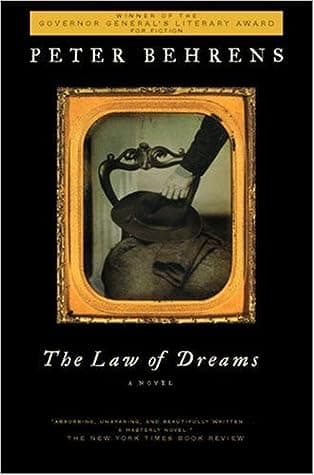
Synopsis
Covers the whole plot, including the ending.
- Difficulty
- Medium
- Pacing
- Moderate
- Mood
- Gritty, Melancholy, Resilient, Atmospheric, Historical
- Read it if
- You are interested in a visceral, immersive, and beautifully written account of the Irish Famine and the immigrant experience.
- Skip it if
- You prefer lighthearted stories or are sensitive to graphic descriptions of suffering, poverty, and historical violence.
The Law of Dreams Plot Summary
Covers the whole plot, including the ending.
The Famine Strikes
In 1847, the Great Famine hits Ireland, destroying fifteen-year-old Fergus O'Brien's life. In Kilhassy, County Clare, his family is among the first to suffer from the potato blight. His father, a tenant farmer, is at first defiant but soon gives in to starvation and disease. The village becomes empty, its people dead, dying, or fleeing. Fergus sees the horror firsthand, including starved bodies and widespread hopelessness. His mother's health quickly worsens, and his younger sister, Una, also shows signs of the famine. This initial trauma sends Fergus on a desperate journey for survival, forcing him to leave his home and face a world changed by disaster.
Flight from Kilhassy
As his family weakens and the community breaks apart, Fergus makes the hard choice to leave Kilhassy. His mother, near death, tells him to go, to find a way to live, a choice that deeply affects him. He carries little more than his clothes and a deep sense of loss. His first travels are without purpose, driven by hunger and a vague hope of finding food or safety. He meets other desperate people, some kind, many cruel, all struggling against the same forces. This time is marked by extreme hardship, forcing Fergus to scavenge and beg. This takes away his innocence and shows him the harsh realities of a famine-stricken land where human life means little.
The Workhouse and the Road
Driven by hunger, Fergus eventually ends up at a workhouse, a place meant to help but often a death trap. Conditions are terrible: overcrowding, disease, and not enough food. He sees the staff's random cruelty and the inmates' despair. He manages to escape, showing his growing will to live. Back on the road, he joins different groups of wanderers, some of whom are thieves. He quickly learns to be careful, to fight for scraps, and to trust no one fully. These encounters toughen him, teaching him the harsh rules of the road and the constant threat of violence. This shapes his understanding of survival in a world without compassion.
Meeting the Soldiers
Fergus's journey changes when he meets a group of young British soldiers, barely older than himself, marching through the ruined countryside. At first cautious, Fergus is drawn to their order and the chance of food. He forms a bond with some of them, especially a young drummer boy named Billy, who shares a similar youthfulness despite their different backgrounds. This connection gives Fergus a temporary break from complete poverty but also shows him the casual brutality of military life and the tensions between the Irish people and their British rulers. He watches their drills and routines, gaining a new view of power and authority in a chaotic world.
Across the Irish Sea
Hoping for a better life and facing constant starvation, Fergus makes his way to a port. Through sheer will and luck, he gets passage on a coffin ship going to Liverpool. The journey across the Irish Sea is terrible, with crowded conditions, widespread disease, and constant fear of death. He sees the despair of his fellow passengers, many of whom are sick and dying. In Liverpool, he finds a different kind of poverty: the crowded, poor streets of an industrial city, far from the rural land he knew. The city's lack of care for Irish immigrants is clear, forcing Fergus to quickly adapt to this new, harsh environment.
Liverpool's Underbelly
In Liverpool, Fergus enters the dirty, dangerous world of the urban poor. He struggles to find work, often stealing or scavenging to survive. The city is a confusing maze of docks, factories, and crowded buildings, a sharp contrast to Ireland's open fields. He meets many different people: street toughs, prostitutes, and other Irish immigrants, all fighting for a meager life. He learns the brutal order of the streets and the constant threat of violence. His experiences deepen his understanding of human strength and depravity, as he sees both kind acts and great cruelty in the struggle for survival in the growing industrial heartland.
A New Alliance
Fergus eventually joins a small group of young, displaced people in Liverpool, including a clever and resourceful girl named Maggie. Maggie, sharp and independent, becomes important in his life as a companion and a possible love interest. Together, they navigate the city's dangers, sharing their resources and wits to survive. This new 'family' gives Fergus a sense of belonging he has not felt since leaving Ireland, offering protection and friendship. Their shared hardships create a strong bond, and Fergus begins to feel a fragile hope among the despair, learning the power of group survival.
The Lure of America
Stories of America, 'the Boston states,' offering land and opportunity, spread quickly among Irish immigrants in Liverpool. This dream becomes a strong motivation for Fergus and his new companions. They begin to plan and save, each helping to reach the goal of getting passage across the Atlantic. The journey has many challenges, as they must avoid authorities, navigate the dangerous docks, and overcome financial hurdles. The idea of America is not just an escape from poverty and famine, but a chance for a true new beginning, a place where they might finally shape their own lives, free from their past.
The Atlantic Crossing
Fergus, Maggie, and their companions finally get passage on an emigrant ship to America. The transatlantic journey is even harder than the trip to Liverpool. The ships are known for being crowded, dirty, and disease-ridden, earning them the name 'coffin ships.' Fergus sees more death and suffering, as typhus and other illnesses kill many passengers. He and Maggie rely on each other for support, their bond growing stronger during the shared ordeal. The vast ocean and uncertain destination weigh heavily, but the hope of a new life sustains them through the unbearable conditions, pushing them to their limits.
Arrival in the New World
After a terrible journey, Fergus and Maggie arrive in Boston, their bodies weak but their spirits still hopeful for a new start. However, 'the Boston states' are not the immediate paradise they imagined. They face prejudice, struggle to find work, and adapt to a new culture. The streets are not easy, and opportunities are hard-won. Yet, there is a clear sense of possibility, a sharp contrast to the suffocating despair of Ireland. Fergus, now a young man shaped by great hardship, begins to navigate this new place, carrying his past but determined to build a future, holding onto the promise of a life free from famine and oppression.
The Law of Dreams Characters
Fergus O'Brien
Protagonist
A young Irish man forced into an epic journey of survival during the Great Famine.
Fergus begins as an innocent, rural Irish boy, deeply connected to his family and the land. The famine shatters his world, forcing him to mature rapidly and confront the brutal realities of survival. He is observant, resourceful, and possesses an innate resilience. Despite the immense suffering he endures, a spark of humanity and a longing for connection persist within him. He is driven by a primal will to live and a vague hope for a better future, often finding himself in situations beyond his control but always striving to adapt.
Relationships: Maggie (Love interest and companion, a fellow survivor); Una O'Brien (Younger sister, a symbol of his lost innocence and family); Billy (Young British soldier, a fleeting friendship forged in shared youth and vulnerability)
Maggie
Supporting
A cunning and resilient young woman who becomes Fergus's companion and love interest.
Maggie is a street-smart and fiercely independent young woman Fergus encounters in Liverpool. She is quick-witted, resourceful, and possesses a sharp understanding of the urban underworld. Maggie is a survivor in her own right, having learned to navigate the dangers of poverty and displacement. She is pragmatic and sometimes cynical, but beneath her tough exterior lies a capacity for loyalty and affection. She provides Fergus with both companionship and a sense of direction, becoming his anchor in the turbulent world they inhabit.
Relationships: Fergus O'Brien (Love interest and companion, a fellow survivor); Unnamed street gang members (Allies and associates in Liverpool)
Una O'Brien
Supporting
Fergus's younger sister, representing his lost family and the tragedy of the famine.
Una is Fergus's younger sister, a gentle and vulnerable child who embodies the innocence lost to the famine. Her decline and eventual fate serve as a powerful catalyst for Fergus's journey and a constant reminder of the devastation he left behind. Though her physical presence in the narrative is brief, her memory and the grief associated with her loss profoundly shape Fergus's motivations and emotional landscape. She represents the personal cost of the famine and the irreversible rupture it caused in countless families.
Relationships: Fergus O'Brien (Older brother, deeply protective and loving); O'Brien Parents (Mother and father, struggling to protect their children)
Billy
Supporting
A young British drummer boy who forms a brief, poignant connection with Fergus.
Billy is a young British soldier, barely more than a boy himself, who Fergus encounters in Ireland. He is a drummer boy, part of a detachment tasked with maintaining order in the famine-stricken country. Despite being on opposing sides of a colonial conflict, Billy and Fergus share a common thread of youth and displacement. Billy's relative innocence and his small acts of kindness offer a brief respite for Fergus from the prevailing brutality. He represents the humanity that can still be found even amidst conflict and the shared vulnerability of young men caught in larger historical forces.
Relationships: Fergus O'Brien (Fleeting friendship and mutual understanding); British soldiers (Fellow soldiers, his military unit)
Fergus's Mother
Supporting
A devoted mother whose dying wish propels Fergus on his journey.
Fergus's mother is a strong, loving woman, though her strength is ultimately consumed by the famine. She represents the traditional Irish mother figure, fiercely protective of her children. Her dying instruction to Fergus – to leave and survive – is a pivotal moment, imbuing his subsequent journey with both a sense of duty and profound guilt. Her memory serves as a moral compass and a source of enduring love for Fergus, even as he navigates a world that has forgotten such tenderness. Her sacrifice underscores the desperate measures families were forced to take.
Relationships: Fergus O'Brien (Son, whom she loves deeply and sacrifices for); Una O'Brien (Daughter); Fergus's Father (Husband, fellow sufferer of the famine)
Fergus's Father
Supporting
A tenant farmer broken by the famine's devastation.
Fergus's father is initially depicted as a proud and hardworking tenant farmer, deeply connected to his land and family. However, the relentless force of the famine quickly breaks his spirit and health. He represents the countless men who were stripped of their livelihood, dignity, and ultimately their lives by the blight and the political indifference. His struggle and eventual demise highlight the devastating impact of the famine on the traditional Irish family structure and the masculine role within it, leaving Fergus to face the world alone.
Relationships: Fergus O'Brien (Son, whom he tries to protect); Fergus's Mother (Wife); Una O'Brien (Daughter)
The Workhouse Master
Antagonist
The cruel and indifferent overseer of a famine workhouse.
The Workhouse Master is a minor but impactful character, representing the bureaucratic cruelty and indifference that exacerbated the famine's suffering. He is depicted as harsh, uncaring, and focused on control rather than genuine relief for the starving. His actions and the conditions he oversees illustrate the systemic failures and dehumanization inherent in the workhouse system. He is a faceless embodiment of the institutional neglect faced by the famine victims, contributing to Fergus's understanding of the world's harshness.
Relationships: Fergus O'Brien (Authority figure, source of oppression)
Various Brigands and Street Toughs
Mentioned
Ephemeral figures representing the lawlessness and desperation of the famine-stricken world.
These are a collection of unnamed or briefly named characters Fergus encounters throughout his journey, both in Ireland and Liverpool. They embody the darker side of human nature unleashed by extreme hardship: theft, violence, and a ruthless pursuit of survival. They teach Fergus the necessity of self-preservation and the constant threat of danger in a world devoid of law and order. While individually fleeting, collectively they illustrate the breakdown of society and the moral compromises forced upon individuals.
Relationships: Fergus O'Brien (Adversaries or temporary, untrustworthy allies)
The Law of Dreams Themes
Survival and Resilience
This theme explores the human will to live against great odds. Fergus's journey shows the body's and spirit's ability to survive starvation, violence, and deep loss. From searching for food in famine-hit Ireland to navigating Liverpool's dangerous streets and the horrors of a coffin ship, Fergus constantly adapts and fights for his life. This theme is clear in his escape from the workhouse and his drive to reach America, showing the strong spirit of those who refused to give up hope.
“The law of dreams, he knew now, was to keep moving, to keep breathing, to keep the blood warm.”
Loss of Innocence and Coming-of-Age
Fergus's journey is a harsh coming-of-age story, sped up by the famine. He starts as an innocent boy and quickly learns about violence, death, and sexual awakening. Losing his family, especially his sister Una, deeply separates him from his childhood. His encounters with thieves, soldiers, and the urban poor force him to face humanity's darker side and lose his youthful innocence, changing him into a tough but still human survivor. This theme is clear in his first acts of self-defense and his growing understanding of the world's unclear morals.
“He had seen too much, done too much, to ever be that boy again.”
The Brutality of Historical Events
The novel clearly shows the Great Famine's devastating effects and the lack of care from political powers. It highlights not just starvation but also the resulting disease, displacement, and social breakdown. The 'coffin ships' and the terrible workhouses are symbols of the era's brutality and the systematic neglect faced by the Irish. The story does not avoid the violence, cruelty, and moral compromises forced on people, showing how historical disaster can strip away humanity and expose the raw fight for existence, as seen in how immigrants were treated in Liverpool.
“The blight was not merely on the potato; it was on the land, on the people, on the very soul of Ireland.”
The Search for Home and Belonging
Away from his home, Fergus constantly searches for a place where he can feel safe and belong. His journey has temporary alliances and brief connections, from his family in Kilhassy to short friendships with soldiers, and later his bond with Maggie and their small group in Liverpool. America, 'the Boston states,' becomes the ultimate symbol of a potential new home, a place to rebuild and find stability. This desire for belonging drives his difficult transatlantic journey, representing a universal human need even in extreme hardship.
“Home was not a place anymore, but a memory, a ghost that haunted his every step.”
Love and Connection Amidst Despair
Despite the great despair and brutality, the novel explores the lasting human need for love and connection. Fergus's deep affection for his family, especially his sister Una, motivates his early survival. Later, his growing relationship with Maggie becomes an important source of comfort, strength, and hope. Their bond offers a contrast to the widespread suffering, showing how emotional connection can sustain people through the darkest times. These relationships, though fragile, provide moments of tenderness and a reason to keep fighting for a future, as seen in their mutual support during the difficult sea crossings.
“In the vast, cold world, her hand in his was a small, fierce fire.”
Plot Devices & Literary Techniques
The Journey as Metaphor
Fergus's physical journey mirrors his internal transformation and the historical migration of the Irish.
Fergus's epic passage from rural Ireland through Britain and across the Atlantic is more than just a physical movement; it is a profound metaphor for his internal development, from innocence to experience. Each stage of the journey – the famine roads, the workhouse, Liverpool's docks, the 'coffin ships' – represents a new trial and a new lesson learned. Simultaneously, it serves as a powerful representation of the mass exodus of the Irish during the Famine, embodying the collective experience of displacement, hardship, and the desperate search for a new life.
Sensory Imagery
Vivid descriptions of sights, sounds, and smells immerse the reader in the harsh realities of the era.
Behrens employs rich and often visceral sensory imagery to transport the reader directly into the historical setting. The descriptions of the famine's stench, the sight of emaciated bodies, the sounds of suffering, the taste of meager food, and the feel of the cold, damp conditions are meticulously rendered. This detailed sensory language creates an immersive and often uncomfortable experience, allowing the reader to viscerally understand the suffering and the environment in which Fergus struggles. It grounds the historical narrative in a deeply personal and immediate way.
The 'Coffin Ship'
A recurring symbol of death, desperation, and the treacherous path to a new life.
The 'coffin ship' appears twice in Fergus's journey – first to Liverpool, then to America – serving as a potent symbol. It represents the extreme desperation of the emigrants, willing to risk death for the chance of survival. It embodies the horrific conditions, disease, and loss of life that characterized these transatlantic voyages. The ship is a liminal space, a floating purgatory between a dying world and an uncertain future, highlighting the immense sacrifices and dangers inherent in the pursuit of a new life during the famine era. It underscores the high cost of hope.
Foreshadowing through Dreams and Omens
Subtle hints and symbolic dreams subtly suggest future events and the weight of Fergus's destiny.
Throughout the narrative, there are subtle instances of foreshadowing, often presented through Fergus's dreams or the superstitious beliefs of the characters. These elements, like the recurring image of his mother or visions of a better land, hint at future challenges or offer glimpses of hope. They serve to deepen the psychological landscape of the protagonist and connect his personal journey to a larger, almost mythic, struggle for survival and destiny. This device adds a layer of depth and often a melancholic beauty to the brutal realism of the plot.
The Law of Dreams Quotes
“The wind was a living thing, and it had a voice.”
“He carried the weight of a thousand sorrows, and the lightness of a thousand dreams.”
“Memory is a landscape you carry with you, whether you want to or not.”
“The world was a map of hunger, and he was just another line drawn on it.”
“Love was a fragile thing, easily broken, but worth the risk of its shattering.”
“There was a language in the land itself, if you only knew how to listen.”
“He learned that freedom was not just the absence of chains, but the presence of choice.”
“Grief was a river, and you could either drown in it or learn to swim.”
“Every step was a prayer, every breath a testament to being alive.”
“The past was a shadow that lengthened with every new dawn.”
“He understood then that true belonging was not a place, but a feeling shared.”
“The silence of the snow was a sound all its own, profound and ancient.”
“Hope was a dangerous thing, but more dangerous still was living without it.”
“He was a man made of journeys, each one leaving its mark upon his soul.”
“The future was a wild horse, and all you could do was try to hold on.”
Quiz
10 questions on the plot and the characters. Each answer comes with a short explanation.
Question 1
At the very beginning of the novel, what catastrophic event forces Fergus to leave his home in County Clare?
- A fire destroys his family's cottage.
- His parents are evicted by the landlord.
- The Great Famine leads to the death of his family and the destruction of their crops.
- He is conscripted into the British army.
Show answer
C. The Great Famine leads to the death of his family and the destruction of their crops. The novel opens with the devastating impact of the Great Famine, which claims Fergus's family and livelihood, forcing him to embark on his journey.
Question 2
Which major city in Ireland does Fergus first travel to after leaving his home, hoping to find refuge or work?
- Dublin
- Cork
- Galway
- Belfast
Show answer
B. Cork After the famine devastates his home, Fergus's initial journey takes him towards Cork, a significant port city, in search of survival.
Question 3
What is the primary mode of transportation Fergus uses to cross the Atlantic Ocean to 'the Boston states'?
- A steamship
- A fishing trawler
- A coffin ship
- A military transport vessel
Show answer
C. A coffin ship Fergus, like many Irish emigrants during the Famine, travels across the Atlantic on a 'coffin ship,' known for their overcrowded, unsanitary, and deadly conditions.
Question 4
What is the name of the spirited young woman Fergus encounters and forms a significant, though often tumultuous, relationship with during his travels in Ireland?
- Mary
- Aisling
- Bridget
- Siobhan
Show answer
B. Aisling Aisling is a key character Fergus meets early in his journey, representing a significant connection and source of both comfort and conflict.
Question 5
Beyond the famine itself, what political and social factor is highlighted as magnifying the catastrophe for the Irish people?
- Internal conflicts between Irish clans.
- A lack of international aid from other European powers.
- Political callousness and brutal neglect by the British government.
- Widespread banditry preventing food distribution.
Show answer
C. Political callousness and brutal neglect by the British government. The novel's description explicitly states that the natural catastrophe of the famine was 'magnified by political callousness and brutal neglect,' referring to the British government's response.
Question 6
What kind of work does Fergus find himself doing in England, exposing him to the 'dangers of the industrial revolution'?
- Agricultural labor on large farms.
- Textile factory work.
- Coal mining.
- Dock work in port cities.
Show answer
B. Textile factory work. Fergus's journey through industrial Britain includes arduous and dangerous work in the burgeoning factories, a common experience for Irish migrants.
Question 7
Which of the following literary devices is most prominently used in the novel's 'incandescent language' to convey Fergus's internal state and the harsh realities of his world?
- Extensive use of alliteration and assonance for lyrical effect.
- Detailed, sensory imagery and visceral descriptions.
- Frequent use of anachronisms to create a sense of timelessness.
- Overarching symbolism that overshadows literal events.
Show answer
B. Detailed, sensory imagery and visceral descriptions. The description highlights 'gorgeously written in incandescent language that unleashes the sexual and psychological energies of a lost world,' implying a strong reliance on vivid, sensory, and often raw descriptions to immerse the reader.
Question 8
The novel is described as an 'epic passage from innocence to experience.' What specific type of initiation does Fergus undergo that marks this transition?
- Initiation to formal education and religious doctrine.
- Initiation to violence, sexual heat, and the glories and dangers of the industrial revolution.
- Initiation to political activism and revolutionary ideals.
- Initiation to the responsibilities of family leadership and land ownership.
Show answer
B. Initiation to violence, sexual heat, and the glories and dangers of the industrial revolution. The synopsis explicitly states Fergus is 'initiated to violence, sexual heat, and the glories and dangers of the industrial revolution,' which are core elements of his transition from innocence to experience.
Question 9
What is the significance of the phrase 'The Law of Dreams' in the context of Fergus's journey and the novel's themes?
- It refers to a specific legal code enforced on Irish migrants.
- It symbolizes the enduring hope and subconscious drives that guide individuals through immense suffering.
- It is a literal reference to the laws governing emigration to America.
- It describes the rigid social hierarchies Fergus encounters.
Show answer
B. It symbolizes the enduring hope and subconscious drives that guide individuals through immense suffering. The title suggests the powerful, often subconscious, force of dreams and inner desires that compel individuals like Fergus to survive and seek a better life despite overwhelming hardship, representing a core thematic element.
Question 10
What specific group of people does Fergus encounter frequently on his odyssey, reflecting the widespread displacement and struggle for survival during this period?
- Wealthy landowners and merchants offering charity.
- Boy soldiers, brigands, street toughs, and charming, willful girls.
- Religious missionaries providing aid and comfort.
- Academics and intellectuals debating the causes of the famine.
Show answer
B. Boy soldiers, brigands, street toughs, and charming, willful girls. The synopsis explicitly mentions that Fergus 'meets an unforgettable generation of boy soldiers, brigands, street toughs and charming, willful girls—all struggling for survival,' indicating these diverse, marginalized groups are central to his encounters.
The Law of Dreams FAQ
What is the central premise of 'The Law of Dreams'?
'The Law of Dreams' follows Fergus O'Connell, a young Irishman, as he navigates the brutal realities of the Great Famine in 1847. His journey takes him from rural Ireland through industrial Britain and eventually across the Atlantic to America, marking his passage from youthful innocence to a harsh, experienced adulthood.
Who is Fergus O'Connell and what is his initial state at the beginning of the novel?
Fergus O'Connell is the protagonist, initially a naive and somewhat sheltered young man living in rural Ireland. He is abruptly thrust into the horrors of the Famine after his family is evicted and his home destroyed, forcing him to confront the immediate threat of starvation and displacement.
What significant events force Fergus to leave Ireland?
Fergus is forced to leave his home after his family's eviction and the subsequent destruction of their dwelling by landlords' agents. The widespread devastation and lack of food during the Famine make survival impossible in his homeland, compelling him to seek refuge and sustenance elsewhere.
Describe Fergus's journey through Britain. What kind of environments does he encounter?
In Britain, Fergus experiences the harsh realities of the burgeoning industrial revolution. He encounters the squalor of Liverpool's slums, the dangerous conditions of coal mines, and the bustling, often brutal, life of port cities, all while struggling to find work and avoid destitution.
What is the significance of the 'Boston states' in Fergus's journey?
The 'Boston states' represent the ultimate destination of hope and a new beginning for Fergus, a common aspiration for many Irish emigrants during the Famine. It signifies the promise of escape from the poverty and suffering of the Old World, despite the arduous and dangerous journey across the Atlantic.
Are there any recurring symbols or motifs related to 'dreams' in the novel, beyond the title?
Yes, dreams often manifest as both literal nocturnal visions and metaphorical aspirations for survival and a better life. Fergus's longing for home and his future often appear in his sleep, contrasting sharply with the waking nightmare of his reality, and highlighting the psychological toll of his experiences.
How does Behrens use sensory details to immerse the reader in the Famine's brutality?
Behrens employs vivid and often disturbing sensory details, describing the stench of disease and death, the gnawing pain of hunger, the cold of exposure, and the visual horror of emaciated bodies. This visceral language directly plunges the reader into the physical and emotional suffering of the period.
What role do the 'boy soldiers' and 'street toughs' play in Fergus's development?
These characters represent the various facets of survival in a lawless world. They expose Fergus to different forms of violence, camaraderie, and moral compromise, forcing him to adapt his own sense of right and wrong and learn to fight for his place in a hostile environment.
How does Fergus's relationship with the 'charming, willful girls' evolve throughout his journey?
Fergus's relationships with women evolve from youthful infatuation to more complex encounters involving desire, loss, and the shared struggle for survival. These connections provide moments of tenderness and humanity amidst the brutality, but also introduce him to the complexities of sexual heat and emotional vulnerability.
How does Fergus's experience of violence change him psychologically?
Initially, Fergus is a victim of violence, but as his journey progresses, he becomes both a participant and an observer of it. This exposure hardens him, eroding his innocence and forcing him to develop a more pragmatic, sometimes ruthless, mindset for self-preservation, blurring his moral lines.
Discuss the psychological impact of constant hunger and deprivation on Fergus.
Constant hunger and deprivation fundamentally reshape Fergus's priorities, reducing his existence to the primal need for survival. It strips away societal niceties, leading to a heightened sense of desperation, a focus on immediate needs, and a profound, lasting trauma that affects his perception of safety and abundance.
How does the novel explore the theme of 'lost innocence' through Fergus?
Fergus's innocence is systematically stripped away by the harsh realities he faces: the loss of family, exposure to death and violence, and his own acts of desperation. He moves from a pastoral, naive youth to a hardened, experienced survivor, forever marked by the trauma of his odyssey.
What psychological resilience does Fergus demonstrate, and how is it portrayed?
Fergus demonstrates remarkable resilience through his persistent will to survive despite immense hardship. This is portrayed through his adaptability to new environments, his ability to form temporary alliances, and his unwavering, albeit often desperate, pursuit of a better future, even when hope seems lost.
To what extent does 'The Law of Dreams' critique British political callousness during the Famine?
The novel strongly critiques British political callousness by depicting the devastating consequences of their inaction and policies. Behrens illustrates how systemic neglect and a lack of humanitarian intervention magnified the natural catastrophe, transforming a food shortage into a genocidal famine through the eyes of its victims.
How does the book's 'incandescent language' contribute to its overall impact?
The 'incandescent language' elevates the narrative beyond mere historical recounting, imbuing the harsh realities with poetic intensity. It allows Behrens to explore the sexual and psychological energies of a lost world, making the suffering and the small moments of beauty more profound and emotionally resonant for the reader.
Is 'The Law of Dreams' primarily a historical account or a psychological exploration of survival?
'The Law of Dreams' is skillfully both. While meticulously grounded in the historical realities of the Great Famine, its primary focus is on Fergus's internal journey and psychological transformation. The historical context serves as a powerful backdrop for a deep exploration of human endurance and the effects of extreme trauma on the individual psyche.
How does Behrens balance the grim realities of the Famine with moments of humanity or hope?
Behrens balances the grim realities by interspersing moments of unexpected kindness, fleeting connections, and Fergus's persistent, albeit often fragile, hope for a better future. These small acts of humanity and the enduring power of dreams provide brief respites from the pervasive suffering, highlighting the resilience of the human spirit.
What is the ultimate message or 'law of dreams' that Fergus discovers by the end of his journey?
The ultimate 'law of dreams' Fergus discovers is likely the enduring human capacity to dream and strive for survival and a better life, even in the face of unimaginable adversity. It suggests that hope, however faint, and the drive to escape suffering are fundamental to the human condition, guiding him across continents.
About the author

Peter Behrens is a Canadian author primarily known for his fiction. His notable work, "The Law of Dreams," explores themes of displacement and identity against the backdrop of historical events. Behrens' writing often reflects his interest in the complexities of human experience.
Similar books
- Angela's Ashes
Frank McCourt
4.1 (540k) average on GoodreadsBiographyExplores Irish poverty and a challenging childhood with a strong narrative voice.
- Paddy Clarke Ha Ha Ha
Roddy Doyle
3.8 (25k) average on GoodreadsFictionDepicts a young boy's perspective on a harsh Irish reality, though in a later period.
- The Road
Cormac McCarthy
4.0 (716k) average on GoodreadsScience FictionFeatures a harrowing journey of survival through a desolate landscape, focusing on human endurance.
- Star of the Sea
Joseph O'Connor
4.0 (7k) average on GoodreadsHistorical Fiction"The Law of Dreams" shares a similar historical backdrop of Irish emigration during the Famine with O'Connor's "Star of the Sea," both exploring the harrowing conditions of transatlantic voyages. However, O'Connor's novel employs a more complex, multi-perspective narrative structure and incorporates elements of a historical mystery, focusing on a diverse cast of characters with intertwining fates. Behrens, in contrast, maintains a tighter focus on a single protagonist's journey, offering a more intimate, immediate, and less overtly intricate narrative. While both are critically acclaimed for their historical accuracy and emotional depth, O'Connor's work delves deeper into class dynamics and the socio-political machinations aboard the ship, whereas Behrens prioritizes the raw, sensory experience of survival.
- Brooklyn
Colm Tóibín
While both Behrens's "The Law of Dreams" and Tóibín's "Brooklyn" deal with Irish emigration and the experience of arriving in a new world, their tones and narrative focuses differ significantly. "The Law of Dreams" is a brutal survival story rooted in the immediate aftermath of the Famine, emphasizing the sheer struggle for existence. "Brooklyn," on the other hand, presents a more nuanced and introspective exploration of identity, belonging, and the emotional complexities of assimilation for a young Irish woman in 1950s New York. Tóibín's prose is more restrained and psychological, focusing on internal conflict and the subtle shifts in character, whereas Behrens's narrative is more externally driven, emphasizing the physical hardships and episodic adventures. "The Law of Dreams" portrays a world of stark necessity, while "Brooklyn" explores the emotional landscape of choice and longing in a relatively more settled, albeit still challenging, environment.
- The Old Man and the Sea
Ernest Hemingway
3.8 (831k) average on GoodreadsLiterary FictionA Cuban fisherman's long struggle with a giant marlin becomes a story of endurance and dignity, now retold for young adults with illustrations, phonetic guides, and writing prompts in Traditional Chinese.





Enjoyed the summary?
A summary gives you the shape of the book. The book itself has the detail, the examples and the voice.
Find The Law of Dreams on AmazonAs an Amazon Associate, BookBrief earns from qualifying purchases. How we're funded