
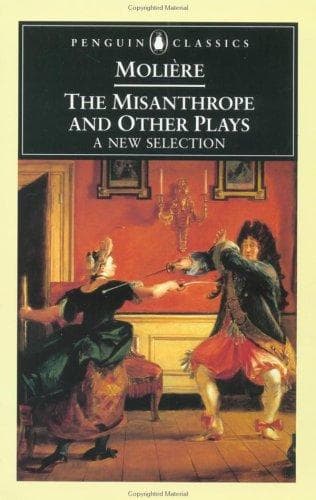
Synopsis
Covers the whole plot, including the ending.
- Difficulty
- Medium
- Pacing
- Moderate
- Mood
- Witty, Satirical, Reflective, Humorous, Cynical
- Read it if
- You enjoy classic comedies of manners, witty dialogue, and a satirical look at human nature and societal hypocrisy.
- Skip it if
- You prefer fast-paced plots, clear-cut heroes and villains, or straightforward romantic comedies.
The Misanthrope Plot Summary
Covers the whole plot, including the ending.
Alceste's Indignation
The play begins in Célimène's salon, where Alceste, a nobleman, tells his friend Philinte about his strong dislike for the dishonesty and flattery common in Parisian high society. Alceste, who believes in complete honesty, scolds Philinte for greeting an acquaintance, Oronte, too warmly, even though Philinte privately admits he dislikes him. Alceste says he will speak his mind to everyone, no matter the social cost, and wishes to be an enemy to all people. Philinte tries to moderate Alceste's extreme views, arguing that some social manners and politeness are needed for peaceful living, but Alceste sticks to his principles, seeing any compromise as a betrayal of truth.
Oronte's Sonnet and Alceste's Brutality
Oronte, a marquis, enters and eagerly shares a poem he has written, asking for Alceste's honest opinion. Philinte, always diplomatic, offers polite praise. However, Alceste, true to himself, finds the poem terrible and, despite Oronte expecting flattery, gives a harsh and unasked-for criticism. He advises Oronte to stop writing poetry and even suggests Oronte should be thankful for his honesty. Oronte, deeply offended, challenges Alceste to a duel, but Philinte calms the situation. This event shows Alceste's inability to soften his truthfulness, even if it harms his social standing and personal safety, confirming his reputation as a misanthrope.
Célimène's Charm and Alceste's Jealousy
Alceste loves Célimène, a clever and charming young widow who enjoys the attention of many suitors and engages in social gossip. Despite saying he hates social fakery, Alceste is drawn to Célimène, even though her behavior goes against his ideals of honesty. He confronts her, showing his jealousy and demanding she choose between him and her other admirers. He criticizes her for entertaining so many men and for her habit of witty but often mean gossip about their acquaintances. Célimène, however, cleverly avoids his accusations with charm and logic, arguing that her social interactions are simply how the world works and that her wit is part of her appeal, leaving Alceste frustrated and no closer to securing her exclusive affection.
The Gossiping Circle
Célimène hosts a gathering with various characters, including Acaste, Clitandre, Eliante, and Philinte. The conversation quickly turns into witty, often mean, gossip about their absent acquaintances. Célimène, with her sharp wit, leads the talk, making cutting remarks about different people in their social circle. Alceste, despite usually condemning such behavior, joins in to some extent, driven by his love for Célimène and perhaps a secret enjoyment of the clever sparring. Eliante and Philinte, however, keep a more balanced and kind view, showing the clear difference in social attitudes within the group. This scene further shows how widespread superficiality and backbiting were in their society.
Arsinoé's Hypocrisy
Arsinoé, a woman who appears religious and moral, arrives and, pretending to be a friend, tries to subtly damage Célimène's reputation, suggesting that Célimène's flirtatious behavior is being widely criticized. Célimène, equally sharp-tongued, exposes Arsinoé's hypocrisy, pointing out that Arsinoé herself secretly desires the attention she publicly condemns. Later, Arsinoé, having failed to diminish Célimène, tries to win Alceste's favor by praising his honesty and suggesting he would be better suited to a woman of her own virtuous character. She implies that Célimène is not good enough for him, hoping to cause a rift between the couple and get Alceste for herself. Alceste, however, sees through her manipulative intentions and rejects her advances, reaffirming his commitment to Célimène despite his frustrations.
The Lawsuit and Oronte's Return
Alceste's dislike for social pleasantries extends to the legal system. He is involved in a lawsuit and, refusing to flatter or bribe the judges, insists on the absolute justice of his case. As expected, he is close to losing because of his strong principles. Meanwhile, Oronte returns, still upset from Alceste's criticism of his poem, and reveals he has filed a complaint against Alceste with the Maréchal of France, a high-ranking official, for Alceste's insulting remarks. This further complicates Alceste's already difficult social standing and legal troubles, showing how his rigid honesty consistently leads him into conflict and misfortune, cementing his separation from the society he criticizes.
The Love Letters
A key moment happens when Alceste confronts Célimène with a letter she wrote to Oronte, which he has found. In the letter, Célimène makes negative comments about Alceste and expresses affection for Oronte. Alceste is crushed by this betrayal of his trust and his ideals of honesty. He demands an explanation from Célimène, who tries to dismiss it as a simple social pleasantry or a way to appease a persistent suitor. However, the harm is done. This discovery breaks Alceste's already weak belief in Célimène's honesty and strengthens his conviction that society is inherently deceitful. The letter is clear proof of Célimène's dishonesty, confirming Alceste's misanthropic view of human nature.
The Public Exposure
The situation quickly worsens when Oronte and Alceste, having settled their personal dispute, return to Célimène's salon, each holding a collection of letters written by Célimène. These letters, meant for various suitors including Oronte, Acaste, and Clitandre, contain witty but often cruel criticisms of each man, as well as expressions of affection for others. The two men expose these letters, reading them aloud to everyone present, including the very men Célimène had mocked. Célimène is publicly shamed and revealed as manipulative and two-faced. Her carefully built image of charm and wit falls apart, showing her true character and destroying her social standing, leaving her alone and embarrassed.
Alceste's Ultimatum
Despite Célimène's public humiliation and the clear proof of her deceit, Alceste, still deeply in love, offers her one last chance. He suggests they leave society entirely, giving up the deceit and superficiality of the Parisian court for a life of honest solitude in the countryside. He believes that only by cutting all ties with the corrupt world can they find true honesty and happiness together. This ultimatum is Alceste's final test of Célimène's love and commitment to his ideals. He asks her to choose between her social life and him, demanding a complete commitment that matches his own strong principles.
Célimène's Refusal and Alceste's Retreat
Célimène, though briefly humbled, cannot accept Alceste's drastic proposal. She values her social life, her status, and the attention she receives too much to give it all up for a secluded life. She argues she is too young to withdraw from the world, and that such a life would be a kind of living death for her. Faced with her refusal, Alceste, completely disappointed by her inability to embrace his ideals, declares his final break from society. He decides to leave the world alone, seeking a place where he can find true honesty and escape the widespread hypocrisy he dislikes. Philinte and Eliante, expressing their mutual affection, decide to follow Alceste, hoping to convince him to change his extreme decision, but the play ends with Alceste's determined solitary departure.
The Misanthrope Characters
Alceste
Protagonist
A principled but cantankerous nobleman who despises societal hypocrisy.
Alceste is a man of rigid principles who values absolute honesty and sincerity above all else. He cannot tolerate flattery, pretense, or social niceties, which he views as fundamental betrayals of truth. His misanthropy stems from his deep disappointment with human nature, believing most people are deceitful and superficial. Despite his strong convictions, he is paradoxically and passionately in love with Célimène, whose flirtatious and gossiping nature directly contradicts his ideals. This internal conflict drives much of his character's struggle and dramatic tension. He is often seen as a tragicomic figure, both admirable for his integrity and ridiculous for his impractical extremism.
Relationships: Célimène (Passionate and conflicted love interest, object of his desire and frustration.); Philinte (Loyal, pragmatic friend, often tries to moderate Alceste's extremism.); Eliante (Admires Alceste's honesty, offers a calmer, more understanding perspective.); Oronte (Rival for Célimène's affection, initially offended by Alceste's bluntness.)
Célimène
Co-Protagonist/Love Interest
A witty, charming, and flirtatious young widow who thrives on social attention.
Célimène is a beautiful, intelligent, and highly sought-after young widow who is a master of social grace and witty banter. She enjoys the attention of numerous suitors and delights in sharp-tongued gossip, which she uses to entertain her circle and maintain her social standing. While she possesses genuine charm, she is also fundamentally insincere, adept at playing different men against each other and saying whatever is convenient in the moment. Her reluctance to commit to Alceste stems from her deep attachment to her social freedom and the adoration she receives from many. She represents the very superficiality that Alceste despises, yet she is undeniably captivating.
Relationships: Alceste (Love interest, her most ardent suitor, whom she both teases and genuinely cares for, but ultimately cannot commit to his terms.); Philinte (Friend, but also a target for her wit in social settings.); Eliante (Friend and confidante, though less privy to her manipulative side.); Oronte (Suitor, recipient of her flirtatious letters.); Acaste (Suitor, another object of her wit and manipulation.); Clitandre (Suitor, also a target of her letters and social games.)
Philinte
Supporting
Alceste's pragmatic and amiable friend, a voice of reason and social compromise.
Philinte is Alceste's loyal friend and intellectual foil. He embodies a more balanced and realistic approach to social interaction, understanding that some level of politeness and compromise is necessary for navigating society. He genuinely cares for Alceste and tries repeatedly to moderate his extreme misanthropy, advocating for a more tolerant view of human flaws. Philinte is kind, good-natured, and observant, often serving as the audience's guide through Alceste's dramatic outbursts. He eventually falls in love with Eliante, representing a harmonious and sensible partnership in contrast to Alceste's turbulent romance.
Relationships: Alceste (Close friend, attempts to guide and temper Alceste's views.); Eliante (Love interest, eventually marries her.); Célimène (Acquaintance, part of their social circle.)
Eliante
Supporting
Célimène's sensible cousin, who secretly admires Alceste and later loves Philinte.
Eliante is Célimène's cousin and a woman of grace, sincerity, and good sense. She possesses a quiet dignity and a more genuinely kind nature than Célimène. She secretly harbors an admiration for Alceste's honesty, even while acknowledging his flaws. She represents a different kind of virtue, one that is not as extreme as Alceste's but still values truth and integrity. When it becomes clear that Alceste will never reciprocate her feelings, she accepts Philinte's affections, forming a loving and sensible match. She serves as a moral compass within the play, offering thoughtful observations on human behavior.
Relationships: Alceste (Object of her initial, unrequited admiration.); Philinte (Love interest, eventually marries him.); Célimène (Cousin and friend.)
Oronte
Supporting/Rival
A marquis and suitor to Célimène, whose vanity is easily bruised.
Oronte is a nobleman and one of Célimène's many suitors. He is a man of considerable vanity, eager for praise and easily offended by criticism, as demonstrated by his reaction to Alceste's harsh critique of his sonnet. He is genuinely in love with Célimène and is willing to go to great lengths to win her affection, even filing a complaint against Alceste. His character highlights the superficiality and sensitivity of the aristocratic class, as he is more concerned with his reputation and poetic skill than with genuine sincerity. He eventually joins Alceste in exposing Célimène's duplicity.
Relationships: Célimène (Suitor, object of his affection, and eventually, his anger.); Alceste (Rival, initially an enemy due to Alceste's bluntness.)
Arsinoé
Supporting/Antagonist
A prudish and hypocritical woman who feigns virtue to mask her envy.
Arsinoé is a seemingly virtuous and pious woman who, in reality, is deeply envious of Célimène's charm and popularity. She uses her outward morality as a facade to criticize others, particularly Célimène, under the guise of concern. She attempts to undermine Célimène's reputation and later tries to seduce Alceste, believing his honest nature would be better suited to her own feigned virtue. Her character serves as a stark example of hypocrisy, demonstrating that even those who preach morality can be driven by malicious intent and concealed desires. Alceste sees through her pretense immediately.
Relationships: Célimène (Rival, feigns friendship while secretly trying to undermine her.); Alceste (Tries to win his affection, attempting to paint herself as a virtuous alternative to Célimène.)
Acaste
Supporting
A marquis, one of Célimène's boastful and self-assured suitors.
Acaste is a young marquis, one of Célimène's many suitors. He is excessively vain and self-important, convinced of his own charm and desirability. He boasts about his wealth, status, and accomplishments, believing himself to be irresistible to women. He is easily swayed by flattery and is deeply offended when he discovers Célimène's true opinions of him in her letters. His character, along with Clitandre, represents the superficial and self-absorbed nature of the aristocratic youth, primarily concerned with appearances and social conquests rather than genuine connection.
Relationships: Célimène (Suitor, object of his affections and later, his scorn.)
Clitandre
Supporting
Another marquis and suitor to Célimène, similar in vanity to Acaste.
Clitandre is another of Célimène's marquis suitors, very similar in character to Acaste. He is equally vain, fashionable, and self-absorbed, vying for Célimène's attention and believing himself to be a worthy catch. He participates in the social games and gossip of Célimène's salon, showcasing the superficial interactions common in their society. Like Acaste, he is shocked and angered when Célimène's private criticisms of him are revealed through her letters. His presence reinforces the idea of a pervasive culture of superficiality and self-delusion among the aristocratic elite.
Relationships: Célimène (Suitor, object of his affections and later, his scorn.)
The Misanthrope Themes
Hypocrisy vs. Sincerity
This is the play's main conflict, shown by Alceste's demand for complete honesty against the widespread dishonesty of Parisian society. Alceste's refusal to engage in polite flattery, even when it costs him his lawsuit or friendships, highlights society's expectation of dishonesty. Célimène, on the other hand, skillfully navigates society through charming deceit and clever gossip, representing the easy compromise most people make. The play questions whether complete honesty is truly desired or even possible in a functioning society, suggesting that some social fakery might be needed for peace, as Philinte argues. The drama comes from Alceste's inability to reconcile his ideals with the world around him.
“I wish that on some solid ground, / One could distinguish friend from foe, / And see men as they really are, you know.”
Love and Idealism
The theme explores the tension between Alceste's strict ideals and his strong love for Célimène. Despite disliking everything Célimène represents—flirtation, gossip, and dishonesty—Alceste loves her deeply. His love puts him in a constant internal struggle as he tries to make her fit his ideals of honesty. Célimène, however, cannot and will not change her nature for him. This theme shows how hard it is to love someone who fundamentally contradicts one's core values and questions whether love can truly overcome deeply set character traits. Alceste's final demand for Célimène to leave society is his last, desperate attempt to match his love with his ideals, which ultimately fails.
“I love her, yes; but my own heart I hate / To think that I'm so caught in my own fate.”
Social Conformity vs. Individualism
The play looks at the pressure to conform to social norms versus the desire for individual expression and integrity. Alceste is the ultimate individualist, refusing to compromise his principles for social acceptance. His isolation and troubles are direct results of his nonconformity. Philinte, conversely, represents the practical conformist who understands and accepts the need for social graces. Célimène, while appearing individualistic in her wit, is ultimately a product of her society, thriving on its attention and following its unspoken rules of superficiality. The play implicitly asks what price one pays for either extreme: the misery of alienation for Alceste or the potential loss of self for those who conform.
“No, I'll not change my ways, I'm quite resolved; / The world's to blame, not I, if it's involved / In such a web of treachery and lies.”
The Nature of Wit and Satire
Molière uses the play to explore the nature and role of wit and satire in society. Célimène's salon is a place of witty, often cruel, gossip and social criticism, showing how wit can be used for entertainment, social climbing, and even malice. Alceste's blunt honesty, while not witty in the usual sense, is a form of harsh satire. The play satirizes the very society it shows, using humor to expose human flaws. It distinguishes between genuine, insightful criticism and superficial, backbiting gossip, prompting thought on the ethical implications of social commentary and the power of language.
“Her tongue is like a poisoned dart, it flies / At every soul, and leaves a sting behind.”
Plot Devices & Literary Techniques
The Love Letters
Physical evidence revealing Célimène's duplicity.
The letters written by Célimène to various suitors serve as a crucial plot device. Initially, Alceste discovers one letter, confirming his suspicions of her insincerity. Later, the collective revelation of multiple letters by Oronte and Alceste publicly exposes Célimène's manipulative nature to her entire social circle. These letters provide concrete, undeniable proof of her hypocrisy, acting as a catalyst for the play's climax and Alceste's final disillusionment. They function as both a dramatic reveal and a symbol of the pervasive deceit within their society, bringing Célimène's carefully constructed facade crashing down.
Alceste's Lawsuit
A subplot demonstrating Alceste's uncompromising honesty and its consequences.
Alceste's ongoing lawsuit, which he is losing because he refuses to flatter or bribe the judges, serves as a recurring subplot that underscores his inability to compromise his principles, even for practical gain. It provides a tangible, real-world consequence of his rigid honesty, illustrating how his ideals clash with the corrupt realities of society. The lawsuit is not central to the romantic plot but reinforces Alceste's character and his ultimate decision to withdraw from a world he perceives as inherently unjust and dishonest. It highlights his consistency and the high price he pays for his integrity.
The Sonnet
An early scene establishing Alceste's uncompromising nature.
Oronte's sonnet and Alceste's brutal critique of it is an early, pivotal scene that immediately establishes Alceste's defining characteristic: his absolute, unvarnished honesty, regardless of social consequence. It sets the tone for his interactions throughout the play and reveals the depth of his misanthropy. This incident not only creates immediate conflict between Alceste and Oronte but also foreshadows the difficulties Alceste will face in navigating a society built on polite falsehoods. It serves as a concise demonstration of why Alceste is considered 'the Misanthrope' and why he struggles so profoundly.
The Misanthrope Quotes
“Ah! rather I would that my life were ended, Than of the truth should be one syllable mended.”
“I find that everywhere, for shame, the best is made a jest.”
“Reason, dear friends, is not the thing to rule the heart.”
“The world is full of tricksters and of fools.”
“For my part, I declare, I'll love no one who is not fair.”
“All men are much the same, and all deserve our blame.”
“I'm not so much afraid of a blow as of a lie.”
“Your perfect character, that you so much prize, Makes you the laughingstock of all wise eyes.”
“I hate all men; some I hate because they are bad, others because they are good.”
“One must forgive a little, and not be too severe.”
“I wish to live in a place where I may be free to be honest.”
“Friendship demands of us a little blindness.”
“The world, you know, will never take your part, If you expose to it too much your heart.”
“I always speak my mind, and scorn to flatter any.”
Quiz
10 questions on the plot and the characters. Each answer comes with a short explanation.
Question 1
What is Alceste's primary complaint about society at the beginning of the play?
- The lack of proper etiquette in social gatherings.
- The prevalence of flattery and insincerity.
- The excessive materialism of the aristocracy.
- The poor quality of contemporary poetry.
Show answer
B. The prevalence of flattery and insincerity. Alceste is introduced as a character who despises the social conventions of his time, particularly the insincerity and flattery he observes in polite society.
Question 2
Which character is Alceste in love with, despite her embodying many of the social traits he despises?
- Arsinoé
- Éliante
- Célimène
- Philinte
Show answer
C. Célimène Alceste's central conflict stems from his love for Célimène, a witty coquette who thrives on social attention and engages in the very flattery and gossip Alceste abhors.
Question 3
What is the relationship between Philinte and Alceste?
- They are romantic rivals for Célimène's affection.
- They are close friends with contrasting views on society.
- Philinte is Alceste's lawyer, advising him on his lawsuit.
- They are distant relatives who rarely interact.
Show answer
B. They are close friends with contrasting views on society. Philinte is Alceste's pragmatic and tolerant friend, often serving as a foil to Alceste's rigid misanthropy and trying to temper his extreme views.
Question 4
What does Alceste demand of Oronte regarding his sonnet?
- That Oronte publish it immediately.
- That Oronte recite it publicly at a salon.
- That Oronte admit the sonnet is bad and rewrite it.
- That Oronte dedicate the sonnet to Célimène.
Show answer
C. That Oronte admit the sonnet is bad and rewrite it. Alceste, true to his nature, gives Oronte a brutally honest critique of his sonnet, demanding that Oronte acknowledge its poor quality rather than accepting polite, insincere praise.
Question 5
Which character attempts to expose Célimène's two-faced nature by revealing her critical letters?
- Éliante
- Acaste
- Arsinoé
- Clitandre
Show answer
C. Arsinoé Arsinoé, out of jealousy and a desire to undermine Célimène, brings letters written by Célimène that mock various members of society, exposing her hypocrisy.
Question 6
What is the primary theme explored through the character of Alceste?
- The importance of social conformity.
- The conflict between uncompromising honesty and social hypocrisy.
- The pursuit of wealth and status.
- The nature of true friendship.
Show answer
B. The conflict between uncompromising honesty and social hypocrisy. Alceste embodies the theme of uncompromising honesty, constantly clashing with the polite but often insincere social norms of his aristocratic setting.
Question 7
What is the outcome of Alceste's lawsuit?
- He wins the lawsuit and is financially secure.
- He loses the lawsuit due to his refusal to flatter the judges.
- The lawsuit is dropped before a verdict is reached.
- He settles the lawsuit out of court.
Show answer
B. He loses the lawsuit due to his refusal to flatter the judges. Alceste loses his lawsuit, a consequence of his principled refusal to engage in the flattery and manipulation that were common practices to win favor in the legal system of the time.
Question 8
What condition does Alceste give Célimène for them to be together at the end of the play?
- She must leave society and live with him in isolation.
- She must publicly apologize to everyone she gossiped about.
- She must choose him over all her other suitors.
- She must agree to marry him immediately.
Show answer
A. She must leave society and live with him in isolation. Alceste, consistent with his misanthropic views, demands that Célimène abandon society and join him in a secluded life, a condition she ultimately refuses.
Question 9
How does Célimène react to Alceste's final proposition?
- She readily agrees, eager to escape society.
- She agrees, but only if he promises to change his ways.
- She refuses, finding his demand for isolation incompatible with her nature.
- She asks for time to consider his offer.
Show answer
C. She refuses, finding his demand for isolation incompatible with her nature. Célimène, being a social creature who thrives on attention and wit, finds Alceste's demand to retreat from society unacceptable and ultimately refuses him.
Question 10
What is the ultimate fate of Alceste at the end of the play?
- He marries Éliante and finds contentment.
- He decides to remain in society and adapt to its ways.
- He resolves to flee society and live in isolation.
- He is reconciled with Célimène and they live happily ever after.
Show answer
C. He resolves to flee society and live in isolation. Disillusioned by Célimène's refusal and society's perceived corruption, Alceste declares his intention to withdraw from society and find an isolated place where he can be truly honest.
The Misanthrope FAQ
What is the central conflict in 'The Misanthrope'?
The central conflict revolves around Alceste's uncompromising demand for absolute sincerity and honesty in a society built on politeness and artifice, particularly clashing with his love for Célimène, who embodies the very social graces he despises. He struggles to reconcile his ideals with the pragmatic realities of human interaction and the nature of love.
Who is Célimène and what role does she play?
Célimène is a young, witty, and charming widow at the center of Parisian high society, known for her sharp tongue and love of gossip. She represents the social world Alceste rails against, yet she is also the object of his intense affection, creating a profound dilemma for him and highlighting the hypocrisy he claims to abhor.
What is Alceste's main complaint about society?
Alceste's primary grievance is the pervasive insincerity and flattery he perceives in aristocratic society. He despises the polite falsehoods, the backbiting disguised as wit, and the lack of genuine emotion or opinion, demanding a radical honesty that most find unbearable or impractical.
How does the play resolve Alceste's romantic pursuit of Célimène?
Alceste's romantic pursuit ends with Célimène refusing to abandon society and retreat with him to a desert, as he demands. Her refusal to compromise her social life for his misanthropic ideals leads to their definitive separation, leaving Alceste to pursue his isolation alone.
Who are Philinte and Éliante, and what do they represent?
Philinte is Alceste's rational and tolerant friend, who advocates for a more balanced and pragmatic approach to social interaction, accepting human flaws. Éliante is Célimène's cousin, a virtuous and sensible woman who quietly admires Alceste and eventually accepts Philinte's proposal, representing a more harmonious and realistic path.
What is the significance of the sonnet Alceste criticizes?
Alceste's scathing critique of Oronte's sonnet isn't just about bad poetry; it's a direct challenge to the superficial flattery and unearned praise common in their social circle. It serves as a catalyst, showcasing Alceste's inability to temper his honesty, even at the cost of offending a powerful man and risking legal trouble.
Are there any subtle hints about Célimène's true feelings for Alceste?
While Célimène openly mocks Alceste's temper, her consistent engagement with his arguments and her reluctance to fully dismiss him, even when presented with other suitors, suggests a deeper, albeit complicated, affection. Her final refusal to leave society, rather than a dismissal of him, might indicate her own self-preservation within her chosen world.
What is the role of the 'billets-doux' (love letters) in the plot?
The discovery of Célimène's indiscreet letters, written to multiple suitors and mocking others, serves as the ultimate exposure of her social duplicity. This revelation forces her to confront the consequences of her actions and provides Alceste with the 'proof' he needed of her insincerity, shattering his illusions.
How does Alceste's misanthropy stem from his own insecurities?
Alceste's extreme misanthropy can be interpreted as a defense mechanism against his own vulnerability and fear of rejection. By preemptively condemning all of humanity, he protects himself from the pain of individual disappointments, projecting his anxieties onto the entire social fabric.
Is Alceste a tragic or a comic figure, from a psychological perspective?
Psychologically, Alceste embodies elements of both: he is tragic in his inability to find happiness or compromise, driven by an unyielding idealism that isolates him. Yet, he is comic in the exaggerated, almost absurd, nature of his demands and his self-defeating obstinacy, making his plight simultaneously pitiable and humorous.
What does Célimène's character reveal about female agency in 17th-century society?
Célimène, despite being a widow, cleverly navigates and manipulates her social environment through wit and charm, asserting a form of agency within the constraints of her time. Her refusal to be dictated by Alceste's demands or to marry for anything other than her own terms speaks to a subtle, yet powerful, independence.
How does Alceste's pursuit of 'truth' become a form of self-sabotage?
Alceste's relentless pursuit of absolute truth, devoid of social graces, consistently alienates him from others and ultimately from the woman he loves. His inability to discern between harmful deception and harmless social convention leads him to destroy his own relationships and opportunities for happiness, making his quest self-destructive.
Is Molière ultimately condemning or empathizing with Alceste's misanthropy?
Molière seems to do both. While the play satirizes Alceste's impractical extremism and self-defeating nature, it also gives voice to his legitimate criticisms of hypocrisy, suggesting a degree of empathy for his desire for authenticity. The play doesn't offer a simple judgment but rather a nuanced portrayal of human flaws.
Does the play suggest that sincerity is impossible or merely impractical in society?
The play largely suggests that absolute sincerity, as Alceste demands it, is impractical and incompatible with the smooth functioning of society, which relies on a certain level of polite artifice. However, it also implies that a degree of genuine sincerity, balanced with tact, is desirable, as exemplified by Philinte and Éliante.
How does 'The Misanthrope' remain relevant in contemporary society?
The play's exploration of authenticity versus social performance, the challenges of honest communication, and the human need for connection despite perceived flaws resonates strongly today. Alceste's struggle mirrors modern debates about cancel culture, political correctness, and the search for genuine relationships in an often superficial world.
Could Alceste and Célimène ever have found happiness together?
It is highly unlikely they could have found happiness together, given their fundamental incompatibility. Alceste's rigid idealism and Célimène's ingrained love for social interaction and witty banter were diametrically opposed, making any long-term union fraught with conflict and mutual dissatisfaction.
What is the significance of Alceste's final decision to retreat from society?
Alceste's final decision to retreat to a 'desert' signifies his ultimate rejection of society and his surrender to his misanthropic ideals. It underscores his inability to compromise or adapt, marking a tragic, yet perhaps inevitable, conclusion for a character so uncompromisingly set against the world.
How does the play challenge the conventions of 17th-century comedy?
Unlike typical farces of its time, 'The Misanthrope' features complex, dynamic characters rather than flat caricatures, and prioritizes character development and psychological nuance over simple plot progression. It also delves into more serious philosophical questions about human nature and society, transcending mere slapstick humor.
About the author

Jean-Baptiste Poquelin, known by his stage name Molière, was a French playwright, actor, and poet, widely regarded as one of the greatest writers in the French language and world literature. His extant works include comedies, farces, tragicomedies, comédie-ballets, and more. His plays have been translated into every major living language and are performed at the Comédie-Française more often than those of any other playwright today. His influence is such that the French language is often referred to as the "language of Molière".
Similar books
- The Importance of Being Earnest
Oscar Wilde
4.2 (302k) average on GoodreadsHistoryA classic comedy of manners that uses wit and paradox to expose the absurdities of Victorian society.
- Pride and Prejudice
Jane Austen
4.3 (3M) average on GoodreadsHistorical FictionExplores social conventions, misjudgment, and the complexities of love within a specific societal framework.
- Nineteen Eighty-Four
George Orwell
4.2 (5.5M) average on GoodreadsFictionWinston Smith dreams of truth and rebellion in a world where Big Brother watches all, but he confronts the terrifying power of a regime that controls not just actions, but thoughts.
- The Frozen River
Ariel Lawhon
4.4 (600k) average on GoodreadsFictionIn 1789 Maine, a heroic midwife's diary helps her expose a murder and get justice in a town that wants to silence her.
- A Man Called Ove
Fredrik Backman
4.4 (569k) average on GoodreadsFictionA stubborn widower, who lives by strict rules, finds his quiet world changed by a lively new family next door, making him face his past and find happiness in human connection.
- The Art of Racing in the Rain
Garth Stein
4.2 (452k) average on GoodreadsFictionThrough the eyes of Enzo, a wise and observant dog, a race car driver's family navigates a journey of love, loss, and resilience, learning that life's most important lessons often come in the curves, not just on the straightaways.




Enjoyed the summary?
A summary gives you the shape of the book. The book itself has the detail, the examples and the voice.
Find The Misanthrope on AmazonAs an Amazon Associate, BookBrief earns from qualifying purchases. How we're funded