

Synopsis
Covers the whole plot, including the ending.
- Difficulty
- Easy
- Pacing
- Moderate
- Mood
- Mysterious, Analytical, Suspenseful, Macabre
- Read it if
- You enjoy classic mysteries, short stories, and the birth of the detective genre.
- Skip it if
- You prefer modern, fast-paced thrillers or intricate character development.
The Murders in the Rue Morgue Plot Summary
Covers the whole plot, including the ending.
The Art of Ratiocination
The unnamed narrator, an American in Paris, meets C. Auguste Dupin in a dusty library. They become friends, sharing a love of books and a preference for solitude. They decide to live together in an old, quiet mansion in the Faubourg St. Germain. The narrator describes Dupin's extraordinary analytical skills, especially his method of 'ratiocination'—logical deduction and inference. He shares a story where Dupin, by observing the narrator's thoughts and actions, correctly guesses what the narrator is thinking at that moment, surprising him.
A Horrific Discovery
Their peaceful lives are interrupted by a shocking news report. Madame L'Espanaye and her daughter, Camille, are found brutally murdered in their fourth-story apartment on the Rue Morgue. The elderly mother's throat is deeply cut, and her body is found in the courtyard, thrown down the chimney. Camille's body is discovered crammed headfirst into the chimney, covered in bruises and scratches. The apartment is locked from the inside, and a large sum of money is untouched, confusing both the police and the public.
Police Investigation and Public Confusion
The Parisian police, led by Prefect G---, investigate but are completely baffled. Witnesses give conflicting accounts of voices heard before the murders. Some heard French, others a foreign, guttural, non-human language. The locked room, the immense strength needed for the acts, and the lack of a clear motive or entry/exit point leave authorities puzzled. The press sensationalizes the case, emphasizing its inexplicable nature and the apparent impossibility of a human killer acting alone.
Dupin Takes an Interest
Dupin, interested by the sensational details and the police's failure to apply good reasoning, decides to get involved. He criticizes the police's reliance on routine and their inability to see past the obvious. He believes the crime's complexity and apparent impossibility make it solvable through careful analysis of details others ignore. He gets permission from Prefect G--- to visit the crime scene with the narrator.
The Crime Scene Examination
Dupin and the narrator go to the apartment on the Rue Morgue. Dupin thoroughly examines the premises, focusing on details the police missed. He inspects the windows, especially their latches, and the chimney. He notes the extreme mess, bloodstains, and general violence. He pays close attention to the windows, observing how they could be secured from the inside but also how they might appear secured while actually being open. He measures the bodies' positions and the room's dimensions, collecting all physical evidence.
Unraveling the Locked Room
Through his careful examination, Dupin figures out how the locked room worked. He finds a hidden spring in one of the window latches that makes it look securely fastened from the inside, even when it is not. This explains how the killer could have entered and exited without forcing a lock. He also notices the unusual hair in Madame L'Espanaye's hand, which is not human, and the impossible strength needed for the murders, far beyond that of any ordinary man. He starts to form a new idea about the killer's identity.
The Non-Human Suspect
Dupin tells the narrator his surprising conclusion: the murderer is not human. He points to the superhuman strength, the agility needed to climb the building, the non-human hair, the strange grip marks on Camille's throat, and the unintelligible 'foreign' language heard by witnesses—which he interprets as guttural cries. He suggests an orangutan, having escaped, committed the murders. To confirm his idea, he places an advertisement in the newspaper for a lost orangutan, hoping its owner will come forward.
The Sailor's Confession
A sailor responds to Dupin's advertisement. He arrives at Dupin's apartment, looking nervous. Dupin confronts him with the evidence, explaining his deductions. The terrified sailor confesses he owns an orangutan that escaped from his care. He recounts how the ape, after watching him shave, tried to imitate him, eventually grabbing a razor and escaping through a window. He followed it, witnessing the horrifying murders from outside, but could not intervene.
The Ape's Escape and the Sailor's Testimony
The sailor explains that the escaped orangutan climbed the lightning rod and entered the L'Espanaye apartment through the open window. It then attacked the two women with the razor, mimicking the shaving action, and using its immense strength. In a panic, it stuffed Camille into the chimney and threw Madame L'Espanaye out the window. The ape then escaped by swinging from the lightning rod to another window, leaving the sailor as the only horrified witness to the impossible crime. He had been too afraid of being implicated to come forward until Dupin's advertisement.
Resolution and Police Reaction
With the sailor's testimony, Dupin's deductions are fully confirmed. The sailor reclaims his orangutan, which he later sells. Prefect G---, while acknowledging the solution, remains unimpressed and somewhat resentful of Dupin's success, showing bureaucratic resistance to new methods. Dupin, however, does not care about public praise or official recognition, content with his logical triumph. The case, once a mystery, shows the power of logical thought over standard police procedures.
Principal Figures
C. Auguste Dupin
Protagonist
The brilliant, reclusive amateur detective.
Dupin is a young, impoverished but highly educated gentleman living in Paris. He possesses an extraordinary intellect, particularly a gift for 'ratiocination' – the ability to deduce complex truths from seemingly insignificant details through logical inference. He is an observer of human nature and society, often preferring solitude and intellectual pursuits. He is characterized by his methodical approach, his disdain for conventional police methods, and his ability to empathize with both the criminal and the victim to understand motives and actions. He is driven by intellectual curiosity and a desire to prove the superiority of his analytical method.
Relationships: The Narrator (Close intellectual companion and confidant)
The Narrator
Supporting
Dupin's devoted friend and chronicler of his exploits.
The unnamed narrator is Dupin's loyal friend and intellectual companion. He is less brilliant than Dupin but serves as an intelligent and appreciative audience for Dupin's deductions. He recounts the story, providing a first-person perspective on Dupin's genius and the unfolding mystery. He is initially astonished and sometimes bewildered by Dupin's insights but ultimately becomes a firm believer in his friend's unique abilities. His role is crucial in explaining Dupin's methods and highlighting the contrast between Dupin's brilliance and the ordinary human mind.
Relationships: C. Auguste Dupin (Close intellectual companion and confidant)
Madame L'Espanaye
Victim
Elderly victim of the Rue Morgue murders.
Madame L'Espanaye is an elderly, wealthy woman who lives with her daughter, Camille, in an apartment on the Rue Morgue. She is described as having some money, which is found untouched after her brutal murder. Her murder is particularly gruesome, with her throat deeply cut and her body later discovered in the courtyard below, having been forced down the chimney. She represents the innocent victim of an inexplicable, terrifying crime, her death serving as the central mystery that Dupin must solve.
Relationships: Camille L'Espanaye (Mother-daughter relationship)
Mademoiselle Camille L'Espanaye
Victim
Younger victim of the Rue Morgue murders.
Camille L'Espanaye is Madame L'Espanaye's daughter, also brutally murdered in their apartment. Her body is found crammed headfirst into the chimney, covered in severe bruises and scratches, indicating a struggle and immense force. She is a key piece of the puzzle, as the specific nature of her injuries and the manner of her concealment point towards a non-human assailant. Like her mother, her role is to define the horror and impossibility of the crime.
Relationships: Madame L'Espanaye (Mother-daughter relationship)
Prefect G---
Supporting
Head of the Parisian police, baffled by the crime.
Prefect G--- is the head of the Parisian police department, responsible for investigating the Rue Morgue murders. He represents the conventional, unimaginative approach to crime-solving, relying heavily on routine and physical evidence without the capacity for imaginative leaps or deep logical inference. He is utterly perplexed by the seemingly impossible circumstances of the murders, highlighting the limitations of official police work when faced with the truly unprecedented. He is initially dismissive of Dupin's amateur involvement but grudgingly acknowledges his success.
Relationships: C. Auguste Dupin (Professional rivalry; Dupin's intellectual foil)
The Sailor (Owner of the Ourang-Outang)
Supporting
The nervous owner of the Ourang-Outang, who witnessed the murders.
The sailor is the owner of the Ourang-Outang that committed the murders. He is a key witness, though he initially keeps silent due to fear of implication. He is a practical man, not particularly intellectual, who provides the crucial eyewitness account that confirms Dupin's extraordinary deductions. His testimony reveals the ape's escape, its imitative behavior, and the horrifying circumstances of the murders, bringing the seemingly impossible case to a complete resolution.
Relationships: Ourang-Outang (Owner-pet (master-animal) relationship)
Ourang-Outang
Antagonist
The non-human perpetrator of the murders.
The Ourang-Outang is the actual murderer of Madame L'Espanaye and Camille. It is a large, powerful, and exceptionally agile ape, recently brought to Paris by the sailor. Its actions are driven by instinct and imitation, specifically mimicking its master's shaving ritual, leading to the brutal use of a razor. Its immense strength, agility, and non-human nature are the keys to understanding the impossible aspects of the crime, such as the forced entry, the brutal injuries, and the disposal of the bodies. It represents the unforeseen and irrational element that conventional human logic struggles to comprehend.
Relationships: The Sailor (Owned by the sailor)
Themes & Insights
The Power of Ratiocination vs. Conventional Intellect
This is the main theme, showing Dupin's analytical method as better than the police's ordinary, routine intelligence. Dupin believes true skill comes from seeing 'beyond the obvious' and using logic on seemingly conflicting details. The police, represented by Prefect G---, fail because they categorize evidence and lack the imagination for new solutions. Dupin's success shows that complex problems often have simple, unexpected solutions when approached with true analytical rigor, not just standard procedures.
“'The police are all very well in their way, and are competent for all ordinary emergencies. Their energy is proverbial. But these exertions are by no means invariably such as to meet the exigencies of all cases. They have no ideas of their own, and are always looking for precedent. This case is one in which they have been utterly baffled.'”
Appearance vs. Reality
The story constantly explores the difference between what seems true and what is actually true. The locked room appears impossible to enter, suggesting a supernatural crime, but Dupin reveals a hidden mechanism. The 'foreign' language heard by witnesses seems to point to a human culprit but is revealed to be an ape's cries. This theme highlights that initial views can be misleading, and deeper analysis is needed to find the truth, prompting the reader to question assumptions and look past surface evidence.
“'It is not so much a question of what is seen, as of what is perceived in the seeing.'”
The Monstrous and the Unforeseen
The story looks at humanity's encounter with the monstrous, not supernaturally, but as an animalistic, irrational force beyond human understanding and ability. The orangutan's violence is beyond human malice, driven by instinct and imitation, making the murders especially horrifying and hard for conventional minds to explain. This theme shows the fragility of human order when faced with raw, untamed nature, and the fear that arises when events defy our established ways of understanding cause and effect, pushing the limits of what is possible.
“'The Ourang-Outang is a very large and formidable quadruped of the East Indian islands. Its height is about five feet. Its strength is prodigious, and its ferocity, at certain seasons, is fearful. I have seen one of them, with a single blow of a club, fell an ox to the ground.'”
The Limitations of Conventional Law and Order
Poe critiques standard law enforcement methods, showing the police as competent only for 'ordinary emergencies' but completely lost when faced with a truly unique and complex crime. Prefect G--- and his officers rely too much on established procedures and cannot make the imaginative leaps needed for such an unprecedented case. Dupin's success, in contrast to the police's failure, directly comments on the shortcomings of a system that favors routine and precedent over individual skill and new ideas, especially when dealing with the truly extraordinary.
“'The Prefect, however, was not a man to give up a point readily. He had been a successful officer, and prided himself on his acumen. But here he was at fault. He had exhausted his ingenuity, and could no longer proceed.'”
Plot Devices & Literary Techniques
The Locked Room Mystery
A crime committed in an apparently inaccessible room.
This is the foundational plot device. The murders occur in an apartment locked from the inside, with no apparent means of entry or exit for the perpetrator. This device creates immense suspense and bafflement for both the characters and the reader, making the crime seem impossible. Dupin's genius is highlighted by his ability to meticulously deconstruct this impossibility, revealing a hidden mechanism (the spring-loaded window catch) that reconciles the appearance of impossibility with the reality of the crime, thereby providing a rational explanation for the seemingly supernatural.
The Unreliable Witness Testimony
Conflicting accounts from witnesses that mislead investigators.
Witnesses provide conflicting accounts of voices heard during the murders – some heard French, others heard a foreign, guttural language. This device initially confuses the police, who try to reconcile these human testimonies. Dupin, however, uses the very contradictions to his advantage. He realizes that the 'foreign' language, when combined with other evidence, points to a non-human source, and the 'French' voices were merely fleeting exclamations. This highlights how subjective human perception can be and how a skilled detective must interpret, rather than simply accept, testimony.
The Disguised Clue
A crucial piece of evidence overlooked or misinterpreted.
Several clues are disguised, meaning they are present but their significance is not immediately apparent or they are misinterpreted by conventional minds. Examples include the non-human hair found in Madame L'Espanaye's hand, the specific nature of Camille's injuries (finger marks), and the super-human strength implied by the disarray. These clues, individually dismissed or misunderstood by the police, are meticulously collected and logically connected by Dupin to form a coherent picture that leads him to the Ourang-Outang. This device underscores Dupin's superior observational and analytical skills.
The Red Herring
Information designed to mislead the reader and police.
The untouched money in the apartment and the extreme brutality of the murders serve as red herrings. The police initially assume robbery as a motive, and the savage nature of the crime suggests a human killer driven by intense rage or madness. However, Dupin quickly dismisses robbery due to the money being left behind and recognizes that the brutality, combined with other details, points away from human agency. These elements are designed to misdirect the reader's and the police's initial assumptions, making Dupin's eventual solution all the more surprising and brilliant.
The Murders in the Rue Morgue Quotes
“The mental features discoursed of as the analytical, are, in themselves, but little susceptible of analysis.”
“It is not so much a question of what we see, as of what we perceive.”
“The more bizarre a thing is, the more likely it is to be a clue.”
“To be shrewd is one thing; to be sagacious is another.”
“The ordinary police are good enough for ordinary occurrences.”
“Had the doors been fastened from within, how could the perpetrator have escaped?”
“It is true that the intellect of the masses is not to be despised.”
“There are no mysteries so profound as those which are daily before our eyes.”
“The faculty of re-solution is possibly much invigorated by mathematical study.”
“I will not waste time in a vain effort to impress you with a sense of my acumen.”
“It is not impossible that the murderer was a madman.”
“The species of ratiocination which Dupin here practices, he terms analysis.”
“He suffers nothing to escape him.”
“The wild conjectures of the police were, of course, utterly futile.”
Quiz
10 questions on the plot and the characters. Each answer comes with a short explanation.
Question 1
Who is the primary narrator and companion to C. Auguste Dupin in 'The Murders in the Rue Morgue'?
- Monsieur G.
- An unnamed friend
- Adolphe Le Bon
- The Prefect of Police
Show answer
B. An unnamed friend The story is narrated by an unnamed friend and companion of Dupin, who recounts the events of the investigation.
Question 2
What is the most unusual circumstance surrounding the entry and exit of the murderer from the fourth-story apartment where the victims were found?
- A secret passage unknown to the residents.
- The windows and doors were securely fastened from the inside.
- The murderer used a complex system of ropes and pulleys.
- The murderer was disguised as one of the victims.
Show answer
B. The windows and doors were securely fastened from the inside. A key perplexing detail for the police was that the apartment, particularly the fourth-story room, appeared to be hermetically sealed from the inside, making both entry and exit seem impossible.
Question 3
What unique physical characteristic is noted about the voice heard by multiple witnesses during the murders?
- It spoke in an ancient, forgotten language.
- It was a guttural, non-human utterance, perceived differently by each witness.
- It was a high-pitched, feminine scream.
- It was a whispering voice, speaking a foreign dialect.
Show answer
B. It was a guttural, non-human utterance, perceived differently by each witness. Witnesses described the voice as harsh, guttural, and non-human, with each witness identifying it as speaking a different foreign language, leading Dupin to deduce its true nature.
Question 4
Which of the following is NOT a characteristic of Dupin's method of deduction, as demonstrated in the story?
- Focusing on what is unusual and seemingly irrelevant.
- Employing 'ratiocination' or logical reasoning.
- Relying heavily on eyewitness testimony as infallible truth.
- Placing himself in the mind of the criminal.
Show answer
C. Relying heavily on eyewitness testimony as infallible truth. Dupin explicitly questions and analyzes the inconsistencies in eyewitness testimony, rather than accepting it as infallible, using it as a clue to the non-human nature of the perpetrator.
Question 5
What specific object does Dupin use to measure the distance from the window to a lightning-rod, proving a key point about the murderer's agility?
- A tape measure.
- His own body and the narrator's height.
- A long stick found in the room.
- A piece of string he carries.
Show answer
B. His own body and the narrator's height. Dupin uses his own height and the narrator's height to calculate and demonstrate the incredible leap required to reach the lightning-rod from the window, highlighting the murderer's extraordinary agility.
Question 6
Who are the two victims found brutally murdered in the Rue Morgue apartment?
- Madame L'Espanaye and Mademoiselle Camille L'Espanaye.
- Adolphe Le Bon and his wife.
- The Prefect of Police and his daughter.
- A sailor and his pet.
Show answer
A. Madame L'Espanaye and Mademoiselle Camille L'Espanaye. The victims are Madame L'Espanaye and her daughter, Mademoiselle Camille L'Espanaye, found in their locked apartment.
Question 7
What is the significance of the hair found clutched in Madame L'Espanaye's hand?
- It belongs to a known criminal.
- It is clearly human, but of an unusual color.
- It is coarse, reddish, and not human hair, but rather from an animal.
- It is a wig belonging to one of the victims.
Show answer
C. It is coarse, reddish, and not human hair, but rather from an animal. Dupin meticulously examines the hair and determines it is not human, but rather belongs to an orangutan, a crucial piece of evidence that points to the true perpetrator.
Question 8
What is the ultimate fate of the orangutan responsible for the murders?
- It is captured and put on trial.
- It is shot and killed by Dupin.
- It escapes and is never seen again.
- It is eventually recovered by its owner, the sailor.
Show answer
D. It is eventually recovered by its owner, the sailor. After Dupin places an advertisement, the sailor who owns the orangutan comes forward to claim it, confirming Dupin's deductions.
Question 9
How does Dupin deduce the specific type of animal that committed the murders?
- By finding its footprints in the mud outside.
- By analyzing the unique strength required for the crime and the non-human hair and throat marks.
- By tracking it through the city streets.
- He interviews a zookeeper who lost an animal.
Show answer
B. By analyzing the unique strength required for the crime and the non-human hair and throat marks. Dupin's deductions are based on the immense, almost superhuman strength required for the mutilations, the unusual guttural voice, and the non-human hair, all pointing towards a large ape, specifically an orangutan, due to the specific thumb-marks and hair type.
Question 10
What is the primary motive for the orangutan's attack on the women?
- It was trained to kill by its owner.
- It was mimicking its owner attempting to shave, leading to accidental, frenzied violence.
- It was seeking food and became aggressive.
- It was startled by the women's screams and lashed out.
Show answer
B. It was mimicking its owner attempting to shave, leading to accidental, frenzied violence. The sailor reveals that the orangutan escaped and, after seeing him shave with a razor, mimicked the action with a similar razor, causing the horrific, accidental yet violent deaths of the women in its frenzy.
The Murders in the Rue Morgue FAQ
What is the central mystery in 'The Murders in the Rue Morgue'?
The central mystery revolves around the brutal and seemingly impossible double murder of Madame L'Espanaye and her daughter, Mademoiselle Camille L'Espanaye, in their fourth-story apartment in Paris. The locked-room nature of the crime, the extreme violence, and the lack of a clear human perpetrator baffle the police and public alike.
Who are the main characters involved in solving the crime?
The primary detective is C. Auguste Dupin, an eccentric and brilliant amateur sleuth with exceptional analytical abilities. He is accompanied by the unnamed narrator, Dupin's close friend and companion, who serves as the chronicler of Dupin's deductive process.
What makes the murders so perplexing to the police?
The police are perplexed by several factors: the apartment's doors and windows were securely fastened from the inside, making entry and exit seem impossible; the sheer brutality and superhuman strength involved; the conflicting testimonies regarding the murderer's voice, heard speaking in an unknown language; and the bizarre nature of Madame L'Espanaye's decapitation and Mademoiselle Camille's strangulation and forceful insertion into the chimney.
How does Dupin begin his investigation, differing from the official police methods?
Dupin begins by meticulously examining all the published evidence and police reports, focusing on inconsistencies and overlooked details rather than immediate physical presence at the crime scene. He then conducts his own thorough inspection of the apartment, paying close attention to the structural layout, window mechanisms, and the physical evidence left behind, such as the peculiar hair and the lack of human footprints.
What is the surprising identity of the murderer revealed by Dupin?
Dupin reveals the murderer to be an escaped orangutan from Borneo. Its immense strength, agility, and the non-human vocalizations heard by witnesses perfectly explain the impossible circumstances of the crime, including the forced entry through a spring-loaded window and the horrific mutilations.
What specific physical evidence leads Dupin to suspect a non-human perpetrator?
Dupin observes the lack of human footprints of the correct size and type, the presence of coarse, reddish-brown hair not belonging to a human, and the unique grip marks on Mademoiselle Camille's throat. He also notes the superhuman strength required to force the victim up the chimney and to inflict such injuries, all pointing away from a human culprit.
How does Dupin deduce the specific method of entry and exit from the locked room?
Dupin deduces the murderer's entry and exit by meticulously examining the windows, discovering a hidden spring mechanism on one of the casement windows that allowed it to appear locked from the inside. He realizes that an agile creature could have swung from a lightning rod, entered through this window, and then exited the same way, with the window snapping back into a seemingly locked position.
What is the significance of the 'sailor's knot' mentioned by Dupin?
The 'sailor's knot' is significant because Dupin recognizes the knot used to tie Madame L'Espanaye's body as one requiring specific manual dexterity and knowledge, commonly found among sailors. This detail, combined with the other evidence, leads him to hypothesize that a sailor must have been involved in some capacity, leading him to the orangutan's owner.
How does Poe use the concept of 'ratiocination' in Dupin's method?
Poe uses ratiocination by having Dupin meticulously analyze all available facts, including seemingly irrelevant details and inconsistencies, to build a logical chain of inference. Dupin systematically eliminates possibilities and focuses on what is truly unique and improbable, rather than what is merely sensational, to arrive at the only plausible conclusion.
What psychological traits make Dupin an effective detective, contrasting with the police?
Dupin possesses superior analytical skills, an ability to detach emotionally from the horror of the crime, and a keen eye for minute details often overlooked by others. Unlike the police, who are bound by conventional thinking and public pressure, Dupin thinks 'outside the box,' considering all possibilities, no matter how outlandish, if they fit the evidence.
How does the narrator's perspective influence our understanding of Dupin's genius?
The narrator's perspective, initially one of awe and slight bewilderment, emphasizes Dupin's extraordinary intellect by highlighting the seemingly impossible leaps of logic he makes. The narrator serves as a proxy for the reader, allowing us to experience the unfolding mystery through his limited understanding, thereby amplifying the impact of Dupin's final revelation.
In what ways does Poe explore the theme of appearance versus reality through the mystery?
Poe explores this theme by presenting a crime that appears to defy human explanation, leading witnesses and police to believe in supernatural or impossibly complex human motives. Dupin's solution reveals the mundane, albeit exotic, reality behind the terrifying appearance, demonstrating how preconceived notions can blind people to the truth.
What is the significance of the 'unknown language' heard by witnesses?
The 'unknown language' is highly significant as it initially confounds the police, with each witness interpreting it as a different foreign tongue. Dupin realizes this cacophony of interpretations points to a sound that is not human speech at all, but rather the chattering and growling of an animal, specifically the orangutan.
How does 'The Murders in the Rue Morgue' establish conventions for future detective fiction?
It establishes several key conventions: the brilliant, eccentric amateur detective; the less intelligent but admiring narrator; the 'locked room' mystery; the meticulous gathering and analysis of clues; and the logical deduction leading to a surprising, yet entirely rational, solution. Poe laid the groundwork for countless detective stories to follow.
Is there any deeper symbolic meaning to the orangutan as the killer?
While primarily a plot device for a 'tale of ratiocination,' the orangutan can symbolize the primal, untamed aspects of nature intruding upon civilized society, or the unexpected and irrational forces that can disrupt order. It also represents the animalistic brutality that can exist, contrasting sharply with human intellect.
How does Poe use setting to enhance the atmosphere of the mystery?
Poe uses the labyrinthine, dimly lit streets of Paris, particularly the narrow, bustling Rue Morgue, to create a sense of claustrophobia and urban mystery. The isolated, high-rise apartment, secured from within, further intensifies the 'locked room' enigma, contributing to a pervasive atmosphere of dread and the inexplicable.
What role does the 'sense of smell' play in Dupin's investigation?
The 'sense of smell' is crucial in a subtle way. Dupin notes the unusual strength and agility required for the crime, and while not explicitly stated as a direct clue to the orangutan, the overall 'animalistic' nature of the crime, including the lack of human scent trails where expected, contributes to his broader understanding that a non-human entity is involved.
How does Dupin's initial disinterest in visiting the crime scene contribute to his method?
Dupin's initial disinterest in visiting the crime scene allows him to approach the case purely from a logical, analytical perspective, unclouded by the emotional shock or preconceived notions that might influence those present. He processes the facts presented in the newspaper first, allowing him to form a hypothesis before confirming it with a physical inspection.
About the author
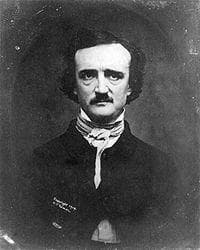
Edgar Allan Poe was an American writer, poet, editor, and literary critic who is best known for his poetry and short stories, particularly his tales of mystery and the macabre. He is widely regarded as a central figure of Romanticism in the United States, and of American literature. He was one of the country's earliest practitioners of the short story, and is considered the inventor of the detective fiction genre, as well as a significant contributor to the emerging genre of science fiction. He is the first well-known American writer to earn a living through writing alone, resulting in a financially difficult life and career.
Similar books
- A Study in Scarlet
Arthur Conan Doyle
4.2 (324k) average on GoodreadsHistorical FictionAnother foundational detective novel that establishes the 'locked room' mystery trope.
- The Purloined Letter
Edgar Allan Poe
3.7 (10k) average on GoodreadsMysteryFeatures C. Auguste Dupin and showcases Poe's 'tales of ratiocination'.
- The Moonstone
Wilkie Collins
3.9 (79k) average on GoodreadsHistorical FictionPublished in 1868, 'The Moonstone' is often cited as the first full-length detective novel in English. Unlike Poe's singular focus on ratiocination and a single, shocking crime, Collins's novel employs multiple narrators, offering diverse perspectives on the theft of a valuable diamond. While it features detective Sergeant Cuff, a professional investigator, the emphasis is less on a single genius's deduction and more on the accumulation of evidence and the unreliability of testimony. 'The Moonstone' explores psychological realism and social commentary more deeply than 'Rue Morgue,' which prioritizes intellectual puzzle-solving over character depth or broader societal implications. Poe's story is a tightly focused intellectual exercise, while Collins's is a sprawling narrative exploring human foibles and the complexities of truth.
- Angels & Demons
Dan Brown
3.9 (2.7M) average on GoodreadsThrillerA Harvard symbologist races through Rome's ancient sites, deciphering cryptic clues to unmask the Illuminati and stop a vengeful plot to destroy the Vatican with a stolen antimatter weapon.
- Gone Girl
Gillian Flynn
4.1 (2.3M) average on GoodreadsThrillerA wife's sudden disappearance on her fifth anniversary reveals a web of lies and psychological warfare, exposing the secrets within a seemingly perfect marriage.
- The Girl on the Train
Paula Hawkins
3.9 (2.1M) average on GoodreadsThrillerA woman’s fascination with a seemingly perfect couple she watches from her daily train commute leads her into a dark investigation when she witnesses something that shatters their idyllic image.




Enjoyed the summary?
A summary gives you the shape of the book. The book itself has the detail, the examples and the voice.
Find The Murders in the Rue Morgue on AmazonAs an Amazon Associate, BookBrief earns from qualifying purchases. How we're funded