
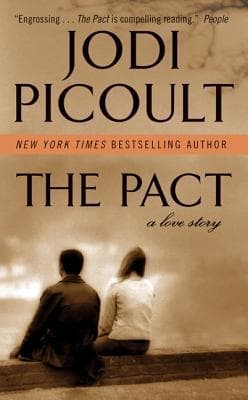
Synopsis
Covers the whole plot, including the ending.
- Difficulty
- Medium
- Pacing
- Variable
- Mood
- Tragic, Suspenseful, Thought-provoking, Emotional
- Read it if
- You enjoy emotionally charged legal dramas with deep character exploration and moral dilemmas.
- Skip it if
- You prefer lighthearted stories or avoid themes of suicide and murder.
The Pact Plot Summary
Covers the whole plot, including the ending.
The Night of the Pact
The story begins with a frantic phone call to the Golds and Hartes. Emily Gold is dead from a gunshot wound to the head, and Chris Harte is in the hospital. The families rush to the hospital, where Chris confesses to a suicide pact with Emily. He claims he meant to shoot himself after shooting Emily but could not. Detective Richmond, leading the police investigation, is immediately suspicious, especially because there is an unspent bullet in the gun. The families, who have been close neighbors and friends for eighteen years, are devastated, trying to understand the event in light of Chris and Emily's deep, lifelong love.
The Investigation Begins
Detective Richmond starts a thorough investigation, questioning Chris, Melanie Gold, Michael Gold, James Harte, and Gus Harte. Chris sticks to his suicide pact story, saying Emily wanted to die, and he agreed to help her. However, Richmond finds inconsistencies in Chris's timeline and the physical evidence. The families are heartbroken, trying to cope with Emily's death and the accusation against Chris. Melanie Gold, Emily's mother, is especially distraught and struggles to believe her daughter would consider suicide. Gus Harte, Chris's father, immediately tries to protect his son, convinced Chris is not capable of murder.
Flashbacks to Childhood
During the initial investigation and legal proceedings, the story often flashes back to Chris and Emily's childhood and teenage years. These flashbacks show their incredibly close relationship, portraying them as inseparable best friends who fell deeply in love. They shared every important moment, secret, and dream. We see their families, the Golds and the Hartes, almost living as one large unit, sharing holidays, vacations, and daily life. These glimpses into their past highlight Chris and Emily's strong connection, making the idea of a murder or suicide pact even harder for those who knew them to believe.
Chris's Arrest and Indictment
Despite Chris's claim of a suicide pact, the police gather enough evidence to charge him with first-degree murder. This news shatters both families, who had hoped for a different outcome. The Hartes support Chris, hiring a well-known defense attorney, Jordan McAfee. The Golds, especially Melanie, struggle with their grief and feel betrayed by the Hartes' firm support of Chris. The legal process begins, turning the once-united families into opponents, each fighting for their version of the truth and justice.
The Trial Commences
The trial starts, with prosecutor Carl Stukey presenting a strong case against Chris. He portrays Chris as a possessive and possibly violent boyfriend, pointing out instances of jealousy and control. Stukey suggests Emily was trying to break up with Chris, and he killed her out of anger. The prosecution calls various witnesses, including friends of Chris and Emily, who offer different views on their relationship. These testimonies create doubt and division, forcing the jury and the families to reconsider everything they thought they knew about the couple.
The Defense's Strategy
Jordan McAfee, Chris's defense attorney, works to prove the suicide pact was real. He aims to show that Emily, despite how she appeared, had deep emotional struggles and thoughts of suicide. McAfee calls witnesses who talk about Emily's perfectionism, her worries, and the great pressure she felt. He argues that Chris, because of his deep love for Emily, simply honored her wishes, even if they were misguided. The defense's strategy forces a painful re-examination of Emily's character, causing more pain for the Gold family, who resist the portrayal of their daughter as troubled.
Melanie's Testimony and Doubt
Melanie Gold is a key witness for the prosecution. Her testimony is full of emotion as she tells about her daughter's life and her relationship with Chris. While she initially believes Chris murdered Emily, the defense's intense questioning and the emergence of past events start to weaken her certainty. She grapples with the possibility that Emily might have been more troubled than she let on, and that Chris might not be the monster the prosecution claims. Her internal conflict shows the devastating impact of the trial on the victims' families.
Chris Takes the Stand
Chris Harte takes the stand in his defense, giving a detailed and emotional account of the night Emily died. He describes Emily's deep sadness and her repeated statements that she wanted to die. He tearfully explains how he agreed to the suicide pact out of love, believing it was the only way to ease her pain. He recounts shooting Emily and then being unable to shoot himself. His testimony is powerful, but the prosecution skillfully finds flaws in his story, questioning his memory and the likelihood of his actions.
The Jury's Deliberation
After weeks of testimony, the jury begins its deliberation. They face conflicting stories: a planned murder driven by jealousy or a tragic suicide pact born of desperate love. The evidence is unclear, and the emotional weight of the case is immense. The jury struggles to reconcile Chris's confession with the lack of a suicide note from Emily, the single unspent bullet, and the varying accounts of Emily's emotional state. The families await the verdict anxiously, their lives uncertain.
The Verdict and Aftermath
The jury finds Chris Harte guilty of first-degree murder. He is sentenced to life in prison. The verdict devastates the Hartes, who still believe Chris is innocent. The Golds, while initially feeling a sense of justice, are left with the empty victory of knowing their daughter is gone and their former neighbors are broken. The once-strong bond between the two families is permanently shattered. The story ends with the lingering questions and the deep, lasting grief that affects everyone involved, showing that no one truly wins in such a tragedy.
Melanie's Revelation
Years after the trial and Chris's imprisonment, Melanie Gold continues to struggle with her grief and lingering doubts about Emily's death. She starts to look deeper into Emily's past, reading her journals and talking to people Emily knew. Through this, Melanie uncovers a devastating truth: Emily had secretly struggled with severe depression and anxiety for a long time, carefully hiding it from her family. This discovery forces Melanie to consider that Chris's story of a suicide pact might have been true, destroying her previous certainty.
A Mother's Regret
Melanie's discovery of Emily's hidden struggles leads to overwhelming guilt and regret. She realizes she had focused so much on Emily's outward perfection that she missed the signs of her daughter's inner turmoil. The revelation that Emily was suicidal, and that Chris may have acted in a misguided attempt to fulfill her wishes, is a crushing blow. Melanie must confront her own biases and her firm belief in Chris's guilt, leading to a deep re-evaluation of the entire tragedy and her relationship with her deceased daughter.
Seeking Justice for Chris
Haunted by her discoveries, Melanie Gold decides to contact Jordan McAfee, Chris's former defense attorney. She shares the evidence of Emily's hidden depression and suicidal thoughts, urging him to reopen Chris's case. This is a huge step for Melanie, requiring her to publicly acknowledge her daughter's struggles and challenge the verdict that gave her some peace. Her actions come from a desperate need for the truth and a desire to correct a potential wrong, even if it means further straining her relationship with her husband, Michael, who remains convinced of Chris's guilt.
The Appeal and Its Implications
Jordan McAfee takes on Chris's appeal, using Melanie's new evidence. The appeal process is difficult, requiring new, compelling information that was not available at the original trial. Reopening the case forces both the Gold and Harte families to relive the trauma, and media attention restarts public debate. The appeal challenges the initial verdict's integrity and makes everyone face the complexities of truth, justice, and the devastating results of misjudgment.
The Lingering Pact
The book ends without a clear resolution to Chris's appeal, leaving the legal outcome uncertain. Instead, it focuses on the tragedy's lasting impact on the characters. Melanie continues to live with deep guilt for not seeing Emily's pain and the difficult choice she made to pursue the appeal. The Hartes hold onto hope for Chris's freedom. The once-close families remain fractured, forever marked by that night's events. The novel shows that even with new information, the pain of loss and accusation runs deep, and true closure is hard to find for those left behind.
The Pact Characters
Chris Harte
Protagonist/Accused
Emily's lifelong best friend and boyfriend, accused of her murder.
Chris is portrayed as a kind, devoted, and somewhat intense young man. He has been inseparable from Emily since birth, and their bond deepened into a passionate love. He is fiercely protective of Emily and deeply sensitive. After Emily's death, he is wracked with grief and guilt, maintaining his story of a suicide pact despite the murder charge. He struggles to articulate the complexities of his relationship with Emily and her hidden pain, making him appear suspicious to those who don't know the full truth. He is a product of a loving, if somewhat naive, family.
Relationships: Emily Gold (Lifelong best friend, girlfriend, and soulmate.); Gus Harte (Father, deeply supportive and protective.); James Harte (Mother, loving and fiercely loyal.); Melanie Gold (Emily's mother, initially his accuser, later his advocate.)
Emily Gold
Victim/Central Figure
Chris's girlfriend, whose death sets the entire story in motion.
Emily is initially presented as a bright, popular, and seemingly perfect young woman. She is artistic, intelligent, and deeply loved by her family and Chris. However, as the story unfolds, particularly through the defense's arguments and Melanie's later discoveries, a more complex and troubled side of Emily emerges. She secretly struggles with immense pressure, perfectionism, and severe depression, meticulously hiding her pain from those closest to her. Her hidden struggles are central to the novel's themes of perception versus reality and the unseen battles within individuals.
Relationships: Chris Harte (Lifelong best friend, boyfriend, and soulmate.); Melanie Gold (Mother, whom she loves but hides her true feelings from.); Michael Gold (Father, whom she loves but also keeps secrets from.)
Melanie Gold
Protagonist/Mother
Emily's mother, who initially believes Chris is a murderer but later seeks to clear his name.
Melanie is a loving and devoted mother, fiercely protective of her daughter. Her initial grief and shock quickly turn into a burning conviction that Chris murdered Emily. She becomes a key figure in the prosecution's case, driven by her love for Emily and her inability to accept that her daughter might have been suicidal. Over time, however, her unwavering belief is challenged by new information, particularly Emily's hidden journals. She embodies the struggle of a parent grappling with the unknown aspects of their child's life and the agonizing process of re-evaluating her own perceptions.
Relationships: Emily Gold (Daughter, deeply loved but misunderstood.); Michael Gold (Husband, their marriage is strained by the tragedy and their differing views.); Chris Harte (Once like a son, then an enemy, eventually a person she seeks justice for.); Jordan McAfee (Chris's attorney, whom she initially despises but later relies on.)
Gus Harte
Supporting/Father
Chris's father, who staunchly believes in his son's innocence.
Gus Harte is a pragmatic and fiercely loyal father. From the moment Chris is accused, Gus's primary focus is on protecting his son and ensuring he receives the best legal defense. He is unwavering in his belief in Chris's innocence, convinced that Chris would never intentionally harm Emily. Gus represents the unwavering parental love and support, even in the face of overwhelming accusations. His steadfastness often puts him at odds with the Gold family, particularly Michael, further fracturing the once-close neighborly bond.
Relationships: Chris Harte (Son, whom he loves and defends unconditionally.); James Harte (Wife, his partner in supporting Chris.); Michael Gold (Former best friend, now alienated by the trial.)
James Harte
Supporting/Mother
Chris's mother, who struggles emotionally but remains loyal.
James Harte is Chris's loving and emotionally sensitive mother. She is deeply affected by the tragedy and the accusations against her son, often struggling with her grief and the public scrutiny. While she shares Gus's belief in Chris's innocence, she is more outwardly vulnerable and prone to emotional distress. She grapples with the loss of Emily, whom she also loved like a daughter, and the devastating impact on her family. James represents the emotional toll of such a crisis on a parent, constantly teetering on the edge of despair but holding on for Chris.
Relationships: Chris Harte (Son, whom she loves and worries for constantly.); Gus Harte (Husband, her emotional anchor during the crisis.); Emily Gold (Like a daughter to her, her death is a profound loss.)
Michael Gold
Supporting/Father
Emily's father, who remains convinced of Chris's guilt.
Michael Gold is Emily's father and Melanie's husband. He is initially a supportive figure, but his grief quickly solidifies into a firm conviction that Chris murdered Emily. Unlike Melanie, Michael struggles to entertain any doubt about Chris's guilt, finding solace in the clear-cut narrative of a murderer and his victim. He represents the unwavering need for justice and accountability, even if it means sacrificing past friendships. His refusal to re-examine the evidence strains his relationship with Melanie, especially when she begins to question the verdict.
Relationships: Emily Gold (Daughter, whom he deeply loves and mourns.); Melanie Gold (Wife, their marriage is tested by their differing views on the case.); Gus Harte (Former best friend, now estranged.)
Jordan McAfee
Supporting/Defense Attorney
Chris Harte's tenacious defense attorney.
Jordan McAfee is a skilled and experienced defense attorney known for taking on difficult cases. He is intelligent, strategic, and deeply committed to his clients. He believes in Chris's innocence and works tirelessly to prove the suicide pact, even when faced with public opinion and seemingly damning evidence. He represents the legal system's role in uncovering truth and protecting the accused, and is instrumental in challenging the prosecution's narrative by highlighting Emily's hidden struggles. He is pragmatic and focused, often serving as a voice of reason amidst the emotional chaos.
Relationships: Chris Harte (Client, whom he defends with conviction.); Gus Harte (Client's father, his primary contact and supporter.); Melanie Gold (Initially an adversary, later his collaborator in seeking justice.)
Detective Richmond
Supporting/Investigator
The lead detective investigating Emily's death.
Detective Richmond is a meticulous and skeptical police officer. He is the first to doubt Chris's suicide pact story, finding inconsistencies in his account and the evidence at the scene. He is driven by a desire for justice and a belief in following the facts, regardless of the emotional pleas of the families. Richmond represents the impartial, albeit sometimes flawed, nature of law enforcement in the face of tragedy. His initial suspicions set the course for the murder investigation and subsequent trial.
Relationships: Chris Harte (Suspect, whom he investigates.); Melanie Gold (Victim's mother, whom he works with to build the prosecution's case.)
Carl Stukey
Supporting/Prosecutor
The prosecutor in Chris Harte's murder trial.
Carl Stukey is the determined and persuasive prosecutor. He builds a strong case against Chris, portraying him as a jealous and controlling boyfriend who murdered Emily. Stukey is skilled at presenting evidence and witness testimonies in a way that sways public opinion and the jury. He represents the adversarial nature of the legal system and the prosecution's role in seeking conviction. His relentless pursuit of a guilty verdict shapes the narrative of the trial.
Relationships: Chris Harte (Defendant, whom he seeks to convict.); Melanie Gold (Victim's mother, a key witness for his case.)
The Pact Themes
Perception vs. Reality
The novel shows how outer appearances can hide inner realities. Emily Gold seems perfect and happy to her family and friends. However, the defense and Melanie's later discoveries reveal a hidden world of deep depression, anxiety, and perfectionism. This theme is central to the story, as the initial view of Chris as a murderer conflicts with his claim of a suicide pact, which is only supported by the later revelation of Emily's true struggles. The trial depends on which 'reality' the jury believes, showing how easily truth can be hidden.
“How can you love someone so completely and not know them at all?”
The Nature of Love and Sacrifice
The book explores the complex and sometimes harmful nature of love, especially Chris and Emily's intense bond. Their love is shown as all-consuming, so deep it blurs the lines between them. Chris claims his action was the ultimate sacrifice, fulfilling Emily's wish to end her suffering, however misguided. This raises questions about where love ends and obsession begins, and if true love can demand such a terrible price. The Harte parents' unwavering love for Chris, and Melanie's later love-driven search for truth, also show this theme.
“When you love someone that much, you'd do anything for them. Anything.”
Grief and Its Manifestations
Grief is a constant theme, explored through the different reactions of the Gold and Harte families. Melanie's grief first appears as anger and a desperate need for justice, leading her to demonize Chris. Michael's grief becomes a firm belief in Chris's guilt. The Hartes' grief is mixed with fear and disbelief, leading to strong loyalty and defense of Chris. The novel shows how grief can twist perceptions, create divides, and take years to change, eventually leading Melanie to a different understanding of her daughter and the tragedy.
“Grief is a process, but it's not a straight line. It's a series of loops, of starts and stops, of tiny steps forward and giant leaps back.”
The Flaws of the Justice System
The novel examines the legal system's limits and biases. The trial is presented not as a perfect search for truth, but as a fight where stories are built, and emotional appeals often outweigh facts. The prosecution's ability to portray Chris as a monster, despite lacking a clear murder motive, and the jury's failure to see Emily's hidden struggles, show how easily an innocent person can be convicted. The later appeal, driven by new evidence, further highlights how initial verdicts can be flawed and justice hard to find.
“Justice isn't about truth. It's about what you can prove.”
Parental Blindness and Responsibility
A main theme is that parents, despite their love, can be unaware of their children's deepest struggles. Melanie Gold especially shows this, having created an image of Emily as perfect and happy, thus missing the deep depression her daughter secretly fought. This blindness contributes to her initial belief in Chris's guilt and her inability to accept the possibility of Emily's suicide. The theme explores the guilt and regret parents feel when they realize they failed to truly see or understand their child, and the great responsibility of raising them.
“We see what we want to see in our children, not always what is there.”
Plot Devices & Literary Techniques
Non-linear Narrative
The story jumps between the present-day trial and flashbacks to Chris and Emily's past.
The novel employs a non-linear narrative, frequently shifting between the ongoing murder trial and extensive flashbacks. These flashbacks detail Chris and Emily's childhood, their developing romance, and the close-knit relationship between the two families. This device is crucial for building suspense and character depth. It allows the reader to understand the profound bond between Chris and Emily, making the murder accusation more shocking, while also slowly revealing details from their past that might support or contradict Chris's suicide pact claim. It forces the reader to constantly re-evaluate their understanding of the characters and events.
Multiple Perspectives (Implied)
The story is told through the viewpoints of various characters, though primarily Melanie.
While the primary narrative voice often leans towards Melanie Gold's perspective, the novel subtly shifts to reflect the viewpoints and internal thoughts of other key characters, including Chris Harte, Gus Harte, and even Jordan McAfee. This allows the reader to access different emotional responses, motivations, and interpretations of the same events. It prevents a singular, biased account, instead presenting a multifaceted exploration of the tragedy. This device is essential for generating empathy for all parties and highlighting the subjective nature of truth in a complex situation.
The Unspent Bullet
A physical object that serves as a key piece of ambiguous evidence.
The single unspent bullet in the gun Chris Harte used is a powerful and ambiguous plot device. For the prosecution, it serves as damning evidence against Chris's suicide pact claim, implying he never intended to kill himself. For the defense, Chris's inability to use it is presented as a consequence of shock, trauma, or a sudden change of heart. This physical detail becomes a focal point of the trial, symbolizing the uncertainty and conflicting interpretations surrounding the events of that night. It forces the reader to question Chris's true intentions and the nature of the pact itself.
Emily's Journals
A collection of writings that reveal Emily's hidden struggles.
Emily's journals are a critical plot device that emerges later in the story. Initially, they are unseen and unknown, contributing to Melanie's blindness to her daughter's pain. When discovered by Melanie, these journals provide irrefutable evidence of Emily's severe, hidden depression and suicidal ideations. This device acts as a turning point, shattering Melanie's preconceptions and providing crucial new evidence for Chris's appeal. The journals represent the hidden truths that can exist beneath a polished surface and the profound impact of secrets on those left behind.
The Pact Quotes
“The hardest part of saying goodbye is knowing that you'll never say hello again.”
“Sometimes the things you can't change, end up changing you.”
“There are no easy answers, only difficult choices.”
“Love isn't about finding the perfect person, it's about seeing an imperfect person perfectly.”
“Memory is a way of holding onto the things you love, the things you are, the things you never want to lose.”
“How can you tell someone you love them when you've already said goodbye?”
“The truth is a stubborn thing, and it has a way of coming out.”
“You can't erase the past, but you can learn from it.”
“Sometimes the greatest acts of love are the ones we don't understand.”
“Grief is like the ocean; it comes in waves, ebbing and flowing. Sometimes the water is calm, and sometimes it is overwhelming. All we can do is learn to swim.”
“We make pacts with ourselves all the time, little promises we hope to keep.”
“When you love someone, you don't give up on them. Ever.”
“It's not about how long you've loved someone, it's about how deeply.”
“Maybe there's no such thing as normal, only different shades of crazy.”
Quiz
10 questions on the plot and the characters. Each answer comes with a short explanation.
Question 1
What is the initial explanation Chris gives to the police for Emily's death?
- He accidentally shot her while cleaning the gun.
- They were involved in a suicide pact.
- Emily took the gun and shot herself.
- An unknown assailant broke into the house.
Show answer
B. They were involved in a suicide pact. Chris initially tells the police that he and Emily had a suicide pact, and he intended to shoot himself after her.
Question 2
How long have the Harte and Gold families been neighbors?
- Ten years
- Since Chris and Emily were born (eighteen years)
- Five years
- Twenty years
Show answer
B. Since Chris and Emily were born (eighteen years) The book states they have lived next door to each other for eighteen years, since the children were born.
Question 3
From whose cabinet did Chris take the gun used in the incident?
- His own
- Emily's father's
- His father's
- A friend's
Show answer
C. His father's The book mentions that Chris took the gun from his father's cabinet.
Question 4
What is the primary reason the local detective becomes suspicious of Chris's suicide pact story?
- Chris changes his story multiple times.
- There is a single unspent bullet in the gun.
- Emily left a suicide note that contradicts Chris's account.
- Chris shows no remorse for Emily's death.
Show answer
B. There is a single unspent bullet in the gun. The detective has doubts because there is a single unspent bullet in the gun, which Chris claimed was for himself, raising questions about the pact's completion.
Question 5
How old was Emily when she died?
- Sixteen
- Seventeen
- Eighteen
- Nineteen
Show answer
B. Seventeen The synopsis clearly states Emily is dead at seventeen.
Question 6
What type of wound did Emily sustain?
- Stab wound to the chest
- Gunshot wound to the abdomen
- Gunshot wound to the head
- Blunt force trauma to the chest
Show answer
C. Gunshot wound to the head The synopsis explicitly states Emily died from a gunshot wound to the head.
Question 7
What role does the 'pact' in the title suggest about the central conflict of the story?
- It refers to an unbreakable friendship between the two families.
- It alludes to a secret agreement or understanding between Chris and Emily that led to the tragedy.
- It represents a legal agreement between the parents to cover up the truth.
- It symbolizes a promise made by Chris to seek revenge for Emily's death.
Show answer
B. It alludes to a secret agreement or understanding between Chris and Emily that led to the tragedy. The 'pact' directly relates to the suicide pact Chris describes, which becomes the central mystery and conflict as its validity is questioned.
Question 8
Beyond the immediate tragedy, what broader theme is introduced by the long-standing closeness of the two families?
- The importance of strong community bonds in times of crisis.
- The potential for hidden tensions and complexities within seemingly perfect relationships.
- The idea that childhood friendships always lead to romantic love.
- The inevitability of tragedy striking even the happiest families.
Show answer
B. The potential for hidden tensions and complexities within seemingly perfect relationships. The description of the families' intertwined lives, followed by such a devastating event, immediately sets up a theme of hidden complexities and the shattering of perceived perfection.
Question 9
Given the setup, what narrative technique is Jodi Picoult likely to employ to unravel the truth?
- A straightforward chronological account from a single narrator.
- Flashbacks and multiple perspectives from family members and investigators.
- Primarily through Emily's diary entries discovered posthumously.
- An omniscient narrator revealing all secrets early on.
Show answer
B. Flashbacks and multiple perspectives from family members and investigators. Jodi Picoult is known for her multi-perspective narratives and use of flashbacks to slowly reveal the truth in complex family dramas, making this a highly probable technique for 'The Pact'.
Question 10
The description mentions Chris and Emily have been 'soul mates since they were born.' How does this detail heighten the impact of the tragedy?
- It suggests their parents had always intended for them to marry.
- It implies that their relationship was too intense and therefore destined for a tragic end.
- It emphasizes the profound loss and the devastating rupture of a seemingly perfect, lifelong bond.
- It provides a motive for Chris to act violently out of possessiveness.
Show answer
C. It emphasizes the profound loss and the devastating rupture of a seemingly perfect, lifelong bond. Calling them 'soul mates since they were born' underscores the deep, almost fated connection between them, making the tragedy of Emily's death and Chris's involvement all the more shocking and heartbreaking.
The Pact FAQ
What is the central premise of 'The Pact'?
The novel revolves around two families, the Hartes and the Golds, whose children, Chris Harte and Emily Gold, are best friends and then fall in love. When Emily is found dead from a gunshot wound and Chris admits to being present, the story unfolds through a murder trial, questioning whether it was a suicide pact, murder, or something else entirely.
Who are the main characters involved in the central tragedy?
The central characters are Chris Harte and Emily Gold, who are childhood sweethearts. Their parents, James and Melanie Harte, and Michael and Giselle Gold, are also pivotal as they grapple with the tragedy, its aftermath, and the ensuing legal battle.
What is Chris Harte's initial explanation for Emily's death?
Chris initially tells the police that he and Emily had a suicide pact, planning to die together. He claims the gun he took from his father's cabinet was intended for himself, implying Emily's death was part of their shared plan to end their lives.
What role does Detective Patrick Duchene play in the story?
Detective Duchene is the local detective investigating Emily's death. He harbors doubts about Chris's suicide pact story, pushing for a deeper investigation that ultimately leads to Chris being charged with murder, driving the legal drama of the book.
How do the two families react to Emily's death and Chris's involvement?
The Golds are devastated and believe Chris murdered their daughter, seeking justice through the legal system. The Hartes are equally heartbroken but staunchly believe in Chris's innocence, supporting him through the trial and trying to understand what truly happened.
What is the significance of the 'pact' in the book's title?
The 'pact' refers to the alleged suicide agreement between Chris and Emily, which Chris initially uses to explain Emily's death. However, as the story progresses, the meaning of 'pact' becomes more ambiguous, hinting at other unspoken agreements or understandings between them.
Are there any clues early in the book that hint at the true nature of Emily's death?
Yes, subtle details like Emily's history of self-harm, her desire to escape her family, and Chris's protective nature, combined with the unspent bullet in the gun, hint that the situation is more complex than a simple suicide pact or murder.
What is revealed about Emily's character that complicates the narrative?
Emily is revealed to have a history of self-harm, an eating disorder, and a deep desire to escape her life and family, particularly her overbearing mother. These details suggest a fragility and desperation that make her involvement in a suicide pact, or even seeking an end to her life, more plausible.
How does the narrative structure contribute to the suspense and eventual reveal?
The story is told through flashbacks and present-day courtroom scenes, gradually revealing details about Chris and Emily's relationship and the events leading up to Emily's death. This fragmented approach builds suspense and allows for the true nature of their 'pact' to be unveiled piece by piece.
How does grief manifest differently in Melanie Harte and Giselle Gold?
Melanie Harte's grief is intertwined with defending her son, manifesting as fierce loyalty and a desperate search for truth. Giselle Gold's grief is characterized by profound anger and a relentless pursuit of justice, believing Chris is a murderer, which fuels her desire for his conviction.
What psychological factors might have driven Chris's actions on the night of Emily's death?
Chris's deep love and protectiveness towards Emily, coupled with her mental health struggles and expressed desire to die, likely created immense pressure. His actions could be interpreted as a desperate attempt to honor her wishes, save her from further pain, or even to share her fate.
How does the concept of codependency play a role in Chris and Emily's relationship?
Chris and Emily exhibit signs of codependency, where their identities become intertwined, and Chris feels responsible for Emily's emotional well-being. This intense bond makes it difficult for them to function independently and could have influenced their decisions regarding the 'pact'.
What is the psychological impact of the trial on Chris?
The trial is an immense psychological burden on Chris, forcing him to relive the trauma, face the accusations of murder, and confront the breakdown of his relationships. He struggles with guilt, grief, and the weight of public judgment, all while trying to protect Emily's memory.
What is the ultimate 'pact' revealed at the end of the book, and how does it change the interpretation of events?
The ultimate 'pact' is revealed to be Chris assisting Emily in her suicide. Emily wanted to die, and Chris, unable to dissuade her, agreed to help her, promising to follow her. This revelation shifts the interpretation from a shared suicide or murder to a more complex act of assisted suicide driven by love and desperation.
Does the book ultimately portray Chris as a murderer or a victim of circumstances?
The book aims for a nuanced portrayal. While legally Chris committed a crime by assisting Emily's suicide, the narrative emphasizes his deep love for Emily and his agonizing decision to fulfill her wishes, presenting him more as a tragic figure caught in impossible circumstances than a cold-blooded murderer.
How does the ending challenge traditional notions of justice?
The ending challenges justice by showing that legal culpability doesn't always align with moral intent. Chris is legally guilty of a serious crime, but the circumstances surrounding his actions—driven by love and a desire to alleviate Emily's suffering—complicate a straightforward punitive judgment, prompting readers to question the nature of justice in such cases.
What message does the book convey about parental responsibility and communication?
The book strongly suggests that a lack of open communication and understanding between parents and children, particularly regarding mental health struggles, can have devastating consequences. Both families, in their own ways, failed to fully grasp the depth of Emily's despair, contributing to the tragedy.
Is the novel's resolution satisfying, given the ambiguity of the situation?
The resolution is emotionally resonant but may not be 'satisfying' in a conventional sense, as it avoids easy answers. It offers a complex understanding of love, loss, and difficult choices, leaving readers to grapple with the moral implications rather than providing a clear-cut 'happy' or 'just' ending.
About the author

Jodi Picoult is an American author known for her thought-provoking fiction that often explores complex moral dilemmas. Her notable works include My Sister's Keeper, Nineteen Minutes, Small Great Things, Plain Truth, Leaving Time, and The Tenth Circle. Picoult's writing frequently delves into themes of family, justice, and the human experience.
Similar books
- My Sister's Keeper
Jodi Picoult
4.1 (1.1M) average on GoodreadsYoung AdultExplores complex family ethics and a courtroom drama with an emotional core.
- The Lovely Bones
Alice Sebold
3.8 (2M) average on GoodreadsFantasyDeals with the aftermath of a young girl's death and its impact on her family.
- Defending Jacob
William Landay
4.0 (264k) average on GoodreadsThrillerFeatures a family dealing with a son accused of murder and a compelling legal battle.
- Presumed Innocent
Scott Turow
4.1 (107k) average on GoodreadsThrillerTurow's 'Presumed Innocent' is a seminal legal thriller that, like 'The Pact,' features a gripping courtroom narrative and explores themes of justice and truth. However, Turow's work is generally lauded for its intricate legal procedural details and a more gritty, realistic portrayal of the justice system, often with less emphasis on the emotional melodrama that sometimes characterizes Picoult's novels. 'The Pact' foregrounds the emotional and ethical quandaries within a family, using the legal framework as a vehicle, while 'Presumed Innocent' places the legal process itself at the core of its narrative, with character emotions serving the plot more than dominating it.
- The Hunger Games
Suzanne Collins
4.3 (6.4M) average on GoodreadsFantasyIn a future where children fight to the death on live television, Katniss Everdeen volunteers for the arena, turning a death sentence into a fight for survival and a spark of rebellion.
- The Great Gatsby
F. Scott Fitzgerald
3.9 (3.8M) average on GoodreadsHistorical FictionIn the opulent Roaring Twenties, a mysterious millionaire's lavish parties hide his desperate, tragic pursuit of a lost love, exposing the emptiness within the American Dream.




Enjoyed the summary?
A summary gives you the shape of the book. The book itself has the detail, the examples and the voice.
Find The Pact on AmazonAs an Amazon Associate, BookBrief earns from qualifying purchases. How we're funded