
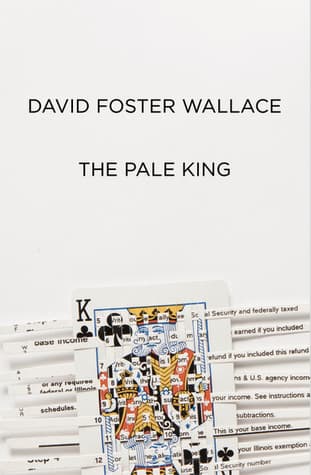
Synopsis
Covers the whole plot, including the ending.
- Difficulty
- Hard
- Pacing
- Slow
- Mood
- Philosophical, Challenging, Meditative, Satirical, Existential
- Read it if
- You enjoy experimental literary fiction, deep dives into philosophical concepts, and character studies set against unconventional backdrops. Fans of Wallace's intricate prose and intellectual humor will find much to appreciate.
- Skip it if
- You prefer fast-paced plots, straightforward narratives, or light reading. The book's extensive digressions, complex sentences, and focus on bureaucratic minutiae can be challenging.
The Pale King Plot Summary
Covers the whole plot, including the ending.
The Author's Note and Introduction to the IRS
The book starts with an 'Author's Foreword' by a character named David Foster Wallace, who says he is the author and describes the manuscript's fragmented, unfinished state. He talks about its 'factuality' and the difficulties of writing it. The story then moves to the IRS Regional Examination Center in Peoria, Illinois, in the 1980s. The first chapters give a broad, philosophical view of tax and the IRS, setting a tone of bureaucratic absurdity and a search for meaning in everyday life. Readers learn about the general mood of the center, a place where extreme boredom is a main part of the work, requiring employees to find ways to cope.
Chris Fogle's Conversion and the Allure of the IRS
Christopher Fogle, a main character, tells about his past, including his aimless college years with heavy drug use and no clear goal. His life changes dramatically during a required college accounting lecture where, under the influence of drugs, he has a powerful, almost spiritual insight about taxes, responsibility, and civic duty. This intense moment, which he calls seeing 'the pale king' of the tax code, makes him leave his old life and work for the IRS. He sees his job as patriotic service, a way to contribute to society, despite the dullness of the work.
David Wallace's Arrival and the Boredom-Survival Training
The character David Wallace, different from the 'Author' character, arrives at the Peoria IRS center as a new trainee. He quickly becomes part of the IRS culture, which includes a special 'boredom-survival training' program. This training acknowledges the extreme monotony of the work – processing tax returns, auditing, and inputting data – and tries to give new agents mental strategies to handle it. David watches and talks with other trainees and veteran agents, starting to understand the psychological situation of a workplace where the main problem is not complexity but a huge lack of stimulation. He struggles with how to find meaning in such an environment.
The Eccentricities of the Examiners
The book introduces many IRS examiners, each with unique habits and ways to deal with the constant boredom. Characters like Lane Dean Jr., with his strict morals and internal struggles, and Meredith Randall, who can almost supernaturally find errors in tax forms, are explored in detail. Other agents create strange routines, obsessions, or mental exercises to stay sane, such as memorizing phone books or having long internal conversations. These character descriptions show the different human responses to an environment designed to remove individuality and engagement, revealing the deep inner lives that continue despite outside pressures.
Irrelevant and the Quest for Perfect Accuracy
David Cuskley, called 'Irrelevant' because he seems insignificant and socially awkward, becomes a focus. He is shown as an extremely dedicated and precise examiner, almost robotically efficient. His past shows a childhood focused on detail and difficulty with social interaction, making the careful, rule-bound world of tax examination a good fit for him. Irrelevant's character explores the extreme level of competence within the IRS, suggesting that some people are uniquely suited, or even drawn, to tasks others find unbearable. His constant pursuit of perfect accuracy balances the more human, flawed struggles of other characters.
The Philosophical Underpinnings of Tedium
Through the various character stories and the 'Author's' comments, the book often moves into philosophical topics, looking at the deeper meanings of extreme tedium. It questions whether sustained, focused attention on boring tasks can lead to a kind of understanding or a deeper grasp of reality. The idea of 'heroism' is redefined, suggesting that true heroism today might be the ability to endure and find meaning in the ordinary, rather than in big, dramatic actions. These philosophical sections often speak directly to the reader, asking them to think about their own ideas about work, value, and the human spirit in a world increasingly filled with bureaucratic and repetitive tasks.
Lane Dean Jr.'s Internal Conflicts
Lane Dean Jr. is a character deeply troubled by internal conflicts, especially about his engagement to Sheri and his strict religious upbringing. His father, a rigid and demanding man, greatly influences Lane's moral views. Lane struggles with his own desires and the perceived 'sins' of his thoughts and actions, leading to intense self-criticism and worry. His story explores themes of guilt, purity, and the search for real connection in an emotionally repressed setting. His internal thoughts show a constant fight between his ingrained sense of duty and his growing, often confusing, personal desires, making him one of the most psychologically complex characters.
Meredith Randall's Unique Abilities
Meredith Randall is an examiner who can almost supernaturally find errors and inconsistencies in tax forms. Her skill is more than just being careful; she describes it as an intuitive, almost psychic sense that lets her 'feel' when something is wrong. This ability is explored in detail, with descriptions of her sensory experiences while reviewing documents, suggesting a deep connection between her mind and the dry, factual data. Her character shows how extreme focus and dedication to a specific, narrow task can result in a unique kind of genius, turning the ordinary into something special, at least within the IRS center.
The Looming Threat of Automation and Efficiency
A subtle but important subplot involves the internal politics of the IRS and the push for more efficiency through automation and standardized procedures. There are hints of a larger ideological conflict within the agency, where some groups argue for minimizing human involvement in tax examination, seeing human agents as inefficient and prone to error. This development threatens the already fragile sense of purpose held by the examiners, suggesting that even their tedious but human-driven work might soon be obsolete. This coming threat highlights the novel's exploration of human value in an increasingly mechanized world and the struggle for dignity in impersonal systems.
The Unfinished Ending and Lasting Impressions
As an unfinished work, 'The Pale King' does not have a traditional ending. The story simply stops, often in the middle of a sentence or scene, leaving many character stories and plot lines open. This sudden ending supports the 'Author's Foreword' about the manuscript's fragmented state. Despite its lack of a clear ending, the book leaves a strong impression about its main ideas: the search for meaning in an age of irony, the strength found in attention and empathy, and the human ability to endure and find dignity in the most monotonous situations. The unresolved nature itself becomes part of the novel's message, mirroring life's ongoing, often unfulfilled, search for understanding.
Principal Figures
Christopher Fogle
Protagonist/Supporting
Former aimless college student turned dedicated IRS agent after a profound epiphany.
Christopher Fogle is one of the central consciousnesses of the novel, whose backstory details a transformative experience. Once a directionless college student heavily involved in drugs, he undergoes a profound, almost spiritual conversion during an accounting lecture. This epiphany, which he likens to seeing 'the pale king' of the tax code, instills in him a deep sense of civic duty and purpose, leading him to join the IRS. He approaches his work with a sincere, if sometimes naive, dedication, viewing it as a form of patriotic service. His journey highlights the book's exploration of finding meaning and heroism in the mundane.
David Wallace (Character)
Protagonist/Supporting
A new IRS trainee in Peoria, observing and grappling with the nature of the work.
This character, distinct from the 'Author' David Foster Wallace, is a new hire at the Peoria IRS Regional Examination Center. He serves as an observer and a vehicle for the reader to experience the peculiar environment and the 'boredom-survival training.' He is intelligent and reflective, constantly trying to make sense of the extreme tedium and the varied psychological responses of his colleagues. His perspective allows for an exploration of the philosophical dimensions of the work, as he attempts to discern meaning and value in tasks designed to be soul-crushingly repetitive.
Relationships: Chris Fogle (colleague and fellow trainee); Lane Dean Jr. (colleague and fellow trainee)
Lane Dean Jr.
Protagonist/Supporting
A morally rigid IRS examiner grappling with guilt, purity, and his father's expectations.
Lane Dean Jr. is a deeply introspective and morally conflicted IRS agent. Raised with a strict religious upbringing, he struggles intensely with feelings of guilt, particularly concerning his relationship with his fiancée, Sheri, and his own sexual desires. His internal monologues are filled with self-recrimination and a desperate search for purity and authenticity. His father's imposing presence and high expectations weigh heavily on him. Lane's character embodies the struggle to reconcile personal desires with ingrained moral codes, providing a profound exploration of conscience, repression, and the quest for spiritual truth in a secular, bureaucratic world.
Relationships: Sheri (fiancée); Lane Dean Sr. (demanding father)
Meredith Randall
Supporting
An IRS examiner with a preternatural ability to detect errors in tax forms.
Meredith Randall possesses an almost supernatural talent for identifying discrepancies and errors in tax forms. Her ability goes beyond mere meticulousness; she describes it as an intuitive 'feeling' or 'vibration' that alerts her to problems. She is highly focused and dedicated to her work, finding a unique form of engagement in the seemingly dry task of tax examination. Her character suggests that extreme attention and dedication to a specific, narrow field can lead to a unique form of genius, transforming the mundane into something extraordinary, at least within the confines of her specialized skill.
David Cuskley (Irrelevant)
Supporting
An exceptionally precise and socially awkward IRS examiner, known for his meticulousness.
David Cuskley, nicknamed 'Irrelevant,' is a highly proficient and almost robotically efficient IRS examiner. His backstory reveals a childhood marked by an intense focus on detail and a significant struggle with social interaction, making the rule-bound, predictable world of tax examination an ideal environment for him. He is obsessively meticulous, striving for perfect accuracy in his work, often to the detriment of social graces. Irrelevant's character explores the extreme end of competence within the IRS, suggesting that some individuals are uniquely suited to tasks that others find unbearable, and that such dedication can be both a strength and a social barrier.
Tony Tallin
Supporting
An IRS agent with an unusual ability to make himself completely unnoticeable.
Tony Tallin is an IRS agent with a peculiar and unsettling ability to become virtually invisible or unnoticeable to others, even when he is physically present. This is not a supernatural power but rather a psychological phenomenon, where people simply fail to register his presence. He uses this ability, consciously or unconsciously, to navigate the IRS environment, often observing without being observed. His character explores themes of presence, absence, and the human desire to either be seen or to disappear, highlighting the psychological toll of anonymity and the peculiar ways individuals adapt to the bureaucratic landscape.
Sylvanshine
Supporting
A veteran IRS agent who imparts wisdom and observations to the new trainees.
Sylvanshine is an older, more experienced IRS agent who often shares his philosophical insights and observations about the nature of their work with the newer trainees, including David Wallace. He has a nuanced understanding of the IRS bureaucracy and the psychological impact of tedium. He acts as a kind of mentor or informal guide, helping the younger agents grapple with the existential challenges of their profession. His character provides a voice of experience and a more seasoned perspective on the themes of attention, boredom, and finding meaning in monotonous labor.
Relationships: David Wallace (mentor/colleague)
The Author (David Foster Wallace)
Mentioned/Narrative Device
The meta-fictional author character who introduces and comments on the fragmented manuscript.
This character is a meta-fictional construct, a version of David Foster Wallace himself, who writes the 'Author's Foreword' and occasionally interjects into the narrative. He explains the unfinished and fragmented nature of the manuscript, claiming it to be a factual account and discussing the challenges of its composition. This character blurs the line between author and narrator, adding a layer of self-reflexivity and commentary on the creative process, the nature of fiction, and the search for truth within the narrative. His presence underscores the novel's experimental structure and philosophical ambitions.
Themes & Insights
Boredom and Attention
The novel deeply explores boredom, not just as a lack of stimulation, but as a possible way to greater attention and even a kind of understanding. Characters like Chris Fogle find a spiritual awakening in the extreme boredom of accounting, while others develop detailed coping methods. The 'boredom-survival training' directly addresses the psychological demands of sustained, monotonous work, suggesting that being able to focus intently on uninteresting tasks might be a modern form of heroism. The book proposes that deep attention, even to the most ordinary tasks, can lead to a deeper engagement with reality and a transcendence of the self.
“'The truth is that the great secret of adulthood is that there is no secret. Just attention. Just attention and the awareness that the world is everything and you are nothing. Just attention and the ability to choose what you pay attention to and to keep paying attention, even when it is boring, even when it is painful, even when it is pointless.”
The Search for Meaning in the Mundane
A main theme is the search for purpose and importance in bureaucratic, repetitive, and seemingly meaningless work. The IRS agents, processing endless tax forms, must face the emptiness of their tasks. Characters like Chris Fogle find deep meaning and a sense of civic duty in their work, turning it into patriotic service. The novel suggests that meaning is not built into the work itself but is actively created by the individual through their approach, attention, and internal stories. This challenges the common idea that meaningful work must be exciting or creative.
“Maybe it's that you have to be in some kind of internal position where you can really see and feel that you're nothing, and that there's nothing out there but a vast, indifferent blankness, and that's when you're ready to fill it up with something, anything.”
Identity and Self-Transcendence
The book examines how people define themselves in environments that try to remove individuality. The IRS agents' unique habits and coping methods are ways they resist the dehumanizing parts of their jobs. The theme also touches on self-transcendence through dedicated attention. By losing themselves in the careful details of their work, some characters reach a state of flow or heightened awareness that allows them to momentarily escape their ego and find a deeper connection to the task. This often feels like a spiritual experience.
“The sort of quiet, uncelebrated, internal, purely psychological heroism of somebody who simply endures, and pays enough attention to get through the day.”
Duty, Responsibility, and Civic Virtue
The novel explores the often-unrecognized importance of civic duty and the quiet strength of those who maintain society's complex systems. Chris Fogle's insight about the tax code is a powerful example of how understanding shared responsibility can give deep meaning to ordinary work. The book argues for the value of contributing to the common good through diligent, even unglamorous, labor. It challenges the cynical view of institutions like the IRS, suggesting that their function, while tedious, is necessary for civil society, and that the agents who do this work represent an important, though uncelebrated, form of civic virtue.
“In point of fact, the U.S. income tax code is a document of almost unbelievable complexity and detail, designed to extract maximal funds from a maximal number of citizens with maximal fairness.”
The Nature of Systems and Bureaucracy
Wallace carefully details the inner workings of the IRS, showing bureaucracy not just as an obstacle but as a complex, almost living system with its own logic and demands. The novel looks at the absurdity, efficiency, and human impact of such systems. It shows how bureaucracy can both dehumanize and, paradoxically, provide a framework for people to find purpose. The complex rules, endless forms, and push for automation are all explored as parts of a larger societal structure that shapes human experience, questioning whether humanity can thrive in increasingly systematized environments.
“The system itself was so vast and intricate and abstract that no one person could ever hope to comprehend it all.”
Plot Devices & Literary Techniques
Meta-fiction and the 'Author's Foreword'
The use of a self-aware author character who comments on the book's creation and nature.
The novel employs meta-fiction through an 'Author's Foreword' and occasional narrative intrusions by a character named David Foster Wallace. This device explicitly acknowledges the book's status as a constructed text, discussing its fragmented, unfinished nature and the challenges of its composition. It blurs the line between fiction and reality, inviting the reader to question the authenticity of the narrative and the role of the author. This technique foregrounds themes of truth, storytelling, and the creative process, making the act of writing and reading an integral part of the novel's subject matter.
Non-linear Narrative and Fragmented Structure
The story unfolds through disjointed chapters, shifts in perspective, and unresolved plotlines.
Reflecting its unfinished status, 'The Pale King' uses a non-linear and fragmented narrative structure. Chapters often jump between different characters' perspectives, time periods, and even different narrative styles without smooth transitions. Character backstories are explored in depth, sometimes interrupting the main flow. This structural choice mirrors the themes of attention and boredom; the reader is required to actively piece together the story, much like the characters must find meaning in their fragmented tasks. It also reflects the chaotic nature of the IRS bureaucracy and the internal struggles of the characters, creating a sense of realism and complexity.
Internal Monologue and Stream of Consciousness
Extensive use of characters' inner thoughts and philosophical musings.
Wallace extensively uses internal monologue and stream-of-consciousness to delve deeply into the psychological states of his characters, particularly Lane Dean Jr. and Chris Fogle. These passages are often long, complex, and filled with philosophical digressions, moral quandaries, and detailed observations. This device allows the reader direct access to the characters' struggles with boredom, guilt, and the search for meaning, illustrating the rich inner lives that exist beneath a veneer of bureaucratic monotony. It underscores the novel's focus on the 'internal heroism' of sustained attention and introspection.
The Pale King (Symbol)
A symbolic representation of the overwhelming, abstract force of the tax code and bureaucratic systems.
The 'Pale King' itself functions as a powerful symbol within the novel. It refers to the overwhelming, abstract, and often terrifying force of the tax code and the bureaucratic system it represents. For Chris Fogle, seeing the 'pale king' is a transformative, almost religious experience that compels him to dedicate his life to the IRS. The symbol evokes the idea of a vast, impersonal power that governs society, demanding attention and submission, yet also offering a potential pathway to understanding and purpose for those willing to confront its mundane majesty. It embodies the novel's central paradox of finding meaning in the seemingly meaningless.
Boredom-Survival Training
A literal and metaphorical plot device for coping with extreme monotony.
The 'boredom-survival training' is both a literal plot point within the IRS setting and a metaphorical device for exploring the novel's central themes. It describes the actual training new IRS agents undergo to mentally endure the extreme monotony of their work. Metaphorically, it represents humanity's inherent struggle to find meaning and maintain sanity in an increasingly mechanized and bureaucratic world. This device allows Wallace to directly address the psychological demands of modern labor and to propose that sustained, focused attention, even on boring tasks, can be a form of heroism and a path to self-discovery.
The Pale King Quotes
“The truth will set you free. But not until it is finished with you.”
“Enduring tedium over real time in a confined space is what real courage is.”
“You will become way less concerned with what other people think of you when you realize how seldom they do.”
“The key to the creative type is that he is separated out of the herd of men for scapegoating and eventual destruction.”
“Bliss—a second-by-second joy and gratitude at the gift of being alive, conscious—lies on the other side of crushing, crushing boredom.”
“It is the key to modern life. If you are immune to boredom, there is literally nothing you cannot accomplish.”
“The whole ball game is what you pay attention to and how you pay attention.”
“The really important kind of freedom involves attention, and awareness, and discipline, and effort, and being able truly to care about other people and to sacrifice for them, over and over, in myriad petty little unsexy ways, every day.”
“What passes for hip cynical transcendence of sentiment is really some kind of fear of being really human, since to be really human [...] is to be unavoidably sentimental and naïve and goo-prone and generally pathetic.”
“The underlying bureaucratic key is the ability to deal with boredom. To function effectively in an environment that precludes everything vital and human. To breathe, so to speak, without air.”
“True heroism is minutes, hours, weeks, year upon year of the quiet, precise, judicious exercise of probity and care—with no one there to see or cheer.”
“It is not the least bit coincidental that adults who commit suicide with firearms almost always shoot themselves in the head. And it is not the least bit coincidental that such people almost always shoot themselves in the head.”
“The world is full of people who are now dead but who are walking around still, because they are too afraid to be dead.”
“We are all of us brothers and sisters in the same deep, dark boat.”
Quiz
10 questions on the plot and the characters. Each answer comes with a short explanation.
Question 1
What is the primary setting of 'The Pale King'?
- A corporate law firm in Chicago
- An IRS Regional Examination Center in Peoria, Illinois
- A university campus in Boston
- A government agency in Washington D.C.
Show answer
B. An IRS Regional Examination Center in Peoria, Illinois The novel centers on the IRS Regional Examination Center in Peoria, Illinois, where the protagonist David Foster Wallace (a character sharing the author's name) arrives as a trainee, immersing himself in the tedious world of tax examination.
Question 2
What unusual training do new employees receive at the IRS center?
- Advanced tax law seminars
- Boredom-survival training
- Physical endurance exercises
- Public speaking workshops
Show answer
B. Boredom-survival training Due to the extremely tedious and repetitive nature of the work, new employees undergo boredom-survival training to help them cope with the monotony, highlighting the novel's exploration of mundane labor.
Question 3
Who is the protagonist and narrator that arrives as a trainee at the IRS center?
- David Foster Wallace
- Chris Fogle
- Lane Dean Jr.
- Irrelevant Chris
Show answer
A. David Foster Wallace The novel features a character named David Foster Wallace who serves as the protagonist and narrator, a trainee at the IRS center, blending autobiography with fiction in a metafictional style typical of Wallace's work.
Question 4
What major plot element threatens the IRS center's environment?
- A corporate takeover by a private firm
- Forces within the IRS plotting to eliminate humanity and dignity from the work
- A natural disaster disrupting operations
- A strike by employees over low pay
Show answer
B. Forces within the IRS plotting to eliminate humanity and dignity from the work The novel's plot involves internal forces within the IRS that are conspiring to strip away even the minimal humanity and dignity remaining in the work, adding tension to the mundane setting.
Question 5
Which theme is central to 'The Pale King' as described in the summary?
- The thrill of adventure and exploration
- Questions of life's meaning and the value of work and society
- The importance of family and relationships
- The dangers of technology and automation
Show answer
B. Questions of life's meaning and the value of work and society The novel grapples with ultimate questions about life's meaning and the value of work and society, using the IRS setting to explore these philosophical themes through characters' internal struggles.
Question 6
What does the novel suggest about the characters drawn to work at the IRS center?
- They are all highly ambitious careerists
- They represent an extraordinary variety of personalities
- They are mostly former criminals seeking redemption
- They are uniformly bored and disinterested
Show answer
B. They represent an extraordinary variety of personalities As the protagonist immerses himself in the IRS, he discovers that the employees are not just ordinary but exhibit an extraordinary variety of personalities, each drawn to the strange calling of tax examination for different reasons.
Question 7
How does 'The Pale King' differ from many other novels in terms of its completion?
- It was co-authored by multiple writers
- It remained unfinished at the time of David Foster Wallace's death
- It was originally written as a screenplay
- It was published posthumously without editing
Show answer
B. It remained unfinished at the time of David Foster Wallace's death 'The Pale King' was left unfinished when David Foster Wallace died in 2008, but it was later edited and published, offering a compelling though incomplete exploration of its themes and characters.
Question 8
What new idea does 'The Pale King' suggest according to the summary?
- A new idea of heroism
- A revolutionary economic theory
- A scientific breakthrough in psychology
- A political manifesto for change
Show answer
A. A new idea of heroism The novel proposes a new concept of heroism, likely tied to the characters' ability to find meaning and dignity in mundane, tedious work, challenging traditional notions of heroism as grand or dramatic.
Question 9
Which literary quality is emphasized in the description of Wallace's characters?
- Exterior action and plot-driven development
- Interior force and generosity
- Minimalist and sparse dialogue
- Historical accuracy and realism
Show answer
B. Interior force and generosity Wallace's characters are noted for their 'interior force and generosity,' meaning they are deeply imagined with rich inner lives and empathetic qualities, which are his unique gifts as a writer.
Question 10
What aspect of the IRS work environment is highlighted as a key challenge for employees?
- High-stakes decision-making under pressure
- Routine so tedious and repetitive that it requires special coping strategies
- Constant interaction with angry taxpayers
- Frequent travel and relocation demands
Show answer
B. Routine so tedious and repetitive that it requires special coping strategies The novel focuses on the extreme tedium and repetitiveness of IRS work, which is so challenging that it necessitates boredom-survival training, making the monotony itself a central obstacle and theme.
The Pale King FAQ
What is 'The Pale King' about?
The novel follows IRS trainee David Foster Wallace at the Peoria Regional Examination Center, where he discovers the bizarre personalities drawn to mind-numbingly tedious tax work. It explores how individuals find meaning in soul-crushing bureaucracy while internal forces threaten to strip away the last remnants of human dignity from the workplace.
Why should I read 'The Pale King'?
Wallace's unfinished masterpiece offers profound insights into modern alienation, the search for meaning in mundane work, and the psychological toll of bureaucratic systems. Through dark humor and deeply human characters, it transforms tax accounting into a meditation on consciousness, attention, and what makes life worth living.
What is the background/setting of 'The Pale King'?
Set primarily in 1985 at the IRS Regional Examination Center in Peoria, Illinois, the novel immerses readers in the fluorescent-lit, paper-filled world of tax return processing. This deliberately mundane setting becomes a laboratory for examining how humans cope with extreme boredom and institutional absurdity.
What are the most memorable quotes?
Key passages include: 'It is the key to modern life. If you are immune to boredom, there is literally nothing you cannot accomplish' and 'Enduring tedium over real time in a confined space is what real courage is.' These encapsulate the novel's central thesis about attention as a form of heroism.
What writing style does the author use?
Wallace employs his signature maximalist style with dense footnotes, recursive digressions, and shifting perspectives. The narrative alternates between IRS procedural details, character backstories, and philosophical asides, mirroring the fragmented attention required to endure bureaucratic work.
What minor details add significant meaning?
The 'Spackman Initiative' memo proposing to eliminate all human contact from IRS processing represents the dehumanizing forces within the bureaucracy. Similarly, characters' peculiar tics—like Claude Sylvanshine's psychic flashes or Chris Fogle's transformation from 'wastoid' to tax expert—reveal how individuals adapt to meaninglessness.
What are some subtle foreshadowing moments?
Early descriptions of 'boredom-survival training' foreshadow the novel's exploration of attention as spiritual discipline. The recurring image of employees staring at their own reflections in computer screens subtly hints at the narcissistic self-examination required to find meaning in repetitive work.
What unexpected character connections exist?
Multiple characters share hidden links through the IRS system: Lane Dean Jr.'s moral crisis connects to Meredith Rand's hospital backstory through themes of ethical choice, while Toni Ware's traumatic childhood echoes in other characters' searches for order amid chaos. The IRS itself becomes the character that binds them all.
What are unspoken character motivations?
Many characters are secretly seeking redemption or escape from past failures: Chris Fogle joins the IRS to atone for his wasted youth, while Meredith Rand uses tax work to create order after medical trauma. Their attraction to tedium masks deeper needs for purpose and control.
What psychological complexities do characters exhibit?
Characters display paradoxical relationships with boredom: some become addicted to the numbness, others fight it through obsessive focus, and a few achieve transcendent states through sustained attention. Wallace shows how extreme monotony can both destroy and define personality.
What are the major emotional turning points?
Key moments include Lane Dean Jr.'s crisis of conscience over a taxpayer's mistake, David Wallace's realization that he's becoming institutionalized, and the 'Glimmer' incident where an employee briefly sees the divine in data entry. These epiphanies occur within seemingly trivial bureaucratic moments.
How do relationship dynamics evolve?
Professional relationships in the IRS become surrogate families, with supervisors as flawed parental figures and coworkers as siblings in suffering. The novel traces how shared boredom creates strange intimacies, from the competitive friendship between trainees to the silent understandings between veteran processors.
Which parts remain ambiguous or open-ended?
The novel's unfinished state leaves the 'Spackman Initiative' resolution unclear, and the mysterious 'Pale King' figure mentioned in the title remains unexplained. Characters' ultimate fates—whether they escape the system or find meaning within it—are deliberately unresolved, mirroring life's lack of neat conclusions.
What are controversial scenes or decisions?
The extended section about a boy who can kiss every inch of his own body divides readers: some see it as profound metaphor for self-sufficiency, others as self-indulgent digression. Similarly, Wallace's insertion of himself as a character blurs autobiography and fiction in ways that continue to spark debate.
'The Pale King' ending explained: how it ends & what it means
The novel ends mid-sentence due to Wallace's death, but the existing conclusion suggests heroism lies in choosing to pay attention despite boredom's assault. The final scenes show characters finding dignity in small acts of focus, proposing that meaning emerges not from grand events but from sustained engagement with the mundane.
What is the significance of the IRS setting?
The IRS represents the ultimate modern bureaucracy—a system designed to process human complexity into numerical data. By making tax accounting his subject, Wallace elevates the most despised form of work into a arena for examining consciousness, ethics, and what happens when humans interface with systems that deny their humanity.
How does Wallace use humor in such a serious novel?
Dark bureaucratic comedy emerges through absurd IRS memoranda, characters' desperate coping mechanisms, and the sheer ridiculousness of finding spiritual meaning in tax forms. The humor serves as both relief from tedium and a serious device for exposing institutional insanity.
What role do footnotes play in the narrative?
The extensive footnotes create a parallel narrative about attention itself—forcing readers to constantly shift focus between main text and digressions, mirroring the characters' fragmented consciousness. They contain crucial character backstories, philosophical asides, and bureaucratic details that enrich the central themes.
How does the novel address Wallace's own struggles?
Through themes of attention, boredom, and finding meaning in pain, the novel reflects Wallace's well-documented battles with depression and addiction. The IRS becomes a metaphor for the mind's own bureaucratic systems, with characters' struggles to focus mirroring Wallace's artistic project of paying attention to what's difficult but essential.
What makes this unfinished novel satisfying despite its incomplete state?
The novel's themes about life's lack of closure make its unfinished state paradoxically appropriate. Wallace's exploration of partial understandings and ongoing struggles feels complete in its incompleteness, offering profound insights about how we construct meaning from fragments rather than waiting for perfect resolutions.
About the author

David Foster Wallace was an American novelist, short story writer, essayist, and university professor of English and creative writing. Wallace is widely known for his 1996 novel Infinite Jest, which Time magazine cited as one of the 100 best English-language novels from 1923 to 2005. His posthumous novel, The Pale King (2011), was a finalist for the Pulitzer Prize for Fiction in 2012. The Los Angeles Times's David Ulin called Wallace "one of the most influential and innovative writers of the last twenty years".
Similar books
- Infinite Jest
David Foster Wallace
4.3 (74k) average on GoodreadsLiterary FictionShares Wallace's distinctive prose, encyclopedic scope, and exploration of complex themes like addiction, entertainment, and the human condition.
- White Noise
Don DeLillo
3.9 (87k) average on GoodreadsLiterary FictionFeatures a satirical look at contemporary American life, with philosophical undertones and a focus on the absurdities of modern existence.
- Catch-22
Joseph Heller
4.0 (723k) average on GoodreadsHistorical FictionWhile Catch-22 satirizes military bureaucracy and external absurdities of war, The Pale King delves into the more insidious, internal oppression of civilian bureaucracy and the self-imposed discipline of monotonous work. Heller's focus is on fighting a clearly defined system; Wallace's is on finding meaning within it.
- The Old Man and the Sea
Ernest Hemingway
3.8 (831k) average on GoodreadsLiterary FictionA Cuban fisherman's long struggle with a giant marlin becomes a story of endurance and dignity, now retold for young adults with illustrations, phonetic guides, and writing prompts in Traditional Chinese.
- One Hundred Years of Solitude
Gabriel García Márquez
4.1 (753k) average on GoodreadsLiterary FictionThrough the multi-generational story of the Buendía family, a mythical town deals with the repeating patterns of time, love, and solitude, as the extraordinary mixes with the ordinary.
- The Goldfinch
Donna Tartt
3.9 (720k) average on GoodreadsLiterary FictionHaunted by a tragic explosion and clutching a stolen Dutch masterpiece, a young orphan navigates the opulent drawing rooms of New York and the gritty underbelly of the art world, desperately seeking connection and redemption amidst a life spiraling into crime and obsession.





Enjoyed the summary?
A summary gives you the shape of the book. The book itself has the detail, the examples and the voice.
Find The Pale King on AmazonAs an Amazon Associate, BookBrief earns from qualifying purchases. How we're funded