
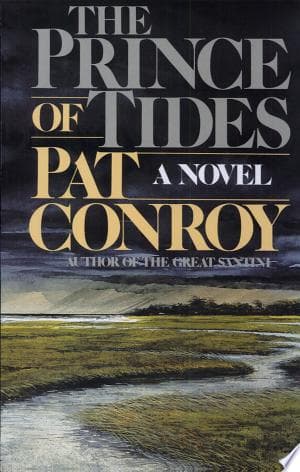
Synopsis
Covers the whole plot, including the ending.
- Difficulty
- Medium
- Pacing
- Variable
- Mood
- Intense, Melancholy, Poignant, Reflective
- Read it if
- You love sprawling, character-driven family sagas with deep psychological insights, vivid Southern settings, and beautiful, lyrical prose.
- Skip it if
- You prefer fast-paced plots, lighthearted stories, or are sensitive to themes of abuse and trauma.
The Prince of Tides Plot Summary
Covers the whole plot, including the ending.
Tom Wingo Arrives in New York
Tom Wingo, a high school English teacher and football coach from Colleton, South Carolina, is called to New York City by his twin sister, Savannah, after her third suicide attempt. His own life is in disarray: his marriage to Sallie is failing, and he has recently been fired from his coaching job. In New York, he meets Dr. Susan Lowenstein, Savannah's psychiatrist, who explains Savannah's fragile mental state. Dr. Lowenstein asks Tom for details about their shared past, believing that understanding their childhood trauma is important for Savannah's recovery. Tom, initially resistant and uncomfortable with looking inward, agrees to help, starting therapy sessions that make him face long-hidden family secrets.
The First Sessions and Lowcountry Memories
In his first sessions with Dr. Lowenstein, Tom struggles to explain his upbringing in the South Carolina lowcountry. He describes his volatile, often violent, shrimper father, Henry Wingo, and his independent, social-climbing mother, Lila. He also talks about his older brother, Luke, a protective and charismatic figure. Tom's memories include vivid, often funny, stories about their poor but lively life on Melrose Island. These stories contrast with the deep pain and problems beneath their family dynamics. Dr. Lowenstein asks him for more emotional truth, sensing his avoidance, as Tom deals with the painful memories he has suppressed for decades.
The Rape and Its Aftermath
Under Dr. Lowenstein's questions, Tom finally reveals the main trauma of their childhood: the brutal rape of Lila Wingo, Savannah, and himself by three escaped convicts who broke into their isolated home on Melrose Island. The event, which happened when Tom and Savannah were teenagers, was hidden by their family, especially Luke and Henry, who violently revenged the perpetrators. This horrific incident, and the silence kept around it, shaped each sibling. Tom explains how this trauma led to Savannah's lifelong mental health struggles, Luke's self-destructive path, and his own emotional repression and inability to face his past.
Luke's Rebellion and Tragic End
Tom tells the story of his older brother, Luke, who became the family's protector and moral guide after the rape. Luke, a talented football player and natural leader, was deeply affected by the family's secrets and the injustice they faced. He worked to save Melrose Island from the land speculator Reese Newbury, a fight that consumed him. Tom recounts Luke's increasingly reckless behavior and his tragic death, which was officially called an accident but implied to be a suicide, or at least a result of his despair. Luke's death left a void in the Wingo family and solidified Tom's feelings of loss and guilt.
Lila's Ambition and Henry's Decline
Tom describes his parents: Lila, a woman driven to escape poverty and climb socially, and Henry, a proud but flawed shrimper who loved the lowcountry but struggled with violence and alcoholism. Lila's ambition often clashed with Henry's traditionalism, creating a turbulent home. After the rape, Henry became more withdrawn and violent, his spirit broken. Lila, in her own way, tried to move past the trauma, focusing on appearances and social acceptance. Tom reveals the deep resentments and unspoken affections that defined their parents' complicated marriage, showing how their ways of coping affected their children.
Tom's Confessions and Lowenstein's Life
As Tom continues to reveal the details of his past, his sessions with Dr. Lowenstein become more intense and personal. He finds himself falling in love with her, drawn to her intelligence, compassion, and the safe space she provides. At the same time, Dr. Lowenstein, a brilliant but emotionally isolated psychiatrist, begins to tell Tom about her unhappy marriage to the famous violinist Herbert Woodruff and her strained relationship with her son, Bernard. Their professional relationship becomes a personal connection, marked by shared vulnerabilities and a growing attraction, as they both find comfort and understanding with each other.
The Affair Begins
The attraction between Tom and Dr. Lowenstein leads to a passionate affair. Their shared emotional intimacy, formed through understanding Tom's painful past, becomes a physical relationship. Tom, feeling alive and understood in a way he has not been in years, finds himself committed to Susan. Susan, in turn, finds a release from the emotional emptiness of her marriage to Herbert. Their affair is secret and intense, giving them both an escape and a deep connection, even as they know the problems and possible results of their actions.
Confronting Herbert Woodruff
Herbert Woodruff, Susan's husband, a self-absorbed and controlling world-renowned violinist, discovers his wife's affair with Tom. Angry and humiliated, Herbert confronts Tom, leading to a tense and emotional encounter. Herbert's reaction shows his own insecurities and the problems in his marriage to Susan. This confrontation makes Tom and Susan acknowledge their situation and how their affair affects their lives and those around them, especially Susan's son, Bernard.
Savannah's Breakthrough
As Tom continues to share the full truth of their family's history, especially the details of the rape and Luke's death, Savannah slowly begins to respond to treatment. The painful memories, once hidden, are finally brought into the open, helping her process her trauma. Tom's willingness to speak about their shared past, to give voice to the unspeakable, helps Savannah heal. She starts to come out of her catatonic state, engaging with the world again and beginning the process of recovery, a sign of the power of truth and shared experience.
Return to South Carolina
With Savannah showing signs of improvement, Tom realizes his time in New York is ending. He makes the difficult decision to end his affair with Susan, knowing a future together is not possible given their lives and responsibilities. Though heartbroken, he has changed, facing his past and finding a voice for his pain. Tom returns to South Carolina, a changed man. He reconciles with his wife, Sallie, and begins to rebuild his life, now with a deeper understanding of himself and his family's history, ready to face the future with honesty and strength.
The Prince of Tides Characters
Tom Wingo
Protagonist
A Southern high school teacher and football coach grappling with a traumatic past.
Tom Wingo is the narrator and protagonist, a man defined by his South Carolina lowcountry roots and the deep, unexamined trauma of his childhood. Initially depicted as a man in crisis—his marriage failing, his career in shambles—he possesses a sharp wit, a gift for storytelling, and a deep, if often suppressed, love for his family. He is a master of deflection and humor, using them as shields against his painful memories. Throughout his sessions with Dr. Lowenstein, he slowly sheds his defenses, confronting the horrors of his past, particularly the family rape and his brother Luke's death, which ultimately leads to his personal redemption.
Relationships: Savannah Wingo (twin sister, deeply connected by shared trauma); Dr. Susan Lowenstein (psychiatrist and lover); Lila Wingo (mother, complex and often distant); Henry Wingo (father, violent but beloved shrimper); Luke Wingo (older brother, protector and hero); Sallie Wingo (wife, estranged but eventually reconciled)
Savannah Wingo
Supporting
Tom's twin sister, a gifted poet battling severe mental illness.
Savannah Wingo is Tom's twin sister, a brilliant and acclaimed poet whose life is tragically overshadowed by the untreated trauma of their childhood. Her profound mental illness, manifested through multiple suicide attempts and periods of catatonia, serves as the catalyst for Tom's journey to New York. Savannah's poetry, though beautiful, often reflects the fragmented and painful memories she cannot articulate directly. She is a fragile but deeply sensitive soul, symbolizing the unhealed wounds of the Wingo family, and her eventual, gradual recovery is a testament to the power of confronting truth.
Relationships: Tom Wingo (twin brother, deeply connected by shared trauma); Dr. Susan Lowenstein (psychiatrist)
Dr. Susan Lowenstein
Supporting
Savannah's psychiatrist, who becomes Tom's confidante and lover.
Dr. Susan Lowenstein is a brilliant, empathetic, and ultimately lonely New York psychiatrist. She is dedicated to healing Savannah but is initially frustrated by Tom's evasiveness. As Tom opens up, Susan becomes deeply invested in his story, recognizing the profound impact of his family's trauma. She is trapped in a sterile marriage to the famous violinist Herbert Woodruff and struggles with her relationship with her son, Bernard. Through her therapeutic relationship with Tom, which evolves into a passionate affair, she begins to confront her own emotional isolation and find a fleeting but intense connection.
Relationships: Savannah Wingo (patient); Tom Wingo (patient's brother, then lover); Herbert Woodruff (husband, emotionally distant); Bernard Woodruff (son, strained relationship)
Luke Wingo
Supporting
Tom and Savannah's older brother, the family's protector and eventual tragic hero.
Luke Wingo is Tom and Savannah's older brother, a charismatic, athletic, and fiercely protective figure who became the family's unofficial patriarch and avenger after the rape. He embodied the best and worst of the Wingo spirit: loyal, brave, but also prone to violence and self-destruction. Luke tirelessly fought to save Melrose Island from Reese Newbury and carried the heavy burden of the family's secrets and his own acts of revenge. His tragic, ambiguous death—officially an accident but implied to be suicide—haunts Tom throughout the novel, representing the ultimate cost of their unaddressed trauma.
Relationships: Tom Wingo (brother, mentor); Savannah Wingo (sister, protected); Lila Wingo (mother); Henry Wingo (father)
Lila Wingo
Supporting
Tom's ambitious and often ruthless mother.
Lila Wingo is the matriarch of the Wingo family, a complex woman driven by an intense desire to escape her impoverished background and achieve social standing. She is both fiercely loving and emotionally manipulative, often prioritizing appearances over genuine emotional connection. Her response to the family rape was to suppress the truth and push for a 'normal' life, which ultimately contributed to her children's suffering. Despite her flaws, she is a survivor, embodying the strength and resilience, as well as the destructive pride, of the Southern woman.
Relationships: Henry Wingo (husband, turbulent marriage); Tom Wingo (son, complex and often strained); Savannah Wingo (daughter, emotionally distant); Luke Wingo (son, admired but also feared)
Henry Wingo
Supporting
Tom's volatile but deeply connected shrimper father.
Henry Wingo is Tom's father, a proud shrimper whose life is intertwined with the South Carolina lowcountry. He is a man of immense physical strength and deep, if often inarticulate, love for his family. However, he is also prone to violent outbursts and alcoholism, especially after the family rape, which broke his spirit. Henry's desire for revenge and his subsequent withdrawal from emotional life deeply impacted his children. He represents a vanishing way of life in the South and the destructive consequences of unaddressed trauma on a proud, traditional man.
Relationships: Lila Wingo (wife, turbulent marriage); Tom Wingo (son, complex mix of fear and love); Savannah Wingo (daughter); Luke Wingo (son, admired and avenged by)
Sallie Wingo
Supporting
Tom's estranged wife, a woman seeking her own identity.
Sallie Wingo is Tom's long-suffering wife, who initially appears as a somewhat neglected figure in Tom's life. Their marriage is failing due to Tom's emotional unavailability and lingering childhood trauma. She is a strong, independent woman who eventually begins an affair with a black doctor, a significant act of rebellion and self-discovery in the racially charged South. Sallie represents Tom's personal failures and the consequences of his emotional repression, but also his eventual capacity for reconciliation and a more honest relationship.
Relationships: Tom Wingo (husband, estranged but reconciled)
Herbert Woodruff
Supporting
Susan Lowenstein's famous, narcissistic husband.
Herbert Woodruff is Dr. Susan Lowenstein's husband, a world-renowned violinist who is arrogant, self-absorbed, and emotionally abusive. He uses his fame and intellect to control those around him, particularly Susan and their son, Bernard. His coldness and emotional distance are a major factor in Susan's unhappiness and her eventual affair with Tom. Herbert represents the intellectual elite of New York, contrasting sharply with Tom's Southern roots, and serves as an antagonist to Tom and Susan's burgeoning relationship.
Relationships: Dr. Susan Lowenstein (wife, estranged); Bernard Woodruff (son, strained relationship)
Bernard Woodruff
Supporting
Susan Lowenstein's son, struggling with his parents' dysfunction.
Bernard Woodruff is Susan and Herbert's son, a sensitive and intelligent boy who is deeply affected by his parents' emotionally distant and dysfunctional marriage. He struggles with his father's demanding nature and his mother's emotional unavailability, often acting out in subtle ways. Bernard forms a bond with Tom, seeing in him a warmth and genuine affection that is lacking in his own home. He represents the innocent collateral damage of adult relationships and the longing for authentic connection.
Relationships: Dr. Susan Lowenstein (mother); Herbert Woodruff (father); Tom Wingo (friend/surrogate father figure)
Reese Newbury
Mentioned
Ruthless land speculator who threatens the Wingo family's home.
Reese Newbury is a wealthy and unscrupulous land speculator who repeatedly attempts to buy and develop Melrose Island, the Wingo family's ancestral home. He represents the encroaching forces of modernity and greed that threaten to destroy the natural beauty and traditional way of life in the South Carolina lowcountry. His actions drive much of Luke's desperate efforts to protect the island and symbolize the external pressures that contribute to the Wingo family's struggles and sense of loss.
Relationships: Luke Wingo (adversary); Henry Wingo (adversary)
The Prince of Tides Themes
The Enduring Impact of Trauma and Silence
The novel shows how childhood trauma, especially the family rape and the silence that followed, shapes the lives of the Wingo siblings. Savannah's severe mental illness, Luke's self-destructive heroism, and Tom's emotional repression are all results of this unaddressed horror. The inability to talk about the past creates a toxic environment that stops emotional growth and continues cycles of pain across generations, showing how destructive secrets can be.
“My wound is my voice.”
The Search for Identity and Self-Discovery
Tom Wingo's journey to New York is a search for self-discovery. By telling his family's history to Dr. Lowenstein, he uncovers his own identity, separate from the roles he played as a son, brother, and husband. His affair with Susan, his confrontation of his past, and his return to South Carolina all lead to a transformation, allowing him to understand who he is and what he values. Savannah's struggle to find her voice through poetry also relates to this theme.
“I was a Southerner, and I knew that Southerners had a peculiar relationship with the past. They were chained to it, but they were also proud of it.”
The Power of Storytelling and Memory
The novel is built on Tom Wingo's storytelling, his verbal recounting of memories to Dr. Lowenstein. This process is not just a narrative; it is therapeutic, a way for Tom to process and heal from his past. The vivid, often embellished, nature of his memories shows how memory is shaped by emotion and perspective. Giving voice to the past, connecting events into a story, becomes the central way for both Tom's and Savannah's recovery.
“I was telling the truth as I remembered it, as I felt it, as I wished it to be.”
Family Loyalty and Dysfunction
The Wingo family is defined by an intense loyalty that exists alongside deep problems. Despite the violence, secrets, and emotional turmoil, there is a strong bond among the siblings and between the children and their parents. This loyalty, while protective in some ways (e.g., Luke's revenge), also contributes to hiding the truth and continuing suffering. The novel explores the complex nature of family love and its capacity for both great support and deep harm.
“My family was my country, and the South was my family.”
The Vanishing South and Environmentalism
The South Carolina lowcountry, especially Melrose Island, is shown as a character itself, representing a disappearing way of life. The fight to protect the island from developers like Reese Newbury reflects an environmental theme and a sadness for the destruction of natural beauty and traditional culture. Tom's deep connection to the land and its ecosystem shows that identity is tied to place, and losing one means losing the other.
“The South was a land of ghosts, and I was one of them.”
Plot Devices & Literary Techniques
First-Person Narrative (Reliable/Unreliable Narrator)
Tom Wingo's subjective and often embellished recounting of events.
The entire novel is narrated by Tom Wingo in the first person. This allows for an intimate, deeply personal exploration of his memories and emotions. However, Tom is initially an unreliable narrator, prone to exaggeration, deflection, and humor to avoid confronting painful truths. As the story progresses and he becomes more honest with Dr. Lowenstein and himself, his narration becomes more reliable, mirroring his journey of self-discovery. This narrative choice immerses the reader directly into Tom's mind, making his healing process profoundly impactful.
Dual Timeline/Flashback Structure
Alternating between present-day New York and past events in South Carolina.
The narrative constantly shifts between Tom's present-day therapy sessions in New York City and his vivid, detailed flashbacks to his childhood and adolescence in the South Carolina lowcountry. This dual timeline is crucial for revealing the gradual unfolding of the Wingo family's traumatic history. The present-day interactions with Dr. Lowenstein provide a framework for the past revelations, allowing the reader to experience Tom's emotional journey alongside him, piece by piece, as he unearths repressed memories and connects them to his current state.
Symbolism of Melrose Island
The Wingo family's ancestral home representing identity, sanctuary, and loss.
Melrose Island is more than just a setting; it is a powerful symbol of the Wingo family's heritage, their connection to the land, and their struggle for survival. It represents their sanctuary, their identity, and the wild, untamed spirit of the lowcountry. The repeated attempts by Reese Newbury to buy and develop it symbolize the encroachment of modernity and the threat to a traditional way of life. The island becomes a physical manifestation of the family's fight to preserve their past and their very essence.
Savannah's Poetry
Literary device for expressing unspoken trauma and emotional states.
Savannah Wingo's poetry serves as a powerful plot device for conveying her inner turmoil and the unspoken trauma of the family. Since Savannah is largely catatonic or unable to articulate her pain directly, her poems, which Tom often reads and interprets, offer glimpses into her fragmented memories and emotional landscape. The poetry allows the novel to explore themes of art as therapy and the struggle to give voice to unspeakable experiences, providing a crucial window into Savannah's mind and the impact of the family's past.
The Prince of Tides Quotes
“My wound is geography. It is also my anchorage, my port of call.”
“In families there are no crimes beyond forgiveness.”
“I wanted to tell her that the only thing I was sure of after this life is that there is a bird.”
“The problem with life is that you can't go back and edit it.”
“Southerners can never resist a losing cause.”
“I learned that you should never, ever discuss your wife with another woman.”
“There is no such thing as a perfect family, only perfect moments.”
“The river was always there, and it was always the same, and it was always changing.”
“I have always depended on the kindness of strangers.”
“You can't go home again, but I guess you can shop there.”
“The heart is a resilient muscle.”
“We are all prisoners of our own stories.”
“In the South, the past is never dead. It's not even past.”
“Love is the only thing that makes life worth living.”
Quiz
10 questions on the plot and the characters. Each answer comes with a short explanation.
Question 1
What is the primary reason Tom Wingo travels to New York City at the beginning of the novel?
- To attend a job interview as a football coach
- To visit his grandmother Tolitha, who is ill
- To help his twin sister Savannah after her suicide attempt
- To confront Reese Newbury about Melrose Island
Show answer
C. To help his twin sister Savannah after her suicide attempt Tom flies to New York after learning that his twin sister Savannah, a gifted poet, has attempted suicide. This event sets the main plot in motion, as Tom works with her psychiatrist to uncover their family's traumatic past.
Question 2
Who is Susan Lowenstein, and what is her role in the story?
- Tom's estranged wife who helps him reconcile with his family
- Savannah's psychiatrist who works with Tom to explore their past
- A poet friend of Savannah's who encourages her writing
- A land speculator threatening the Wingo family's property
Show answer
B. Savannah's psychiatrist who works with Tom to explore their past Susan Lowenstein is Savannah's psychiatrist in New York. She collaborates with Tom to delve into the Wingo family's history, helping both siblings confront their trauma and ultimately aiding Tom's personal healing.
Question 3
What is the name of the eccentric character who wordlessly directs traffic in Colleton, South Carolina?
- Reese Newbury
- Herbert Woodruff
- Mr. Fruit
- Tolitha Wingo
Show answer
C. Mr. Fruit Mr. Fruit is a lovable, eccentric figure in Colleton who has directed traffic at the same intersection for decades without speaking. He represents the quirky, vanishing way of life in the South Carolina lowcountry.
Question 4
Which character is described as the first real feminist in the Wingo family and serves as Savannah's mentor?
- Susan Lowenstein
- Tolitha Wingo
- Savannah Wingo
- Lila Wingo
Show answer
B. Tolitha Wingo Tolitha Wingo is Savannah's grandmother and a strong, eccentric figure who challenges traditional gender roles. Her independence and unconventional life inspire Savannah and highlight themes of feminism and resilience.
Question 5
What worldly possession of the Wingo family is threatened by the land speculator Reese Newbury?
- Their family home in Colleton
- Savannah's poetry manuscripts
- Melrose Island
- Tom's football coaching job
Show answer
C. Melrose Island Reese Newbury, a ruthless patrician, threatens Melrose Island, which is the Wingos' only secure worldly possession. This conflict underscores themes of loss, heritage, and the changing South.
Question 6
How does Tom Wingo's journey to help Savannah ultimately impact him personally?
- It leads him to abandon his family and start a new life in New York
- It helps him save his marriage and football career immediately
- It becomes his last chance to save himself by confronting his past
- It causes him to resent Savannah for her mental illness
Show answer
C. It becomes his last chance to save himself by confronting his past Through unraveling Savannah's trauma with Susan Lowenstein, Tom confronts his own family's violent history and personal struggles. This process of healing Savannah becomes crucial for his own redemption and self-discovery.
Question 7
What historical periods does the novel trace through the Wingo family's story?
- The Civil War through the Great Depression
- World War I through the 1950s
- World War II through the Vietnam War and into the 1980s
- The Roaring Twenties through the Cold War
Show answer
C. World War II through the Vietnam War and into the 1980s The novel moves from present to past, tracing the Wingo family's history from World War II through the Vietnam War era and into the 1980s. This span highlights generational trauma and societal changes affecting the characters.
Question 8
Which character is married to Susan Lowenstein and is a world-famous violinist?
- Reese Newbury
- Herbert Woodruff
- Mr. Fruit
- Tom Wingo
Show answer
B. Herbert Woodruff Herbert Woodruff is Susan Lowenstein's husband, a renowned violinist. His character adds complexity to Susan's life and contrasts with the Wingos' Southern background, enriching the novel's exploration of relationships and art.
Question 9
What central theme is highlighted by the contrast between New York City and the South Carolina lowcountry in the novel?
- The superiority of urban life over rural traditions
- The conflict between modernity and a vanishing Southern way of life
- The economic opportunities available in big cities
- The importance of travel for personal growth
Show answer
B. The conflict between modernity and a vanishing Southern way of life The novel juxtaposes New York's urban setting with the South Carolina lowcountry to explore themes of change, loss, and identity. The lowcountry's fading beauty symbolizes a disappearing Southern culture, while New York represents new beginnings and confrontation with the past.
Question 10
In what way does Savannah's poetry relate to the novel's exploration of family trauma?
- It serves as a direct confession of the family's secrets, solving the mystery early on
- It is purely decorative and unrelated to the main plot
- Its cadenced beauty and jumbled cries provide clues to the hidden family story
- It focuses on romantic themes, distracting from the family's violence
Show answer
C. Its cadenced beauty and jumbled cries provide clues to the hidden family story Savannah's poetry blends artistic beauty with chaotic expressions of pain, mirroring her mental illness and hinting at the Wingos' repressed trauma. This artistic element drives the plot as Tom and Susan decode these clues to understand her suicide attempt and their shared past.
The Prince of Tides FAQ
What is 'The Prince of Tides' about?
The novel follows Tom Wingo, a South Carolina football coach, who travels to New York after his poet twin sister Savannah's suicide attempt. Through sessions with her psychiatrist Susan Lowenstein, Tom recounts their traumatic childhood in the lowcountry—including abuse, poverty, and family secrets—while confronting his own crumbling marriage and identity. The story weaves between past and present as Tom tries to save Savannah and, in the process, heal himself.
Why should I read 'The Prince of Tides'?
It's a powerful exploration of trauma, family bonds, and redemption, told with Conroy's lyrical prose and deep emotional resonance. The novel masterfully blends Southern Gothic elements with psychological drama, offering rich character studies and a haunting portrayal of how past violence shapes present lives. Readers praise its raw honesty, vivid settings, and the gripping unraveling of the Wingo family's hidden history.
What is the background/setting of 'The Prince of Tides'?
The story shifts between 1980s New York City, where Tom stays with psychiatrist Susan Lowenstein, and flashbacks to the South Carolina lowcountry (particularly the fictional town of Colleton and Melrose Island). The Southern settings highlight the Wingos' ties to the land, coastal beauty, and decaying aristocratic culture, contrasting with New York's urban intensity where Tom confronts modern psychiatry and his own displacement.
What are the most memorable quotes?
Notable lines include Savannah's poetic 'My wound is geography,' reflecting the family's rooted trauma, and Tom's reflection 'In families there are no crimes beyond forgiveness.' Another is Tolitha Wingo's feminist declaration 'I was born to be a remarkable woman,' emphasizing the novel's themes of resilience and self-definition against Southern patriarchal constraints.
What writing style does the author use?
Conroy employs lush, lyrical prose with vivid descriptions of the lowcountry landscape, blending Southern Gothic atmosphere with psychological depth. The narrative moves fluidly between past and present, using Tom's first-person recollections to create an intimate, confessional tone. His style balances poetic beauty with raw, often brutal honesty about trauma and memory.
What minor details add significant meaning?
Mr. Fruit's lifelong, wordless traffic directing in Colleton symbolizes the town's stagnant, quirky traditions masking deeper dysfunctions. The recurring imagery of tides and water mirrors the Wingos' emotional ebbs and flows, while Savannah's poetry fragments serve as cryptic clues to their shared trauma. Melrose Island represents the family's fragile hold on stability amidst external threats like land speculator Reese Newbury.
What are some subtle foreshadowing moments?
Early references to Savannah's 'cries of illness' in her poetry hint at the repressed childhood trauma later revealed. Tom's initial reluctance to discuss his past foreshadows the severity of the secrets, such as the violent attack on the family by escaped convicts. The decaying beauty of the lowcountry subtly mirrors the Wingos' own hidden scars and inevitable confrontations with history.
What unexpected character connections exist?
Susan Lowenstein's strained marriage to violinist Herbert Woodruff parallels Tom's failing relationship, creating an unexpected bond as they each seek emotional honesty. Tolitha Wingo's feminist independence indirectly influences Savannah's artistic rebellion against family silence. Reese Newbury's land schemes connect to broader themes of Southern economic exploitation, tying personal loss to historical greed.
What are unspoken character motivations?
Tom's coaching career and humor mask deep-seated guilt over failing to protect Savannah and shame about his family's poverty. Savannah's poetry and mental illness are unconscious cries for the family to acknowledge their trauma. Susan Lowenstein's dedication to Savannah's case stems from her own unfulfilled maternal desires and marital dissatisfaction, not just professional duty.
What psychological complexities do characters exhibit?
Tom grapples with survivor's guilt, repressed anger, and a fractured identity as both caregiver and victim. Savannah embodies the artist's struggle to transform trauma into art, with her psychosis reflecting fragmented memory. Their parents, Henry and Lila, show how generational abuse and Southern stoicism breed emotional silence, affecting all three Wingo children differently.
What are the major emotional turning points?
Key moments include Tom's first full confession to Susan about the convict attack, which breaks his lifelong denial; Savannah's suicide attempt forcing the family's secrets into the open; and Tom's realization that saving Savannah requires forgiving himself. The climax involves confronting their mother Lila's complicity in silence, leading to a painful but liberating emotional reckoning.
How do relationship dynamics evolve?
Tom and Savannah's twin bond shifts from childhood protectiveness to adult estrangement, then to a fragile reconciliation through shared memory. Tom and Susan's professional relationship deepens into a platonic intimacy that helps heal both. The Wingo siblings' relationships with their parents move from idealized childhood views to painful, nuanced understanding of their flaws and sacrifices.
Which parts remain ambiguous or open-ended?
The novel leaves Savannah's long-term recovery uncertain, emphasizing that healing is ongoing. Tom's future with his wife Sally is unresolved, suggesting reconciliation is possible but not guaranteed. The fate of Melrose Island after Reese Newbury's threats is ambiguous, symbolizing the precariousness of the Wingos' legacy in a changing South.
What are controversial scenes or decisions?
The graphic depiction of the convicts' violent attack on the Wingo family sparks debate over its necessity in portraying trauma. Tom's emotional affair with Susan Lowenstein, while unconsummated, raises questions about infidelity and boundaries in therapeutic relationships. Lila Wingo's passive complicity in hiding the family's abuse is often critiqued as a portrayal of maternal failure.
'The Prince of Tides' ending explained: how it ends & what it means
Tom returns to South Carolina, having helped Savannah begin recovery and faced his past, but his marriage remains uncertain. The ending implies that acknowledging trauma is the first step toward healing, not a complete cure. It suggests that family legacy, like the tides, is cyclical—painful memories may recede but never fully disappear, and self-forgiveness is an ongoing journey.
What themes are central to the novel?
Major themes include the destructive power of silenced trauma, the complex bonds of family loyalty, and the struggle for identity amidst Southern societal expectations. The novel also explores art as a means of processing pain, the contrast between Northern and Southern cultures, and the search for redemption through truth-telling and memory.
How does the title 'The Prince of Tides' relate to the story?
The title metaphorically represents Tom Wingo, who navigates the emotional 'tides' of his family's history—the ebb and flow of trauma, memory, and recovery. It alludes to his role as a protector ('prince') in the coastal lowcountry setting, where tides symbolize both natural beauty and the relentless, shaping force of past events on present lives.
About the author

Donald Patrick Conroy was an American author who wrote several acclaimed novels and memoirs; his books The Water is Wide, The Lords of Discipline, The Prince of Tides and The Great Santini were made into films, the last two being nominated for Oscars. He is recognized as a leading figure of late-20th-century Southern literature.
Similar books
- The Great Santini
Pat Conroy
4.1 (30k) average on GoodreadsLiterary FictionAnother powerful, semi-autobiographical family drama by the same author, exploring similar themes of an abusive father and Southern life.
- East of Eden
John Steinbeck
4.4 (429k) average on GoodreadsLiterary FictionA multi-generational family epic with complex characters, moral dilemmas, and a deep exploration of good and evil within a specific American landscape.
- A Little Life
Hanya Yanagihara
4.3 (212k) average on GoodreadsLiterary FictionExplores profound trauma, friendship, and the long-term impact of childhood abuse with intense emotional depth, though in a contemporary setting.
- The Sound and the Fury
William Faulkner
3.9 (158k) average on GoodreadsLiterary FictionBoth are Southern Gothic novels exploring familial dysfunction and trauma. However, Faulkner uses a more fragmented, experimental narrative structure with multiple unreliable narrators, making it more challenging to read. Conroy's narrative, while complex with flashbacks, is more linear and emotionally direct, prioritizing accessibility and immersive emotional resonance over structural innovation. Conroy's prose is also more overtly lyrical and descriptive compared to Faulkner's often starker, stream-of-consciousness style.
- Beloved
Toni Morrison
3.9 (325k) average on GoodreadsLiterary FictionBoth novels confront the profound psychological and emotional effects of severe trauma and abuse. Morrison's Beloved integrates magical realism and historical allegory more deeply, specifically addressing the trauma of slavery and its collective memory. Conroy's The Prince of Tides focuses more intensely on the personal and familial aftermath of individual abuse within a contemporary setting, with less emphasis on broader historical allegory and more on the internal psychological landscape of its characters.
- The Old Man and the Sea
Ernest Hemingway
3.8 (831k) average on GoodreadsLiterary FictionA Cuban fisherman's long struggle with a giant marlin becomes a story of endurance and dignity, now retold for young adults with illustrations, phonetic guides, and writing prompts in Traditional Chinese.






Enjoyed the summary?
A summary gives you the shape of the book. The book itself has the detail, the examples and the voice.
Find The Prince of Tides on AmazonAs an Amazon Associate, BookBrief earns from qualifying purchases. How we're funded