
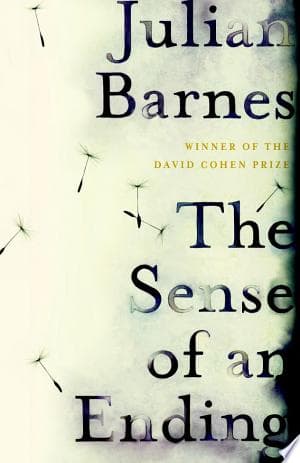
Synopsis
Covers the whole plot, including the ending.
- Difficulty
- Medium
- Pacing
- Slow
- Mood
- Reflective, Melancholy, Introspective, Unsettling
- Read it if
- You enjoy introspective literary fiction that explores memory, regret, and the unreliable narrator, with a subtle, unfolding mystery.
- Skip it if
- You prefer fast-paced plots, clear-cut answers, or stories with overtly likable protagonists.
The Sense of an Ending Plot Summary
Covers the whole plot, including the ending.
Sixth Form Days and Adrian's Arrival
As an older man, Tony Webster thinks back to his time in sixth form with his friends Colin, Alex, and Graham. They spent their days talking about ideas, sex, and feeling superior. This changed when Adrian Finn arrived, a new student who was clearly smarter and more thoughtful than the others. Adrian quickly joined their group, questioning their ideas and starting deeper talks about history, philosophy, and life. Tony, though impressed at first, felt a bit uneasy with Adrian's deep insights and serious nature, which was different from Tony's more casual way. The group, especially Tony, started to compare themselves to Adrian's intelligence.
Veronica Ford and the Double Date
Tony meets Veronica Ford, a girl from a different, seemingly richer and more complicated background. Their first meetings were awkward, without much deep feeling, but they started dating. Tony introduced Veronica to his friends, including Adrian, during a double date at a pub. The evening was tense; Veronica seemed quiet and a bit dismissive, while Adrian talked to her in a more intellectual way than Tony did. Tony felt more and more inadequate and uncomfortable, noticing the small but important differences in how Adrian and Veronica interacted compared to his own relationship with her. The date showed the growing problems in Tony and Veronica's connection.
The Breakup and the Infamous Letter
Veronica broke up with Tony during their university years, saying he lacked emotional depth and was a 'coward.' Upset and angry, Tony wrote a cruel letter to Veronica, insulting her and her family, and suggesting Adrian would be a better match for her. He sent the letter, thinking it was a final, satisfying act of revenge. Soon after, Tony learned that Adrian and Veronica had started a relationship, a fact that hurt him deeply and confirmed his worst fears, solidifying his anger toward both of them. This letter became an important, long-forgotten event that would reappear with serious results years later, showing Tony's immaturity and meanness at the time.
Adrian's Suicide and Tony's Reflection
Years later, at university, Tony received the shocking news of Adrian Finn's suicide. Adrian had ended his own life, leaving a puzzling note without a clear explanation. This event deeply affected Tony, making him rethink his understanding of Adrian and their shared past. Tony struggled with why Adrian did it, remembering Adrian's sharp mind and philosophical thoughts about life and death. He felt a sense of loss and regret, wondering if he had ever truly understood his friend. The suicide left a lasting mark on Tony, shaping how he saw memory, truth, and the unknown parts of human nature, a theme he would think about throughout his life.
The Lawyer's Letter and Sarah Ford's Will
Decades later, a retired Tony Webster received a letter from a lawyer. The letter said that Veronica Ford's mother, Sarah Ford, had left him £500 and two personal items in her will. This unexpected inheritance disrupted Tony's quiet, orderly life. He was confused by Sarah Ford's gift, as he had only met her a few times and hadn't seen Veronica in years. The items mentioned were Adrian Finn's diary and a photograph. This letter immediately brought back many memories and questions for Tony, making him face his past and how unreliable his own memories were about Veronica, Adrian, and the events of their youth. It started his journey into the past.
The Quest for the Diary
Tony contacted the lawyer to get his inheritance, specifically Adrian's diary, only to be told that Veronica Ford had it and wouldn't give it up. This refusal made Tony determined to get the diary, believing it held the answer to Adrian's suicide and his past with Veronica. He began a series of frustrating emails and phone calls with Veronica, who was evasive and unhelpful. Their talks were tense, marked by old grudges and unspoken history. Tony's pursuit of the diary became an obsession, pushing him to meet Veronica in person and look deeper into the confusing, broken memories of their shared youth. He felt a strong need to get back this piece of his past.
Meeting Veronica Again
Tony arranged to meet Veronica Ford in person to talk about the diary. Their meetings were awkward and full of unspoken history. Veronica was intentionally vague, giving fragmented comments and holding back information, which further frustrated Tony. She hinted at deeper truths and challenged his version of events, making him doubt his own memories. Veronica's behavior was often dismissive and mocking, but she also showed moments of vulnerability. Tony found himself constantly trying to figure out what she meant, feeling that she held an important secret. These meetings deepened his confusion and started a lasting feeling of unease, as he realized his understanding of their past was far more incomplete than he had imagined. He felt like he was being deliberately provoked.
The Unreliable Narrator and Shifting Memories
As Tony continued to talk with Veronica, his long-held memories of his youth, his relationship with Veronica, and Adrian's character were steadily broken down. Veronica's puzzling remarks and clear contradictions made Tony rethink what he thought he knew. He began to question how accurate his own memories were, realizing how much he had forgotten, made better, or purposely suppressed over the decades. He looked back at key moments, such as his breakup with Veronica and the letter, seeing them in a new, more critical way. This process was confusing and painful, as Tony struggled with how unreliable memory is and how subjective truth is, realizing his past was not as settled as he believed.
The Revelation of Adrian's Fate
In a powerful and painful meeting, Veronica finally told Tony the full, shocking truth. She explained that Adrian Finn did not die by suicide because of deep despair, but because of a disturbing relationship with Veronica's mother, Sarah Ford. Veronica revealed that Adrian had gotten her mother pregnant, and his suicide was the desperate act of a young man caught in a scandalous and emotionally complex situation. She implied that Tony's cruel letter, written when he was angry after their breakup, might have added to Adrian's despair by making him feel even more alone and judged. This revelation shattered Tony's carefully built version of the past, forcing him to face the serious results of his youthful actions and the true, tragic nature of Adrian's end.
The Final Piece: Tony's Letter
Veronica eventually revealed that the 'diary' was not a traditional journal but a letter. She gave Tony a copy of his own spiteful letter, the one he wrote to her after their breakup, in which he had cruelly suggested that Adrian would be better off with her or her mother. The full impact of his forgotten words hit Tony with overwhelming force. He realized the deep irony and tragic consequence of his casual cruelty. The letter, sent decades ago, had not only insulted Veronica but also, by accident, planted a seed or confirmed a path for Adrian, who then became involved with Sarah Ford and ultimately died by suicide. Tony is left to deal with the crushing weight of his past actions and the unreliable nature of his memory, which had conveniently hidden this crucial, incriminating piece of his personal history. The ending is unclear, leaving Tony to face the serious implications of his own unexamined past.
The Sense of an Ending Characters
Tony Webster
Protagonist
A retired, seemingly ordinary man grappling with the unreliable nature of memory.
Tony Webster is presented as a somewhat complacent, conventional man in his retirement, who believes he has led a decent, unremarkable life. He is initially portrayed as a self-satisfied, if slightly cynical, observer of life, particularly his own past. He prides himself on his rationality and his ability to recall events accurately. However, his journey through the narrative reveals him to be deeply flawed, prone to self-deception, and burdened by unexamined actions. He is driven by a need to understand his past, particularly Adrian Finn's suicide, but also by a desire to maintain a favorable self-image.
Relationships: Adrian Finn (Friend, intellectual rival, a figure Tony both admired and felt inferior to.); Veronica Ford (First girlfriend, later antagonist and revealer of truth, a source of lifelong confusion and regret.); Margaret (Ex-wife, a stable, rational presence who offers occasional, clear-sighted advice.)
Adrian Finn
Central Catalyst (Deceased)
Tony's brilliant, enigmatic school friend whose suicide forms the central mystery.
Adrian Finn is introduced as an exceptionally intelligent, philosophical, and serious young man, who quickly outshines Tony and his friends in intellectual depth. He is presented as someone who grapples with profound questions about life, history, and meaning, often challenging conventional thought. His enigmatic nature and the mystery surrounding his suicide are the primary drivers of Tony's quest. Adrian represents intellectual purity and a tragic flaw, ultimately revealed to be entangled in a deeply complex and scandalous personal life that contradicts his public intellectual persona. His actions, even in death, force others to confront uncomfortable truths.
Relationships: Tony Webster (Friend, intellectual superior, a source of both admiration and envy for Tony.); Veronica Ford (Girlfriend after Tony, a connection that deepens the mystery.); Sarah Ford (Veronica's mother, with whom Adrian had a secret, scandalous relationship.)
Veronica Ford
Antagonist/Truth-Teller
Tony's first girlfriend, who holds the keys to the past and challenges his self-perception.
Veronica Ford is initially presented through Tony's biased, often dismissive memories as a somewhat cold, enigmatic, and emotionally distant young woman. As an adult, she becomes the primary obstacle and catalyst for Tony's journey, deliberately withholding information and challenging his version of events. She is sharp, perceptive, and carries a deep-seated resentment towards Tony and the past. Her role is to dismantle Tony's comfortable self-deception, forcing him to confront uncomfortable truths. She is the gatekeeper of the past, eventually revealing the shocking realities that Tony has suppressed or misinterpreted.
Relationships: Tony Webster (First boyfriend, later a figure of resentment and a means to reveal the past.); Adrian Finn (Later boyfriend, a connection that remains shrouded in mystery for Tony.); Sarah Ford (Mother, whose relationship with Adrian profoundly impacted Veronica's life.)
Margaret
Supporting
Tony's ex-wife, a voice of reason and occasional clear-sightedness.
Margaret is Tony's ex-wife, with whom he maintains an amicable, if somewhat detached, relationship. She serves as a grounding force for Tony, often offering practical advice and a more objective perspective on his increasingly convoluted quest into the past. Margaret represents a certain common sense and emotional maturity that Tony often lacks. While not central to the plot's unfolding mystery, her presence highlights Tony's self-absorption and provides moments of contrast to his unreliable internal monologue. She is a stable, understanding figure who observes Tony's struggle with a quiet empathy.
Relationships: Tony Webster (Ex-wife, a long-standing, supportive, and occasionally exasperated friend.)
Sarah Ford
Mentioned (Deceased)
Veronica's mother, whose will sparks Tony's journey into the past and whose secret life is revealed.
Sarah Ford is Veronica's mother, a figure Tony remembers as somewhat aloof and intimidating during his youth. Her unexpected bequest to Tony in her will is the catalyst for the entire narrative. She is a posthumous character whose hidden life and secret relationship with Adrian Finn ultimately provide the shocking resolution to the central mystery. Her character represents the hidden complexities and moral ambiguities that often lie beneath the surface of seemingly ordinary lives, and her actions have profound, lasting consequences for her daughter and Adrian.
Relationships: Veronica Ford (Mother, whose actions deeply affected her daughter.); Adrian Finn (Secret lover, a relationship that led to Adrian's tragic end.)
The Sense of an Ending Themes
The Unreliability of Memory
This is the main theme, shown through Tony Webster's journey. Tony first believes his memories are correct and complete, but as he looks at the past, he realizes how much he has forgotten, exaggerated, or purposely hidden. His talks with Veronica constantly challenge his memories, making him face how subjective and rebuilt memory is. The novel shows that memory is not a factual record but a story we create, often to protect our self-image. For example, Tony's first memory of his breakup with Veronica is cleaned up, while his cruel letter is entirely forgotten until Veronica makes him remember.
“How often do we tell our own life story? How often do we adjust, embellish, make slight changes? And the longer we do it, the more confidently we tell it, until, in the end, it is the truth.”
The Nature of History and Personal Truth
The novel suggests that history, both personal and shared, is not fixed but a story constantly reinterpreted. Tony's search to understand Adrian's suicide is a search for a definite historical truth, but he eventually finds that such a truth is hard to grasp and often painful. The 'ending' of Adrian's story, as Tony understood it for decades, is completely changed by Veronica's reveals. The book proposes that our understanding of the past is always partial, filtered through our own biases, and can change when new information appears. This theme is clear in Tony's realization that 'history is the lies of the victors, the self-delusions of the defeated, and the memories of the survivors.'
“What do you do when you are not sure what you know? When you are not sure what you remember?”
Consequences of Youthful Indifference and Cruelty
The novel shows how seemingly small actions and attitudes in youth can have serious and unexpected results decades later. Tony's youthful arrogance, his emotional fear in his relationship with Veronica, and especially his spiteful letter, are at first dismissed by him as teenage mistakes. However, the climax reveals that this letter, combined with Adrian's vulnerability, led to a tragic series of events. The book argues that even small acts of unkindness or judgment can spread through time, affecting lives in ways the person never intended or even remembered. Tony's journey is a reckoning with his past moral failings and their far-reaching impact.
“I thought: this is what it means to be a grown-up. To have a past, and to have to live with it.”
Authenticity vs. Performance
From the start, the novel explores the idea of acting and being real, especially among the teenage boys who try to seem smart and cynical. Adrian Finn, while seeming more genuine, is also shown to have a hidden life that goes against his public image. Tony, too, plays the role of the 'sensible' and 'reliable' man, both in his youth and retirement, avoiding real emotional connection. The story eventually removes these acts, forcing Tony to face the hard, uncomfortable truths of his own and others' lives, showing the often-painful gap between the face we show the world and our inner reality. Veronica's puzzling behavior is also a form of acting, meant to provoke Tony.
“It strikes me that I have spent my life in a state of mild pretentiousness, always slightly aware of the effect I am having, even on myself.”
Plot Devices & Literary Techniques
Unreliable Narrator
Tony Webster's subjective and flawed recounting of events.
The entire novel is narrated from Tony Webster's first-person perspective, making him an inherently unreliable narrator. His memories are shown to be selective, biased, and prone to self-justification, particularly regarding his own actions and character. This device is crucial as it creates suspense and forces the reader to question Tony's version of events, mirroring his own eventual realization. The gap between what Tony remembers and what truly happened forms the core of the mystery, leading to a profound re-evaluation of his character and the plot's events. The reader, like Tony, is constantly re-evaluating the narrative as new information surfaces.
Epistolary Device (The Letter)
A crucial, forgotten letter that serves as a catalyst and ultimate revelation.
Tony's spiteful letter to Veronica, written in his youth and subsequently forgotten by him, acts as a powerful epistolary device. It is initially a symbol of youthful cruelty, then a forgotten piece of personal history, and finally, the devastating key to understanding Adrian's tragic end. The letter's existence and its eventual re-discovery by Tony serve as the ultimate proof of his unreliability and the tangible link between his past actions and their profound consequences. It is the 'diary' he sought, a physical manifestation of a crucial, suppressed truth.
Anachrony (Flashback and Foreshadowing)
Non-linear narrative structure that gradually reveals past events.
The novel heavily utilizes anachrony, particularly through Tony's extensive flashbacks to his youth. These flashbacks are not presented chronologically or as complete memories, but rather as fragmented recollections that are continually re-evaluated and re-contextualized as the present-day narrative unfolds. Foreshadowing is subtle, often through Veronica's cryptic remarks or Tony's vague feelings of unease about his past, hinting that there is more to the story than he (or the reader) initially understands. This non-linear approach enhances the theme of unreliable memory and builds suspense, as the true 'ending' is only revealed in the final chapters.
The MacGuffin (Adrian's Diary)
An object that drives the plot forward, but whose true nature is different than expected.
Adrian Finn's diary serves as a classic MacGuffin. Tony's relentless pursuit of the diary is the primary external driver of the plot, compelling him to reconnect with Veronica and delve into his past. He believes it will contain Adrian's philosophical musings and provide answers about his suicide. However, the diary itself is ultimately revealed to be something entirely different – Tony's own forgotten letter. The true significance lies not in the object itself, but in the journey it precipitates and the devastating truths it indirectly uncovers about Tony's own complicity and the nature of Adrian's death.
The Sense of an Ending Quotes
“History is that certainty produced at the point where the imperfections of memory meet the inadequacies of documentation.”
“What did I know of life, I who had been fortunate enough to have a happy childhood, and had never been hungry, or cold, or afraid?”
“You get to a certain age, and you realise that, in the end, it's not about what you say, it's about what you do.”
“How often do we tell our own life story? How often do we adjust, embellish, make slight changes? And not just for an audience, but for ourselves.”
“I thought of this as a kind of moral algebra. If you did something bad, you were punished. If you did something good, you were rewarded. Life was fair.”
“We are not always what we think we are, nor do we always remember what we have done.”
“The past is not a foreign country; it is a contiguous state, and we are all its citizens.”
“It seems to me that what you remember is not what happened, but what you remember remembering.”
“There is an age when you are young enough to believe that you can change the world, and old enough to know that you can't.”
“Sometimes you just have to give in to the fact that you might be wrong.”
“You live your life, you go along, you think you're pretty self-aware, and then something happens and you realize you know nothing.”
“Isn't it odd, how much of the past we forget? And how much of it we invent?”
“Life is a matter of accumulation. Of things, of experiences, of memories. And then, at the end, it's all about loss.”
Quiz
10 questions on the plot and the characters. Each answer comes with a short explanation.
Question 1
What significant item does Tony Webster inherit from Sarah Ford, Adrian's mother?
- A collection of Adrian's philosophical essays.
- Adrian's diary.
- A substantial sum of money.
- A photograph of Adrian and Veronica together.
Show answer
B. Adrian's diary. Tony is surprised to receive a letter from a lawyer informing him that Sarah Ford, Adrian's mother, has bequeathed Adrian's diary to him, which he had previously forgotten about.
Question 2
What is the initial reason Tony Webster gives for his breakup with Veronica Ford?
- She cheated on him with Adrian.
- They grew apart after university.
- Her family was too demanding.
- He felt she was too controlling and he desired freedom.
Show answer
D. He felt she was too controlling and he desired freedom. Tony initially remembers the breakup as being instigated by him, due to Veronica's perceived intensity and his own desire for independence, though this memory is later challenged.
Question 3
What is the primary theme explored through Tony's unreliable narration?
- The importance of living in the present.
- The subjective and fallible nature of memory.
- The inevitable decline of friendships over time.
- The pursuit of intellectual superiority.
Show answer
B. The subjective and fallible nature of memory. The entire novel revolves around Tony's re-evaluation of his past and the stark contrast between what he remembers and what actually happened, highlighting memory's unreliability.
Question 4
What specific act does Tony eventually remember doing that had a profound impact on Adrian and Veronica?
- He stole Adrian's university scholarship.
- He wrote a cruel letter to Adrian and Veronica after their relationship began.
- He spread rumors about Veronica's family.
- He prevented Adrian from pursuing a career in philosophy.
Show answer
B. He wrote a cruel letter to Adrian and Veronica after their relationship began. Tony slowly recalls writing a vindictive letter to Adrian and Veronica, urging them to get married and implying a connection between Veronica's family history and Adrian's intellectualism, a letter he had completely suppressed.
Question 5
What is Adrian Finn's ultimate fate, as revealed later in the novel?
- He becomes a reclusive philosopher.
- He commits suicide.
- He moves abroad and loses contact.
- He marries Veronica and lives a quiet life.
Show answer
B. He commits suicide. Adrian's suicide is a central plot point that Tony struggles to comprehend and whose causes he later investigates, discovering his own role in the events leading up to it.
Question 6
How does Veronica primarily communicate with Tony during his quest for understanding?
- Through lengthy emails.
- Via a series of cryptic phone calls.
- Through brief, often withholding, in-person meetings and short, evasive messages.
- She sends him a detailed letter explaining everything.
Show answer
C. Through brief, often withholding, in-person meetings and short, evasive messages. Veronica is consistently elusive and reluctant to provide direct answers, communicating mostly through brief, often frustrating encounters and short, unhelpful replies to Tony's inquiries.
Question 7
What is the 'sense of an ending' that the title refers to, beyond the literal end of a life?
- The end of Tony's career as an art dealer.
- The ending of a romantic relationship.
- The human tendency to impose narrative coherence and definitive endings on messy, ongoing life events and memories.
- The finality of old age and approaching death.
Show answer
C. The human tendency to impose narrative coherence and definitive endings on messy, ongoing life events and memories. The title reflects Tony's realization that humans construct narratives for their lives, imposing beginnings, middles, and ends, even when reality is more fragmented and less conclusive, particularly regarding his own past.
Question 8
What shocking revelation does Tony eventually piece together about Veronica's relationship with Adrian and his own past actions?
- Veronica was Adrian's half-sister.
- Veronica's mother (Sarah) had an affair with Tony's father.
- Adrian had a child with Veronica, who was the result of Adrian's relationship with Sarah Ford (Veronica's mother), which Tony's cruel letter had encouraged.
- Veronica had been secretly married to Adrian for years before he died.
Show answer
C. Adrian had a child with Veronica, who was the result of Adrian's relationship with Sarah Ford (Veronica's mother), which Tony's cruel letter had encouraged. The ultimate, devastating revelation is that Adrian had a relationship with Veronica's mother, Sarah, resulting in a child, and that Tony's spiteful letter, intended to hurt Adrian and Veronica, had ironically encouraged this very outcome.
Question 9
What is the significance of the phrase 'It's all a bit of a mess, isn't it?' as used by Veronica?
- It refers to the disarray of Adrian's apartment.
- It's a dismissive comment about Tony's life choices.
- It encapsulates the complex, often contradictory, and ultimately unresolvable nature of their shared past and the human condition.
- It's a direct quote from Adrian's suicide note.
Show answer
C. It encapsulates the complex, often contradictory, and ultimately unresolvable nature of their shared past and the human condition. Veronica's repeated phrase, 'It's all a bit of a mess, isn't it?' serves as a poignant summary of the entangled, imperfect, and often incomprehensible reality of their past, contrasting sharply with Tony's desire for a neat, coherent narrative.
Question 10
How does Tony's understanding of his own character change throughout the novel?
- He realizes he was always a more heroic figure than he remembered.
- He discovers he was far more passive and less influential than he believed.
- He evolves from seeing himself as a harmless, well-meaning individual to confronting his capacity for cruelty, self-deception, and significant impact on others' lives.
- He concludes that his past actions were entirely justified given the circumstances.
Show answer
C. He evolves from seeing himself as a harmless, well-meaning individual to confronting his capacity for cruelty, self-deception, and significant impact on others' lives. Tony's journey is one of profound self-revelation. He begins with a benign self-image but is forced to confront evidence that reveals his past self as judgmental, vindictive, and more consequential than he had allowed himself to remember.
The Sense of an Ending FAQ
What is the central premise of 'The Sense of an Ending'?
The novel follows Tony Webster, a retired man whose carefully constructed memories of his youth are challenged when he receives an unexpected inheritance related to his past, particularly involving his enigmatic friend Adrian Finn and his former girlfriend Veronica Ford. This forces him to confront the unreliability of his own recollections and the true nature of past events.
Who are the main characters in the story?
The main characters are Tony Webster, the narrator, who reflects on his past; Adrian Finn, Tony's brilliant and philosophical school friend; and Veronica Ford, Tony's first serious girlfriend, who later becomes entangled with Adrian. Other minor characters include Tony's school friends Colin and Alex, and his ex-wife Margaret.
What event triggers Tony's re-evaluation of his past?
Tony receives a letter from a solicitor informing him that Sarah Ford, Veronica's mother, has bequeathed him a small amount of money and Adrian Finn's diary. This unexpected inheritance, particularly the diary, forces Tony to confront forgotten or misrepresented aspects of his relationship with Veronica and Adrian.
What is the significance of Adrian Finn's diary in the plot?
Adrian's diary is initially withheld by Veronica, creating suspense and driving Tony's quest for it. When Tony eventually reads the diary, he finds it to be an academic and philosophical text rather than a personal confession, which further complicates his understanding of Adrian and the past. The diary's content, or lack thereof, becomes a key point of contention and misinterpretation.
How does Veronica Ford's character evolve throughout Tony's recollections and current interactions?
Veronica is initially presented as a somewhat aloof and mysterious girlfriend from Tony's youth. As Tony interacts with her in the present, she remains guarded and cryptic, gradually revealing her deep resentment and anger towards Tony for his past actions. Her character serves as a catalyst for Tony's self-discovery and the unraveling of his complacent memories.
What is the specific 'hidden detail' regarding Adrian and Veronica's relationship that Tony eventually uncovers?
Tony eventually realizes that Adrian had an affair with Veronica's mother, Sarah, and that Veronica became pregnant with Adrian's child, which she later aborted. This shocking revelation, which Tony had unknowingly facilitated through a cruel letter, completely reframes his understanding of Adrian's suicide and Veronica's lifelong bitterness.
How does the cruel letter Tony sent to Adrian and Veronica connect to the tragedy?
After his breakup with Veronica, Tony, fueled by jealousy and bitterness, sent a scathing letter to Adrian and Veronica, wishing them ill and suggesting they both deserved each other. This letter, particularly its harsh tone and implied accusations, is later revealed to have played a significant role in Adrian's decision to pursue a relationship with Veronica's mother and ultimately his suicide, as Veronica directly attributes it to Tony's malice.
What is the true nature of Adrian Finn's suicide?
Adrian's suicide, initially presented as a philosophical act, is later revealed to be more deeply intertwined with his personal life. It stemmed from the complex entanglement with Veronica's family, specifically his affair with Sarah Ford and Veronica's subsequent pregnancy. His final act was not just a philosophical statement but a desperate response to a deeply personal and morally compromising situation.
What is the significance of the 'four-letter word' that Tony initially misinterprets?
Tony initially recalls a 'four-letter word' as a trivial, shared joke from his youth, a symbol of youthful camaraderie and intellectual posturing. However, its true significance is revealed to be a much darker, more profound reference to a philosophical concept about the nature of time and memory, which Adrian articulated, hinting at the very themes of the book.
How does Tony's memory function as a coping mechanism throughout his life?
Tony's memory serves as a selective filter, allowing him to construct a comfortable narrative of his life, avoiding discomfort and responsibility. He actively suppresses or reinterprets events to maintain an image of himself as a decent, harmless man, thereby protecting his ego and enabling him to lead a seemingly 'calm' and uncomplicated existence.
What psychological impact does the uncovering of past truths have on Tony?
The uncovering of past truths shatters Tony's complacent self-perception, forcing him to confront his own complicity, malice, and the profound impact of his actions. This realization leads to immense guilt, regret, and a complete re-evaluation of his life, leaving him with a deeper, albeit more painful, understanding of himself and the past.
How does the novel explore the concept of emotional cowardice in Tony's character?
Tony exhibits emotional cowardice by consistently avoiding deep emotional engagement, responsibility, and confrontation throughout his life. He opts for superficial relationships and a detached perspective, preferring to observe rather than actively participate or take accountability. This avoidance prevents him from understanding the true depth of human emotion and connection until it's too late.
In what ways does Adrian Finn represent a contrasting psychological profile to Tony?
Adrian represents a more intellectually intense and morally burdened psychological profile compared to Tony. While Tony seeks comfort and avoids introspection, Adrian grapples with philosophical questions and the weight of his actions, ultimately leading to a tragic end. Adrian's depth, though flawed, stands in stark contrast to Tony's initial superficiality.
What is the central philosophical question the novel poses about memory?
The novel profoundly questions the reliability and objectivity of personal memory, suggesting that it is not a factual record but a constructed narrative, constantly edited and re-edited by the self to maintain a preferred identity. It asks whether we can ever truly know the past, or if we are forever trapped in our own subjective interpretations.
Is Tony Webster a morally culpable character, or merely a victim of his own imperfect memory?
This is a key debate. While his memory is imperfect, the novel strongly suggests Tony is morally culpable for his youthful malice, particularly the cruel letter, and his lifelong emotional detachment. His 'imperfect memory' serves as a convenient excuse rather than a complete exoneration, making him an active participant in the tragic chain of events.
What does the ending imply about the possibility of true understanding or redemption for Tony?
The ending suggests that while Tony achieves a profound, albeit painful, understanding of his past and his role in it, true redemption is elusive. He is left to live with the weight of his revelations, acknowledging his past mistakes but with no clear path to undoing them or fully atoning. It's a somber acceptance rather than a triumphant redemption.
How does the title, 'The Sense of an Ending,' relate to the narrative's themes?
The title refers to our human tendency to impose narrative structure and closure on our lives, creating a 'sense of an ending' to events that are often messy and unresolved. Tony attempts to construct a coherent ending for his own story, only for it to be shattered by the messy, open-ended truths of the past, highlighting the artificiality of such constructions.
What is the significance of the recurring motif of 'history' versus 'memory' in the book?
The book constantly contrasts 'history' (what objectively happened) with 'memory' (what we recall and believe happened). Tony's journey is a painful realization that his personal 'memory' is vastly different from the actual 'history,' emphasizing that history is often irretrievable and subject to biased interpretation, especially when filtered through individual recollection.
About the author

Julian Patrick Barnes is an English writer. He won the Man Booker Prize in 2011 with The Sense of an Ending, having been shortlisted three times previously with Flaubert's Parrot, England, England, and Arthur & George. Barnes has also written crime fiction under the pseudonym Dan Kavanagh. In addition to novels, Barnes has published collections of essays and short stories.
Similar books
- Atonement
Ian McEwan
4.4 (70) average on GoodreadsExplores themes of memory, guilt, and the devastating consequences of past actions through a complex narrative perspective.
- The Remains of the Day
Kazuo Ishiguro
4.1 (200k) average on GoodreadsLiterary FictionFeatures an unreliable narrator reflecting on a life of missed opportunities and self-deception, driven by a subtle emotional mystery.
- Fates and Furies
Lauren Groff
3.6 (114k) average on GoodreadsLiterary FictionExamines a relationship from multiple, often conflicting, perspectives, revealing hidden depths and misunderstandings.
- The Old Man and the Sea
Ernest Hemingway
3.8 (831k) average on GoodreadsLiterary FictionA Cuban fisherman's long struggle with a giant marlin becomes a story of endurance and dignity, now retold for young adults with illustrations, phonetic guides, and writing prompts in Traditional Chinese.
- One Hundred Years of Solitude
Gabriel García Márquez
4.1 (753k) average on GoodreadsLiterary FictionThrough the multi-generational story of the Buendía family, a mythical town deals with the repeating patterns of time, love, and solitude, as the extraordinary mixes with the ordinary.
- The Goldfinch
Donna Tartt
3.9 (720k) average on GoodreadsLiterary FictionHaunted by a tragic explosion and clutching a stolen Dutch masterpiece, a young orphan navigates the opulent drawing rooms of New York and the gritty underbelly of the art world, desperately seeking connection and redemption amidst a life spiraling into crime and obsession.





Enjoyed the summary?
A summary gives you the shape of the book. The book itself has the detail, the examples and the voice.
Find The Sense of an Ending on AmazonAs an Amazon Associate, BookBrief earns from qualifying purchases. How we're funded