
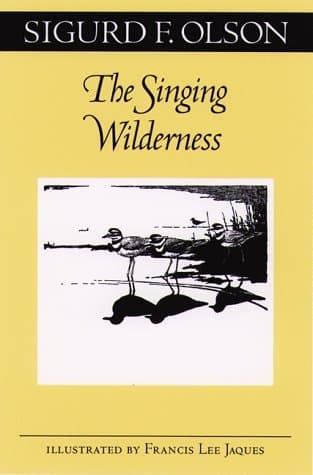
Core Idea
- Difficulty
- Easy
- Read it if
- You seek a meditative, poetic reflection on nature and the spiritual benefits of wilderness, or if you appreciate memoirs that blend personal experience with broader philosophical observations about conservation and human connection to the wild.
- Skip it if
- You prefer fast-paced narratives, detailed scientific analysis of ecosystems, or practical guides to outdoor survival. This book is more about the emotional and philosophical experience of nature than its technical aspects.
Key Takeaways from The Singing Wilderness
The Call of the Wild is Innate
Humanity's deep-seated need for wilderness connection persists despite modern advancements.
Olson argues that the appeal of wilderness is not just a hobby but a basic human need. He suggests that even in our modern world, an old instinct in us longs for the wild, the quiet, and nature's raw beauty. This is more than just escaping city life; it is about reconnecting with a part of ourselves that has been forgotten. Wilderness offers a return to simplicity, a chance to shed modern complexities and experience life on a more basic, sensory level. This connection is important for our mental health, creating a sense of belonging and a deeper understanding of our place in nature. It is like coming home spiritually, recognizing our ancient roots beyond just recreation.
“There is a hunger in all of us, a longing for something we have lost, a yearning for the primeval and the ancient.”
In the book: Olson frequently recounts the transformation he observes in people—from jaded city dwellers to revitalized individuals—after even short trips into the Quetico-Superior wilderness, noting their renewed spirit and clarity of thought.
Try this: Actively seek opportunities to spend time in natural, undeveloped areas, even if it's just a local park. Prioritize experiences that allow for quiet contemplation and sensory engagement with the environment, rather than just active recreation.
Related ideas: wilderness-therapy, biophilia, nature-connection
Silence as a Spiritual Balm
True wilderness offers a profound silence that heals and reorients the human spirit.
Olson praises wilderness quiet, not as an absence of sound, but as a rich mix of natural noises that allows for deep thought and spiritual renewal. This is not the dead silence of a soundproof room, but the soft symphony of wind through trees, a distant loon's call, or the gentle sound of water. In this setting, the noise of modern life fades, replaced by clear thinking and heightened senses. It is a place where one can truly think, process feelings, and connect with an inner calm. This deep quiet is rare in our noisy world and is presented as vital for mental and emotional recovery, helping people adjust their views and find peace.
“In the wilderness, one finds a silence so profound it becomes a presence, a living thing that speaks without words.”
In the book: He details how the sounds of the city—cars, horns, human chatter—are replaced by the 'voices' of the wilderness: the whisper of wind, the splash of a paddle, the calls of birds and animals, which he describes as far more enriching and restorative.
Try this: Seek out quiet places regularly, even if it's just turning off all devices for an hour. Practice mindful listening to natural sounds when outdoors, focusing on the nuanced auditory landscape rather than seeking complete absence of sound.
Related ideas: mindfulness, solitude, forest-bathing
The Journey, Not Just the Destination
The process of engaging with the wilderness through primitive travel builds character and deep appreciation.
Olson stresses that the real value of the wilderness experience comes from actively engaging with it, especially through traditional methods like canoeing and portaging. These activities require physical effort, problem-solving, and relying on one's own abilities, building strength and self-reliance. The challenges faced—navigating rapids, carrying heavy canoes over rough land, adapting to changing weather—are part of the journey, not just obstacles. They create a deeper bond with the landscape and give a sense of achievement and humility. The 'Bourgeois' knew that the struggle and effort made the eventual moments of peace and beauty even more meaningful, turning a simple trip into a life-changing adventure.
“The portage, the paddle, the camp by the lake—these are not merely means to an end, but the very essence of the wilderness experience.”
In the book: His vivid descriptions of portaging through dense forests with canoes, the strain, the sweat, and the eventual reward of reaching a new lake, illustrate how physical effort deepens the sensory and spiritual experience.
Try this: When engaging with nature, choose activities that require active participation and a degree of effort, rather than passive observation. Embrace challenges as part of the experience, understanding they contribute to a deeper connection and personal growth.
Related ideas: self-reliance, resilience, experiential-learning
Reading the Wilderness Language
Developing an intimate understanding of nature's subtle signs unlocks its deepest secrets.
Olson, the experienced guide, shows that the wilderness is not a still background but a living, communicating presence. He teaches the importance of 'reading' nature's subtle signs—the shift in wind, the patterns on water, the flight of birds, animal tracks—to understand the environment. This keen observation skill is not just practical for survival; it is a way to have a deep conversation with the natural world. It moves beyond just seeing to truly perceiving, recognizing patterns and connections that are hidden to those unfamiliar. This 'language' greatly enriches the experience, turning a casual observer into an active participant, able to predict weather, understand animal behavior, and feel truly at home in the wild.
“The wilderness speaks in a language of its own, a language of wind and water, of tracks and calls, and only those who listen carefully can understand.”
In the book: He details how he could predict weather changes by observing cloud formations and wind direction, or locate wildlife by understanding their tracks and sounds, demonstrating a profound intuitive knowledge of the ecosystem.
Try this: When in nature, consciously observe your surroundings: notice the details of plants, the movements of animals, the feel of the air, the sounds. Try to interpret what these signs might mean, fostering a more active and engaged perception.
Related ideas: nature-observation, ecological-literacy, tracking
The Impermanence of Wilderness
The fragile beauty of wild places necessitates urgent and vigilant conservation efforts.
Olson's deep love for the Quetico-Superior wilderness comes with a strong concern for its protection. He saw, even in the mid-20th century, the constant pressures of development and human activity threatening these untouched areas. He understood that once a wilderness is lost, it is gone forever, taking with it not only unique ecosystems but also a vital part of the human spirit's connection to its beginnings. This point is a strong call to action, emphasizing that the inherent value of wilderness far outweighs short-term economic gains. It argues that protecting these places is not just an environmental issue, but a moral duty for future generations to experience the same deep connections he valued.
“We cannot afford to lose the last remnants of the primeval, for in them lies the memory of what we once were and what we still need to be.”
In the book: Olson was a tireless advocate for the establishment and protection of the Boundary Waters Canoe Area Wilderness and Quetico Provincial Park, highlighting the constant threats from logging, mining, and recreational overuse.
Try this: Support conservation organizations dedicated to protecting wild spaces. Advocate for policies that prioritize wilderness preservation. Educate yourself and others on the importance of minimal impact practices when visiting natural areas.
Related ideas: conservation, environmental-activism, wilderness-ethics
The Power of Fire and Renewal
Natural cycles, including forest fires, are essential for wilderness health and transformation.
Olson offers a balanced view of natural processes, especially forest fires, challenging the common idea that they are only destructive. He explains how fire, in its natural cycle, is a key part of the boreal forest ecosystem. It clears old growth, returns nutrients to the soil, and encourages new, diverse plant life. This understanding moves past human fear to an appreciation of nature's wisdom and ability to recover. He shows how the wilderness, left alone, uses seemingly destructive forces for long-term health. This idea encourages a broader view of change and renewal, reminding us that endings often lead to new beginnings, a truth that applies beyond the forest.
“Fire is not always destruction; often, it is the great purifier, the catalyst for new life and vibrant growth.”
In the book: He describes witnessing the aftermath of a natural fire, noting how quickly new growth emerges from the ashes, leading to a richer, more diverse forest floor and attracting different wildlife, demonstrating nature's regenerative power.
Try this: Challenge preconceived notions about natural events. Understand the ecological role of processes like fire, floods, or decomposition. Embrace the idea of cyclical change and renewal in personal and natural systems.
Related ideas: ecological-succession, ecosystem-resilience, natural-cycles
Solitude as Self-Discovery
Extended time alone in the wilderness fosters profound self-awareness and inner peace.
Olson promotes the power of solitude in the wilderness to change people. He argues that stepping away from constant stimulation and social demands allows for a unique kind of self-reflection. Without outside distractions, one is forced to face their inner thoughts and emotions. This isolation, though daunting at first, eventually leads to a deeper understanding of one's values, priorities, and true self. It is a journey inward as much as it is outward, building clarity, resilience, and a deep sense of inner peace. The wilderness, in its quiet grandeur, acts as a mirror, showing us who we are when we remove our social masks.
“When one is truly alone in the wilderness, the distractions fall away, and one is left with oneself, stark and clear.”
In the book: He often describes the profound sense of clarity and peace experienced by individuals, including himself, after days or weeks spent alone or in small, quiet groups deep within the wilderness, far from human settlements.
Try this: Schedule regular periods of intentional solitude, whether in nature or a quiet personal space. Use this time for reflection, journaling, or simply being present with your thoughts without external input.
Related ideas: introspection, mindfulness, spiritual-growth
The Enduring Spirit of the Voyageurs
History and human connection to the land imbue the wilderness with deeper meaning.
Olson skillfully weaves the rich history of the voyageurs—the French-Canadian fur traders who traveled the Quetico-Superior region—into his personal story. He highlights that the wilderness is not just a natural space but also a historical one, filled with the stories and struggles of those who came before. By following their old routes, camping at their traditional sites, and even using their travel methods, Olson connects today's explorer to a lively past. This historical layer adds deep meaning to the wilderness experience, turning it from a simple outdoor trip into a journey through time, fostering a sense of continuity and respect for human legacy within the natural world.
“The echoes of the voyageurs' paddles still resound across these lakes, connecting us to a past that shaped this land and its spirit.”
In the book: He frequently references the routes, portages, and campsites used by the voyageurs, imagining their presence and struggles, and even adopting the honorific 'Bourgeois' himself, linking directly to this historical tradition.
Try this: When exploring natural areas, research their human history—indigenous cultures, explorers, early settlers. Reflect on the stories and lives lived in those spaces, fostering a deeper connection to both nature and history.
Related ideas: cultural-heritage, historical-ecology, sense-of-place
Sensory Immersion for Fullness of Life
Engaging all senses in the wilderness enriches perception and deepens appreciation for existence.
Olson consistently invites readers to experience the wilderness not just visually, but through all their senses. He describes the taste of cool lake water, the smell of pine needles warmed by the sun, the feel of rough granite underfoot, and the subtle sounds of the forest. This focus on engaging all senses is important, as it changes the wilderness experience from passive watching to active participation. By paying attention to these sensory details, people become more present, more alive, and more deeply connected to their surroundings. It is a call to shed the numbness of modern life and rediscover the richness of the world through direct, unfiltered sensory input, leading to a deep sense of life and wonder.
“To truly know the wilderness, one must taste its water, smell its pines, hear its silence, and feel its earth beneath one's feet.”
In the book: His prose is rich with sensory details: the 'tang of wood smoke,' the 'feel of a paddle in the hand,' the 'smell of wet moss and decaying leaves,' and the 'sound of water lapping against the shore,' all contributing to a vivid, immersive experience.
Try this: When outdoors, consciously engage each of your five senses. Take moments to close your eyes and focus on sounds and smells, or touch different textures. Describe these sensations to yourself to heighten awareness.
Related ideas: sensory-awareness, present-moment, embodiment
Wilderness as a Moral Compass
The values learned in nature—humility, patience, respect—guide a more ethical way of living.
Olson suggests that the wilderness is more than a place; it is a teacher of important life lessons. It teaches humility by making human concerns seem small against its vastness and power, reminding us of our place in the larger world. It teaches patience through its slow rhythms and the need to wait for the right conditions. It demands respect for all living things and the delicate balance of ecosystems. These lessons, learned in the wild, can be applied to daily life, encouraging a more thoughtful, empathetic, and responsible way of living. The wilderness, in essence, acts as a moral guide, leading people towards a more balanced and ethical existence.
“The wilderness teaches us humility, for we are but a small part of its grandeur, and patience, for its rhythms are slow and deliberate.”
In the book: He recounts numerous instances where individuals, including himself, are forced to adapt to nature's schedule, wait out storms, or respect the power of rapids, leading to a profound sense of humility and patience.
Try this: Reflect on how challenges and observations in nature can teach you about patience, adaptation, and interdependence. Consider how these 'wilderness values' can be applied to your relationships and daily decisions.
Related ideas: environmental-ethics, virtue-ethics, personal-growth
The Singing Wilderness Quotes
“There is a quality of life in the wilderness, and to be in the midst of it is to feel a part of something ancient, something that has been going on for a long, long time.”
“The voices of the wilderness are not loud, but they are persistent, and if you listen carefully, you will hear them.”
“To be alone in the wilderness is not to be lonely, but to be a part of everything.”
“The canoe is not merely a means of travel; it is a way of life, a symbol of freedom and discovery.”
“What we save, we save for ourselves, for our own spiritual renewal.”
“The wind in the pines, the splash of a paddle, the cry of a loon – these are the voices of the singing wilderness.”
“It is not so much what you see, but what you feel that matters in the wilderness.”
“The old trails are still there, faint and overgrown, but they speak of those who passed before us.”
“Every portage is an adventure, a challenge, and a chance to truly connect with the land.”
“There is a deep peace in the north country, a quietude that penetrates the very soul.”
“The fire is more than just warmth; it is companionship, a focal point for stories and dreams.”
“To learn the rhythm of the wilderness is to learn the rhythm of life itself.”
“The true meaning of wilderness is not just in its untouched beauty, but in what it does to us.”
“We need the wilderness, not just for recreation, but for perspective, for a sense of belonging.”
Quiz
10 questions on the main ideas. Each answer comes with a short explanation.
Question 1
Which specific region is the primary setting and focus of Sigurd F. Olson's experiences described in 'The Singing Wilderness'?
- The Boundary Waters Canoe Area Wilderness
- The Quetico-Superior country
- The Great Smoky Mountains
- The Adirondack Mountains
Show answer
B. The Quetico-Superior country The book explicitly states that Olson was a wilderness guide in the Quetico-Superior country, which is the setting for his intimate knowledge of the lakes and forests.
Question 2
What honorific title was Sigurd F. Olson known by among those who canoed and portaged with him?
- The Pathfinder
- The Guide Extraordinaire
- The Bourgeois
- The Old Man of the Woods
Show answer
C. The Bourgeois The text states Olson was known honorifically as the Bourgeois, a term historically used by voyageurs for their trusted leaders in the same region.
Question 3
For approximately how many years was Sigurd F. Olson a wilderness guide in the Quetico-Superior country, according to the description?
- More than ten years
- More than twenty years
- More than thirty years
- More than forty years
Show answer
C. More than thirty years The description clearly states Olson was a wilderness guide for 'more than thirty years'.
Question 4
The title 'The Singing Wilderness' most likely refers to Olson's perception of the wilderness as:
- A place of complete silence, broken only by human activity.
- A vibrant, living entity filled with natural sounds and rhythms.
- A dangerous and foreboding place that tests human endurance.
- A historical site where ancient songs and chants were once performed.
Show answer
B. A vibrant, living entity filled with natural sounds and rhythms. Given Olson's deep intimacy and appreciation for the wilderness, 'singing' implies a rich auditory landscape and a spiritual connection to its natural sounds and vitality, rather than silence or danger.
Question 5
The description emphasizes Olson's 'intimacy' with the Quetico-Superior country. What does this suggest about his approach to experiencing the wilderness?
- He focused primarily on scientific study and data collection.
- He had a deep, personal, and profound understanding of its natural rhythms and secrets.
- He preferred to observe from a distance, maintaining objectivity.
- He sought to conquer and tame the wild aspects of the region.
Show answer
B. He had a deep, personal, and profound understanding of its natural rhythms and secrets. Intimacy implies a deep, personal connection and understanding, suggesting a profound immersion in and appreciation for the wilderness rather than a detached or conquering approach.
Question 6
The reference to 'voyageurs of old' and their 'trusted leaders' (Bourgeois) in the same region serves to:
- Highlight the dramatic changes the region has undergone since their time.
- Emphasize Olson's role as a modern-day continuation of a historical tradition of wilderness guidance.
- Suggest that Olson's methods were outdated and inefficient compared to modern techniques.
- Indicate that the wilderness was much more dangerous in the past.
Show answer
B. Emphasize Olson's role as a modern-day continuation of a historical tradition of wilderness guidance. By connecting Olson's honorific title and role to the historical voyageurs, the text draws a parallel, suggesting Olson embodies a continuation of a revered wilderness tradition.
Question 7
Given Olson's extensive experience as a wilderness guide, what practical insight would readers likely gain from 'The Singing Wilderness'?
- Detailed instructions on how to build modern wilderness shelters.
- An understanding of the subtle signs and rhythms of the northern wilderness environment.
- Advanced techniques for competitive wilderness racing.
- Strategies for commercial logging operations in pristine forests.
Show answer
B. An understanding of the subtle signs and rhythms of the northern wilderness environment. Olson's 'intimacy' and long tenure as a guide suggest he would convey a deep, nuanced understanding of the natural world, rather than modern technical skills or commercial practices.
Question 8
The description implies that Olson's knowledge of the Quetico-Superior country was unique. What specific phrase supports this idea of exclusivity?
- 'more than thirty years a wilderness guide'
- 'no one knew with the same intimacy the mysteries of the lakes and forests'
- 'magnificent primitive area'
- 'honourifically as the Bourgeois'
Show answer
B. 'no one knew with the same intimacy the mysteries of the lakes and forests' The phrase 'no one knew with the same intimacy' explicitly states the uniqueness and exclusivity of Olson's knowledge, suggesting others could not match his deep understanding.
Question 9
Considering the genre 'Memoir, History', what would be a primary purpose of 'The Singing Wilderness' beyond simply recounting adventures?
- To provide a fictionalized account of historical events.
- To preserve and share the cultural and ecological history of the Quetico-Superior wilderness through personal experience.
- To advocate for the immediate commercial development of the region.
- To serve as a comprehensive scientific field guide for botanists.
Show answer
B. To preserve and share the cultural and ecological history of the Quetico-Superior wilderness through personal experience. As a memoir and history, the book uses personal experience to document and reflect on the significance of the wilderness, its past, and its natural characteristics, aiming to preserve this understanding.
Question 10
The phrase 'magnificent primitive area' suggests a particular value judgment about the Quetico-Superior country. What is implied by 'primitive' in this context?
- That the area is underdeveloped and lacking in modern amenities, making it undesirable.
- That the area is dangerous and untamed, requiring extreme caution.
- That the area retains its original, unspoiled natural state, largely untouched by human development.
- That the area is inhabited by indigenous tribes with a primitive way of life.
Show answer
C. That the area retains its original, unspoiled natural state, largely untouched by human development. In the context of wilderness literature and conservation, 'primitive' often denotes a state of being original, pristine, and unspoiled by human industrialization, which is usually valued positively by wilderness advocates.
The Singing Wilderness FAQ
What is 'The Singing Wilderness' by Sigurd F. Olson about?
'The Singing Wilderness' is a memoir and historical account by Sigurd F. Olson, chronicling his deep connection and experiences as a wilderness guide in the Quetico-Superior country. It explores the mysteries and beauty of its lakes and forests through his intimate perspective.
Who was Sigurd F. Olson and why was he called 'The Bourgeois'?
Sigurd F. Olson was a renowned wilderness guide for over thirty years in the Quetico-Superior region. He was honorifically known as 'The Bourgeois' by those who canoed with him, a title historically given by voyageurs to their trusted leaders, signifying his expertise and leadership in the wilderness.
Does 'The Singing Wilderness' offer practical advice for wilderness travel?
While primarily a memoir and reflection on nature, 'The Singing Wilderness' implicitly conveys principles of wilderness appreciation and respect. It focuses more on the philosophical and spiritual aspects of being in nature rather than explicit how-to guides for travel.
What is the 'Quetico-Superior country' that Olson writes about?
The Quetico-Superior country refers to the vast, interconnected wilderness area spanning the border between Ontario, Canada (Quetico Provincial Park) and Minnesota, USA (Boundary Waters Canoe Area Wilderness). It is renowned for its pristine lakes, forests, and canoe routes.
How is 'The Singing Wilderness' different from modern wilderness survival guides?
'The Singing Wilderness' differs significantly by focusing on the sensory, emotional, and historical experience of nature, rather than survival techniques. It's a contemplative journey into the soul of the wilderness, contrasting with the instructional focus of modern survival guides.
What themes are explored in 'The Singing Wilderness'?
The book explores themes of solitude, the interconnectedness of nature, the passage of time, the importance of preserving wild places, and the profound spiritual impact of the wilderness on the human spirit. It's a celebration of primeval beauty and the quiet wisdom of nature.
Is 'The Singing Wilderness' suitable for someone new to nature writing?
Yes, 'The Singing Wilderness' is an excellent entry point for new readers of nature writing. Olson's evocative prose and deep personal connection to the landscape make it accessible and inspiring, drawing readers into the beauty and wonder of the wild.
Does the book include historical details about the voyageurs?
While the book references the voyageurs through Olson's nickname, 'The Bourgeois,' it primarily focuses on his personal experiences and observations of the wilderness. It touches on the historical spirit of exploration but isn't a detailed historical account of the voyageurs themselves.
What kind of impact did Sigurd F. Olson have on wilderness conservation?
Sigurd F. Olson was a passionate advocate for wilderness preservation and played a crucial role in establishing and protecting the Boundary Waters Canoe Area Wilderness and Quetico Provincial Park. His writings, including 'The Singing Wilderness,' inspired countless individuals to value and conserve wild spaces.
About the author

Sigurd F. Olson was an American author and environmentalist known for his writings on nature and wilderness. His notable work, The Singing Wilderness, reflects his deep appreciation for the natural world and advocates for conservation. Olson's contributions to literature and environmentalism have made him a significant figure in discussions about the relationship between humans and nature.
Similar books
- Walden
Henry David Thoreau
3.8 (158k) average on GoodreadsBiographyFocuses on the benefits of solitude in nature, simple living, and profound observations drawn from direct experience in a natural setting.
- The Diary of a Young Girl
Anne Frank
4.2 (2.7M) average on GoodreadsBiographyDuring the Nazi occupation, a teenage girl's diary, written from a secret annex, shares observations on humanity, hope, and the wait for freedom.
- Eat, Pray, Love
Elizabeth Gilbert
3.6 (1.5M) average on GoodreadsLifestyleA heartbroken writer leaves her conventional life for a year-long global search for pleasure in Italy, spiritual devotion in India, and unexpected love and balance in Bali.
- Night
Elie Wiesel
4.3 (970k) average on GoodreadsBiographyIn the darkness of Auschwitz and Buchenwald, a teenage Elie Wiesel faces the extermination of his family, the loss of his faith, and the lasting scars of humanity's deepest cruelty.
- The Glass Castle
Jeannette Walls
4.3 (903k) average on GoodreadsBiographyJeannette Walls's memoir describes her unusual childhood with brilliant, free-spirited parents whose poverty-stricken life shaped her independence and love despite family problems.
- Bossypants
Tina Fey
4.0 (848k) average on GoodreadsBiographyFrom a 'vicious nerd' with stress dreams to the comedic force behind Liz Lemon and 'Weekend Update,' Tina Fey chronicles her journey to proving that 'you're no one until someone calls you bossy.'





Enjoyed the summary?
A summary gives you the shape of the book. The book itself has the detail, the examples and the voice.
Find The Singing Wilderness on AmazonAs an Amazon Associate, BookBrief earns from qualifying purchases. How we're funded