
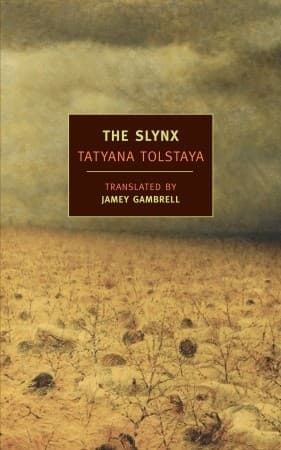
Synopsis
Covers the whole plot, including the ending.
- Difficulty
- Medium
- Pacing
- Moderate
- Mood
- Philosophical, Darkly Humorous, Satirical, Bleak, Atmospheric
- Read it if
- You enjoy thought-provoking, darkly humorous, and literary speculative fiction that explores themes of knowledge, power, and memory in a post-apocalyptic setting.
- Skip it if
- You prefer fast-paced, plot-driven narratives or clear-cut fantasy/sci-fi without philosophical depth and a somewhat bleak outlook.
The Slynx Plot Summary
Covers the whole plot, including the ending.
Benedikt's Simple Life in Post-Blast Russia
Two hundred years after the Blast, Benedikt lives in a mutated, post-apocalyptic Moscow, now called Fyodor-Kuzmichsk. He is a 'golubchik' (scribe) in the household of Fyodor Kuzmich, the supposed 'Glorybe' leader who claims to have written all the surviving books. Benedikt's job involves copying and slightly altering pre-Blast texts, attributing them to Fyodor Kuzmich. He lives a simple life, primarily concerned with finding enough mice to eat, avoiding the oppressive Saniturions who hunt 'Freethinkers,' and steering clear of the mythical Slynx. He is physically unmutated, a rare blessing in a world where many people have extra fingers, gills, or cockscombs. He wants a wife and a more meaningful existence, despite the widespread ignorance and fear that define his society.
Olenka's Arrival and Benedikt's Growing Affection
Olenka, a beautiful young woman with unmutated features, arrives in Fyodor Kuzmich's household as a new servant. Benedikt immediately likes her beauty and her apparent lack of mutations, which sets her apart from most other women he encounters. He begins to watch her, developing a quiet affection and a desire for her attention. Olenka, however, seems somewhat distant and busy, often doing tasks for Fyodor Kuzmich or interacting with other household members. Benedikt's desire for her becomes a significant part of his daily life, contrasting with his otherwise monotonous and fear-driven existence. He dreams of a future with her, imagining a simple domestic life that seems almost impossible in their harsh world.
The Nature of Books and Fyodor Kuzmich's Deception
As a golubchik, Benedikt spends his days copying old books, which are then presented as the original works of Fyodor Kuzmich. He notices inconsistencies and strange words in these texts, which he struggles to understand because of his limited education and the corrupted language of his time. His fellow golubchiks, especially the older ones, occasionally hint about the 'old world' and the true nature of the books, but their insights are fragmented and often hidden by fear. Benedikt's curiosity grows, and he starts to suspect that Fyodor Kuzmich is not the true author of all these works. This leads to a nascent 'Freethinking' within him, a dangerous path in their society. He secretly tries to understand the real meaning of the ancient words.
Nikita Ivanovich's Influence and the Whispers of the Past
Benedikt frequently encounters Nikita Ivanovich, a seemingly ordinary old man who sometimes visits Fyodor Kuzmich's household. Nikita Ivanovich, one of the few who remembers fragments of the pre-Blast world, speaks in riddles and subtle hints about knowledge, art, and a different way of life. He talks about 'culture' and 'books' in a way that suggests they are more than just Fyodor Kuzmich's pronouncements. While Benedikt doesn't fully grasp what Nikita Ivanovich means, his words plant seeds of doubt and curiosity in his mind, further fueling his nascent desire to understand the world beyond the immediate propaganda. Nikita Ivanovich is a fading link to the lost civilization, a quiet source of genuine knowledge in a world of manufactured ignorance.
Benedikt's Marriage to Olenka and Domestic Life
Benedikt eventually marries Olenka, fulfilling his long-held desire for companionship. Their initial domestic life is relatively peaceful, with Benedikt enjoying the simple joys of having a wife and a home. However, Olenka remains somewhat mysterious. She is often withdrawn and seems to possess a knowledge or awareness that Benedikt lacks. She has a peculiar attachment to a small, hidden room in their house, which she keeps locked and secret. Benedikt's initial happiness is gradually tinged with suspicion and confusion as he observes Olenka's strange habits and veiled expressions. He feels a growing distance between them, despite their shared life, and her secrets begin to trouble him.
The Saniturions and the Suppression of Freethinking
The Saniturions are the feared enforcers of Fyodor Kuzmich's regime. They identify and punish 'Freethinkers' – anyone who thinks independently, questions the established order, or shows signs of pre-Blast knowledge. They are ruthless and often arbitrary in their judgments, creating an atmosphere of constant fear and suspicion. Benedikt, like everyone else, lives in dread of them, always careful to conform and avoid any behavior that could be interpreted as 'Freethinking.' The Saniturions' presence is a constant reminder of the regime's strong control over the populace, ensuring that the mutated, ignorant society remains subservient and unquestioning. Their methods are brutal, often involving public humiliation and disappearance.
The Degenerators and the Harsh Reality of Survival
Beyond the 'golubchiks' and 'Murzas' (the privileged class), society has 'Degenerators' – heavily mutated individuals with animalistic features, often used as beasts of burden or kept in subservient roles. These four-legged creatures, some with multiple heads or other grotesque deformities, are a stark reminder of the devastating effects of the Blast and the regression of humanity. Benedikt views them with a mix of pity and revulsion, grateful that he is not one of them. Their existence shows the harsh realities of survival in this new world and the rigid social hierarchy, where mutations dictate one's place. They are the lowest rung, treated as property rather than people, further showing the loss of human dignity.
Olenka's Secret Room and the Discovery of Old Books
Driven by his growing suspicion and curiosity, Benedikt eventually breaks into Olenka's locked room. Inside, he discovers a hidden library filled with actual pre-Blast books, carefully preserved. This revelation shatters his understanding of his world and Fyodor Kuzmich's deception. He realizes that Olenka has been secretly hoarding and reading these forbidden texts, making her a dangerous 'Freethinker.' The books are a direct link to the past, filled with knowledge, art, and culture that have been suppressed and distorted. This discovery is a turning point for Benedikt, as he now has direct access to the truth, forcing him to confront the lies he has lived under and the true nature of his society.
The Truth About Fyodor Kuzmich and the Old World
Through Olenka's hidden books and further interactions with Nikita Ivanovich, Benedikt slowly puts together the truth. He learns that Fyodor Kuzmich is not a great author but a charlatan who merely collects and rebrands pre-Blast literature as his own. He also learns about the 'old world' – a time of advanced civilization, art, science, and genuine knowledge, which was destroyed by the Blast. The books reveal a world of beauty and complexity that is almost unimaginable to Benedikt. This knowledge is both liberating and terrifying. It exposes the vast ignorance and deliberate deception that define his current reality. He begins to understand 'culture' and 'history'.
The Slynx's Presence and the Fear of Knowledge
Throughout the story, the Slynx is a pervasive mythical creature, a screeching, invisible entity that preys on those who venture too far into the wilderness or engage in 'Freethinking.' It is said to 'eat thoughts' and cause madness. As Benedikt's own knowledge expands, the Slynx takes on a more symbolic meaning, representing the terrifying consequences of independent thought and the unknown dangers of the world beyond Fyodor-Kuzmichsk. The fear of the Slynx keeps people tied to their ignorance and subservience. It is the ultimate boogeyman, used by the regime to control the populace and prevent them from questioning their reality or seeking forbidden knowledge. Its presence is a constant threat.
Benedikt's Transformation and the Burden of Knowledge
As Benedikt continues to read Olenka's hidden books, he changes internally. The crude language and limited understanding that once defined him begin to give way to a growing intellect and a grasp of complex ideas. He starts to speak with more eloquence and questions the world around him with greater insight. This newfound knowledge, however, is a heavy burden. It isolates him from the ignorant populace and puts him in grave danger from the Saniturions. He struggles with knowing the truth but being unable to share it openly. He feels increasingly alienated from his society and even from Olenka, who seems to have accepted the secret. He is no longer the simple golubchik.
The Betrayal and the Slynx's True Nature Revealed
Benedikt's 'Freethinking' is eventually discovered. It is implied that Olenka, for self-preservation or a darker motive, betrays him to the Saniturions. He is captured and dragged into the wilderness to face the Slynx. In a harrowing confrontation, Benedikt discovers the true nature of the Slynx. It is not a mythical beast but a manifestation of his own uncontrolled knowledge and the trauma of the Blast. It is a creature born of the human mind, of the forbidden thoughts and memories of the old world. The Slynx 'eats' his thoughts, leaving him a blank slate. He is stripped of his newfound intellect and returned to a state of primal ignorance, fulfilling the regime's ultimate goal of mental subjugation. He is effectively 'cured' of Freethinking.
Benedikt's Post-Slynx Existence and the Cycle of Ignorance
After his encounter with the Slynx, Benedikt returns to Fyodor-Kuzmichsk, physically unharmed but mentally devastated. He has lost all his acquired knowledge, his ability to understand complex ideas, and his capacity for independent thought. He is reduced to his former, ignorant self, content with the simple, crude existence of the other inhabitants. The cycle of ignorance and control is complete. He is no longer a threat to the regime, having been effectively lobotomized by the Slynx. His story ends with him rejoining the populace, a poignant symbol of humanity's regression and the triumph of deliberate ignorance in the post-Blast world. The 'Slynx' ensures that no true knowledge can flourish.
Principal Figures
Benedikt
Protagonist
A simple-minded scribe who slowly awakens to the truth of his post-apocalyptic world.
Benedikt is a 'golubchik' (scribe) in post-Blast Moscow, whose primary concerns are survival, finding enough mice to eat, and avoiding the dreaded Saniturions. He is physically unmutated, which is a rare blessing. Initially naive and ignorant, he gradually develops a curiosity about the old world and the true nature of the books he copies. His longing for Olenka and his discovery of her hidden library drive his intellectual awakening. He represents the common person, susceptible to propaganda but also capable of seeking truth, though ultimately overwhelmed by it.
Relationships: Olenka (wife, source of desire and eventual betrayal); Fyodor Kuzmich (employer, figurehead of deception); Nikita Ivanovich (mentor, source of forbidden knowledge)
Olenka
Supporting
Benedikt's beautiful and enigmatic wife, a secret keeper of forbidden knowledge.
Olenka is Benedikt's wife, initially desired for her beauty and lack of mutations. She is enigmatic and withdrawn, possessing a hidden intelligence and a secret library of pre-Blast books. She represents the preservation of culture in secret, but also the compromises and dangers involved in doing so. Her motivations are complex, possibly driven by self-preservation or a desire to control knowledge. She ultimately plays a role in Benedikt's downfall, whether directly or indirectly, highlighting the perilous nature of truth in their society.
Relationships: Benedikt (husband, object of his affection and intellectual awakening); Fyodor Kuzmich (servant in his household)
Fyodor Kuzmich
Antagonist
The tyrannical, self-proclaimed 'Glorybe' leader who maintains power through deception and ignorance.
Fyodor Kuzmich is the 'Glorybe,' the supposed leader and author of all books in post-Blast Moscow. He is a figure of authority and reverence, but in reality, he is a charlatan who takes credit for pre-Blast literature. He represents the oppressive regime that actively suppresses knowledge and promotes ignorance to maintain control. His power is built on a foundation of lies, and he uses the Saniturions to eliminate any 'Freethinkers' who might expose his deception. He embodies the forces of regression and anti-intellectualism.
Relationships: Benedikt (employer); Saniturions (enforcers of his regime)
Nikita Ivanovich
Supporting
An old man who subtly holds fragments of pre-Blast knowledge, acting as a mentor figure.
Nikita Ivanovich is an old man who has vague memories and fragmented knowledge of the pre-Blast world. He speaks in riddles and allusions, subtly guiding Benedikt towards the truth without openly defying the regime. He represents the dying embers of genuine culture and intellect, a fragile link to a lost past. He is a quiet source of wisdom, offering glimpses of what humanity has lost, and his interactions with Benedikt are crucial in sparking the protagonist's intellectual curiosity.
Relationships: Benedikt (informal mentor); Fyodor Kuzmich (subject under his rule)
The Saniturions
Antagonist
The brutal enforcers of Fyodor Kuzmich's regime, tasked with suppressing 'Freethinking.'
The Saniturions are the feared police force of Fyodor-Kuzmichsk. They are depicted as ruthless, often arbitrary, and dedicated to rooting out any signs of 'Freethinking' or independent thought. They embody the oppressive nature of the regime and the constant threat of surveillance and punishment. Their methods are violent and dehumanizing, ensuring that the populace remains ignorant and subservient. They are the physical manifestation of the societal fear that permeates the post-Blast world.
Relationships: Fyodor Kuzmich (enforcers of his will); Benedikt (persecutors)
The Degenerators (Goyads)
Mentioned
Heavily mutated, subhuman individuals used as beasts of burden.
The Degenerators, also called Goyads, are the lowest class in post-Blast society, heavily mutated individuals with animalistic features. They are depicted as four-legged creatures, often used for labor and treated as property rather than humans. They represent the extreme physical regression of humanity due to the Blast and serve as a stark reminder of the harsh realities of this new world. Their existence highlights the brutal social hierarchy and the loss of human dignity.
Relationships: Benedikt (object of his pity and revulsion); Fyodor Kuzmich (subjects under his rule)
Kupka
Supporting
One of Benedikt's fellow golubchiks, representing the general ignorance and fear.
Kupka is a fellow golubchik, a simple and fearful individual who embodies the general ignorance and unquestioning acceptance of Fyodor Kuzmich's propaganda. He is content with his limited understanding of the world and fears any deviation from the norm. Kupka serves as a foil to Benedikt's burgeoning curiosity, highlighting the pervasive intellectual stagnation of their society. He participates in the crude humor and daily routines of the golubchiks, reinforcing the mundane and unexamined nature of their lives.
Relationships: Benedikt (colleague)
Cheburashka
Supporting
A mutated creature, a pet of Fyodor Kuzmich, symbolizing the grotesque normalcy.
Cheburashka is a peculiar, mutated creature that serves as a sort of pet or companion to Fyodor Kuzmich. Its name is a reference to a popular Soviet cartoon character, but in this context, it highlights the grotesque and distorted nature of the post-Blast world. Cheburashka represents the 'new normal' of mutation and the acceptance of the bizarre as commonplace. Its presence in the leader's household underscores the pervasive strangeness and the extent to which humanity has adapted to a deformed reality.
Relationships: Fyodor Kuzmich (pet/companion)
Themes & Insights
Ignorance vs. Knowledge
This is the central theme of 'The Slynx.' The post-Blast society is deliberately kept ignorant by Fyodor Kuzmich, who controls information by claiming authorship of all books. Benedikt's journey is one from blissful ignorance to the painful burden of knowledge, gained through Olenka's hidden library and Nikita Ivanovich's hints. The novel explores how ignorance can be a form of control and how knowledge, while freeing, can also be terrifying and isolating in an unready world. The Slynx itself embodies the fear and suppression of true understanding.
“What had been books before the Blast? Just books. But now, after the Blast, books were a special thing. Books were Fyodor Kuzmich. Books were wisdom. Books were power. Books were everything.”
The Nature of Language and Culture
The novel shows the degradation of language and culture after the Blast. Words have lost their original meanings, concepts are misunderstood, and the richness of pre-Blast civilization is reduced to fragmented, often grotesque, interpretations. Benedikt's struggle to understand the old texts shows this linguistic and cultural decay. The deliberate alteration of books by Fyodor Kuzmich symbolizes the destruction of genuine culture and its replacement with a manufactured, simplistic narrative. The re-discovery of true books is a re-discovery of language itself.
“Words, like people, had suffered the Blast. Some were crippled, some were gone entirely, and some were born anew, strange and twisted.”
Oppression and Totalitarianism
The society in 'The Slynx' is a stark depiction of a totalitarian regime under Fyodor Kuzmich. The Saniturions enforce conformity and brutally suppress 'Freethinking,' creating an atmosphere of widespread fear. The control over information, the rewriting of history, and the constant surveillance are hallmarks of this oppressive system. The novel explores how such a regime thrives on the ignorance of its populace and the fear of the unknown (symbolized by the Slynx) to maintain absolute power, sacrificing individual freedom for a false sense of order.
“Freethinking was a sickness, a deviation, a sure path to the Slynx.”
Humanity's Regression and Adaptation
The world of 'The Slynx' shows humanity's dramatic regression after a catastrophic event. Physical mutations (extra fingers, cockscombs), intellectual stagnation, and the loss of pre-Blast knowledge are central. People have adapted to a primitive, fear-driven existence, where survival is most important and higher thought is suppressed. The Degenerators represent the extreme end of this physical and mental decay. The novel questions what it means to be human when civilization collapses and how quickly people can revert to a more animalistic state, accepting the grotesque as normal.
“And the people, what were they? Not quite human, not quite beast, but something in between, forged by the Blast.”
The Search for Identity and Meaning
Beneath the surface of survival, Benedikt grapples with a yearning for identity and meaning beyond his prescribed role as a golubchik. His desire for Olenka, his curiosity about the books, and his eventual intellectual awakening are all parts of this search. In a world where personal history is erased and individuality is suppressed, finding one's true self and purpose becomes a dangerous act of 'Freethinking.' His journey is a quest to understand who he is in relation to a lost past and a terrifying present.
“He wanted to know, not just to copy. He wanted to understand what was before him, what was behind him, what was inside him.”
Plot Devices & Literary Techniques
The Blast
The catastrophic event that ended the old world and ushered in the mutated present.
The Blast is the seminal, cataclysmic event that destroyed the pre-existing civilization and led to the mutated, regressed world of 'The Slynx.' Its exact nature is never fully explained, but its consequences are pervasive: physical mutations in humans and animals, the destruction of knowledge, and the rise of a new, primitive society. The Blast serves as a narrative device to justify the post-apocalyptic setting, the societal structure, and the pervasive fear and ignorance. It's the ultimate 'before and after' marker for the world's history.
The Slynx
A mythical, invisible creature symbolizing the fear of knowledge and independent thought.
The Slynx is a legendary, invisible, screeching creature that lives in the wilderness and is said to 'eat thoughts,' driving people mad. It functions as both a literal threat and a powerful symbol. As a plot device, it is the ultimate deterrent against 'Freethinking' and exploration, used by the regime to control the populace. Symbolically, it represents the destructive consequences of forbidden knowledge, the trauma of the past, and the internal struggle with understanding a terrifying truth. Its true nature is revealed to be more psychological than physical, a manifestation of the mind's confrontation with overwhelming information.
The Books (Old World Texts)
Forbidden relics of the pre-Blast world, embodying lost knowledge and culture.
The books, particularly the pre-Blast texts hidden by Olenka, are central plot devices. They are the physical link to the lost civilization, containing genuine knowledge, art, and history. In the hands of Fyodor Kuzmich, they are instruments of deception, rewritten and attributed to him to maintain control. For Benedikt, they are catalysts for his intellectual awakening, challenging his understanding of the world. The act of reading and understanding these books drives the narrative's central conflict between ignorance and knowledge, representing the potential for both liberation and destruction.
The Mutations
Physical deformities resulting from the Blast, symbolizing humanity's regression.
The widespread physical mutations (extra fingers, cockscombs, gills, animalistic features) are a constant plot device, visually defining the post-Blast world and its inhabitants. They serve as a stark reminder of the catastrophe's lasting effects and humanity's physical and genetic regression. The mutations reinforce the social hierarchy (unmutated individuals like Benedikt and Olenka are considered 'normal' and higher status), and their prevalence normalizes the grotesque, highlighting the extent to which humanity has adapted to a deformed reality. They are a constant, visible manifestation of the world's brokenness.
Degraded Language (Goyad dialect)
The corrupted and simplified language spoken by the post-Blast populace.
The degraded and simplified language used by the characters is a crucial plot device that reflects the intellectual and cultural regression of the society. Words are often misunderstood, misused, or replaced with crude neologisms. This linguistic decay emphasizes the loss of knowledge and the difficulty of comprehending pre-Blast texts. Benedikt's struggle to decipher the 'old words' highlights the chasm between the past and present. The language itself becomes a symbol of the mind's limitations and the deliberate suppression of complex thought by the regime, reinforcing the theme of ignorance.
The Slynx Quotes
“The Slynx is a creature that lives in the forest, and it's very dangerous. It can kill you just by looking at you.”
“We live in the past, but we don't know it. We think we're living in the present, but it's already gone.”
“Books are dangerous. They can make you think things you shouldn't think.”
“The old world is gone, but its ghosts are everywhere.”
“We are all mutants here, but some of us are more mutant than others.”
“To remember is to suffer, but to forget is to be nothing.”
“The Consequence is always watching. It knows what you do.”
“We eat what we can find, and we call it food. But it's not food, it's just something to put in your mouth.”
“The past is a book that no one can read anymore.”
“In this world, to be different is to be dangerous.”
“We build our houses out of ruins, and we call them homes.”
“The Slynx doesn't exist, but we fear it anyway. That's what keeps us in line.”
“To know a word is to have power over it, and over the thing it names.”
“We are all waiting for something, but we don't know what it is.”
Quiz
10 questions on the plot and the characters. Each answer comes with a short explanation.
Question 1
What is Benedikt's occupation in the post-Blast society?
- A Saniturion who hunts Freethinkers
- A Murza with privileged status
- A serf working in the fields
- A transcriber of old books for Fyodor Kuzmich
Show answer
D. A transcriber of old books for Fyodor Kuzmich Benedikt works as a transcriber, copying old books and presenting them as the words of the leader Fyodor Kuzmich, Glorybe. This job places him in a unique position between the ruling class and the oppressed, giving him access to forbidden knowledge while maintaining a semblance of loyalty.
Question 2
What event destroyed civilization 200 years before the story begins?
- The Great Fire
- The Mutation Plague
- The Blast
- The Slynx Invasion
Show answer
C. The Blast The Blast is the catastrophic event that ended civilization 200 years prior to the story. It caused widespread destruction, mutations, and the collapse of society, leading to the primitive, oppressive world Benedikt inhabits.
Question 3
What are the Saniturions responsible for in this society?
- Cooking meals from mice
- Transcribing books for the leader
- Tracking down and punishing Freethinkers
- Harnessing Degenerators to troikas
Show answer
C. Tracking down and punishing Freethinkers The Saniturions are the ever-vigilant enforcers who monitor the population for any signs of Freethinking, which is considered dangerous and subversive in this tightly controlled society. They represent the oppressive authority that Benedikt fears.
Question 4
What is a key reason Benedikt considers himself fortunate compared to others?
- He owns a large estate with many serfs
- He has no physical mutations from the Blast
- He is a close advisor to Fyodor Kuzmich
- He can freely travel beyond the wilderness
Show answer
B. He has no physical mutations from the Blast Benedikt is happy to be free of mutations like extra fingers, gills, or cockscombs, which are common among the population due to the Blast. This lack of physical deformity sets him apart from many others in his degraded world.
Question 5
What mythical creature is said to wait in the wilderness beyond the settlement?
- The Degenerator
- The Murza
- The Slynx
- The Freethinker
Show answer
C. The Slynx The Slynx is a legendary screeching creature that lurks in the wilderness, representing the unknown dangers and fears of the outside world. It serves as a metaphor for the terrors that keep people confined within the oppressive society.
Question 6
How does Benedikt's job as a transcriber contribute to the theme of control over knowledge?
- He creates new books to educate the public freely
- He destroys all old books to prevent Freethinking
- He copies old books but attributes them to Fyodor Kuzmich to reinforce the leader's authority
- He uses the books to plan a rebellion against the Saniturions
Show answer
C. He copies old books but attributes them to Fyodor Kuzmich to reinforce the leader's authority Benedikt's transcription work involves taking old books and presenting them as the words of Fyodor Kuzmich, which illustrates how the regime controls and distorts knowledge to maintain power. This manipulation of information is central to the novel's critique of totalitarianism.
Question 7
What are Degenerators in this society?
- People who have lost their jobs and become homeless
- Half-human, four-legged beings harnessed to troikas
- Saniturions who have mutated from the Blast
- Freethinkers who openly oppose Fyodor Kuzmich
Show answer
B. Half-human, four-legged beings harnessed to troikas Degenerators are half-human, four-legged creatures resulting from mutations caused by the Blast. They are used as beasts of burden, harnessed to troikas, symbolizing the extreme degradation and loss of humanity in this post-apocalyptic world.
Question 8
Why might Benedikt's access to old books through his job be ironically dangerous?
- The books are poisonous and cause mutations
- Reading them could lead to Freethinking, making him a target of the Saniturions
- They attract the Slynx from the wilderness
- They are so valuable that Murzas will steal them
Show answer
B. Reading them could lead to Freethinking, making him a target of the Saniturions Although Benedikt's job requires handling old books, engaging with their content could inspire Freethinking—questioning the regime or seeking knowledge. This puts him at risk of being hunted by the Saniturions, creating a tension between his duty and potential subversion.
Question 9
What does the hierarchy from Murzas to serfs to Degenerators reflect about this society?
- A fair system based on merit and hard work
- A rigid class structure exacerbated by mutations and oppression
- A temporary arrangement soon to be overthrown by revolution
- A religious order determined by purity of thought
Show answer
B. A rigid class structure exacerbated by mutations and oppression The society in 'The Slynx' features a strict hierarchy where Murzas enjoy privilege, serfs are oppressed laborers, and Degenerators are dehumanized mutants. This structure highlights themes of inequality, control, and the dehumanizing effects of the post-Blast world, critiquing totalitarian systems.
Question 10
In what way does the Slynx serve as more than just a physical threat in the story?
- It is a source of food for the settlement
- It represents the internalized fears and psychological control that keep people compliant
- It is a mutated form of Fyodor Kuzmich
- It guards the old books from being transcribed
Show answer
B. It represents the internalized fears and psychological control that keep people compliant The Slynx symbolizes the unknown and the fears that prevent characters from questioning or escaping their oppressive society. It acts as a tool of psychological control, much like the threat of the Saniturions, reinforcing the theme of how terror is used to maintain authority and limit freedom.
The Slynx FAQ
What is 'The Slynx' about?
'The Slynx' follows Benedikt, a scribe in a post-apocalyptic society 200 years after the Blast destroyed civilization. He transcribes old books for the regime of Fyodor Kuzmich while navigating a mutated world filled with Degenerators, Saniturions who punish Freethinking, and the mythical Slynx creature. The story explores his awakening consciousness as he encounters forbidden knowledge and questions the oppressive system.
Why should I read 'The Slynx'?
You should read 'The Slynx' for its brilliant satire of totalitarianism, censorship, and human nature, blending dark humor with philosophical depth. Tolstaya creates a richly imaginative post-apocalyptic Russia filled with grotesque mutations and bureaucratic absurdity, while exploring timeless themes about knowledge, power, and what makes us human.
What is the background/setting of 'The Slynx'?
The setting is a primitive settlement in former Russia, 200 years after the Blast—a nuclear or catastrophic event that destroyed civilization. Society is stratified with Murzas (elite), workers like Benedikt, serfs, and mutated Degenerators. The regime controls all knowledge, banning pre-Blast books as dangerous, while Saniturions police thought and the wilderness harbors the feared Slynx.
What are the most memorable quotes?
Memorable quotes include Benedikt's realization 'I want to understand everything' as he discovers forbidden books, and descriptions of the regime's propaganda like 'Fyodor Kuzmich, Glorybe.' The Slynx's mythical description—'it waits in the wilderness'—captures the existential fear permeating the society.
What writing style does the author use?
Tolstaya uses a richly descriptive, satirical style blending folk tale elements with dark comedy and philosophical reflection. The prose alternates between Benedikt's naive perspective and lyrical passages about the mutated world, creating both absurd humor and profound commentary on human civilization.
What minor details add significant meaning?
Minor details like the mice Benedikt cooks symbolizing the scarcity and degradation of his world, while his lack of mutations (no extra fingers or gills) ironically highlights his spiritual conformity. The troikas pulled by Degenerators represent how the regime dehumanizes those deemed inferior, reinforcing the social hierarchy.
What are some subtle foreshadowing moments?
Early scenes where Benedikt uneasily copies books without understanding them foreshadow his later intellectual awakening. Mentions of the Slynx 'waiting in the wilderness' hint at both external danger and the internal fears that will confront him as he begins Freethinking.
What unexpected character connections exist?
Unexpected connections emerge between Benedikt and the Degenerators he initially pities—his growing empathy reveals their shared humanity. His relationship with the Murza elite, particularly through his work for Fyodor Kuzmich, shows how the regime's beneficiaries are complicit in oppression despite their privilege.
What are unspoken character motivations?
Benedikt's unspoken motivation is a deep craving for meaning beyond his mundane existence, driving his curiosity about forbidden books. The Saniturions' zeal in hunting Freethinkers masks their own fear of the regime's instability, while Fyodor Kuzmich's cult of personality hides insecurity about his illegitimate power.
What psychological complexities do characters exhibit?
Benedikt exhibits complexity through his transition from passive acceptance to rebellious curiosity, grappling with guilt and fear. The Degenerators show resilience and dignity despite their brutalization, while the Murzas display cognitive dissonance, enjoying privileges while ignoring the system's cruelty.
What are the major emotional turning points?
Key emotional turning points include Benedikt's first secret reading of a forbidden book, sparking awe and terror; his moments of empathy toward Degenerators, challenging his prejudices; and his final confrontation with the reality of the Slynx and the regime's lies, leading to a crisis of faith in the system.
How do relationship dynamics evolve?
Benedikt's relationship with authority evolves from obedient reverence to skeptical defiance as he learns the truth about Fyodor Kuzmich. His interactions with Degenerators shift from detached pity to solidarity, while his connection to other potential Freethinkers grows from isolation to tentative community.
Which parts remain ambiguous or open-ended?
The true nature of the Slynx remains ambiguous—whether it's a real creature, a psychological manifestation of fear, or a myth used for control. The exact cause of the Blast and the full extent of Fyodor Kuzmich's deception are left open, inviting interpretation about history and power.
What are controversial scenes or decisions?
Controversial scenes include the brutal treatment of Degenerators, raising ethical questions about dehumanization. Benedikt's decision to continue working for the regime while secretly doubting it sparks debate about complicity versus survival in oppressive systems.
'The Slynx' ending explained: how it ends & what it means
The ending leaves Benedikt in a state of unresolved tension, having glimpsed truth but still trapped in the oppressive society. It suggests that awakening consciousness is both liberating and perilous, with the Slynx symbolizing the enduring threats of both external tyranny and internal fear. The ambiguity reflects the ongoing struggle for meaning in a broken world.
What does the Slynx symbolize?
The Slynx symbolizes the primal fears and unknown dangers that both control and haunt the society—representing the regime's manufactured threats to maintain power, the wilderness of untamed knowledge, and the psychological terror of Freethinking. Its elusive nature mirrors the characters' struggle to grasp truth in a distorted world.
How does the book critique totalitarianism?
The book critiques totalitarianism through its depiction of Fyodor Kuzmich's cult of personality, the Saniturions' thought policing, and the manipulation of history via Benedikt's transcription work. It shows how such regimes thrive on ignorance, fear (like the Slynx myth), and the stratification of society into Murzas, workers, and dehumanized Degenerators.
What role do books and knowledge play?
Books and knowledge are central as both dangerous contraband and sources of liberation. Benedikt's transcription job highlights how the regime controls narrative by repurposing old texts, while his secret readings awaken his consciousness, illustrating the transformative power and risks of forbidden knowledge in a censored society.
How are mutations used metaphorically?
Mutations like extra fingers or gills metaphorically represent the physical and spiritual deformities caused by the Blast and the oppressive regime. Benedikt's lack of mutations ironically marks his initial conformity, while the Degenerators' four-legged forms symbolize how the system reduces some to subhuman status, critiquing social hierarchies and degradation.
About the author

Tatyana Tolstaya is a Russian author known for her contributions to contemporary fiction. Her notable work, The Slynx, explores a dystopian future in post-apocalyptic Russia, blending elements of satire and fantasy. Tolstaya's writing often reflects her deep engagement with Russian culture and history.
Similar books
- The Master And Margarita
Mikhail Bulgakov
4.3 (243k) average on GoodreadsFantasyShares a satirical tone, elements of magical realism, and a critique of societal norms in a Russian context.
- Annihilation
Jeff VanderMeer
4.0 (5k) average on GoodreadsFantasyBoth novels feature mysterious, transformative events (the 'Blast' in 'The Slynx', 'Area X' in 'Annihilation') that lead to mutated environments and beings. However, 'Annihilation' is primarily a scientific mystery and ecological horror, focusing on the enigma of the 'Shimmer' and its effects on nature and perception. 'The Slynx' uses its mutated world as a backdrop for a philosophical exploration of cultural memory, the nature of truth, and the cyclical rise and fall of civilization, with language as its central concern rather than a scientific puzzle.
- Harry Potter and the Sorcerer's Stone
J.K. Rowling
4.5 (7M) average on GoodreadsFantasyRescued from a miserable life under the stairs, an orphaned boy discovers he's a wizard destined for a magical school, where he uncovers a dangerous secret tied to the dark wizard who murdered his parents.
- The Hunger Games
Suzanne Collins
4.3 (6.4M) average on GoodreadsFantasyIn a future where children fight to the death on live television, Katniss Everdeen volunteers for the arena, turning a death sentence into a fight for survival and a spark of rebellion.
- 1984
George Orwell
4.2 (3.1M) average on GoodreadsPoliticsIn a future where surveillance and thought control are absolute, a man's search for truth clashes with the Party, showing that hope can be a form of rebellion.
- Divergent
Veronica Roth
4.2 (2.9M) average on GoodreadsFantasyIn a society divided by virtues, a sixteen-year-old's difference from the norm starts a rebellion that threatens her world.




Enjoyed the summary?
A summary gives you the shape of the book. The book itself has the detail, the examples and the voice.
Find The Slynx on AmazonAs an Amazon Associate, BookBrief earns from qualifying purchases. How we're funded