
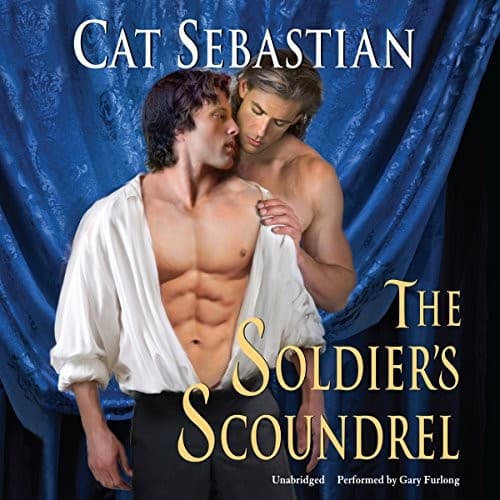
Synopsis
Covers the whole plot, including the ending.
- Difficulty
- Easy
- Pacing
- Moderate
- Mood
- Romantic, witty, angsty, charming, adventurous
- Read it if
- you enjoy historical romance with a significant class disparity, a 'grumpy/sunshine' dynamic (with a twist), and a focus on character development and societal commentary. Perfect for fans of m/m romance with a touch of adventure and emotional depth.
- Skip it if
- you prefer your historical romances without significant social commentary or if you're looking for a plot purely driven by external conflict rather than character-driven emotional arcs.
The soldier's scoundrel Plot Summary
Covers the whole plot, including the ending.
A Plea for Assistance
Major Oliver Rivington, a decorated soldier back from the Napoleonic Wars, has a problem. His younger brother, Jonathan, is being blackmailed over a gambling debt and an indiscretion. Oliver does not want to involve the authorities because of the potential scandal. His friend, Lord Ashworth, advises him to find Jack Turner, a known 'scoundrel' who works outside the law. Oliver, a man of strict principles, initially dislikes the idea but is desperate. He finds Jack in a smoky tavern. Jack, recognizing Oliver's aristocratic look, is immediately dismissive and hostile, refusing to help a 'gentleman.' Oliver, however, keeps trying, explaining the blackmail, which involves compromising letters.
An Unlikely Alliance
Jack initially refuses, but Oliver's quiet desperation and the real threat to Jonathan's reputation eventually persuade him. Jack usually helps the vulnerable against the powerful, so Oliver's situation is unusual for him. He agrees to take the case, though he charges a high fee and clearly dislikes Oliver's class. Their first step is to investigate the blackmailer, Mr. Finch. Jack uses his network of informants and his knowledge of the underworld, while Oliver provides what information he can from his brother. Their work together is tense; Oliver is appalled by Jack's methods, and Jack is annoyed by Oliver's strict morality. Still, a strange attraction begins to grow between them.
The First Confrontation
Jack plans to confront Mr. Finch and get the letters back. He takes Oliver to a rundown place where Finch does business. Oliver, dressed in plain clothes, feels very out of place in the grimy setting, relying on Jack's street smarts. During the confrontation, Jack tries to intimidate Finch and trick him into giving up the letters without violence. Finch, however, is tougher than expected and does not give in easily. The encounter gets heated, showing Jack's quick thinking and skill under pressure. It forces Oliver to see the harsh realities of the underworld. They do not succeed immediately but learn important information about Finch's operations and associates.
A Glimpse into Jack's World
As they continue their investigation, Oliver finds himself more involved in Jack's world. He visits Jack's modest home in the slums, which is very different from his own rich house. There, Oliver meets Jack's younger siblings, Eliza and Thomas, whom Jack fiercely protects and supports with his illegal earnings. Oliver sees Jack's deep love and responsibility for his family, which softens his initial judgment of the 'scoundrel.' He realizes that Jack's criminal activities come from necessity and a desire to provide for his own, not from malice. This insight starts to break down Oliver's strict class prejudices and helps him see Jack as a complex person, not just a 'criminal.'
Growing Intimacy
Working closely and facing shared danger slowly breaks down the barriers between Oliver and Jack. During stakeouts and late-night talks, they begin to confide in each other. Oliver shares his war experiences, the lasting trauma, and his difficulty adjusting to civilian life. Jack, in turn, reveals more about his past, the poverty he grew up in, and his constant fight for survival. Their conversations include sharp banter, but underneath, a strong attraction develops. A stolen touch, a lingering glance, and the undeniable pull of their different personalities create a clear sexual tension that neither can ignore, leading to their first tentative kisses.
The Threat Deepens
The blackmail gets worse when Finch, angered by Jack and Oliver's interference, increases his demands and threatens to expose not just Jonathan but other members of society. It becomes clear that Finch is part of a larger, more organized criminal network, and his activities go beyond simple gambling debts. This puts not only Jonathan but potentially Oliver's own reputation and career at risk. The stakes are much higher, forcing Jack and Oliver to work even more closely and quickly. The danger grows, pushing them deeper into London's treacherous underbelly and testing their growing relationship.
A Reckless Act
Recognizing the growing threat and urgency, Jack plans a daring and dangerous way to get into Finch's hideout and retrieve the letters. He insists on going alone, knowing the risks are too great for Oliver, but Oliver refuses to let him face it alone. Against Oliver's better judgment, Jack breaks in. He finds the letters, but his escape is almost stopped, leading to a desperate struggle. Oliver, who had followed, steps in at a critical moment, saving Jack from capture or worse. The incident strengthens their bond, showing they will protect each other.
Consequences and Confessions
After successfully getting the letters, Jack is injured, though not badly. Oliver, full of fear and relief, tends to his wounds. In that intimate moment, their true feelings for each other surface. Oliver admits his strong attraction and growing affection for Jack, saying that Jack has challenged all his previous ideas. Jack, not used to such open declarations, responds with rare vulnerability, acknowledging his own feelings for Oliver. Their different social standings and lifestyles remain a big problem, but their shared experiences and undeniable connection make it impossible to ignore the love growing between them.
Social Scrutiny
With the blackmail resolved, Oliver's life returns to its 'proper' order, but he cannot simply forget Jack. Their secret meetings continue, but the clear contrast between their worlds becomes more apparent. Oliver struggles with the expectations of his class and family, especially his brother Jonathan, who, once safe, urges Oliver to stay away from the 'criminal' Jack. Jack, always practical, understands that a public relationship with a gentleman like Oliver is impossible. The social pressures begin to strain their fragile connection, forcing them to face difficult choices and potential sacrifices to maintain their relationship in a society that condemns such unions.
A Future Forged
Despite society's obstacles, neither Oliver nor Jack can end their bond. Oliver, changed by his experiences with Jack, realizes that a conventional life without him would be empty. Jack, for his part, sees that Oliver values him in a way no one else ever has. They decide to create an unconventional path, one that respects Oliver's need for discretion while allowing Jack to continue his work and care for his family. This means finding a delicate balance, making compromises, and accepting that their love will largely exist in the shadows, a sign of their lasting commitment to each other against all odds.
The soldier's scoundrel Characters
Jack Turner
Protagonist
A cunning, principled scoundrel of the London underworld.
Jack Turner is a resourceful and intelligent man who grew up in the harsh poverty of London's slums. He operates outside the law, using his street smarts and network of contacts to help those in need, particularly against the abuses of the wealthy. Beneath his cynical, hardened exterior and sharp wit lies a deep sense of loyalty and a fierce protectiveness, especially towards his younger siblings, Eliza and Thomas, for whom he is solely responsible. He harbors a profound distrust and resentment of the aristocracy, seeing them as inherently corrupt and self-serving, making his initial interactions with Oliver particularly fraught.
Relationships: Oliver Rivington (lover, client, reluctant partner); Eliza Turner (younger sister, dependent); Thomas Turner (younger brother, dependent)
Oliver Rivington
Protagonist
A principled, decorated soldier struggling with civilian life and societal expectations.
Major Oliver Rivington is a high-born gentleman and a decorated veteran of the Napoleonic Wars. He is deeply principled, honorable, and accustomed to order and duty. Returning from the chaos of war, he craves a predictable, respectable life. However, his family's blackmail crisis forces him to confront the messy realities of the world and his own rigid beliefs. He is initially judgmental of Jack's illicit lifestyle but possesses an underlying compassion and a growing disillusionment with the hypocrisy of his own class. He is also struggling with his repressed desires and the constraints of his societal position.
Relationships: Jack Turner (lover, blackmailer's target, reluctant partner); Jonathan Rivington (younger brother, blackmail victim); Lord Ashworth (friend, advisor)
Jonathan Rivington
Supporting
Oliver's younger brother, whose indiscretion sparks the plot.
Jonathan Rivington is Oliver's younger brother, a somewhat naive and reckless young gentleman prone to gambling and indiscretions. His entanglement in a blackmail scheme over a gambling debt and compromising letters sets the entire plot in motion. He is initially terrified and ashamed, relying on Oliver to solve his problems. While grateful for Oliver's intervention, he later embodies the societal pressures Oliver faces, urging him to maintain a respectable distance from Jack Turner once the crisis is over.
Relationships: Oliver Rivington (older brother); Mr. Finch (blackmailer)
Mr. Finch
Antagonist
The cunning blackmailer who targets Jonathan Rivington.
Mr. Finch is the primary antagonist, a shrewd and ruthless blackmailer who operates within London's criminal underworld. He preys on the indiscretions of the wealthy, using compromising letters and gambling debts to extort money. He is tenacious and not easily intimidated, posing a significant challenge to Jack and Oliver. Finch represents the darker, exploitative side of the criminal world, contrasting with Jack's more principled 'scoundrel' activities. His actions escalate the threat, forcing Jack and Oliver into increasingly dangerous situations.
Relationships: Jonathan Rivington (victim); Jack Turner (adversary); Oliver Rivington (adversary)
Eliza Turner
Supporting
Jack's younger sister, a recipient of his fierce protection.
Eliza is Jack's younger sister, whom he cares for deeply alongside their brother Thomas. She represents the innocent side of Jack's life and the primary motivation for his 'scoundrel' activities – his desire to provide for and protect his family from the harsh realities of poverty. Her presence in Jack's home offers Oliver a glimpse into Jack's humanity and the genuine love he holds, challenging Oliver's initial perception of him as merely a criminal. She is bright and observant, adding warmth to Jack's otherwise tough exterior.
Relationships: Jack Turner (older brother); Thomas Turner (brother)
Thomas Turner
Supporting
Jack's youngest brother, symbolizing his responsibilities.
Thomas is Jack's youngest brother, completing the trio of siblings Jack is devoted to protecting. Like Eliza, he serves as a tangible representation of Jack's responsibilities and the depth of his commitment to his family. His innocence and vulnerability underscore the necessity of Jack's illicit work and the lengths he goes to ensure their safety and well-being. Oliver's interactions with Thomas, even brief ones, further humanize Jack in his eyes, revealing the tender side beneath the scoundrel's facade.
Relationships: Jack Turner (older brother); Eliza Turner (sister)
The soldier's scoundrel Themes
Class Divide and Prejudice
The novel explores the strict class structures of Regency England and the prejudices they cause. Oliver, a gentleman, first sees Jack, a man from the slums, with disdain and suspicion, viewing him only as a 'criminal.' Jack, in turn, distrusts and resents the nobility, seeing them as corrupt and exploitative. Their growing relationship forces both men to confront and change their preconceived notions, showing the shared humanity and moral complexities that exist beyond social standing. The story highlights how societal expectations can create barriers, but genuine connection can overcome them.
“Oliver had always thought of men like Jack as a necessary evil, a shadowy undercurrent to the respectable world. Now, he found himself drawn to that darkness, fascinated by the life that thrived in the city's hidden corners.”
Identity and Authenticity
Both main characters struggle with their identities and the roles society expects of them. Oliver, a decorated soldier, finds it hard to reconcile his wartime experiences with the demands of a conventional gentleman's life. He also struggles with his sexuality, which conflicts with his public image. Jack, while embracing his identity as a 'scoundrel,' hides the softer, more responsible parts of his character from the world. Their relationship allows them to drop these facades and be their true selves, finding acceptance and love in a world that would otherwise condemn them. The story questions the cost of fitting in versus the freedom of being oneself.
“He was a soldier, a gentleman, a man of order. And yet, with Jack, all those carefully constructed walls crumbled, revealing a hunger he hadn't known he possessed.”
Love Against All Odds
At its core, the novel is a romance about two men from very different worlds who fall in love despite strong societal pressures and personal biases. Their connection ignores class, expectations, and the dangers of the criminal underworld. The story emphasizes love's power to overcome significant obstacles, suggesting that true affection can grow even in the most unlikely situations. It explores the compromises and sacrifices needed to maintain a forbidden relationship in a disapproving society, highlighting the resilience and determination of those who follow their hearts.
“He knew it was madness, this pull towards a man who defied everything he stood for. But it was a madness he couldn't, wouldn't, deny.”
Justice and Morality
The story looks at different ideas of justice and morality. Oliver follows the established legal system, believing in order and the rule of law. Jack, however, operates by his own moral code, providing a form of 'justice' for those the system fails or ignores. His methods are often illegal, but his intentions are to protect the vulnerable and correct power imbalances. The novel asks whether legality always equals morality, and whether 'scoundrels' can sometimes enact a deeper or more necessary form of justice than official channels allow. Their work together blurs these lines, making Oliver question his black-and-white view of right and wrong.
“The law, Oliver knew, was often a blind lady, and sometimes, a man had to see for himself, even if it meant stepping outside the lines.”
Plot Devices & Literary Techniques
The Blackmail Plot
A classic mystery hook driving the initial interaction.
The blackmail of Jonathan Rivington serves as the primary inciting incident and plot driver. It forces Oliver, a man of strict decorum, to step outside his comfort zone and engage with the criminal underworld, thereby introducing him to Jack Turner. This device not only creates immediate tension and a shared goal for the protagonists but also highlights the hypocrisy and vulnerabilities within the 'respectable' upper echelons of society. It acts as a catalyst for their unlikely alliance and the subsequent development of their romantic relationship, providing a tangible problem that requires both their unique skills to solve.
Opposites Attract Trope
The fundamental dynamic between the two main characters.
This device is central to the novel's romantic appeal, pairing the honorable, aristocratic soldier (Oliver) with the street-smart, cynical scoundrel (Jack). Their contrasting backgrounds, moral codes, and social standings create inherent conflict and tension, both external and internal. However, it is precisely these differences that draw them to each other, as each finds qualities in the other that they lack or secretly admire. The trope allows for rich character development as they challenge each other's prejudices and expand their worldviews, ultimately proving that love can bridge the widest divides.
The Underworld as a Setting
A dangerous backdrop that tests characters and reveals truths.
London's grimy, dangerous underworld serves as a crucial plot device, contrasting sharply with Oliver's genteel world. It is the setting where Jack operates, where the blackmail takes place, and where Oliver is forced to venture. This setting provides constant external conflict and danger, pushing the characters to their limits. More importantly, it acts as a crucible, stripping away Oliver's societal polish and revealing his true character, while also showcasing Jack's resourcefulness and protective nature. The underworld is not just a backdrop but an active force that shapes the characters and their relationship.
The soldier's scoundrel Quotes
“He was a scoundrel, yes, but he was *his* scoundrel.”
“He had a mouth that could charm the devil and a heart that was surprisingly soft.”
“War had a way of stripping away pretenses, leaving only the raw, desperate need for connection.”
“He was the kind of trouble a man didn't know he was looking for until it found him.”
“Sometimes, the most dangerous battles were fought not on the battlefield, but within the confines of one's own heart.”
“He wanted him. Not just his body, but his mind, his laughter, his infuriating way of looking at the world.”
“The world was a harsh place, but in his arms, it felt a little less so.”
“He was a man of contradictions, a rogue with a conscience, a soldier who craved peace.”
“He was a storm, and she was the lighthouse, steadfast and unwavering.”
“The scars he carried were not just on his skin, but etched deep within his soul.”
“He had a knack for finding the light in the darkest of places.”
“He was a dangerous game, and she knew she was losing, but she couldn't bring herself to stop playing.”
“In the quiet moments between the chaos, their connection was the only thing that felt real.”
“He was a soldier's scoundrel, and she wouldn't have him any other way.”
Quiz
10 questions on the plot and the characters. Each answer comes with a short explanation.
Question 1
What is the title of the book?
- The Soldier's Scoundrel
- The Gentleman's Scoundrel
- Scoundrel of the Army
- The Shadowed Soldier
Show answer
A. The Soldier's Scoundrel The title of the book is explicitly stated as 'The Soldier's Scoundrel'.
Question 2
Who is the author of 'The Soldier's Scoundrel'?
- Jane Austen
- Cat Sebastian
- Georgette Heyer
- Julia Quinn
Show answer
B. Cat Sebastian The author's name, Cat Sebastian, is provided at the beginning of the book description.
Question 3
What is Jack Turner's background?
- He grew up in a wealthy noble family.
- He was a soldier before turning to crime.
- He grew up in London's slums and lived a life of crime.
- He was a street performer.
Show answer
C. He grew up in London's slums and lived a life of crime. The text states, 'Jack Turner grew up in the darkness of London's slums, born into a life of crime'.
Question 4
What motivates Jack Turner's actions?
- A desire for wealth and power.
- To keep his belly full and his siblings safe.
- To exact revenge on the nobility.
- To gain the respect of the military.
Show answer
B. To keep his belly full and his siblings safe. The book description mentions Jack's motivation: 'willing to do anything to keep his belly full and his siblings safe'.
Question 5
What kind of assistance does Jack Turner provide?
- Legal representation for the poor.
- Financial aid to noble families.
- The kind of assistance only a scoundrel can provide.
- Military training and strategy.
Show answer
C. The kind of assistance only a scoundrel can provide. The text states Jack 'uses the tricks and schemes of the underworld to help those who need the kind of assistance only a scoundrel can provide'.
Question 6
What is Jack's general feeling towards the nobility?
- He admires them.
- He is indifferent to them.
- His distrust of the nobility runs deep.
- He aspires to join their ranks.
Show answer
C. His distrust of the nobility runs deep. The book description clearly states, 'His distrust of the nobility runs deep'.
Question 7
What does Oliver Rivington crave after the chaos of war?
- A life of adventure and excitement.
- The safe predictability of a gentleman's life.
- More military service.
- A career in politics.
Show answer
B. The safe predictability of a gentleman's life. The text says, 'After the chaos of war, Oliver Rivington craves the safe predictability of a gentleman's life'.
Question 8
How does Oliver Rivington view Jack Turner initially?
- As a potential ally.
- As a charming rogue.
- As a ne'er-do-well who flouts the law.
- As someone to be pitied.
Show answer
C. As a ne'er-do-well who flouts the law. Oliver 'craves a gentleman's life--one that doesn't include sparring with a ne'er-do-well who flouts the law at every turn.'
Question 9
What effect does Jack have on Oliver's 'genteel polish'?
- It makes Oliver more reserved.
- It causes Oliver to become more cynical.
- Jack takes pleasure in watching it crumble.
- It reinforces Oliver's gentlemanly demeanor.
Show answer
C. Jack takes pleasure in watching it crumble. The text states, 'Jack's pleasure in watching his genteel polish crumble every time they're together.'
Question 10
Which of the following best describes the central conflict or dynamic between Jack and Oliver?
- A clash between two soldiers vying for promotion.
- A forbidden attraction between a man of the underworld and a high-born soldier.
- A rivalry over business ventures in London.
- A struggle for Oliver to escape his past.
Show answer
B. A forbidden attraction between a man of the underworld and a high-born soldier. The description highlights Jack's background as a scoundrel from the slums and Oliver's as a high-born soldier, and their mutual attraction despite their vastly different worlds and Jack's distrust of nobility.
The soldier's scoundrel FAQ
What is 'The Soldier's Scoundrel' about?
'The Soldier's Scoundrel' by Cat Sebastian tells the story of Jack Turner, a street-smart criminal from London's slums, who uses his underworld skills to help others. He finds himself drawn to Oliver Rivington, a high-born soldier who represents everything Jack is not.
Who are the main characters in 'The Soldier's Scoundrel'?
The main characters are Jack Turner, a resourceful scoundrel from the London underworld, and Oliver Rivington, a gentleman soldier seeking a peaceful life after the war.
What is the central conflict in the book?
The central conflict arises from the stark contrast between Jack's criminal background and Oliver's noble upbringing, and their growing attraction despite their opposing worlds and Jack's deep distrust of the nobility.
What kind of relationship do Jack and Oliver have?
Jack and Oliver develop a passionate and complex romantic relationship. Jack enjoys challenging Oliver's refined demeanor, while Oliver finds himself increasingly captivated by Jack's unapologetic nature.
What themes are explored in 'The Soldier's Scoundrel'?
The book explores themes of class differences, redemption, found family, and the complexities of desire that can transcend social barriers.
Is 'The Soldier's Scoundrel' a historical romance?
Yes, 'The Soldier's Scoundrel' is a historical romance novel set in London, focusing on the relationship between two men from very different social strata.
What makes Jack Turner a 'scoundrel'?
Jack is a scoundrel because he operates outside the law, using his cunning and knowledge of the underworld to survive and help others, often employing methods that are considered illicit or morally gray.
What is Oliver Rivington's background?
Oliver Rivington is a soldier who desires a predictable, respectable life as a gentleman after the chaos of war. He is untainted by vice and comes from a high-born background.
Does the book have a happy ending?
While the cover copy doesn't explicitly state a happy ending, Cat Sebastian's books typically feature satisfying resolutions for their main couples, often involving them overcoming significant obstacles together.
What is the tone of 'The Soldier's Scoundrel'?
The tone is a blend of passion, wit, and emotional depth, exploring the intense attraction between two men from opposite sides of society while dealing with themes of vulnerability and trust.
Similar books
- Harry Potter and the Sorcerer's Stone
J.K. Rowling
4.5 (7M) average on GoodreadsFantasyRescued from a miserable life under the stairs, an orphaned boy discovers he's a wizard destined for a magical school, where he uncovers a dangerous secret tied to the dark wizard who murdered his parents.
- The Hunger Games
Suzanne Collins
4.3 (6.4M) average on GoodreadsFantasyIn a future where children fight to the death on live television, Katniss Everdeen volunteers for the arena, turning a death sentence into a fight for survival and a spark of rebellion.
- Nineteen Eighty-Four
George Orwell
4.2 (5.5M) average on GoodreadsFictionWinston Smith dreams of truth and rebellion in a world where Big Brother watches all, but he confronts the terrifying power of a regime that controls not just actions, but thoughts.
- Pride & Prejudice
Jane Austen
4.3 (4.9M) average on GoodreadsElizabeth Bennet and Mr. Darcy navigate love and misunderstanding, learning that first impressions can be wrong.
- To Kill a Mockingbird
Harper Lee
4.3 (4.5M) average on GoodreadsHistorical FictionIn the 1930s Jim Crow South, Harper Lee writes about racial injustice, moral growth, and the quiet courage of a lawyer father, Atticus Finch, as seen through his young daughter's eyes.
- The Great Gatsby
F. Scott Fitzgerald
3.9 (3.8M) average on GoodreadsHistorical FictionIn the opulent Roaring Twenties, a mysterious millionaire's lavish parties hide his desperate, tragic pursuit of a lost love, exposing the emptiness within the American Dream.





Enjoyed the summary?
A summary gives you the shape of the book. The book itself has the detail, the examples and the voice.
Find The soldier's scoundrel on AmazonAs an Amazon Associate, BookBrief earns from qualifying purchases. How we're funded