
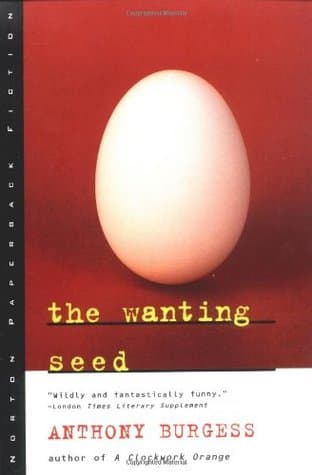
Synopsis
Covers the whole plot, including the ending.
- Difficulty
- Medium
- Pacing
- Moderate
- Mood
- Satirical, Darkly Humorous, Dystopian, Philosophical, Absurdist
- Read it if
- You enjoy satirical dystopian science fiction that explores themes of overpopulation, government control, and human nature with dark humor and intellectual depth.
- Skip it if
- You prefer straightforward narratives, are sensitive to themes of cannibalism and societal collapse, or dislike overtly philosophical and satirical writing.
The Wanting Seed Plot Summary
Covers the whole plot, including the ending.
The World of Demographic Control
The novel begins in a future, overpopulated England where the government enforces strict population control. Tristram Foxe, a history teacher, and his wife, Beatrice-Joanna, live in a small apartment with their son, Ferdinand. The official belief, 'Pelagianism,' promotes homosexuality to control population, quietly discouraging heterosexual relationships. Heterosexual acts are often viewed with suspicion, and children are seen as a burden. Beatrice-Joanna secretly wants another child, a dangerous desire in this society. Tristram, while outwardly conforming, struggles with the hypocrisy and emotional emptiness of their world, often feeling alienated and wanting a more natural existence.
The Secret Pregnancy
Beatrice-Joanna gets pregnant, despite societal pressure. This act directly defies Pelagian policy. As a result, Tristram loses his teaching position, and their son, Ferdinand, is sent to a state-run 'Infant Institute,' a term for an orphanage where children are often neglected. The couple's finances worsen, and they face growing social exclusion. Tristram, despite his initial anger at Beatrice-Joanna's impulsiveness, feels a strong need to protect his family and a growing anger at the oppressive system that punishes them for a natural human desire.
Ferdinand's Disappearance and the Journey North
The Foxe family learns that Ferdinand has died at the Infant Institute. This devastating news fuels Beatrice-Joanna's grief and a desperate desire to escape their situation. They decide to flee north, aiming for Scotland, where they believe population controls might be less strict, or where they can find peace. Their journey is dangerous and shows widespread societal decay. They encounter various groups, from desperate migrants to armed youth gangs, all struggling in the crowded and increasingly chaotic world. This shows the breakdown of social order.
The Rise of 'Adamism'
As Tristram and Beatrice-Joanna travel, they notice a subtle but growing rebellion against Pelagianism. This new belief, called 'Adamism,' advocates for procreation and natural heterosexual relations, often defying the state. Adamist groups start to appear, holding secret meetings and performing fertility rituals. This shift in belief shows a societal pendulum swing, a subconscious rebellion against the forced sterility and emotional repression of the Pelagian era. The rise of Adamism offers a glimmer of hope for Tristram and Beatrice-Joanna, suggesting their personal desires might match a broader societal change.
The Cannibalistic Dining Clubs
During their difficult journey, Tristram and Beatrice-Joanna see more disturbing signs of societal collapse. Food scarcity has become so severe that cannibalism, called 'dining clubs,' is a common, though hidden, practice. These clubs operate with a chilling normalcy, showing the extreme lengths people go to survive in a world with depleted resources. The discovery of these practices deeply disturbs Tristram, forcing him to face the dark side of human nature when pushed to its limits. This highlights the moral decay that comes with extreme societal pressures and the breakdown of order.
The Pelagian Counter-Attack
The Pelagian government, seeing the growing threat of Adamism, increases its crackdown on pro-fertility activities. Propaganda against 'breeders' becomes more intense, and state forces become more aggressive in enforcing population control. This escalation leads to more conflict between Pelagian loyalists and Adamist rebels. Tristram and Beatrice-Joanna find themselves caught in the middle of this ideological war, their personal struggle for survival now connected to a larger societal conflict. The government's desperate measures only fuel the rebellion, creating a cycle of violence and oppression.
Beatrice-Joanna's Second Pregnancy and the Adamist Movement
Despite the dangers, Beatrice-Joanna gets pregnant a second time. This pregnancy, a symbol of defiance and hope, quickly makes her a leader for the Adamist movement. Her fertile state is celebrated and protected by Adamist followers, who see her as a living example of their pro-fertility ideals. Tristram, at first cautious of the attention, finds himself drawn into the movement's activities, becoming a reluctant participant in the growing rebellion. The personal act of procreation becomes a political statement, giving their journey a new, larger purpose within the unfolding societal transformation.
The War of Ideologies
The ideological struggle between Pelagianism and Adamism results in open warfare. However, these battles are often absurd and ritualistic rather than truly destructive. Soldiers on both sides, wanting 'war without anger,' engage in theatrical combat, often using non-lethal methods. This unusual form of warfare shows Burgess's satirical comment on human conflict and the contradictions of ideological fervor. Tristram, watching these strange battles, struggles with the meaninglessness and the underlying violence, even when presented in a stylized, almost comical way. This highlights the human capacity for both absurdity and brutality.
The Discovery of Ferdinand's Survival
During the chaos of the war, Tristram makes a shocking discovery: Ferdinand is alive. He learns that his son was not killed at the Infant Institute but was taken and raised by a group of homosexuals who strictly follow Pelagian ideology. This revelation adds another layer of complexity to Tristram's personal journey, forcing him to confront the state's manipulation and deception. The reunion with Ferdinand is bittersweet, as his son has been taught a worldview very different from his parents', showing the deep impact of societal engineering on individual identity and family bonds.
The Reversal of Ideologies
As Adamism wins and becomes the main belief, the societal pendulum swings dramatically. Procreation is now praised, and homosexuality, once state-sanctioned, becomes stigmatized and demonized. The new regime, in its fervor, begins to persecute homosexuals, mirroring the previous Pelagian persecution of heterosexuals. This rapid reversal of values shows the cyclical nature of human extremism and the dangers of any absolute belief. Tristram observes this shift with a cynical eye, recognizing that the new order, while different in its ideas, shares the same oppressive and intolerant characteristics as the old one, continuing the cycle of societal control.
Tristram's Resignation and the New World
With Adamism firmly established, Tristram, tired by the constant ideological shifts and societal upheavals, withdraws from public life. He and Beatrice-Joanna find a quiet life, adopting the new pro-fertility norms without fully giving in to the extremism. Tristram, having seen the rise and fall of two contrasting beliefs, develops a deep sense of resignation and a detached understanding of human nature's cyclical patterns. He finds a certain peace in a more agrarian, 'natural' existence, away from urban centers and political schemes. The novel ends with Tristram reflecting on the human desire for control and the futility of imposing artificial orders on fundamental biological drives.
The Wanting Seed Characters
Tristram Foxe
Protagonist
A history teacher struggling to reconcile his natural desires with a state-enforced anti-procreation ideology.
Tristram is a somewhat passive, intellectual man, initially a conformist to the Pelagian regime, albeit with an underlying sense of unease. He teaches history, giving him a unique perspective on the cyclical nature of human folly. His journey is one of reluctant rebellion, driven by his wife's actions and the injustices inflicted upon his family. He often feels alienated and cynical, observing the absurdities of his world with a detached, analytical eye. Despite his intellectualism, he possesses a deep, if often suppressed, longing for a more authentic, natural existence.
Relationships: Beatrice-Joanna Foxe (Husband, initially resentful of her fertility, later protective and united in their defiance.); Ferdinand Foxe (Father, deeply affected by his son's perceived death and later reunion.)
Beatrice-Joanna Foxe
Protagonist
Tristram's wife, whose strong maternal instincts directly challenge the Pelagian state.
Beatrice-Joanna is a spirited and impulsive woman, driven by a powerful, almost primal, desire for children. She embodies the natural human urge to procreate, directly opposing the state's anti-fertility policies. Her actions, born of instinct rather than intellectual rebellion, are the catalyst for many of the plot's developments, forcing Tristram out of his complacency. She becomes a symbolic figure for the Adamist movement due to her defiant pregnancies, representing the triumph of nature over artificial control. Her emotional depth and resilience are a stark contrast to the sterile world she inhabits.
Relationships: Tristram Foxe (Wife, her actions often propel their shared journey, and they grow closer through adversity.); Ferdinand Foxe (Mother, deeply grieves his supposed death and is overjoyed by his return.)
Ferdinand Foxe
Supporting
Tristram and Beatrice-Joanna's son, whose fate highlights the state's manipulation of children.
Ferdinand is initially a young child, removed from his parents and placed in a state institution. His 'death' serves as a major catalyst for his parents' journey. Later, he is revealed to be alive, having been raised by a group of homosexual Pelagian loyalists. This upbringing has indoctrinated him into the very ideology his parents defied, creating a significant emotional and ideological divide between them. He represents the malleability of identity and the power of state-sponsored education and manipulation, showcasing the profound impact of societal control on the younger generation.
Relationships: Tristram Foxe (Son, his father's struggle for him is a major plot point.); Beatrice-Joanna Foxe (Son, his mother's grief and love for him are profound.)
Mr. Enderby
Supporting
A high-ranking Pelagian official who embodies the bureaucratic and ideological rigidity of the state.
Mr. Enderby is a seemingly minor character who represents the impersonal, bureaucratic face of the Pelagian state. He is a rigid enforcer of the anti-fertility policies, exhibiting a cold, detached demeanor. His interactions with Tristram highlight the oppressive nature of the government and the lack of compassion within its systems. While not overtly villainous, his unwavering adherence to the ideology makes him an effective antagonist, symbolizing the dehumanizing aspects of extreme demographic control. He is a product of the system, embodying its logical, yet ultimately destructive, principles.
The General
Supporting
A military leader in the 'war without anger,' representing the absurdities of the societal conflict.
The General is a character encountered during the 'war without anger' between Pelagian and Adamist forces. He is a figure of military authority, yet his command is focused on a highly ritualized, almost theatrical form of combat. He embodies the peculiar and often absurd nature of the societal conflict, where violence is present but often devoid of genuine passion or hatred. His role highlights Burgess's satirical critique of warfare and the human tendency to ritualize even the most destructive acts, revealing a deeper critique of modern society's detachment.
The Cannibal Club Proprietor
Mentioned
A representative of the extreme measures taken for survival in the overpopulated world.
This unnamed character, or type of character, represents the chilling normalization of cannibalism in the desperate, resource-scarce world. They manage the 'dining clubs' where human flesh is consumed, highlighting the ultimate breakdown of moral and social taboos. This character serves to illustrate the dire consequences of overpopulation and resource depletion, pushing humanity to its darkest extremes. They are a stark symbol of the societal degradation that Tristram and Beatrice-Joanna witness on their journey, underscoring the novel's grim warnings.
The Adamist Leader (various)
Supporting
Figures who champion procreation and lead the rebellion against Pelagianism.
These are various unnamed or briefly mentioned leaders of the burgeoning Adamist movement. They articulate the philosophy of procreation and natural human desires, providing a counter-narrative to the state-sanctioned Pelagianism. They organize clandestine meetings and rituals, galvanizing support for the rebellion. These characters represent the collective will of those who reject artificial population control, embodying the resurgence of fundamental human instincts. Their zeal, however, also hints at the potential for a new form of extremism once their ideology gains dominance.
The Wanting Seed Themes
The Perils of Overpopulation and State Control
The novel shows a dystopian future where extreme overpopulation leads to harsh government policies. The Pelagian state's efforts to control fertility, from discouraging heterosexuality to the forced separation of families and the institutionalization of children, show the dehumanizing effects of such control. The scarcity of resources, leading to practices like cannibalism (the 'dining clubs'), highlights the extreme consequences. The societal decay and the constant struggle for survival underscore Burgess's warning about unchecked population growth and the resulting loss of individual freedom and dignity, as seen in Tristram's demotion and Ferdinand's fate.
“The greatest crime of all, the most deadly sin, was to bring forth another mouth to feed.”
The Cyclical Nature of Ideology and Extremism
Burgess shows how one extreme belief (Pelagianism, promoting homosexuality and anti-fertility) is replaced by another equally extreme one (Adamism, promoting procreation and persecuting homosexuals). The 'war without anger' and the rapid societal pendulum swing from one set of values to its opposite reveal the human tendency towards dogmatism and the dangers of absolute belief systems. Tristram's cynical observation of this cycle, from the initial oppression to the new wave of persecution, shows the novel's message that humanity often replaces one form of tyranny with another, rather than finding a balanced path.
“The human race, it seemed, was condemned to swing between two poles of absurdity.”
Nature vs. Nurture and Innate Human Drives
A main theme is the conflict between natural human instincts, especially the drive to procreate, and artificial societal rules. Beatrice-Joanna's strong desire for children, despite severe state penalties, shows nature's triumph. The eventual rise of Adamism, a pro-fertility movement, further illustrates that basic biological needs cannot be suppressed forever. Even the 'war without anger' shows a distorted, yet persistent, human drive for conflict. The novel suggests that attempts to engineer human nature or suppress innate drives will eventually fail, leading to chaotic and often violent reactions, as seen in the societal upheaval.
“You cannot argue with the sperm and the egg, for they are the voice of God.”
The Absurdity of Modern Society and Bureaucracy
Burgess adds satire and dark humor to his critique of modern society. The 'war without anger,' the term 'dining clubs' for cannibalism, and the bureaucratic doublespeak of the Pelagian state all show the absurdity of human attempts to control and rationalize complex issues. Tristram's detached, often cynical observations of these strange events underscore the gap between official rhetoric and grim reality. The novel uses these absurdities to expose the dehumanizing and illogical consequences of extreme social engineering and the pervasive hypocrisy that underlies it.
“It was a war of the imagination, a war of symbols, a war without anger. And yet, people still died.”
Plot Devices & Literary Techniques
Dystopian Setting
A futuristic, overpopulated England serving as a cautionary tale.
The novel's setting is a quintessential dystopian future, characterized by extreme social engineering, resource scarcity, and a pervasive sense of state control. This setting allows Burgess to explore the potential negative consequences of unchecked population growth and governmental overreach. The cramped living conditions, the omnipresent propaganda, and the fear of procreation all contribute to a suffocating atmosphere, effectively illustrating the loss of individual freedom and dignity in such a society. It serves as a stark warning, amplifying the novel's thematic concerns.
Satire and Dark Humor
The use of irony and exaggeration to critique societal flaws.
Burgess employs biting satire and dark humor to underscore the absurdities and hypocrisies of his dystopian world. Examples include the 'war without anger,' the euphemistic 'dining clubs' for cannibalism, and the state's glorification of homosexuality as a means of population control. This comedic approach, despite the grim subject matter, prevents the novel from becoming overly didactic and instead highlights the ridiculousness of human behavior when driven by extreme ideologies. It allows Burgess to deliver serious social commentary with a unique and engaging tone.
The Ideological Pendulum
The cyclical shift between two opposing, equally extreme societal ideologies.
This device refers to the rapid and complete reversal of dominant societal ideologies, from Pelagianism (anti-fertility, pro-homosexuality) to Adamism (pro-fertility, anti-homosexuality). This pendulum swing illustrates the human tendency to replace one form of extremism with another, rather than finding a balanced approach. It highlights the inherent dangers of absolute belief systems and the cyclical nature of oppression, showing how yesterday's persecuted can become tomorrow's persecutors. This device is crucial for conveying the novel's message about the futility of human attempts to control fundamental drives.
Euphemism
The use of mild or indirect words to disguise unpleasant realities.
Throughout the novel, euphemisms are used to mask the grim realities of the dystopian society. 'Infant Institutes' are effectively orphanages where children are neglected or worse, and 'dining clubs' are establishments for cannibalism. This linguistic device highlights the state's manipulation of language to control public perception and sanitize atrocities. It also underscores the characters' complicity in accepting these veiled truths, demonstrating how a society can normalize horrific practices through the power of words. It contributes to the novel's dark humor and satirical tone.
The Wanting Seed Quotes
“It was not a question of being able to do it, it was a question of doing it.”
“The earth, in its wisdom, knew only how to be fruitful. It had no wisdom for barrenness.”
“What was the point of art if it didn't make you want to go out and do something, even something stupid?”
“Every man a father, every woman a mother. That was the law, unspoken but absolute.”
“The greatest sin was not to be fruitful. It was to deny life.”
“Love was a luxury, a diversion. Procreation was a necessity, a duty.”
“We are all merely instruments of the great biological imperative.”
“The future was a vast, fertile field, waiting for the seed.”
“Ignorance was bliss, but knowledge was power, and power was sometimes a terrible burden.”
“To want, to desire, that was the human condition, even when the object of desire was forbidden.”
“The machine hummed, ready to receive, ready to create.”
“Sanity was a matter of conforming to the prevailing madness.”
“There was no escape from the wanting seed, no ultimate denial of the biological imperative.”
“The individual was nothing; the species was all.”
Quiz
10 questions on the plot and the characters. Each answer comes with a short explanation.
Question 1
In the initial society depicted in 'The Wanting Seed,' what is the official government stance on procreation?
- It is encouraged for all married couples.
- It is strictly limited and homosexuality is glorified as an alternative.
- It is only permitted after obtaining a special license and undergoing psychological evaluation.
- It is a private matter with no government intervention.
Show answer
B. It is strictly limited and homosexuality is glorified as an alternative. The novel establishes a society where official family limitation is key, and homosexuality is promoted to control population growth.
Question 2
Who are the two main protagonists of 'The Wanting Seed'?
- F. Alexander and Helen.
- Tristram Foxe and Beatrice-Joanna.
- Roger and Mary.
- Evelyn and Arthur.
Show answer
B. Tristram Foxe and Beatrice-Joanna. The story centers around the married couple Tristram Foxe and Beatrice-Joanna as they navigate their society.
Question 3
What is the primary reason for the government's promotion of homosexuality and family limitation in the novel's initial setting?
- To create a more harmonious and peaceful society.
- To prevent overpopulation and resource depletion.
- To experiment with social engineering and human behavior.
- To eliminate traditional family structures.
Show answer
B. To prevent overpopulation and resource depletion. The core problem the society faces, leading to its extreme policies, is overpopulation.
Question 4
What eventually replaces the initial controlled society in 'The Wanting Seed'?
- A utopian society of perfect balance and harmony.
- A chaos of cannibalistic dining-clubs, fertility rituals, and wars without anger.
- A return to traditional family values and rural living.
- A technologically advanced civilization where all needs are met by machines.
Show answer
B. A chaos of cannibalistic dining-clubs, fertility rituals, and wars without anger. The society undergoes a dramatic transformation into a chaotic, primitive state, characterized by extreme behaviors.
Question 5
What is the name of Tristram Foxe's wife?
- Elizabeth
- Beatrice-Joanna
- Penelope
- Ophelia
Show answer
B. Beatrice-Joanna His wife's unique name, Beatrice-Joanna, is central to the narrative.
Question 6
The 'wars without anger' described in the transformed society suggest a particular theme. What is it?
- The triumph of logical conflict resolution.
- The ritualistic and almost naturalistic aspect of violence when societal controls break down.
- A society where emotions have been completely suppressed.
- The emergence of a highly disciplined military culture.
Show answer
B. The ritualistic and almost naturalistic aspect of violence when societal controls break down. The 'wars without anger' highlight the primal, almost ritualistic nature of conflict that emerges, devoid of the emotional motivations typically associated with warfare, reflecting a deeper, perhaps biological, urge.
Question 7
What is the significance of the 'skyscraper world' setting in the initial phase of the novel?
- It symbolizes the aspiration for technological advancement and space exploration.
- It represents the dense overpopulation and the vertical expansion of humanity due to lack of space.
- It signifies a society that has abandoned ground-level living for environmental reasons.
- It is merely an aesthetic choice with no deeper meaning.
Show answer
B. It represents the dense overpopulation and the vertical expansion of humanity due to lack of space. The skyscraper world is a direct consequence and visual representation of the extreme overpopulation that necessitated the government's family limitation policies.
Question 8
What kind of 'dining-clubs' emerge in the chaotic phase of the society, reflecting a breakdown of moral boundaries?
- Exclusive vegetarian restaurants.
- Clubs specializing in synthetic meat products.
- Cannibalistic establishments.
- Historical themed dining experiences.
Show answer
C. Cannibalistic establishments. The novel explicitly mentions the emergence of 'cannibalistic dining-clubs' as part of the societal breakdown, highlighting extreme depravity.
Question 9
How does the novel 'The Wanting Seed' balance its 'extravagantly funny' and 'grimly serious' aspects?
- By alternating between purely comedic and purely tragic chapters.
- Through satire and black humor, juxtaposing absurd situations with dire consequences.
- By having two distinct narrative threads, one funny and one serious, that never intersect.
- It primarily focuses on humor, with seriousness only in the background.
Show answer
B. Through satire and black humor, juxtaposing absurd situations with dire consequences. Burgess masterfully uses satire and black humor to address serious themes, creating a unique blend of comedy and grim reality.
Question 10
What underlying human drive, often suppressed in the initial society, is unleashed and becomes central in the chaotic, transformed world?
- The drive for technological innovation.
- The desire for intellectual enlightenment.
- The fundamental urge for procreation and survival of the species.
- The pursuit of artistic expression.
Show answer
C. The fundamental urge for procreation and survival of the species. The initial society actively suppresses the procreative urge. Its eventual collapse and the rise of 'fantastic fertility rituals' and the general chaos directly reflect the uncontrolled resurgence of this fundamental human drive.
The Wanting Seed FAQ
What is the central premise of 'The Wanting Seed'?
The novel is set in a future dystopia where overpopulation has led the global government, dubbed 'Polypop', to promote homosexuality and discourage heterosexuality through social engineering and propaganda. This policy aims to control population growth by making traditional family units undesirable and even criminal, creating a society that outwardly celebrates same-sex relationships while subtly repressing procreation.
Who are Tristram Foxe and Beatrice-Joanna, and what is their initial conflict?
Tristram Foxe is a history teacher and Beatrice-Joanna is his wife, living in a skyscraper apartment in this 'Polypop' world. Their initial conflict stems from Beatrice-Joanna's secret desire for a child and Tristram's internal struggle with the societal norms that condemn such desires, despite his own latent heterosexual urges. Their relationship is strained by this fundamental disagreement about their future and the societal pressures they face.
How does the 'fertility cult' emerge, and what role does it play in the story?
The fertility cult emerges as a clandestine, rebellious movement driven by the natural human urge to procreate, directly defying Polypop's anti-natal policies. It manifests through secret meetings, symbolic rituals, and a growing underground network of individuals who embrace fertility, often leading to chaotic and orgiastic displays. This cult represents the primal resistance to engineered social control and becomes a catalyst for societal breakdown.
What is the 'Great Change' and how does it transform society?
The 'Great Change' is the pivotal moment when Polypop's rigid social structure collapses, leading to widespread societal chaos and a complete reversal of values. The glorification of homosexuality gives way to an explosion of heterosexuality, fertility rituals, and a return to more primitive, often violent, social structures. This transformation is marked by the emergence of 'cannibalistic dining-clubs' and 'wars without anger', signifying a bizarre new order.
What is the significance of the 'cannibalistic dining-clubs' and 'wars without anger'?
The 'cannibalistic dining-clubs' symbolize the ultimate breakdown of civilization and moral boundaries, where human flesh becomes a commodity in a world devoid of ethics, yet presented with a veneer of sophistication. The 'wars without anger' represent a detached, almost ritualistic form of conflict, where violence is normalized and depersonalized, reflecting a society that has lost its emotional core and rational purpose. Both elements highlight the absurdity and horror of the post-Polypop world.
What is the meaning behind the name 'Tristram Foxe'?
Tristram's name subtly hints at his 'sad' or 'sorrowful' nature, reflecting his internal conflict and the melancholic undertones of his existence in a world that denies fundamental human desires. 'Foxe' might allude to cunning or a certain animalistic instinct, which eventually surfaces as he navigates the chaotic post-Polypop society. This combination suggests a character both introspective and driven by primal urges.
How does Burgess use language and wordplay to enhance the satirical elements of the novel?
Burgess, known for his linguistic prowess, employs extensive wordplay, neologisms, and ironic juxtapositions to create a darkly humorous and satirical tone. Terms like 'Polypop' itself, or descriptions of 'wars without anger,' highlight the absurdity of the dystopian society and its policies. This linguistic inventiveness serves to both entertain and underscore the novel's critical commentary on social engineering and human nature.
Are there any subtle allusions to historical or literary figures within the narrative?
Yes, Beatrice-Joanna's name is a direct reference to Beatrice-Joanna Stukeley, a character from John Webster's 'The White Devil', known for her moral ambiguity and destructive nature. This allusion hints at Beatrice-Joanna's own complex motivations and the potential for chaos she embodies. Burgess often wove such literary references into his work to add layers of meaning and intertextual depth.
What is the significance of the recurring motif of 'water' or 'rain' throughout the book?
The motif of water, often appearing as rain, frequently symbolizes cleansing, renewal, or the unstoppable force of nature, contrasting with the artificiality of Polypop's world. It can also represent the primal urges and the 'wanting seed' itself, an uncontrollable force that ultimately breaks through societal suppression. Its presence often precedes or accompanies significant shifts in the narrative and character development.
How does Tristram Foxe's character evolve psychologically throughout the novel?
Tristram begins as a repressed, conforming individual, struggling with his true desires under Polypop's strictures. As society collapses, he undergoes a psychological transformation, shedding his inhibitions and embracing his primal urges, becoming more assertive and even ruthless in his pursuit of survival and fatherhood. His journey reflects a descent from civilized conformity into a more instinctual, almost animalistic state.
What psychological factors drive Beatrice-Joanna's intense desire for a child?
Beatrice-Joanna's desire for a child is portrayed as a powerful, almost instinctual drive that transcends societal conditioning and personal comfort. It represents a deep-seated biological imperative to procreate, a psychological resistance to the sterile world Polypop has created. This longing is so strong that it pushes her to defy norms, take extreme risks, and ultimately becomes a major catalyst for the plot's unfolding chaos.
How does the novel explore the psychology of societal repression and its eventual backlash?
The novel masterfully explores the psychological consequences of extreme societal repression, demonstrating how denying fundamental human needs, like the urge to procreate, inevitably leads to explosive and often chaotic backlashes. Polypop's attempts to engineer human nature ultimately fail, resulting in a violent eruption of the very desires it tried to suppress, illustrating the futility of fighting against intrinsic biological and psychological drives.
What psychological impact does the 'Great Change' have on the general populace?
The 'Great Change' plunges the populace into psychological disarray, as their previously stable, albeit repressed, world is shattered. Many experience a rapid shift in identity and values, leading to widespread confusion, moral relativism, and a frenzied embrace of previously forbidden behaviors. This sudden liberation from societal constraints results in both exhilarating freedom and profound psychological disorientation, manifesting in extreme, often violent, actions.
Is 'The Wanting Seed' ultimately a pessimistic or optimistic view of humanity?
The novel presents a grimly serious and largely pessimistic view of humanity, suggesting that while societal constructs can shape behavior, primal instincts ultimately prevail, often leading to chaos and barbarity when unleashed. Burgess implies that humanity's 'wanting seed' is a double-edged sword: essential for survival but also a source of uncontrollable urges that can undermine civilization. However, the sheer resilience of life and the drive to procreate could be seen as a dark form of optimism.
How does Burgess critique utopian ideals through the collapse of Polypop's society?
Burgess critiques utopian ideals by showing how Polypop's perfectly engineered, population-controlled society collapses under the weight of its own unnatural strictures. The attempt to create a 'rational' utopia by suppressing fundamental human drives proves disastrous, demonstrating that human nature is too complex and resilient to be neatly controlled. The resulting chaos highlights the inherent flaws in any system that ignores the irrational and instinctual aspects of humanity.
What is the novel's commentary on the relationship between nature and civilization?
The novel strongly argues that nature, particularly human biological and procreative urges, will always triumph over even the most sophisticated attempts at civilization and social engineering. Polypop's sterile, controlled society represents an extreme attempt to suppress nature, but the 'wanting seed' ultimately breaks through, leading to a chaotic, almost 'natural' state where primal instincts dictate behavior. It suggests civilization is a fragile veneer over fundamental human drives.
Does the ending offer any resolution or hope for a stable future?
The ending of 'The Wanting Seed' offers a cyclical, rather than definitive, resolution. While the immediate chaos subsides into a new, albeit bizarre, societal order focused on procreation, it doesn't necessarily promise a stable or 'better' future. The final scene often implies that humanity is trapped in an endless cycle of overpopulation, repression, and subsequent breakdown, suggesting that the 'wanting seed' is an eternal problem without a lasting solution, leaving a bleak, open-ended sense of inevitability.
How does the novel explore the concept of 'freedom' in both its positive and negative aspects?
The novel explores freedom as a complex and dual-natured concept. The initial freedom from procreation under Polypop is shown as a form of repression, while the 'Great Change' brings an explosive, chaotic freedom that leads to cannibalism and 'wars without anger.' This suggests that true freedom is not merely the absence of constraint, but also requires a balance with responsibility and moral order. Unbridled freedom, in Burgess's view, can be as destructive as extreme repression.
About the author
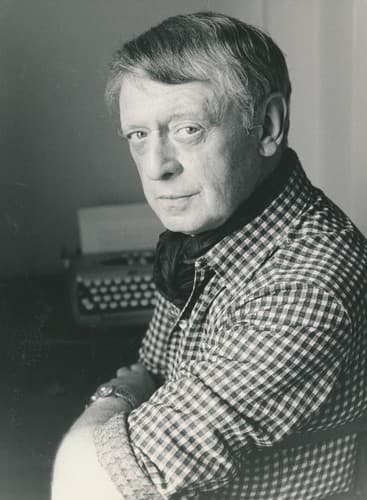
John Anthony Burgess Wilson, who published under the name Anthony Burgess, was an English writer and composer.
Similar books
- A Clockwork Orange
Anthony Burgess
4.0 (601k) average on GoodreadsThrillerShares Burgess's distinctive style, dystopian themes, and exploration of societal control and individual freedom.
- Brave New World
Aldous Huxley
4.0 (1.4M) average on GoodreadsFantasyExplores a future society with extensive governmental control over reproduction and social structure, albeit with different mechanisms.
- Gulliver's Travels
Jonathan Swift
3.6 (232k) average on GoodreadsFantasyOffers a satirical critique of human nature and society through absurd scenarios and philosophical undertones.
- Nineteen Eighty-Four
George Orwell
4.2 (5.5M) average on GoodreadsFictionBoth novels explore totalitarian control and the manipulation of truth. However, The Wanting Seed's focus is specifically on demographic control and the consequences of suppressing natural human instincts for procreation, leading to a breakdown of society and the rise of anarchic movements like 'Adamism.' Nineteen Eighty-Four centers on political thought control, surveillance, and the psychological subjugation of the individual by a monolithic party. While both critique state power, Burgess's critique is more biologically and theologically rooted, whereas Orwell's is primarily political and psychological.
- The Hunger Games
Suzanne Collins
4.3 (6.4M) average on GoodreadsFantasyIn a future where children fight to the death on live television, Katniss Everdeen volunteers for the arena, turning a death sentence into a fight for survival and a spark of rebellion.
- 1984
George Orwell
4.2 (3.1M) average on GoodreadsPoliticsIn a future where surveillance and thought control are absolute, a man's search for truth clashes with the Party, showing that hope can be a form of rebellion.





Enjoyed the summary?
A summary gives you the shape of the book. The book itself has the detail, the examples and the voice.
Find The Wanting Seed on AmazonAs an Amazon Associate, BookBrief earns from qualifying purchases. How we're funded