
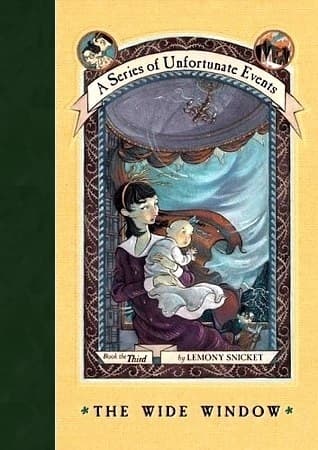
Synopsis
Covers the whole plot, including the ending.
- Difficulty
- Easy
- Pacing
- Moderate
- Mood
- Melancholic, Witty, Suspenseful, Morbid
- Read it if
- You enjoy dark humor, clever mysteries, and a consistent, melancholic tone.
- Skip it if
- You prefer stories with happy endings or straightforward, lighthearted plots.
The Wide Window Plot Summary
Covers the whole plot, including the ending.
A New Guardian and a Looming Storm
After the events at the Lucky Smells Lumbermill, Mr. Poe takes the Baudelaire orphans – Violet, Klaus, and Sunny – to their new guardian, Aunt Josephine Anwhistle. She lives in a house on a cliff overlooking Lake Lachrymose. Aunt Josephine is nervous and obsessed with grammar. She has many phobias, including realtors, doorknobs, and the lake itself, especially its carnivorous Lachrymose Leeches. Her house has fragile furniture and a large, dirty 'wide window' with a lake view. Despite her quirks, she seems to like the children. Violet, Klaus, and Sunny hope for a peaceful stay, but they are immediately wary of her extreme shyness and constant fear.
Aunt Josephine's Fears and a Familiar Face
The Baudelaire children quickly learn how much Aunt Josephine's phobias control her life. She will not use the stove, fearing it will explode, so they eat cold cucumber soup. She will not touch doorknobs, fearing they will shatter, and always insists on correct grammar. While grocery shopping in Curdled Cave, they meet Captain Sham, a one-legged sailor. Klaus immediately suspects Captain Sham is Count Olaf in disguise, despite Mr. Poe saying Olaf has two legs. Violet and Sunny also recognize Olaf's unibrow and the eye tattoo on his ankle, which he tries to hide.
The 'Death' of Aunt Josephine
One morning, the children find Aunt Josephine gone and her wide window shattered. A note, in Aunt Josephine's handwriting, says she jumped out the window into Lake Lachrymose, unable to live with her fear of Captain Sham. The note also says Captain Sham will be the Baudelaire's new guardian. Klaus immediately sees a grammar error in the note, the misuse of 'unlikely' instead of 'unlikely.' This seems very suspicious, as Aunt Josephine was careful about grammar. He believes the note is fake and her 'death' is part of Count Olaf's plan.
Mr. Poe's Blindness and the Hurricane
Mr. Poe arrives, oblivious as usual. He accepts the suicide note as real and dismisses the children's claims that Captain Sham is Count Olaf and the note is fake. He cares more about legal rules than the children's safety. Despite Violet, Klaus, and Sunny's strong protests, Mr. Poe prepares to hand them over to Captain Sham. While legal steps are underway, Hurricane Herman begins to hit Lake Lachrymose and Curdled Cave. The storm grows stronger, making the already dangerous lake even more perilous and adding to the orphans' desperate situation.
Deciphering the Note
Convinced Aunt Josephine's note has a hidden message, Klaus looks at it closely. He realizes the specific grammar errors, like the misspelling of 'curdled' and the wrong use of 'unlikely,' are not mistakes but clues. By focusing on these deliberate errors and the unusual wording, Klaus finds that the note is an acrostic. The first letters of certain words spell a message. He deciphers it to mean 'Curdled Cave,' 'Lachrymose Lake,' and 'Anwhistle Aquatics.' This makes him think Aunt Josephine is not dead but hiding in Curdled Cave, specifically in the Anwhistle Aquatics cave, a place she had mentioned as an emergency hiding spot.
A Desperate Journey to the Cave
With their discovery, Violet, Klaus, and Sunny know they must reach the cave. They escape Captain Sham and Mr. Poe during Hurricane Herman. They steal a small boat, even though they have no sailing experience, and begin a dangerous trip across the storm-tossed Lake Lachrymose. The hurricane rages, threatening to flip their boat. They barely avoid the hungry Lachrymose Leeches, which are drawn to food. Violet uses her inventing skills to make a sail, and Klaus navigates using the few visible landmarks. Sunny uses her sharp teeth to chew ropes and signal for help.
Aunt Josephine's Revelation
After a terrifying journey, the children find the entrance to Curdled Cave. Inside, they find Aunt Josephine, alive but scared, hiding in a small, damp spot. She admits that Count Olaf, as Captain Sham, forced her to write the suicide note. He threatened to throw her into the lake with the Lachrymose Leeches if she did not obey. Her fear of leeches, a long-held phobia, was used by Olaf. She explains the grammar errors were her attempt to tell Klaus the note was fake and reveal her location without Olaf knowing.
The Leeches and the Escape
Their reunion ends quickly when Count Olaf, as Captain Sham, finds them in the cave. He reveals his identity and boasts about his plan. As the hurricane continues outside, the rising water in the cave brings the Lachrymose Leeches closer. Aunt Josephine, frozen by fear, drops a banana into the water, attracting many carnivorous creatures. In the panic, leeches bite her. The children try to help, but Olaf ignores her, focused on catching the orphans. They realize they must escape the cave and the leeches soon.
Aunt Josephine's Tragic End
As they try to leave the cave, Aunt Josephine, weak from leech bites and overcome by fear, clings to the side of the boat. Count Olaf, still as Captain Sham, appears in his own boat. He cruelly pushes Aunt Josephine off the orphans' boat, sending her into the leech-filled waters of Lake Lachrymose, where she is eaten. The children watch in horror, unable to save her. With Aunt Josephine gone and no other adult to protect them, Olaf easily recaptures the upset Baudelaire orphans. His plan seems to have worked. He takes them back to shore, ready to claim their fortune.
Mr. Poe's Disbelief and Olaf's Escape
Back on shore, Mr. Poe waits. Despite the children's frantic pleas and their detailed story of Count Olaf's trickery and Aunt Josephine's death, Mr. Poe, blinded by his own incompetence and rules, refuses to believe them. He dismisses their story as childish imagination, even when they point out Captain Sham's obvious disguise and the eye tattoo. Using Mr. Poe's gullibility and the confusion from the hurricane, Count Olaf, as Captain Sham, slips away unnoticed, again avoiding justice. The Baudelaire orphans are left alone, grieving Aunt Josephine and facing an uncertain future, with no guardian and Count Olaf still free.
Principal Figures
Violet Baudelaire
Protagonist
The eldest Baudelaire, an inventive and resourceful young girl.
Violet is fourteen and the eldest of the Baudelaire orphans. She is an incredibly talented inventor and tinkerer, often tying her hair back with a ribbon when deep in thought, a signal to her siblings that she is about to invent something. She is fiercely protective of Klaus and Sunny and often takes the lead in difficult situations, using her quick thinking and engineering skills to devise solutions to the many predicaments they face. Her primary motivation is to protect her siblings and find a safe home, constantly battling the schemes of Count Olaf.
Relationships: Klaus Baudelaire (Younger brother, intellectual partner); Sunny Baudelaire (Younger sister, cared for and protected); Aunt Josephine Anwhistle (Temporary guardian, initially hopeful but ultimately tragic bond); Count Olaf (Arch-enemy, source of all their misery)
Klaus Baudelaire
Protagonist
The middle Baudelaire, an intelligent and well-read boy.
Klaus is twelve and the middle Baudelaire orphan. He possesses an extraordinary memory and a voracious appetite for books, retaining vast amounts of information from his reading. His intelligence and encyclopedic knowledge are crucial in solving mysteries and deciphering clues, often being the first to recognize patterns or inconsistencies. He is analytical and observant, frequently pointing out details that others miss. His motivation is to use his knowledge to protect his family and understand the dangers they face, often complementing Violet's practical inventions with his intellectual insights.
Relationships: Violet Baudelaire (Older sister, relies on her inventions); Sunny Baudelaire (Younger sister, protected and cared for); Aunt Josephine Anwhistle (Temporary guardian, shares an affinity for grammar and books); Count Olaf (Arch-enemy, consistently outwits his schemes with intellect)
Sunny Baudelaire
Protagonist
The youngest Baudelaire, a baby with sharp teeth and surprising strength.
Sunny is a baby, known for her four incredibly sharp teeth and her unique, often indecipherable, vocabulary. Despite her age, she is remarkably intelligent and contributes significantly to the orphans' survival, using her teeth to bite through ropes or even climb. Her baby babble often contains surprisingly insightful observations or expressions of emotion, which her siblings understand. She is brave and resourceful, often surprising adults with her capabilities. Her motivation is to be a helpful and contributing member of the family, proving that even a baby can be a hero.
Relationships: Violet Baudelaire (Older sister, protected and understood); Klaus Baudelaire (Older brother, protected and understood); Aunt Josephine Anwhistle (Temporary guardian, she attempts to communicate with her); Count Olaf (Arch-enemy, she often tries to bite him)
Aunt Josephine Anwhistle
Supporting
The Baudelaire's second guardian, a grammar-obsessed woman with an extreme list of phobias.
Aunt Josephine is the Baudelaire orphans' second guardian, a widow who lives in a house precariously perched above Lake Lachrymose. She is a timid, nervous woman with an extensive list of phobias, including doorknobs, realtors, and particularly, Lachrymose Leeches. Her life is dictated by these fears, leading to eccentric habits like eating cold cucumber soup and refusing to lock doors. Despite her anxieties, she is initially kind to the children and possesses a deep knowledge of grammar and the history of Lake Lachrymose. Her greatest fear, however, ultimately leads to her downfall.
Relationships: Violet Baudelaire (Guardian, initially forms a bond, relies on her ingenuity); Klaus Baudelaire (Guardian, shares an intellectual connection over grammar); Sunny Baudelaire (Guardian, finds her endearing); Count Olaf (Manipulator, her fear is exploited by him)
Count Olaf
Antagonist
The villainous actor determined to steal the Baudelaire fortune.
Count Olaf is the primary antagonist of the series, a greedy and cruel actor who relentlessly pursues the Baudelaire orphans and their vast inheritance. In 'The Wide Window,' he disguises himself as Captain Sham, a one-legged sailor with an eye patch, attempting to deceive Mr. Poe and the authorities. He is cunning, manipulative, and utterly without remorse, exploiting Aunt Josephine's fears and orchestrating her 'suicide' to gain custody of the children. His distinctive eye tattoo and unibrow are recurring clues to his identity, which he clumsily tries to conceal.
Relationships: Violet Baudelaire (Arch-nemesis, constantly thwarts his plans); Klaus Baudelaire (Arch-nemesis, his intellect exposes Olaf's schemes); Sunny Baudelaire (Arch-nemesis, she often tries to bite him); Aunt Josephine Anwhistle (Victim, manipulates her fears to his advantage); Mr. Poe (Unwitting accomplice, easily deceived by Olaf's disguises)
Mr. Poe
Supporting
The clueless banker in charge of the Baudelaire fortune and their guardianship.
Mr. Poe is the bumbling, well-meaning but utterly incompetent banker in charge of the Baudelaire orphans' affairs. He suffers from a persistent cough and an alarming inability to recognize Count Olaf in his various disguises, despite overwhelming evidence. He is a stickler for bureaucratic procedures and often prioritizes paperwork over the children's safety and well-being. His good intentions are constantly undermined by his naivety and his refusal to listen to the children, making him an unwitting enabler of Count Olaf's schemes. He represents the failure of the adult world to protect the orphans.
Relationships: Violet Baudelaire (Guardian's representative, consistently dismisses her concerns); Klaus Baudelaire (Guardian's representative, ignores his intellectual insights); Sunny Baudelaire (Guardian's representative, fails to understand her); Count Olaf (Unwitting accomplice, easily fooled by his disguises)
Lemony Snicket
Narrator
The melancholic, omnipresent narrator who recounts the tragic tale of the Baudelaires.
Lemony Snicket is the enigmatic and melancholic narrator of the series. He is a chronicler of the Baudelaire orphans' misfortunes, constantly warning the reader about the unhappiness within the story while providing morbid details and philosophical asides. He maintains a detached yet sympathetic tone, often interjecting with definitions, historical facts, and personal reflections. Snicket's role is to frame the narrative, provide context, and reinforce the tragic nature of the children's lives, often hinting at a larger, darker mystery surrounding the Baudelaire family.
Themes & Insights
The Incompetence of Adults
A main theme is how adults consistently fail to protect the Baudelaire orphans. Mr. Poe, with his bureaucratic mind and cough, repeatedly ignores the children's concerns and is easily fooled by Count Olaf's weak disguises. Aunt Josephine, though well-meaning, is paralyzed by her phobias, making her unable to truly protect the children. This is clear when Mr. Poe accepts Aunt Josephine's 'suicide' note as real, even when Klaus points out a clear grammar error that shows it is fake. The children must always rely on their own intelligence and resourcefulness because the adults in their lives are either unaware, scared, or actively harmful.
“It is a popular misconception that the elderly are always wise and that the young are always foolish. But in the case of the Baudelaire orphans and the various adults with whom they had stayed, the reverse seemed to be true.”
The Power of Fear
Fear is a strong force in 'The Wide Window,' especially shown through Aunt Josephine. Her life is completely controlled by many phobias, from doorknobs to realtors, and most importantly, Lachrymose Leeches. Count Olaf skillfully uses her deepest fear of the leeches, forcing her to write the fake suicide note and eventually causing her tragic death. This theme shows how fear can stop people from acting, making them easy to manipulate and preventing them from helping themselves or those they should protect. The children, despite their own fears, must overcome them to survive.
“Fear is a powerful emotion, and it is all too easy to let it rule your life.”
The Importance of Language and Literacy
Language, grammar, and reading are important tools for survival and understanding in a deceptive world. Klaus's knowledge, gained from reading, helps him decode Aunt Josephine's hidden message in the 'suicide' note, revealing her location. Aunt Josephine's careful grammar, though obsessive, becomes the key to her desperate call for help. The specific grammar errors in the note serve as a secret code that only an educated and observant person like Klaus can solve. This theme shows how intellect and attention to detail, especially in language, can be the only defense against clever villains and incompetent adults.
“It is one of the great tragedies of life that one can read a book over and over again and still not be able to understand a single word of it.”
Resilience and Resourcefulness in Adversity
Despite constant bad luck and no adult support, the Baudelaire orphans always show great strength and cleverness. Violet uses her inventing skills to make a sail during Hurricane Herman. Klaus uses his knowledge to decode the hidden message in Aunt Josephine's note. Sunny, though a baby, helps with her sharp teeth and strong grip. They face a deadly hurricane, carnivorous leeches, and the relentless Count Olaf, yet they never stop trying to protect each other and escape danger. This theme highlights their courage and ingenuity against overwhelming odds.
“Even in the darkest of times, there is always hope, if you are clever enough to find it.”
Plot Devices & Literary Techniques
Disguise
Count Olaf's primary method of deception.
Count Olaf's disguise as Captain Sham is a central plot device. The children immediately recognize him, but Mr. Poe and other adults are completely fooled, highlighting adult incompetence. The disguise allows Olaf to infiltrate the orphans' lives repeatedly, creating a recurring source of conflict and demonstrating the adults' inability to protect the children. The tell-tale eye tattoo and unibrow serve as constant reminders of Olaf's true identity, making the adults' blindness even more frustrating for the reader and the children.
The Hidden Message/Code
Aunt Josephine's subtle cry for help embedded in a forged document.
Aunt Josephine's 'suicide' note, with its deliberate grammatical errors, functions as a crucial hidden message. This device relies on Klaus's intelligence and Aunt Josephine's character (her obsession with grammar) to reveal the truth. It provides a moment of hope and allows the children to take action, showing that even under duress, victims can leave clues. It also emphasizes the power of literacy and observation as tools for survival against deception.
Dramatic Irony
The audience and children know the truth, but the adults do not.
Dramatic irony is prevalent throughout the story, particularly concerning Count Olaf's disguises and the adults' gullibility. The reader and the Baudelaire children are always aware of Olaf's true identity and his malicious intentions, while Mr. Poe and other adults remain oblivious. This creates tension, frustration, and a sense of helplessness, as the intelligent children's warnings are constantly dismissed, reinforcing the theme of adult incompetence and the orphans' isolation.
Foreshadowing/Warnings
Lemony Snicket's constant warnings to the reader about impending doom.
Lemony Snicket's narration frequently uses foreshadowing and direct warnings to the reader, setting a somber tone and preparing them for the tragic events to come. He explicitly mentions hurricanes, leeches, and despair, building suspense and reinforcing the series' melancholic atmosphere. This device creates a sense of dread and inevitability, highlighting the children's inescapable bad luck and reminding the reader that happiness is fleeting in their lives.
The Wide Window Quotes
“It is a curious thing, the death of a parent. We are never so old that we are not children again.”
“The world is a bad place, not because bad people exist, but because good people do nothing.”
“It is a sad but true fact that some people are so intent on doing bad things that they don’t even notice when they’re doing them.”
“If you are a person who is looking for a happy ending, you have come to the wrong place.”
“There are many things in the world that are not true, and this is one of them.”
“It is always sad when someone you love dies. But it is even sadder when they die without you knowing why.”
“Just because you don't understand something doesn't mean it's not true.”
“The Baudelaire orphans were not only clever, but also very good at pretending not to be clever, which is sometimes the cleverest thing of all.”
“The only way to keep a secret is to tell no one.”
“A 'man of his word' is a man who keeps his promises, even if he has to break them.”
“It is a rare and special thing to find someone who will listen to you, even when you are saying something that is not true.”
“The Baudelaire orphans knew that it is one thing to be sad, and another thing to be helpless, and that it is best to avoid being both at the same time.”
“It is one thing to be afraid, and another thing to be a coward.”
“The word 'disaster' is often used to describe events that are merely inconvenient.”
Quiz
10 questions on the plot and the characters. Each answer comes with a short explanation.
Question 1
What is the name of the Baudelaire orphans' aunt in 'The Wide Window'?
- Justice Strauss
- Josephine Anwhistle
- Georgina Orwell
- Esme Squalor
Show answer
B. Josephine Anwhistle Aunt Josephine Anwhistle is the Baudelaire orphans' new guardian in 'The Wide Window'.
Question 2
What is Aunt Josephine's biggest fear, which she obsessively details in her grammar books?
- Fire
- Germs
- Real estate agents
- Lakes and anything to do with them
Show answer
D. Lakes and anything to do with them Aunt Josephine is terrified of Lake Lachrymose and everything associated with it, including doorknobs and real estate agents, due to a past tragedy.
Question 3
What disguise does Count Olaf use in 'The Wide Window' to infiltrate the Baudelaire's new home?
- Captain Widdershins
- Shirley Anwhistle
- Captain Sham
- Dr. Georgina Orwell
Show answer
C. Captain Sham Count Olaf disguises himself as Captain Sham, a peg-legged sailor, to trick Aunt Josephine and gain control of the Baudelaire fortune.
Question 4
How does Klaus discover the secret message Aunt Josephine left behind after her 'suicide'?
- He finds a note hidden in a teacup.
- He notices a grammatical error in the suicide note.
- Sunny points to a specific word with her teeth.
- Violet uses her inventing skills to reveal invisible ink.
Show answer
B. He notices a grammatical error in the suicide note. Klaus, being a keen reader, spots a deliberate grammatical mistake in the 'suicide' note, revealing a coded message that spells out Curdled Cave.
Question 5
What is the name of the hurricane that strikes Lake Lachrymose?
- Hurricane Herman
- Hurricane Lulu
- Hurricane Herman
- Hurricane Herman
Show answer
D. Hurricane Herman The fearsome storm that engulfs Lake Lachrymose and puts the orphans in peril is named Hurricane Herman.
Question 6
What specific type of creature inhabits the Curdled Cave and poses a threat to the Baudelaires and Aunt Josephine?
- Giant spiders
- Man-eating fish
- Lachrymose Leeches
- Poisonous snakes
Show answer
C. Lachrymose Leeches The Curdled Cave is infested with Lachrymose Leeches, which are attracted to food and pose a significant danger to anyone in the water.
Question 7
What item does Aunt Josephine repeatedly mention that she keeps in her 'icebox' (refrigerator)?
- Tuna casserole
- Cold cucumber soup
- Lemon meringue pie
- Roast beef sandwiches
Show answer
B. Cold cucumber soup Aunt Josephine frequently offers the children cold cucumber soup, a detail that highlights her peculiar habits and fears (like not wanting to cook anything that might catch fire).
Question 8
How do the Baudelaire orphans attempt to signal for help from the Curdled Cave?
- They light a large bonfire.
- They use a series of mirrors to reflect sunlight.
- They tie their clothes together to form a distress flag.
- Violet uses pieces of Aunt Josephine's house to create a signalling device that spells 'HELP'.
Show answer
D. Violet uses pieces of Aunt Josephine's house to create a signalling device that spells 'HELP'. Violet ingeniously uses pieces of broken furniture and other debris from Aunt Josephine's house to construct a signaling device that spells 'HELP' on the water.
Question 9
What is the primary reason Aunt Josephine betrays the children to Count Olaf (as Captain Sham)?
- She is offered a large sum of money.
- Count Olaf threatens to reveal her deepest secret.
- She is genuinely afraid of Captain Sham and his threats.
- She believes it's the only way to protect her precious grammar books.
Show answer
C. She is genuinely afraid of Captain Sham and his threats. Aunt Josephine is a coward and easily intimidated. Count Olaf (as Captain Sham) threatens her with a knife, which terrifies her into complying with his demands, including signing a new will and luring the children.
Question 10
What happens to Aunt Josephine at the end of 'The Wide Window'?
- She escapes with the Baudelaires to a new guardian.
- She is rescued by Mr. Poe and returns to her home.
- She is pushed into Lake Lachrymose by Count Olaf and devoured by leeches.
- She decides to join Count Olaf's troupe.
Show answer
C. She is pushed into Lake Lachrymose by Count Olaf and devoured by leeches. After being found by Count Olaf in the Curdled Cave, Aunt Josephine is pushed into Lake Lachrymose by him and is eaten by the Lachrymose Leeches, a fitting end given her greatest fear.
The Wide Window FAQ
What is the main premise of 'The Wide Window'?
In 'The Wide Window', the Baudelaire orphans—Violet, Klaus, and Sunny—are sent to live with their third guardian, their Aunt Josephine, who lives in a house precariously perched over Lake Lachrymose. They hope for a safe haven, but soon discover that Aunt Josephine is terrified of nearly everything, making their new home far from secure.
Who is Aunt Josephine, and what are her most prominent quirks?
Aunt Josephine Anwhistle is the Baudelaires' third guardian, a highly intelligent woman with an extensive knowledge of grammar but crippling phobias of almost everything, including doorknobs, realtors, and particularly Lake Lachrymose. Her extreme anxieties make her an ineffective protector for the children.
How does Count Olaf infiltrate the Baudelaires' lives in this book?
Count Olaf disguises himself as Captain Sham, a peg-legged, one-eyed sea captain who befriends Aunt Josephine. He manipulates her fear and loneliness to gain her trust, eventually tricking her into changing her will and faking her death.
What significant event occurs involving Hurricane Herman?
Hurricane Herman is a powerful storm that strikes Lake Lachrymose, causing immense damage and creating a dangerous environment. The Baudelaires use the hurricane's chaos to their advantage to escape Count Olaf's clutches and try to find Aunt Josephine.
What is the significance of the 'wide window' in the title?
The wide window refers to the large picture window in Aunt Josephine's library that overlooks Lake Lachrymose. It is a symbol of her greatest fear and eventually becomes the site where Count Olaf fakes her 'fall' and where the children later discover a crucial clue.
What is the importance of grammar in Aunt Josephine's character and the plot?
Aunt Josephine's obsession with grammar is a key character trait; she corrects everyone's speech and even wrote a book on grammar. This detail becomes crucial when Klaus deciphers a hidden message in her suicide note, realizing her 'mistakes' are actually a coded plea for help.
How do the hungry leeches play a role in the story?
The Lachrymose Leeches are a dangerous species inhabiting Lake Lachrymose, known for their hunger for anything that has recently eaten. They are a constant threat to anyone on the lake and are implied to be the ultimate fate of Aunt Josephine.
What is the 'signalling device' mentioned by Lemony Snicket in the introduction?
The 'signalling device' is the spyglass that Captain Sham (Count Olaf) uses. It is later revealed to be a communication tool for Count Olaf's troupe and possibly a V.F.D. device, connecting to the larger mystery of the series.
What is the significance of the name 'Pretty Penny'?
Pretty Penny is the name of Sunny's doll, which she uses as a comfort object. While seemingly trivial, it represents Sunny's innocence and her attempt to find joy amidst the misery, and is one of the few items the children possess from their past.
How do the Baudelaire children demonstrate resilience in this book?
Despite Aunt Josephine's overwhelming fears and Count Olaf's manipulative tactics, the Baudelaires consistently use their individual skills—Violet's inventing, Klaus's research, and Sunny's biting—to solve problems, decipher clues, and escape danger, showcasing their remarkable resilience.
What psychological impact does Aunt Josephine's fear have on the children?
Aunt Josephine's pervasive fear initially offers the Baudelaires a false sense of security, as she seems harmless. However, it quickly becomes a source of frustration and danger, forcing the children to become even more self-reliant and highlighting the inadequacy of their adult guardians.
How does Count Olaf exploit Aunt Josephine's psychological vulnerabilities?
Count Olaf, as Captain Sham, preys on Aunt Josephine's profound loneliness and her numerous phobias. He subtly reinforces her fears while presenting himself as a charming, decisive figure, making her dependent on him and easily manipulated into changing her will.
What does the children's experience with Aunt Josephine reveal about the nature of fear?
The children's interaction with Aunt Josephine illustrates how fear, when unchecked, can paralyze individuals and make them vulnerable to manipulation. It highlights the distinction between healthy caution and debilitating phobia, showing how extreme fear can be as dangerous as outright malice.
Is Aunt Josephine truly evil for abandoning the children, or is she a victim herself?
Aunt Josephine is portrayed as a victim of her own fears and Count Olaf's manipulation rather than being truly evil. While her actions ultimately endanger the children, her initial attempt to leave a coded message suggests a desire to help, indicating a complex character driven by terror.
What is the moral ambiguity surrounding Mr. Poe's actions in this book?
Mr. Poe consistently dismisses the children's concerns about Captain Sham and fails to recognize Count Olaf's disguise, despite obvious clues. His unwavering trust in adults and inability to listen to the children highlights a recurring theme of adult incompetence and indifference, rather than malicious intent.
How does 'The Wide Window' foreshadow future events or revelations in the series?
The book introduces the concept of coded messages and the unreliability of appearances, themes that are central to the entire series. The spyglass and its potential connection to V.F.D., though not explicitly named, hint at the larger secret organization and the children's parents' involvement.
What broader message about trust and deception does this book convey?
'The Wide Window' strongly conveys that appearances can be deceiving, and that trust should be earned, not automatically given based on adult status. It shows how easily people can be manipulated by those who exploit their weaknesses, and how children are often more perceptive than adults.
About the author
Lemony Snicket is the pen name of author Daniel Handler, known for his children's books featuring dark humor and whimsical storytelling. His series "A Series of Unfortunate Events" includes titles such as The Bad Beginning, The Reptile Room, The Wide Window, The Miserable Mill, The Austere Academy, and The Ersatz Elevator, which follow the misadventures of the Baudelaire orphans. Snicket's work has garnered a significant following and has been adapted into various media, including films and television.
Similar books
- Coraline
Neil Gaiman
4.0 (23k) average on GoodreadsFantasyFeatures resourceful children facing a sinister, magical threat in a dark, atmospheric setting.
- Miss Peregrine's Home for Peculiar Children
Ransom Riggs
3.9 (977k) average on GoodreadsFantasyCombines a sense of mystery and danger with unique, slightly off-kilter characters and settings.
- Harry Potter and the Sorcerer's Stone
J.K. Rowling
4.5 (7M) average on GoodreadsFantasyRescued from a miserable life under the stairs, an orphaned boy discovers he's a wizard destined for a magical school, where he uncovers a dangerous secret tied to the dark wizard who murdered his parents.
- The Hunger Games
Suzanne Collins
4.3 (6.4M) average on GoodreadsFantasyIn a future where children fight to the death on live television, Katniss Everdeen volunteers for the arena, turning a death sentence into a fight for survival and a spark of rebellion.
- 1984
George Orwell
4.2 (3.1M) average on GoodreadsPoliticsIn a future where surveillance and thought control are absolute, a man's search for truth clashes with the Party, showing that hope can be a form of rebellion.
- Divergent
Veronica Roth
4.2 (2.9M) average on GoodreadsFantasyIn a society divided by virtues, a sixteen-year-old's difference from the norm starts a rebellion that threatens her world.






Enjoyed the summary?
A summary gives you the shape of the book. The book itself has the detail, the examples and the voice.
Find The Wide Window on AmazonAs an Amazon Associate, BookBrief earns from qualifying purchases. How we're funded