
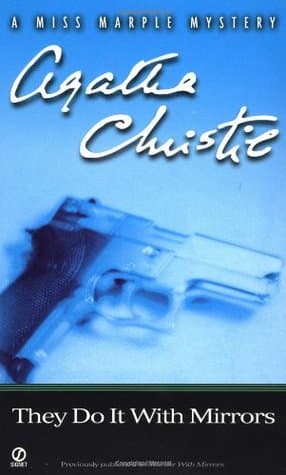
Synopsis
Covers the whole plot, including the ending.
- Difficulty
- Medium
- Pacing
- Moderate
- Mood
- Intriguing, Suspenseful, Classic, Intellectual
- Read it if
- You enjoy classic Golden Age mysteries with intricate plots, a cozy setting, and a clever detective who solves the crime through observation and psychological insight.
- Skip it if
- You prefer fast-paced thrillers, graphic violence, or a modern, gritty detective style.
They Do It with Mirrors Plot Summary
Covers the whole plot, including the ending.
Carrie Louise's Concern and Miss Marple's Visit
Miss Marple receives a letter from her old school friend, Ruth Van Rydock, expressing concern for their mutual friend, Carrie Louise Serrocold. Ruth fears that Carrie Louise, now married to Lewis Serrocold, is in danger at Stonygates, their sprawling Victorian mansion that also is a progressive reformatory for juvenile delinquents. Concerned, Miss Marple agrees to visit Stonygates. Upon her arrival, she finds Carrie Louise to be somewhat frail and dreamy, seemingly oblivious to any potential threats. Her kind and trusting nature makes her vulnerable. Miss Marple observes the unique and chaotic environment of the reformatory, noting the various young men and staff members, all under the benevolent eye of Carrie Louise and the practical guidance of Lewis.
The Shooting and the Simultaneous Murder
The family gathers for dinner, including Carrie Louise's children, Gina and Alex Restarick, and her stepson, Walter Hudd. After dinner, a peculiar incident occurs. Edgar Lawson, one of the young delinquents, stages a dramatic scene where he pretends to shoot Lewis Serrocold with a revolver, seemingly in a fit of delusion. The lights flicker, a shot is fired, and everyone is startled but Lewis is unharmed. Simultaneously, in a locked study on the floor below, Mr. Gilbrandsen, a trustee of the reformatory and a solicitor who was visiting to discuss Carrie Louise's will, is found shot dead. The two events, seemingly separate but occurring at the exact same moment, baffle everyone, especially the local police, Inspector Slack.
Initial Investigation and Conflicting Accounts
Inspector Slack, a gruff but astute detective, arrives to investigate the murder. Gilbrandsen was found in a locked room, with the key on the inside, which creates a classic 'locked room mystery.' Edgar Lawson, who fired the shot at Lewis, is found in a dazed state, claiming to have seen a vision of Lewis being threatened. His gun is examined, and it is clear it was not the weapon that killed Gilbrandsen. The family members and staff provide their accounts, but many details are contradictory or incomplete. Miss Marple, with her observational skills, begins to notice subtle discrepancies and tensions within the household, sensing that the theatrical shooting incident was a deliberate distraction for the real crime.
The Family Dynamics and Financial Motives
As the investigation progresses, Miss Marple pays close attention to the various family members and their relationships with Carrie Louise and Gilbrandsen. Walter Hudd, Carrie Louise's stepson, has a history of financial troubles and a strained relationship with Gilbrandsen, who managed Carrie Louise's substantial fortune. Gina, Carrie Louise's adopted daughter, and her husband, Alex Restarick, also seem to have their own secrets and motivations. Alex, in particular, appears shifty. Miss Marple considers the possibility that Gilbrandsen's visit, specifically concerning Carrie Louise's will, could have provided a strong motive for murder, as his death would prevent any changes to the will that might disadvantage certain beneficiaries.
Gina's Past and the Impersonation
Further details emerge about Gina's past. She was adopted by Carrie Louise after being orphaned in America and had a difficult childhood. Miss Marple learns that Gina had a close friend named Gina Hudd, and the two girls were very similar in appearance. This detail sparks a suspicion in Miss Marple's mind: what if the 'Gina' currently at Stonygates is not the real Gina Restarick, but her friend impersonating her? This theory would explain certain inconsistencies in her behavior and knowledge of the family's past. It would introduce a new layer of motive and opportunity for the murder, potentially linked to inheriting Carrie Louise's fortune under false pretenses.
The Second Murder and Alex's Death
The mystery deepens with a second murder. Alex Restarick, Gina's husband, is found dead, having been bludgeoned. This murder complicates the investigation significantly. The police initially suspect 'Gina' due to her increasingly erratic behavior and the fact that Alex was her husband. The motive appears to be to silence Alex, who might have known about the impersonation or other secrets. Miss Marple, however, sees this as another piece of a larger, intricate puzzle, carefully orchestrated by a cunning killer. She realizes that the murderer is attempting to divert suspicion and create confusion, possibly by framing the most obvious suspect.
Miss Marple's Realization: The Mirror Trick
Miss Marple has an epiphany, triggered by a conversation about magic tricks and illusions, specifically a stage trick involving mirrors. She remembers a parlor trick where mirrors are used to create the illusion of a wall or a person being in one place when they are actually in another. She realizes that the 'staged' shooting of Lewis Serrocold and the simultaneous murder of Gilbrandsen were not coincidental but meticulously planned using this very principle. The apparent 'locked room' was an illusion, and the shooter was not Edgar Lawson in the main hall, but someone else positioned to commit the actual murder in the study below, using the 'shooting' as a distraction.
Unmasking the Impersonator and the Motive
Miss Marple confronts 'Gina' with her suspicions, revealing that she knows 'Gina' is actually Gina Hudd, the original Gina Restarick's friend, who assumed her identity to claim Carrie Louise's inheritance. The real Gina Restarick had died years ago, and Gina Hudd, seeing an opportunity, took her place. Gilbrandsen, as Carrie Louise's solicitor, was on the verge of uncovering the truth during his visit to discuss the will, making him a dangerous witness who needed to be silenced. Alex Restarick was also murdered because he either knew the truth about the impersonation or was getting too close to discovering it, and was therefore a liability to Gina Hudd's scheme.
The True Killer and the Master Plan
In a revelation, Miss Marple exposes Lewis Serrocold, Carrie Louise's husband, as the true mastermind behind the murders. He had orchestrated the entire elaborate plot, using Gina Hudd as his unwitting, or perhaps willing, accomplice. Lewis, a brilliant but cold and manipulative man, had been using the reformatory as a front for his own plans. He had secretly administered drugs to Carrie Louise to make her appear more frail and confused, hoping to gain control of her fortune. He used the 'mirror trick' with a cleverly placed passage and mirrors to create the illusion of the shooting, while he himself was the one who shot Gilbrandsen from a hidden vantage point. He then murdered Alex to cover his tracks and frame Gina Hudd.
Justice and Resolution
Miss Marple meticulously explains how Lewis had constructed a hidden passage behind the mirror in the great hall, allowing him to move between the hall and the study undetected. When Edgar Lawson fired his blank, Lewis simultaneously shot Gilbrandsen from the passage, making it appear as if the two events were separate and coincidental. He then murdered Alex to eliminate another witness and further muddy the waters. With Miss Marple's insights, Inspector Slack is able to piece together the evidence and apprehend Lewis Serrocold. Carrie Louise, though heartbroken by her husband's betrayal, is finally safe, and the truth about the murders and the impersonation comes to light, restoring order to the chaotic household of Stonygates.
Principal Figures
Miss Marple
Protagonist
Elderly amateur detective, observing human nature at its core
An elderly, astute spinster from the village of St. Mary Mead, Miss Marple possesses an unparalleled understanding of human nature and a keen eye for detail. She visits her old friend Carrie Louise at Stonygates and becomes embroiled in the murder mystery. Her seemingly innocent, gentle demeanor belies a sharp intellect and a remarkable ability to connect seemingly disparate events and motives. She often draws parallels between the crimes she encounters and everyday village occurrences, which helps her unravel complex plots. She is driven by a strong sense of justice and a desire to protect her friends.
Relationships: Carrie Louise Serrocold (Old school friend); Ruth Van Rydock (Old school friend, who requests Miss Marple's help); Inspector Slack (Investigating officer, initially dismissive but eventually reliant on her insight)
Carrie Louise Serrocold
Supporting
Miss Marple's old friend, wealthy and benevolent but naive
Carrie Louise is a wealthy, kind-hearted, and somewhat dreamy woman who owns Stonygates. She is married to Lewis Serrocold and runs the estate as a progressive reformatory. Despite her immense wealth and position, she possesses a childlike innocence and trust, often oblivious to the darker undercurrents around her. She genuinely believes in the good in people, making her vulnerable to manipulation. Her will and her fortune are central to the murder plot, and her well-being is the primary concern for Ruth and Miss Marple.
Relationships: Miss Marple (Old school friend); Lewis Serrocold (Husband and primary antagonist); Gina Restarick (Adopted daughter (or rather, the person impersonating her)); Walter Hudd (Stepson)
Lewis Serrocold
Antagonist
Carrie Louise's intellectual husband and the mastermind behind the murders
Lewis Serrocold is Carrie Louise's second husband, a brilliant and seemingly benevolent intellectual who runs the reformatory at Stonygates. He projects an image of a progressive thinker dedicated to rehabilitation. However, beneath this facade lies a cold, calculating, and manipulative individual. He is the true antagonist, orchestrating the murders of Gilbrandsen and Alex to gain control of Carrie Louise's fortune and cover his tracks. His intelligence is used for nefarious purposes, creating an elaborate and seemingly impossible crime.
Relationships: Carrie Louise Serrocold (Wife and victim of his manipulation); Gina Hudd (impersonating Gina Restarick) (Accomplice/pawn); Mr. Gilbrandsen (Murder victim)
Gina Restarick (Gina Hudd)
Supporting
Carrie Louise's adopted daughter, later revealed as an impersonator
Initially presented as Gina Restarick, Carrie Louise's adopted daughter from America, she is later revealed to be Gina Hudd, a childhood friend who assumed Gina Restarick's identity after the real Gina's death. She is beautiful, somewhat volatile, and has a strained relationship with her husband, Alex. Her impersonation is a key element of the plot, providing a motive for murder as she stands to inherit Carrie Louise's wealth. She is either a willing accomplice or a manipulated pawn in Lewis Serrocold's larger scheme, creating confusion and misdirection.
Relationships: Carrie Louise Serrocold (Adoptive mother (under false pretenses)); Alex Restarick (Husband, later murdered); Lewis Serrocold (Co-conspirator or manipulator)
Alex Restarick
Supporting
Gina's husband, who becomes a second murder victim
Alex is Gina's husband, described as somewhat shifty and not entirely trustworthy. He is aware of certain family secrets or becomes too close to uncovering the truth about Gina's identity or Lewis's schemes. His murder further complicates the investigation and serves as a means for the killer to eliminate a potential witness and further obscure the motive behind Gilbrandsen's death. His death initially points suspicion towards Gina, serving as a clever misdirection.
Relationships: Gina Restarick (Gina Hudd) (Wife); Lewis Serrocold (His murderer)
Mr. Gilbrandsen
Supporting
Trustee and solicitor, the first murder victim
Mr. Gilbrandsen is a solicitor and a trustee of the Stonygates reformatory. He visits Carrie Louise to discuss her will and financial affairs, which puts him in a dangerous position. He is the first murder victim, shot simultaneously with the staged 'shooting' of Lewis Serrocold. His knowledge of Carrie Louise's finances and his potential to uncover the impersonation or other financial schemes make him a critical threat to the killer's plans, thus sealing his fate.
Relationships: Carrie Louise Serrocold (Client and friend); Lewis Serrocold (His murderer)
Inspector Slack
Supporting
Gruff but capable local police inspector
Inspector Slack is the lead police investigator on the case. He is portrayed as a somewhat gruff and cynical character, initially dismissive of Miss Marple's 'old lady' observations. However, he is a diligent and capable policeman who eventually recognizes Miss Marple's keen intellect and relies on her unique insights to solve the seemingly impossible crime. He represents the official arm of justice, working to gather evidence and piece together the facts.
Relationships: Miss Marple (Reluctant collaborator); Lewis Serrocold (The murderer he eventually apprehends)
Walter Hudd
Supporting
Carrie Louise's stepson with financial troubles
Walter Hudd is Carrie Louise's stepson, a man with a history of financial difficulties and a somewhat unsavory reputation. He has a strained relationship with Gilbrandsen, who managed Carrie Louise's money. His financial situation makes him an initial suspect, as he would benefit from Carrie Louise's death and any changes to her will. However, he ultimately plays a secondary role, serving as a red herring for the true killer.
Relationships: Carrie Louise Serrocold (Stepmother); Mr. Gilbrandsen (Antagonistic relationship due to finances)
Edgar Lawson
Mentioned
Delinquent at Stonygates, involved in the staged shooting
Edgar Lawson is one of the young delinquents at Stonygates. He is mentally unstable and prone to dramatic outbursts. He is the one who stages the 'shooting' of Lewis Serrocold, believing he is acting out a vision. His role is crucial in creating the distraction that allows the actual murder of Gilbrandsen to occur simultaneously, making him an unwitting pawn in the killer's elaborate scheme. He is genuinely confused and believes himself to be the shooter, further adding to the initial misdirection.
Relationships: Lewis Serrocold (Unwittingly used by him); Carrie Louise Serrocold (Under her care at the reformatory)
Ruth Van Rydock
Supporting
Miss Marple's old friend who initiates the investigation
Ruth Van Rydock is another old school friend of Miss Marple and Carrie Louise. She is a worldly and perceptive woman who senses that Carrie Louise is in danger at Stonygates. It is Ruth who writes to Miss Marple, urging her to visit Carrie Louise and investigate, thereby setting the entire plot in motion. Her concern and insight provide the initial impetus for Miss Marple's involvement, acting as a catalyst for the investigation.
Relationships: Miss Marple (Old school friend); Carrie Louise Serrocold (Old school friend)
Themes & Insights
Appearance vs. Reality
This theme is central to the entire narrative, epitomized by the title 'They Do It with Mirrors'. The apparent shooting of Lewis Serrocold, the locked room mystery, and Gina's identity are all illusions designed to mislead. Miss Marple constantly looks beyond the surface, questioning what she sees and hears. For instance, the reformatory itself appears benevolent but hides dark secrets, and Lewis Serrocold projects an image of a kind intellectual while being a ruthless murderer. The book challenges the reader to discern truth from deception, showing how easily appearances can be manipulated.
“One often sees what one expects to see. It’s a very common human failing.”
Manipulation and Deception
The plot is a masterclass in manipulation, primarily orchestrated by Lewis Serrocold. He manipulates Edgar Lawson into performing the 'staged' shooting, uses Gina Hudd's impersonation for his own gain, and even subtly drugs Carrie Louise to make her appear more confused. The entire murder scheme relies on elaborate deception, creating a complex web of lies and misdirection to conceal the true killer and his motives. Miss Marple's task is to untangle these layers of manipulation to expose the underlying truth.
“It’s a very clever trick, you know, to make people look one way when you want them to look another.”
Identity and Impersonation
The theme of identity is explored through the character of 'Gina'. The revelation that she is not the real Gina Restarick, but Gina Hudd impersonating her, is a crucial plot twist. This deception raises questions about who we truly are and how easily one's identity can be assumed or lost. The motive for this impersonation—inheritance—shows the fragility and value placed on identity. Miss Marple's ability to discern the 'true' Gina from the imposter is key to unlocking the larger mystery, demonstrating how a false identity can be a powerful tool for crime.
“People are not always what they seem, even to those who think they know them best.”
Justice and Morality
As with most Christie novels, the pursuit of justice is a core theme. Miss Marple is driven by a strong moral compass to ensure that the killer is brought to account, not just for the sake of the law, but for the inherent wrongness of the acts committed. The moral decay of Lewis Serrocold, who uses his intelligence for evil and preys on his trusting wife, contrasts with Miss Marple's unwavering commitment to truth and fairness. The novel ultimately affirms that even the most elaborate schemes cannot escape the reach of justice.
“Evil is not something that happens in a vacuum. It grows out of human hearts.”
The Nature of Evil
The book explores the nature of evil, portraying it not as a monstrous, obvious force, but as something insidious and calculating, often hidden behind a respectable facade. Lewis Serrocold embodies this, presenting himself as a benevolent intellectual while harboring a cold, manipulative heart. The reformatory setting, meant to rehabilitate delinquents, ironically becomes the stage for a sophisticated murder orchestrated by one of its most respected figures. This shows how evil can reside in unexpected places and among seemingly good people, making it all the more terrifying and difficult to detect.
“There are some people, you know, who are quite mad, but they're not mad in the way you expect.”
Plot Devices & Literary Techniques
The Locked Room Mystery
A classic impossible crime scenario where a victim is found in a sealed room.
The murder of Mr. Gilbrandsen occurs in a seemingly locked study, with the key on the inside, presenting a classic 'locked room' puzzle. This device heightens the mystery and makes the crime appear impossible, challenging both the police and the reader. Miss Marple's solution, involving a hidden passage and mirrors, ultimately reveals that the room was not as 'locked' as it appeared, subverting the traditional expectations of this device and revealing the killer's ingenious method of deception.
The Mirror Trick (Illusion)
A literal and metaphorical device used to create misdirection and conceal the truth.
The 'mirror trick' is both a literal and metaphorical plot device. Literally, it refers to the hidden passage and mirrors used by Lewis Serrocold to create the illusion of the shooting in the great hall while simultaneously committing the murder in the study. Metaphorically, it represents the entire web of deception and misdirection employed by the killer. The title itself, 'They Do It with Mirrors', explicitly points to this device, signifying how appearances are manipulated to hide reality. Miss Marple's understanding of this illusion is the key to solving the impossible crime.
The Red Herring (Edgar Lawson's Shooting)
A deliberate distraction to divert suspicion from the true crime.
Edgar Lawson's staged shooting of Lewis Serrocold serves as a significant red herring. This dramatic, seemingly unhinged act is designed to draw all attention and suspicion away from the actual murder occurring simultaneously in another room. The chaotic nature of the incident, combined with Edgar's mental state, makes it a highly effective distraction. It misleads the police and the family into believing the events are either coincidental or that Edgar is responsible for some form of violence, thereby masking the carefully planned, cold-blooded murder of Gilbrandsen.
Impersonation
A character assuming another's identity to gain an advantage.
The impersonation of the real Gina Restarick by her friend Gina Hudd is a crucial plot device that introduces a significant motive for murder—inheritance. This deception complicates the family dynamics and provides a strong reason for Gilbrandsen, who was dealing with the will, to be silenced. It also allows the killer to use the 'imposter' as a pawn or a convenient scapegoat. The revelation of the impersonation is a major turning point, shifting the focus of the investigation and providing Miss Marple with a clearer understanding of the underlying motives and the intricate connections between the crimes.
They Do It with Mirrors Quotes
“The young are so often impatient of the slow workings of justice.”
“It's always the quiet ones, isn't it? The ones you'd least suspect.”
“Mirrors, you know, can be very deceptive. They show you what you expect to see, or what someone wants you to see.”
“People always like to think the worst. It saves them the trouble of thinking at all.”
“There are some things that even the cleverest murderer can't hide forever.”
“One often finds that the most ordinary things are used in the most extraordinary ways.”
“Memory is a queer thing. Sometimes it plays tricks on you, sometimes it brings things back you never thought you'd remember.”
“The past has a way of catching up with one, doesn't it?”
“It is not the facts themselves that are misleading, but the way we interpret them.”
“Evil, you see, is a very simple thing. It's goodness that's complicated.”
“One must always look beyond the obvious, my dear. That is where the truth usually lies.”
“There are more ways of killing a cat than choking it with cream.”
“It's astonishing how little people really see, even when they're looking straight at it.”
Quiz
10 questions on the plot and the characters. Each answer comes with a short explanation.
Question 1
What type of institution does the Victorian mansion serve as in the story?
- An elderly care home
- A finishing school for young ladies
- A rehabilitation centre for delinquents
- A private hospital for nervous disorders
Show answer
C. A rehabilitation centre for delinquents The book explicitly states that the Victorian mansion doubles as a rehabilitation centre for delinquents, where Miss Marple's friend lives.
Question 2
Who is the administrator of the institution at whom a youth initially fires a revolver?
- Mr. Gilbrandsen
- Lewis Serrocold
- Miss Marple's friend
- The youth himself
Show answer
B. Lewis Serrocold The synopsis clearly states that a youth fires a revolver at the administrator, Lewis Serrocold, though neither he nor the youth are injured in that initial incident.
Question 3
Who is the mysterious visitor who is shot dead simultaneously in another part of the building?
- Lewis Serrocold
- Miss Marple's friend
- Mr. Gilbrandsen
- One of the delinquents
Show answer
C. Mr. Gilbrandsen While Lewis Serrocold is the initial target, it is Mr. Gilbrandsen, a mysterious visitor, who is shot dead in a separate but simultaneous incident.
Question 4
What prompts Miss Marple to visit the Victorian mansion in the first place?
- She is invited to inspect the facility by the police.
- She is visiting a friend who lives there.
- She is conducting research for a book on juvenile delinquency.
- She is seeking rehabilitation for a troubled relative.
Show answer
B. She is visiting a friend who lives there. The description states that Miss Marple senses danger when she visits a friend living in the Victorian mansion, indicating her visit is personal.
Question 5
What is Miss Marple's initial reaction to the simultaneous shooting of Mr. Gilbrandsen and the attempt on Lewis Serrocold?
- She believes it is a tragic but pure coincidence.
- She immediately suspects the delinquent youth of both crimes.
- She thinks it is not pure coincidence and vows to investigate.
- She is too frightened to get involved and leaves the premises.
Show answer
C. She thinks it is not pure coincidence and vows to investigate. The text explicitly states: 'Pure coincidence? Miss Marple thinks not, and vows to discover the real reason for Mr Gilbrandsen’s visit.'
Question 6
What is the primary motivation for Miss Marple's investigation into Mr. Gilbrandsen's death?
- To clear the name of the delinquent youth who fired the first shot.
- To ensure the safety of her friend living at the institution.
- To understand the true reason for Mr. Gilbrandsen's presence at the mansion.
- To expose corruption within the juvenile justice system.
Show answer
C. To understand the true reason for Mr. Gilbrandsen's presence at the mansion. Miss Marple's primary goal, as stated, is to 'discover the real reason for Mr Gilbrandsen’s visit,' implying she believes his death is directly linked to his presence.
Question 7
What kind of weapon is used in the initial shooting incident involving Lewis Serrocold?
- A knife
- A revolver
- A shotgun
- A blunt object
Show answer
B. A revolver The synopsis explicitly mentions, 'a youth fires a revolver at the administrator, Lewis Serrocold.'
Question 8
The title 'They Do It with Mirrors' likely hints at which recurring theme or device in the mystery?
- The use of literal mirrors to create optical illusions or misdirection.
- The reflection of past crimes in present events.
- Characters literally seeing their own reflections in others.
- A metaphor for self-reflection and personal growth among the delinquents.
Show answer
A. The use of literal mirrors to create optical illusions or misdirection. Agatha Christie often uses titles that are literal or metaphorical clues. 'They Do It with Mirrors' strongly suggests the use of misdirection, illusion, or trickery, often involving literal mirrors in the context of a mystery.
Question 9
Why is the simultaneous nature of the two shooting incidents particularly suspicious to Miss Marple?
- It suggests a coordinated effort rather than two isolated events.
- The weapons used were identical, which is highly unlikely.
- Both victims were in the same room, yet one survived and one didn't.
- It implies a supernatural element, which she finds unsettling.
Show answer
A. It suggests a coordinated effort rather than two isolated events. Miss Marple's rejection of 'pure coincidence' for simultaneous events implies she suspects a deeper connection, likely a planned or coordinated act of murder and attempted murder.
Question 10
What role does Miss Marple's 'senses danger' play in the unfolding of the plot?
- It leads her to immediately call the police before any crime occurs.
- It is a premonition that is proven false, adding to the mystery.
- It establishes her as an astute observer whose instincts are usually correct, setting up her investigation.
- It causes her to become a victim herself later in the story.
Show answer
C. It establishes her as an astute observer whose instincts are usually correct, setting up her investigation. Miss Marple's intuition, 'senses danger,' is a classic trait of her character. It highlights her observational skills and sets the stage for her to become actively involved in solving the mystery, as her fears are indeed 'confirmed' by the murder.
They Do It with Mirrors FAQ
What is 'They Do It with Mirrors' about?
'They Do It with Mirrors' by Agatha Christie follows Miss Marple as she visits her old friend Ruth Van Rydock, who expresses concern for her sister Carrie Louise Serrocold. Carrie Louise lives in a grand Victorian mansion that has been converted into Stonygates, a rehabilitation center for juvenile delinquents. Miss Marple's visit takes a dark turn when a man, Mr. Gilbrandsen, is murdered during what initially appears to be a separate incident involving a delinquent shooting at Carrie Louise's husband, Lewis Serrocold.
Why should I read 'They Do It with Mirrors'?
You should read 'They Do It with Mirrors' for its clever misdirection, intricate plotting, and classic Christie atmosphere. It features a unique setting—a reform home within a stately manor—and explores themes of appearance versus reality, making it a compelling read for fans of Golden Age detective fiction and those who enjoy psychological depth in their mysteries. Miss Marple's astute observations and ability to see beyond the obvious make for a satisfying investigative journey.
What is the background/setting of 'They Do It with Mirrors'?
The story is primarily set at Stonygates, a large, somewhat dilapidated Victorian mansion that belongs to Carrie Louise Serrocold. This mansion also functions as a progressive rehabilitation center for young male delinquents, run by Carrie Louise's husband, Lewis Serrocold. The contrast between the grand, old-world elegance of the house and the modern, experimental nature of the reformatory creates a unique and slightly unsettling backdrop for the murder.
What writing style does the author use?
Agatha Christie employs her signature clear, concise, and engaging writing style in 'They Do It with Mirrors.' She uses a third-person narrative, often filtered through Miss Marple's perspective, allowing readers to follow her thought process. The prose is direct, focusing on dialogue and plot progression, with subtle clues woven into seemingly innocuous details, leading to a satisfyingly logical, if often surprising, reveal.
What minor details add significant meaning?
The seemingly trivial detail of the stage props and the dramatic society within Stonygates is crucial. It initially appears to be part of the reform program, but it subtly introduces the concept of illusion and performance, directly mirroring the murder's methodology. Also, the casual mention of the different types of windows and doors throughout the old house becomes vital in understanding how the 'mirror trick' was physically executed.
What are some subtle foreshadowing moments?
Early on, there are discussions about Carrie Louise's failing memory and her tendency to confuse events, which subtly foreshadows how easily she might be manipulated or how an event might be staged to appear different than it was. The constant emphasis on the 'theatrical' aspect of the reform school, with its plays and costumes, also hints at the elaborate staging of the murder itself, where appearances are deceiving.
What unexpected character connections exist?
One of the most unexpected connections is the true relationship between Lewis Serrocold and Carrie Louise. It's revealed that Lewis isn't just her husband but also her former lover and a man who has been deeply involved in her life for decades, far more than initially presented. The connection between Edgar Lawson, the 'delinquent' who shoots at Lewis, and the Serrocolds is also unexpectedly deep, with Lawson having a profound, albeit misguided, sense of loyalty to Carrie Louise.
What are unspoken character motivations?
Carrie Louise's unspoken motivation is her deep-seated love and protectiveness towards her family, particularly her desire to shield her husband Lewis. This makes her vulnerable to manipulation and willing to participate in a deception to protect him. Lewis Serrocold's unspoken motivation is a desperate, calculated attempt to prevent exposure and protect the fortune he stands to inherit, leading him to orchestrate the murder and subsequent cover-up.
What psychological complexities do characters exhibit?
Lewis Serrocold exhibits a complex blend of intellectual brilliance and profound amorality, capable of orchestrating an elaborate murder while maintaining a facade of philanthropy. Carrie Louise displays a poignant complexity, grappling with memory loss and a deep-seated loyalty that makes her susceptible to manipulation, blurring the lines between victim and unwitting accomplice. Edgar Lawson shows a disturbed, yet passionate, loyalty that borders on delusion, interpreting events through a distorted lens of protection.
What are the major emotional turning points?
A major emotional turning point is when Miss Marple realizes the 'shooting' incident involving Edgar Lawson and Lewis Serrocold was not an isolated event, but intricately connected to Mr. Gilbrandsen's murder, shifting her focus from a simple delinquent act to a complex, premeditated crime. Another turning point is the revelation of Carrie Louise's involvement in the deception, which adds a layer of tragic loyalty and sacrifice to the narrative.
How do relationship dynamics evolve?
The relationship dynamics between Carrie Louise and Lewis Serrocold evolve from seemingly a gentle, devoted, elderly couple to one built on a deep, long-standing secret and a tragic act of mutual protection. The initial perception of Edgar Lawson as merely a troubled delinquent shifts to reveal his intense, almost filial, devotion to Carrie Louise, driven by a past connection and a desire to protect her, albeit misguidedly.
Which parts remain ambiguous or open-ended?
While the core mystery is solved, the full extent of the emotional toll on the surviving family members, particularly Gina and Wally, is left somewhat open-ended. The long-term implications of Carrie Louise's participation in the cover-up and her mental state at the very end also leave a lingering sense of ambiguity regarding her future and her ability to fully reconcile with the truth.
What are controversial scenes or decisions?
One controversial decision is Carrie Louise's active participation in the elaborate deception to protect Lewis Serrocold. Her willingness to stage her own 'memory lapse' and corroborate a false narrative, even after knowing the truth of the murder, raises ethical questions about her complicity and the limits of loyalty. The lenient handling of Edgar Lawson, despite his dangerous actions, could also be seen as controversial.
'They Do It with Mirrors' ending explained: how it ends & what it means
The ending reveals that Lewis Serrocold murdered Mr. Gilbrandsen because Gilbrandsen knew Lewis was not the real Lewis Serrocold, but rather Christian Gulbrandsen, a man who had faked his own death years ago to escape a past crime and marry Carrie Louise. The 'shooting' by Edgar Lawson was a cleverly staged diversion, using mirrors and a dummy, to provide an alibi. Carrie Louise, realizing the truth, agrees to participate in a final deception to protect Lewis from the gallows, allowing him to die peacefully after taking a lethal dose of medicine, making it appear as a natural death. The ending signifies the ultimate power of love and loyalty, even in the face of grave crimes, and highlights how appearances can be masterfully manipulated.
About the author

Dame Agatha Mary Clarissa Christie, Lady Mallowan, was an English writer known for her 66 detective novels and 14 short story collections, particularly those revolving around fictional detectives Hercule Poirot and Miss Marple. She also wrote the world's longest-running play, the murder mystery The Mousetrap, which has been performed in the West End since 1952. A writer during the "Golden Age of Detective Fiction", Christie has been called the "Queen of Crime". She also wrote six novels under the pseudonym Mary Westmacott. In 1971, she was made a Dame (DBE) by Queen Elizabeth II for her contributions to literature. Guinness World Records lists Christie as the best-selling fiction writer of all time, her novels having sold more than two billion copies.
Similar books
- Sad Cypress
Agatha Christie
3.9 (25k) average on GoodreadsThrillerFeatures a complex inheritance plot and a focus on psychological motives within a confined setting.
- And Then There Were None
Agatha Christie
4.3 (822k) average on GoodreadsThrillerWhile 'Mirrors' features a larger, more open setting and a broader pool of suspects, 'And Then There Were None' utilizes extreme isolation and a decreasing number of characters to generate intense psychological tension and a more focused, inescapable sense of dread. The deception in 'Mirrors' is about what you see, whereas in 'And Then There Were None,' it's about who is and isn't present.
- THE MURDER OF ROGER ACKROYD
Agatha Christie
4.2 (153k) average on GoodreadsThriller'Ackroyd' is celebrated for its groundbreaking narrative twist that challenges the very structure of the detective novel, playing with the reader's trust in the narrator. 'Mirrors' employs a more traditional form of misdirection through plot and character manipulation, rather than a meta-narrative trick, making its deception clever but less revolutionary in its execution.
- Angels & Demons
Dan Brown
3.9 (2.7M) average on GoodreadsThrillerA Harvard symbologist races through Rome's ancient sites, deciphering cryptic clues to unmask the Illuminati and stop a vengeful plot to destroy the Vatican with a stolen antimatter weapon.
- Gone Girl
Gillian Flynn
4.1 (2.3M) average on GoodreadsThrillerA wife's sudden disappearance on her fifth anniversary reveals a web of lies and psychological warfare, exposing the secrets within a seemingly perfect marriage.
- The Girl on the Train
Paula Hawkins
3.9 (2.1M) average on GoodreadsThrillerA woman’s fascination with a seemingly perfect couple she watches from her daily train commute leads her into a dark investigation when she witnesses something that shatters their idyllic image.





Enjoyed the summary?
A summary gives you the shape of the book. The book itself has the detail, the examples and the voice.
Find They Do It with Mirrors on AmazonAs an Amazon Associate, BookBrief earns from qualifying purchases. How we're funded