
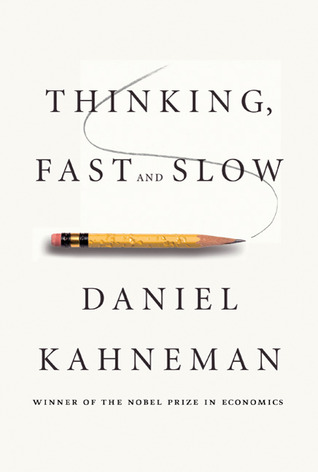
"Thinking, Fast and Slow" Quiz

"Thinking, Fast and Slow" explores the dual systems of thought that drive our decisions: the fast, intuitive, and emotional system and the slow, deliberate, and analytical system.
nonfiction | 499 pages | Published in 2011
Play the quiz
Test your knowledge about the book "Thinking, Fast and Slow". We have come up with 15 quiz questions for the book. Hit play and start testing your knowledge. Each correctly answered question gives one point.
15 questions available
Essay questions
These essay questions are meant to be used as a starting point for your essay or research paper.
- Discuss how Daniel Kahneman's concept of 'System 1' and 'System 2' thinking affects decision-making in everyday life.
- Analyze the role of cognitive biases as described in 'Thinking, Fast and Slow' and their impact on human judgment.
- Examine the implications of the 'anchoring effect' as presented by Kahneman. How does this cognitive bias manifest in real-world scenarios?
- How does Daniel Kahneman differentiate between the 'experiencing self' and the 'remembering self'? Discuss the implications of this distinction.
- Evaluate the significance of the 'loss aversion' concept in Kahneman's work. How does it influence economic and personal decision-making?
- Discuss the concept of 'availability heuristic' and its influence on people's perception of frequency and probability of events.
- Analyze the impact of the 'halo effect' in various fields such as business, education, and social interactions as explained by Kahneman.
- What are the potential drawbacks of relying too heavily on System 1 thinking in professional environments?
- Discuss the concept of 'WYSIATI' (What You See Is All There Is) and its limitations in rational decision-making.
- Explore how Kahneman's theories in 'Thinking, Fast and Slow' can be applied to improve decision-making in policy-making and governance.
- Examine the relationship between intuition and expertise as discussed by Kahneman. Under what conditions can intuitive judgments be trusted?
- How does Kahneman's exploration of the 'planning fallacy' reveal common errors in project management and personal goal setting?
- Discuss how 'Thinking, Fast and Slow' challenges traditional economic theories by integrating psychological insights into human behavior.


