
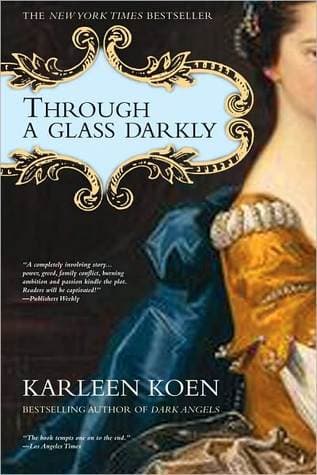
Synopsis
Covers the whole plot, including the ending.
- Difficulty
- Medium
- Pacing
- Moderate
- Mood
- Opulent, Romantic, Intriguing, Dramatic, Suspenseful
- Read it if
- You love sweeping, opulent historical fiction with intricate family drama, romance, and political intrigue set in 18th-century France.
- Skip it if
- You prefer fast-paced plots with minimal courtly politeness or find extensive descriptions of historical settings tedious.
Through a Glass Darkly Plot Summary
Covers the whole plot, including the ending.
A Childhood Betrothal and a Mother's Cruelty
The story begins with Barbara Alderley as a young girl, living under her cruel mother, Diana. Barbara's only comfort is her affection for her cousin, Roger Montgeoffry, the Earl of Devane, to whom she was betrothed in childhood by their powerful grandmother, the Dowager Countess. Despite the betrothal, Diana constantly belittles Barbara, comparing her to Roger's more worldly female relatives and friends. Barbara often observes the sophisticated, scandalous lives of the adults around her, especially the social interactions at Alderley, their estate, and with the French court. This early period shows Barbara's desire for love and acceptance in an emotionally cold environment, hinting at the challenges she will face in her marriage and family.
The Marriage and Arrival at Devane
Barbara and Roger marry, fulfilling the family agreement. Barbara, in love with Roger, arrives at Devane, the Montgeoffry family estate, with hope and nervousness. She soon realizes that her husband, while charming and attentive, is distant and often preoccupied. Roger often leaves her alone, pursuing his own interests and spending time with his friends, including the mysterious Julian. Barbara struggles to find her place in the grand, intimidating household and the social circles of the French aristocracy. Her attempts to connect with Roger are met with politeness but no true intimacy, leaving her isolated and confused about their relationship and his feelings.
Whispers and Suspicions
As Barbara settles into her new life, she starts to notice Roger's odd behaviors and hears veiled comments from others, especially Julian. There are whispers of a 'curse' or 'secret' connected to the Montgeoffry family, and to Roger. Julian, often present and seemingly protective, occasionally makes remarks hinting at a dark past or a hidden burden Roger carries. Barbara's initial questions about these secrets are met with evasion or dismissal by Roger, increasing her suspicions and worries. She feels a growing unease, realizing a significant part of her husband's life and identity is hidden from her, creating a gap between them.
The Dowager's Influence and Family Dynamics
The Dowager Countess, Roger's grandmother and Barbara's own, has great influence over the family. She is intelligent and strong-willed, arranging marriages and managing the family's reputation and wealth. While she seems to support Barbara, her motives are often unclear, and she uses subtle manipulation to get what she wants. Barbara finds herself caught in family loyalties and rivalries, especially with her mother, Diana, who continues to undermine her, and with other relatives who view her with suspicion or disdain. The Dowager's presence is constant, reminding Barbara of the expectations and secrets that bind the Montgeoffry line.
The French Court and Political Intrigue
Barbara accompanies Roger to the French court, a dazzling but dangerous place of elaborate balls, political maneuvering, and scandalous affairs. She observes the intricate dance of power and influence, where reputations are made or destroyed instantly. While Roger seems comfortable here, Barbara feels like an outsider, struggling to understand the hidden meanings behind polite smiles and whispered conversations. She sees the excess and loose morals of some courtiers, and the constant threat of political intrigue that could affect her family. This experience expands her understanding of Roger's complex world, but also highlights her own inexperience.
Julian's Confidante and Confessions
As Roger remains emotionally distant, Barbara finds herself drawn to Julian, Roger's close friend. Julian, initially mysterious, gradually opens up to Barbara, becoming her only source of comfort and understanding. He begins to reveal parts of Roger's past, hinting at a traumatic event and a secret that has haunted Roger since childhood. Julian's disclosures, though incomplete, show a man deeply scarred and burdened. He emphasizes Roger's suffering and the weight of family expectations, subtly guiding Barbara toward empathy for her husband, even as he himself has complex feelings for her.
Diana's Machinations and Barbara's Growing Strength
Diana, Barbara's mother, continues her emotional abuse and manipulation, often trying to discredit Barbara in social settings and within the family. She makes cutting remarks about Barbara's lack of sophistication and her inability to win Roger's affection. However, instead of breaking Barbara, Diana's cruelty strengthens her resolve. Barbara, through her experiences at Devane and court, and her growing understanding of Roger's situation, begins to develop a stronger sense of self. She learns to defend herself, subtly at first, then more directly, showing a resilience that surprises even her mother and the Dowager.
The Truth Revealed
The long-held secret about Roger is finally revealed to Barbara. It involves a tragic childhood incident where he accidentally caused his younger brother's death, a secret meticulously covered up by the Dowager Countess and other family members to protect the family name and Roger's inheritance. This revelation explains Roger's deep guilt, emotional distance, and fear of intimacy. Barbara learns that the family created a 'curse' narrative to explain the tragedy, rather than confronting the truth. The weight of this confession profoundly impacts Barbara, changing her perception of her husband from a distant figure to a deeply wounded man needing compassion.
Confrontation and Forgiveness
With the full truth, Barbara confronts Roger. At first, he is defensive and resistant, still trapped by his guilt and decades of silence. However, Barbara's steadfastness, empathy, and willingness to understand, rather than condemn, slowly break through his emotional barriers. She assures him she does not blame him and that his past, though tragic, does not lessen her love. This confrontation is a key moment, leading to a raw, emotional outpouring from Roger. For the first time, he truly opens up to Barbara, sharing his deep pain and fear. This shared vulnerability marks the start of true intimacy and trust between them, building the foundation for a real partnership.
The Dowager's Justification and Acceptance
The Dowager Countess, realizing the secret is out and that Barbara has handled it with grace and strength, finally explains her reasons for the cover-up. She reveals her fierce determination to protect the family's legacy and Roger's future, believing she acted in their best interests. While Barbara doesn't fully agree with her methods, she understands the Dowager's strong motivations. Over time, the Dowager, observing Barbara's positive influence on Roger and her growing maturity, begins to genuinely respect and accept her as a worthy Countess of Devane. This shift in their relationship solidifies Barbara's position within the family and acknowledges her strength.
Julian's Departure and Sacrifice
Julian, a silent observer and subtle helper throughout Barbara's journey, realizes his presence and unspoken feelings for Barbara could complicate her growing relationship with Roger. Having helped Barbara understand Roger and bring them closer, Julian makes a selfless decision to leave Devane. His departure, though sad, is an act of sacrifice, ensuring Roger and Barbara can build their future without the shadow of his complex affections. He leaves a lasting impression on Barbara, who recognizes his loyalty and his own hidden sorrows.
Barbara's Triumph and a New Beginning
With the truth revealed, the secrets exposed, and Roger's emotional walls broken, Barbara fully steps into her role as the Countess of Devane. She and Roger begin to form a true partnership, built on honesty, understanding, and love. Barbara, no longer the naive girl, has matured into a strong, compassionate woman capable of handling the complexities of her family and the French court. She has won her husband's heart and earned the respect of her grandmother, finding her place within the Montgeoffry lineage. The novel ends with Barbara and Roger looking toward a future together, free from the past, embracing their love and shared destiny.
Principal Figures
Barbara Alderley Montgeoffry
Protagonist
A naive young woman who marries into a powerful French family and uncovers dark secrets.
Barbara begins as a somewhat naive and emotionally vulnerable young woman, yearning for love and acceptance from her cruel mother, Diana. She is intelligent, observant, and possesses an innate kindness and empathy. Despite her initial innocence, she is resilient and determined to understand her distant husband, Roger. Her deep capacity for love and forgiveness is her greatest strength, allowing her to break through decades of secrecy and pain within the Montgeoffry family. She values honesty and true connection above social artifice.
Relationships: Roger Montgeoffry (Husband, initially distant and secretive, later loving and vulnerable); Diana Alderley (Cruel and emotionally abusive mother); Dowager Countess Montgeoffry (Formidable grandmother, initially manipulative, later respectful); Julian (Confidante and protector, harbors unrequited feelings)
Roger Montgeoffry, Earl of Devane
Protagonist/Love Interest
Barbara's charming yet emotionally distant husband, haunted by a childhood tragedy.
Roger is initially presented as a charming, handsome, and sophisticated nobleman, but also deeply reserved and emotionally distant from Barbara. He is burdened by immense guilt and trauma from a childhood accident that led to his brother's death, a secret meticulously guarded by his family. This secret has made him fearful of intimacy and unable to fully express his emotions or accept love. He values duty and honor, but his internal suffering prevents him from forming true connections until Barbara's persistent empathy breaks through his defenses.
Relationships: Barbara Alderley Montgeoffry (Wife, initially distant, later deeply loving and confiding); Julian (Lifelong best friend and confidante); Dowager Countess Montgeoffry (Powerful grandmother, protector, and architect of the secret); Diana Alderley (Aunt by marriage, disliked)
Julian
Supporting
Roger's loyal best friend and Barbara's enigmatic confidante, who carries his own secrets.
Julian is a complex and enigmatic character, Roger's closest friend and a fixture in his life. He is intelligent, observant, and possesses a quiet strength. He is privy to Roger's deepest secrets and has long acted as his protector, often at personal cost. Julian develops deep, unspoken feelings for Barbara, but his loyalty to Roger and his understanding of the larger family dynamics prevent him from acting on them. He subtly guides Barbara towards understanding Roger's pain, demonstrating a profound capacity for selfless love and sacrifice.
Relationships: Roger Montgeoffry (Lifelong best friend, confidante, and protector); Barbara Alderley Montgeoffry (Confidante, harbors unspoken affection)
Dowager Countess Montgeoffry
Antagonist/Supporting
The powerful, manipulative matriarch of the Montgeoffry family.
The Dowager Countess is a formidable and intelligent woman, the undisputed matriarch of the Montgeoffry family. She is fiercely protective of her family's name, legacy, and wealth, willing to go to extreme lengths, including orchestrating elaborate cover-ups, to maintain their reputation and ensure Roger's inheritance. She is a master manipulator, pulling strings behind the scenes with a calculating mind. While her methods are often morally ambiguous, her underlying motivation is a deep, if sometimes misguided, love for her family. She slowly comes to respect Barbara's strength.
Relationships: Roger Montgeoffry (Grandson, fiercely protected and manipulated); Barbara Alderley Montgeoffry (Granddaughter-in-law, initially viewed as a pawn, later respected); Diana Alderley (Daughter-in-law, often disapproves of her behavior)
Diana Alderley
Antagonist
Barbara's beautiful, cruel, and self-centered mother.
Diana is Barbara's mother, a woman renowned for her striking beauty but equally infamous for her profound cruelty and self-centeredness. She is emotionally abusive towards Barbara, constantly belittling her and making her feel inadequate. Diana is obsessed with appearances, social standing, and her own pleasure, often engaging in affairs and showing little genuine affection for anyone. Her actions are driven by vanity and a desire for control, and she views Barbara more as a pawn in social games than as a daughter. She represents the superficial and often toxic aspects of the aristocratic society.
Relationships: Barbara Alderley Montgeoffry (Daughter, emotionally abusive mother); Dowager Countess Montgeoffry (Mother-in-law, often at odds with her)
Louis XV
Mentioned
The King of France during the time of the story.
Louis XV is the reigning monarch of France, whose court forms the backdrop for much of the novel's social and political intrigue. He is depicted as a figure of immense power and luxury, but also as increasingly detached from the realities of his kingdom, indulging in lavish pleasures and affairs. His presence, though often indirect, symbolizes the decadence and underlying instability of the era. The Montgeoffry family's standing is closely tied to their favor at his court.
Madame de Pompadour
Mentioned
The powerful chief mistress of Louis XV.
Madame de Pompadour is the influential mistress of King Louis XV, a woman of great political acumen and cultural patronage. She is a key figure at court, wielding significant power and influence over the king and state affairs. Her presence underscores the political machinations and the role of women, even those not born to royalty, in shaping the destiny of France. Characters like the Montgeoffrys often seek her favor to advance their own standing.
Themes & Insights
The Burden of Secrets and Guilt
The novel explores how secrets, especially those born of tragedy and hidden for reputation, can harm individuals and families for generations. Roger's deep guilt over his brother's accidental death, suppressed for decades, makes him emotionally numb and unable to form true intimacy. The Dowager Countess's elaborate cover-up, meant to protect Roger and the family name, instead prolongs his suffering. Barbara's journey is about uncovering this secret, and only by revealing it can healing begin. This theme shows the destructive power of denial and the freedom found in truth, as seen when Roger finally confides in Barbara, breaking his long silence.
“Secrets, like old wounds, festered if not properly tended. And this one was a gaping, poisoned thing.”
Love, Intimacy, and Marriage in the 18th Century
The story examines marriage and love in an era where unions were often strategic, not emotional. Barbara's marriage to Roger is initially a duty-bound arrangement, lacking true intimacy because of Roger's emotional walls. The novel contrasts Barbara's romantic ideals with the cynical realities of the French court, where affairs and political maneuvering often overshadowed genuine affection. Barbara's struggle to earn Roger's love and break through his defenses highlights how rare and precious true connection is. Her persistence ultimately changes their marriage from a formal arrangement into a deep, loving partnership based on understanding and shared vulnerability, contrasting sharply with the superficial relationships around them.
“She had married a man she loved, but it seemed she had not married the man she knew.”
The Power and Manipulation of Family
The Montgeoffry family, especially through the Dowager Countess, shows the immense power and manipulative influence families had in the 18th century. The Dowager's actions, from arranging Barbara and Roger's betrothal to orchestrating the cover-up of Roger's past, are driven by a strong desire to protect the family's lineage, reputation, and wealth. This theme explores how individual lives can be shaped, and sometimes crushed, by family expectations and tradition. Barbara's journey involves navigating this complex web of family loyalties and power dynamics, eventually finding her own strength to challenge and reshape these influences, rather than simply being a pawn within them.
“The Montgeoffrys, she was learning, were like a finely woven tapestry: beautiful, intricate, and capable of hiding many tangled threads.”
Coming of Age and Self-Discovery
Barbara's journey is a classic coming-of-age story. She starts as a sheltered, naive, and emotionally vulnerable young woman, constantly belittled by her mother and unsure of her place. Through her marriage, her experiences at the French court, and her pursuit of the truth about Roger, she transforms. She learns to navigate complex social situations, stand up to cruelty, and develop empathy and resilience. Her self-discovery is tied to her understanding of Roger's past and her growing ability to assert her own voice and values, ending with her becoming a strong and respected Countess.
“She had been a child, dreaming of love. Now she was a woman, fighting for it.”
Appearance vs. Reality
The novel contrasts the glittering, opulent facade of the French aristocracy and the Montgeoffry family with the darker, often painful realities beneath. The charming Roger hides deep trauma; the Dowager Countess's kind exterior conceals her manipulative plans; and the elegant court is full of excess and intrigue. Barbara's initial perceptions are often challenged as she uncovers the truth, forcing her to look 'through a glass darkly' to see the true nature of people and events. This theme emphasizes how appearances can deceive and the importance of seeking deeper understanding beyond the surface.
“The world, she was learning, was rarely as it seemed on the surface; beauty often cloaked a deeper, darker truth.”
Plot Devices & Literary Techniques
The Family Secret
A hidden childhood tragedy that haunts the protagonist and his family.
The central plot device is the Montgeoffry family secret: Roger's accidental killing of his younger brother during childhood. This secret is meticulously concealed by the Dowager Countess and others to protect Roger's inheritance and the family's reputation. It functions as the primary source of Roger's emotional distance and guilt, driving much of the narrative tension. Barbara's quest to uncover this secret propels her character arc and ultimately leads to the emotional breakthrough between her and Roger, serving as the catalyst for their true intimacy and the resolution of the central conflict.
The Manipulative Matriarch
A powerful grandmother who orchestrates events to preserve family legacy.
The Dowager Countess serves as a key plot device through her relentless manipulation and control over the family. Her actions, driven by a deep-seated desire to protect the Montgeoffry name and secure Roger's future, directly influence the betrothal, the concealment of the secret, and the various social maneuvers within the court. She embodies the traditional power structures of the era and acts as both an antagonist and, eventually, a facilitator of Barbara's growth, subtly guiding events while ultimately being forced to acknowledge Barbara's strength and the truth.
The Distant Husband
A husband whose emotional unavailability creates a central conflict for the protagonist.
Roger's initial emotional distance and enigmatic behavior towards Barbara function as a crucial plot device. This unavailability creates a barrier to intimacy, fueling Barbara's confusion, insecurity, and determination to understand him. His reserved nature is a direct consequence of the family secret, and his gradual thawing and eventual vulnerability are directly tied to Barbara's efforts to uncover the truth and offer him unconditional love. This dynamic establishes the central romantic conflict and drives Barbara's investigative and emotional journey throughout the novel.
The French Court as a Microcosm
The opulent yet treacherous French court reflecting broader societal themes.
The French court serves as a vibrant and dangerous backdrop, functioning as a microcosm for the larger themes of appearance versus reality, political intrigue, and moral decay. Its glittering facade hides a world of scandal, manipulation, and superficiality, mirroring the secrets within the Montgeoffry family. Barbara's experiences at court expose her to the harsh realities of aristocratic life, forcing her to mature and develop a discerning eye. It highlights the social pressures and expectations that characters like Roger and the Dowager must navigate, emphasizing the high stakes involved in maintaining reputation and power.
Through a Glass Darkly Quotes
“The past is a foreign country; they do things differently there.”
“Love, like history, is not a straight line, but a labyrinth of choices and consequences.”
“Even the most carefully constructed truths can shatter when confronted with the light of forgotten memories.”
“Sometimes, the greatest magic lies not in what we can do, but in what we choose not to.”
“The echoes of the past are not always whispers; sometimes they are shouts that demand to be heard.”
“To truly see, one must first be willing to look through a glass, however darkly.”
“Fate is a weaver, but we are the threads, and sometimes we can choose the pattern.”
“Grief is a mirror that shows us not just what we've lost, but what we still have to cherish.”
“The heart remembers what the mind tries to forget, especially when it comes to love.”
“Courage is not the absence of fear, but the decision to act in spite of it.”
“Every secret kept is a stone added to a wall, and eventually, the wall becomes a prison.”
“The greatest battles are often fought not with swords, but within the confines of one's own soul.”
“History does not repeat itself, but it often rhymes, especially for those who refuse to listen.”
“Hope is a fragile thing, easily broken, but even a shard can reflect the brightest light.”
Quiz
10 questions on the plot and the characters. Each answer comes with a short explanation.
Question 1
Who is Barbara Alderly's husband, the wealthy Earl of Devane?
- Lord Ashworth
- Roger Montgeoffry
- Count de Valois
- Sir Julian Thorne
Show answer
B. Roger Montgeoffry The book description explicitly states that Barbara Alderly's husband is the Earl of Devane, Roger Montgeoffry.
Question 2
What historical setting is the primary backdrop for the novel's events?
- 16th century English court
- 17th century Italian Renaissance
- 18th century French court
- 19th century Russian aristocracy
Show answer
C. 18th century French court The synopsis clearly states the novel is 'set against a French court awash in intrigue, treachery and debauchery' and 'as opulent and passionate as the 18th century it celebrates'.
Question 3
What is the primary emotional challenge Barbara Alderly faces in her marriage and the French court?
- Financial hardship and poverty
- Physical illness and recovery
- Deception, scandal, and betrayal
- Political uprisings and revolution
Show answer
C. Deception, scandal, and betrayal The summary notes Barbara 'must learn to navigate the dark currents of deception, scandal and betrayal' within the French court.
Question 4
Who is described as 'the cruel and self-centered' mother of Barbara Alderly?
- Lady Margaret
- Duchess Anne-Marie
- Diana
- Countess Isabelle
Show answer
C. Diana The description specifically names 'her mother, the cruel and self-centered Diana'.
Question 5
What is the central secret that haunts Barbara's husband, Roger Montgeoffry?
- His hidden gambling addiction
- A secret that could turn all of their dreams to ashes
- His true identity as a commoner
- A previous, secret marriage
Show answer
B. A secret that could turn all of their dreams to ashes The text states 'a man haunted by a secret that could turn all of their dreams to ashes...', indicating a profound and destructive secret.
Question 6
What kind of power does the dowager of the great family possess?
- Political influence within Parliament
- Extraordinary power over the family
- Magical abilities and foresight
- Control over vast military forces
Show answer
B. Extraordinary power over the family The summary mentions 'a great family ruled by a dowager of extraordinary power'.
Question 7
Which of the following themes is NOT explicitly mentioned as being infused into the novel?
- Intrigue
- Sweetened by romance
- Awash in the black ink of betrayal
- Modern industrialization
Show answer
D. Modern industrialization The concluding sentence states the novel is 'infused with intrigue, sweetened by romance and awash in the black ink of betrayal'. Modern industrialization is not mentioned and is out of scope for the 18th-century setting.
Question 8
Given the description, what is the most significant challenge Barbara faces in her personal growth?
- Overcoming illiteracy and lack of education
- Learning to navigate a world of deception and seeking love amidst storms
- Mastering the art of political negotiation
- Escaping indentured servitude
Show answer
B. Learning to navigate a world of deception and seeking love amidst storms The text describes Barbara as 'a young woman coming of age, seeking love in the midst of a storm' and needing to 'navigate the dark currents of deception, scandal and betrayal'.
Question 9
How does the 'darkly' in the title 'Through a Glass Darkly' likely relate to the novel's themes, based on the description?
- It refers to a literal stained-glass window in a key setting.
- It symbolizes the obscured truth, deception, and moral ambiguity of the French court.
- It alludes to a character's poor eyesight.
- It suggests the story primarily takes place at night.
Show answer
B. It symbolizes the obscured truth, deception, and moral ambiguity of the French court. The phrase 'through a glass darkly' often implies seeing things imperfectly or ambiguously. Given the themes of 'intrigue, treachery and debauchery,' 'deception, scandal and betrayal,' and 'black ink of betrayal,' it strongly suggests obscured truth and moral complexity.
Question 10
What specific characteristic makes Roger Montgeoffry a particularly complex figure in the narrative, beyond his wealth and charm?
- His exceptional skill as a duelist
- His secret that threatens to destroy his family's dreams
- His ambition to become king of France
- His philanthropic efforts for the poor
Show answer
B. His secret that threatens to destroy his family's dreams The description highlights that he is 'a man haunted by a secret that could turn all of their dreams to ashes...', adding a layer of hidden depth and potential conflict to his character.
Through a Glass Darkly FAQ
What is the central premise of 'Through a Glass Darkly'?
The novel follows Barbara Alderly, a young English noblewoman, as she navigates the complexities of her marriage to Roger Montgeoffry, the Earl of Devane, and the treacherous French court of Louis XV. She must contend with family secrets, political intrigue, and personal betrayals while seeking genuine love and understanding.
Who are the primary protagonists in the story?
Barbara Alderly, the young Countess of Devane, is the central protagonist, whose journey of self-discovery forms the core of the narrative. Her husband, Roger Montgeoffry, Earl of Devane, is also a key figure, burdened by secrets and struggling with his past and present responsibilities.
What is the historical setting for the majority of the novel?
The story is primarily set in 18th-century France, specifically within the opulent and politically charged environment of the French court during the reign of Louis XV. This historical backdrop provides a rich tapestry of intrigue, extravagance, and social customs.
What kind of challenges does Barbara face within her marriage to Roger?
Barbara's marriage to Roger is fraught with challenges, including his emotional distance, the pervasive rumors about his past, and a significant secret he keeps hidden. She struggles to understand his true feelings and to forge a genuine connection amidst the deceptions surrounding them.
Who is the 'dowager of extraordinary power' mentioned in the synopsis?
The dowager of extraordinary power is the Dowager Countess of Devane, Roger's grandmother. She is a formidable and influential matriarch who holds significant sway over the Montgeoffry family and its affairs, often manipulating events from behind the scenes.
What is the nature of the 'secret that could turn all of their dreams to ashes'?
The secret Roger harbors is deeply tied to his family's past and involves a scandal or event that, if revealed, could ruin his reputation, jeopardize his standing, and potentially destroy his marriage to Barbara. Its precise nature unfolds gradually throughout the narrative, impacting many characters.
How does Barbara's mother, Diana, impact the story?
Diana, Barbara's cruel and self-centered mother, plays a significant role through her manipulative behavior and lack of maternal affection. Her actions and attitudes contribute to Barbara's initial insecurities and complicate her efforts to find happiness and establish her own identity.
Are there any characters who serve as a moral compass or confidante for Barbara?
While Barbara often feels isolated, she eventually finds a degree of solace and guidance in certain secondary characters, who offer different perspectives or moments of genuine support. However, much of her journey involves navigating deception without a consistent, trustworthy confidante.
What role does the French court's 'intrigue, treachery and debauchery' play in the main characters' lives?
The court's pervasive atmosphere of intrigue, treachery, and debauchery acts as a constant threat and a catalyst for many plot developments. It influences political alliances, personal reputations, and creates an environment where secrets thrive, directly impacting Barbara's and Roger's struggles for trust and survival.
How does Barbara's journey reflect a 'coming of age' despite her marriage?
Barbara's 'coming of age' is not just about maturity, but about developing resilience, discernment, and self-awareness in a hostile environment. She transforms from a somewhat naive young woman into one capable of navigating complex deceptions and asserting her own will, separate from societal expectations or her husband's secrets.
What psychological impact does Roger's secret have on his character?
Roger's secret creates a deep internal conflict, manifesting as emotional distance, a guarded demeanor, and a struggle with vulnerability. It shapes his interactions, fuels his anxieties, and prevents him from fully trusting or opening up to Barbara, despite his underlying affection for her.
How does the novel explore themes of trust and betrayal from a psychological perspective?
The novel deeply explores the psychological toll of trust broken and trust withheld. Barbara's constant questioning of Roger's honesty and the motivations of others leads to paranoia and emotional pain, while Roger's inability to confide creates a barrier that impacts his own mental state and their relationship.
What is the significance of the title 'Through a Glass Darkly'?
The title, derived from 1 Corinthians 13:12, suggests themes of imperfect understanding, obscured truth, and seeing things unclearly. It reflects Barbara's struggle to truly know Roger and the motivations of those around her, as well as the pervasive deception that clouds her perception of reality.
Is Barbara's love for Roger unconditional, or does it evolve throughout the story?
Barbara's love for Roger evolves significantly. Initially, it's rooted in childhood affection and idealized notions, but as she confronts his secrets and betrayals, her love is tested. It transforms into a more mature, resilient love, predicated on understanding and acceptance, rather than blind devotion.
How does the novel balance its 'romance' elements with the 'intrigue' and 'betrayal'?
The novel intertwines romance with intrigue by making the challenges to Barbara and Roger's relationship central to the plot's mysteries. The 'black ink of betrayal' often serves to complicate and test the developing romance, rather than overshadow it, making their eventual connection hard-won and more meaningful.
Does the novel offer a definitive resolution to all of its mysteries, or are some elements left ambiguous?
While the primary mysteries surrounding Roger's secret and the challenges to their marriage are largely resolved, some elements of the complex web of court intrigue and personal motivations may retain a degree of ambiguity. This allows for reader interpretation on the long-term implications for certain characters.
How does the portrayal of the 18th-century French court contribute to the novel's themes?
The decadent and treacherous French court serves as a microcosm for the novel's themes of appearance versus reality, moral corruption, and the struggle for authenticity. Its opulence hides deep-seated betrayals, mirroring the personal deceptions Barbara faces and emphasizing the superficiality of high society.
What makes 'Through a Glass Darkly' stand out among other historical fiction novels?
The novel distinguishes itself by its rich psychological depth, intricate plotting, and vivid portrayal of both external opulence and internal turmoil. It goes beyond simple historical romance to explore the complexities of human relationships, power dynamics, and the pursuit of truth within a meticulously researched historical setting.
Similar books
- A Kingdom of Dreams
Judith McNaught
4.2 (45k) average on GoodreadsHistorical FictionFeatures a strong heroine navigating a historical romance with courtly intrigue.
- Forever Amber
Kathleen Winsor
4.0 (17k) average on GoodreadsHistorical FictionEpic historical romance set in a scandalous European court with a resilient female protagonist.
- The Other Boleyn Girl
Philippa Gregory
4.1 (456k) average on GoodreadsHistorical FictionFocuses on female protagonists within a powerful historical court, dealing with family dynamics and betrayal.
- Harry Potter and the Sorcerer's Stone
J.K. Rowling
4.5 (7M) average on GoodreadsFantasyRescued from a miserable life under the stairs, an orphaned boy discovers he's a wizard destined for a magical school, where he uncovers a dangerous secret tied to the dark wizard who murdered his parents.
- The Hunger Games
Suzanne Collins
4.3 (6.4M) average on GoodreadsFantasyIn a future where children fight to the death on live television, Katniss Everdeen volunteers for the arena, turning a death sentence into a fight for survival and a spark of rebellion.
- 1984
George Orwell
4.2 (3.1M) average on GoodreadsPoliticsIn a future where surveillance and thought control are absolute, a man's search for truth clashes with the Party, showing that hope can be a form of rebellion.





Enjoyed the summary?
A summary gives you the shape of the book. The book itself has the detail, the examples and the voice.
Find Through a Glass Darkly on AmazonAs an Amazon Associate, BookBrief earns from qualifying purchases. How we're funded