
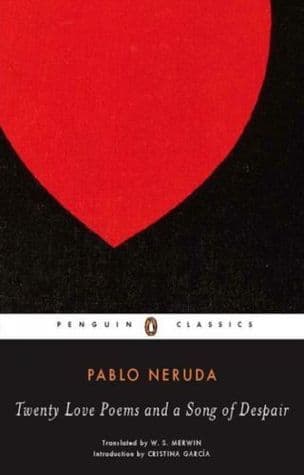
Synopsis
Covers the whole plot, including the ending.
- Difficulty
- Easy
- Pacing
- Moderate
- Mood
- Romantic, Melancholy, Lyrical, Evocative
- Read it if
- You appreciate lyrical, passionate poetry that explores themes of love, longing, and melancholy, and you enjoy dual-language editions.
- Skip it if
- You prefer narrative-driven works or find highly emotional, romantic poetry unappealing.
Twenty Love Poems and a Song of Despair Plot Summary
Covers the whole plot, including the ending.
Poem 1: Body of a Woman
The speaker begins by describing his lover's body using natural images: white hills, a world, and a yielding shape. He compares her to hunger, a furrow, and a land of white hills, linking her physical presence to nature's vastness and fertility. He states that his 'savage peasant's body' works her and makes her grow from the earth. The poem declares his possession and admiration for her body, emphasizing their raw, earthy connection and her deep impact on his view of the world.
Poem 5: So That You Will Hear Me
The speaker addresses his beloved, saying he writes poems for her to hear him, as the wind carries his words. He remembers her eyes, sometimes still or bright, and her lips, full of kisses. He describes her as a vessel of endless tenderness and a distant, quiet figure. The poem conveys longing and a struggle to connect with a lover who seems increasingly far away. He regrets the absence of her voice and presence, highlighting the loneliness he feels despite his poetic attempts to reach her.
Poem 6: I Remember You As You Were
The speaker vividly recalls his lover's past self, especially her eyes and voice, which he compares to an autumn twilight. He remembers her as a graceful, quiet woman, often wearing a beret. He says that leaves fell in her soul, creating a sad feeling. Her presence was tied to autumn, and he remembers their intertwined arms. The poem conveys deep nostalgia for a love that has faded or changed, contrasting vibrant memories with current emptiness. It emphasizes the passage of time and the pain of lost connection.
Poem 7: Leaning Into the Afternoons
The speaker describes himself leaning into the afternoons, casting nets of his sad eyes toward the sea. He sees gulls, the burning sun, and ships, all seeming to carry his grief. He feels desolate, comparing himself to a 'sad pier' that holds his longing. The poem evokes deep sadness, mixing the external landscape with his inner emotional state. The vastness of the sea and the fading light reflect his own sense of loss and the quiet despair in his observations.
Poem 11: Almost Out of the Sky
The speaker describes his lover appearing 'almost out of the sky,' like a white ship. He sees her as profoundly beautiful and mysterious, comparing her to twilight and a 'sad vine' that entwines his life. He feels her presence among the vast night and the stars, which he sees as 'cold and blue.' His own heart is a 'mad mill,' grinding shadows. The poem conveys awe and wonder mixed with deep, personal sadness, as he sees her against a backdrop of cosmic indifference and his own inner turmoil.
Poem 15: I Like For You To Be Still
The speaker expresses his preference for his lover's stillness, saying her silence is beautiful, like she is absent. He compares her to a distant, silent star, and her words to a butterfly. He feels her silence is a form of presence, and her eyes are like the sea. He finds comfort in her quietness, which lets him see her more deeply. The poem suggests that true connection can exist beyond spoken words, and that the beloved's silence can be a powerful and intimate way to communicate, allowing for deeper thought and connection.
Poem 17: Thinking, Intertwining Your Hands
The speaker describes himself thinking, intertwining his hands, and remembering time passing. He recalls his lover's eyes, which he calls 'sad.' He feels loss and the weight of memory, as if his words are falling like leaves onto her. He links his feelings to the vastness of the sea and life's fleeting nature. The poem expresses deep sadness, a contemplation of love's impermanence, and how memories linger even as the present moment changes. It is a bittersweet thought about what was and what remains.
Poem 18: Here I Love You
The speaker declares his love in a specific setting, where 'pines are green' and the 'wind sings.' He describes the moon as a 'broken wheel' and the sea as 'murmuring.' He feels his love intertwined with nature, but also acknowledges deep sadness. He sees her as a 'sad rose' and himself as 'a 'dark tunnel.' The poem is a poignant declaration of love that is both beautiful and sad, suggesting that even in deep connection, a sense of loss or coming sorrow is present, mirroring nature's brief beauty.
Poem 20: Tonight I Can Write
The speaker famously says, 'Tonight I can write the saddest lines.' He thinks about losing his beloved, whom he loved 'sometimes, and she loved me sometimes too.' He remembers holding her 'on nights like this one,' but now she is gone. The night is 'enormous' without her, and he feels the pain of her absence. He questions if she is still his, accepting that love is short and forgetting is long. Writing becomes a way to process his grief, even as it deepens his sorrow, making his lost love live on in verse.
The Song of Despair
The 'Song of Despair' is a long, final lament where the speaker is completely taken over by the loss of his beloved. He describes a desolate landscape of 'sad islands' and 'bitter light,' reflecting his inner state. He recalls his lover's body, her eyes, her voice, and their shared closeness, but these memories are now filled with immense pain. He feels utterly alone, lost in sorrow, unable to escape her memory. The poem is a raw outpouring of grief, resignation, and a lasting feeling of emptiness, marking the end of his romantic idealization and his descent into deep sadness.
Principal Figures
The Speaker
Protagonist
A passionate, melancholic lover and poet.
The unnamed speaker is the central consciousness of the poems, expressing a wide range of emotions from intense adoration and physical desire to profound longing, despair, and nostalgia. He is deeply attuned to nature, often using natural imagery to describe his beloved and his emotional state. He is a sensitive and reflective individual, finding solace and pain in the act of writing poetry. His identity is almost entirely defined by his love and subsequent loss.
Relationships: The Beloved (Intense, passionate, and ultimately lost love)
The Beloved
Object of Affection
The idealized, often silent, and ultimately lost woman.
The beloved is never directly named and is primarily presented through the speaker's perceptions and memories. She is idealized, often described in terms of natural beauty (body like a landscape, eyes like the sea) and associated with elements like the wind, twilight, and silence. She is a figure of immense tenderness and beauty, but also of mystery and distance. Her silence is a recurring motif, suggesting both her ethereal quality and her eventual inaccessibility.
Relationships: The Speaker (Object of intense adoration, desire, and eventual sorrow)
Themes & Insights
Love and Loss
The main theme explores romantic love, from its first intense passion to its painful end. The poems clearly show the joy of physical intimacy and emotional connection (e.g., Poem 1, 'Body of a Woman'), but increasingly move to the pain of separation and memory (e.g., Poem 20, 'Tonight I Can Write'). The book is a journey through a love affair, ending in deep sadness over what is lost, suggesting that love's beauty is tied to its briefness.
“Love is so short, forgetting is so long.”
Nature as Metaphor for Emotion
Nature is not just a setting but a strong mirror and amplifier of the speaker's inner feelings. The beloved's body is described as a 'world' of 'white hills' (Poem 1), while the speaker's sorrow is reflected in the 'sad pier' and 'nets of my sad eyes' cast into the sea (Poem 7). Changing seasons, the vast ocean, stars, and wind all show and deepen feelings of love, longing, and despair, making the personal universal.
“Leaning into the afternoons I throw my sad nets to that sea that is thrashed by your oceanic eyes.”
Memory and Nostalgia
Memory is key, as the speaker constantly revisits past intimate and happy moments, comparing them with his current loneliness. These memories are often bittersweet, tinged with the pain of what is no longer present (e.g., Poem 6, 'I Remember You As You Were'). Remembering becomes a source of both comfort and torment, highlighting the lasting power of past experiences even when they are absent now. The poems show how memory shapes identity and keeps both love and sorrow alive.
“I remember you as you were in the last autumn. You were the grey beret and the still heart.”
The Power and Limits of Language
The poems explore the speaker's attempt to use language to connect with his beloved and express his overwhelming emotions. He writes 'so that you will hear me' (Poem 5), suggesting a desperate effort to communicate across a growing distance. Yet, there is also an acknowledgment of language's limits; the beloved is often silent, and the ultimate despair ('The Song of Despair') hints at feelings that are hard to put into words. The act of writing itself is a form of release, a way to hold onto a fleeting love, even as it emphasizes its loss.
“Tonight I can write the saddest lines. I loved her, and sometimes she loved me too.”
Plot Devices & Literary Techniques
Natural Imagery
Extensive use of nature to symbolize emotions and physical attributes.
Neruda employs rich and pervasive natural imagery throughout the collection. The beloved's body is a 'world' of 'white hills' and 'furrows,' her eyes are 'oceanic,' and her voice is compared to the wind. The speaker's emotions are mirrored by the sea, the stars, the autumn leaves, and the twilight. This device grounds the intense, often abstract emotions in tangible, universal experiences, creating a vivid sensory landscape that enhances the poems' emotional depth and resonance.
Repetition and Anaphora
Recurrent phrases and structures to emphasize themes and create rhythm.
The repetition of certain phrases or grammatical structures, particularly at the beginning of lines or stanzas (anaphora), is a key device. For example, 'Tonight I can write the saddest lines...' in Poem 20 is a powerful recurring thought. This repetition creates a hypnotic rhythm, reinforces key emotional states, and builds intensity, allowing the speaker's obsessive thoughts about his beloved and his sorrow to resonate more profoundly with the reader, echoing the cyclical nature of grief and memory.
Personification
Attributing human qualities to inanimate objects or abstract concepts.
Neruda frequently personifies elements of nature and abstract concepts to deepen their emotional impact. The wind 'sings,' the night is 'enormous,' and the sea 'moans.' This device imbues the natural world with a living, feeling presence that actively participates in the speaker's emotional drama. It blurs the line between the internal and external, making the environment a direct reflection and even an active participant in the speaker's love and despair, enhancing the lyrical and subjective quality of the poems.
Metaphor and Simile
Comparing disparate things to reveal deeper meanings.
The collection is replete with striking metaphors and similes that forge unexpected connections and enrich the poems' emotional and sensory texture. The beloved's silence is 'like a lamp,' her voice 'like a butterfly,' and the speaker's heart is a 'mad mill.' These comparisons allow Neruda to express complex feelings and abstract ideas in concrete, imaginative ways, creating vivid images that resonate with the reader and convey the depth of the speaker's passion and sorrow.
Twenty Love Poems and a Song of Despair Quotes
“I want to do with you what spring does with the cherry trees.”
“Tonight I can write the saddest lines. Write, for example, 'The night is starry and the stars are blue and shiver in the distance.'”
“I like for you to be still: it is as though you are absent and you hear me from far away and my voice does not touch you.”
“My body, a portion of the earth, will find its way in your body.”
“From the south, like a ship, you arrived, bringing the south with you.”
“Ah, the vastness of the sea that you poured into my soul!”
“I have gone marking the white hot summer with your absence.”
“My soul is not content with having lost her.”
“You are like the night, with its stillness and constellations.”
“The wind of the night spins in the sky and sings.”
“I no longer love her, that's certain, but maybe I love her. Love is so short, forgetting is so long.”
“Naked you are simple as one of your hands; smooth, earthy, small, transparent, round.”
“What does it matter that my love could not keep her?”
“Always, always, you are in my eyes, in my words, in my thoughts.”
Quiz
10 questions on the plot and the characters. Each answer comes with a short explanation.
Question 1
Which year marked the initial publication of 'Twenty Love Poems and a Song of Despair', launching Pablo Neruda into international recognition?
- 1914
- 1924
- 1934
- 1944
Show answer
B. 1924 The book 'Twenty Love Poems and a Song of Despair' first appeared in 1924, when Neruda was a young and unknown poet.
Question 2
Who provided the 'incomparable translation' of 'Twenty Love Poems and a Song of Despair' that faces the original Spanish text in the described edition?
- Cristina Garcia
- Gael García Bernal
- W. S. Merwin
- Pablo Larraín
Show answer
C. W. S. Merwin W. S. Merwin's translation is specifically highlighted as facing the original Spanish text.
Question 3
What is the primary emotional landscape explored throughout 'Twenty Love Poems and a Song of Despair'?
- Political activism and social injustice
- The beauty of nature and the Chilean landscape
- Romantic love, desire, and the pain of loss
- Existential dread and philosophical inquiry
Show answer
C. Romantic love, desire, and the pain of loss The book's title itself, 'Twenty Love Poems and a Song of Despair', clearly indicates its central theme of romantic love and its accompanying sorrows, consistent with the 'Romance' genre description.
Question 4
The collection includes 'a Song of Despair' in addition to the love poems. What does this 'song' typically represent in the context of the overall work?
- A celebration of new beginnings and hope after heartbreak.
- The inevitable pain, loss, and melancholy that often accompany intense love.
- Neruda's early political disillusionment.
- A lament for the state of the world in the 1920s.
Show answer
B. The inevitable pain, loss, and melancholy that often accompany intense love. The 'Song of Despair' serves as a culmination of the emotional journey, expressing the sorrow and sense of loss often inherent in passionate love, completing the emotional arc from intense desire to profound sadness.
Question 5
Which Nobel Prize did Pablo Neruda receive, solidifying his status as a globally recognized literary figure?
- Nobel Peace Prize
- Nobel Prize in Literature
- Nobel Prize in Physics
- Nobel Prize in Economic Sciences
Show answer
B. Nobel Prize in Literature The description states Neruda is 'Chile's Nobel Prize-winning poet,' implying his recognition for his literary contributions.
Question 6
The description mentions a 'black-spine Classics edition' with an introduction. Who wrote this introduction for the specified edition?
- W. S. Merwin
- Pablo Neruda
- Cristina Garcia
- Gael García Bernal
Show answer
C. Cristina Garcia The description explicitly states, 'Now in a black-spine Classics edition with an introduction by Cristina Garcia'.
Question 7
What is a prominent characteristic of Neruda's poetic style in 'Twenty Love Poems and a Song of Despair' that often resonates with readers?
- Highly formal, structured verse with strict rhyme schemes.
- Abstract philosophical musings detached from sensory experience.
- Sensual imagery, direct address, and a blend of natural elements with human emotion.
- An ironic and satirical tone used to critique societal norms.
Show answer
C. Sensual imagery, direct address, and a blend of natural elements with human emotion. Neruda's love poems are renowned for their passionate, sensual imagery, often weaving natural elements (like the sea, night, earth) with profound human feelings of desire and melancholy, making them deeply relatable to 'lovers and poets'.
Question 8
The description mentions 'Pablo Larraín's acclaimed feature film Neruda'. What is the relationship of this film to 'Twenty Love Poems and a Song of Despair'?
- The film is a direct adaptation, scene-by-scene, of the poems.
- The film specifically dramatizes the events leading to the book's publication.
- The film explores the life of Pablo Neruda, with the book being his 'most popular work' and thus a significant part of his legacy and artistic identity.
- The film features Gael García Bernal reciting every poem from the collection.
Show answer
C. The film explores the life of Pablo Neruda, with the book being his 'most popular work' and thus a significant part of his legacy and artistic identity. The description states 'the subject of Pablo Larraín's acclaimed feature film Neruda', indicating the film is about Neruda himself, whose 'most popular work' is this collection, thus integrating it into his broader life story rather than being a direct adaptation.
Question 9
Considering the impact of 'Twenty Love Poems and a Song of Despair', why is it considered 'an essential collection that continues to inspire lovers and poets around the world'?
- Its detailed historical accounts of Chilean political events offer timeless lessons.
- It provides a rigid structural framework for composing modern poetry.
- It captures universal human emotions of love, desire, and melancholy with profound beauty and accessibility, transcending cultural barriers.
- It introduced a unique philosophical system that revolutionized existential thought.
Show answer
C. It captures universal human emotions of love, desire, and melancholy with profound beauty and accessibility, transcending cultural barriers. The enduring appeal and inspiration of the collection stem from its ability to articulate universally felt emotions of love and loss in a way that resonates deeply with people across different backgrounds, rather than being tied to specific historical or philosophical contexts.
Question 10
What does the phrase 'ignite a generation' imply about the initial reception and influence of 'Twenty Love Poems and a Song of Despair'?
- It caused widespread political unrest and revolutionary fervor.
- It sparked a renewed interest in traditional, classical poetic forms.
- It captivated young readers and writers, influencing their emotional expression and poetic styles, and perhaps challenging existing literary norms.
- It literally involved the burning of books that were considered outdated.
Show answer
C. It captivated young readers and writers, influencing their emotional expression and poetic styles, and perhaps challenging existing literary norms. To 'ignite a generation' in a literary context implies that the work deeply resonated with and inspired young people, influencing their perspectives, emotional language, and artistic output, rather than causing literal or political ignition.
Twenty Love Poems and a Song of Despair FAQ
What is the central theme explored in 'Twenty Love Poems and a Song of Despair'?
The central theme is the intense, often tumultuous nature of youthful love, encompassing both its ecstatic joys and profound sorrows. Neruda explores the transient beauty of physical intimacy, the pain of absence, and the melancholic reflection on past relationships, all set against the backdrop of natural landscapes.
Who is the 'you' addressed throughout many of the poems, and is it always the same person?
The 'you' in many poems refers to a generalized beloved, often representing composite figures rather than a single individual. While some poems might allude to specific real-life romances Neruda experienced, the collection deliberately cultivates an archetypal lover, making the emotions universally relatable rather than strictly autobiographical.
How does the 'Song of Despair' differ thematically and tonally from the preceding love poems?
The 'Song of Despair' acts as a poignant culmination, shifting from the intimate, often sensual, declarations of love to a profound sense of loss and melancholic solitude. It grapples with the permanent absence of the beloved and the enduring pain that such a separation leaves, starkly contrasting the passionate presence celebrated earlier in the collection.
What role does nature play in the emotional landscape of these poems?
Nature serves as a powerful metaphor and backdrop, reflecting and amplifying the poet's internal emotional states. The sea, stars, wind, and twilight often mirror the intensity of love, the vastness of longing, or the emptiness of despair, creating a deeply immersive sensory experience for the reader.
How did the book's publication in 1924 impact Pablo Neruda's career?
The publication of 'Twenty Love Poems and a Song of Despair' in 1924 launched the young and previously unknown Neruda into international prominence. It immediately established him as a significant poetic voice, garnering widespread critical and popular acclaim that set the stage for his celebrated literary career and future Nobel Prize.
Are there any specific literary allusions or influences hidden within the poems?
While not explicitly stated, Neruda's work subtly draws upon a rich tradition of Spanish and Latin American romantic poetry, echoing themes of unrequited love and the sublime in nature found in poets like Gustavo Adolfo Bécquer. His innovative use of surrealist imagery also hints at nascent European avant-garde movements, blended with a distinctly Latin American voice.
How does Neruda's use of anaphora and repetition contribute to the emotional impact of the poems?
Neruda frequently employs anaphora and repetition, particularly phrases like 'I remember you as you were' or 'Tonight I can write,' to build a hypnotic rhythm and emphasize the persistent nature of memory and emotion. This technique deepens the reader's immersion into the poet's internal world, reinforcing the intensity of his longing and recollection.
What is the significance of the female body imagery throughout the collection?
The female body is often depicted as intertwined with natural elements—a 'body of a country,' 'hills,' 'rivers'—symbolizing a profound, almost primal connection between love, sensuality, and the earth itself. This imagery elevates physical love to a spiritual experience, blurring the lines between the human and the cosmic.
How does the 'Song of Despair' contrast with the more hopeful or passionate tones found in earlier poems like 'Poem 15'?
'Poem 15' celebrates a vibrant, present love, with lines like 'I like for you to be still: it is as if you were absent.' In stark contrast, the 'Song of Despair' grapples with a definitive, painful absence, where silence is no longer a comforting stillness but an agonizing void, reflecting a complete emotional shift from presence to loss.
Does the collection present a unified narrative or a series of disconnected emotional snapshots?
While not a linear narrative with a specific plot, the collection presents a cohesive emotional journey, moving from the initial intoxicating moments of love and passion through the complexities of intimacy, to the eventual pain of separation and profound despair. Each poem acts as an emotional snapshot, contributing to a broader arc of a relationship's lifecycle.
What is the significance of the 'black-spine Classics edition' and its introduction by Cristina Garcia?
The 'black-spine Classics edition' signifies its enduring status as a literary masterpiece, making it accessible to new generations of readers. Cristina Garcia's introduction provides a contemporary critical perspective, contextualizing Neruda's work within modern literary discourse and highlighting its continued relevance and impact.
How might the film 'Neruda' starring Gael García Bernal interpret the themes of this book?
The film 'Neruda,' while focusing on a specific period of the poet's life and his political pursuits, likely draws upon the emotional depth and lyrical intensity found in 'Twenty Love Poems.' It might explore the origins of his romantic sensibility, how his personal loves influenced his public persona, or parallel the yearning for freedom with the longing for a beloved, even if not directly adapting the poems.
How does Neruda use sensory details to evoke specific emotions?
Neruda masterfully employs a rich tapestry of sensory details—the 'pale' light, 'rough' wind, 'silent' stars, and the 'smell of the sea'—to create vivid, palpable experiences. These details are not merely descriptive but are deeply interwoven with the emotional state, making the reader feel the cold of absence, the warmth of touch, or the vastness of longing.
What is the lasting appeal of these poems to 'lovers and poets around the world'?
The lasting appeal lies in Neruda's raw, honest, and universally relatable exploration of love's spectrum—from its exhilarating highs to its devastating lows. His lyrical language, powerful imagery, and ability to articulate complex emotions resonate deeply, providing a timeless voice for the ineffable experiences of the heart, inspiring both romantic sentiment and poetic expression.
Are there any recurring symbolic objects or colors that carry significant meaning?
Blue, often associated with the sea and sky, frequently symbolizes both vastness and melancholy, representing the boundless nature of love or the depth of sorrow. The wind is another recurring symbol, often embodying the transient nature of love, the passage of time, or the unseen forces that shape relationships, adding layers of symbolic depth.
How does W. S. Merwin's translation contribute to the book's international success?
W. S. Merwin's translation is widely acclaimed for its ability to capture the original Spanish text's lyrical beauty, emotional intensity, and poetic rhythm while making it accessible to English-speaking audiences. His careful rendering ensures that the essence and power of Neruda's verses are not lost, allowing the poems to resonate across linguistic barriers and securing their international recognition.
To what extent can these poems be considered autobiographical versus universal?
While Neruda drew upon his personal experiences and relationships for inspiration, the poems transcend mere autobiography to achieve universal resonance. He distills individual emotions into archetypal expressions of love and loss, allowing readers from diverse backgrounds to connect with the raw human experience portrayed, making them both personal and universally applicable.
About the author
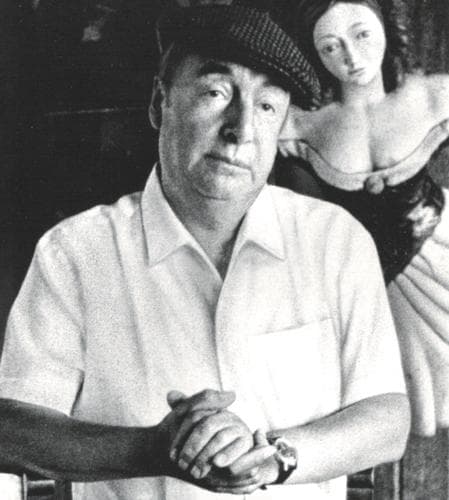
Pablo Neruda (born Ricardo Eliécer Neftalí Reyes Basoalto; 12 July 1904 – 23 September 1973) was a Chilean poet-diplomat and politician who won the 1971 Nobel Prize in Literature. Neruda became known as a poet when he was 13 years old, and wrote in a variety of styles, including surrealist poems, historical epics, political manifestos, a prose autobiography, and passionate love poems such as the ones in his collection Twenty Love Poems and a Song of Despair (1924).
Similar books
- Ariel
Sylvia Plath
4.2 (54k) average on GoodreadsPsychologyFeatures intense, confessional poetry with strong emotional depth, though with a darker tone.
- Sonnets from the Portuguese
Elizabeth Barrett Browning
4.1 (11k) average on GoodreadsRomanceA classic collection of love poems expressing deep affection and devotion, written with lyrical beauty.
- The Hunger Games
Suzanne Collins
4.3 (6.4M) average on GoodreadsFantasyIn a future where children fight to the death on live television, Katniss Everdeen volunteers for the arena, turning a death sentence into a fight for survival and a spark of rebellion.
- The Great Gatsby
F. Scott Fitzgerald
3.9 (3.8M) average on GoodreadsHistorical FictionIn the opulent Roaring Twenties, a mysterious millionaire's lavish parties hide his desperate, tragic pursuit of a lost love, exposing the emptiness within the American Dream.
- The Fault in Our Stars
John Green
4.2 (3.6M) average on GoodreadsYoung AdultA girl with a terminal illness finds her story rewritten when a charming boy with a similar past enters her life at a cancer support group, leading to a star-crossed romance.
- Pride and Prejudice
Jane Austen
4.3 (3M) average on GoodreadsHistorical FictionIn a society focused on status and money, Elizabeth Bennet navigates love and pride, challenging Mr. Darcy and social expectations to find true affection.





Enjoyed the summary?
A summary gives you the shape of the book. The book itself has the detail, the examples and the voice.
Find Twenty Love Poems and a Song of Despair on AmazonAs an Amazon Associate, BookBrief earns from qualifying purchases. How we're funded