
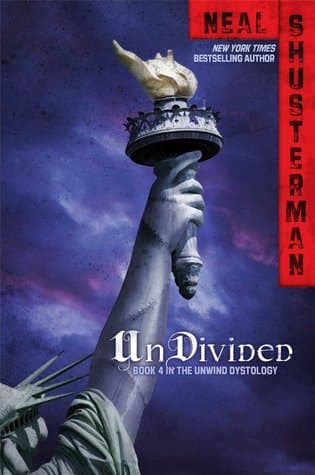
Synopsis
Covers the whole plot, including the ending.
- Difficulty
- Medium
- Pacing
- Fast
- Mood
- Intense, Suspenseful, Thought-provoking, Hopeful
- Read it if
- You enjoy dystopian thrillers with complex moral dilemmas, fast-paced action, and a focus on rebellion and social justice.
- Skip it if
- You prefer lighthearted reads or are sensitive to themes of body horror and societal oppression.
UnDivided Plot Summary
Covers the whole plot, including the ending.
The Rewind Project and the Capitol Siege
Cam, the first successful 'rewound' teen, struggles with his made identity and the memories of his donors. He works for Proactive Citizenry and discovers their plan: to mass-produce rewound soldiers for a new military, believing they can control their personalities. Meanwhile, Conner Lassiter, Risa Ward, and Lev Calder lead a growing youth movement. They, along with other activists, organize a large march on Washington D.C. to expose unwinding and demand its end. This peaceful protest, however, faces increasing resistance and the threat of violence from authorities and radical elements within their own ranks, especially Starkey's storked army.
Starkey's Rise to Power
Hayden, now allied with Starkey, helps him gain power among the 'storked' teens — those abandoned on doorsteps. Starkey, driven by rage against adults and the system that allowed unwinding, forms a disciplined, militant army. His goal is not just to end unwinding, but to enact violent revenge against all adults responsible, starting with burning harvest camps and executing staff. His brutal methods create a dangerous parallel movement that threatens to derail Conner's efforts for peaceful reform and push the nation into further chaos, as his followers are loyal and ready for war.
Unveiling the Truth about the Soul
Risa, using her medical knowledge and access within the system, investigates unwinding. She finds disturbing evidence that challenges the belief that unwinding merely redistributes body parts while preserving the soul. Through research, she learns the process might destroy an individual's consciousness and identity, making it more horrific than previously thought. This discovery becomes a key piece of evidence for the youth movement, giving undeniable moral weight to their cause and encouraging more people to join their fight against Proactive Citizenry and unwinding, confirming that unwinding is murder.
Lev's Sacrifice and the Soul-Splice
Lev, still dealing with his past as a tithe and his complex relationship with his family and faith, faces an identity crisis. He learns about the 'soul-splice' technology, which Proactive Citizenry has hidden — a method that could theoretically allow unwound consciousnesses to continue. He realizes this technology, while potentially offering a form of afterlife, could also be exploited. Lev struggles with the ethical implications and the personal cost of using such a device. His journey forces him to confront his own beliefs about life, death, and the soul, leading to a critical decision that will affect the future of unwinding and potentially offer redemption for many.
The D.C. Confrontation
The planned peaceful march on Washington D.C. begins as a powerful display of unity. Thousands of teens arrive at the Capitol, demanding an end to unwinding. However, the situation quickly turns chaotic. Starkey's militant storked army, arriving with its own agenda of violent revenge, clashes with authorities and even with Conner's peaceful faction. The D.C. streets become a battleground, with casualties on both sides. This escalation forces Conner, Risa, and Lev to make difficult choices, as their message of peace is overshadowed by violence and the desperate fight for survival.
Cam's Betrayal and Redemption
Cam, increasingly unhappy with Proactive Citizenry and their manipulative agenda, struggles with his fragmented identity. He feels like a pawn, a collection of parts rather than a whole person. During the D.C. confrontation, he decides to betray his creators, using his unique position and access to help Conner and the unwound movement. This act of defiance is a turning point for Cam, as he begins to form his own identity and purpose, separate from his creators' intentions. He uses his knowledge of Proactive Citizenry's secrets to expose their lies and bring their operations to light, seeking his own redemption.
The Revelation of Rewinding's Flaw
As the conflict rages, the fatal flaw in Proactive Citizenry's rewinding process is revealed. It is discovered that while rewound individuals like Cam can integrate memories and personalities from their donors, the process is unstable. The donated parts retain some of their original consciousness, causing internal conflict, mental instability, and ultimately, a breakdown of the rewound individual's mind. This truth exposes Proactive Citizenry's project as unethical, flawed, and cruel, proving that their attempts to control human lives cause immense suffering. This revelation further fuels public outrage against unwinding.
Conner's Leadership and the Unwound Army
Amidst the chaos and violence, Conner becomes a true leader. He gathers the different groups of unwound teens, storked teens who reject Starkey's extremism, and their adult allies. He inspires them to fight not just for their own lives, but for a future where no child is ever unwound. He organizes their defenses, makes strategic decisions, and becomes a symbol of hope and resistance against the oppressive system. His leadership is essential in uniting the various groups and focusing their efforts on a common goal, even as they face overwhelming odds against Proactive Citizenry and government forces.
The Soul-Splice Solution
In a desperate attempt to find a humane alternative to unwinding, Lev and his allies work to activate and publicize the hidden 'soul-splice' technology. This technology, if successful, could offer a way for individuals to transfer their consciousness into a new form, avoiding unwinding while preserving their identity. It is a risky, unproven solution, but it represents the only hope for a future where children are not simply harvested. Implementing this technology becomes a race against time, as they try to offer a viable alternative before the conflict consumes everything, providing a chance for a new kind of existence.
The Aftermath and a New Beginning
The conflict eventually ends, leaving a scarred nation but also the promise of a new beginning. Unwinding is abolished, and its proponents are brought to justice. The soul-splice technology, though imperfect, offers a path for many. Conner, Risa, and Lev, along with other key figures, take on new roles in shaping the future. They work to establish a society that values every life, where children are no longer seen as disposable. The ending has lingering challenges and questions, but it marks a profound shift in societal values and the fragile emergence of a more humane world, built on the sacrifices of the unwound.
UnDivided Characters
Conner Lassiter
Protagonist
The Head Unwind and leader of the youth revolution.
Conner, initially a runaway 'unwind' destined for harvest, transforms into the charismatic and determined leader of the unwound movement. Driven by a fierce sense of justice and a protective instinct for others, he constantly seeks to unite disparate factions and build a peaceful, equitable future. His personal experiences with unwinding, including his own near-unwinding, fuel his unwavering resolve to end the practice. He is pragmatic, brave, and often impulsive, but always guided by a strong moral compass.
Relationships: Risa Ward (Love interest and co-leader); Lev Calder (Close friend and ally); Hayden (Friend and fellow activist); Cam (Complicated alliance, initially distrustful)
Risa Ward
Protagonist
A talented musician and medical professional who seeks truth and healing.
Risa, a former ward of the state and talented pianist, uses her intelligence and medical skills to expose the horrors of unwinding. After being unwound and then re-attached, she gains unique insights into the process. She is analytical, compassionate, and determined, often serving as the strategic mind behind Conner's more impulsive actions. Her search for scientific truth about the soul and unwinding is crucial to the movement's success. She is a voice of reason and empathy amidst the chaos.
Relationships: Conner Lassiter (Love interest and co-leader); Lev Calder (Friend and ally)
Lev Calder
Protagonist
A former tithe grappling with faith, identity, and the meaning of sacrifice.
Lev, originally a 'tithe' destined for unwinding as a religious sacrifice, has a complex and evolving moral compass. His journey is marked by profound internal struggle, questioning his faith, his identity, and the nature of sacrifice. He carries the trauma of his past and the weight of his choices, including his involvement with the explosion at the Happy Jack Harvest Camp. Lev is deeply empathetic and seeks redemption, ultimately finding it by advocating for the soul-splice technology and a path forward for all. He is a quiet force, often acting with profound impact.
Relationships: Conner Lassiter (Close friend and ally); Risa Ward (Friend and ally); CyFi (Former friend and influence); Pastor Dan (Conflicted mentor figure)
Cam (Complete-Awareness-Modality)
Supporting
The first rewound teen, a living embodiment of the ethical dilemmas of unwinding.
Cam is a unique character, created entirely from the parts of unwound teens by Proactive Citizenry. He struggles with his manufactured identity, piecing together fragments of his donors' memories and personalities. Initially a tool for Proactive Citizenry, he is intelligent but emotionally vulnerable, yearning for a true sense of self and belonging. His journey involves betraying his creators to find his own purpose and identity, ultimately becoming a symbol of the inherent flaws in the rewinding process.
Relationships: Marie (Love interest); Conner Lassiter (Initial antagonist, later ally); Risa Ward (Initial antagonist, later ally); Proactive Citizenry (Creators and later adversaries)
Starkey
Antagonist
The ruthless and militant leader of the storked army.
Starkey is a deeply embittered and vengeful 'storked' teen – abandoned on a doorstep as an infant. He embodies the rage and despair of those marginalized by society. He is a charismatic but brutal leader, forming a large, militant army of storked teens with the goal of violent retribution against adults and the system of unwinding. His extremism poses a significant threat to Conner's peaceful revolution, as he is willing to resort to any means necessary to achieve his goals, including widespread destruction and murder. He represents the danger of unchecked anger and the cycle of violence.
Relationships: Hayden (Lieutenant and close ally); Conner Lassiter (Rival and ideological opponent)
Hayden
Supporting
A cynical but ultimately moral friend, initially allied with Starkey.
Hayden is a thoughtful and often cynical unwound teen, known for his philosophical musings and dry wit. He initially aligns with Starkey, believing in the necessity of action, but grows increasingly uncomfortable with Starkey's violent extremism. He serves as Starkey's lieutenant but ultimately questions his methods and motives. Hayden's internal conflict and eventual shift in allegiance highlight the moral complexities of the revolution. He is a voice of reason who struggles to find his place within the competing ideologies.
Relationships: Conner Lassiter (Friend and ally); Starkey (Leader and later ideological opponent)
Marie
Supporting
Cam's girlfriend, whose love becomes a catalyst for his self-discovery.
Marie is Cam's girlfriend, a seemingly ordinary girl who accepts Cam for who he is, despite his unusual origins. Her unwavering love and belief in Cam's individuality are crucial to his journey of self-discovery. She helps him to see beyond his constructed identity and encourages him to forge his own path, free from Proactive Citizenry's control. She represents hope and the possibility of genuine connection even in a fractured world. Her presence grounds Cam and provides him with a reason to fight for his own humanity.
Relationships: Cam (Love interest)
J.T. Nelson
Supporting
A key figure in Proactive Citizenry, responsible for the Rewind project.
J.T. Nelson is a high-ranking executive within Proactive Citizenry, the architect behind the 'Rewind' project and the mass production of rewound soldiers. He embodies the cold, calculating logic of the system, believing that his work is for the greater good, even if it involves profound ethical compromises. He is manipulative and power-hungry, seeing humans as resources to be optimized. Nelson is a primary antagonist, representing the institutionalized evil that Conner and his allies fight against. His intelligence is matched only by his lack of empathy.
Relationships: Cam (Creator and manipulator); Conner Lassiter (Adversary)
UnDivided Themes
Identity and Self-Definition
The novel explores identity, especially through Cam's struggle as a 'rewound' individual made of multiple donors. He deals with fragmented memories and personalities, questioning if he is unique or just a collection of parts. This theme extends to all unwound teens, who are told their parts are more valuable than their whole. The story suggests that identity is not inherent but shaped by choice and experience, as seen when Cam defines himself apart from his creators, and when characters like Lev redefine their purpose beyond their initial societal roles. (e.g., Cam's internal struggle with the 'ghosts' of his donors, the unwound's fight to be recognized as whole people).
“The soul isn’t in the body. The soul is in the choices you make.”
The Nature of Humanity and the Soul
A central question is what defines a human and whether the soul can be divided or destroyed. Proactive Citizenry operates on the idea that unwinding preserves the soul by distributing parts. However, Risa's research and the failure of the rewinding process suggest a more complex truth: consciousness and identity are linked to the whole person. The 'soul-splice' technology further complicates this, offering a technological attempt to preserve consciousness, yet raising new ethical issues about what it means to exist. (e.g., Risa's medical findings on brain function post-unwinding, Lev's theological debates about the soul).
“They say that an unwind is still alive, just in a 'divided state.' But what if that's a lie? What if it's just plain murder?”
The Perils of Extremism and Retribution
The novel highlights the dangers of both institutional oppression and radical, violent reactions. While unwinding is a horrific system, Starkey's militant 'storked' army, driven by rage and a desire for revenge against all adults, proves equally destructive. His goal to burn harvest camps and execute adults, though born from legitimate grievances, threatens to push the nation into a deeper cycle of violence and prevent any peaceful resolution. Conner and Risa consistently advocate for justice and reform, contrasting with Starkey's anger and showing that violence, even in response to injustice, can be self-defeating. (e.g., The clash between Starkey's army and Conner's peaceful protest in D.C.).
“There’s a difference between justice and revenge. One builds, the other burns.”
Hope and the Power of Collective Action
Despite the dystopian setting and the threat of unwinding, the novel emphasizes the power of hope and collective action, especially among youth. Conner, Risa, and Lev, along with thousands of other teens, unite to challenge a seemingly unbeatable system. Their march on Washington D.C. symbolizes their collective voice and refusal to be silenced. Even when met with violence, their determination to fight for a better future, whether through peaceful protest or strategic resistance, ultimately leads to unwinding's abolition. The story shows that even a small group of determined individuals can spark a revolution and bring about societal change.
“We are not just parts. We are whole. And we will not be silent.”
Plot Devices & Literary Techniques
The Rewind Project
Proactive Citizenry's attempt to create a perfect human from unwound parts.
The Rewind Project is a central plot device, serving as a terrifying extension of the unwinding concept. It's Proactive Citizenry's secret endeavor to create 'complete awareness modalities' like Cam from the best parts of unwound teens, intending to mass-produce them for military purposes. This device not only raises profound ethical questions about identity and synthetic life but also ultimately reveals the inherent flaw in the entire unwinding premise: that the individual consciousness cannot be perfectly reassembled or controlled, leading to mental instability and reinforcing the inviolability of the human self.
The Soul-Splice Technology
A suppressed technology offering a potential alternative to unwinding by transferring consciousness.
The soul-splice technology is a crucial Deus ex machina and a central thematic device. It's a suppressed invention capable of transferring a person's consciousness into a new, non-biological form, thereby offering a theoretical alternative to unwinding that preserves identity. Its existence, and Proactive Citizenry's decision to suppress it, highlights the company's cynical motives. Lev's efforts to publicize and implement this technology offer a glimmer of hope and a path towards a more humane future, even as its ethical implications are still being explored, representing a technological 'solution' to a deeply moral problem.
The Capitol Siege/Mass Protest
A large-scale demonstration that serves as the climax of the youth movement.
The mass protest and subsequent siege on Washington D.C. is the primary climactic device. It brings all the major factions – Conner's peaceful movement, Starkey's militant army, and Proactive Citizenry/government forces – into direct conflict. This event is where the various ideological battles and personal narratives converge, forcing characters to make critical decisions under extreme pressure. It serves as a crucible for the characters' development and the ultimate showdown between the forces of oppression and liberation, determining the fate of unwinding and the nation.
The Storked Army
A militant faction of abandoned teens seeking violent retribution.
The 'storked' army, led by Starkey, functions as an internal antagonist to the broader unwound movement. While they share the goal of ending unwinding, their extreme methods and thirst for violent retribution create a dangerous counterpoint to Conner's more peaceful approach. This plot device highlights the perils of extremism and the potential for a revolution to consume itself. Their presence escalates the conflict, forces difficult moral choices, and demonstrates that not all who suffer under oppression will choose the path of peace and justice.
UnDivided Quotes
“All of us are an unwilling part of a machine that is a million times bigger than us, and we are just small cogs. We have no choice but to turn, and turn, and turn.”
“Being alive is a risk. And every day is a gamble. So what's the difference between a life of risk and a life of safety? Only the illusion of control.”
“The greatest prison people live in is the fear of what other people think.”
“No one is ever truly gone. Not if you remember them.”
“Sometimes the only way to stay sane is to go a little crazy.”
“Fear is a powerful weapon. It can make people do things they never thought they would.”
“The world doesn't need saviors. It needs solutions.”
“There's a difference between being alive and living.”
“Justice isn't about what's fair. It's about what's done.”
“Even the smallest spark can ignite the greatest fire.”
“The truth is a dangerous thing, especially when it's inconvenient.”
“You can't choose your past, but you can choose your future.”
“Sometimes the greatest acts of rebellion are the quietest ones.”
“Love isn't a choice; it's a force.”
Quiz
10 questions on the plot and the characters. Each answer comes with a short explanation.
Question 1
What is the primary goal of Proactive Citizenry regarding 'rewound' teens like Cam?
- To integrate them into civilian society as model citizens.
- To mass produce them for military purposes.
- To use them as experimental subjects for new medical procedures.
- To display them in museums as a testament to scientific advancement.
Show answer
B. To mass produce them for military purposes. The synopsis explicitly states that Proactive Citizenry's plan is to mass produce rewound teens like Cam for military purposes.
Question 2
What crucial technology has Proactive Citizenry been suppressing?
- A method to reverse the unwinding process.
- A way to make unwinding completely unnecessary.
- Advanced weaponry for the rewound teens.
- A communication device that connects all unwinds.
Show answer
B. A way to make unwinding completely unnecessary. The synopsis reveals that Proactive Citizenry has been suppressing technology that could make unwinding completely unnecessary.
Question 3
Who are the three main characters mentioned in the synopsis who uncover the startling secrets?
- Cam, Starkey, and Risa
- Conner, Risa, and Lev
- Lev, Starkey, and Conner
- Risa, Cam, and Lev
Show answer
B. Conner, Risa, and Lev The synopsis states, 'As Conner, Risa, and Lev uncover these startling secrets...'
Question 4
What action do enraged teens take in response to the uncovered secrets?
- They go into hiding to form a resistance.
- They initiate a nationwide hacking campaign.
- They march on Washington to demand justice and a better future.
- They attempt to negotiate with Proactive Citizenry.
Show answer
C. They march on Washington to demand justice and a better future. Following the uncovering of secrets, 'enraged teens begin to march on Washington to demand justice and a better future.'
Question 5
What is Starkey's group composed of, and what is their primary objective?
- Unwound teens, seeking to establish new unwinding camps.
- Storked teens, aiming to burn harvest camps and execute adults.
- Rewound teens, trying to protect Proactive Citizenry.
- Adult sympathizers, working to disarm the military.
Show answer
B. Storked teens, aiming to burn harvest camps and execute adults. The synopsis describes Starkey's group as 'storked teens' who want to 'burn the harvest camps to the ground and put every adult in them before a firing squad.'
Question 6
What potential consequence could Starkey's group's actions have on America's future?
- It could lead to a new era of unwinding for all citizens.
- It could create a totalitarian regime run by teens.
- It could destroy any chance America has for a peaceful future.
- It could force Proactive Citizenry to reveal all their secrets.
Show answer
C. It could destroy any chance America has for a peaceful future. The synopsis warns that Starkey's group's actions 'could destroy any chance America has for a peaceful future.'
Question 7
What is the broader theme suggested by Proactive Citizenry's suppression of technology that could make unwinding unnecessary?
- The inevitable march of scientific progress.
- The moral imperative of technological advancement.
- The corruption and self-interest of powerful corporations and institutions.
- The difficulty of implementing new technologies in society.
Show answer
C. The corruption and self-interest of powerful corporations and institutions. Suppressing technology that could end unwinding, while simultaneously profiting from it and planning military applications for rewound teens, strongly suggests corruption and self-interest within Proactive Citizenry.
Question 8
How does the conflict between the teens marching on Washington and Starkey's group highlight a central dilemma for the future of America?
- It shows the division between those who want to restore the old order and those who want to create a new one.
- It illustrates the tension between peaceful protest and violent revolution as means to achieve justice.
- It represents the struggle between technological advancement and a return to simpler times.
- It demonstrates the power struggle between different factions of Proactive Citizenry.
Show answer
B. It illustrates the tension between peaceful protest and violent revolution as means to achieve justice. The teens marching on Washington seek justice and a better future (implying peaceful change), while Starkey's group advocates for burning harvest camps and executing adults (violent revolution). This juxtaposition highlights the dilemma of how to achieve change.
Question 9
Given the description, what is the significance of the title 'UnDivided' in the context of the story's major conflicts?
- It refers to the process of unwinding being completely abolished.
- It symbolizes the hope for a united America, despite internal conflicts and divisions among teens.
- It directly relates to the concept of rewound teens being made whole again.
- It describes the main characters' unwavering resolve against their enemies.
Show answer
B. It symbolizes the hope for a united America, despite internal conflicts and divisions among teens. With enraged teens marching, Starkey's militant group, and the underlying secrets, America is clearly divided. 'UnDivided' suggests the overarching goal or theme of overcoming these divisions to achieve a unified, peaceful future.
Question 10
What element of the story positions it strongly within the 'dystology' genre, beyond just being the final book?
- The presence of a complex romance subplot.
- The focus on a futuristic military and advanced weaponry.
- The exploration of a seemingly perfect society built on a horrific, suppressed truth and the rebellion against it.
- The emphasis on individual character journeys and personal growth.
Show answer
C. The exploration of a seemingly perfect society built on a horrific, suppressed truth and the rebellion against it. Dystopian literature often features a society that appears ideal but hides a dark, oppressive truth, and the narrative focuses on characters who uncover and rebel against this system. Proactive Citizenry's suppressed technology and the system of unwinding fit this perfectly.
UnDivided FAQ
What is the central conflict driving the plot of 'UnDivided'?
The central conflict revolves around the revelation that Proactive Citizenry has been suppressing technology that could make unwinding obsolete, while simultaneously planning to mass-produce rewound teens like Cam for military use. This drives Conner, Risa, and Lev to expose the truth and ignite a nationwide teen rebellion against the unwinding system, clashing with both Proactive Citizenry and militant groups like Starkey's.
Who are the primary protagonists leading the charge against unwinding in this final installment?
Conner, Risa, and Lev are the main protagonists. Conner, the 'Akron AWOL,' continues to be a symbol of resistance and a leader for the runaway unwinds. Risa, with her medical knowledge and strategic thinking, plays a crucial role in uncovering Proactive Citizenry's secrets. Lev, having come to terms with his past as a tithe, uses his influence and unique perspective to advocate for change, particularly among the tithe community.
What is Proactive Citizenry's ultimate goal with the rewound teens, and how does Cam fit into this plan?
Proactive Citizenry's ultimate goal is to mass-produce rewound teens like Cam for military purposes, creating an obedient and highly capable army. Cam, as the first successful rewound, is the prototype and a crucial asset for their research and development. He struggles with his identity and purpose, often torn between his programming and his developing sense of self, which becomes a key factor in the unfolding events.
How does Starkey's group of storked teens influence the broader conflict, and what are their specific demands?
Starkey's group of storked teens represents a more radical and violent faction of the resistance. They demand immediate retribution against adults and the unwinding system, advocating for burning harvest camps and executing those involved. Their growing power and militant actions threaten to destabilize any chance for a peaceful resolution and complicate the efforts of Conner's more moderate movement.
What is the 'suppressed technology' that Proactive Citizenry has been hiding, and what are its implications?
The suppressed technology is a medical breakthrough that could make unwinding completely unnecessary by allowing for organ regeneration or alternative solutions to medical needs, thus removing the primary justification for the procedure. Its existence implies that the entire unwinding system was based on a lie or a deliberately withheld solution, exposing the immense corruption and moral bankruptcy of the governing bodies.
What is the significance of the march on Washington, and how does it symbolize the shift in power dynamics?
The march on Washington symbolizes the collective voice and power of the enraged teens demanding justice and a better future. It's a direct challenge to adult authority and the established system, demonstrating that the younger generation is no longer passive. This mass demonstration forces the government and Proactive Citizenry to acknowledge the widespread discontent and the potential for a complete societal upheaval.
How does the concept of 'rewounding' challenge the ethical boundaries established by unwinding?
Rewounding, while seemingly a reversal of unwinding, introduces new ethical dilemmas by creating individuals like Cam from the parts of others without their original consciousness. It raises questions about identity, personhood, and the right to exist, effectively treating human parts as a resource for creating new, controlled beings. This pushes the boundaries of medical ethics even further than unwinding itself.
What role does Sonia's antique shop play in the larger narrative of resistance and memory?
Sonia's antique shop serves as a sanctuary and a repository of memories and resistance. It's where many runaway unwinds find temporary refuge and where their stories and last letters are collected. In 'UnDivided,' it continues to be a symbol of preserving individual humanity and fighting against the system's attempt to erase identities, serving as a hub for the burgeoning rebellion.
How does the final resolution address the fate of the unwound parts and the concept of their 'soul'?
The final resolution suggests a nuanced approach to the fate of unwound parts, particularly through the understanding that while the original consciousness is gone, the parts themselves carry a legacy. The suppressed technology offers a path where 'unwinding' is no longer necessary, implicitly valuing every individual's body whole. The debate around 'soul' remains philosophical, but the practical outcome is a future where such fragmentation is avoided.
How does Cam's internal struggle with his identity and free will evolve throughout the book?
Cam's internal struggle intensifies as he grapples with being a composite of different unwound teens and Proactive Citizenry's control. He yearns for genuine connection and autonomy, often questioning his programming and developing his own moral compass. His journey culminates in a pivotal decision that demonstrates his capacity for independent thought and action, ultimately choosing to side with humanity over his creators.
Analyze the psychological impact of being a 'storked' child on characters like Starkey and his followers.
Being storked instills a deep sense of abandonment, injustice, and often rage in characters like Starkey. They feel discarded by society and their parents, leading to a profound distrust of adults and authority. This trauma fuels their militancy and desire for radical change, as they seek to reclaim agency and inflict retribution on a system they believe wronged them, often at the expense of peaceful solutions.
How do Conner, Risa, and Lev each process and cope with the trauma of their past experiences with unwinding?
Conner channels his trauma into fierce leadership and a burning desire for justice, using his anger to fuel the rebellion. Risa, having nearly been unwound and later losing her ability to play piano, copes by focusing on practical solutions and strategic planning, using her intellect to dismantle the system. Lev, burdened by his past as a tithe and his involvement with the clappers, seeks redemption and peace through advocating for understanding and non-violence, particularly among the tithe community.
What psychological factors contribute to the widespread acceptance of unwinding by the general public for so long?
The widespread acceptance of unwinding is driven by several psychological factors: fear of overpopulation and resource scarcity, the comfort of a 'solution' to unwanted children, and the powerful propaganda that frames unwinding as not truly 'dying' but rather 'living on' in parts. Cognitive dissonance allows adults to rationalize the horror, while a strong societal narrative of peace and order overrides individual moral objections.
How does the book explore the concept of collective consciousness or shared identity through the rewound process?
The rewound process, particularly through Cam, explores a form of collective consciousness by literally combining parts from multiple individuals. Cam struggles with the echoes of these different personalities and memories, raising questions about whether a new, singular identity can truly form from such disparate origins. This process suggests a fragmented shared identity, where the whole is greater than, yet still influenced by, the sum of its parts.
Does 'UnDivided' offer a definitive answer to what constitutes a 'soul' or 'personhood' in a world of unwinding and rewounding?
'UnDivided' doesn't offer a single definitive answer to what constitutes a 'soul' or 'personhood,' but rather explores the multifaceted nature of these concepts. Through the unwound, the rewound, and the debates surrounding the suppressed technology, the book suggests that personhood is tied to consciousness, memory, and the capacity for individual will, challenging the dehumanizing logic of the unwinding system.
To what extent is the ending optimistic or pessimistic regarding humanity's capacity for change?
The ending offers a cautiously optimistic outlook on humanity's capacity for change. While the unwinding system is dismantled and a more just society is envisioned, the scars of the past and the lingering potential for conflict (as seen with Starkey's faction) remain. It suggests that while progress is possible, vigilance and continued effort are necessary to maintain a more ethical and humane society.
How does the novel critique the role of corporations and government in manipulating public opinion and scientific advancements?
The novel heavily critiques corporations like Proactive Citizenry and the government for their manipulation of public opinion through propaganda, their suppression of life-saving technology for profit and control, and their willingness to exploit human lives for perceived societal benefits. It highlights how power structures can corrupt scientific advancements and moral principles, prioritizing self-interest over ethical responsibility.
Is Starkey's radical approach justified in any way, given the atrocities of unwinding, or is it purely destructive?
Starkey's radical approach is presented as understandable given the atrocities of unwinding and the deep trauma experienced by storked children. However, the novel ultimately portrays his methods as counterproductive and destructive, threatening to plunge society into further chaos rather than building a stable, just future. While his anger is justified, his solutions are not endorsed as viable.
What message does 'UnDivided' convey about the importance of youth activism and challenging established norms?
'UnDivided' strongly conveys the message that youth activism is crucial for challenging established norms and enacting significant societal change. The entire rebellion is spearheaded by teens who refuse to accept the status quo, demonstrating that young people have the power to identify injustices, organize, and demand a better future, even against seemingly insurmountable adult authority.
About the author

Neal Shusterman is an American author known for his contributions to young adult fiction. His notable works include "Unwind," "The Toll," "Everlost," "Challenger Deep," "UnDivided," and "Bruiser," which explore themes of identity, morality, and the human experience. Shusterman has received various awards for his writing, including the National Book Award for "Challenger Deep."
Similar books
- The Hunger Games
Suzanne Collins
4.3 (6.4M) average on GoodreadsFantasyFeatures a dystopian society, teen rebellion, and a fight against an oppressive government.
- Divergent
Veronica Roth
4.2 (2.9M) average on GoodreadsFantasyExplores a fractured society, a young protagonist challenging the system, and a quest for identity.
- Mockingjay
Suzanne Collins
4.0 (2.3M) average on GoodreadsFantasyUnDivided shares structural and thematic similarities with Mockingjay in its depiction of a large-scale, youth-led rebellion against a tyrannical government. Both novels explore the moral compromises and personal sacrifices required in such a conflict, with protagonists forced into leadership roles they didn't seek. However, Shusterman's exploration of bodily autonomy and consciousness is arguably more visceral and central to the core conflict than Collins's focus on political oppression and media manipulation.
- The Road
Cormac McCarthy
4.0 (716k) average on GoodreadsScience FictionWhile The Road is a post-apocalyptic novel and UnDivided is dystopian, both delve into the grim realities of survival in a broken world and the lengths to which individuals will go for their loved ones. However, McCarthy's prose is stark and minimalist, focusing on internal despair and external desolation, whereas Shusterman employs a more intricate plot with multiple perspectives and a clearer, albeit morally complex, path towards potential societal change. Shusterman's work also maintains a sense of hope, however tenuous, that is largely absent in McCarthy's bleak narrative.
- Angels & Demons
Dan Brown
3.9 (2.7M) average on GoodreadsThrillerA Harvard symbologist races through Rome's ancient sites, deciphering cryptic clues to unmask the Illuminati and stop a vengeful plot to destroy the Vatican with a stolen antimatter weapon.
- Gone Girl
Gillian Flynn
4.1 (2.3M) average on GoodreadsThrillerA wife's sudden disappearance on her fifth anniversary reveals a web of lies and psychological warfare, exposing the secrets within a seemingly perfect marriage.






Enjoyed the summary?
A summary gives you the shape of the book. The book itself has the detail, the examples and the voice.
Find UnDivided on AmazonAs an Amazon Associate, BookBrief earns from qualifying purchases. How we're funded