
Core Idea
- Difficulty
- Easy
Key Takeaways from Unguarded
The Unsung Architect of Dynasty
Pippen argues his role was foundational, not merely supportive, to the Bulls' success.
Pippen strongly states his contributions were essential to the Chicago Bulls' two three-peats. He was more than a sidekick; he was key to the team's structure, allowing Jordan's scoring with his strong defense, playmaking, and versatility. Pippen believes the story, especially as told in 'The Last Dance,' unfairly lessened his impact, showing him as a secondary character instead of a co-star whose unique skills made the Bulls' offense and defense work. He points out how his all-around game let Jordan focus on scoring, changing the team from a regular playoff contender into a dominant dynasty.
“Without Pippen, there are no championship banners—let alone six—hanging from the United Center rafters. There’s no Last Dance documentary. There’s no 'Michael Jordan' as we know him.”
In the book: Pippen's detailed accounts of his defensive assignments against opposing stars, his role as the primary facilitator in the triangle offense, and his leadership during Jordan's first retirement.
Try this: Leaders should recognize and credit the 'unsung heroes' in their organizations, understanding that foundational support is as critical as star performance for sustained success.
The Price of Loyalty and Undervaluation
Pippen laments his long-term contract and its financial implications, feeling undervalued by management.
This is one of the book's best points, showing the problems with player pay and loyalty in professional sports. Pippen signed a long-term, low-paying contract early in his career, a choice he later regretted as his value grew. This contract became a constant source of frustration, as he was always paid less than other superstars and even some role players. He saw this as a major disrespect from Bulls management, who gained greatly from his top performance while paying him a small part of what he was worth. This money difference fueled his anger and led to some of his more debated on-court actions.
“I could have (and should have) received more respect from the Bulls’ management and the media.”
In the book: His detailed discussion of his 1991 contract extension (seven years, $18 million) and its subsequent impact on his financial standing relative to other NBA stars.
Try this: Individuals in any career should be vigilant about their market value and not let early career decisions financially hamstring them, even out of loyalty. Renegotiation and advocacy are crucial.
The Jordan-Pippen Dynamic: More Complex Than Portrayed
Pippen offers a nuanced, often critical, perspective on his relationship with Michael Jordan.
Pippen questions the perfect image of his partnership with Michael Jordan, especially as presented in 'The Last Dance.' While he acknowledges Jordan's skill, Pippen shows the complicated and tense relationship below the surface. He describes Jordan as a demanding, often harsh, teammate who cared most about his own story and stats. Pippen felt Jordan didn't always fully appreciate or publicly recognize his unique contributions, making him feel constantly in Jordan's shadow. This view offers a needed counter-story, making the famous duo seem more human and showing the personal sacrifices Pippen made for team success, often at the cost of his own ego and recognition.
“I cringed at being labeled Jordan’s sidekick.”
In the book: Pippen's recounting of specific interactions, Jordan's competitive nature, and his perception of how 'The Last Dance' framed their relationship.
Try this: It's crucial to seek multiple perspectives when evaluating historical narratives or team dynamics, as dominant stories often overlook the experiences of key contributors.
The 'Last Dance' Controversy
Pippen expresses deep dissatisfaction with his portrayal in the popular documentary.
Pippen spends much of the book analyzing 'The Last Dance,' arguing it was a biased, Jordan-focused story that downplayed his impact and even damaged his character. He felt betrayed by the documentary's approach, which he believes purposely minimized his essential role in the Bulls' success and highlighted moments that made him look bad, such as the 1.8 seconds incident. This criticism is important for understanding how media can shape public views and history, especially when one person largely controls the story. Pippen sees his book as a necessary correction to that story.
“I could not believe my eyes. I was nothing more than a prop, my 'greatest teammate of all time' designation a throwaway line.”
In the book: His detailed analysis of specific scenes and interpretations within 'The Last Dance' documentary.
Try this: Be critical consumers of media and understand that even documentaries can have inherent biases, especially when produced by or heavily featuring one primary subject.
The 1.8 Seconds Incident: A Stand for Respect
Pippen defends his controversial refusal to re-enter a playoff game, framing it as a protest against disrespect.
Pippen gives his clear account of the famous 1994 playoff game against the New York Knicks, where he refused to re-enter with 1.8 seconds left after Phil Jackson drew up a play for Toni Kukoc instead of him. Pippen frames this not as childishness but as a breaking point, a direct reaction to years of feeling undervalued, underpaid, and disrespected by both management and coaching. He argues it was a moment when his personal dignity and professional worth were more important than simply following a coach's order, especially given his leadership role in Jordan's absence. This argument, though debated, shows the intense mental pressures and personal stakes in elite sports.
“I was not going to stand for being disrespected by Phil Jackson, not after everything I had given to the team.”
In the book: His detailed recollection of the specific moment, his emotional state, and his long-standing frustrations with management and perceived slights.
Try this: Understanding that even seemingly irrational actions can stem from deeply rooted feelings of injustice or disrespect. Leaders should be attuned to the emotional 'bank accounts' of their team members.
Overcoming Adversity: From Poverty to Prominence
Pippen details his challenging upbringing and the resilience required to reach the NBA.
Pippen's early life in Hamburg, Arkansas, included poverty and major family tragedies, like his father's stroke and his brother's paralysis. He was initially overlooked by major college scouts, starting at the University of Central Arkansas as a walk-on. This underdog story shows his natural talent, strong work ethic, and mental strength. It highlights that his success was not easy but earned through sheer persistence against big challenges. This early struggle likely shaped his later sensitivity to perceived slights and his strong will.
“The youngest of twelve... endured two family tragedies along the way, to become a revered NBA legend.”
In the book: Pippen's personal stories of his childhood, family struggles, and his journey from a small college to becoming a lottery pick.
Try this: Perspective on how early life challenges can build resilience and drive, which are critical for long-term success in any field.
The Triangle Offense: Pippen's Crucial Role
Pippen explains how his versatility was essential to the success of Phil Jackson's complex system.
Pippen carefully explains his important role in the triangle offense, a complex system often credited only to Phil Jackson and Tex Winter. He stresses that his unique mix of size, athleticism, passing vision, and defensive skill allowed him to move easily between roles: starting offense, finding open players, making extra passes, and guarding multiple positions on defense. He argues that without his ability to play effectively as a point forward, the triangle would not have worked as well, making him an irreplaceable part of the Bulls' system. This technical detail shows his basketball intelligence and deep understanding of the game.
“I served as the facilitator for the offense and the anchor for the defense.”
In the book: Detailed descriptions of his responsibilities within the triangle offense and how his skill set maximized its effectiveness.
Try this: In complex systems, the versatility of key individuals can be more valuable than specialized skills, enabling greater adaptability and overall efficiency.
The Burden of Being 'The Guy'
Pippen reflects on the immense pressure of leading the Bulls during Jordan's first retirement.
During Michael Jordan's first retirement, Pippen took on the main leadership role, improving his game and showing his ability as a franchise player. He talks about the huge pressure and scrutiny he faced, but also the satisfaction of proving his individual worth. He led the Bulls to a 55-win season in 1993-94, showing his all-around brilliance and earning an All-Star Game MVP. This time is key for Pippen's story, as it cemented his argument that he was much more than a 'sidekick' and could be the clear leader of a very successful team. This experience no doubt deepened his frustration with later descriptions that downplayed his solo leadership.
“It was a challenging period, but I proved I could carry a team.”
In the book: His account of the 1993-94 season, his statistical achievements, and the team's performance without Jordan.
Try this: Individuals often rise to the occasion when given the opportunity to lead, revealing untapped potential and strengthening their self-belief.
The Human Cost of Elite Competition
Pippen reveals the physical and emotional toll of sustained championship-level basketball.
Beyond money and recognition issues, Pippen describes the sheer physical and emotional drain of competing at the highest level for over ten years. He details the constant aches, injuries, the mental tiredness of performing at peak, and the unique psychological pressure of being part of one of the greatest dynasties ever. This perspective reminds readers that professional athletes, despite their amazing talents, are still human beings dealing with huge stress and physical wear. It adds empathy to his frustrations, as he was sacrificing his body and mind while feeling undervalued.
“Dealing with Jordan on a day-to-day basis, while serving as the facilitator for the offense and the anchor for the defense, took its toll.”
In the book: Pippen's discussions of specific injuries, the grind of an NBA season, and the mental demands of playing alongside intense personalities like Jordan and Rodman.
Try this: Recognize the holistic impact of high-pressure environments on individuals, including physical health, mental well-being, and personal relationships.
Redefining Legacy on His Own Terms
Pippen's memoir is an attempt to reclaim his narrative and solidify his place in basketball history.
Ultimately, 'Unguarded' is Pippen's clear statement, a strong act of telling his own story. After decades of being defined by others—especially by Michael Jordan and the media—Pippen takes control of his own story. He carefully details his journey, contributions, frustrations, and views, aiming to correct what he sees as historical errors and slights. This act of reclaiming his story is vital for his legacy, ensuring that future generations understand his essential role in the Bulls' dynasty, not just as a supporting character, but as an equally important builder of their unmatched success. The book shows the importance of an individual voice in shaping shared history.
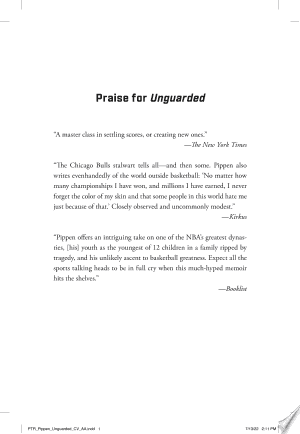
“Pippen is finally giving millions of adoring basketball fans what they crave; an unvarnished... look into his life and role within one of the greatest, most popular teams of all time.”
In the book: The entire premise and content of the book, acting as a direct counterpoint to previous narratives.
Try this: It's essential for individuals to tell their own stories and advocate for their own legacies, rather than allowing others to exclusively define their contributions.
Quiz
10 questions on the main ideas. Each answer comes with a short explanation.
Question 1
What is the title of Scottie Pippen's memoir?
- The Last Dance
- Unguarded
- Sidekick
- Bulls Dynasty
Show answer
B. Unguarded The memoir's title is explicitly stated as 'Unguarded' in the provided text.
Question 2
According to the text, Scottie Pippen was the youngest of how many siblings?
- Ten
- Eleven
- Twelve
- Thirteen
Show answer
C. Twelve The text states, 'Scottie Pippen, the youngest of twelve, overcame...'.
Question 3
In which small town in Arkansas did Scottie Pippen grow up?
- Little Rock
- Fayetteville
- Hamburg
- Pine Bluff
Show answer
C. Hamburg The text mentions, '...growing up poor in the small town of Hamburg, Arkansas...'.
Question 4
What significant event in the 1990s is mentioned in relation to the Chicago Bulls' success and Scottie Pippen's role?
- The NBA lockout of 1998
- The 'Last Dance' documentary series
- The expansion of the league to include new teams
- The introduction of the three-point line
Show answer
B. The 'Last Dance' documentary series The text states, 'There’s no Last Dance documentary.' implying its significance to the Bulls' legacy.
Question 5
How did Scottie Pippen feel about being labeled as Michael Jordan's 'sidekick'?
- He embraced the label as a sign of teamwork.
- He found it amusing but ultimately accepted it.
- He cringed at it.
- He never publicly addressed the label.
Show answer
C. He cringed at it. The text explicitly states, 'Pippen details how he cringed at being labeled Jordan’s sidekick...'.
Question 6
Which NBA team was Scottie Pippen playing against in the 1994 playoff game where he controversially took himself out with 1.8 seconds left?
- Boston Celtics
- Detroit Pistons
- New York Knicks
- Indiana Pacers
Show answer
C. New York Knicks The text mentions, '...including the 1994 playoff game against the New York Knicks when he took himself out with 1.8 seconds to go.'
Question 7
What was Scottie Pippen's draft position in the 1987 NBA Draft?
- First overall pick
- Third overall pick
- Fifth overall pick
- Tenth overall pick
Show answer
C. Fifth overall pick The text states, '...go on to become the fifth overall pick in the 1987 NBA Draft?'.
Question 8
Beyond his basketball achievements, what personal challenges did Scottie Pippen overcome, as mentioned in the memoir's description?
- A career-ending injury and financial mismanagement
- Two family tragedies and disregard by college scouts
- A public scandal and a rivalry with a teammate
- A prolonged contract dispute and a trade demand
Show answer
B. Two family tragedies and disregard by college scouts The description highlights that he 'overcame two family tragedies and universal disregard by college scouts'.
Question 9
The text suggests that Scottie Pippen played a crucial role in the Chicago Bulls' success, stating that without him, there would be no:
- New NBA arenas
- Michael Jordan's individual scoring records
- Championship banners and 'The Last Dance' documentary
- Player empowerment movement in the NBA
Show answer
C. Championship banners and 'The Last Dance' documentary The text emphasizes his importance by saying, 'Simply put, without Pippen, there are no championship banners... There’s no Last Dance documentary.'
Question 10
In 'Unguarded,' Scottie Pippen offers his perspectives on several key figures from his time with the Bulls. Which of the following is NOT explicitly mentioned as someone he discusses?
- Michael Jordan
- Phil Jackson
- Dennis Rodman
- Toni Kukoc
Show answer
D. Toni Kukoc The text lists Michael Jordan, Phil Jackson, and Dennis Rodman as individuals Pippen discusses. Toni Kukoc is not mentioned in this specific list.
Unguarded FAQ
What is "Unguarded" by Scottie Pippen about?
"Unguarded" is a memoir by NBA Hall of Famer Scottie Pippen. It details his journey from a disadvantaged childhood in Arkansas to becoming a crucial player in the Chicago Bulls dynasty of the 1990s.
What personal challenges did Scottie Pippen face before becoming famous?
Pippen grew up in poverty in Hamburg, Arkansas, and experienced two family tragedies. He was also largely overlooked by college basketball scouts despite his talent.
What is Scottie Pippen's perspective on Michael Jordan in the book?
Pippen offers his candid thoughts on playing with Michael Jordan and discusses his feelings about being labeled Jordan's sidekick. He provides insights into their dynamic on and off the court.
Does "Unguarded" discuss Pippen's relationship with other Bulls teammates like Dennis Rodman and coach Phil Jackson?
Yes, the book includes Pippen's transparent takes on other key figures from the Bulls era, including Dennis Rodman and Phil Jackson, offering his personal experiences and perspectives.
What does Scottie Pippen say about his role in the Chicago Bulls' success?
Pippen emphasizes his essential role in the Bulls' six championship wins, arguing that the team's dynasty would not have existed without him. He discusses setting aside his ego for the team's success.
Are there any specific famous games discussed in "Unguarded"?
Yes, Pippen recounts never-before-told stories about significant games, including the 1994 playoff game against the New York Knicks where he famously removed himself from the game with seconds remaining.
Did Scottie Pippen feel he received enough respect from management and media?
Pippen expresses his belief that he deserved more respect from the Bulls' management and the media throughout his career, detailing instances and his feelings about it.
What is the tone of "Unguarded"?
The memoir is described as unflinching, transparent, closely observed, and uncommonly modest, offering an unvarnished look into Pippen's life and career.
What makes "Unguarded" a must-read for basketball fans?
For basketball fans, the book provides a unique and candid perspective from one of the game's greatest players on the legendary Chicago Bulls, their dynamics, and Pippen's often-understated contributions.
About the author

Scottie Pippen is a former professional basketball player known for his time with the Chicago Bulls in the NBA during the 1990s. He is the author of "Unguarded," a memoir that reflects on his life, career, and experiences in basketball. Pippen is recognized as one of the greatest basketball players in history, having won six NBA championships.
Similar books
- The Diary of a Young Girl
Anne Frank
4.2 (2.7M) average on GoodreadsBiographyDuring the Nazi occupation, a teenage girl's diary, written from a secret annex, shares observations on humanity, hope, and the wait for freedom.
- Twisted 1. Twisted love
Ana Huang
3.7 (1.7M) average on GoodreadsA quiet billionaire with a difficult past finds his guarded heart opening to the woman he must protect, but their growing passion uncovers dangerous secrets and a shared, traumatic history.
- Eat, Pray, Love
Elizabeth Gilbert
3.6 (1.5M) average on GoodreadsLifestyleA heartbroken writer leaves her conventional life for a year-long global search for pleasure in Italy, spiritual devotion in India, and unexpected love and balance in Bali.
- Night
Elie Wiesel
4.3 (970k) average on GoodreadsBiographyIn the darkness of Auschwitz and Buchenwald, a teenage Elie Wiesel faces the extermination of his family, the loss of his faith, and the lasting scars of humanity's deepest cruelty.
- Steve Jobs
Walter Isaacson
4.1 (957k) average on GoodreadsBusinessSteve Jobs was a visionary who fused creativity and technology to revolutionize six industries and shape our digital world.
- The Glass Castle
Jeannette Walls
4.3 (903k) average on GoodreadsBiographyJeannette Walls's memoir describes her unusual childhood with brilliant, free-spirited parents whose poverty-stricken life shaped her independence and love despite family problems.






Enjoyed the summary?
A summary gives you the shape of the book. The book itself has the detail, the examples and the voice.
Find Unguarded on AmazonAs an Amazon Associate, BookBrief earns from qualifying purchases. How we're funded