
Core Idea
- Difficulty
- Medium
- Read it if
- You want to understand the fundamentals of investing, learn strategies from top financial experts, and build a resilient financial plan for long-term wealth creation. This book is particularly useful for those seeking to gain confidence and clarity in managing their investments.
- Skip it if
- You are already a seasoned financial professional with extensive knowledge of market mechanics and investment strategies, or you are looking for advanced, speculative trading techniques rather than foundational wealth-building principles.
Key Takeaways from Unshakeable
The Power of Compounding
Time and consistent investment are your greatest allies in wealth creation.
Robbins explains that understanding and using the power of compounding is key to building lasting wealth. He shows how even small, regular investments, given enough time, can grow significantly. This means focusing on consistent saving and reinvesting returns over decades, not just finding the next popular stock. The book points out that the real benefit comes from reinvesting dividends and capital gains, letting your money earn more money. This idea highlights why it's important to start early and think long-term, making it a strategy anyone can use, no matter their current income.
“The greatest force in the universe is compound interest.”
In the book: Historical market data showing the long-term growth of diversified portfolios, particularly through reinvested dividends.
Try this: Automate savings and investments into low-cost index funds or ETFs as early as possible and resist the urge to withdraw funds.
Related ideas: compound-interest, long-term-investing, passive-income
Mastering Your Psychology
Your emotional state, not market conditions, is the primary determinant of your financial success.
This is one of the book's best ideas, showing Robbins's main area of expertise. He argues that controlling your emotions is most important in investing. Fear and greed are the two biggest problems, causing investors to buy high and sell low. Robbins offers ways to stay rational, even when the market is unstable. He stresses that true wealth is not just about money, but about having a full and good life, which needs a positive and strong mindset. This mental discipline helps investors stick to their long-term plan and avoid quick decisions that reduce wealth.
“The secret to wealth is simple: Find a way to do more for others than anyone else. Become more valuable. Do more. Give more. Serve more. And you will get more.”
In the book: Behavioral economics studies demonstrating how emotional biases impact investment decisions, leading to suboptimal outcomes.
Try this: Develop a pre-defined investment strategy and commit to reviewing it only during calm periods, not during market downturns. Practice mindfulness to manage emotional responses.
Related ideas: behavioral-finance, emotional-intelligence, mindset
The All-Weather Portfolio
Diversification across asset classes provides stability in any economic climate.
Robbins promotes the idea of an 'All-Weather Portfolio,' based on Ray Dalio's ideas. This plan involves spreading money across different types of investments—stocks, bonds, commodities, and gold—in specific amounts designed to do well in various economic situations (rising prices, falling prices, economic growth, economic decline). The goal is that when one investment struggles, another will likely do well, providing steady, though possibly moderate, returns over time. This method lowers risk and reduces the need to guess market movements, giving investors peace of mind.
“The single greatest investment lesson ever taught is diversification.”
In the book: Analysis of Ray Dalio's Bridgewater Associates' 'All Weather' strategy performance over decades, demonstrating its resilience in diverse market environments.
Try this: Construct a portfolio with broad diversification across equities, bonds (both long-term and inflation-protected), commodities, and gold, rebalancing periodically.
Related ideas: diversification, asset-allocation, risk-management
Beware of Fees and Taxes
Hidden costs can significantly erode your long-term returns.
Robbins spends a lot of time discussing how high fees and taxes hurt investment returns. He carefully explains how small percentages—like advisory fees, mutual fund costs, and trading fees—can add up over decades to take a large part of an investor's wealth. He suggests using low-cost index funds and ETFs, which offer broad market exposure at minimal expense. The point is simple: every dollar saved in fees is a dollar that can grow for you, instead of going to a financial company. This idea is important for average investors who often miss these 'hidden costs' to wealth.
“The greatest enemy of the investor is not the stock market, but rather high fees and expenses.”
In the book: Illustrative examples showing how a 1% difference in annual fees can lead to hundreds of thousands of dollars in lost returns over a 30-year investment horizon.
Try this: Opt for low-cost index funds or ETFs over actively managed mutual funds. Utilize tax-advantaged accounts (401k, IRA) and consider tax-loss harvesting where applicable.
Related ideas: expense-ratio, index-funds, tax-efficiency
The Illusion of Market Timing
Attempting to predict market movements is a fool's errand that consistently underperforms.
Robbins firmly rejects market timing as a good investment strategy. He provides strong evidence that even professional fund managers struggle to consistently beat the market, let alone predict its highs and lows. The book shows that missing even a few of the market's best days can greatly lower overall returns. Instead, he suggests a 'buy and hold' approach, along with regular rebalancing, staying invested through different market cycles. This argument has limits, as it doesn't fully cover how hard it is mentally to handle long market downturns without doing anything, but its main point is still valid.
“It's not about timing the market, it's about time in the market.”
In the book: Studies showing that investors who attempt to time the market consistently underperform those who remain invested for the long term.
Try this: Adopt a disciplined, long-term investment plan and resist the temptation to make impulsive trades based on market predictions or news cycles.
Related ideas: market-timing, buy-and-hold, dollar-cost-averaging
The Power of Financial Education
Knowledge empowers you to make informed decisions and avoid common pitfalls.
Robbins strongly believes that financial knowledge is not just for the rich; it's a basic need for anyone wanting financial freedom. He notes the lack of practical financial education in traditional schools and aims to fill that gap. The book breaks down complex financial ideas into easy-to-understand terms, explaining everything from asset allocation to annuities. This focus on education helps people question financial advisors, understand product offers, and ultimately take charge of their own financial future, rather than just trusting others. This is the book's main idea—giving readers the tools to be their own financial advocates.
“Knowledge is power. The more you know, the more control you have over your financial destiny.”
In the book: Anecdotal stories of individuals who transformed their financial lives by acquiring robust financial knowledge and applying it.
Try this: Commit to continuous learning about personal finance and investing. Read books, listen to podcasts, and understand the products you invest in.
Related ideas: financial-literacy, investor-education, empowerment
The Myth of the 'Safe' Investment
Every investment carries risk, and understanding it is key to managing it.
Robbins explains the common misunderstanding that some investments are completely 'safe.' He argues that even seemingly secure options like cash or traditional bonds have risks, such as inflation reducing buying power or changes in interest rates. The book stresses that risk is part of any financial choice and that the goal is not to get rid of risk, but to understand, measure, and manage it well through diversification and proper asset allocation. This view encourages investors to move past fear-driven decisions and adopt a planned, informed way of taking risks.
“Risk comes from not knowing what you're doing.”
In the book: Discussions of historical inflation rates and their impact on cash savings, and bond market volatility during periods of rising interest rates.
Try this: Assess your personal risk tolerance honestly. Understand the risks associated with each asset class in your portfolio and diversify to mitigate specific risks.
Related ideas: risk-tolerance, inflation-risk, market-risk
The Importance of Rebalancing
Regularly adjusting your portfolio back to its target allocation maintains risk profile.
Robbins points out rebalancing as an important, often overlooked, part of a successful investment plan. Over time, different investments in a portfolio will perform differently, causing the original target mix to change. Rebalancing means selling investments that have gone up in value and buying those that have gone down to bring the portfolio back to its desired proportions. This disciplined method automatically makes investors 'buy low and sell high,' lowers overall risk, and ensures the portfolio stays aligned with the investor's long-term goals and risk tolerance. It's a practical, systematic way to keep control without needing to predict market movements.
“Rebalancing is boring, but it's one of the most powerful tools an investor has to control risk and maintain their desired asset allocation.”
In the book: Simulations demonstrating how rebalancing can reduce portfolio volatility and potentially enhance returns over the long term compared to a 'set it and forget it' approach.
Try this: Set a schedule (e.g., annually) to review and rebalance your portfolio, selling assets that have grown disproportionately and buying those that have lagged.
Related ideas: rebalancing, asset-allocation, portfolio-management
Finding a Fiduciary Advisor
Seek out advisors legally bound to act in your best interest, not their own.
This idea is a strong call to action for investors. Robbins differentiates between financial professionals who work under a 'suitability standard' and those who follow a 'fiduciary standard.' He strongly advises looking for fiduciary advisors, who are legally and ethically required to put their clients' best interests first, disclosing all fees and possible conflicts of interest. This is an important difference often misunderstood by the public, and Robbins provides clear advice on how to find and check such advisors. While the book encourages self-education, it recognizes the value of expert guidance, as long as that guidance is truly unbiased.
“The single most important decision you'll make in your financial life is choosing who to trust with your money.”
In the book: Discussion of the difference between suitability and fiduciary standards, highlighting regulatory efforts to protect investors and the benefits of working with fiduciaries.
Try this: When seeking financial advice, always ask if an advisor is a fiduciary and how they are compensated. Request a written commitment to a fiduciary standard.
Related ideas: fiduciary-duty, financial-advisor, conflict-of-interest
Give Back and Live Richly
True wealth is measured not just by what you accumulate, but by what you contribute.
Beyond the practical side of investing, Robbins includes his usual philosophy of giving back. He argues that the ultimate goal of financial freedom is not just to accumulate money for oneself, but to be able to contribute and make a real difference in the world. This is the 'why' behind the 'what' of investing. He shares personal stories of his charitable work, especially with Feeding America, to inspire readers to think about how their financial success can be used for the greater good. This argument offers a strong motivating framework, shifting the focus from scarcity and fear to abundance and purpose, making the journey of wealth creation more fulfilling.
“The secret to living is giving.”
In the book: Robbins's personal story of feeding millions through his partnership with Feeding America, demonstrating the impact of giving.
Try this: Integrate charitable giving into your financial plan. Consider setting up a donor-advised fund or regularly contributing to causes you care about.
Related ideas: philanthropy, meaningful-life, purpose-driven
Unshakeable Quotes
“The only thing that can stop you is you.”
“The quality of your life is the quality of your communication.”
“It is in your moments of decision that your destiny is shaped.”
“The path to success is to take massive, determined action.”
“Focus on where you want to go, not on what you fear.”
“The greatest force in the human personality is the ability to change.”
“If you aren't having fun, you're not doing it right.”
“The only real failure is the failure to try.”
“We don't control circumstances; we control our responses to them.”
“The secret to living is giving.”
“You are the master of your fate, the captain of your soul.”
“The greatest gift you can give someone is the gift of your presence.”
“Conditions for success are made, not found.”
“The only thing standing between you and your goal is the story you keep telling yourself.”
Quiz
10 questions on the main ideas. Each answer comes with a short explanation.
Question 1
What is the primary focus of Tony Robbins' book 'Unshakeable'?
- Building a successful business empire.
- Achieving financial freedom and security in uncertain times.
- Mastering public speaking and presentation skills.
- Improving physical health and fitness.
Show answer
B. Achieving financial freedom and security in uncertain times. 'Unshakeable' focuses on strategies and mindsets to build financial security and resilience, especially during market volatility.
Question 2
According to Robbins, what is one of the biggest mistakes investors make during market downturns?
- Not investing enough money.
- Selling their investments out of fear.
- Diversifying their portfolio too much.
- Ignoring market trends altogether.
Show answer
B. Selling their investments out of fear. Robbins emphasizes that panic selling during market crashes is a common and often detrimental mistake that prevents investors from recovering their losses.
Question 3
What does Robbins refer to as the 'ultimate goal' of investing?
- Outperforming the stock market every year.
- Achieving a specific monetary amount.
- Financial freedom and the ability to live life on your own terms.
- Leaving a significant inheritance for heirs.
Show answer
C. Financial freedom and the ability to live life on your own terms. Robbins defines the ultimate goal of investing not just as accumulating wealth, but as achieving the freedom and control to live the life you desire.
Question 4
Robbins discusses the importance of a 'long-term perspective.' What does this mean in the context of investing?
- Focusing solely on short-term gains.
- Ignoring market fluctuations and staying invested through cycles.
- Constantly rebalancing your portfolio.
- Only investing in companies with immediate growth potential.
Show answer
B. Ignoring market fluctuations and staying invested through cycles. A long-term perspective involves understanding that markets go through cycles and that staying invested through ups and downs is crucial for compounding growth.
Question 5
What is the concept of 'asset allocation' as explained in 'Unshakeable'?
- The process of choosing individual stocks.
- The strategy of dividing investments among different asset classes.
- The act of selling all your assets at once.
- The calculation of potential investment returns.
Show answer
B. The strategy of dividing investments among different asset classes. Asset allocation is the practice of spreading your investments across various categories like stocks, bonds, and real estate to manage risk and optimize returns.
Question 6
Robbins highlights the role of 'fear' in investment decisions. What is his recommended antidote to fear?
- Avoiding the stock market entirely.
- Seeking advice from a single financial guru.
- Having a well-defined plan and understanding the fundamentals.
- Constantly checking your portfolio's performance.
Show answer
C. Having a well-defined plan and understanding the fundamentals. Robbins suggests that a solid understanding of investment principles and a clear, long-term plan are the best defenses against making emotional decisions driven by fear.
Question 7
The book mentions the concept of 'diversification.' Why is it important?
- To concentrate all your wealth in one place.
- To reduce overall risk by not putting all your eggs in one basket.
- To guarantee a specific rate of return.
- To make investing more complicated.
Show answer
B. To reduce overall risk by not putting all your eggs in one basket. Diversification is a risk management strategy where you spread investments across different asset classes and sectors, so if one performs poorly, others may still do well.
Question 8
What does Tony Robbins mean by the 'Greatest Wealth Transfer' in the context of the book?
- A government-led redistribution of wealth.
- The shift of wealth from younger generations to older generations.
- The potential for significant wealth creation and transfer due to demographic shifts and economic changes.
- A historical event where fortunes were lost and gained.
Show answer
C. The potential for significant wealth creation and transfer due to demographic shifts and economic changes. Robbins refers to the 'Greatest Wealth Transfer' as the massive movement of assets from one generation to the next, presenting opportunities for those who are prepared.
Question 9
Robbins advocates for understanding 'macroeconomic trends.' What is an example of a macroeconomic trend that could impact investments?
- A company's quarterly earnings report.
- The interest rate set by the central bank.
- A specific marketing campaign by a single business.
- A local zoning law change.
Show answer
B. The interest rate set by the central bank. Central bank interest rate decisions are a significant macroeconomic factor that influences borrowing costs, inflation, and overall economic activity, thereby affecting investments.
Question 10
What is the significance of 'compound interest' as discussed in 'Unshakeable'?
- It is a fixed rate of return that is guaranteed.
- It is the process where earnings from investments also start earning returns, leading to exponential growth over time.
- It is a fee charged by investment managers.
- It is a strategy to minimize short-term risk.
Show answer
B. It is the process where earnings from investments also start earning returns, leading to exponential growth over time. Compound interest is the 'eighth wonder of the world' according to many, as it allows your money to grow exponentially by earning returns on both your initial investment and the accumulated interest.
Unshakeable FAQ
What is Tony Robbins' Unshakeable about?
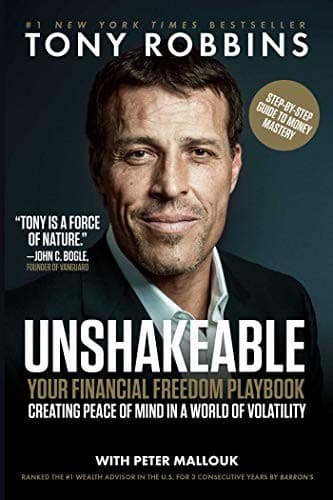
Unshakeable is a book by Tony Robbins that focuses on building financial resilience and achieving long-term wealth. It provides strategies and insights to navigate market volatility and make informed investment decisions, even during uncertain economic times.
How does Unshakeable help with financial uncertainty?
The book offers practical steps and a mindset shift to help readers remain calm and strategic during market downturns. Robbins emphasizes the importance of a long-term perspective and disciplined investing.
What are the main principles of Unshakeable?
Key principles include understanding market cycles, diversifying your portfolio, focusing on long-term growth, and managing emotional responses to financial news. It also highlights the importance of seeking expert advice.
Is Unshakeable suitable for beginner investors?
Yes, Unshakeable is designed to be accessible to investors of all levels. Robbins breaks down complex financial concepts into understandable terms and provides actionable advice that beginners can implement.
Does Unshakeable discuss specific investment products?
While the book discusses investment principles and strategies, it generally avoids recommending specific stocks or funds. The focus is on empowering readers with the knowledge to make their own informed decisions.
How does Unshakeable differ from other investment books?
Unshakeable stands out by combining financial strategy with psychological resilience. Robbins emphasizes the emotional aspect of investing and how to overcome fear and greed to achieve sustained success.
What is the 'Unshakeable' mindset?
The 'Unshakeable' mindset is about maintaining a calm, confident, and disciplined approach to your finances regardless of market fluctuations. It involves trusting your long-term plan and avoiding impulsive decisions driven by fear.
Can I use the advice in Unshakeable during a recession?
Absolutely. The book is specifically designed to help readers navigate challenging economic periods like recessions. It provides tools and perspectives to protect your assets and even find opportunities during downturns.
Where can I buy Tony Robbins' Unshakeable?
Unshakeable is available at major online retailers such as Amazon, Barnes & Noble, and other booksellers. It can be purchased in hardcover, paperback, ebook, and audiobook formats.
What are the benefits of reading Unshakeable?
Reading Unshakeable can lead to increased financial confidence, a clearer understanding of investment strategies, improved emotional control during market volatility, and a more robust long-term financial plan.
Similar books
- The Diary of a Young Girl
Anne Frank
4.2 (2.7M) average on GoodreadsBiographyDuring the Nazi occupation, a teenage girl's diary, written from a secret annex, shares observations on humanity, hope, and the wait for freedom.
- Twisted 1. Twisted love
Ana Huang
3.7 (1.7M) average on GoodreadsA quiet billionaire with a difficult past finds his guarded heart opening to the woman he must protect, but their growing passion uncovers dangerous secrets and a shared, traumatic history.
- Eat, Pray, Love
Elizabeth Gilbert
3.6 (1.5M) average on GoodreadsLifestyleA heartbroken writer leaves her conventional life for a year-long global search for pleasure in Italy, spiritual devotion in India, and unexpected love and balance in Bali.
- Night
Elie Wiesel
4.3 (970k) average on GoodreadsBiographyIn the darkness of Auschwitz and Buchenwald, a teenage Elie Wiesel faces the extermination of his family, the loss of his faith, and the lasting scars of humanity's deepest cruelty.
- Steve Jobs
Walter Isaacson
4.1 (957k) average on GoodreadsBusinessSteve Jobs was a visionary who fused creativity and technology to revolutionize six industries and shape our digital world.
- The Glass Castle
Jeannette Walls
4.3 (903k) average on GoodreadsBiographyJeannette Walls's memoir describes her unusual childhood with brilliant, free-spirited parents whose poverty-stricken life shaped her independence and love despite family problems.






Enjoyed the summary?
A summary gives you the shape of the book. The book itself has the detail, the examples and the voice.
Find Unshakeable on AmazonAs an Amazon Associate, BookBrief earns from qualifying purchases. How we're funded