
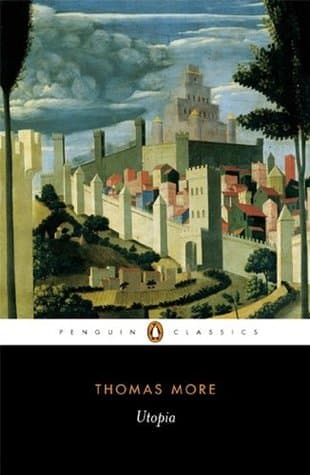
Core Idea
- Difficulty
- Medium
- Read it if
- You are interested in early political philosophy, the origins of utopian thought, or a satirical critique of societal norms through the lens of an idealized (and sometimes unsettling) society.
- Skip it if
- You prefer modern, fast-paced narratives or are looking for a practical guide to societal reform rather than a philosophical exploration.
Key Takeaways from Utopia
The Root of All Evil: Private Property
More argues that private ownership is the fundamental cause of societal ills, fostering greed and inequality.
More's most radical claim, made through Hythloday, is that private property is society's original sin. He argues that individual ownership inevitably leads to an endless desire for more, creating a system where the wealthy exploit the poor. This basic flaw, More says, prevents true justice and happiness from growing in any nation. By removing private property in Utopia, the society eliminates theft, poverty, and the constant pursuit of material gain, allowing citizens to focus on collective well-being and intellectual pursuits. It is a strong critique of early capitalist tendencies and an argument for communal living.
“For where property is private, where money is the measure of all things, it is impossible for a commonwealth to be governed justly or prosperously.”
In the book: Hythloday's description of Utopian society, where 'all things are common,' and the absence of locks on doors or personal possessions. He contrasts this with European societies plagued by poverty, crime, and social unrest directly attributed to private ownership.
Try this: Reflect on how modern societal structures, driven by private property and wealth accumulation, contribute to current inequalities. Consider advocating for policies that prioritize communal resources or explore alternative economic models that de-emphasize individual ownership in certain sectors.
Related ideas: private-property, socialism, communism, inequality
Labor as a Communal Duty
In Utopia, everyone contributes to society's needs through mandatory, yet limited, labor.
Utopian society requires all citizens to do productive labor, mainly farming or a specific craft, to support the entire community. This labor is not hard; it is limited to six hours a day, allowing plenty of time for education, leisure, and intellectual activities. This system eliminates idleness and ensures everyone contributes their share, preventing the exploitation of workers by an idle upper class. The system's efficiency, combined with the absence of unnecessary desires, means minimal effort is needed to meet everyone's needs, creating a balanced life of work and self-improvement.
“They divide the day into twenty-four hours, and allot six only to work; three before dinner, and three after. The rest of their time they are at liberty to employ as they please.”
In the book: The detailed description of Utopian work schedules, where all able-bodied citizens learn at least two trades (farming and one other). The emphasis on efficiency and the absence of unnecessary goods means less labor is needed overall.
Try this: Consider how modern work-life balance could be improved by rethinking mandatory work hours and emphasizing shared responsibility. Advocate for policies that promote shorter workweeks or incentivize meaningful contributions beyond just economic productivity.
Related ideas: work-ethic, leisure, communal-labor, work-life-balance
Pleasure as the Highest Good (with a Catch)
Utopians pursue pleasure, but define it rationally and communally, avoiding excess and prioritizing virtue.
While often seen as a strict society, Utopians are, surprisingly, Epicureans who believe pleasure is life's ultimate goal. However, their idea of pleasure is rational. They distinguish between true pleasures (mental and physical well-being, intellectual pursuits, friendship, virtue) and false pleasures (vanity, excessive wealth, gluttony, cruelty). They understand that chasing immediate, fleeting pleasures often leads to greater pain, so they prioritize long-term, virtuous pleasures that benefit both the individual and the community. This rational approach to pleasure guides their moral philosophy.
“They reason thus: that since the chief end of man is happiness, and since happiness consists in pleasure, it is our duty to pursue it.”
In the book: More's detailed exposition on Utopian philosophy, where they debate the nature of pleasure and ultimately conclude that the 'greatest and truest pleasures' come from a good conscience, health, and intellectual activity, guided by reason and religion.
Try this: Critically evaluate your own pursuit of happiness. Are you prioritizing fleeting gratifications over more sustainable, meaningful pleasures? Consider how cultivating virtue, strong relationships, and intellectual growth can lead to deeper, more lasting contentment.
Related ideas: hedonism, epicureanism, virtue-ethics, happiness
Religious Tolerance, Yet State-Sanctioned Belief
Utopia champions religious freedom, but with a crucial caveat: belief in a higher power and the immortality of the soul is mandatory.
More's Utopians practice religious tolerance that was remarkable for their time, allowing individuals to worship as they choose and even encouraging open debate to find the 'true' religion. However, this tolerance has limits. Atheism is not allowed, nor is denying the soul's immortality. Those with such beliefs are not punished but are excluded from public office and seen as less than human, as their lack of belief in divine judgment is considered a threat to social order and morality. This shows a conflict between individual liberty and the state's need for a shared moral framework, a common issue in political philosophy.
“For they look on this as one of the most important of their tenets, that the soul is immortal, and that God of His goodness has designed that it shall be happy.”
In the book: The Utopian laws explicitly state that anyone denying God or the immortality of the soul is not to be punished but 'despised' and 'excluded from all honors,' as they are deemed incapable of a virtuous life without fear of divine retribution.
Try this: Examine the role of shared moral frameworks, religious or secular, in maintaining social cohesion today. Consider the challenges of balancing individual freedom of belief with the perceived need for common ethical ground in diverse societies.
Related ideas: religious-tolerance, state-religion, atheism, moral-philosophy
War as a Last Resort, Deception as a First Tactic
Utopians despise warfare but are ruthlessly pragmatic and cunning when forced to engage in it.
Despite their peaceful nature, Utopians are not naive. When war is necessary — typically to defend themselves, help allies, or free oppressed people — they use unconventional and often questionable tactics. They use psychological warfare, bribery, and assassination of enemy leaders to win with minimal Utopian casualties. They even hire mercenaries (the Zapoletes), whom they consider expendable, to fight their battles. This contrast between their internal pacifism and external ruthlessness shows a deep practicality, suggesting that even an ideal society must sometimes compromise its ideals for survival.
“They detest war as a very brutal thing, and which, to the reproach of human nature, is more practiced by man than by any sort of beasts.”
In the book: The detailed accounts of Utopian war strategies, including offering rewards for the assassination of enemy generals, inciting internal dissent in enemy states, and using hired foreign soldiers (Zapoletes) as cannon fodder.
Try this: Analyze the ethics of 'just war' theory in modern conflict. Consider whether the ends (peace, liberation) ever justify morally questionable means (deception, targeted killing) in international relations.
Related ideas: just-war-theory, pacifism, realpolitik, military-strategy
The Scrutiny of Authority
Utopian leaders are elected, accountable, and subject to public oversight, preventing tyranny.
Unlike many European monarchies of More's time, Utopian governance is based on accountability and checks and balances. Magistrates are elected annually, and even the Prince, who serves for life, can be removed if suspected of tyranny. Decisions on important matters are made by councils and assemblies, ensuring broad representation and preventing power concentration. This system guards against corruption and ensures leaders serve the common good rather than their own interests, reflecting a distrust of unchecked authority.
“The Prince is for life, unless he is suspected of aiming at tyranny. The other magistrates are chosen annually.”
In the book: The detailed structure of Utopian government, including the election of 'Syphogrants' (Phylarchs) by groups of families, who then elect the 'Tranibors' (Archphylarchs), and finally the Prince (Ademus). The rule that all matters of great importance must be debated in the Senate before being proposed to the people.
Try this: Evaluate the democratic processes and accountability mechanisms in your own government. Consider how transparency and public oversight can be strengthened to prevent abuse of power and ensure leaders truly serve their constituents.
Related ideas: democracy, governance, accountability, checks-and-balances
Education for All, Not Just the Elite
Universal education is central to Utopian society, fostering intellectual growth and civic virtue.
In contrast to contemporary Europe where education was mostly for the clergy and nobility, Utopian society provides universal education for all citizens, men and women. This includes practical skills, philosophy, science, and the arts. Utopians believe an educated population is essential for a well-functioning society, capable of rational thought, ethical decision-making, and contributing to the collective good. This focus on lifelong learning and intellectual development is a core part of their ideal society, preventing ignorance and encouraging continuous improvement.
“They give great attention to the culture of the mind, and the improvement of their understanding.”
In the book: The description of Utopians dedicating their leisure time to lectures, reading, and intellectual discussions. The fact that 'all the children are taught letters' and a general thirst for knowledge is encouraged across all social strata.
Try this: Advocate for equitable access to high-quality education for all, regardless of socioeconomic status. Consider how fostering a culture of lifelong learning and intellectual curiosity can benefit individuals and society.
Related ideas: universal-education, public-education, lifelong-learning, intellectual-development
The Ambiguity of 'Utopia'
More's 'perfect' society is not without its unsettling aspects, blurring the line between ideal and authoritarian.
While Utopian society has many admirable qualities — equality, peace, universal welfare — it also has elements that modern readers find unsettling. The lack of privacy, state control over travel, strict laws against expressing certain beliefs, the use of mercenaries, and communal dining where individuals have little choice can feel authoritarian. This ambiguity is perhaps More's most brilliant move: he makes the reader consider whether a perfectly ordered society, free from want and conflict, might come at the cost of individual liberty and personal expression. The 'ideal' is thus shown to be complex and potentially chilling.
“I cannot agree to all that he said, for it seems to me that many things in the Utopian commonwealth are absurd; but I readily admit that there are many things in their commonwealth which I wish our own had.”
In the book: The detailed rules about needing a passport to travel between cities, the communal meals with assigned seating, the severe penalties for adultery, and the exclusion of atheists from public life. Even the name 'Utopia' itself, meaning 'no place' or 'good place,' hints at this ambiguity.
Try this: Critically analyze any proposed 'perfect' solutions to societal problems, questioning the potential trade-offs between order, efficiency, and individual freedoms. Recognize that true utopias may be inherently unattainable or undesirable.
Related ideas: dystopia, authoritarianism, individual-liberty, social-control
The Power of Satire and the Frame Narrative
More uses the fictional travelogue to critique contemporary European society indirectly and safely.
More's use of a frame narrative, with the fictional traveler Raphael Hythloday describing Utopia, is a clever move. This literary device allowed More to voice radical critiques of European political, economic, and social systems — especially the problems of private property, the foolishness of war, and the corruption of power — without directly supporting them or risking personal harm. By presenting Utopia as a distant, 'no-place' ideal, he could encourage thought and debate among his readers about the flaws of their own societies, while keeping a degree of plausible deniability. It shows the lasting power of allegorical storytelling.
“For it is not just to judge that anything is better which is only more ancient, for old things are not therefore good, but better when they are more agreeable to reason.”
In the book: The entire structure of the book: the initial dialogue between More, Giles, and Hythloday, where Hythloday critiques European society before describing Utopia. The fact that More, as a character, expresses reservations about some Utopian practices, further distancing the author from the most radical ideas.
Try this: Consider how satire and indirect communication can be powerful tools for social commentary and challenging prevailing norms, especially in contexts where direct criticism might be risky. Explore the use of fictional narratives to explore complex philosophical and political ideas.
Related ideas: satire, frame-narrative, allegory, political-philosophy
Utopia Quotes
“For if you suffer your people to be ill-educated, and their manners corrupted from their infancy, and then punish them for those crimes to which their education had disposed them, what else is to be concluded from this, but that you first make thieves and then punish them?”
“They wonder much to hear that gold, which in itself is so useless a thing, should be everywhere had in such estimation, that even among the rudest and barbarous nations it is looked upon as a very valuable thing, and that for it men daily commit so many crimes.”
“They account it a sign of gross stupidity to be carried away with the glittering of a jewel, or the shining of gold; to which man by his own nature can add no ornament, and which, by its own nature, is as liable to be corrupted, as the meanest thing.”
“They detest war as a very brutal thing; and, to the reproach of human nature, they think there is no sort of wild beasts so fierce as man, when he is engaged in fighting with one another.”
“They wonder at the folly of those who make a great show with their clothes, and admire themselves in them, because they are made of a finer sort of thread, or spun with more art.”
“For what justice is there in this: that a nobleman, a goldsmith, or a usurer, or any other man, that either does nothing at all, or at best is employed in things that are of no use to the public, should live in great luxury and splendor, while in the mean time a laborer, a carter, or a carpenter, by so great and continual toil, as being almost beasts of burden, can scarce earn their bread?”
“They have but few laws, and such is their constitution, that they need not many.”
“They think it is an unreasonable thing to make a man suffer for the fault of another, and that a man ought not to be punished for what he could not help.”
“They define virtue to be living according to nature, and think that we are made by God for that end.”
“But a man of a noble mind will not give up his life for a thing that is of no value.”
“For they think that all pleasures are lawful, that do no harm.”
“They are of opinion that no man ought to be punished for his religion.”
“They account idleness a disease, and think it is a great injustice that some should be worn out with perpetual labour, and others live in idleness and luxury.”
“They eat and drink out of earthen ware, and they have no other sort of vessels; but they have some of gold and silver, which serve for no other use than to be chamber-pots, and other vile uses.”
“They live merrily together, and are a great comfort to one another.”
Quiz
10 questions on the main ideas. Each answer comes with a short explanation.
Question 1
Which of the following best describes the Utopian approach to private property?
- It is highly valued and protected by law, with inheritance being a cornerstone of their society.
- It is completely abolished; all goods are held in common.
- It is tolerated but discouraged, with heavy taxes on individual possessions.
- It exists only for essential tools and personal items, not for land or housing.
Show answer
B. It is completely abolished; all goods are held in common. In Utopia, Raphael Hythloday explicitly states that private property is abolished, and all goods are shared among the citizens. This is a fundamental aspect of their society designed to eliminate greed and inequality.
Question 2
What is the primary occupation of all Utopian citizens, regardless of their other professions?
- Philosophy and scholarly pursuits.
- Agriculture.
- Military training and defense.
- Craftsmanship and trade.
Show answer
B. Agriculture. Hythloday explains that every Utopian, men and women alike, is trained in agriculture from childhood and spends a portion of their time working on farms. This ensures self-sufficiency and a connection to the land for all citizens.
Question 3
How do Utopians view gold and silver?
- As precious metals used for currency and display of wealth.
- They are used for common, ignoble purposes like chamber pots and chains for criminals.
- They are stored in government vaults for national emergencies.
- They are traded internationally to acquire necessary goods.
Show answer
B. They are used for common, ignoble purposes like chamber pots and chains for criminals. To demonstrate their disdain for wealth and to prevent avarice, Utopians use gold and silver for the most ignoble purposes, such as making chamber pots and fetters for slaves and criminals. This devalues the metals in the eyes of their children.
Question 4
What is the Utopian stance on religious tolerance?
- Only one state-sanctioned religion is permitted, with severe punishment for dissenters.
- They allow freedom of belief, provided individuals believe in a single supreme being and the immortality of the soul.
- All religions are tolerated, including atheism, as long as public order is maintained.
- They actively promote conversion to their official religion through missionary work.
Show answer
B. They allow freedom of belief, provided individuals believe in a single supreme being and the immortality of the soul. While Utopians initially had diverse religions, King Utopus decreed religious tolerance. However, this tolerance has limits: citizens are expected to believe in a divine power and the immortality of the soul, as those who don't are seen as a threat to societal order.
Question 5
How are Utopian cities structured, and how often do citizens change residences?
- Each family owns a permanent home passed down through generations.
- Houses are randomly assigned based on family size and needs, with no set rotation.
- Houses are assigned by lot and exchanged every ten years.
- Citizens choose their houses freely, but must re-apply every five years.
Show answer
C. Houses are assigned by lot and exchanged every ten years. In Utopia, houses are not privately owned. They are assigned to families by lot, and there is a mandatory exchange of houses every ten years to prevent any sense of individual ownership or attachment.
Question 6
What is the Utopian method for choosing their Prince (chief magistrate)?
- The Prince inherits the position from their predecessor.
- The Prince is chosen by a direct popular vote of all adult citizens.
- The Prince is elected by the Tranibores (chief magistrates of each district) from a pool of learned individuals.
- The Prince is selected by lot from the eldest citizens.
Show answer
C. The Prince is elected by the Tranibores (chief magistrates of each district) from a pool of learned individuals. The Prince is elected for life by the Tranibores (also called Phylarchs in some translations), who are themselves elected by the families. This indirect election system is a key part of Utopian governance.
Question 7
How do Utopians typically wage war, and what is their preferred strategy?
- They engage in direct, large-scale military confrontations with their enemies.
- They prefer to avoid war entirely, even if it means sacrificing some interests.
- They primarily rely on cunning, bribery, and psychological warfare to defeat enemies without direct combat.
- They use a highly trained professional army composed of their own citizens.
Show answer
C. They primarily rely on cunning, bribery, and psychological warfare to defeat enemies without direct combat. Utopians detest war but will fight when necessary. Their preferred strategy is to use cunning, sow discord among enemy leaders, and offer large sums of money to assassinate or capture enemy generals, thus avoiding direct bloodshed for their own citizens.
Question 8
What is the role of pleasure in Utopian philosophy, particularly regarding their view of happiness?
- Pleasure is seen as a distraction from true virtue and is largely suppressed.
- They believe that happiness consists of pleasure, but only those pleasures that are natural and good, aligned with reason and virtue.
- All forms of pleasure are pursued without restraint, as long as they do not harm others.
- Pleasure is a necessary evil, tolerated for the sake of societal harmony.
Show answer
B. They believe that happiness consists of pleasure, but only those pleasures that are natural and good, aligned with reason and virtue. Utopians believe that happiness is found in pleasure, but they distinguish between 'true' and 'false' pleasures. True pleasures are those that are natural, virtuous, and not harmful to oneself or others, often derived from intellectual pursuits, health, and a good conscience.
Question 9
Raphael Hythloday argues that European societies suffer from a fundamental flaw. What is it?
- Lack of strong monarchical leadership and too much democracy.
- The existence of private property, which breeds greed, inequality, and crime.
- Insufficient military power and constant threats from external enemies.
- Too much emphasis on scientific advancement at the expense of moral values.
Show answer
B. The existence of private property, which breeds greed, inequality, and crime. Hythloday's central critique of European society, particularly England, is that private property is the root of all evil, leading to social injustice, poverty, and conflict. He contrasts this sharply with the Utopian system.
Question 10
What is the significance of the Utopian island's physical transformation by King Utopus?
- He built a massive wall around the island to protect it from invasion.
- He dug a broad channel to separate the peninsula from the mainland, making it an island.
- He constructed a vast network of canals for irrigation and transportation.
- He razed all existing structures to build new, uniform cities.
Show answer
B. He dug a broad channel to separate the peninsula from the mainland, making it an island. King Utopus, upon conquering the land, ordered the digging of a fifteen-mile-wide channel to cut off the peninsula from the mainland, thereby making it an island. This act symbolizes the Utopians' self-imposed isolation and unique societal foundation.
Utopia FAQ
What is the main idea behind Thomas More's Utopia?
Thomas More's Utopia presents a fictional island society with an ideal political, legal, and social system, designed to provoke thought and criticism of European society during More's time. It explores themes of communal living, reason, and justice through the eyes of the traveler Raphael Hythloday.
Does the Utopian society described by More actually work in practice?
The Utopian society in More's book is a fictional construct, not a practical blueprint for real-world governance. Its purpose is to serve as a philosophical tool for critique and discussion, rather than a literal model for implementation.
What is 'Utopianism' as derived from More's book?
'Utopianism' refers to the belief in or pursuit of a perfect society, often characterized by ideal social, political, and moral conditions. It's a concept that stems directly from More's imaginative depiction of an ideal commonwealth.
How is Thomas More's Utopia different from Plato's Republic?
While both works describe ideal societies, More's Utopia is presented as an existing (though fictional) island, detailed with practical customs and daily life, and is often seen as a satire. Plato's Republic, conversely, is a philosophical dialogue exploring the theoretical ideal state and justice within the soul, with less focus on specific societal mechanics.
Is Utopia a serious proposal for a better society or a satire?
Utopia is widely considered to be a complex work that functions as both a serious philosophical exploration and a biting satire. More uses the ideal society to highlight the flaws and injustices of contemporary European society, often through ironic praise of Utopian customs.
What are the religious customs of the Utopians?
The Utopians practice a form of deism, believing in a single, unknowable supreme being, but they also tolerate a wide variety of other religions. They prioritize moral living and communal harmony over rigid dogma, reflecting a surprisingly progressive view for More's era.
What is the role of private property in Utopia?
In Utopia, private property is abolished; all goods are held in common. This communal ownership is a cornerstone of Utopian society, intended to eliminate greed, poverty, and social strife, fostering equality among all citizens.
How did Thomas More's personal life influence Utopia?
More's background as a lawyer, statesman, and devout Catholic deeply influenced Utopia, allowing him to critique political corruption, social inequality, and religious conflicts of his time. His humanist education also shaped the philosophical underpinnings of the ideal society he envisioned.
About the author
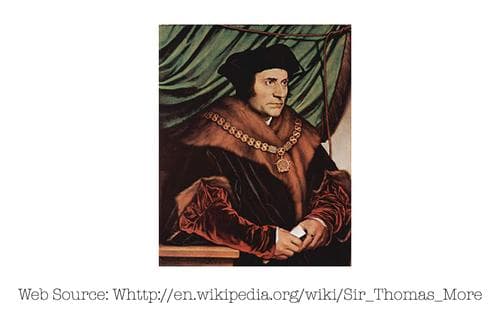
Thomas More was an English statesman and philosopher of the Renaissance era, best known for his work "Utopia," which explores themes of political and social philosophy through a fictional account of an ideal society. His writings often reflect his views on morality, governance, and human nature, contributing significantly to discussions on ethics and societal structures.
Similar books
- The Republic
Plato
3.9 (171k) average on GoodreadsPoliticsBoth are foundational texts in political philosophy that describe an ideal state and explore justice, governance, and societal structure.
- Gulliver's Travels
Jonathan Swift
3.6 (232k) average on GoodreadsFantasyBoth use a travel narrative and fictional societies to satirize contemporary European politics and human nature.
- 1984
George Orwell
4.2 (3.1M) average on GoodreadsPoliticsIn a future where surveillance and thought control are absolute, a man's search for truth clashes with the Party, showing that hope can be a form of rebellion.
- Animal Farm
George Orwell
4.0 (2.7M) average on GoodreadsPoliticsA farm animals' rebellion against humans turns into a pig-led dictatorship, showing how power corrupts and revolutionary ideals are betrayed.
- Freakonomics: A Rogue Economist Explores the Hidden Side of Everything
Steven D. Levitt
4.0 (709k) average on GoodreadsBusinessThis book uses economic principles to reveal the surprising incentives behind everything from drug dealing and real estate to cheating teachers and the decline of crime.
- I Am Malala: The Story of the Girl Who Stood Up for Education and Was Shot by the Taliban
Malala Yousafzai
4.1 (419k) average on GoodreadsPoliticsA teenage girl from a Taliban-controlled valley refuses to give up her books, becoming a global voice for education even after an assassination attempt.




Enjoyed the summary?
A summary gives you the shape of the book. The book itself has the detail, the examples and the voice.
Find Utopia on AmazonAs an Amazon Associate, BookBrief earns from qualifying purchases. How we're funded