
Synopsis
Covers the whole plot, including the ending.
- Difficulty
- Easy
- Pacing
- Slow
- Mood
- Heartwarming, Gentle, Reflective, Hopeful
- Read it if
- You love heartwarming stories about the power of family, enjoy books where animals have secret lives and help humans, and appreciate gentle fantasy with a focus on emotional themes.
- Skip it if
- You prefer high-stakes adventure, complex magic systems, or stories without anthropomorphic animal characters.
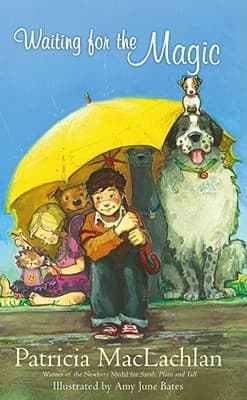
Waiting for the Magic Plot Summary
Covers the whole plot, including the ending.
A New Family and a New Home
The story opens with William and Lucy, a brother and sister, moving with their parents to a new house in the country. They bring with them their pets: four dogs named Eleanor, Penelope, Ben, and Zoey, and a cat named Sassy. The move is a fresh start, though the children sense a subtle tension between their parents. William, in particular, observes his mother's quietness and his father's preoccupation. The family tries to settle into their new rural life, exploring the old house and its surroundings. The pets, especially the dogs, seem unusually observant and connected to the family's emotional state, hinting at their deeper role to come.
Unusual Abilities Emerge
One day, while the children are playing, they are astonished to discover that their pets can talk. Eleanor, the oldest dog, is the first to speak, starting a conversation that confirms the impossible. All four dogs and Sassy the cat can communicate verbally with William and Lucy, though not with their parents. The pets explain that they have always understood human language and that this ability has now extended to speech, awakened by the family's need. This revelation is a turning point, as the children realize their pets are not just companions but sentient beings with their own perspectives and advice.
Pets' Observations and Parental Distance
The pets, particularly the dogs, express concern over the increasing emotional distance between William and Lucy's parents. They observe the parents' lack of communication, separate activities, and the quiet sadness that has settled over the household. Eleanor, Penelope, Ben, and Zoey, along with Sassy, hold 'meetings' with the children, discussing strategies to bring their parents closer. They believe that their family's love is fading, and they feel a responsibility to help rekindle it. The pets, with their unique perspectives, suggest various subtle interventions, discussing the importance of shared experiences and communication.
Operation 'Bring the Parents Together'
Under the guidance of the pets, William and Lucy begin to implement small, seemingly innocuous plans to bring their parents together. These include suggesting family walks with the dogs, encouraging shared meals, and creating opportunities for their parents to talk. For instance, the dogs might 'accidentally' lead the parents to the same spot in the garden, or Sassy might strategically place herself between them on the couch. The children feel a heavy responsibility, understanding that the pets believe the family's future depends on their success. While the parents remain oblivious to the pets' verbal abilities, they do notice the children's increased efforts to create family unity.
Memories and the Magic of Shared History
The pets advise William and Lucy to remind their parents of their shared history and the happy memories they once created. They believe that recalling past joys can help rekindle present affection. William and Lucy start mentioning specific anecdotes, old jokes, or past adventures their parents had together. These gentle prompts are met with mixed reactions; sometimes a flicker of a smile, other times a quiet acknowledgment. The pets discuss that love isn't just about grand gestures but about the accumulation of small, cherished moments. The children learn the power of narrative and nostalgia in reconnecting people.
The Importance of 'Magic'
Through their conversations, the pets clarify what they mean by 'magic.' They explain to William and Lucy that it isn't about spells or supernatural powers, but rather the invisible, powerful force of love, connection, and shared history that holds families together. This 'magic' is what they are trying to help the family rediscover. The pets say that while people might drift apart, this inherent 'magic' can always pull them back. This understanding empowers William and Lucy, helping them see their efforts not just as manipulation, but as an act of nurturing the fundamental bonds of their family.
A Significant Argument
One evening, William and Lucy's parents have a loud, distressing argument. The children overhear harsh words, and the tension in the house becomes strong. The pets, sensing the children's fear and sadness, gather around them, offering comfort and reassurance. This argument, while painful, is a catalyst. The pets see it as a sign that the underlying issues are finally surfacing, which, though difficult, is a necessary step towards resolution. It reinforces their urgency to help the family, making their mission feel even more critical to William and Lucy.
The Pets' Final Push
After the argument, the pets decide they need a more direct approach. They create a situation that forces the parents to confront each other and truly talk. This involves a series of coordinated 'accidents' or 'mishaps' that require both parents to be present and engaged. For example, Ben might 'lose' his favorite toy in a way that requires both parents to search for it together, or Sassy might 'get stuck' in a place that needs joint effort to retrieve her. These gentle manipulations are designed to create an environment where the parents are forced to communicate beyond superficial pleasantries.
A Small Breakthrough
The pets' efforts, combined with William and Lucy's persistent encouragement, slowly begin to work. The parents, initially wary, start to engage in longer conversations, share small laughs, and show subtle gestures of affection. There's a noticeable shift in the atmosphere of the house, from quiet tension to a more relaxed and open environment. William and Lucy observe their parents sitting closer, talking about their day, and even reminiscing together. The children feel a sense of hope and relief, seeing their family's 'magic' slowly returning, proving the pets' wisdom.
Family Reunited and the Quiet Magic
By the end of the story, William and Lucy's family is visibly reunited. Their parents are communicating, laughing, and sharing moments of affection, much to the children's and pets' joy. The 'magic' of their love has been rekindled, not through grand supernatural events, but through the patient, loving interventions of their children and their extraordinary pets. The pets' ability to speak quietly fades as the family's need lessens, a subtle sign that their mission is complete. William and Lucy understand that the true magic was always within their family, a powerful bond that, with a little help, could overcome any distance.
Waiting for the Magic Characters
William
Protagonist
The observant and sensitive son, actively working to save his family.
William is one of the two child protagonists. He is sensitive and perceptive, quickly noticing the growing distance between his parents and feeling the weight of their unhappiness. He forms a strong bond with the talking animals, becoming a key participant in their plan to reunite the family. William is driven by a deep love for his parents and a desire for his family to be whole again. He takes the pets' advice seriously and actively helps implement their strategies, demonstrating a maturity beyond his years.
Relationships: Lucy (sister, co-conspirator); Eleanor (dog, wise mentor); Parents (loved ones, source of his concern)
Lucy
Protagonist
William's sister, equally involved in the pets' plan to bring her family together.
Lucy is William's younger sister and the other child protagonist. She is also aware of the tension between her parents and readily embraces the astonishing reality of their talking pets. Lucy is enthusiastic and creative in her approach to the pets' plans, often coming up with ideas or helping to execute the smaller interventions. She shares William's desire to see her parents happy and their family restored. Her open-mindedness and willingness to believe in the 'magic' are crucial to the success of their mission.
Relationships: William (brother, co-conspirator); Sassy (cat, companion); Parents (loved ones, focus of her efforts)
Eleanor
Supporting
The oldest and wisest dog, serving as the leader and primary voice of the animal group.
Eleanor is one of the four dogs and the clear leader of the animal pack. She is the first to speak to William and Lucy and often articulates the pets' observations and plans. Eleanor is wise, calm, and deeply perceptive, understanding the nuances of human emotion and the dynamics of the family. She acts as a mentor to the children, explaining the nature of the 'magic' and guiding their efforts to help their parents. Her presence provides a stable and authoritative voice for the pets.
Relationships: William (pupil, friend); Lucy (pupil, friend); Penelope, Ben, Zoey (fellow dogs, companions); Sassy (fellow pet, companion)
Penelope
Supporting
One of the four dogs, often providing practical suggestions and observations.
Penelope is another of the four dogs. She contributes to the pets' discussions with practical insights and often reinforces Eleanor's wisdom. Penelope is observant and sometimes more direct in her assessment of the parents' behavior. She is an active participant in the 'operation' to bring the parents together, helping to strategize and execute the subtle interventions. Her character adds another layer of perspective to the pets' collective intelligence.
Relationships: Eleanor (fellow dog, companion); Ben (fellow dog, companion); Zoey (fellow dog, companion)
Ben
Supporting
One of the four dogs, known for his playful nature and sometimes humorous contributions.
Ben is one of the four dogs, often characterized by his more playful and sometimes mischievous nature. While he participates in the serious discussions, he also brings a lighter touch to the group. Ben is instrumental in some of the more active 'interventions,' such as 'losing' a toy to create a shared parental activity. His presence reminds the children that even in serious situations, there can be moments of joy and gentle persuasion.
Relationships: Eleanor (fellow dog, companion); Penelope (fellow dog, companion); Zoey (fellow dog, companion)
Zoey
Supporting
One of the four dogs, often quieter but equally perceptive and supportive.
Zoey is the fourth dog in the family. While perhaps less vocal than Eleanor or Penelope, she is no less perceptive or committed to the family's cause. Zoey often offers quiet affirmations or subtle observations that contribute to the pets' overall understanding of the situation. She provides a steady, supportive presence for both the children and the other animals, reinforcing the collective effort to mend the family's bonds. Her quiet wisdom is an important part of the animal team's dynamic.
Relationships: Eleanor (fellow dog, companion); Penelope (fellow dog, companion); Ben (fellow dog, companion)
Sassy
Supporting
The family cat, offering a distinct, often more cynical or pragmatic perspective.
Sassy is the family cat. She is unique among the pets not only because she is a cat but also for her distinct personality. Sassy is often more cynical or pragmatic than the dogs, offering a contrasting viewpoint that sometimes provides comic relief but also grounding realism. Despite her independence, she is equally invested in the family's well-being and participates in the discussions and plans. Her strategic 'mishaps' often serve to bring the parents into closer proximity.
Relationships: William (companion); Lucy (companion); Eleanor (fellow pet, sometimes rival in opinion)
Mother (William and Lucy's)
Supporting
The quiet and somewhat withdrawn mother, struggling with an unspecified marital strain.
William and Lucy's mother is initially portrayed as quiet and somewhat withdrawn, her happiness seemingly diminished by the tension in her marriage. She loves her children but struggles to connect with her husband. Her emotional state is a primary concern for the pets and children. As the story progresses, she slowly begins to respond to the subtle interventions, showing signs of rekindled joy and affection. She represents the 'magic' that needs to be rediscovered within the family.
Relationships: William (son); Lucy (daughter); Father (husband, source of marital strain)
Father (William and Lucy's)
Supporting
The preoccupied father, initially distant but capable of rekindling his love.
William and Lucy's father is depicted as preoccupied and somewhat distant, contributing to the marital strain. He is not malicious but has allowed the connection with his wife to wane. Like the mother, he loves his children, but his attention is often elsewhere. He is oblivious to the pets' abilities but subtly responds to the children's and pets' orchestrated efforts. His journey involves breaking through his preoccupation to reconnect with his wife and the 'magic' of their shared life.
Relationships: William (son); Lucy (daughter); Mother (wife, strained relationship)
Waiting for the Magic Themes
The Enduring Power of Family Love
The central theme is that love, while sometimes challenged, is an enduring force that binds families together. The story explores how this 'magic' of love can fade when neglected but can be rekindled through conscious effort and shared experiences. The pets' mission is based entirely on the belief that William and Lucy's parents still love each other, even if they've forgotten how to show it. The children's actions, guided by the animals, demonstrate that love isn't passive but requires nurturing, communication, and a willingness to remember shared joys.
“'Love is the magic,' said Eleanor, 'and sometimes it gets lost, but it's always there, waiting to be found.”
Communication and Connection
The lack of communication between William and Lucy's parents is a key driver of the plot. The pets explicitly identify this lack of talking and shared experience as the reason for the parents' growing distance. Conversely, the pets' ability to communicate with the children, and the children's subsequent efforts to help their parents communicate, show the vital role of open dialogue in maintaining relationships. The story says that genuine connection is built on listening, sharing, and actively engaging with one another, rather than merely coexisting.
“They don't talk anymore,' said Penelope. 'Not real talking. Just about groceries and bills.”
The Unseen Wisdom of Animals
A core theme is that animals possess a deep, often unseen wisdom and perception about human emotions and relationships. The talking pets are not just a fantastical element; they are the catalysts and guides for the family's healing. They observe nuances that the children sense but cannot articulate, and they understand the fundamental needs of the human heart. Their ability to speak symbolizes their deep connection to the family's emotional state and their role as guardians of its well-being, suggesting that we often underestimate the intelligence and empathy of our animal companions.
“We see more than you think,' said Sassy, stretching. 'And hear more, too.”
Child's Perspective on Marital Strife
The story offers a look at marital problems through the eyes of children. William and Lucy's worry, confusion, and determination to 'fix' their parents' relationship are central. They experience the tension and sadness that marital discord brings into a home, and their actions are driven by a desire to restore the comfort and happiness they associate with a united family. This perspective shows the impact of parental relationships on children and their innate desire for family harmony, even if they don't fully grasp the complexities of adult love.
“William felt it, that quiet, empty space between his mother and father, a space that grew bigger every day.”
Defining 'Magic'
The book redefines 'magic' not as supernatural spells or fantastical occurrences, but as the inherent, powerful, and sometimes intangible force of love, connection, and shared humanity. While the pets' ability to talk is magical, they themselves clarify that the 'magic' they are referring to in the family is the bond of love. This theme suggests that the most profound and impactful 'magic' in life is often found in everyday relationships and the efforts we make to nurture them, discussing that true wonder is in human connection.
“The magic isn't a trick,' said Eleanor. 'It's what holds you together, even when you try to pull apart.”
Plot Devices & Literary Techniques
Anthropomorphism (Talking Animals)
Animals with human-like qualities, specifically the ability to speak.
The most prominent plot device is the anthropomorphism of the family's pets, who gain the ability to speak to William and Lucy. This device serves as the primary catalyst for the plot, allowing the animals to directly guide the children in their mission to save their parents' marriage. Without this ability, the pets could only observe, but with it, they become active, intelligent agents of change, offering wisdom and strategy. It also adds a fantastical element that makes a serious topic accessible and engaging for young readers.
Limited Omniscient Point of View (Children's Perspective)
The story is primarily told through the experiences and observations of William and Lucy.
The narrative largely maintains the perspective of William and Lucy. While the narrator occasionally provides insights into the animals' thoughts, the core emotional and observational lens is that of the children. This allows the reader to experience the parents' marital strain as children would – with worry, a sense of helplessness, and a strong desire to fix things, without fully understanding the adult complexities. It highlights the impact of parental relationships on children and makes their efforts to mend the family feel all the more significant.
Symbolism of the 'Magic'
The term 'magic' symbolizes the intangible bond of love and family connection.
The word 'magic' itself functions as a powerful symbol throughout the book. Initially, it might imply a literal supernatural force, especially with the talking animals. However, the pets repeatedly redefine it, explaining that the true 'magic' is the love, shared history, and connection within the family. This symbolism elevates the everyday act of loving and nurturing relationships to something extraordinary, teaching that the most profound 'magic' isn't found in spells but in the human heart and the bonds we forge.
The Journey/Quest Motif
William and Lucy embark on a quest to restore their family's happiness.
While not a physical journey, the children and pets undertake a metaphorical quest to 'save' their family. They have a clear goal (reuniting the parents), face obstacles (the parents' emotional distance, arguments), and receive guidance (from the pets). This quest structure provides a clear narrative arc, creating suspense and investment in the outcome. It transforms the abstract problem of marital discord into a concrete mission for the children, making their efforts feel heroic and purposeful.
Waiting for the Magic Quotes
“Sometimes the magic is there, and sometimes it's not. You just have to wait for it.”
“A house isn't a house without animals. It's just a building.”
“Dogs know things. They just don't always tell you in words.”
“The best stories are the ones that grow in your heart.”
“Sometimes you have to be quiet to hear what's important.”
“Love isn't always easy, but it's always worth it.”
“Animals are good at knowing who needs them.”
“Every day is a new story waiting to be told.”
“You don't always need to see magic to know it's there.”
“Family isn't just people. It's everyone and everything that belongs.”
“The world is full of wonders, if you just stop to look.”
“Sometimes the most ordinary things are the most magical.”
“A good book is like a quiet friend.”
Quiz
10 questions on the plot and the characters. Each answer comes with a short explanation.
Question 1
What is the primary goal of William and his sister, as stated in the book's description?
- To find a hidden treasure
- To win a pet show
- To save their family
- To learn how to perform magic tricks
Show answer
C. To save their family The book description explicitly states that the story is about how the animals help the boy and his sister 'save their family'.
Question 2
How many dogs are mentioned as helping William and his sister?
- Two
- Three
- Four
- Five
Show answer
C. Four The description clearly states 'four dogs' and one cat are part of the animal helpers.
Question 3
Besides 'love can hold them together' and 'magic is all around us,' what other theme is explicitly mentioned in the book's description?
- The importance of friendship
- People may drift apart
- The power of imagination
- Overcoming fear
Show answer
B. People may drift apart The very first line of the description states: 'People may drift apart But love can hold them together.'
Question 4
What kind of animals, in addition to dogs, are involved in helping William and his sister?
- Birds
- Hamsters
- A cat
- Fish
Show answer
C. A cat The description specifies 'four dogs and one cat' as the animal helpers.
Question 5
The book description implies that magic plays a role in finding love. What other way is love suggested to be found or maintained?
- Through hard work and determination
- Through shared experiences and memories
- Through the strength of existing bonds, even when people drift apart
- Through seeking advice from wise elders
Show answer
C. Through the strength of existing bonds, even when people drift apart The description begins with 'People may drift apart But love can hold them together,' indicating that love's power to maintain connections is a key aspect, alongside magic.
Question 6
The book is categorized as 'Fantasy, Children's'. Which element from the description best supports the 'Fantasy' categorization?
- A boy and his sister saving their family
- The involvement of four dogs and one cat
- The idea that love can hold people together
- The concept of finding love through magic, or magic being all around us
Show answer
D. The concept of finding love through magic, or magic being all around us The inclusion of 'magic' as a means to find love and as a pervasive force ('magic is all around us') is the clearest indicator of the fantasy genre.
Question 7
What specific challenge or situation is implied to be facing the family that requires saving?
- They are lost in a wilderness.
- They are facing financial ruin.
- They are drifting apart, suggesting emotional or relational strain.
- They are threatened by an external villain.
Show answer
C. They are drifting apart, suggesting emotional or relational strain. The opening lines, 'People may drift apart But love can hold them together,' strongly suggest that the family's 'saving' relates to reconnecting emotionally or relationally, rather than a physical or financial threat.
Question 8
How many human characters are explicitly named as protagonists in the description?
- None
- One (William)
- Two (William and his sister)
- Three (William, his sister, and their parent)
Show answer
A. None The description refers to 'one boy and his sister' but does not provide any specific names for them, making 'None' the correct answer for named protagonists.
Question 9
The description states, 'Sometimes we find that love through magic – Sometimes that magic is all around us.' What nuanced difference does this suggest about the role of magic?
- Magic is only present in specific, grand events.
- Magic can be an active force in finding love, but also a more subtle, ever-present influence.
- Magic is exclusively found in physical objects or spells.
- Magic is a metaphor for good luck, not a real force.
Show answer
B. Magic can be an active force in finding love, but also a more subtle, ever-present influence. The phrasing 'through magic' suggests an active, directed use or encounter with magic, while 'magic is all around us' points to a more pervasive, possibly subtle or inherent magical quality of the world or relationships. This implies both direct and ambient forms of magic.
Question 10
Based on the description, what is the most likely central conflict or problem that the animals are helping to resolve?
- A physical threat to the family's home or safety.
- A lack of resources or financial stability for the family.
- The emotional distance or fragmentation within the family unit.
- A mystery that needs to be solved by the children.
Show answer
C. The emotional distance or fragmentation within the family unit. The opening lines 'People may drift apart But love can hold them together' and the overall theme of love and magic saving the family strongly suggest that the core issue is the emotional or relational 'drifting apart' of family members, which the animals help to mend.
Waiting for the Magic FAQ
What is "Waiting for the Magic" about?
"Waiting for the Magic" tells the story of William and his sister, who, along with their parents, are grappling with their parents' impending separation. Their eccentric grandmother sends them four dogs and a cat, who turn out to be magical and articulate, helping the children understand and navigate their family's changing dynamics.
Why should I read "Waiting for the Magic"?
You should read this book for its heartwarming exploration of family, love, and change, viewed through the unique lens of talking animals. It offers comfort and wisdom about difficult emotions, blending gentle humor with profound insights, making it a beautiful read for both children and adults facing family transitions.
What is the background/setting of "Waiting for the Magic"?
The story is set in a contemporary, somewhat rural family home where William and his sister live. The arrival of the magical pets from their grandmother introduces an element of enchantment into their otherwise ordinary, though emotionally turbulent, lives, creating a cozy yet fantastical backdrop for their journey.
What are the most memorable quotes?
Memorable quotes often revolve around the animals' sage advice, such as 'Love holds us together,' or moments where the animals articulate complex human emotions in simple, profound ways. The book is filled with gentle wisdom about the nature of family and connection.
What writing style does the author use?
Patricia MacLachlan employs a gentle, lyrical, and accessible writing style, characteristic of her children's literature. She uses clear, evocative language that conveys deep emotions and complex themes without being overwhelming, perfectly balancing simplicity with profound meaning.
What minor details add significant meaning?
The names of the animals – Eleanor, Gus, Frank, and May for the dogs, and Edward for the cat – often subtly reflect their personalities or roles, adding a layer of depth. For example, the steadfastness of Eleanor or the philosophical musings of Edward enrich their contributions to the family's healing.
What are some subtle foreshadowing moments?
Subtle foreshadowing includes the grandmother's initial letter, hinting at the special nature of her gifts beyond just being pets. Also, the animals' immediate, uncanny understanding of the family's unspoken sadness from the moment they arrive subtly prepares readers for their magical abilities.
What unexpected character connections exist?
The most unexpected connections are between the children and the animals, who quickly become confidantes and counselors, bridging the emotional gap created by the parents' struggles. The animals' shared past with the grandmother also hints at a deeper, mystical lineage.
What are unspoken character motivations?
The parents' unspoken motivation is often a desire to protect their children from the pain of their separation, leading them to delay difficult conversations. The animals' motivation, on the other hand, is driven by an inherent magical purpose to foster love and connection, acting as catalysts for healing.
What psychological complexities do characters exhibit?
William and his sister exhibit the complex emotions of children grappling with parental separation: confusion, sadness, and a desire to fix things. Their parents show the complexities of adults trying to navigate personal pain while maintaining a semblance of normalcy for their children.
What are the major emotional turning points?
A major emotional turning point is when the children first realize the animals can understand and communicate with them, transforming their pets into allies. Another is when the parents finally acknowledge their struggles to each other and the children, prompted by the animals' subtle interventions.
How do relationship dynamics evolve?
The relationship dynamics evolve from strained and distant between the parents, and confused for the children, to more open and understanding. The animals act as facilitators, helping each family member communicate their feelings, ultimately strengthening the bonds within the family, even if it means changing their structure.
Which parts remain ambiguous or open-ended?
The exact nature and origin of the animals' magic remain somewhat ambiguous, presented as an inherent, unexplained gift. While the family's emotional healing is clear, the long-term future of the parents' relationship is handled with a gentle open-endedness, focusing on love's enduring presence rather than a definitive 'fix'.
What are controversial scenes or decisions?
There are no overtly controversial scenes in this gentle children's book. However, the decision of the parents to separate, even if handled with care, is a central difficult topic. The book navigates this with sensitivity, focusing on the children's perspective and the healing process rather than judgment.
"Waiting for the Magic" ending explained: how it ends & what it means
The book ends with the family, including the magical animals, having found a new equilibrium. The parents might still separate, but the children have come to terms with it, understanding that love persists even through change. The magic of the animals has helped them articulate unspoken fears and find comfort, signifying that love and connection, though not always perfect, are enduring forces that bind a family together.
About the author

Patricia MacLachlan is an American author known for her works of children's and young adult fiction. Her notable books include "Skylark," "Waiting for the Magic," "White Fur Flying," and "The Facts and Fictions of Minna Pratt," which often explore themes of family and connection. MacLachlan's writing has received various accolades, reflecting her impact on children's literature.
Similar books
- The One and Only Ivan
Katherine Applegate
4.3 (141k) average on GoodreadsFantasyExplores deep emotional themes and the power of connection through the perspective of an animal.
- Because of Winn-Dixie
Kate DiCamillo
4.0 (206k) average on GoodreadsChildren'sA dog helps a child navigate family difficulties and build new connections in a small town.
- Bridge to Terabithia
Katherine Paterson
4.0 (445k) average on GoodreadsFantasyBridge to Terabithia offers a significantly more profound and emotionally raw exploration of grief and loss. While MacLachlan's book uses magic to soften the blow, Paterson's confronts it directly, resulting in a more impactful and enduring emotional experience for the reader. The friendship and imaginative world in Terabithia are deeply tied to the characters' internal lives, whereas the magic in Waiting for the Magic feels more external.
- Coraline
Neil Gaiman
4.0 (23k) average on GoodreadsFantasyWhile both books feature fantastical elements and a child protagonist discovering a hidden world, Gaiman's Coraline uses its magic to explore themes of courage, family, and danger with far greater thematic depth and narrative tension. The magic in Coraline is often unsettling and serves to challenge the protagonist, leading to significant character growth, whereas the magic in Waiting for the Magic primarily provides comfort and companionship without intense challenge.
- Harry Potter and the Sorcerer's Stone
J.K. Rowling
4.5 (7M) average on GoodreadsFantasyRescued from a miserable life under the stairs, an orphaned boy discovers he's a wizard destined for a magical school, where he uncovers a dangerous secret tied to the dark wizard who murdered his parents.
- The Hunger Games
Suzanne Collins
4.3 (6.4M) average on GoodreadsFantasyIn a future where children fight to the death on live television, Katniss Everdeen volunteers for the arena, turning a death sentence into a fight for survival and a spark of rebellion.




Enjoyed the summary?
A summary gives you the shape of the book. The book itself has the detail, the examples and the voice.
Find Waiting for the Magic on AmazonAs an Amazon Associate, BookBrief earns from qualifying purchases. How we're funded