
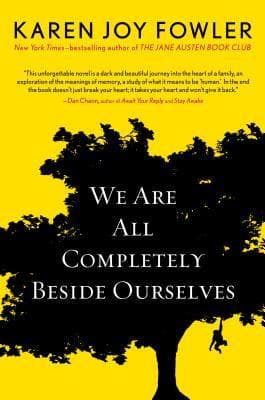
Synopsis
Covers the whole plot, including the ending.
- Difficulty
- Medium
- Pacing
- Moderate
- Mood
- Reflective, Poignant, Thought-provoking, Melancholy
- Read it if
- You enjoy thought-provoking literary fiction that explores themes of family, memory, identity, and ethics with a unique premise.
- Skip it if
- You prefer fast-paced thrillers or straightforward narratives without moral ambiguity.
We Are All Completely Beside Ourselves Plot Summary
Covers the whole plot, including the ending.
A College Confession
Rosemary Cooke, a college student at the University of California, Davis, has trouble with social interactions and is often quiet. She begins to tell her past, hinting at a secret in her family. She says she had a sister, Fern, who was taken from her at age five. This event, along with her older brother Lowell's later disappearance, has affected her family, leaving her parents distant and hurt. Rosemary's storytelling is conversational and indirect, purposefully holding back the main reveal about Fern's true nature, while emphasizing the emotional emptiness left by her absence and the breakdown of her family. She speaks of her own difficulty making connections, blaming it on her unusual upbringing.
The Early Years with Fern
Rosemary remembers her early childhood on a research farm in Bloomington, Indiana, where she and Fern were always together. She describes Fern as her constant companion, a sister with whom she shared everything. Their parents, a psychologist father and a linguist mother, were involved in their upbringing, creating an environment of curiosity and learning. The family seemed loving, though unusual because of their father's academic work. Rosemary remembers their house being busy, often with graduate students and researchers visiting. She points out Fern's distinctiveness, noting her unusual eating habits and non-verbal communication, which Rosemary, as a young child, thought was just 'Fern being Fern'.
The Revelation of Fern's Identity
Rosemary suddenly reveals the family secret: Fern was not a human girl, but a chimpanzee. This comes after much hinting, explaining earlier mentions of Fern's unique traits. Rosemary explains that Fern was part of a cross-fostering experiment her father, a psychologist, conducted to study language acquisition and human-animal bonding. Rosemary, as a human child, was raised with Fern as a sibling, learning sign language together. The family treated Fern as a daughter, dressing her, teaching her, and including her fully in their lives. This experiment, while new, caused great emotional stress on the family, especially Rosemary, who was too young to understand the scientific meaning of her sister's species.
The Separation and its Aftermath
At age five, Fern is suddenly removed from the Cooke home. Rosemary describes the event as traumatic and confusing, leaving her with a strong sense of loss and betrayal. She does not fully understand why Fern is gone, only that her parents' mood changes greatly. Her mother becomes withdrawn, and her father becomes distant and secretive. The house, once lively, becomes quiet and filled with unspoken sadness. Rosemary at first believes Fern has simply gone to live with other chimpanzees, but the emotional impact on her family is huge. This separation marks the end of Rosemary's carefree childhood and the start of her family's slow breakdown, as they struggle with the void left by Fern's absence and the ethical arguments around the experiment.
Lowell's Rebellion and Disappearance
Lowell, Rosemary's older brother, becomes more rebellious and withdrawn after Fern's removal. He feels a strong sense of injustice and guilt about Fern's fate, believing she was unfairly taken. He tries to find Fern, searching for information and even trying to visit the facility where she was taken. His activism against animal experimentation grows, leading to fights with his father and authorities. Eventually, Lowell disappears from the family's life, leaving a note that he is going to help other chimpanzees. His disappearance adds to the family's grief and secrecy, leaving Rosemary as an only child and her parents even more isolated in their sorrow. Lowell's actions show the ethical complexities of the experiment and its lasting impact on the Cooke children.
The Silence and the Guilt
After losing both Fern and Lowell, the Cooke family retreats into a deep silence. Rosemary, once a talkative child, learns to suppress her questions and memories, internalizing the family's unspoken grief. Her parents, consumed by their own sorrow and guilt, cannot openly discuss Fern or Lowell, creating an emotional gap in the home. Rosemary struggles with her own guilt, believing she might have caused Fern's removal by talking too much or acting wrongly. This period of silence shapes Rosemary's personality, making her reserved and socially awkward, as she carries the burden of her family's broken past and the secret of Fern's identity, which she feels she must protect.
Meeting Harlow and the Truth About Fern
At college, Rosemary meets Harlow, a former graduate student of her father's. Harlow, now a primatologist, gives Rosemary more details about Fern's life after she was taken from the Cooke family. Harlow reveals that Fern was placed in a research facility with other chimpanzees but struggled to adjust to a purely chimpanzee environment after being raised as a human. Fern developed self-harming behaviors and depression. Harlow explains the ethical debates around cross-fostering experiments and the long-term psychological damage they can cause to non-human primates. This information deeply upsets Rosemary, making her face the full, painful reality of Fern's suffering and the ethical implications of her father's work, challenging her idealized childhood memories.
The Search for Lowell
Rosemary's mother, finally breaking her long silence, encourages Rosemary to find Lowell. She admits her own guilt and desire for her son, revealing that she has kept a box of Lowell's letters and postcards, hinting at his location. Inspired by her mother's new openness and her own desire for answers, Rosemary begins a journey to find Lowell. Her search takes her to various places connected with animal rights activism, following clues from Lowell's past. This quest shows Rosemary actively engaging with her family's broken history and trying to mend the relationships that have been broken by years of silence and secrets, seeking closure for herself and her parents.
Reunion with Lowell
Rosemary eventually finds Lowell at a secluded cabin in the Pacific Northwest, where he lives off the grid and is still involved in animal rights and rescue operations. Their reunion is tense at first, as Lowell is cautious and still resentful of their father and the experiment. He has dedicated his life to advocating for animal welfare, especially chimpanzees, to make up for Fern's suffering. Rosemary learns about Lowell's experiences, his commitment to his cause, and his sacrifices. This meeting allows them to start closing the gap of years of separation and unspoken pain, as they share their grief and their different views on Fern's life and their family's past.
Visiting Fern
Rosemary and Lowell decide to visit Fern at a chimpanzee sanctuary where she now lives. The sanctuary offers a more natural environment for chimpanzees rescued from research or entertainment. Seeing Fern again, after decades, is an emotional experience for both siblings. Fern is older, her behavior still showing the scars of her past, but she lives with other chimpanzees. Rosemary observes Fern's interactions with her own kind, recognizing the impact of her human upbringing and her struggle to integrate. This visit provides a form of closure, allowing Rosemary to directly face the reality of Fern's life and to acknowledge the complex legacy of her family's experiment, fostering a deeper understanding between her and Lowell.
Reconciliation and Forgiveness
After their visit to Fern, Rosemary and Lowell return to their parents, bringing a new openness to the family. They begin to openly discuss Fern, Lowell's activism, and the impact of the experiment on all of them. The long silence is finally broken, allowing for a painful but necessary process of reconciliation and forgiveness. Their parents, especially their father, begin to confront the ethical consequences of his work and the personal cost to his family. This period marks a turning point, as the family starts to heal, finding a way to acknowledge their shared history and the unique bond they all shared with Fern, moving towards a future based on honesty and mutual understanding.
Moving Forward
With her family's secrets finally revealed and reconciliation begun, Rosemary finds her own voice. She continues her studies, now able to engage more genuinely with the world and her peers. She accepts her unique past, no longer burdened by silence or secrecy. Rosemary's story ends with hope and resilience, showing her growth from a withdrawn young woman to someone able to face difficult truths and form meaningful connections. She reflects on the lasting bond with her siblings, both human and chimpanzee, and the complex, beautiful, and sometimes painful nature of family love, accepting her identity shaped by extraordinary circumstances.
Principal Figures
Rosemary Cooke
Protagonist
The narrator, a young woman grappling with her family's unique past.
Rosemary is the observant, often silent narrator of the story. As a child, she was talkative, but after Fern's removal, she became withdrawn and secretive, internalizing her family's grief and the unspoken truth about her sister. She struggles with social interactions and forming connections, shaped by her unconventional upbringing and the trauma of loss. Her narrative voice is conversational yet circuitous, deliberately withholding information to maintain suspense. She is driven by a deep longing for understanding and connection, both with her past and her estranged family members.
Relationships: Fern (Younger sister (chimpanzee), best friend, object of deep love and loss); Lowell (Older brother, initially estranged, later reunited through shared trauma and love for Fern); Dr. Cooke (Father) (Distant, academic father, conductor of the experiment, source of both love and pain); Mrs. Cooke (Mother) (Initially lively, then withdrawn, later reconnects with Rosemary); Harlow (Academic connection to her father, provides crucial information about Fern)
Fern
Central Figure
Rosemary's chimpanzee sister, the subject of her father's cross-fostering experiment.
Fern is a chimpanzee raised as a human child alongside Rosemary. She is intelligent, curious, and deeply bonded with her human family, particularly Rosemary. Her 'human-like' behaviors and responses challenge conventional understanding of animal intelligence and family bonds. After her removal from the Cooke home, Fern struggles to adapt to a purely chimpanzee environment, exhibiting signs of trauma and depression. She represents the ethical complexities of interspecies experiments and the profound emotional impact such research can have on both the subjects and the human families involved. Her existence drives much of the plot and the emotional core of the story.
Relationships: Rosemary (Sister, best friend, deeply bonded); Lowell (Older brother, protector, deeply devoted); Dr. Cooke (Father) (Adoptive father, researcher, object of her loyalty and later, the cause of her suffering); Mrs. Cooke (Mother) (Adoptive mother, caregiver)
Lowell Cooke
Supporting
Rosemary's older brother, a passionate animal rights activist.
Lowell is Rosemary's older brother, deeply affected by Fern's removal. He is a passionate and idealistic individual who feels a profound sense of responsibility and guilt over Fern's fate. His love for Fern transforms into a fierce dedication to animal rights, leading him to become an activist and eventually to disappear from his family's life. He is intelligent and articulate, often clashing with his father over the ethics of the experiment. Lowell represents the moral conscience of the family and the extreme lengths one might go to fight for what they believe is right, even if it means sacrificing personal connections.
Relationships: Fern (Younger sister, object of his protection and activism); Rosemary (Younger sister, initially estranged, later reunited); Dr. Cooke (Father) (Antagonistic relationship due to the experiment, source of his rebellion); Mrs. Cooke (Mother) (Source of longing and eventual reconciliation)
Dr. Cooke
Supporting
Rosemary's father, a psychologist who conducted the cross-fostering experiment.
Dr. Cooke is a psychologist and academic, driven by intellectual curiosity and a desire to understand human language acquisition. He designed and conducted the cross-fostering experiment with Fern, raising her as his own daughter. He is initially portrayed as an intelligent, somewhat detached figure, more focused on the scientific aspects than the emotional consequences. After Fern's removal, he becomes distant, brooding, and consumed by guilt, unable to openly discuss the past. He represents the ethical ambiguities of scientific research and the personal cost of pursuing knowledge without fully considering its emotional and moral implications.
Relationships: Fern (Research subject, adopted daughter, source of his professional ambition and personal guilt); Rosemary (Daughter, initially distant, later begins to reconnect); Lowell (Son, source of conflict and estrangement); Mrs. Cooke (Wife, partner in the experiment, shares the burden of grief)
Mrs. Cooke
Supporting
Rosemary's mother, a linguist who helped raise Fern.
Mrs. Cooke is a linguist and Rosemary's mother, initially a vibrant and engaged participant in the experiment. She played a significant role in teaching Fern sign language and fostering her development. After Fern's removal, she becomes deeply withdrawn and a 'shell of her former self,' consumed by grief and unable to communicate openly with her family. Her silence reflects the depth of her pain and her struggle to cope with the loss of both Fern and Lowell. She eventually finds the courage to break her silence, prompting Rosemary to search for Lowell and initiating the family's healing process.
Relationships: Fern (Adopted daughter, object of her love and grief); Rosemary (Daughter, later reconnects and confides in); Lowell (Son, longs for his return, keeps his letters); Dr. Cooke (Husband, partner in the experiment, shares the burden of grief)
Harlow
Supporting
A former graduate student of Dr. Cooke's, now a primatologist.
Harlow is a knowledgeable and compassionate primatologist who was once a student of Dr. Cooke's. She provides Rosemary with crucial information about Fern's life after her removal from the family, shedding light on the harsh realities of chimpanzee research facilities and the ethical implications of cross-fostering experiments. Harlow represents an informed perspective on animal welfare and the scientific community's evolving understanding of animal sentience. Her insights help Rosemary understand the full scope of Fern's suffering and the ethical complexities that her family's experiment entailed.
Relationships: Rosemary (Informant, friend, mentor figure); Dr. Cooke (Father) (Former student, colleague)
Themes & Insights
The Nature of Family and Love
The novel explores what makes a family and the limits of love. The Cooke family, with a chimpanzee sister, challenges usual definitions. Rosemary's bond with Fern, Lowell's protectiveness, and the parents' early devotion show that love goes beyond species. The family's breakdown after Fern's removal shows how losing a loved one, regardless of species, can shatter family structures. The eventual reconciliation emphasizes that shared history, grief, and facing painful truths are essential for rebuilding family bonds. The story suggests that love is about commitment and care, not biology.
“We are all completely beside ourselves,”
Ethics of Scientific Research
A main theme is the ethical problems of scientific experimentation, especially in animal research. Dr. Cooke's cross-fostering experiment, meant to advance understanding of language and development, causes suffering to Fern and devastates his family. The novel asks about the line between scientific curiosity and exploitation, and the responsibility researchers have to their subjects. Lowell's activism and Harlow's insights offer different views from Dr. Cooke's initial scientific detachment, making the reader consider the long-term emotional costs of such experiments, showing the changing understanding of animal awareness and welfare.
“The experiment was a failure, but the family was a success.”
Memory, Truth, and Silence
The novel uses memory as a storytelling tool, with Rosemary's indirect narration showing her struggle to face painful truths. The family's silence after Fern's removal is a coping mechanism that ultimately causes more harm, creating a void of unspoken grief. Rosemary's journey is about breaking this silence, putting together fragmented memories, and facing the full truth about Fern's life and her family's past. The narrative structure itself reflects this theme, as Rosemary slowly reveals the main secret, showing how memory can be selectively held, distorted, and eventually, bravely faced for healing.
“I'm not saying I kept the secret. I'm saying I was the secret.”
Identity and Belonging
The theme of identity is explored through Rosemary's struggle to define herself because of her unusual childhood. Being raised with a chimpanzee sister and then losing her, followed by her brother's disappearance, leaves Rosemary feeling disconnected from normal social rules. Fern's identity, caught between human and chimpanzee worlds, is central to this theme, showing the tragic results of not truly belonging anywhere. Lowell's identity as an activist comes from his love for Fern and his sense of injustice. The novel suggests that identity is complex, shaped by unique experiences, and that true belonging comes from accepting one's full, often unconventional, self and past.
“What is a sister? Is it a human being, or is it a feeling?”
Grief and Trauma
The novel deeply examines the lasting effects of grief and trauma on a family. The loss of Fern, followed by Lowell's departure, causes deep trauma to each family member. Rosemary's parents become emotionally distant, while Rosemary herself develops social anxieties and a tendency toward silence. Lowell's activism is a direct response to his grief and guilt. The story shows how unprocessed grief can fester and create deep divisions within a family. The eventual healing process involves acknowledging the trauma, breaking the silence, and allowing each member to express their sorrow, showing that confronting grief, no matter how painful, is essential for recovery.
“Grief is a house that has been burned down. Love is the ashes.”
Plot Devices & Literary Techniques
Unreliable Narrator
Rosemary deliberately withholds crucial information, shaping the reader's perception.
Rosemary's narration is highly subjective and deliberately circuitous. She withholds the central revelation that Fern is a chimpanzee for a significant portion of the book, using hints and misdirection. This technique creates suspense and allows the reader to experience Rosemary's own journey of remembering and confronting the truth. It also forces the reader to question their own assumptions about family and species, mirroring the confusion and secrecy Rosemary experienced as a child. Her unreliability is not malicious but a reflection of her own trauma and the family's long-held silence.
Non-linear Narrative
The story jumps between past and present, reflecting Rosemary's fragmented memory.
The novel's plot does not unfold chronologically. Rosemary frequently jumps between her childhood with Fern, her college years, and the period immediately after Fern's removal. This non-linear structure mirrors the way memory works, particularly when dealing with trauma, where recollections are often fragmented and resurface out of order. It also allows the author to gradually reveal information, building suspense and reflecting Rosemary's own struggle to piece together her past and come to terms with the full story, rather than presenting a straightforward account.
Symbolism of Silence
Silence represents the family's grief, secrets, and inability to cope.
Silence is a pervasive motif and plot device. After Fern's removal and Lowell's disappearance, the Cooke family retreats into a profound silence, a coping mechanism for their grief and guilt. Rosemary, once talkative, becomes silent and withdrawn. This silence prevents healing, perpetuates secrets, and creates emotional distance. The breaking of this silence, first by Mrs. Cooke and then by Rosemary's narrative itself, is a crucial step towards reconciliation and recovery, symbolizing the family's willingness to confront their painful past and begin communicating honestly.
The 'Reveal' of Fern's Identity
The delayed revelation of Fern's species is a powerful narrative twist.
The most significant plot device is the delayed revelation that Fern is a chimpanzee. This twist is meticulously set up through Rosemary's ambiguous descriptions and the reader's inherent assumptions about a 'sister.' When the truth is revealed, it retroactively recontextualizes all prior information, forcing the reader to re-evaluate their understanding of the characters, their relationships, and the ethical dilemmas presented. This device not only generates surprise but also immerses the reader in Rosemary's perspective, highlighting how easily one can misinterpret information based on ingrained biases and expectations about family.
We Are All Completely Beside Ourselves Quotes
“I'm telling you a story, one I've been telling myself for years.”
“The thing about my family was, we didn't talk about things. We just did them.”
“This is how you do it: you make yourself a story. You make it a good story. You make it a story that means you want to tell it again.”
“The greatest gift is not being afraid to try.”
“We were all completely beside ourselves.”
“There are some things you can't undo, no matter how hard you try.”
“The truth is, I don't remember much about the first five years of my life. I have to piece it together from other people's memories, from photographs, from what I've been told.”
“What do we do with the unwanted parts of our lives? We try to forget them, or we try to make sense of them. Or we just live with them.”
“I wanted to be a good sister. I wanted to be a good daughter. I wanted to be a good person. But it turns out, sometimes, you just can't be all those things at once.”
“Grief is a funny thing. It comes in waves, and sometimes, it just washes over you when you least expect it.”
“We're all just trying to make sense of the world, aren't we?”
“The hardest part of any journey is the first step.”
“Love isn't always enough to keep a family together.”
“Sometimes the things you don't say are more important than the things you do.”
Quiz
10 questions on the plot and the characters. Each answer comes with a short explanation.
Question 1
What is the primary reason Rosemary, as a college student, has become mostly silent?
- She has lost her voice due to a traumatic event.
- She is intentionally forgetting and protecting herself from past memories.
- She is naturally shy and introverted in new environments.
- She is angry at her parents and refuses to speak to them.
Show answer
B. She is intentionally forgetting and protecting herself from past memories. The synopsis explicitly states Rosemary 'has wrapped herself in silence: the silence of intentional forgetting, of protective cover,' indicating her silence is a coping mechanism.
Question 2
Before starting college, what was Rosemary's childhood communication style like?
- She was extremely quiet and rarely spoke.
- She never stopped talking.
- She communicated primarily through writing.
- She only spoke to her sister, Fern.
Show answer
B. She never stopped talking. The synopsis states, 'As a child, she never stopped talking,' directly contrasting with her current silence.
Question 3
Which family members are 'gone—vanished from her life' by the time Rosemary is in college?
- Her parents
- Her sister and her older brother
- Her mother and her brother
- Her sister and her father
Show answer
B. Her sister and her older brother The synopsis mentions, 'Rosemary is now an only child, but she used to have a sister the same age as her, and an older brother. Both are now gone—vanished from her life.'
Question 4
How does Rosemary describe her mother's current state compared to her past self?
- Her mother is more lively and energetic now.
- Her once lively mother is a shell of her former self.
- Her mother is now more clever and imperious.
- Her mother has become distant and brooding.
Show answer
B. Her once lively mother is a shell of her former self. The synopsis states, 'Her once lively mother is a shell of her former self,' indicating a significant decline in her mother's demeanor.
Question 5
What is the primary mystery or unique aspect hinted about Rosemary's family in the synopsis?
- The reason for her brother's disappearance.
- The cause of her parents' marital problems.
- Something unique about Rosemary's sister, Fern, that makes the family unlike any other.
- The location of their family's ancestral home.
Show answer
C. Something unique about Rosemary's sister, Fern, that makes the family unlike any other. The synopsis concludes by stating, 'And there was something unique about Rosemary's sister, Fern. You'll have to find out for yourself what it is that makes her unhappy family unlike any other,' clearly pointing to Fern as the key mystery.
Question 6
How does Rosemary describe her father's current disposition?
- He is more clever and imperious than ever.
- He is now a distant, brooding man.
- He has become lively and talkative.
- He is consumed by guilt over his children's disappearance.
Show answer
B. He is now a distant, brooding man. The synopsis states, 'her clever and imperious father now a distant, brooding man,' indicating a significant shift in his personality.
Question 7
What phrase is used to describe Rosemary's father's original personality?
- Lively and energetic
- Distant and brooding
- Clever and imperious
- Shy and withdrawn
Show answer
C. Clever and imperious The synopsis mentions 'her clever and imperious father now a distant, brooding man,' implying his original personality was 'clever and imperious.'
Question 8
The synopsis hints at a central theme revolving around:
- The challenges of academic life in college.
- The impact of a unique family secret and the process of selective memory/forgetting.
- The complexities of sibling rivalry and competition.
- The adventures of growing up in a close-knit community.
Show answer
B. The impact of a unique family secret and the process of selective memory/forgetting. The emphasis on Rosemary's silence as 'intentional forgetting, of protective cover,' combined with the 'unique' nature of Fern and the family's unhappiness, strongly suggests themes of memory, secrets, and their psychological impact.
Question 9
What is implied about the emotional state of the Cooke family as a whole?
- They are a close-knit and supportive family.
- They are a happy family despite their challenges.
- They are an unhappy family due to unspoken secrets and changed dynamics.
- They are indifferent to each other's well-being.
Show answer
C. They are an unhappy family due to unspoken secrets and changed dynamics. The phrases 'unhappy family,' 'shell of her former self,' 'distant, brooding man,' and the vanished children all point to a family in distress and unhappiness.
Question 10
The narrative structure is likely to involve:
- A linear progression of events from childhood to adulthood.
- Flashbacks and revelations as Rosemary uncovers suppressed memories.
- Multiple perspectives from different family members.
- An external narrator providing an objective account.
Show answer
B. Flashbacks and revelations as Rosemary uncovers suppressed memories. Rosemary's role as the narrator, her 'intentional forgetting,' and the mystery surrounding Fern strongly suggest that the plot will involve her recalling or confronting past events and suppressed memories.
We Are All Completely Beside Ourselves FAQ
What is the central mystery or revelation in 'We Are All Completely Beside Ourselves'?
The central revelation, disclosed early in the book, is that Rosemary's sister, Fern, was not a human child but a chimpanzee raised as a human member of the Cooke family. This fact profoundly shapes Rosemary's childhood and the subsequent fracturing of her family.
Who are the key members of the Cooke family and what are their roles in the story?
The Cooke family consists of Dr. Philip Cooke, a behavioral psychologist; Dr. Martha Cooke, his wife; Lowell, their older human son; Rosemary, their human daughter and narrator; and Fern, the chimpanzee raised as Rosemary's sister. Their interactions and the parents' scientific experiment drive the narrative and its emotional impact.
What happened to Fern, Rosemary's sister, and why is she no longer with the family?
Fern was removed from the family home when she was five years old due to ethical concerns and the increasing difficulty of managing a growing chimpanzee in a human household. She was taken to a research facility, a separation that traumatized the entire family and marked the beginning of their silence and dysfunction.
How does Rosemary's narration style reflect her psychological state throughout the book?
Rosemary's narration is fragmented and non-linear, mirroring her struggle to process traumatic memories and her initial inability to directly address the truth about Fern. Her shifting timelines and guarded voice gradually give way to more directness as she confronts her past and begins to speak openly.
What role does Lowell, Rosemary's older brother, play in the family's story?
Lowell is the rebellious older brother who actively seeks to find Fern after her removal and becomes an animal rights activist. He frequently disappears from the family, driven by guilt and a desire to atone for his family's actions, eventually becoming a wanted fugitive.
Are there subtle clues about Fern's true nature before the explicit revelation?
Yes, the narrative includes subtle hints, such as Rosemary's occasional mention of Fern's unusual strength, agility, and specific dietary preferences (like eating her peas one by one). These details, initially presented as quirky childhood memories, gain new meaning after the revelation of Fern's species.
What is the significance of the repeated phrase 'We are all completely beside ourselves'?
The phrase reflects the profound emotional distress, mental disarray, and sense of alienation experienced by each member of the Cooke family. It encapsulates their individual and collective inability to cope with the trauma of Fern's removal and the subsequent breakdown of their family unit.
How does the author use the setting of Rosemary's college life to frame her past?
Rosemary's college life in the present day serves as a catalyst for her to finally confront her past. Her new friendships and academic environment provide a safe space and an impetus to break her years of silence, allowing her to process and articulate the long-suppressed memories of Fern and her family's history.
What is the implied fate of Fern and what does it represent?
Fern's implied fate is that she eventually lives in a sanctuary for chimpanzees, having suffered greatly in various research facilities after leaving the Cooke home. Her journey represents the ethical complexities and tragic consequences of interspecies experiments and the animal rights movement's efforts.
How does the concept of 'language' manifest as a central psychological theme for Rosemary?
Language is central to Rosemary's psychological journey; her early childhood was marked by constant talking, which then gave way to years of silence after Fern's removal. Her eventual return to speaking and narrating her story signifies her healing process and her ability to articulate her trauma.
What psychological impact did Fern's removal have on Dr. Martha Cooke?
Dr. Martha Cooke suffered a severe psychological breakdown after Fern's removal, becoming withdrawn, depressed, and a 'shell of her former self.' Her grief was compounded by guilt over her complicity in the experiment and the loss of her 'daughter,' leading to a deep, prolonged silence.
How does the novel explore the concept of identity, particularly for Rosemary and Fern?
The novel deeply explores identity, questioning what makes one 'human' or 'family.' Rosemary struggles with her identity as Fern's sister and the secrets surrounding her, while Fern's identity is constantly in flux, caught between her chimpanzee nature and her upbringing as a human child, leading to profound confusion and suffering.
What is the psychological motivation behind Dr. Philip Cooke's experiment with Fern?
Dr. Philip Cooke's primary motivation was scientific curiosity: to study language acquisition and the development of a chimpanzee raised in a human family. However, this scientific ambition eventually overshadowed ethical considerations and led to tragic emotional consequences for his entire family.
To what extent is Rosemary an unreliable narrator, especially in the early parts of the book?
Rosemary is significantly unreliable early on, not due to malice, but due to intentional forgetting and repression of traumatic memories. Her narrative is fragmented and omits crucial details about Fern for a long time, reflecting her psychological defense mechanisms before she is ready to confront the truth.
What ethical questions does the novel raise regarding animal experimentation and family bonds?
The novel raises profound ethical questions about the boundaries of scientific research, particularly when it involves sentient beings. It challenges the definition of family and love, questioning whether the scientific pursuit of knowledge justifies potentially harmful experiments and the emotional cost to both humans and animals.
How does the book challenge or reinforce traditional definitions of 'family'?
The book profoundly challenges traditional definitions of 'family' by presenting Fern, a chimpanzee, as an integral and beloved member of the Cooke household. It suggests that love, care, and shared experience, rather than species, can create powerful familial bonds, even as it explores the immense difficulties of such a unique arrangement.
What is the novel's stance on the animal rights movement, as depicted through Lowell's character?
Through Lowell's character, the novel portrays the complexities and sometimes radical actions of the animal rights movement. It shows his deep conviction and willingness to sacrifice his own freedom for the cause, highlighting the passion and moral urgency felt by activists, even as it acknowledges the legal and social repercussions of their methods.
Is the ending of the book hopeful or tragic for Rosemary and the Cooke family?
The ending offers a sense of cautious hope and resolution rather than outright tragedy. While the family can never fully recover from their past, Rosemary's ability to speak her truth and reconnect with her brother, Lowell, signifies a step towards healing and acceptance, suggesting a path forward despite their enduring pain.
About the author
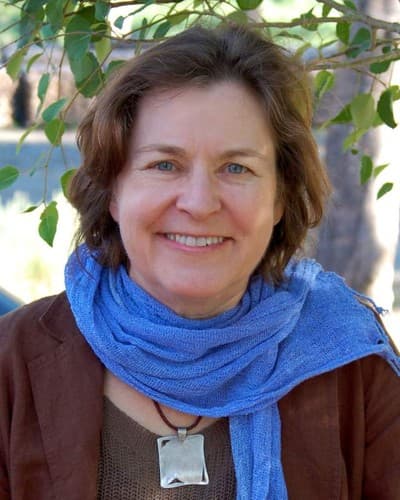
Karen Joy Fowler is an American author known for her fiction that often explores themes of family and identity. Her notable works include "We Are All Completely Beside Ourselves," which delves into the complexities of family dynamics, and "The Jane Austen Book Club," a novel that intertwines the lives of its characters with the works of Jane Austen.
Similar books
- Room
Emma Donoghue
4.1 (714k) average on GoodreadsThrillerExplores an unconventional upbringing and a child's unique perspective on their world.
- The Art of Racing in the Rain
Garth Stein
4.2 (452k) average on GoodreadsFictionFeatures an animal's perspective and deep emotional bonds between humans and animals.
- A Man Called Ove
Fredrik Backman
4.4 (569k) average on GoodreadsFictionFocuses on family dynamics, loss, and the unexpected connections that heal.
- We Need to Talk About Kevin
Lionel Shriver
4.0 (162k) average on GoodreadsLiterary FictionBoth novels explore profound parental guilt and the devastating impact of a child on a family. However, Fowler's novel introduces the unique interspecies element, shifting the ethical focus from human nature vs. nurture to species boundaries and animal rights, making its core conflict distinct.
- Life of Pi
Yann Martel
3.9 (1.3M) average on GoodreadsFantasyWhile both feature human-animal companionship, Martel's novel uses it as a rich allegory for faith, survival, and storytelling. Fowler's approach is more grounded in a fictionalized scientific experiment, making its ethical questions about speciesism and human responsibility more direct and less metaphorical, challenging readers on a societal level rather than purely spiritual.
- The Old Man and the Sea
Ernest Hemingway
3.8 (831k) average on GoodreadsLiterary FictionA Cuban fisherman's long struggle with a giant marlin becomes a story of endurance and dignity, now retold for young adults with illustrations, phonetic guides, and writing prompts in Traditional Chinese.






Enjoyed the summary?
A summary gives you the shape of the book. The book itself has the detail, the examples and the voice.
Find We Are All Completely Beside Ourselves on AmazonAs an Amazon Associate, BookBrief earns from qualifying purchases. How we're funded