
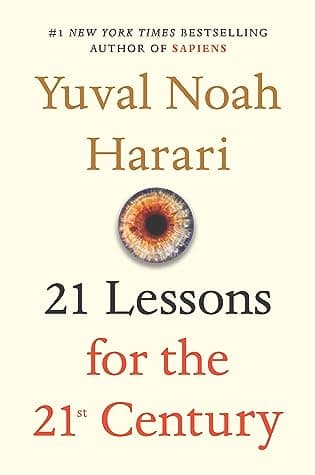
Core Idea
- Difficulty
- Medium
- Read it if
- You are interested in the philosophical, political, and social implications of current global trends and technological advancements, and want to understand the challenges humanity faces in the coming decades.
- Skip it if
- You are looking for practical, actionable solutions to specific problems, or prefer a less speculative and more optimistic outlook on the future.
Key Takeaways from 21 Lessons for the 21st Century
The Data Religion is Here
Algorithms know you better than you know yourself, challenging the core of human free will.
Harari argues that the rise of Big Data and AI is creating a new 'data religion' where algorithms become the ultimate authority. Our personal data, collected and analyzed, allows systems to predict and even influence our choices with great accuracy. This challenges the idea of individual free will, suggesting our decisions might be less about unique consciousness and more about biochemical algorithms that external algorithms can understand. As these systems improve, they will subtly guide our lives, raising ethical questions about autonomy and the future of human experience.
“As algorithms learn to understand and manipulate human emotions better than we ourselves can, they will increasingly make decisions for us, whether about what to study, whom to marry, or for whom to vote.”
In the book: Harari cites examples of personalized advertising and political campaigns that leverage psychographic data to target individuals with highly effective, tailored messages, demonstrating how algorithms already influence our choices in subtle but powerful ways.
Try this: Cultivate a deep skepticism towards 'convenient' recommendations and personalized content. Actively seek out diverse information sources that challenge your existing viewpoints, rather than relying on algorithms that reinforce them. Engage in practices that foster self-awareness to better distinguish between genuine desires and algorithmically induced ones.
Related ideas: big-data, artificial-intelligence, free-will, data-religion, algorithms
The Meaningless of Work
Automation threatens not just jobs, but the very purpose and dignity many derive from labor.
Harari predicts a future where AI and robotics will replace many human jobs, not just in manual labor but also in cognitive tasks. The challenge is not just unemployment, but 'unemployability' – a situation where many people lack the skills for an automated economy. This raises the possibility of a 'useless class,' not exploited, but simply unneeded. The social and psychological effects are huge, as work often provides identity, community, and purpose. Governments and societies must consider how to provide meaning and dignity in a post-work world, beyond just basic income.
“What will humans do once algorithms and robots can do everything better?”
In the book: Harari points to the rapid advancements in fields like self-driving cars and diagnostic AI, which are already demonstrating superior performance to humans in specific, complex tasks, foreshadowing widespread job displacement.
Try this: Prioritize lifelong learning and adaptability, focusing on uniquely human skills like creativity, emotional intelligence, and critical thinking that are harder for AI to replicate. Advocate for policies like universal basic income and invest in social structures that provide meaning beyond traditional employment.
Related ideas: automation, unemployment, universal-basic-income, future-of-work, meaning-of-life
The Post-Truth Era
In an age of information overload, distinguishing fact from fiction becomes a critical survival skill.
Harari argues that we live in a 'post-truth' era where facts are often less important than appeals to emotion and personal belief. The digital revolution, while making information accessible, has also created echo chambers and made it easier for false stories and 'fake news' to spread quickly. This harms shared understanding and rational discussion, making collective problem-solving very difficult. The challenge is not just identifying lies, but recognizing how our own biases and group loyalties make us open to stories that confirm our existing views, regardless of truth.
“If you want to control people, you don't need to send soldiers to their homes. You just need to control their stories.”
In the book: Harari references the spread of conspiracy theories and politically motivated misinformation campaigns, particularly during elections and referendums, demonstrating how easily populations can be swayed by emotionally resonant, though factually dubious, stories.
Try this: Actively practice 'information hygiene': vet sources, cross-reference facts, and be wary of emotionally charged content. Cultivate intellectual humility and be open to changing your mind when presented with compelling evidence, even if it contradicts your existing beliefs. Engage in constructive dialogue rather than simply consuming reinforcing narratives.
Related ideas: fake-news, post-truth, misinformation, critical-thinking, media-literacy
Global Challenges, Local Politics
Humanity faces planetary threats, but our political systems remain stubbornly nationalistic.
Harari highlights the problem of global threats (climate change, nuclear war, pandemics, AI regulation) clashing with the national focus of our political institutions. Nations are primarily concerned with their own citizens, often at the expense of global cooperation. This 'global problems, local politics' dilemma prevents effective solutions to issues that cross borders. The book asks us to think beyond national loyalties and develop a sense of global responsibility, acknowledging that humanity's fate is connected, regardless of nationality.
“Humankind is currently facing unprecedented global problems, from nuclear war and ecological collapse to technological disruption and the rise of a global 'useless class.' But our political systems are still organized on a national basis.”
In the book: The inadequate global response to climate change, despite scientific consensus, serves as a prime example of national interests overriding collective human survival. Similarly, the fragmented response to global pandemics like COVID-19 highlights the limitations of purely national approaches.
Try this: Support and advocate for international cooperation and organizations. Engage in political discourse that emphasizes global solidarity and long-term planetary well-being over narrow nationalistic interests. Recognize your own biases and tendencies towards 'us vs. them' thinking, and actively work to broaden your perspective.
Related ideas: global-governance, climate-change, nationalism, international-cooperation, humanity
The Crisis of Liberalism
The foundational narratives of liberal democracy are struggling to address 21st-century realities.
Harari observes that the liberal narrative, which championed individual freedom, free markets, and democratic institutions, has lost much of its power. It struggles to provide good answers to the challenges of technological change, economic inequality, and cultural division. Populist movements on both the left and right use these weaknesses, offering simpler, often divisive, stories. The problem is not necessarily a failure of liberal values themselves, but the inability of the established liberal framework to adapt and offer a vision for the future that connects with a broad population facing new changes.
“For decades, the liberal story provided a convincing answer to the question 'What is happening in the world?' But in the early 21st century, this story is crumbling.”
In the book: The rise of populist leaders in various democracies, Brexit, and the increasing political polarization in many Western nations serve as Harari's evidence for the current crisis of the liberal order.
Try this: Engage critically with political narratives, questioning assumptions and seeking nuanced understanding beyond simplistic slogans. Support reforms that aim to make democratic institutions more resilient and responsive to contemporary challenges. Understand that solutions require collaboration across ideological divides.
Related ideas: liberal-democracy, populism, political-polarization, free-markets, individual-freedom
The Illusion of Choice
Big Data's power to predict and manipulate our preferences erodes genuine personal freedom.
This point builds on 'The Data Religion is Here.' Harari explains how the great predictive power of algorithms, fueled by our data, creates an illusion of choice. We might feel we are making independent decisions, but in reality, our preferences, desires, and even emotions are increasingly shaped by sophisticated AI. This is not open force but a subtle, widespread form of control that operates below our conscious awareness. The danger is not just losing freedom, but losing the ability to recognize when it's being taken away, as our 'choices' become indistinguishable from algorithmic suggestions.
“The algorithms will get to know you so well that they could predict your desires and manipulate your feelings, and you would never know it.”
In the book: Harari references social media feeds and online shopping recommendations, which are designed to keep users engaged and spending by presenting content and products that align perfectly with their predicted interests, often without the user realizing the extent of this algorithmic curation.
Try this: Practice digital minimalism and periodically disconnect from platforms designed for constant engagement. Actively seek out experiences and information that are not algorithmically curated. Engage in critical self-reflection about the origins of your desires and choices, questioning if they are truly your own or influenced by external forces.
Related ideas: algorithmic-control, personal-freedom, consumerism, privacy, digital-literacy
Education for Uncertainty
Traditional education is obsolete; we must teach adaptability and mental flexibility for an unpredictable future.
Harari argues that current educational systems, designed for a more stable industrial era, are not ready for the 21st century. Memorization and teaching specific facts are becoming outdated as information is instantly accessible. Instead, education must focus on developing mental flexibility, critical thinking, creativity, and emotional intelligence. The most important skill for the future is the ability to learn, unlearn, and relearn throughout life, as knowledge and job markets will constantly change. The goal is to prepare children not for a specific career, but for a world defined by continuous change and uncertainty.
“In a world deluged by irrelevant information, clarity is power. Censorship works not by blocking the flow of information, but by flooding people with misinformation and distractions.”
In the book: Harari contrasts the information scarcity of past eras with today's information overload, highlighting that the challenge is no longer access to knowledge, but processing and making sense of it, underscoring the need for different educational priorities.
Try this: Prioritize skills over specific knowledge: foster critical thinking, problem-solving, creativity, and emotional intelligence in children. Encourage a lifelong learning mindset, embracing new technologies and ideas. Teach media literacy and the ability to discern reliable information from noise.
Related ideas: future-of-education, lifelong-learning, critical-thinking, adaptability, mental-flexibility
The Meaning of Suffering
Finding meaning in suffering is a uniquely human response that AI cannot replicate, offering a path to resilience.
Among the big stories of technology and politics, Harari explores the personal realm of meaning and suffering. He suggests that while AI might ease physical pain, it cannot create meaning from it. The human ability to find purpose, growth, and even beauty in hardship is a deep part of our consciousness that algorithms cannot copy. This ability to create stories around our experiences, even painful ones, offers a unique form of strength and a source of meaning that will remain distinctly human, even as other parts of our lives become automated or managed by algorithms.
“Suffering is not just suffering. It is also a source of meaning. If you can find meaning in your suffering, you can endure almost anything.”
In the book: Harari implicitly references existentialist philosophy and the human tendency across cultures to create stories and rituals around loss and hardship, transforming mere pain into a meaningful experience.
Try this: Cultivate mindfulness and self-awareness to better understand your own experiences and reactions. Practice introspection to find personal meaning in challenging situations, rather than simply avoiding or suppressing discomfort. Engage in practices that foster empathy and connection with others, recognizing shared human experiences.
Related ideas: meaning-of-life, suffering, resilience, human-consciousness, mindfulness
Know Thyself
In a world of external noise and algorithmic influence, inner clarity is the ultimate power.
Harari concludes that the most important advice for the 21st century is the ancient saying 'know thyself.' With external authorities, stories, and even our own internal experiences increasingly open to algorithmic manipulation, understanding our true selves is essential. This is not just about looking inward, but about developing a deep awareness of our biases, weaknesses, and the subtle ways we are influenced. In a world full of information and external pressures, the ability to tell our authentic thoughts and desires from external impositions is the ultimate power, allowing for true freedom and purpose.
“In such a world, the last thing a teacher needs to give her pupils is more information. They already have too much of it. Instead, people need the ability to make sense of information, to tell the difference between what is important and what is unimportant, and above all, to see the big picture.”
In the book: Harari's entire framework of algorithmic control and the 'data religion' points to the need for individuals to develop a stronger internal compass, as external guidance becomes increasingly suspect.
Try this: Dedicate time to practices that cultivate self-awareness, such as meditation, journaling, or reflective walks. Regularly question your own assumptions and motivations. Seek feedback from trusted individuals who can offer an objective perspective. Prioritize inner clarity over external validation or information overload.
Related ideas: self-awareness, introspection, mindfulness, authenticity, personal-growth
21 Lessons for the 21st Century Quotes
“In a world deluged by irrelevant information, clarity is power.”
“Humans think in stories rather than in facts, numbers, or equations, and the simpler the story, the better.”
“We are now acquiring the power to re-engineer life, and we are not ready for it.”
“The greatest danger facing liberals is not fascism or communism, but irrelevance.”
“If you want to know the truth about the universe, about the meaning of life, and about your own identity, the best place to start is by observing suffering.”
“The algorithms are watching you right now. They are watching where you go, what you buy, who you meet. Soon they will be watching what you feel.”
“When you don't know what to do, don't do anything. Just observe. Just understand.”
“Never underestimate human stupidity. Both individually and collectively, humans are quite capable of holding on to patently false beliefs, of pursuing futile endeavours, and of harming themselves and others.”
“Dataism declares that the universe consists of data flows, and the value of any phenomenon or entity is determined by its contribution to data processing.”
“The future of humanity will not be decided in parliament, in the battlefield or in the courtroom. It will be decided in the laboratory.”
“We are far better at wielding power than at handling happiness.”
“In a world that is increasingly interconnected and complex, the ability to zoom out and see the big picture is more crucial than ever.”
“The greatest challenges facing humanity are global, but our political systems are still national.”
“The most important thing for you to know is yourself. Not your Facebook profile, not your Instagram feed, but your actual self.”
Quiz
10 questions on the main ideas. Each answer comes with a short explanation.
Question 1
According to Harari, what is a primary danger of the rise of artificial intelligence and Big Data in the 21st century?
- The complete eradication of all human jobs.
- The erosion of human free will and the ability for algorithms to make better decisions for us.
- The inevitable outbreak of global cyber-warfare.
- The collapse of all nation-states due to decentralized networks.
Show answer
B. The erosion of human free will and the ability for algorithms to make better decisions for us. Harari frequently warns that as AI and Big Data become more sophisticated, they could understand us better than we understand ourselves, potentially leading to algorithms making our decisions, thus eroding our perceived free will.
Question 2
What does Harari suggest is a crucial skill for individuals to cultivate in an age of abundant, often misleading, information?
- Mastering advanced coding and data analysis.
- Developing a strong ability to focus and discern what is important amidst noise.
- Joining a global online community for information verification.
- Blindly trusting established news organizations.
Show answer
B. Developing a strong ability to focus and discern what is important amidst noise. Harari emphasizes that in a world deluged with irrelevant information and fake news, 'clarity is power,' and the ability to focus and discern is paramount.
Question 3
Regarding the future workforce, what challenge does Harari highlight that education systems need to address?
- Teaching children to specialize in a single, highly technical skill from a young age.
- Preparing children for a world where many current jobs will disappear and they will need to constantly reinvent themselves.
- Focusing exclusively on humanities to counterbalance technological advancements.
- Ensuring every child learns at least three foreign languages.
Show answer
B. Preparing children for a world where many current jobs will disappear and they will need to constantly reinvent themselves. Harari discusses how automation will make many jobs obsolete, requiring individuals to be adaptable and continuously learn new skills throughout their lives.
Question 4
What is Harari's perspective on the continued relevance of nations and religions in the 21st century?
- They are rapidly becoming obsolete and will soon disappear entirely.
- They remain powerful forces but are struggling to adapt to global challenges like climate change and technological disruption.
- They are experiencing a resurgence and becoming more influential than ever before.
- Their primary role has shifted to purely cultural and ceremonial functions.
Show answer
B. They remain powerful forces but are struggling to adapt to global challenges like climate change and technological disruption. Harari acknowledges their continued power but argues they are often ill-equipped to handle global issues that transcend national and religious boundaries.
Question 5
In the context of 'fake news' and information overload, what does Harari suggest is a key challenge to liberal democracy?
- The inability of governments to censor all online content.
- Citizens losing the ability to distinguish truth from fiction, leading to informed public discourse becoming impossible.
- The rise of authoritarian regimes that ban all forms of media.
- The over-reliance on traditional print media for news.
Show answer
B. Citizens losing the ability to distinguish truth from fiction, leading to informed public discourse becoming impossible. Harari discusses how the epidemic of fake news and the difficulty in discerning reality undermine the very foundation of liberal democracy, which relies on an informed citizenry.
Question 6
Harari argues that human consciousness and feelings are increasingly being understood as what, in the age of neuroscience and AI?
- Purely spiritual phenomena beyond scientific understanding.
- Complex biochemical algorithms that can potentially be deciphered and manipulated.
- Unique, irreducible qualities that will always elude technological replication.
- Social constructs with no biological basis.
Show answer
B. Complex biochemical algorithms that can potentially be deciphered and manipulated. Building on ideas from 'Sapiens' and 'Homo Deus,' Harari explores how science views human feelings and consciousness as products of biochemical processes, making them potentially susceptible to algorithmic analysis and even engineering.
Question 7
What does Harari identify as a significant threat to global stability, potentially exacerbated by technological advancements, that traditional political systems struggle to address?
- The resurgence of ancient empires.
- The increasing inability of humans to cooperate on global issues like climate change and nuclear proliferation.
- The overpopulation of the planet.
- A global shortage of natural resources.
Show answer
B. The increasing inability of humans to cooperate on global issues like climate change and nuclear proliferation. Harari dedicates sections to global challenges, emphasizing that while technology creates global problems, our political structures are often still nationalistic, hindering effective cooperation.
Question 8
Harari discusses 'hacking humans.' What does he mean by this concept?
- The physical act of breaking into human-controlled computer systems.
- The ability of algorithms and AI to understand and manipulate human emotions and decision-making processes.
- The process of genetic engineering to create superhuman abilities.
- The use of virtual reality to simulate human interactions.
Show answer
B. The ability of algorithms and AI to understand and manipulate human emotions and decision-making processes. Harari argues that as our understanding of biology and algorithms deepens, it becomes possible to 'hack' humans by influencing their internal states and choices without their full awareness.
Question 9
What is Harari's advice regarding personal engagement and finding meaning in a world of 'noise and uncertainty'?
- To withdraw from society and live a purely solitary life.
- To focus on developing self-knowledge and understanding one's own biases and internal narratives.
- To blindly accept the narratives provided by powerful institutions.
- To dedicate all efforts to technological innovation.
Show answer
B. To focus on developing self-knowledge and understanding one's own biases and internal narratives. Harari encourages introspection and self-awareness as vital tools for navigating a complex world where external narratives can be overwhelming or misleading.
Question 10
Harari suggests that one of the biggest challenges for humanity in the 21st century is not necessarily technological unemployment itself, but rather:
- The inability to invent new technologies at a fast enough pace.
- How to create new meaning and purpose for billions of 'unemployable' people.
- The lack of sufficient computing power to run advanced AI.
- The excessive leisure time provided by automation.
Show answer
B. How to create new meaning and purpose for billions of 'unemployable' people. While technological unemployment is a concern, Harari argues the deeper issue is how societies will provide meaning, identity, and a sense of purpose to people when traditional work roles diminish.
21 Lessons for the 21st Century FAQ
What is the main focus of '21 Lessons for the 21st Century'?
The book focuses on navigating the most pressing issues of the present day, from technological advancements and political polarization to the rise of fake news, offering insights and questions for surviving in a rapidly changing world.
How does '21 Lessons' differ from Harari's previous books, 'Sapiens' and 'Homo Deus'?
While 'Sapiens' explored humanity's past and 'Homo Deus' looked to the future, '21 Lessons' centers on contemporary challenges, providing a guide to understanding and engaging with the urgent issues of the current moment.
Does technology, like computers and robots, change the meaning of being human?
Yes, the book explores how the rapid advancement of technology, including AI and robotics, fundamentally alters our understanding of human identity, consciousness, and the future of work and society.
What is Harari's perspective on the epidemic of fake news?
Harari addresses the challenge of distinguishing truth in an age of misinformation, emphasizing the importance of critical thinking and clarity amidst a deluge of irrelevant information to maintain a grasp on reality.
Are nations and religions still relevant in the 21st century?
The book investigates the enduring, yet evolving, relevance of traditional structures like nations and religions in a globalized and technologically advanced world, questioning their future roles and influence.
What should we teach our children to prepare them for the future?
Harari suggests that adaptability, critical thinking, emotional intelligence, and the ability to learn and unlearn will be crucial skills for future generations in a world characterized by constant and disorienting change.
How can individuals retain freedom of choice when Big Data is watching us?
The book delves into the implications of ubiquitous data surveillance, prompting readers to consider how to preserve personal autonomy and make meaningful choices in an era of algorithmic influence and predictive analysis.
What is the crisis of liberal democracy discussed in the book?
Harari examines the challenges facing liberal democracy today, including rising populism, polarization, and the impact of technological disruption on democratic processes and institutions.
Does '21 Lessons' offer solutions or just raise questions?
While it raises important questions, the book also offers a framework for understanding complex contemporary challenges and provides advice on how to prepare for a very different future, encouraging personal engagement and critical reflection.
About the author
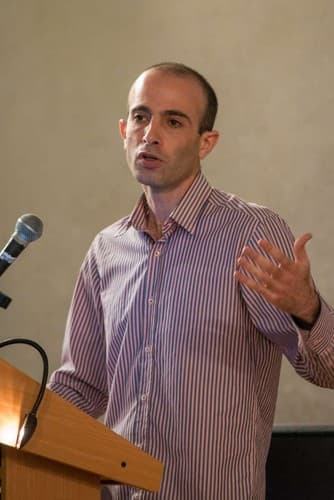
Yuval Noah Harari is an Israeli historian and professor known for his exploration of humanity's past, present, and future. His notable works include "Sapiens: A Brief History of Humankind," which examines the evolution of humans, "Homo Deus: A History of Tomorrow," which speculates on future developments, and "21 Lessons for the 21st Century," addressing contemporary global challenges.
Similar books
- Sapiens: A Brief History of Humankind
Yuval Noah Harari
4.4 (502k) average on GoodreadsPsychologyExpands on themes of human history and societal evolution, providing context for the challenges discussed in '21 Lessons'.
- 1984
George Orwell
4.2 (3.1M) average on GoodreadsPoliticsIn a future where surveillance and thought control are absolute, a man's search for truth clashes with the Party, showing that hope can be a form of rebellion.
- Animal Farm
George Orwell
4.0 (2.7M) average on GoodreadsPoliticsA farm animals' rebellion against humans turns into a pig-led dictatorship, showing how power corrupts and revolutionary ideals are betrayed.
- Freakonomics: A Rogue Economist Explores the Hidden Side of Everything
Steven D. Levitt
4.0 (709k) average on GoodreadsBusinessThis book uses economic principles to reveal the surprising incentives behind everything from drug dealing and real estate to cheating teachers and the decline of crime.
- I Am Malala: The Story of the Girl Who Stood Up for Education and Was Shot by the Taliban
Malala Yousafzai
4.1 (419k) average on GoodreadsPoliticsA teenage girl from a Taliban-controlled valley refuses to give up her books, becoming a global voice for education even after an assassination attempt.
- Atlas Shrugged
Ayn Rand
3.7 (354k) average on GoodreadsPoliticsIn a dystopian America where innovators vanish, a brilliant heiress races to uncover the truth behind the disappearing industrialists and the enigmatic John Galt, who vows to stop the world's progress.






Enjoyed the summary?
A summary gives you the shape of the book. The book itself has the detail, the examples and the voice.
Find 21 Lessons for the 21st Century on AmazonAs an Amazon Associate, BookBrief earns from qualifying purchases. How we're funded