
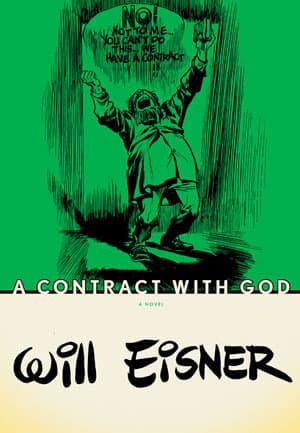
Synopsis
Covers the whole plot, including the ending.
- Difficulty
- Medium
- Pacing
- Moderate
- Mood
- Melancholic, Gritty, Reflective, Poignant, Realistic
- Read it if
- You appreciate pioneering graphic novels, character-driven historical fiction, and stories that explore the complexities of faith, ambition, and the human condition in a gritty urban setting.
- Skip it if
- You prefer lighthearted stories, fast-paced action, or shy away from melancholic narratives and themes of existential struggle.
A Contract With God Plot Summary
Covers the whole plot, including the ending.
A Contract With God: Frimme Hersh's Broken Faith
Frimme Hersh, a religious man on Dropsie Avenue, loses his faith when his adopted daughter, Rachel, dies suddenly from a fever. He had saved and raised Rachel, seeing her as a gift from God and a sign of his agreement with God. In his sadness and anger, Frimme scratches out his 'contract with God'—a stone tablet he made as a young man—on the tenement roof. He starts a cynical, materialistic life, becoming a harsh landlord who takes advantage of his tenants, leaving his spiritual path for money and bitterness.
The Street Singer: Eddie's Fleeting Dream
Eddie, a young street singer with a good voice, lives in the same Dropsie Avenue building. He likes Marta, a rich woman who visits her grandmother there. Eddie is poor and has unfulfilled dreams, but he hopes to escape his situation with his music. He sings to Marta from the street, and for a short time, they have a secret romance. Marta, however, is just playing with him, using him as a temporary break from her rich life. She leaves him, going back to her world, leaving Eddie heartbroken and disappointed, his dreams of love and success again crushed by his surroundings.
The Super: Schmidt's Obsession
Schmidt, the German superintendent of the Dropsie Avenue building, is a lonely, old man troubled by his hidden sexual desires and a past he wants to forget. He is especially interested in Rosie, a young dancer who often sunbathes on the roof. Schmidt secretly watches her, and his desires grow into a dangerous fantasy. He remembers his past in Germany, which suggests a darker history and adds to his inner struggle. His interest in Rosie leads to a disturbing act of watching and an attempt to get closer to her, showing his deep loneliness and the harmful nature of his unfulfilled wants.
Cookalein: The Girls' Summer Escape
This story follows four young, working-class Jewish women from the Bronx—Goldie, Becky, Daisy, and Florrie—who leave the city for a summer vacation at a 'cookalein' (a simple resort) in the Catskills. They are looking for romance and a temporary break from their normal lives. Each girl experiences a different part of summer love and disappointment: Goldie is seduced and left by an older man, Becky finds a brief romance with a musician, Daisy has a short, innocent flirtation, and Florrie watches it all with some doubt and longing. The summer ends with them going back to Dropsie Avenue, their romantic hopes mostly not met, but with shared memories of youthful hope and the mixed feelings of reality.
The Return to Dropsie Avenue: Unfulfilled Dreams
After their summer in the Catskills, Goldie, Becky, Daisy, and Florrie return to their lives on Dropsie Avenue. The short time of freedom and romance is over, and they must face their working-class lives. Their experiences leave them with memories and some sadness, but they mostly go back to their routines, perhaps a little wiser or more cynical about love and life. The 'cookalein' part shows how life on Dropsie Avenue often repeats, where dreams often meet reality, and escapes are temporary, always leading back to the daily struggles and hopes of the building's residents.
Frimme's Final Act: A Lingering Question
After years as a cynical, rich landlord, Frimme Hersh grows old and weak. Despite his money, he is still bothered by his past and the 'contract with God' he broke. He tries to find comfort or meaning in his last days, perhaps regretting leaving his faith. His death is a quiet, unclear end, not a moment of forgiveness. The original stone tablet, his 'contract,' is found among his things, leaving the reader to wonder if he ever truly made peace with his faith or if his life always showed a broken agreement. His story opens and closes the collection strongly, framing the bigger themes of faith, loss, and human struggle on Dropsie Avenue.
A Contract With God Characters
Frimme Hersh
Protagonist
Pious Jew turned cynical landlord after a personal tragedy.
Frimme Hersh is the central figure of the first story, 'A Contract With God'. He begins as a deeply devout and righteous man, marked by his strong faith and a literal 'contract' he believes he holds with God. The sudden death of his adopted daughter, Rachel, shatters his world, leading him to renounce his faith and embrace a life of materialism and ruthlessness as a landlord. He becomes a symbol of lost faith and the corrupting influence of grief and bitterness, exploiting his tenants with cold efficiency. Despite his outward success, he remains internally tormented by his past.
Relationships: Rachel (Adopted daughter, whose death triggers his crisis of faith); God (His 'contractual' partner, later renounced)
Rachel
Supporting
Frimme Hersh's adopted daughter, whose death drives the plot.
Rachel is a young, innocent girl adopted by Frimme Hersh. She is presented as a gift from God, a symbol of Frimme's covenant and piety. Her sudden and inexplicable death from a fever is the catalyst for Frimme's profound crisis of faith. Though she appears only briefly, her presence and subsequent loss are central to the emotional and thematic core of 'A Contract With God', representing the fragility of life and the challenging nature of faith in the face of tragedy. Her memory continues to haunt Frimme throughout his life.
Relationships: Frimme Hersh (Adopted father)
Eddie
Protagonist
A romantic street singer with unfulfilled dreams.
Eddie is the protagonist of 'The Street Singer'. He is a young, charismatic, yet impoverished man living in the Dropsie Avenue tenement, who dreams of escaping his circumstances through his beautiful singing voice. He is a romantic idealist, easily swept up in the illusion of love and success. His brief, passionate affair with the wealthy Marta highlights the class divide and the harsh realities of unrequited love and social mobility in his world. Eddie embodies the hopes and inevitable disappointments faced by many residents of Dropsie Avenue.
Relationships: Marta (Brief, unrequited romantic interest)
Marta
Supporting
Wealthy woman who briefly toys with Eddie's affections.
Marta is a beautiful, affluent young woman who occasionally visits her grandmother in the Dropsie Avenue tenement. She represents a world of wealth and privilege that is far removed from Eddie's reality. She is charming but ultimately superficial, using Eddie's admiration and musical talent for her own amusement. Her casual abandonment of Eddie underscores the social barriers and the power imbalance between their worlds, leaving Eddie heartbroken and further cementing his sense of disillusionment.
Relationships: Eddie (Temporary romantic interest)
Schmidt
Protagonist
The lonely, repressed superintendent of the Dropsie Avenue tenement.
Schmidt is the superintendent in 'The Super'. He is a middle-aged German immigrant, a solitary and melancholic figure haunted by his past and consumed by repressed sexual desires. He secretly observes the tenants, particularly the young dancer Rosie, projecting his fantasies onto her. His character explores themes of loneliness, voyeurism, and the darker aspects of human psychology within the confines of the tenement. His internal struggles and unsettling actions reveal the hidden lives and pathologies that exist within the seemingly ordinary building.
Relationships: Rosie (Object of his voyeuristic obsession)
Rosie
Supporting
A vivacious dancer, the object of Schmidt's obsession.
Rosie is a young, vibrant dancer and a tenant in the Dropsie Avenue building. She is unaware of Schmidt's intense gaze and fixation. Her carefree nature and physical expressiveness, particularly when she sunbathes on the rooftop, make her the unwitting object of Schmidt's repressed desires. She represents youth, vitality, and innocence, contrasting sharply with Schmidt's aged and tormented existence. Her presence highlights the superintendent's inner turmoil and the invasive nature of his voyeurism.
Relationships: Schmidt (Object of his voyeuristic obsession)
Goldie
Protagonist
One of the four girls seeking romance at the 'cookalein'.
Goldie is one of the four young women from Dropsie Avenue who go to the Catskills 'cookalein' in the final story. She is perhaps the most eager for romance and experiences a brief, passionate affair with an older, charming man. Her story reflects the allure and dangers of summer love, as she is ultimately seduced and then abandoned, returning to the Bronx with a sense of disillusionment but also a newfound, if painful, experience of the world. She represents the vulnerability and hopeful romanticism of youth.
Relationships: Becky (Friend); Daisy (Friend); Florrie (Friend)
Becky
Supporting
One of the four girls, experiencing a brief summer fling.
Becky is another of the four friends at the 'cookalein'. She has a more pragmatic approach to romance than Goldie, finding a brief, physical relationship with a musician. Her experience is less about grand passion and more about fleeting connection and physical intimacy. She represents a different facet of youthful exploration and the varied ways young women navigate the search for companionship and pleasure during their summer escape.
Relationships: Goldie (Friend); Daisy (Friend); Florrie (Friend)
Florrie
Supporting
The most observant and cynical of the four girls.
Florrie is one of the four friends in 'Cookalein'. She is often depicted as the most observant and slightly cynical of the group, perhaps a bit more world-weary or cautious. She watches her friends' romantic escapades with a discerning eye, often commenting on them or reflecting on the broader implications. Her character provides a grounding perspective amidst the romantic aspirations of the others, highlighting the bittersweet reality of their summer experiences and the inevitable return to their ordinary lives.
Relationships: Goldie (Friend); Becky (Friend); Daisy (Friend)
A Contract With God Themes
Faith, Doubt, and Despair
The main theme, seen most clearly through Frimme Hersh, questions faith when tragedy happens. Frimme's 'contract with God' breaks when his adopted daughter dies, making him give up his religious devotion for cynicism and money. This theme looks at how people struggle to understand suffering and belief, and the deep sadness that can happen when core beliefs are broken. It suggests that faith is not always rewarded, and loss can change one's spiritual path permanently.
“A contract... A contract with God! There were witnesses! The Almighty and I! We signed it, with my blood! And my blood delivered! My soul! My very soul! To You! And You... You broke Your end of the contract!”
Dreams Versus Reality
This theme is in all four stories, showing characters who hope for love, success, and escape, only to have those hopes ruined by the hard facts of their lives on Dropsie Avenue. Eddie dreams of fame and love but is left alone. The girls in 'Cookalein' look for romance that is short-lived and often disappointing. The building itself represents the limited chances that often stop these dreams, showing the difference between what people want and the often-harsh truth of daily life.
“The dream was over. He was still Eddie, the street singer, and the girl was gone.”
Loneliness and Isolation
Many characters, especially Schmidt and Frimme Hersh, deal with deep loneliness. Schmidt's watching others comes from his inability to make real connections, making him observe from afar. Frimme, despite his money, lives alone, separated from his community and his old self after his tragedy. Even the shared experience of the 'cookalein' does not fully fix the loneliness each girl feels in her search for love, suggesting that connections can be brief and real closeness hard to find.
“His only contact with the world was through the peephole of his own loneliness.”
The Human Condition in the Urban Landscape
Dropsie Avenue is more than just a place; it is like a character, a small picture of city life in the Bronx in the early 1900s. The tenement building shows the crowded, connected, yet often isolating lives of its working-class residents. The stories together show common human struggles—love, loss, desire, faith, sadness, and the search for meaning—all happening within the specific social, economic, and cultural setting of this immigrant neighborhood. The city shapes and reflects the characters' lives.
“Dropsie Avenue... it was more than just a street. It was a world, an artery, a living thing that pulsed with the lives of its people.”
Sexuality and Repression
This theme is clearest in 'The Super' with Schmidt's troubled interest in Rosie, caused by his hidden desires and possibly a darker past. It looks at the hidden, often uncomfortable, parts of human sexuality, especially when it is not met or is twisted. In 'The Street Singer' and 'Cookalein', sexuality is shown more openly as a force in romantic pursuits, sometimes leading to joy, but often to exploitation, disappointment, and a loss of innocence, showing its complex and strong role in human relationships.
“He watched her... a hunger, a craving he couldn't name, growing inside him.”
Plot Devices & Literary Techniques
The Dropsie Avenue Tenement
A unifying setting that acts as a character and microcosm of urban life.
The tenement building on Dropsie Avenue is more than just a backdrop; it is a central unifying element across the stories. It represents the shared struggles and interconnected lives of the working-class immigrants in the Bronx. The building itself is a character, with its cramped apartments, communal spaces, and hidden corners where dreams and despair unfold. It symbolizes the confinement and opportunities (or lack thereof) faced by its inhabitants, acting as a microcosm for the larger urban experience and the human condition.
Interwoven Short Stories
A narrative structure that connects disparate lives through a shared setting and themes.
Eisner employs a quartet of distinct, yet thematically linked, short stories. While each narrative focuses on different characters and plots, they are all set within or around Dropsie Avenue and explore common themes of faith, loss, desire, and disillusionment. This structure allows Eisner to present a multifaceted portrait of a community, showing how individual lives, though separate, contribute to a larger tapestry of human experience in a specific urban environment, creating a sense of collective narrative despite the episodic format.
The 'Contract With God' Tablet
A symbolic object representing faith, covenant, and its shattering.
The stone tablet, carved by Frimme Hersh, literally represents his covenant with God. Its physical existence and Frimme's act of scratching it out symbolize the breaking of his faith and his renunciation of the divine. It serves as a powerful visual and narrative metaphor for the fragility of belief and the profound impact of personal tragedy on spiritual conviction. The tablet's rediscovery at the end of Frimme's life underscores the lingering questions of faith and the unresolved nature of his despair.
Visual Metaphor and Symbolism in Art
Eisner's use of expressive visuals to convey emotion and deeper meaning.
Eisner's masterful artwork goes beyond merely illustrating the text; it functions as a primary plot device. He uses visual metaphors (e.g., the rain mirroring Frimme's tears, the oppressive shadows in Schmidt's apartment, the stark contrast between the tenement and Marta's world) and symbolic imagery (e.g., the rooftop as a place of both spiritual connection and despair, the street as a stage for unfulfilled dreams). The highly expressive faces and body language of his characters convey their inner turmoil and emotional states directly to the reader, enhancing the narrative's depth and impact.
A Contract With God Quotes
“He knew that there was a contract. A contract with God. And that if he lived up to his end, God would live up to His.”
“The rain came down, not in drops, but in sheets, washing away the dirt and the grime of the city... and the hope.”
“He had renounced God, and God had renounced him.”
“There was a loneliness in the city that could freeze the very marrow in one's bones.”
“The street had its own rhythm, its own heartbeat, a pulse that never truly stopped.”
“Every man builds his own prison, and every man carries his own key.”
“She was a woman of the streets, but she had a heart that was purer than many who lived behind respectable doors.”
“The past is never truly past. It lives within us, shaping our present and our future.”
“He learned that sometimes, the only way to survive was to become harder than the world around you.”
“Dropsie Avenue... a place where dreams came to die, and sometimes, to be reborn.”
“The city was a beast, always hungry, always demanding its pound of flesh.”
“Love, he discovered, was a fragile thing, easily broken, but also capable of mending the most shattered souls.”
“There are contracts made on paper, and contracts made in the heart. The latter are often the most binding.”
“He sought solace in the bottle, but found only a deeper emptiness.”
Quiz
10 questions on the plot and the characters. Each answer comes with a short explanation.
Question 1
In the titular story, 'A Contract With God,' what significant event leads Frimme Hersh to renounce his faith?
- His wife leaves him for another man.
- His adopted daughter, Rachele, dies unexpectedly.
- He loses all his savings in a fraudulent scheme.
- He is accused of a crime he did not commit.
Show answer
B. His adopted daughter, Rachele, dies unexpectedly. Frimme Hersh, a devout man who believes he has a literal contract with God, abandons his faith and becomes a slumlord after the sudden death of his beloved adopted daughter, Rachele, from an illness.
Question 2
What is the primary profession Frimme Hersh adopts after leaving his religious life in 'A Contract With God'?
- A wealthy businessman in textiles.
- A successful lawyer.
- A slumlord and real estate owner.
- A street vendor.
Show answer
C. A slumlord and real estate owner. After Rachele's death, Frimme Hersh sheds his religious identity and becomes a hardened, greedy slumlord, accumulating wealth by exploiting his tenants.
Question 3
In the story 'The Street Singer,' what is the name of the aspiring young singer who dreams of fame?
- Rose
- Sandra
- Kitty
- Esther
Show answer
C. Kitty The central character of 'The Street Singer' is Kitty, a young woman with a beautiful voice who tries to make a living singing on the streets and dreams of a bigger career.
Question 4
What is the central theme explored in 'The Super,' regarding the character of Mr. Scuggs?
- The pursuit of artistic expression.
- The loneliness and unfulfilled desires of an aging man.
- The triumph of good over evil.
- The corruption of power.
Show answer
B. The loneliness and unfulfilled desires of an aging man. Mr. Scuggs, the superintendent, is a lonely and aging man who fantasizes about young girls, highlighting themes of isolation, unfulfilled desires, and the often-unseen struggles of ordinary people.
Question 5
Which of these best describes the setting of all four stories in 'A Contract With God'?
- A suburban community in New York during the 1960s.
- A rural town in the Midwest during the Great Depression.
- The mythical Dropsie Avenue in the Bronx during the Depression era.
- A bustling downtown area of Manhattan in the early 20th century.
Show answer
C. The mythical Dropsie Avenue in the Bronx during the Depression era. All four stories are set on the fictional Dropsie Avenue in the Bronx, primarily during the difficult economic times of the Great Depression, which heavily influences the characters' struggles.
Question 6
In 'The Street Singer,' how does Kitty's encounter with the wealthy man, Eddie, ultimately impact her aspirations?
- He signs her to a major record label, launching her career.
- He offers her a stable, respectable job, causing her to abandon singing.
- He exploits her, leading to disillusionment and the end of her dreams.
- He becomes her mentor and helps her develop her talent.
Show answer
C. He exploits her, leading to disillusionment and the end of her dreams. Kitty's encounter with Eddie is a harsh reality check. He seduces and then discards her, leaving her heartbroken and effectively crushing her dreams of a glamorous singing career.
Question 7
What is the primary motivation behind the actions of the three young men in 'Cookalein'?
- To find meaningful employment and escape poverty.
- To escape the heat of the city and find romance at a summer resort.
- To engage in political activism and social change.
- To commit petty crimes and avoid the authorities.
Show answer
B. To escape the heat of the city and find romance at a summer resort. The three friends in 'Cookalein' are primarily motivated by a desire to escape the oppressive summer heat of the city and seek out romantic encounters and fleeting pleasures at a 'cookalein' (a cheap summer resort).
Question 8
How does Frimme Hersh attempt to 'renegotiate' his contract with God towards the end of the first story?
- He attempts to perform a miracle to prove his worth.
- He tries to gather other religious men to support his claim.
- He sacrifices his wealth to charity.
- He writes a new contract, detailing his terms.
Show answer
B. He tries to gather other religious men to support his claim. Frimme Hersh, plagued by guilt and seeking answers, attempts to convene a group of religious men to debate the existence and nature of his 'contract' with God, hoping to find a way back to faith or understanding.
Question 9
What overarching artistic and literary significance does 'A Contract With God' hold, as described by its reception?
- It popularized the use of superheroes in comic books.
- It established the 'graphic novel' as a legitimate art form.
- It was the first book to use color printing extensively.
- It introduced a new style of abstract art to the mainstream.
Show answer
B. It established the 'graphic novel' as a legitimate art form. Will Eisner's 'A Contract With God' is widely credited with coining the term 'graphic novel' and demonstrating the potential for comics to tell mature, complex, and literary stories, elevating the medium beyond traditional comic books.
Question 10
In 'The Super,' what is the ultimate fate of Mr. Scuggs after his encounter with the young girl and her dog?
- He is arrested for his inappropriate behavior.
- He finds a new purpose in life by adopting the dog.
- He dies alone in his apartment, unmourned.
- He moves away from Dropsie Avenue to start fresh.
Show answer
C. He dies alone in his apartment, unmourned. Mr. Scuggs, the lonely super, dies alone in his apartment, a poignant end that underscores the themes of isolation and the tragic, unfulfilled lives of the working class on Dropsie Avenue.
A Contract With God FAQ
What is A Contract With God about?
A Contract With God is a collection of four interwoven graphic short stories set on Dropsie Avenue in the Bronx during the 1930s. It explores themes of faith, disillusionment, struggle, and the human condition through the lives of working-class Jewish immigrants, starting with Frimme Hersh's crisis of faith after the death of his adopted daughter.
Why should I read A Contract With God?
You should read A Contract With God because it's a seminal work in graphic literature, often credited with popularizing the term 'graphic novel'. Will Eisner's masterful sequential art and poignant storytelling offer a raw, emotional look at the immigrant experience and the universal search for meaning amidst life's hardships, making it a powerful and historically significant read.
What is the background/setting of A Contract With God?
The book is set primarily on Dropsie Avenue in the Bronx, New York, during the Great Depression era of the 1930s. This specific setting provides a backdrop of urban struggle, close-knit immigrant communities, and the unique cultural milieu of Jewish life in a burgeoning American city.
What are the most memorable quotes?
While graphic novels rely heavily on visual storytelling, a memorable line is Frimme Hersh's internal lament, 'You hear, God? You broke it!' referring to his perceived contract. Another notable sentiment, often conveyed visually, is the pervasive feeling of resignation and the cyclical nature of hope and despair among the residents of Dropsie Avenue.
What writing style does the author use?
Will Eisner employs a highly expressive and atmospheric graphic style, using dynamic panel layouts, chiaroscuro lighting, and exaggerated character expressions to convey emotion and mood. His 'writing' is often visual, with sparse, impactful dialogue and narration that complements the detailed artwork, creating a powerful sense of place and character psychology.
What minor details add significant meaning?
The recurring visual motif of the tenement buildings themselves, often looming oppressively or showing signs of decay, subtly emphasizes the characters' entrapment and the harsh realities of their lives. Also, the brief glimpses of other residents through windows or in shared spaces connect the disparate stories, reinforcing the communal yet isolated nature of Dropsie Avenue.
What are some subtle foreshadowing moments?
In 'A Contract With God,' the initial depiction of Frimme Hersh's rigid adherence to his religious 'contract' subtly foreshadows his eventual, dramatic break from faith. Similarly, the brief, seemingly innocent interactions between the characters in 'The Street Singer' hint at the predatory nature lurking beneath the surface of seemingly normal social dynamics.
What unexpected character connections exist?
While the stories are largely self-contained, the overarching 'Dropsie Avenue' setting itself acts as a unifying character, connecting disparate individuals like the disillusioned Frimme Hersh, the ambitious Eddie, and the struggling street singer. The shared environment and the collective immigrant experience forge an invisible bond between them, even when they don't directly interact.
What are unspoken character motivations?
Frimme Hersh's ultimate decision to pursue wealth after abandoning his faith is driven by a deep-seated desire to control his own destiny and exact a form of revenge on a God he feels betrayed him. Rosie, the street singer, seeks not just fame but a desperate escape from her poverty and the mundane existence of Dropsie Avenue, a motivation largely conveyed through her yearning expressions.
What psychological complexities do characters exhibit?
Frimme Hersh exhibits profound psychological complexity, grappling with existential despair, righteous anger, and a subsequent embrace of materialism as a coping mechanism for his loss of faith. His journey showcases the human capacity for radical transformation under extreme duress, oscillating between piety and cynical self-interest.
What are the major emotional turning points?
For Frimme Hersh, the death of his adopted daughter, Rachele, is the catastrophic emotional turning point that shatters his faith and leads him to renounce his 'contract with God.' In 'The Super,' the moment Mr. Scuggs realizes his true, predatory nature after his encounter with the young girl marks a dark emotional shift, revealing his moral depravity.
How do relationship dynamics evolve?
In 'A Contract With God,' Frimme Hersh's relationship with God transforms from devoted servitude to bitter resentment and outright defiance. In 'The Super,' the relationship between the old superintendent and the young tenant evolves from seemingly paternalistic to shockingly abusive, exposing a dark undercurrent of power and vulnerability.
Which parts remain ambiguous or open-ended?
The ultimate spiritual fate of Frimme Hersh after he re-enters the synagogue remains ambiguous; it's unclear if his return is out of genuine renewed faith or a cynical manipulation. Similarly, the long-term consequences for the characters in 'The Street Singer' and 'Cookalein' are left to the reader's imagination, reflecting the ongoing, unresolved nature of life.
What are controversial scenes or decisions?
The most controversial aspect often cited is the depiction of the superintendent, Mr. Scuggs, and his predatory actions towards the young girl in 'The Super.' This story, with its stark portrayal of a child predator, is a jarring and uncomfortable read, pushing boundaries for its time and still provoking strong reactions today.
A Contract With God ending explained: how it ends & what it means
The book ends with Frimme Hersh, having accumulated wealth through cynical means, returning to the synagogue on Rosh Hashanah and seemingly making a new 'contract' with God, though his true intentions are ambiguous. This ending suggests the cyclical nature of faith and human struggle, implying that even after profound disillusionment, people seek meaning or solace, whether genuinely or out of habit, within established structures.
About the author

Will Eisner was an American cartoonist and writer, known for his pioneering work in the graphic novel format. His notable book, A Contract With God, is often regarded as one of the first graphic novels, exploring themes of faith and community in a fictionalized version of the Bronx. Eisner's contributions to the comic book industry have had a lasting impact on the medium.
Similar books
- Fun Home: A Family Tragicomic
Alison Bechdel
4.1 (130k) average on GoodreadsBiographyA poignant, character-driven graphic memoir that delves into complex family dynamics and personal identity.
- To Kill a Mockingbird
Harper Lee
4.3 (4.5M) average on GoodreadsHistorical FictionIn the 1930s Jim Crow South, Harper Lee writes about racial injustice, moral growth, and the quiet courage of a lawyer father, Atticus Finch, as seen through his young daughter's eyes.
- The Great Gatsby
F. Scott Fitzgerald
3.9 (3.8M) average on GoodreadsHistorical FictionIn the opulent Roaring Twenties, a mysterious millionaire's lavish parties hide his desperate, tragic pursuit of a lost love, exposing the emptiness within the American Dream.
- Pride and Prejudice
Jane Austen
4.3 (3M) average on GoodreadsHistorical FictionIn a society focused on status and money, Elizabeth Bennet navigates love and pride, challenging Mr. Darcy and social expectations to find true affection.
- Angels & Demons
Dan Brown
3.9 (2.7M) average on GoodreadsThrillerA Harvard symbologist races through Rome's ancient sites, deciphering cryptic clues to unmask the Illuminati and stop a vengeful plot to destroy the Vatican with a stolen antimatter weapon.
- The Kite Runner
Khaled Hosseini
4.3 (2.4M) average on GoodreadsHistorical FictionIn pre-Taliban Afghanistan, a wealthy boy's betrayal of his servant's son during a kite-running tournament starts a lifelong journey for amends as his country collapses.





Enjoyed the summary?
A summary gives you the shape of the book. The book itself has the detail, the examples and the voice.
Find A Contract With God on AmazonAs an Amazon Associate, BookBrief earns from qualifying purchases. How we're funded