
Synopsis
Covers the whole plot, including the ending.
- Difficulty
- Easy
- Pacing
- Slow
- Mood
- Melancholy, Poignant, Heartbreaking, Sentimental
- Read it if
- You want a classic, emotionally resonant story about loyalty, artistic dreams, and the harsh realities of poverty, with a bittersweet ending.
- Skip it if
- You prefer stories with happy endings or find narratives focused on intense suffering and death difficult to read.
A Dog of Flanders Plot Summary
Covers the whole plot, including the ending.
Nello and Patrasche's Early Life
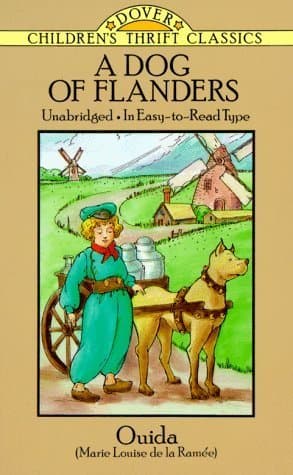
The story begins with Nello, an orphaned boy living with his poor grandfather, Jehan Daas, in a small Flemish village near Antwerp. They earn little money selling milk, which Jehan delivers in a small cart. One day, Nello finds a large, thin dog, Patrasche, by the road. The dog had been beaten and left by his cruel owner. Nello and his grandfather, despite their own poverty, take the dog in. They nurse him back to health, and Patrasche soon becomes a key part of their lives, helping pull the milk cart. Nello, a talented but unknown artist, dreams of becoming a great painter like Rubens, whose works he wants to see in Antwerp Cathedral.
The Dream of Rubens and Alois
Nello spends his days helping his grandfather with the milk rounds and sketching in the dirt. He often draws inspiration from the beautiful scenery and people around him. His greatest wish is to see the Rubens paintings in Antwerp Cathedral, which are kept covered and cost money to view, money he does not have. He becomes good friends with Alois Cogez, the daughter of the village's rich miller. Alois is kind and supports Nello's art dreams, often bringing him food and comforting him. Their bond gives Nello joy, even though Alois's father, Baas Cogez, does not approve of their friendship because Nello is poor.
The First Competition and Growing Hardship
Nello hears about an important art competition in Antwerp, offering a large prize and a chance for artistic recognition. He works hard on a drawing, putting his heart into the piece, hoping to win and help his grandfather with money troubles. Meanwhile, the harsh Flemish winter arrives, making their milk rounds harder and their poverty worse. Jehan Daas, already weak, gets weaker, and they lose customers. Despite these problems, Nello stays hopeful, driven by his art dreams and Patrasche's constant loyalty.
False Accusations and Broken Trust
A fire breaks out at Baas Cogez's mill. Without any proof, Nello is wrongly accused of starting it. This accusation, fueled by Baas Cogez's existing dislike for Nello, further separates the boy from the community. People start to avoid him and his grandfather, and their already uncertain living is put at risk. This false accusation deeply hurts Nello, not just because of the unfairness but also because it strains his friendship with Alois, as her father forbids her from seeing him. Despite being alone, Nello keeps drawing, finding peace in his art.
Grandfather's Decline and Death
The stress of poverty, the accusations, and the harsh winter greatly affect Jehan Daas's health. He becomes very ill and bedridden, unable to work. Nello, with Patrasche's help, tries to manage the milk rounds alone, but their income is not enough for their needs and medical costs. Nello takes care of his grandfather carefully, but the old man's condition worsens. Jehan Daas eventually dies, leaving Nello completely alone, with only Patrasche for company and support. This loss is a crushing blow to the young boy.
Eviction and Despair
After his grandfather's death, Nello cannot pay the rent for their small cottage. The landlord, uncaring about his situation, evicts him. With nowhere to go and no way to support himself, Nello feels more despair. He has no family, no friends left in the village (except Alois, who is forbidden to see him), and his art dreams seem further away than ever. He and Patrasche are forced to wander the roads, homeless and hungry, facing a bleak future on the streets. Nello holds onto the small hope of the art competition results.
The Competition Results
Driven by a desperate hope, Nello travels to Antwerp on the day the art competition results are announced. He stands in the crowd, waiting for news that could change his life. When the winners are read, Nello's name is not among them. His drawing, despite his great effort and talent, has been rejected, seen as too rough or simple by the judges. This rejection is the final, crushing blow, putting out the last spark of hope in Nello's heart. He feels completely defeated, his dreams of becoming an artist seeming impossible.
A Final Journey to the Cathedral
With his last hope gone and nowhere else to go, Nello decides to fulfill his lifelong dream: to see the Rubens paintings in Antwerp Cathedral. He knows he has no money for the viewing fee, but he is drawn to the church. He and Patrasche make their way through the snowy streets of Antwerp. The weather is very cold, and Nello is weak from hunger and tiredness. He feels a deep sense of peace and acceptance as he nears the cathedral, a place he has always linked with beauty and inspiration.
The Unveiled Masterpieces
As Nello and Patrasche arrive at the cathedral, they find that, by rare chance, the Rubens paintings – "The Elevation of the Cross" and "The Descent from the Cross" – have been left uncovered after a late-night service. Nello, weak but filled with deep wonder, looks at the masterpieces he has dreamed of seeing his whole life. The beauty and grandeur of the art overwhelm him, giving him a moment of pure joy and fulfillment in the midst of his suffering. Patrasche stays faithfully by his side, sharing in this quiet, sacred experience.
A Tragic, Peaceful End
After seeing the Rubens paintings, Nello and Patrasche, tired and freezing, curl up together on the cold stone floor of the cathedral, beneath the very paintings Nello loved. The extreme cold and Nello's weak state, along with the emotional and physical toll of his hardships, prove too much. In the morning, they are found dead, intertwined in a final embrace. Their tragic end is peaceful, as they passed away together, having found comfort and beauty in their last moments. The villagers, including Baas Cogez and Alois, eventually learn the truth of Nello's innocence regarding the fire, but it is too late.
Principal Figures
Nello
Protagonist
An orphaned, artistic boy with a pure heart and unwavering spirit.
Nello is a young, orphaned boy living with his grandfather in a small Flemish village. He possesses an innate talent for drawing and dreams of becoming a great painter like Rubens. Despite extreme poverty, hunger, and numerous injustices, Nello maintains a gentle, kind, and hopeful nature. He is deeply devoted to his grandfather, his dog Patrasche, and his friend Alois. His artistic aspirations are his driving force, a beacon of hope in his otherwise bleak existence. He represents innocence and the unfulfilled potential often crushed by societal indifference.
Relationships: Jehan Daas (Grandson and caregiver); Patrasche (Devoted companion and best friend); Alois Cogez (Close childhood friend and unrequited love)
Patrasche
Supporting
Nello's loyal and intelligent Belgian work dog.
Patrasche is a large, powerful dog of Flemish breed, initially abused and abandoned, but rescued and nursed back to health by Nello and his grandfather. He is fiercely loyal, intelligent, and hardworking, becoming an indispensable part of their milk delivery business. Patrasche's devotion to Nello is absolute; he is Nello's constant companion, protector, and source of comfort. He understands Nello's moods and shares in his joys and sorrows, symbolizing unconditional love and faithfulness in the face of adversity. His presence highlights the deep bond between humans and animals.
Relationships: Nello (Devoted companion and best friend); Jehan Daas (Cared for him after rescue)
Jehan Daas
Supporting
Nello's kind, elderly, and impoverished grandfather.
Jehan Daas is Nello's elderly grandfather and sole guardian. He is a kind, hardworking, but very poor old man who earns a meager living selling milk. He deeply loves Nello and provides him with the only family he knows. Despite his own struggles, he demonstrates compassion by taking in Patrasche. His health is frail, and he eventually succumbs to the hardships of their poverty and the harsh winter, leaving Nello alone. He represents the struggles of the working poor and the vulnerability of the elderly in a harsh world.
Relationships: Nello (Grandfather and guardian); Patrasche (Cared for him after rescue)
Alois Cogez
Supporting
The kind daughter of the wealthy miller, Nello's friend.
Alois is the daughter of Baas Cogez, the wealthy village miller. She is kind-hearted, compassionate, and one of Nello's few true friends. Unlike her father, she does not judge Nello for his poverty and genuinely cares for him, often bringing him food and offering comfort. Her friendship is a source of joy and hope for Nello. She is caught between her affection for Nello and her father's disapproval, which eventually leads to their separation. She represents innocence and kindness, constrained by societal expectations and parental authority.
Relationships: Nello (Close childhood friend); Baas Cogez (Daughter)
Baas Cogez
Antagonist
The wealthy, prejudiced village miller and Alois's father.
Baas Cogez is the wealthy and influential miller in the village. He is portrayed as arrogant, judgmental, and prejudiced against Nello due to the boy's poverty. He actively disapproves of Nello's friendship with his daughter, Alois, and prevents them from seeing each other. His most significant act of malice is falsely accusing Nello of setting fire to his mill, further ostracizing the boy. He embodies the harshness of social class division and the injustice faced by the poor. His character highlights the theme of societal indifference and cruelty.
Relationships: Alois Cogez (Father); Nello (Antagonist, prejudiced against Nello)
The Old Woman (Milk Customer)
Mentioned
A recurring customer who eventually abandons Nello.
This character represents the general public's fickle nature and lack of loyalty once Nello and his grandfather fall on harder times. She is initially a regular customer for their milk, but as their circumstances worsen and rumors spread, she, like others, stops buying from them. Her actions contribute to Nello's growing isolation and financial despair, illustrating how quickly even small support can vanish when misfortune strikes. She is a minor character but significant in demonstrating the compounding effects of poverty and social ostracization.
Relationships: Nello (Former customer); Jehan Daas (Former customer)
Themes & Insights
The Crushing Power of Poverty
Poverty is the main enemy in Nello's life, shaping his every struggle and leading to his sad end. From his meager life with his grandfather, struggling to sell milk, to not being able to afford basic needs like food, warmth, and even the fee to see the Rubens paintings, poverty starves Nello physically and emotionally. It isolates him, as shown by Baas Cogez's dislike and the villagers' abandonment. His eviction after his grandfather's death is a direct result of not being able to pay rent, showing how poverty takes away dignity and basic safety, leaving Nello and Patrasche completely vulnerable.
“He was poor, and he was friendless, and the world was very cold to him.”
Unfulfilled Dreams and Artistic Aspiration
Nello's strong desire to become a painter like Rubens is a central theme, representing the human need for beauty, purpose, and self-expression. Despite his talent, Nello's dreams are always blocked by his circumstances. He lacks the money for proper training, his art is dismissed by judges, and seeing his idol's work is a luxury he cannot afford for most of his life. This theme highlights the tragedy of unused potential and the societal barriers that stop talented people from following their passions, especially when they come from poor backgrounds. His final moments seeing the Rubens paintings offer a touching, though brief, fulfillment.
“To see the Rubens, that was his life's desire.”
The Unconditional Love and Loyalty of Animals
Patrasche's constant loyalty to Nello stands out against the cruelty and indifference Nello faces from people. Rescued from abuse, Patrasche devotes his life to Nello, helping him with the milk cart, comforting him, and staying by his side through every hardship, including hunger, homelessness, and Nello's eventual death. This theme stresses the pure and deep bond between humans and animals, showing Patrasche as Nello's most loyal friend and family member. His loyalty highlights the often-missing compassion in human society and gives Nello his only steady source of comfort.
“Patrasche loved Nello more than all the world, more than his own life.”
Social Injustice and Cruelty
The story is full of examples of social unfairness and human cruelty towards Nello. Baas Cogez's prejudice against Nello because of his poverty, his false accusation of arson, and the community's subsequent shunning show the harshness of societal judgment. Nello's eviction and the villagers' general indifference to his suffering show how easily the vulnerable are used and left behind. This theme criticizes a society that values wealth and status over kindness and fairness, showing how widespread biases and individual malice can lead to deep suffering and tragedy for those at the bottom of the social ladder.
“It was always the poor who were suspected, and the poor who were condemned.”
Plot Devices & Literary Techniques
Foreshadowing
Hints at future tragic events.
The narrative frequently employs foreshadowing, subtly hinting at the tragic fate awaiting Nello and Patrasche. For instance, descriptions of Nello's extreme poverty, his grandfather's failing health, and the harshness of the Flemish winter all build a sense of impending doom. The recurring motif of the covered Rubens paintings, unattainable to Nello, foreshadows his unfulfilled dreams and the difficulty of achieving his aspirations. These elements create a melancholic atmosphere and prepare the reader for the story's poignant conclusion, emphasizing the inevitability of their struggle against overwhelming odds.
Symbolism of the Rubens Paintings
Representing unattainable beauty, hope, and artistic aspiration.
The Rubens paintings in Antwerp Cathedral symbolize Nello's deepest desires, his artistic soul, and the beauty he longs to experience but cannot afford. They represent a world of art, culture, and recognition that is perpetually out of his reach due to his poverty. The fact that he can only see them in his final moments, when they are accidentally uncovered, underscores the tragedy of his life – that his greatest dream is fulfilled only at the very end, and through sheer chance, not merit or opportunity. They become a symbol of both the beauty of art and the cruelty of a world that denies access to it based on class.
Pathetic Fallacy
Nature mirroring the characters' emotional states.
The story frequently uses pathetic fallacy, where the natural environment reflects the emotional state and plight of Nello and Patrasche. The harsh, bitter Flemish winter, with its snow and freezing temperatures, directly mirrors Nello's growing despair, isolation, and physical suffering. The coldness of the weather parallels the 'coldness' of human indifference and cruelty he experiences. Conversely, brief moments of warmth or sunshine might coincide with a fleeting hope, though these are rare. This device heightens the emotional impact of their struggles and emphasizes the overwhelming forces of nature and society against them.
Irony
Contradictions between expectation and reality.
Irony is a prominent device, particularly situational irony. Nello, a talented artist, is rejected by the art competition, while his greatest artistic desire (seeing the Rubens paintings) is only fulfilled by accident in his last moments of life. He is falsely accused of arson by Baas Cogez, who later realizes Nello's innocence, but too late to make amends. The greatest kindness Nello receives is from an animal, Patrasche, while humans often treat him with cruelty or indifference. This irony underscores the injustice and tragedy inherent in Nello's life, highlighting the unfairness of his fate.
A Dog of Flanders Quotes
“They were only a boy and a dog; but they were all that was left to each other.”
“Love is eternal, and the love of a dog is the most eternal of all.”
“For the love of a dog, like the love of a child, is a thing of heaven.”
“He lay there, at the foot of the great picture, and the last smile on his face was for Patrasche.”
“No one knew how long they had been there, or how they had come, but they lay side by side, dead.”
“To be able to paint like Rubens! To be able to give to the world such beauty!”
“It was Christmas Eve; and the snow was falling fast.”
“The wind howled round the little hut, and shook its frail walls.”
“He would never be a painter; he would never even see the pictures again.”
“The boy was too little to work, and the old man too old.”
“For Patrasche loved Nello better than his life.”
“He had only wanted to see the Rubens.”
“No one had ever been so kind to him as Patrasche.”
“The great picture was before him, and he was alone with it.”
Quiz
10 questions on the plot and the characters. Each answer comes with a short explanation.
Question 1
What is the name of Nello's devoted dog?
- Bruno
- Patrasche
- Max
- Flanders
Show answer
B. Patrasche Nello's loyal companion throughout the story is a Belgian work dog named Patrasche.
Question 2
What is Nello's greatest aspiration in life?
- To become a wealthy merchant
- To travel the world
- To become a famous painter
- To own a large farm
Show answer
C. To become a famous painter Nello, a gentle boy, dreams of becoming a painter, inspired by the artist Rubens.
Question 3
Which famous artist, Nello's idol, once worked in the village near Antwerp?
- Vincent van Gogh
- Rembrandt
- Rubens
- Leonardo da Vinci
Show answer
C. Rubens The story explicitly states that Nello's idol, the artist Rubens, once worked in the village near Antwerp.
Question 4
What kind of work does Patrasche typically do to help Nello and his grandfather?
- Guarding sheep
- Pulling a milk cart
- Hunting for food
- Delivering letters
Show answer
B. Pulling a milk cart Patrasche is a Belgian work dog, and his primary role is often depicted as pulling a cart, usually for milk delivery, to help the family earn a meager living.
Question 5
What is one of the main hardships Nello and Patrasche endure throughout the story?
- Constant illness
- Fear of war
- Poverty and hunger
- Loneliness and isolation
Show answer
C. Poverty and hunger The story highlights that Nello and Patrasche suffer 'countless hardships — poverty, hunger, cruelty, and rejection.'
Question 6
What specific building in Antwerp does Nello long to see the paintings inside?
- The Royal Palace
- The Cathedral
- The Town Hall
- The Academy of Fine Arts
Show answer
B. The Cathedral Nello's deepest desire is to see the great Rubens paintings housed within the Antwerp Cathedral, which he cannot afford to enter.
Question 7
What event leads to Nello and Patrasche being dispossessed from their home?
- Nello's grandfather passes away, leaving them without support.
- Nello accidentally damages a valuable painting.
- Patrasche attacks a villager.
- Nello refuses to work for a local farmer.
Show answer
A. Nello's grandfather passes away, leaving them without support. After Nello's grandfather dies, Nello and Patrasche are left completely alone and without means, leading to their eviction.
Question 8
What is the ultimate fate of Nello and Patrasche at the end of the story?
- They become rich and famous.
- They are separated and live out their lives apart.
- They die together in the Antwerp Cathedral, beneath Rubens' paintings.
- They find a new, loving family to take them in.
Show answer
C. They die together in the Antwerp Cathedral, beneath Rubens' paintings. The story famously concludes with Nello and Patrasche found frozen to death together in the Antwerp Cathedral, having finally seen the Rubens paintings Nello so longed to view.
Question 9
Which of the following themes is most central to 'A Dog of Flanders'?
- The pursuit of wealth and power
- The triumph of good over evil
- Unconditional love, loyalty, and the tragic consequences of poverty.
- The importance of formal education.
Show answer
C. Unconditional love, loyalty, and the tragic consequences of poverty. The narrative deeply explores the profound bond between Nello and Patrasche, their enduring loyalty, and the devastating impact of their extreme poverty and societal indifference.
Question 10
What specific piece of Nello's artwork is judged in a competition, and what is the outcome?
- A landscape painting, which wins first prize.
- A portrait of Patrasche, which is praised but not awarded.
- A drawing of his grandfather, which is rejected and not even considered.
- A still life, which receives an honorable mention.
Show answer
C. A drawing of his grandfather, which is rejected and not even considered. Nello submits a drawing of his grandfather to a competition, but it is cruelly overlooked and rejected, adding to his despair.
A Dog of Flanders FAQ
What is the central plot of 'A Dog of Flanders'?
The story follows Nello, an orphaned boy with artistic dreams, and his loyal dog, Patrasche, as they navigate extreme poverty and hardship in a village near Antwerp. Nello aspires to be a painter like Rubens but faces constant setbacks, culminating in a tragic yet serene end for both him and Patrasche inside Antwerp Cathedral.
Who are the main characters in the story?
The primary characters are Nello, a kind-hearted and artistic orphan; Patrasche, his devoted and hardworking Belgian dog; and Jehan Daas, Nello's aging and impoverished grandfather. Alois Cogez is Nello's only friend, and her father, Baas Cogez, is a wealthy but often harsh miller.
What role does Patrasche play in Nello's life and the family's survival?
Patrasche, initially an abused work dog, becomes Nello's constant companion and the family's primary means of income after Nello nurses him back to health. He helps Nello's grandfather transport milk to Antwerp, demonstrating unwavering loyalty and immense physical strength despite their meager circumstances.
What specific artistic aspirations does Nello have?
Nello deeply admires the works of the Flemish painter Peter Paul Rubens, whose masterpieces are displayed in Antwerp Cathedral. He dreams of becoming a great artist himself, often sketching and imagining his own paintings, particularly inspired by Rubens's 'The Elevation of the Cross' and 'The Descent from the Cross'.
What is the significance of the Antwerp Cathedral in the story's climax?
Antwerp Cathedral is the sanctuary where Nello and Patrasche find their final rest. Nello yearned to see Rubens's masterpieces within its walls but could never afford the viewing fee. In their last moments, they are found frozen to death before the very paintings Nello longed to see, fulfilling his wish in a poignant, tragic manner.
Were Nello's parents ever mentioned, and what happened to them?
Nello's parents are only briefly mentioned as having died when he was very young, leaving him an orphan to be raised by his grandfather, Jehan Daas. Their absence underscores Nello's profound loneliness and dependence on his grandfather and Patrasche for emotional support.
What specific acts of cruelty or injustice does Nello face?
Nello endures several injustices: being falsely accused of arson at the mill, which leads to his eviction; being unfairly denied the art competition prize despite his talent; and being constantly rejected and scorned by the wealthy villagers, particularly Baas Cogez, who prevents him from marrying Alois due to his poverty.
Is there any symbolism behind the specific Rubens paintings Nello admires?
Nello's admiration for 'The Elevation of the Cross' and 'The Descent from the Cross' by Rubens holds symbolic weight. These paintings depict suffering, sacrifice, and eventual peace, mirroring Nello's own life of hardship and his ultimate, serene release from suffering alongside Patrasche.
How does Nello's environment contribute to his psychological state?
Nello's impoverished and often hostile environment fosters a deep sense of isolation and resignation, yet it also fuels his artistic escapism and resilience. The constant struggle for survival and the lack of recognition for his talents contribute to a profound melancholy, tempered only by his bond with Patrasche and his dreams.
Analyze the bond between Nello and Patrasche from a psychological perspective.
The bond between Nello and Patrasche is a profound example of mutual dependency and unconditional love. Patrasche serves as Nello's sole consistent source of comfort, loyalty, and companionship, filling the void left by societal rejection and poverty. For Patrasche, Nello represents salvation and kindness, fostering an unbreakable devotion.
How does the story explore themes of human cruelty versus animal loyalty?
The narrative sharply contrasts the often harsh and unfeeling nature of human society, particularly the villagers' indifference and cruelty towards Nello, with the unwavering loyalty and selfless devotion of Patrasche. Patrasche's actions consistently highlight the purity of animal love against human prejudice and greed.
What psychological impact does Nello's unfulfilled artistic ambition have on him?
Nello's unfulfilled artistic ambition is a source of both hope and deep frustration. It provides him with an escape from his bleak reality but also intensifies his suffering when he is denied opportunities, such as the art competition, or access to the very masterpieces that inspire him. This constant yearning contributes to his melancholic disposition.
Is the ending truly tragic, or can it be interpreted as bittersweet or even triumphant?
While undeniably tragic in its depiction of Nello and Patrasche's deaths, the ending can also be seen as bittersweet. They achieve peace and are united in death before the Rubens paintings Nello so longed to see, free from earthly suffering. In this sense, it's a triumph over their harsh reality, finding solace in their final moments together.
What is Ouida's potential message about society's treatment of the poor and gifted?
Ouida likely critiques a society that fails to recognize and support talent among the impoverished, instead punishing them for their circumstances. The story highlights how societal prejudice, economic hardship, and a lack of compassion can crush even the most gentle and gifted spirits, suggesting a need for greater empathy and social justice.
How does 'A Dog of Flanders' reflect the Romantic tradition mentioned in its description?
The story embodies Romantic ideals through its emphasis on intense emotion, the beauty of nature (despite the harsh reality), the suffering of the innocent, and the celebration of individual artistic genius. It also features a strong sense of sentimentality, idealization of animal loyalty, and a tragic, dramatic climax, all hallmarks of the Romantic era.
Does Nello's refusal to accept charity from the kind woman at the end signify anything deeper?
Nello's refusal of charity can be interpreted as a final act of preserving his dignity and independence, or perhaps a profound weariness. He may feel too broken to accept help, or his spirit, having endured so much, simply seeks an end to his struggles rather than temporary relief, preferring to meet his fate with Patrasche.
Could Patrasche have lived if Nello had made different choices?
Patrasche's fate is inextricably linked to Nello's. As Nello's loyal companion, Patrasche would likely not have survived without him, given their shared poverty and the dog's deep devotion. While Nello's choices led them to their final destination, Patrasche's unwavering loyalty meant he would follow Nello even to death, making their shared end almost inevitable.
About the author

Ouida was a British author known for her works of fiction in the 19th century. She is best recognized for her novel "A Dog of Flanders," which tells a poignant story of love and sacrifice. Her writing often reflects themes of compassion and the bond between humans and animals.
Similar books
- Black Beauty
Anna Sewell
4.0 (239k) average on GoodreadsChildren'sExplores animal welfare and the hardships faced by both humans and animals in 19th-century society.
- Les Misérables
Victor Hugo
4.2 (683k) average on GoodreadsHistorical FictionFeatures themes of poverty, social injustice, and the resilience of the human spirit amidst suffering, though on a much grander scale.
- Harry Potter and the Sorcerer's Stone
J.K. Rowling
4.5 (7M) average on GoodreadsFantasyRescued from a miserable life under the stairs, an orphaned boy discovers he's a wizard destined for a magical school, where he uncovers a dangerous secret tied to the dark wizard who murdered his parents.
- The Hobbit, or There and Back Again
J.R.R. Tolkien
4.3 (2.9M) average on GoodreadsFantasyA comfort-loving hobbit named Bilbo Baggins is whisked away by a mischievous wizard and a band of dwarves on an unexpected journey to reclaim stolen treasure from a fearsome dragon, discovering courage and a magical ring along the way.
- Harry Potter and the Goblet of Fire
J.K. Rowling
4.6 (2.6M) average on GoodreadsFantasyA bewildered Harry Potter, underage and thrust into a deadly Triwizard Tournament, must brave dragons, mermaids, and a resurgent dark magic to survive a year that will forever alter the wizarding world.
- Harry Potter and the Order of the Phoenix
J.K. Rowling
4.5 (2.5M) average on GoodreadsFantasyIn a year of oppressive secrets and the threat of Voldemort, Harry Potter and Dumbledore's Army secretly train for war, shown through Jim Kay and Neil Packer's dark illustrations.




Enjoyed the summary?
A summary gives you the shape of the book. The book itself has the detail, the examples and the voice.
Find A Dog of Flanders on AmazonAs an Amazon Associate, BookBrief earns from qualifying purchases. How we're funded