
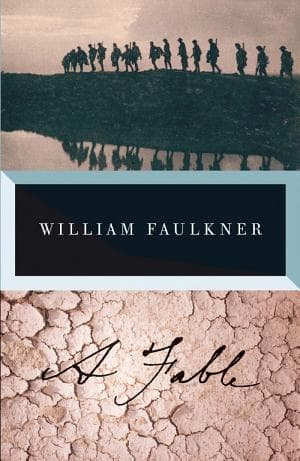
Synopsis
Covers the whole plot, including the ending.
- Difficulty
- Hard
- Pacing
- Slow
- Mood
- Philosophical, Somber, Allegorical, Profound, Challenging
- Read it if
- You appreciate allegorical narratives, complex moral dilemmas, and deeply philosophical explorations of war, faith, and humanity. Ideal for readers who enjoy dense, challenging prose and are familiar with Faulkner's style.
- Skip it if
- You prefer straightforward plots, light reading, or are averse to highly symbolic and abstract storytelling. Not recommended if you dislike Faulkner's stream-of-consciousness or non-linear narratives.
A Fable Plot Summary
Covers the whole plot, including the ending.
The Armistice and the Imprisonment
In the spring of 1918, during World War I, the entire Western Front inexplicably falls silent for three days. This armistice is caused by a French corporal and his twelve followers who refuse to fight, starting a mutiny that spreads across the lines. The French high command, with their British and German counterparts, sees this as a catastrophic breach of military order and a threat to the war. The corporal, a Christ-like figure, and his twelve disciples are apprehended and imprisoned in a chateau behind the French lines. The military hierarchy is determined to make an example of them, fearing that such an act of peace could unravel the war effort and expose the futility of their command.
General Gragnon's Despair and the Arrival of the Old General
General Gragnon, the commander of the French division where the mutiny occurred, is overwhelmed by the disgrace and potential consequences. He attempts suicide by shooting himself, but only wounds his shoulder, adding to the chaotic atmosphere. His failure and the mutiny bring the Supreme Commander of the Allied armies, an old, seemingly omnipotent French General, to the chateau. The General, a figure of authority, arrives to personally oversee the handling of the mutiny. His presence signifies the gravity with which the high command views the corporal's actions, and he immediately takes charge of the situation, preparing to restore order and punish the offenders.
The Old General's Confrontation with the Corporal
The Supreme Commander, the corporal's biological father, confronts him in his cell. The General offers the corporal a chance to recant his actions, deny his leadership of the mutiny, and accept a pardon, allowing the war to continue. He argues that the corporal's act of peace is a dangerous illusion, a threat to the established order that, despite its flaws, is necessary for human civilization. The General, a pragmatist and a figure of worldly power, tries to convince his son that his idealism is naive and destructive. The corporal, however, refuses, maintaining his belief in peace and the power of human compassion over the machinery of war, even when facing certain death.
The Corporal's Trial and Execution
Despite the Supreme Commander's efforts, the corporal is court-martialed. The trial is a formality, a predetermined exercise designed to uphold military law and send a clear message. The corporal and two of his disciples, a British private and a German sentry who had joined their cause, are sentenced to death. On the third day of the armistice, the corporal is executed by firing squad. His death, however, does not end the ripple effect of his actions. His body is buried in a makeshift grave, but his sacrifice transforms him into a symbol of resistance against the futility of war and a martyr for peace, echoing the story of Christ.
The Aftermath of the Execution and the Spread of the Fable
Following the corporal's execution, the war immediately resumes with renewed ferocity, as if to erase the memory of the three days of peace. However, the story of the corporal and his twelve men begins to spread through the trenches and beyond, taking on the quality of a fable. Soldiers on both sides are affected by it, some inspired by the corporal's defiance, others simply bewildered by the brief respite from fighting. The high command tries to suppress the narrative, but it continues to circulate, becoming an underground legend that challenges the official version of events. The brief armistice and the corporal's sacrifice become a symbol of the human desire for peace amidst the brutality of conflict.
The British Private's Fate and the Re-establishment of Order
The British private, one of the corporal's original twelve followers, is also executed. His death, alongside the corporal's, reinforces the military's determination to crush dissent. The Supreme Commander, having fulfilled his duty to maintain the war, returns to his headquarters, leaving behind the immediate aftermath of the executions. He has re-established military order, but at the cost of his own son's life and the suppression of a nascent movement for peace. The chateau, once a place of tension and potential revolution, reverts to a symbol of military authority, its purpose served in quashing the most significant challenge to the war's continuation.
The Quartermaster General's Journey and the Corporal's Burial
The Quartermaster General, a former cavalry officer named Fougant, is tasked with overseeing the disposal of the corporal's body. He is a man caught between the demands of military protocol and a growing sense of disillusionment. He arranges for the corporal's body to be buried in a common grave, but the act itself is symbolic. Fougant, though a part of the military machine, begins to question the war's purpose and the cost of maintaining it. His journey reflects a broader unease within certain elements of the high command, who, despite their positions, are not immune to the moral implications of the war and the corporal's sacrifice.
The Three Women and the Search for Meaning
Three women—Marthe, the corporal's sister; Marya, his mother; and a prostitute named Stella—are drawn into the aftermath of the mutiny. Marthe arrives seeking to claim her brother's body, driven by familial duty and a desire to understand his actions. Marya, a figure of silent suffering, embodies the grief of mothers who lose their sons to war. Stella, who had known the corporal before the war, represents a more worldly, yet compassionate, perspective on his idealism. Their presence highlights the human cost of the war and the personal impact of the corporal's sacrifice, moving beyond the purely military narrative to explore the emotional and spiritual dimensions of his story.
The Old General's Philosophical Struggle
In the privacy of his headquarters, the Supreme Commander, the corporal's father, reflects on the events. He is a man burdened by the weight of his command and the moral dilemma his son's actions present. He grapples with the conflict between his duty to the war and his personal connection to the corporal's message of peace. He believes in the necessity of maintaining order, even at the cost of individual lives, viewing humanity as flawed and prone to conflict. His internal monologue reveals the complex philosophical underpinnings of his character, a man who understands the corporal's idealism but ultimately rejects it as impractical in a world defined by power and violence.
The Corporal's Reburial and the Unfolding Fable
Years after the armistice, the corporal's body is exhumed and reburied in a more prominent grave, a symbol of the lasting power of his story. The reburial is orchestrated by those who recognize the symbolic significance of his sacrifice. The fable of the corporal and his followers continues to evolve, passed down through generations, embodying the hope for peace and the defiance against oppression. His story becomes a permanent fixture in the collective memory, a counter-narrative to the official history of the war, suggesting that even in the face of overwhelming power, individual acts of conscience can resonate and inspire across time.
Principal Figures
The Corporal (Stephan)
Protagonist
A Christ-like figure who leads a mutiny for peace during World War I.
The Corporal, later revealed as Stephan, is a young French soldier who, with twelve followers, orchestrates a three-day armistice on the Western Front by refusing to fight. He is a pacifist and an idealist, believing in the inherent goodness of humanity and the possibility of peace. His actions are deliberate and sacrificial, mirroring the Passion of Christ, as he willingly faces execution for his convictions. He is the biological son of the Supreme Commander, a fact that adds a profound layer of personal tragedy and ideological conflict to his story. His quiet defiance and unwavering commitment to peace make him a martyr and a symbol of hope against the futility of war.
Relationships: The Supreme Commander (biological son); Marthe (sister); Marya (mother); Stella (acquaintance/lover)
The Supreme Commander (General Gragnon's Father)
Antagonist/Complex Figure
The powerful Allied General who is also the corporal's biological father.
The Supreme Commander is a formidable, pragmatic, and ruthless French General, the ultimate embodiment of military power and the established order. He believes in the necessity of war and the maintenance of societal structure, even if it means sacrificing individuals. He is revealed to be the biological father of the Corporal, a secret that complicates his duty and adds a tragic dimension to his character. He attempts to persuade his son to recant, not out of mercy, but to preserve the war and the system he represents. His struggle is philosophical, believing that humanity is inherently flawed and requires the rigid control of institutions like war to function. He is a figure of immense authority, but also one burdened by the moral weight of his decisions.
Relationships: The Corporal (biological father); General Gragnon (father of the disgraced General); Marthe (daughter)
Marthe
Supporting
The corporal's half-sister, seeking to claim his body.
Marthe is the Corporal's half-sister, though their familial connection to the Supreme Commander is complex and intertwined. She is a determined and somewhat embittered woman who arrives at the chateau seeking to claim her brother's body after his execution. Her motivations are complex, driven by a mix of familial duty, a desire for recognition, and perhaps a yearning for a connection to the man who has become a symbol. She represents the civilian world grappling with the consequences of the war and the personal tragedies it inflicts, and her persistence challenges the military's attempts to erase the corporal's memory.
Relationships: The Corporal (half-sister); The Supreme Commander (daughter)
Marya
Supporting
The corporal's mother, a silent figure of universal grief.
Marya is the Corporal's mother, a silent and suffering figure who embodies the universal grief of mothers who lose their children to war. She is present at the chateau, a poignant symbol of the personal cost of conflict. Her presence emphasizes the human, emotional dimension of the story, contrasting with the cold, strategic calculations of the military command. She represents the innocent victims of war, her sorrow a powerful indictment of the violence that consumes young lives. Her quiet dignity and profound loss resonate throughout the narrative, making her a symbol of enduring maternal love and suffering.
Relationships: The Corporal (mother); The Supreme Commander (former lover)
Stella
Supporting
A prostitute connected to the corporal, representing earthly compassion.
Stella is a prostitute who knew the Corporal before the war. She represents a more earthly, pragmatic, yet ultimately compassionate perspective on humanity. Her presence at the chateau, along with Marthe and Marya, forms a trio of women connected to the Corporal, each reacting to his sacrifice in her own way. Stella's character brings a dimension of human kindness and understanding, contrasting with the harsh realities of war and military justice. She offers a different kind of support and recognition for the corporal's actions, rooted in her understanding of human nature and suffering.
Relationships: The Corporal (acquaintance/lover)
General Gragnon
Supporting
The disgraced French divisional commander of the mutinying regiment.
General Gragnon is the French divisional commander under whom the mutiny occurs. He is a figure of tragic incompetence and despair. Overwhelmed by the shame and consequences of the mutiny, he attempts suicide, only wounding himself. His failure highlights the fragility of the military hierarchy and the immense pressure placed upon commanders. He is the son of the Supreme Commander, adding another layer of complex family dynamics and the weight of expectation within the military establishment. His character serves to illustrate the immediate, devastating impact of the corporal's actions on the existing military structure.
Relationships: The Supreme Commander (son)
The Quartermaster General (Fougant)
Supporting
A former cavalry officer tasked with the corporal's burial.
Fougant, the Quartermaster General, is a former cavalry officer who is tasked with overseeing the disposal and later reburial of the Corporal's body. He is a more nuanced character, a part of the military machine but also capable of reflection and a growing sense of disillusionment with the war. His actions, particularly in the later reburial of the corporal, suggest a subtle shift in perspective, hinting at the lingering impact of the corporal's sacrifice even on those within the military establishment. He represents the possibility of questioning and quiet dissent within the ranks.
The British Private
Supporting
One of the corporal's twelve followers, executed for mutiny.
The British Private is one of the Corporal's twelve disciples, representing the international solidarity of the mutiny. He is executed alongside the Corporal, underscoring the severe consequences for any act of defiance against the military order. His participation highlights that the desire for peace transcends national boundaries, uniting soldiers from opposing sides in a common cause. His death contributes to the growing legend of the corporal, making him part of the collective sacrifice for peace.
Relationships: The Corporal (follower)
The German Sentry
Supporting
One of the corporal's twelve followers, executed for mutiny.
The German Sentry is another of the Corporal's twelve disciples, a soldier from the 'enemy' side who joins the mutiny. His inclusion emphasizes the universal nature of the desire for peace and the artificiality of nationalistic conflict. He is also executed, reinforcing the high command's determination to suppress any challenge to the war effort. His sacrifice, alongside the Corporal and the British Private, illustrates the potential for human connection and shared purpose to override the divisions of war.
Relationships: The Corporal (follower)
Themes & Insights
Idealism vs. Pragmatism
This theme is central to the confrontation between the Corporal and the Supreme Commander. The Corporal embodies an unwavering idealism, believing in the possibility of universal peace and human compassion, even at the cost of his own life. The Supreme Commander, conversely, represents a stark pragmatism, arguing that humanity is flawed and requires the brutal order of war and established institutions to prevent chaos. The novel explores the tension between these two worldviews, questioning whether idealistic acts can truly change a cynical world or if they are doomed to be crushed by the machinery of power. The Corporal's death, while a defeat for his physical presence, ensures his idealism lives on as a fable.
“You are doomed to choose. You cannot choose not to choose. You can choose to be what you are, or you can choose to be what you will be. You can choose to be what you were, or you can choose to be what you will be. You can choose to be what you are, or you can choose to be what you will be.”
The Nature of War and Peace
Faulkner examines the mechanisms and justifications of war, portraying it as a self-perpetuating machine that consumes human lives. The three-day armistice started by the Corporal is a stark contrast, offering a glimpse of an alternative—a world without conflict. The novel scrutinizes the motivations behind continuing the war, showing how the military hierarchy prioritizes order and power over human life and peace. It suggests that war, despite its horrors, is upheld by those who benefit from its structure and the control it affords. The Corporal's actions and subsequent martyrdom highlight the human desire for peace amidst the brutality, even if that desire is ultimately suppressed by force.
“War is the ultimate expression of man's folly and his genius. It is the ultimate expression of his capacity for destruction, and his capacity for creation.”
Sacrifice and Martyrdom
The Corporal's story is an explicit allegory for the Passion of Christ, emphasizing sacrifice and martyrdom. His act of mutiny, his twelve followers, his trial, and his execution all echo biblical narratives. His death is not a failure but a transformative act, elevating him from a simple soldier to a symbolic figure whose legacy inspires hope and resistance. The novel explores how sacrifice, even when seemingly futile in the immediate sense, can create lasting meaning and create a 'fable' that transcends the physical realm, challenging the dominant narratives of power and violence. His body's eventual reburial further cements his status as a martyr.
“He didn't have to choose to die for man. He chose to die for man. He chose to choose.”
Authority and Rebellion
The novel examines the dynamics between absolute authority (represented by the Supreme Commander and the military hierarchy) and individual rebellion (embodied by the Corporal). The military's swift and brutal response to the mutiny shows the lengths to which established power will go to maintain control and suppress dissent. However, the very act of rebellion, even when crushed, plants seeds of resistance and creates a counter-narrative. The 'fable' of the Corporal becomes a form of ongoing rebellion, a challenge to official history and a symbol of the human spirit that questions and resists oppressive systems. The power of the fable lies in its ability to inspire future acts of defiance.
“Man is immortal, not because he alone among creatures has an inexhaustible voice, but because he has a soul, a spirit capable of compassion and sacrifice and endurance.”
Family and Legacy
The revelation that the Corporal is the Supreme Commander's illegitimate son adds a personal tragedy and complexity to the narrative. It transforms an ideological conflict into a personal one, exploring how familial bonds can be strained or broken by conflicting ideologies and duties. The General's struggle with his son's actions, and Marthe's efforts to claim her brother's body, highlight how individuals grapple with personal legacies within a larger historical context. The 'fable' itself becomes a form of legacy, ensuring the Corporal's memory and ideals persist beyond his physical death, influencing future generations.
“A man doesn't choose to be a father. He is a father. He chooses to be a good one.”
Plot Devices & Literary Techniques
Biblical Allegory
The narrative explicitly parallels the Passion of Christ.
Faulkner uses biblical allegory extensively throughout 'A Fable'. The Corporal is a clear Christ-figure, leading twelve followers, orchestrating a three-day cessation of conflict (echoing Christ's three days in the tomb), facing betrayal (implied by the resumption of war), and undergoing a trial and execution as a sacrifice for humanity's redemption. His mother, Marya, parallels the Virgin Mary, and the prostitute, Stella, can be seen as a Magdalene figure. This device elevates the story from a mere war narrative to a profound meditation on sacrifice, faith, and humanity's capacity for both good and evil, giving the Corporal's actions universal, timeless significance.
The Fable Itself
The story of the mutiny transforms into a legendary tale.
The 'fable' is not just the title but a key plot device. The events of the mutiny and the Corporal's sacrifice are not merely reported; they are immediately transformed into an oral tradition, a legend passed among soldiers and civilians. This device highlights the power of storytelling and collective memory to create meaning and resistance, even in the face of official suppression. The evolving 'fable' ensures the Corporal's message of peace and defiance endures beyond his death, becoming a living, subversive narrative that challenges the authoritative version of history and inspires hope for future change.
Three-Day Armistice
A miraculous cessation of hostilities that sets the plot in motion.
The three-day armistice is the inciting incident and a powerful symbolic device. Its inexplicable nature and the subsequent silence on the Western Front create a vacuum in which the Corporal's actions gain immense significance. It represents a brief, utopian glimpse of peace, a moment when humanity transcends its self-destructive tendencies. This temporary peace serves as a direct challenge to the entrenched military order and underscores the artificiality of war. Its abrupt end, followed by renewed violence, highlights the fragility of peace and the powerful forces determined to maintain conflict.
The Chateaux Setting
A confined, symbolic location for the drama of authority and rebellion.
The chateau where the Corporal and his followers are imprisoned, and where the Supreme Commander operates, serves as a crucial symbolic setting. It is a microcosm of power, authority, and the containment of dissent. Its walls hold both the prisoners of peace and the architects of war. The confinement of the chateau emphasizes the intense, claustrophobic nature of the ideological and personal clashes occurring within. It acts as a stage for the 'trial' and execution, a place where the grand philosophical debates of the novel are enacted on a very human scale, representing the nexus where abstract power meets individual lives.
A Fable Quotes
“Perhaps to lose a battle is the only way to win it.”
“The only thing you can do for a man who's going to be shot for desertion is to shoot him.”
“Man is indomitable, but he is not immortal.”
“The war was not a war anymore; it was a condition.”
“There are no good wars or bad wars, only wars.”
“He who would be free must first be bound.”
“The human heart is a lonely hunter.”
“Peace is not the absence of war, but the presence of justice.”
“Courage is the base of all virtue.”
“It is not defeat that destroys you, but the fear of defeat.”
“Every man has to find his own way to live with the world, and his own way to die out of it.”
“The living, not the dead, are responsible for the past.”
“The longest journey is the journey inward.”
“Hope is not a substitute for action.”
Quiz
10 questions on the plot and the characters. Each answer comes with a short explanation.
Question 1
What is the primary setting for the majority of the novel's action?
- A small town in rural Mississippi
- The trenches of World War I in France
- A military hospital in London
- The German High Command headquarters
Show answer
B. The trenches of World War I in France The novel is explicitly set in the trenches of World War I in France, focusing on the mutiny within a French regiment during this conflict.
Question 2
What event forms the central conflict and catalyst for the novel's allegorical themes?
- A major offensive launched by Allied forces
- A mutiny within a French regiment
- The signing of an armistice agreement
- An espionage mission behind enemy lines
Show answer
B. A mutiny within a French regiment The core of the story revolves around a mutiny in a French regiment, which serves as the central event prompting the allegorical exploration of sacrifice, war, and humanity.
Question 3
Which historical conflict serves as the backdrop and allegorical framework for 'A Fable'?
- The American Civil War
- World War II
- The Vietnam War
- World War I
Show answer
D. World War I The book is described as an 'allegorical story of World War I,' using that conflict as its historical and thematic foundation.
Question 4
What is the general critical reception of 'A Fable' immediately following its publication, compared to later evaluations?
- It was universally acclaimed as a masterpiece from the start.
- It was initially seen as a sharp departure for Faulkner but later recognized as a major work.
- It was largely ignored by critics and the public alike.
- It was praised for its realism but criticized for its allegorical elements.
Show answer
B. It was initially seen as a sharp departure for Faulkner but later recognized as a major work. The provided text states it was 'originally considered a sharp departure for Faulkner' but has 'recently come to be recognized as one of his major works and an essential part of the Faulkner oeuvre.'
Question 5
According to Malcolm Cowley, what notable quality do some of the scenes in 'A Fable' possess?
- They are among the most humorous scenes he ever conceived.
- They are some of the most powerful scenes he ever conceived.
- They are exceptionally detailed historical accounts.
- They are the most abstract and confusing scenes in his work.
Show answer
B. They are some of the most powerful scenes he ever conceived. The text quotes Malcolm Cowley saying the book includes 'some of the most powerful scenes he ever conceived,' highlighting the emotional impact of Faulkner's writing in this novel.
Question 6
What literary awards did 'A Fable' win in 1955?
- The Nobel Prize in Literature and the Booker Prize
- The Pulitzer Prize and the National Book Award
- The PEN/Faulkner Award and the O. Henry Award
- The National Medal of Arts and the Frost Medal
Show answer
B. The Pulitzer Prize and the National Book Award The book explicitly won 'both the Pulitzer Prize and the National Book Award in 1955,' marking its critical success.
Question 7
How does 'A Fable' fit into the broader body of Faulkner's work, according to recent recognition?
- It is considered an anomaly, unrelated to his other major themes.
- It is recognized as a minor work, distinct from his more significant contributions.
- It is now recognized as one of his major works and an essential part of his oeuvre.
- It is seen primarily as a historical document rather than a literary achievement.
Show answer
C. It is now recognized as one of his major works and an essential part of his oeuvre. The text states that 'Recently it has come to be recognized as one of his major works and an essential part of the Faulkner oeuvre,' indicating its elevated status within his complete body of work.
Question 8
What specific characteristic of Faulkner's descriptions of the war is highlighted by The New York Times?
- Their meticulous historical accuracy
- Their stark realism and brutality
- Their ability to 'rise to magnificence'
- Their detachment and objective tone
Show answer
C. Their ability to 'rise to magnificence' The New York Times is quoted as saying Faulkner's descriptions of the war 'rise to magnificence,' suggesting a powerful and elevated quality to his prose.
Question 9
Given the allegorical nature of the novel, what might the mutiny in the French regiment primarily represent or symbolize?
- A straightforward historical account of military insubordination.
- The inherent futility and moral bankruptcy of war itself.
- A specific political protest against the French government.
- The strategic genius of a rebellious military leader.
Show answer
B. The inherent futility and moral bankruptcy of war itself. As an 'allegorical story of World War I,' the mutiny likely symbolizes broader themes beyond a simple historical event, such as the human cost of war, the challenge to authority, or the search for peace amidst conflict. The 'fable' aspect suggests a deeper message about the nature of humanity and warfare.
Question 10
How did 'A Fable' initially challenge readers and critics regarding Faulkner's established style and themes?
- It was too similar to his previous Southern Gothic works, disappointing those seeking novelty.
- Its focus on international conflict and explicit allegory marked a 'sharp departure' from his typical regional settings and character studies.
- The language was surprisingly simple and direct, unlike his complex prose.
- It lacked the psychological depth and interior monologue characteristic of his earlier novels.
Show answer
B. Its focus on international conflict and explicit allegory marked a 'sharp departure' from his typical regional settings and character studies. The text explicitly states it 'was originally considered a sharp departure for Faulkner,' implying it deviated from what critics expected based on his previous works, likely due to its international setting and overt allegorical nature, rather than his usual focus on the American South.
A Fable FAQ
What is A Fable about?
A Fable is an allegorical novel set during World War I, primarily in the trenches of France. It centers on a French corporal, Stephan, and his 12 followers who intentionally stop fighting, leading to a spontaneous armistice across the Western Front. This act of defiance challenges the established military and political powers, forcing them to confront the moral implications of war and the nature of humanity's will for peace versus conflict.
Why should I read A Fable?
You should read A Fable for its profound exploration of pacifism, sacrifice, and the human condition against the backdrop of war. Faulkner masterfully blends realism with allegory, creating powerful scenes and philosophical debates that resonate deeply. It's a challenging but ultimately rewarding read that offers a unique perspective on faith, rebellion, and the futility of conflict, earning it both a Pulitzer Prize and National Book Award.
What is the background/setting of A Fable?
The novel is primarily set in the muddy, war-torn trenches of the Western Front in France during World War I, specifically in the year 1918. The immediate setting is a sector where a French regiment stages a mutiny, causing a three-day armistice. The narrative also delves into the headquarters of the Allied generals and occasionally shifts to other locations, providing a broad view of the war's impact and the power structures controlling it.
What are the most memorable quotes?
Some memorable quotes include the Corporal's defiant pronouncements against the generals, such as his assertion of humanity's enduring will to endure and resist. Also, the General's cynical yet profound reflections on man's inherent need for both good and evil, and his argument that war is an essential mechanism for society, provide stark philosophical counterpoints.
What writing style does the author use?
Faulkner employs his characteristic dense, often labyrinthine prose, featuring long, complex sentences, stream-of-consciousness elements, and shifting perspectives. While still recognizable as Faulkner, the style in A Fable also incorporates a more overtly allegorical and philosophical tone, often bordering on epic poetry, to convey its universal themes of sacrifice and humanity's struggle against itself.
What minor details add significant meaning?
The recurring motif of the old General's clock, which meticulously marks the time even amidst the chaos of war, subtly underscores the relentless march of fate and the human attempt to impose order on an inherently disordered world. Also, the detailed descriptions of the soldiers' mundane routines contrast sharply with the grand, abstract ideals they are fighting for, highlighting the disconnect between the individual and the cause.
What are some subtle foreshadowing moments?
The early descriptions of Corporal Stephan's quiet authority and his followers' unwavering devotion subtly foreshadow the profound impact their eventual act of mutiny will have. The General's initial dismissive attitude towards the 'trouble' in the trenches also foreshadows his later, more personal and agonizing confrontation with Stephan, revealing his deep, unspoken connection to the rebel.
What unexpected character connections exist?
The most unexpected connection is between Corporal Stephan, the Christ-like mutineer, and the seemingly detached, cynical Allied Generalissimo. It is revealed that the General is Stephan's biological father, a secret that adds immense personal tragedy and a layer of familial betrayal to the larger allegorical conflict between authority and rebellion, and between the old order and the new hope for humanity.
What are unspoken character motivations?
The Generalissimo's unspoken motivation for orchestrating Stephan's execution, despite their familial bond, is to preserve the established order and the very concept of war, which he believes is essential for humanity's existence and progress. He views Stephan's pacifism as a dangerous threat to this necessary balance, a challenge to the inherent duality of good and evil that he believes governs human nature.
What psychological complexities do characters exhibit?
The Generalissimo exhibits profound psychological complexity, embodying a tragic figure torn between his love for his son and his deeply ingrained, almost philosophical conviction in the necessity of war and suffering. He is a man who understands and even respects Stephan's idealism, yet believes it must be crushed for the greater, albeit brutal, good of humanity's continued existence as he perceives it.
What are the major emotional turning points?
A major emotional turning point is the moment the three-day armistice spontaneously erupts across the front lines, bringing a sudden, eerie silence and a glimmer of hope that the war might truly end. Another is the Generalissimo's private confrontation with Stephan, where their hidden father-son relationship is brought to the fore, transforming the ideological conflict into a deeply personal and agonizing one.
How do relationship dynamics evolve?
The relationship dynamics between the soldiers and their officers evolve from blind obedience to questioning and, in Stephan's case, open rebellion. The most significant evolution is between Stephan and the Generalissimo: initially an unknown rebel and a distant authority figure, their dynamic transforms into a tragic father-son struggle, culminating in the father's agonizing decision to sacrifice his son for his beliefs about humanity's nature.
Which parts remain ambiguous or open-ended?
The ultimate success or failure of Stephan's message of pacifism remains ambiguous. While his act causes a temporary armistice, the war eventually resumes, and he is executed. However, the novel suggests that his sacrifice plants a seed of hope and resistance in the hearts of some, leaving the long-term impact of his 'fable' open to interpretation regarding humanity's capacity for change.
What are controversial scenes or decisions?
The most controversial decision is the Generalissimo's choice to execute his own son, Stephan, for mutiny, even though it ensures the continuation of a war he himself finds abhorrent. This act forces readers to confront the moral dilemma of whether the preservation of an existing, albeit flawed, order justifies the sacrifice of an innocent, idealistic life, and whether peace is truly attainable or even desirable under certain philosophies.
A Fable ending explained: how it ends & what it means
A Fable ends with Corporal Stephan's execution and burial, after which the war resumes. However, his body is later exhumed and re-buried in an unknown soldier's grave, becoming a symbol of enduring hope and sacrifice. The Generalissimo, his father, eventually dies and is also buried, symbolizing the passing of the old order. The ending suggests that while individual acts of rebellion may be crushed, the spirit of humanity's longing for peace and its capacity for sacrifice will persist, making Stephan's story a lasting 'fable' rather than a forgotten incident.
About the author
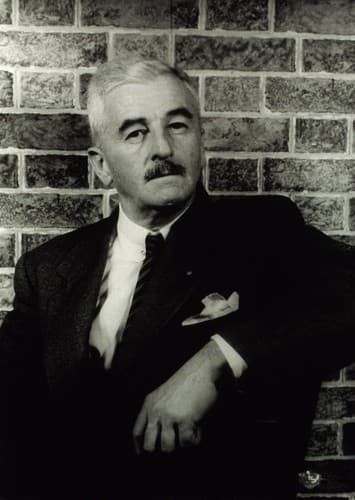
William Cuthbert Faulkner was an American writer known for his novels and short stories set in the fictional Yoknapatawpha County, based on Lafayette County, Mississippi, where Faulkner spent most of his life. A Nobel laureate, Faulkner is one of the most celebrated writers of American literature and often is considered the greatest writer of Southern literature.
Similar books
- The Sound and the Fury
William Faulkner
3.9 (158k) average on GoodreadsLiterary FictionShares Faulkner's distinctive narrative style, complex character studies, and exploration of moral decay.
- The Old Man and the Sea
Ernest Hemingway
3.8 (831k) average on GoodreadsLiterary FictionFeatures a singular protagonist facing immense struggle, with strong allegorical undertones about endurance and meaning.
- All Quiet on the Western Front
Erich Maria Remarque
4.0 (355k) average on GoodreadsHistorical FictionOffers a powerful and poignant depiction of the horrors and futility of World War I, though 'A Fable' is more allegorical.
- A Farewell to Arms
Ernest Hemingway
3.8 (263k) average on GoodreadsHistorical FictionHemingway's novel offers a more intimate, personal, and realistic account of war's impact on individuals, focusing on love and loss. While both critique war, Hemingway's approach is grounded in direct experience, whereas Faulkner elevates his narrative to a universal, almost mythical plane.
- Nineteen Eighty-Four
George Orwell
4.2 (5.5M) average on GoodreadsFictionWinston Smith dreams of truth and rebellion in a world where Big Brother watches all, but he confronts the terrifying power of a regime that controls not just actions, but thoughts.
- The Frozen River
Ariel Lawhon
4.4 (600k) average on GoodreadsFictionIn 1789 Maine, a heroic midwife's diary helps her expose a murder and get justice in a town that wants to silence her.




Enjoyed the summary?
A summary gives you the shape of the book. The book itself has the detail, the examples and the voice.
Find A Fable on AmazonAs an Amazon Associate, BookBrief earns from qualifying purchases. How we're funded