
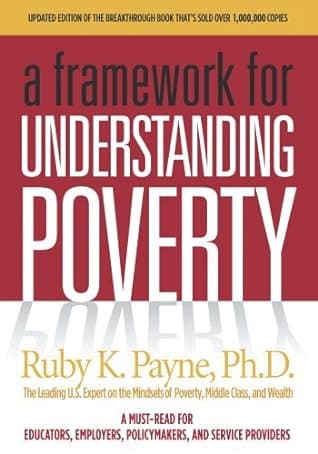
Core Idea
- Difficulty
- Medium
- Read it if
- You are an educator, social worker, policymaker, or anyone working directly with individuals from impoverished backgrounds and want to understand the underlying cultural dynamics and mindsets that influence behavior and decision-making.
- Skip it if
- You are looking for a solely economic analysis of poverty or a book that proposes large-scale governmental policy solutions without focusing on individual and community-level interactions.
Key Takeaways from A Framework for Understanding Poverty
Hidden Rules of Class
Unspoken norms and assumptions govern behavior within socioeconomic classes.
Payne states that each socioeconomic class (poverty, middle, wealth) uses a distinct set of 'hidden rules' – unspoken understandings that guide behavior, decisions, and interactions. These rules are learned without conscious effort early in life and become deeply ingrained. For people in poverty, these rules often prioritize relationships, survival, entertainment, and a more concrete, present-focused view of the world. In contrast, middle-class rules emphasize achievement, work, planning, and a future orientation. Wealth often follows rules centered on financial and social connections, legacy, and abstract ideas. Misunderstandings happen when people from different classes interact without knowing about these different rule sets, leading to incorrect interpretations of intentions and behaviors.
“Each socioeconomic group has its own hidden rules that, once understood, can unlock more effective communication and interaction.”
In the book: Payne illustrates this with examples of how time, money, and education are perceived differently across classes. For instance, in poverty, time might be seen as present-focused and fluid, while in the middle class, it's structured and future-oriented.
Try this: Professionals working with individuals from poverty should actively identify and acknowledge the hidden rules of their clients' class. Instead of judging behaviors through a middle-class lens, seek to understand the underlying logic within the client's own framework. Explicitly teach middle-class hidden rules when appropriate and necessary for success in middle-class dominated institutions (e.g., schools, workplaces).
Related ideas: hidden-rules, socioeconomic-class, cultural-competence
Poverty's Survival Mentality
Life in poverty fosters a present-focused, relational, and often reactive approach to daily challenges.
The daily realities of poverty — limited resources, unexpected crises, and systemic barriers — create a survival mindset. This way of thinking prioritizes immediate needs and maintaining important relationships over long-term planning or abstract goals. Decisions are often reactive, focused on 'getting by' today. Relationships are very important because they are a main source of support, favors, and information in a system that often feels unsupportive. Entertainment provides necessary relief and distraction from constant stress. This contrasts sharply with the middle-class emphasis on delayed gratification, planning for the future, and individual achievement, causing significant problems when these two worldviews meet.
“The driving force for decision-making in poverty is survival, relationships, and entertainment. Choices are made based on the immediacy of needs and the strength of personal bonds.”
In the book: Payne discusses how individuals in poverty often spend money as soon as they get it, not due to irresponsibility, but because it's a volatile resource that needs to be used for immediate needs, or it might be lost. She also highlights the importance of oral language and storytelling as key communication tools.
Try this: When working with individuals from poverty, recognize that their 'lack of planning' or 'impulsivity' may be a rational response within a survival framework. Build trust through genuine relationships. Frame requests and expectations in terms of immediate benefits and concrete steps, rather than distant, abstract goals. Understand that 'fun' or 'entertainment' might be a vital coping mechanism, not a frivolous distraction.
Related ideas: survival-mentality, present-orientation, relational-focus
Language Registers and Communication Gaps
Different language styles contribute to misunderstandings across socioeconomic classes.
Payne identifies distinct 'language registers' (frozen, formal, consultative, casual, intimate). She says that people from poverty often use casual and intimate registers, while middle-class institutions (schools, workplaces, healthcare) mainly use formal and consultative registers. This mismatch creates significant communication problems. In casual language, sentences are often incomplete, and meaning relies heavily on non-verbal cues and context. Formal language requires precise vocabulary, complete sentence structures, and the ability to express thoughts logically and in order. Not being able to use formal language effectively can lead to people in poverty being seen as uneducated, unclear in their speech, or even defiant, which limits their access to resources and opportunities.
“Language is a powerful indicator of socioeconomic status, and our proficiency in different registers significantly impacts how we are perceived and understood.”
In the book: Payne provides examples of how a simple question like 'What's wrong?' might elicit a detailed, formal response from a middle-class individual, but a vague, context-dependent response from someone accustomed to casual or intimate registers.
Try this: Educators and professionals must be explicit in teaching and modeling formal language. Do not assume understanding. Provide opportunities for practice in formal communication. Also, recognize and value the richness of casual and intimate language, using it to build rapport when appropriate, but consciously shifting to formal language when the context demands it. Avoid jargon and simplify complex instructions.
Related ideas: language-registers, communication-barriers, code-switching
Support Systems: From Resources to Coping
Understanding the different types of support is crucial for effective intervention.
Payne defines 'support system' as more than just financial or material help. She identifies several important types of support: financial, emotional, mental, spiritual, physical, and knowledge of hidden rules. People in poverty often have strong emotional and spiritual support within their immediate networks, but they may lack mental support (problem-solving skills, planning), knowledge of hidden rules (understanding how middle-class systems work), or enough financial resources. Middle-class individuals often have access to all these types of support, making it easier to navigate complex systems. Recognizing these gaps allows professionals to customize help to provide the specific missing types of support, rather than assuming everyone just needs money.
“Support systems are not just about financial aid; they encompass emotional, mental, spiritual, and role models necessary for thriving, not just surviving.”
In the book: Payne uses a 'resource wheel' or similar diagnostic tool to help individuals identify their strengths and weaknesses across different support categories. She might describe a scenario where a parent in poverty struggles to help their child with homework, not due to lack of care, but due to a lack of 'mental' or 'hidden rules' support for navigating the educational system.
Try this: Assess the specific types of support an individual lacks. Instead of just offering money, consider if they need help developing problem-solving skills (mental support), understanding school expectations (hidden rules support), or connecting with reliable transportation (physical support). Frame assistance as building these crucial 'resources' rather than simply providing handouts.
Related ideas: types-of-support, resource-gaps, holistic-support
Instability and Chronic Stress
The constant unpredictability of poverty leads to chronic stress and impacts cognitive function.
Life in poverty is often very unstable: unpredictable income, housing insecurity, unreliable transportation, and frequent crises. This constant state of change causes chronic stress, which has significant physical and psychological effects. Chronic stress can harm executive functions like planning, impulse control, and decision-making, making it harder for people to escape poverty. It can also lead to a heightened sense of alertness and a focus on immediate threats, further strengthening the survival mentality. Professionals must understand that behaviors that seem illogical or unmotivated may be logical adaptations to a very stressful and unpredictable environment.
“The daily chaos and unpredictability inherent in poverty create a state of chronic stress that fundamentally alters how individuals perceive and respond to their environment.”
In the book: Payne discusses how individuals in poverty often live with a sense of 'fate' or external locus of control, where they feel less agency over their lives due to constant external pressures and unpredictable events. She also refers to research on the impact of chronic stress on brain development and function.
Try this: When working with individuals experiencing chronic stress, prioritize creating predictable, safe, and consistent environments. Be patient with perceived 'lack of follow-through' or 'impulsivity,' understanding its roots in stress. Offer support that helps reduce instability and provides a sense of control, even if small. Emphasize routines and clear expectations.
Related ideas: chronic-stress, instability, executive-function, trauma-informed-care
Bridging the Gap: Relationship-Based Solutions
Genuine relationships are the most effective bridge between different socioeconomic worlds.
Payne emphasizes that relationships are the foundation of support and growth for people from poverty. In a world of scarcity and systemic barriers, personal connections provide a vital safety net, access to information, and emotional sustenance. For professionals, building genuine, respectful relationships based on trust and mutual understanding is very important. Without this relational foundation, attempts to 'help' or 'teach' may seem condescending or irrelevant. Effective change happens when people feel seen, heard, and valued within a supportive relationship, which then creates a safe space for learning new hidden rules and developing new resources.
“Relationships are the single most significant factor in the success of individuals from poverty, both in terms of survival and in moving to self-sufficiency.”
In the book: Payne often shares anecdotes of successful interventions where a caring teacher or mentor formed a strong, consistent relationship with a student or family from poverty, leading to significant positive outcomes.
Try this: Prioritize building rapport and trust above all else. Spend time listening and understanding the individual's perspective before offering solutions. Show genuine care and consistency. Recognize that relationship-building might take longer than in middle-class interactions, but it is an essential investment. Be a consistent, reliable presence.
Related ideas: relationship-building, trust, rapport, empathy
The Role of Education and Abstraction
Education is key to breaking the cycle of poverty, but it requires teaching abstract concepts.
Payne highlights that success in middle-class institutions, especially education and professional environments, relies heavily on the ability to think abstractly – to understand concepts, theories, and future implications. Life in poverty, driven by concrete, immediate survival needs, often does not encourage this abstract thinking. Children from poverty may struggle with academic tasks that require hypothetical reasoning, long-term planning, or understanding cause-and-effect relationships over long periods. For educators, this means intentionally teaching abstract thinking skills, connecting concrete experiences with abstract concepts, and clearly explaining the 'why' behind academic tasks and expectations.
“The ability to think abstractly is a critical skill for navigating middle-class institutions and moving out of poverty, yet it is often underdeveloped in individuals from impoverished backgrounds.”
In the book: Payne describes how a child from poverty might understand a concrete instruction like 'put the book on the table' but struggle with a more abstract concept like 'main idea' or 'theme' in a story, as these require inferential reasoning and moving beyond the literal.
Try this: Educators should use concrete examples to introduce abstract concepts, gradually moving towards more abstract discussions. Provide explicit instruction on vocabulary, organizational skills, and critical thinking. Explain the relevance of education and future planning in tangible, relatable terms. Be patient and persistent in developing these skills.
Related ideas: abstract-thinking, education, cognitive-development, scaffolding
Shifting Mindsets: From Blame to Understanding
Effective intervention requires moving beyond judgment to an empathetic understanding of different realities.
A main idea of Payne's framework is that professionals need to change their mindset from judgment or blame (e.g., 'they're lazy,' 'they don't care') to understanding the underlying reasons that shape behaviors in poverty. Without this empathetic shift, help will likely be ineffective because it fails to address the root causes or acknowledge the client's reality. This does not mean excusing all behaviors, but rather understanding their function within a different set of hidden rules and survival strategies. This understanding allows professionals to design more relevant and respectful strategies for support and change.
“Until we understand the lens through which individuals from poverty view the world, our attempts to help will often be met with resistance or failure.”
In the book: Payne challenges common stereotypes about poverty by explaining the 'why' behind behaviors that might seem illogical to the middle class (e.g., why someone might buy an expensive item on credit rather than saving).
Try this: Actively challenge your own assumptions and biases about poverty. Seek to understand the 'why' behind behaviors that seem counterintuitive. Engage in self-reflection and professional development to deepen your understanding of socioeconomic differences. Approach interactions with curiosity and a genuine desire to learn from the individual's experience.
Related ideas: empathy, bias-awareness, mindset-shift, cultural-humility
The Cycle of Generational Poverty
Poverty often perpetuates across generations due to inherited hidden rules and resource deficits.
Payne distinguishes between situational poverty (due to a specific crisis) and generational poverty (having been in poverty for at least two generations). Generational poverty is particularly deep-seated because individuals inherit not only a lack of financial resources but also a specific set of hidden rules, coping mechanisms, and often a lack of other key resources (mental, knowledge of hidden rules, formal language skills) that are crucial for navigating middle-class systems. Breaking this cycle requires intentional, long-term interventions that address these multiple resource deficits and explicitly teach the hidden rules necessary for success in different socioeconomic contexts. It is a complex challenge that financial aid alone cannot solve.
“Generational poverty is not just about a lack of money; it's about a lack of resources across multiple domains, passed down through the hidden rules and experiences of one's upbringing.”
In the book: Payne discusses how children raised in generational poverty often have fewer role models who have successfully navigated middle-class institutions, limiting their exposure to different ways of thinking and behaving.
Try this: Recognize that interventions for generational poverty require a multi-faceted approach addressing all types of resources. Focus on long-term support and skill-building, not just immediate relief. Provide consistent role models and explicit instruction on navigating middle-class systems (e.g., job interviews, school conferences). Celebrate small successes and build self-efficacy.
Related ideas: generational-poverty, situational-poverty, resource-deficits, cycle-of-poverty
Building Resources, Not Just Providing Them
Sustainable change comes from empowering individuals to build their own resources.
A key takeaway from Payne's framework is that real empowerment when working with people from poverty is not about constantly providing services or handouts. Instead, it is about helping people acquire and build their own resources across all categories: financial, emotional, mental, spiritual, physical, and knowledge of hidden rules. This involves teaching problem-solving skills, critical thinking, formal language, and navigation strategies for middle-class systems. The goal is to move people from dependence to interdependence and ultimately to self-sufficiency, giving them the tools to thrive rather than just survive.
“Our goal is not merely to provide resources, but to teach the skills and provide the support necessary for individuals to build their own resources and become self-sufficient.”
In the book: Payne would advocate for programs that focus on adult literacy, financial literacy, job skill training, and mentorship, rather than just welfare distribution, as examples of building resources.
Try this: Shift from a service-delivery model to a resource-building model. Identify existing strengths and build upon them. Provide coaching and mentorship. Set clear, achievable goals that empower individuals to take ownership of their progress. Celebrate their efforts in building their own support systems and navigating new territories.
Related ideas: self-sufficiency, empowerment, resource-building, skill-development
A Framework for Understanding Poverty Quotes
“Poverty is relative.”
“The hidden rules of the middle class are about work and achievement.”
“Relationships are key to survival in poverty.”
“Language is the mediator of all learning.”
“An individual brings with him/her the hidden rules of the class in which he/she was raised.”
“Most schools and businesses operate from middle-class norms and values.”
“Understanding is not the same as condoning.”
“The greatest predictor of student success is not socioeconomic status, but the presence of a caring adult.”
“Resources are not just financial; they include emotional, mental, spiritual, physical, and support systems.”
“Discipline in poverty is about consequences; in the middle class, it's about choices.”
“People in poverty often live in the tyranny of the moment.”
“To move from poverty to middle class or middle class to wealth requires that you give up relationships.”
“We cannot fix what we do not understand.”
“The role of the educator is to teach, to provide the resources for learning, and to build relationships.”
Quiz
10 questions on the main ideas. Each answer comes with a short explanation.
Question 1
According to Ruby K. Payne's 'A Framework for Understanding Poverty,' what is one of the primary reasons people in poverty develop a 'survival mentality'?
- Lack of motivation to pursue long-term goals.
- The constant challenges and hidden sources of stress they face.
- A cultural preference for immediate gratification over future planning.
- Limited access to educational resources and intellectual stimulation.
Show answer
B. The constant challenges and hidden sources of stress they face. The book emphasizes that the reality of being poor brings out a survival mentality due to the constant, often overwhelming, challenges and hidden sources of stress, which diverts attention from opportunities.
Question 2
Payne's framework suggests that individuals from middle-class backgrounds often take certain opportunities for granted. Which of the following is an example of such an opportunity?
- The ability to secure a high-paying job without a college degree.
- Having reliable transportation to get to work or appointments.
- Access to international travel and diverse cultural experiences.
- The freedom to choose any career path regardless of financial constraints.
Show answer
B. Having reliable transportation to get to work or appointments. The book highlights that many practical aspects of daily life, like reliable transportation, are often taken for granted by those in middle-class or wealth, but are significant challenges for those in poverty.
Question 3
What is the primary benefit for professionals (educators, social workers, etc.) in understanding the different worldviews presented in 'A Framework for Understanding Poverty'?
- To justify different standards of behavior for individuals from different socioeconomic backgrounds.
- To develop a sense of pity for those experiencing poverty.
- To improve their effectiveness in working with people from all socioeconomic backgrounds.
- To identify individuals who are unlikely to succeed regardless of support.
Show answer
C. To improve their effectiveness in working with people from all socioeconomic backgrounds. The book explicitly states that understanding how different their world is will be invaluable for professionals to improve their effectiveness in working with people from all socioeconomic backgrounds.
Question 4
Payne's framework details 'hidden rules' that govern different socioeconomic classes. Which of the following best describes a 'hidden rule' often present in the poverty class regarding relationships?
- Relationships are primarily transactional and based on mutual benefit.
- Relationships are for entertainment and leisure only, not for support.
- Relationships are about people, and the most important thing is the loyalty and connections within a group.
- Relationships are structured hierarchically, with strict adherence to authority figures.
Show answer
C. Relationships are about people, and the most important thing is the loyalty and connections within a group. The book contrasts the hidden rules of different classes. For poverty, relationships are often about people and loyalty, forming a crucial support network, whereas for middle class, achievement and work are paramount.
Question 5
According to Payne, what is a common challenge faced by individuals from poverty when interacting with institutions (e.g., schools, healthcare, legal systems) that operate under middle-class hidden rules?
- They often perceive these institutions as overly generous and easily manipulated.
- They struggle to understand and navigate the unstated expectations and procedures, leading to misunderstandings and frustration.
- They are typically well-versed in the formal rules but resist informal social norms.
- They find the focus on individual responsibility to be empowering and easy to adopt.
Show answer
B. They struggle to understand and navigate the unstated expectations and procedures, leading to misunderstandings and frustration. A core tenet of Payne's work is that individuals from poverty often struggle with institutions because these institutions operate on 'hidden rules' of the middle class, which are unfamiliar and often implicitly assumed, leading to communication breakdowns and misinterpretations.
Question 6
The book emphasizes that poverty is not just about a lack of money. What other key resource is often significantly lacking for individuals in poverty, according to Payne?
- An inherent desire for personal growth and self-improvement.
- Access to high-quality entertainment and leisure activities.
- Emotional resources, such as coping strategies and emotional stamina.
- Strong spiritual beliefs and a sense of purpose.
Show answer
C. Emotional resources, such as coping strategies and emotional stamina. Payne identifies various 'resources' beyond financial, including emotional, mental, spiritual, physical, support systems, relationships/role models, and knowledge of hidden rules. Emotional resources, such as the stamina to handle emotional pain and the ability to choose and control emotional responses, are often depleted in poverty.
Question 7
When working with students from poverty, Payne would most likely advise an educator to prioritize which of the following instructional strategies?
- Focus primarily on rote memorization to ensure basic knowledge acquisition.
- Strictly enforce rigid classroom rules and consequences to establish authority.
- Explicitly teach the 'hidden rules' of school and academic success, alongside content knowledge.
- Minimize direct interaction and allow students to learn independently to foster self-reliance.
Show answer
C. Explicitly teach the 'hidden rules' of school and academic success, alongside content knowledge. A central practical application of Payne's framework is for educators to explicitly teach the 'hidden rules' of the middle class, which are often the unspoken expectations of school, to bridge the gap for students from poverty.
Question 8
Payne introduces the concept of 'registers of language.' How does an understanding of these registers primarily help professionals working with individuals from poverty?
- It helps them identify individuals who are intentionally using informal language to avoid accountability.
- It allows professionals to use only formal language to maintain a professional distance.
- It enables professionals to recognize and effectively communicate using the appropriate language style for different contexts, reducing misunderstandings.
- It suggests that individuals from poverty are incapable of understanding formal language.
Show answer
C. It enables professionals to recognize and effectively communicate using the appropriate language style for different contexts, reducing misunderstandings. Payne discusses different registers of language (e.g., casual, formal) and how individuals from poverty are often more comfortable and proficient in casual language. Understanding this helps professionals adapt their communication to be more effective and reduce misinterpretations, rather than assuming a lack of intelligence or deliberate non-compliance.
Question 9
The book argues that one significant difference between the middle class and poverty is how 'time' is perceived and utilized. Which statement accurately reflects Payne's perspective on time for individuals in poverty?
- Time is seen as a commodity to be invested for future gains, with a strong focus on long-term planning.
- Time is often perceived as present-oriented, focused on survival and meeting immediate needs rather than future planning.
- Time is irrelevant, as daily life is dictated by external forces beyond individual control.
- Time is viewed as cyclical, with little emphasis on linear progression or deadlines.
Show answer
B. Time is often perceived as present-oriented, focused on survival and meeting immediate needs rather than future planning. Payne contrasts the time orientation of different classes. For those in poverty, time is often focused on the present and immediate survival, whereas the middle class tends to be future-oriented with planning and deferred gratification.
Question 10
A key argument in 'A Framework for Understanding Poverty' is that poverty is often cyclical. Which of the following strategies, based on Payne's work, would be most effective in breaking this cycle for an individual?
- Providing only financial aid without addressing underlying resource deficits.
- Implementing programs that explicitly teach the 'hidden rules' of success and build multiple resources (e.g., emotional, mental, support systems).
- Encouraging individuals to move away from their support networks to avoid negative influences.
- Focusing solely on job training without addressing the psychological impacts of poverty.
Show answer
B. Implementing programs that explicitly teach the 'hidden rules' of success and build multiple resources (e.g., emotional, mental, support systems). Payne's framework advocates for a holistic approach to breaking the cycle of poverty, which involves not just financial aid or job training, but critically, teaching the 'hidden rules' of the middle class and building up various resources (emotional, mental, support systems) that are often depleted.
A Framework for Understanding Poverty FAQ
What is 'A Framework for Understanding Poverty' about?
This book provides insights into the unique challenges faced by individuals in poverty, highlighting the differences in their world view and survival mentality compared to those in middle class or wealth. It aims to equip professionals with a practical understanding to improve their effectiveness when working with people from all socioeconomic backgrounds.
Who is the target audience for 'A Framework for Understanding Poverty'?
The book is primarily for educators, social workers, health professionals, legal services professionals, and anyone who works with individuals from diverse socioeconomic backgrounds. It offers guidance for understanding and addressing the impact of poverty.
Does understanding poverty really help in practical situations?
Yes, the book argues that gaining an understanding of the realities of poverty is invaluable for professionals. It provides practical, real-world support and guidance to improve effectiveness in working with people from all socioeconomic backgrounds, leading to better outcomes and more compassionate strategies.
What is the 'survival mentality' discussed in the book?
The 'survival mentality' refers to the mindset often developed by individuals living in poverty, where immediate needs and daily challenges take precedence. This focus on survival can divert attention from long-term opportunities and perspectives commonly embraced by those in more secure economic situations.
How does 'A Framework for Understanding Poverty' differ from other books on social inequality?
While many books discuss social inequality, 'A Framework for Understanding Poverty' stands out by offering not just documentation of facts but also practical, compassionate strategies for addressing the impact of poverty on people's lives. It focuses on providing actionable guidance for professionals rather than just theoretical analysis.
What are the 'hidden sources' of challenges for people in poverty?
The book explores challenges that go beyond the obvious financial struggles, delving into less apparent factors such as differing social rules, communication styles, and the psychological toll of chronic stress. These 'hidden sources' often create barriers that are not immediately evident to those outside of poverty.
Does the book offer strategies for educators working with students from poverty?
Absolutely. 'A Framework for Understanding Poverty' provides specific strategies and guidance for educators. It helps them understand the unique experiences of students from poverty, enabling them to create more supportive learning environments and improve student engagement and success.
Is the information in 'A Framework for Understanding Poverty' based on research?
Yes, the book is carefully researched and supported by data. It includes charts, tables, and questionnaires to document the facts of poverty and provide a robust foundation for its practical strategies and insights.
About the author

RuK. Payne is an author known for their work in non-fiction, particularly in the field of social issues. Their notable book, "A Framework for Understanding Poverty," explores the complexities of poverty and its impact on society.
Similar books
- Hillbilly Elegy: A Memoir of a Family and Culture in Crisis
J.D. Vance
3.9 (302k) average on GoodreadsPoliticsExplores the cultural and psychological aspects of poverty in a specific American context, emphasizing generational challenges.
- 1984
George Orwell
4.2 (3.1M) average on GoodreadsPoliticsIn a future where surveillance and thought control are absolute, a man's search for truth clashes with the Party, showing that hope can be a form of rebellion.
- Animal Farm
George Orwell
4.0 (2.7M) average on GoodreadsPoliticsA farm animals' rebellion against humans turns into a pig-led dictatorship, showing how power corrupts and revolutionary ideals are betrayed.
- Freakonomics: A Rogue Economist Explores the Hidden Side of Everything
Steven D. Levitt
4.0 (709k) average on GoodreadsBusinessThis book uses economic principles to reveal the surprising incentives behind everything from drug dealing and real estate to cheating teachers and the decline of crime.
- I Am Malala: The Story of the Girl Who Stood Up for Education and Was Shot by the Taliban
Malala Yousafzai
4.1 (419k) average on GoodreadsPoliticsA teenage girl from a Taliban-controlled valley refuses to give up her books, becoming a global voice for education even after an assassination attempt.
- Atlas Shrugged
Ayn Rand
3.7 (354k) average on GoodreadsPoliticsIn a dystopian America where innovators vanish, a brilliant heiress races to uncover the truth behind the disappearing industrialists and the enigmatic John Galt, who vows to stop the world's progress.






Enjoyed the summary?
A summary gives you the shape of the book. The book itself has the detail, the examples and the voice.
Find A Framework for Understanding Poverty on AmazonAs an Amazon Associate, BookBrief earns from qualifying purchases. How we're funded