
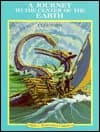
Synopsis
Covers the whole plot, including the ending.
- Difficulty
- Easy
- Pacing
- Fast
- Mood
- Adventurous, wondrous, suspenseful, awe-inspiring
A Journey To The Center Of The Earth Plot Summary
Covers the whole plot, including the ending.
The Cryptic Parchment
Professor Otto Lidenbrock, an eccentric mineralogist, finds an old Icelandic saga. Inside, he discovers a cryptic parchment in runic script. He tries to decipher it, but fails, frustrating both him and his nephew, Axel. The Professor becomes obsessed, neglecting his work and meals. Axel, more cautious, watches his uncle's growing fixation with concern, knowing any discovery will lead to a grand, likely dangerous, adventure.
The Alchemist's Secret
After days, Axel accidentally finds the key to the runic cipher. While fanning himself with the parchment, the Latin message becomes clear. It is from Arne Saknussemm, a 16th-century Icelandic alchemist, detailing his trip to the Earth's center through a volcano in Snaefellsjökull, Iceland, and providing directions. Terrified, Axel tries to keep it secret, fearing his uncle's decision to go. However, the Professor quickly gets the truth from Axel, and his excitement is immense.
Preparation for the Descent
Professor Lidenbrock, now convinced of Saknussemm's claims, immediately prepares for the journey. He tells Axel they are leaving for Iceland, despite Axel's attempts to stop him. The Professor is firm, dismissing Axel's scientific arguments about the Earth's molten core as mere theory, favoring Saknussemm's account. He gathers equipment: instruments, weapons, ropes, provisions, and a new explosive. Axel, resigned, helps with the arrangements, dreading the dangers ahead.
Arrival in Iceland
The Professor and Axel travel by ship from Hamburg to Copenhagen, then to Reykjavik, Iceland. They arrive to a stark, volcanic landscape and unique culture. Their first task is to find a guide to Snaefellsjökull. They meet Hans Bjelke, a stoic eider-hunter known for his strength and efficiency. Hans agrees to go, his calm contrasting with the Professor's enthusiasm and Axel's apprehension.
Ascending Snaefellsjökull
With Hans leading, the trio begins the climb up Snaefellsjökull. The journey is hard, over rugged terrain, lava fields, and glaciers. Axel struggles physically and with growing anxiety, but the Professor remains determined. Hans, with his knowledge of the land, navigates the slopes easily. They reach the summit, a desolate peak, where the three chimneys from Saknussemm's parchment await.
The Descent Begins
At the summit, the Professor searches for the correct chimney, following Saknussemm's instructions: the shadow of Scartaris must fall on the opening at noon on the last day of June. After a tense wait, the shadow points to the opening. Without hesitation, the Professor, then Axel and Hans, descends into the dark shaft. The start is terrifying as they lower themselves with ropes, lanterns lighting the unknown. Axel's fear is clear, but the Professor's drive pushes them on.
Lost in the Labyrinth
As they go deeper, the explorers find a maze of passages. At a crossroads, Professor Lidenbrock chooses a path that leads them astray, despite Axel's doubts. They wander for days, provisions dwindling, and water running low. Axel suffers from thirst and exhaustion. The Professor, though outwardly strong, shows worry. Hans plans to search for water by listening for springs, but the situation becomes serious, threatening the expedition.
The Underground Sea
Just as they despair, Hans finds a hidden stream, providing much-needed water. Refreshed, they continue their descent, entering a huge cavern. Before them is a vast, illuminated underground sea, with a stormy horizon. This confirms Saknussemm's accounts and excites the Professor. The air is warm and humid, and strange, phosphorescent light reveals a unique ecosystem. They name it the 'Lidenbrock Sea'.
Sailing the Subterranean Ocean
To cross the Lidenbrock Sea, Hans builds a raft from petrified wood. The trio sails across the dark waters. They see incredible things, including an electrical storm and a battle between prehistoric marine reptiles – an ichthyosaur and a plesiosaur – a terrifying glimpse into a lost world. Axel is both amazed and scared, while the Professor records every observation. The sea's vastness makes them feel small.
Signs of Humanity and a Critical Discovery
After days of sailing, a storm shipwrecks them on a sandy shore. Exploring, they find a forest of giant mushrooms and ancient plants and animals. More surprisingly, Axel finds a graveyard of mastodons and, carved into a rock face, the initials 'A.S.' – Saknussemm's signature – confirming his earlier passage. Nearby, they also find a rusted dagger. They locate another passage deeper into the Earth, marked by Saknussemm, but a large boulder blocks it, creating a new challenge.
Dynamite and a Volcanic Ascent
Faced with the boulder, Professor Lidenbrock decides to use dynamite. Despite Axel's fears of collapsing the passage, Hans carefully sets the charge. The explosion clears the way but causes an earthquake and a flood of boiling water. The explorers are swept away, descending deeper. They enter a narrow shaft where the water rises due to volcanic activity. They realize they are being carried upwards by an impending eruption, their journey to the center reversed.
Eruption and Return to the Surface
The upward journey inside the volcanic chimney is terrifying, with molten lava threatening them. The heat is unbearable, and they are violently tossed by the rising magma. After a harrowing ascent, they are ejected from the volcano's crater, not in Iceland, but on Stromboli, an active volcano in Sicily, Italy. They emerge disheveled but alive, having traveled across the Earth's interior in hours. Local villagers are astonished. The Professor, though he did not reach the absolute center, is thrilled by their survival and discoveries.
Fame and Reflection
News of their journey spreads, and Professor Lidenbrock, Axel, and Hans become celebrities. They return to Hamburg to a hero's welcome. The Professor publishes his findings, initially met with skepticism, but his detailed accounts and their survival slowly convince doubters. Axel, changed by the experience, marries his beloved Graüben and leads a more adventurous life. Hans, after his payment, returns to Iceland. The expedition, though not reaching the Earth's core, challenges existing science and leaves a lasting mark.
Principal Figures
Professor Otto Lidenbrock
Protagonist
The brilliant but eccentric mineralogist who instigates the journey.
Professor Lidenbrock is a highly intelligent, intensely passionate, and somewhat impetuous mineralogist from Hamburg. He possesses an insatiable curiosity and an unwavering belief in his own theories, often dismissing conventional scientific wisdom. His enthusiasm borders on obsession, driving him to extreme lengths to prove his hypotheses, sometimes at the expense of others' comfort or safety. He is a man of immense courage and intellectual rigor, but can also be stubborn, impatient, and prone to fits of temper. His scientific drive is the primary engine of the entire expedition.
Relationships: Axel (Uncle and nephew, mentor and reluctant apprentice); Hans Bjelke (Employer and guide); Graüben (Future aunt-in-law, fond of her)
Axel Lidenbrock
Protagonist/Narrator
The Professor's cautious and often terrified nephew.
Axel is a young, intelligent, and relatively timid man who serves as the narrator of the story. He is a student of mineralogy and deeply devoted to his uncle, but lacks the Professor's adventurous spirit and scientific fanaticism. Axel is often the voice of caution and reason, constantly worrying about the dangers of the journey and the scientific improbability of their mission. Despite his fears, he possesses a deep love for his uncle and a latent capacity for courage, which is tested repeatedly throughout the expedition. He is also in love with Graüben.
Relationships: Professor Otto Lidenbrock (Uncle and nephew, mentor and reluctant apprentice); Hans Bjelke (Fellow explorer, reliant on his strength and calm); Graüben (Fiancée, beloved)
Hans Bjelke
Supporting
The stoic, indispensable Icelandic guide.
Hans is an Icelandic eider-hunter hired by Professor Lidenbrock and Axel to guide them. He is characterized by his immense strength, calm demeanor, unwavering loyalty, and remarkable resourcefulness. Hans is a man of few words, always composed and practical, never showing fear or excitement, even in the face of extreme danger. He is an expert in survival and navigation, proving to be an invaluable asset to the expedition. His quiet competence provides a stable counterpoint to the Professor's exuberance and Axel's apprehension.
Relationships: Professor Otto Lidenbrock (Employer and guide); Axel (Fellow explorer, protector)
Graüben
Supporting
Axel's fiancée and the Professor's ward.
Graüben is Professor Lidenbrock's ward and Axel's fiancée. She is an intelligent and sensible young woman, described as beautiful and with a kind disposition. She supports Axel and her uncle, though she shares some of Axel's concerns about the Professor's more outlandish ideas. Despite her worries, she encourages Axel to accompany his uncle, understanding the Professor's need for companionship and Axel's eventual benefit from the experience. She represents the warmth and domesticity that Axel leaves behind and longs to return to.
Relationships: Axel (Fiancée, beloved); Professor Otto Lidenbrock (Guardian, future uncle-in-law)
Arne Saknussemm
Supporting (posthumous)
The 16th-century alchemist whose message inspires the journey.
Arne Saknussemm is a historical figure, a 16th-century Icelandic alchemist whose coded message, hidden within an ancient book, details his own journey to the Earth's center. Though never appearing alive in the story, his presence is central to the plot, as his account serves as the primary motivation and guide for Professor Lidenbrock's expedition. Saknussemm represents the audacious spirit of early scientific inquiry and exploration, a predecessor whose incredible claims challenge the established scientific understanding of the natural world.
Relationships: Professor Otto Lidenbrock (Inspirational figure, scientific predecessor); Axel (Figure of awe and dread)
Themes & Insights
The Spirit of Scientific Discovery and Exploration
This theme drives the story, seen mostly in Professor Lidenbrock. It explores the human desire to expand knowledge, question theories, and explore the unknown. The Professor's relentless pursuit of Saknussemm's secret and his drive to prove the Earth's interior is traversable show the thrilling, often obsessive, nature of scientific inquiry. The story celebrates the courage and intellect needed to explore new areas, whether physical or theoretical, and how these efforts impact human understanding.
“Science, my lad, is made up of errors, but of errors that it is good to commit, for they lead little by little to the truth.”
Man vs. Nature
The journey to the Earth's center is a constant fight against nature's powerful and often terrifying forces. From the hard climb up Snaefellsjökull to the vast, stormy underground sea and the volcanic eruption, the explorers face extreme environments. This theme explores human vulnerability against nature's power, as well as resilience and ingenuity in adapting and surviving. It highlights the awe-inspiring beauty and the deadly indifference of the natural world, making the characters confront their limits and the planet's scale.
“We were merely atoms in this vast, underground world, at the mercy of its colossal forces.”
Courage and Fear
The balance between courage and fear is central to Axel's development and the story. Axel's initial hesitation and constant worry contrast with Professor Lidenbrock's almost reckless bravery. The journey forces Axel to face his deepest fears – claustrophobia, thirst, isolation, and the unknown – and gradually grow his own courage. The story suggests that true bravery is not lacking fear, but acting despite it. It also shows how different people, like the stoic Hans, show courage in various ways.
“I was a coward, but I had to follow my uncle, for he was leading me to the greatest discovery of the age.”
The Power of the Unknown and Imagination
The book's main idea relies on the appeal of the unknown and imagination's ability to conceive extraordinary possibilities beyond common understanding. Saknussemm's message and the Professor's belief in it start an adventure into a world science deemed impossible. The underground realm, with its prehistoric creatures, glowing seas, and ancient forests, shows the wonders that might exist beyond common knowledge. This theme encourages readers to question assumptions and embrace discovery in unexpected places.
“What a spectacle! What a panorama! My eyes were never weary of contemplating this subterranean ocean!”
Plot Devices & Literary Techniques
The Cryptic Parchment
The catalyst for the entire journey.
The coded parchment, hidden within an ancient Icelandic saga, serves as the primary inciting incident and plot driver. Its decipherment by Axel reveals Arne Saknussemm's incredible claim of reaching the Earth's center, providing the Professor with both the motivation and the initial instructions for the expedition. This device creates immediate mystery and suspense, setting the stage for the extraordinary adventure. It also acts as a historical link, connecting the present-day explorers to a forgotten predecessor and validating the seemingly impossible journey.
The Lidenbrock Sea
A vast, subterranean ocean that reveals a lost world.
The discovery of the Lidenbrock Sea is a major turning point and a key plot device for expanding the scope of the adventure. This vast underground ocean, complete with its own weather systems, prehistoric marine life, and unique illumination, allows for new forms of exploration (sailing) and introduces significant dangers (sea monsters, storms). It provides a vivid illustration of the unknown wonders that exist deep within the Earth, challenging previous scientific assumptions and offering a profound sense of awe and terror for the characters and the reader.
Volcanic Activity (Upward Current)
The unexpected force that reverses the journey and brings them back to the surface.
The sudden onset of volcanic activity, specifically the rising magma and boiling water that sweeps the explorers upward, functions as a powerful deus ex machina. While it places the characters in extreme peril, it ultimately provides the mechanism for their miraculous return to the surface after being trapped deep within the Earth. This device cleverly resolves the seemingly impossible challenge of exiting the planet's interior, bringing the journey to a dramatic and unexpected conclusion while also transporting them geographically to a new location (Italy).
Quiz
10 questions on the plot and the characters. Each answer comes with a short explanation.
Question 1
Who is the author of 'A Journey to the Center of the Earth' according to the provided text?
- Jules Verne
- Raymond James
- Sir Arthur Conan Doyle
- H.G. Wells
Show answer
B. Raymond James The text explicitly states the author as 'Raymond James'.
Question 2
What is the primary genre of the book as listed in the text?
- Mystery
- Historical Fiction
- Science Fiction
- Romance
Show answer
C. Science Fiction The text lists 'Science Fiction' as one of the genres.
Question 3
What document leads Professor Otto Lidenbrock on his journey?
- A treasure map
- A secret message on a crumbling scrap of parchment
- An ancient diary
- A scientific journal article
Show answer
B. A secret message on a crumbling scrap of parchment The text mentions a 'secret message by an ancient alchemist, found on a crumbling scrap of parchment'.
Question 4
According to the text, whose theories about the Earth's core are challenged by the discovery?
- Axel's theories
- Hans's theories
- Saknussemm's theories
- Every theory about the molten core of the earth
Show answer
D. Every theory about the molten core of the earth The text states, 'And if Saknussemm was right, then every theory about the molten core of the earth is wrong.'
Question 5
Who are the main characters accompanying Professor Otto Lidenbrock on his expedition?
- Axel and Saknussemm
- Hans and an alchemist
- Axel and Hans
- Saknussemm and a guide
Show answer
C. Axel and Hans The text mentions, 'So Lidenbrock, his nephew Axel, and the Icelandic hunter Hans climb down...'.
Question 6
What is the profession of Hans?
- Scientist
- Alchemist
- Hunter
- Explorer
Show answer
C. Hunter Hans is described as an 'Icelandic hunter'.
Question 7
Where does the descent into the Earth begin?
- A cave in Iceland
- The cone of an arctic volcano
- A deep sea trench
- A forgotten mine shaft
Show answer
B. The cone of an arctic volcano The text states they 'climb down the cone of an arctic volcano'.
Question 8
The name 'Saknussemm' is associated with what in the narrative?
- The protagonist's rival
- A character who wrote the secret message
- An ancient alchemist whose findings challenge current scientific theories
- The location of the volcano
Show answer
C. An ancient alchemist whose findings challenge current scientific theories The text implies Saknussemm is the source of the 'secret message' and his findings are key to challenging existing theories.
Question 9
What is Professor Otto Lidenbrock's primary motivation for undertaking this journey?
- To find a lost city
- To prove his nephew's theories correct
- To discover the truth about the Earth's core
- To escape a dangerous situation
Show answer
C. To discover the truth about the Earth's core The text states, 'And if Saknussemm was right, then every theory about the molten core of the earth is wrong. Prof. Otto Lidenbrock has to learn the truth.'
Question 10
Which of the following is NOT mentioned as a genre of the book in the provided text?
- Fantasy
- Adventure
- Children's
- Science Fiction
Show answer
B. Adventure The genres listed are 'Fantasy, Children's, Science Fiction'. 'Adventure' is not explicitly mentioned.
A Journey To The Center Of The Earth FAQ
What is 'A Journey to the Center of the Earth' about?
The book follows Professor Otto Lidenbrock and his nephew Axel as they discover a secret message from an ancient alchemist. This message suggests that current theories about the Earth's core are incorrect, leading them on an expedition down an arctic volcano to uncover the truth.
Who are the main characters in 'A Journey to the Center of the Earth'?
The primary characters are Professor Otto Lidenbrock, a determined and knowledgeable geologist, his cautious nephew Axel, and their brave Icelandic guide, Hans.
What is the premise of the secret message?
The secret message, found on an ancient alchemist's parchment, claims that the theories about the Earth's molten core are wrong and hints at a hidden world within the planet.
Where does the journey begin?
The journey begins in the Arctic, with Professor Lidenbrock, Axel, and Hans descending into the cone of an arctic volcano, which serves as the entrance to their subterranean adventure.
What genres does 'A Journey to the Center of the Earth' fit into?
The book is a classic work of science fiction and fantasy, often categorized as adventure fiction, and is suitable for young readers.
Is 'A Journey to the Center of the Earth' based on scientific fact?
While inspired by scientific curiosity and theories of the time, the novel takes significant creative liberties. The journey and discoveries within the Earth are fictional and imaginative.
What makes this journey so dangerous?
The descent into the Earth is fraught with peril, including extreme temperatures, unknown geological formations, potential lack of resources, and the inherent dangers of exploring uncharted subterranean environments.
What is the significance of Saknussemm?
Saknussemm is the ancient alchemist who left the secret message. His writings are the catalyst for Professor Lidenbrock's expedition, as they propose a revolutionary, albeit fictional, understanding of the Earth's interior.
What kind of world do they discover inside the Earth?
The book describes a fantastical subterranean world, complete with prehistoric creatures, vast oceans, and unique geological wonders, challenging the conventional understanding of the planet's core.
Is this book suitable for children?
Yes, 'A Journey to the Center of the Earth' is widely considered a children's adventure classic. Its exciting plot and imaginative elements make it engaging for younger audiences, though some themes might be better appreciated by older children or adults.
About the author

Raymond James is an author known for his fiction works, including "A Journey To The Center Of The Earth." His writing often explores imaginative themes and adventurous narratives. Further details about his life and other notable works are not widely documented.
Similar books
- Journey to the Center of the Earth
Jules Verne
3.9 (154k) average on GoodreadsFantasyRaymond James's work inevitably invites comparison to Jules Verne's seminal novel. While James attempts to capture a similar sense of scientific wonder and adventure, Verne's original excels in its meticulous detail, creating a more believable (within its fantastical premise) and gripping narrative. Verne's characters, while archetypal, feel more distinct and their motivations clearer. James's version, perhaps due to its children's fiction leaning, simplifies some of the scientific rigor and psychological depth found in Verne, making it less impactful for an adult audience but potentially more digestible for younger readers.
- Harry Potter and the Sorcerer's Stone
J.K. Rowling
4.5 (7M) average on GoodreadsFantasyRescued from a miserable life under the stairs, an orphaned boy discovers he's a wizard destined for a magical school, where he uncovers a dangerous secret tied to the dark wizard who murdered his parents.
- The Hunger Games
Suzanne Collins
4.3 (6.4M) average on GoodreadsFantasyIn a future where children fight to the death on live television, Katniss Everdeen volunteers for the arena, turning a death sentence into a fight for survival and a spark of rebellion.
- 1984
George Orwell
4.2 (3.1M) average on GoodreadsPoliticsIn a future where surveillance and thought control are absolute, a man's search for truth clashes with the Party, showing that hope can be a form of rebellion.
- Divergent
Veronica Roth
4.2 (2.9M) average on GoodreadsFantasyIn a society divided by virtues, a sixteen-year-old's difference from the norm starts a rebellion that threatens her world.
- The Hobbit, or There and Back Again
J.R.R. Tolkien
4.3 (2.9M) average on GoodreadsFantasyA comfort-loving hobbit named Bilbo Baggins is whisked away by a mischievous wizard and a band of dwarves on an unexpected journey to reclaim stolen treasure from a fearsome dragon, discovering courage and a magical ring along the way.






Enjoyed the summary?
A summary gives you the shape of the book. The book itself has the detail, the examples and the voice.
Find A Journey To The Center Of The Earth on AmazonAs an Amazon Associate, BookBrief earns from qualifying purchases. How we're funded