
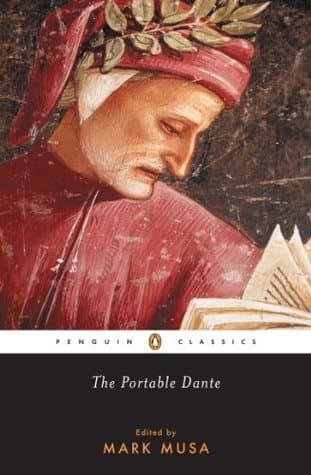
Synopsis
Covers the whole plot, including the ending.
- Difficulty
- Hard
- Pacing
- Moderate
- Mood
- Philosophical, Spiritual, Profound, Allegorical, Epic
- Read it if
- You are interested in the foundational works of Western literature, epic poetry, medieval theology, or a profound exploration of sin, redemption, and divine love.
- Skip it if
- You prefer light, fast-paced reads or are not interested in dense allegorical and philosophical texts with extensive historical and religious context.
The Portable Dante Plot Summary
Covers the whole plot, including the ending.
The Dark Wood and Virgil's Appearance
At the start of the Divine Comedy, on Good Friday evening in 1300, Dante Alighieri is lost and scared in a dark wood, which represents spiritual confusion and sin. He tries to climb a sunny hill but is blocked by three fierce beasts: a leopard (lust/fraud), a lion (pride/violence), and a she-wolf (greed). These drive him back into the shadows. As he loses hope, a figure appears, identifying himself as the Roman poet Virgil, Dante's literary hero. Virgil explains that Beatrice, Dante's love, sent him from Heaven to guide Dante through the afterlife to salvation. However, Virgil warns that he cannot enter Paradise himself because he is a pagan.
The Gates of Hell and Limbo
Virgil leads Dante to the Gates of Hell, which bear the chilling warning, 'Abandon all hope, ye who enter here.' Inside, they first find the Ante-Inferno, where the 'neutrals' – those who lived without good or evil – are endlessly stung by wasps and flies, chasing a meaningless banner. They then cross the Acheron River, ferried by Charon, into Limbo, the first circle of Hell. Here, Dante sees unbaptized infants and virtuous pagans, including famous philosophers, poets, and heroes like Homer, Socrates, Plato, and Virgil. Their punishment is not physical pain but eternal longing and sorrow, as they live without hope of ever knowing God.
Circles of Incontinence
Going deeper into Hell, Dante and Virgil meet Minos, the judge who assigns souls to their circle by coiling his tail. In the second circle, the lustful are swept forever by a strong whirlwind, unable to rest, as seen with Francesca da Rimini and Paolo Malatesta. The third circle punishes the gluttonous, who lie in freezing mud under a constant, dirty rain, guarded by the three-headed dog Cerberus. The fourth circle holds the greedy and the wasteful, who endlessly push huge weights against each other. Finally, in the fifth circle, the wrathful furiously attack each other in the muddy Styx River, while the sullen lie submerged beneath it, gurgling their sorrow.
The City of Dis and Heresy
The journey continues to the fiery walls of the City of Dis, the capital of lower Hell, guarded by fallen angels who initially refuse them entry. Medusa and the Furies threaten them, but a heavenly messenger intervenes, opening the gates. Inside the sixth circle, Dante sees the heretics, mostly Epicureans, trapped in fiery tombs. Here, he speaks with Farinata degli Uberti, a Ghibelline leader, and Cavalcante de' Cavalcanti, father of Dante's friend Guido. This circle marks the divide between sins of lack of control (upper Hell) and sins of malice (lower Hell), which are punished more severely and are considered more serious offenses against God and reason.
Circles of Violence
Beyond the City of Dis, the seventh circle is for violence. It has three rings. The first ring, the Phlegethon, is a river of boiling blood where those violent against neighbors (tyrants, murderers) are submerged to different levels, guarded by centaurs who shoot arrows at those who try to rise. The second ring is the Wood of Suicides, where those violent against themselves (suicides) become twisted trees, their leaves eaten by Harpies, and their bodies can only speak when a branch is broken. The third ring punishes those violent against God, nature, and art (blasphemers, sodomites, usurers) under a constant rain of fire on a burning plain.
Malebolge: Circles of Fraud
Dante and Virgil ride on the back of the monster Geryon, a creature representing fraud, down into Malebolge ('Evil Pouches'), the eighth circle of Hell. This circle has ten concentric ditches, or 'bolge,' each punishing a different type of ordinary fraud. They see panderers and seducers (whipped by demons), flatterers (in excrement), simoniacs (head-down in holes with fiery feet), sorcerers and false prophets (heads twisted backward), barrators (in boiling tar, guarded by demons), hypocrites (wearing heavy leaden cloaks), thieves (attacked by snakes and changing forms), fraudulent counselors (in flames), sowers of discord (mutilated), and finally, falsifiers (with horrible diseases).
Cocytus: Treachery and Lucifer
The ninth and final circle of Hell, Cocytus, is a large, frozen lake, divided into four concentric rings, each punishing a different level of treachery. Caina holds those who betrayed kin (frozen up to their necks). Antenora contains those who betrayed their country (frozen up to their heads). Ptolomea traps those who betrayed guests (frozen with only their faces exposed, tears freezing their eyes shut). Finally, Judecca punishes those who betrayed their masters (completely submerged in ice, twisted). At the very center of Hell, trapped in the ice, is Lucifer, the ultimate betrayer, a three-headed monster chewing on Brutus, Cassius, and Judas Iscariot. Dante and Virgil climb down Lucifer's hairy body, pass the center of the Earth, and emerge on the other side.
Mount Purgatory and the Ante-Purgatory
After leaving Hell, Dante and Virgil arrive on the shores of Mount Purgatory, an island mountain rising from the southern hemisphere. Cato of Utica, the guardian of Purgatory, purifies them. In the Ante-Purgatory, they meet souls who delayed repentance or died violently, who must wait before starting their climb. This includes the excommunicated, negligent rulers, and those who repented at the last moment. They see an angelic boat bringing new souls to the mountain and learn about Purgatory as a place of hope and temporary suffering, a stark contrast to the eternal despair of Hell.
The Seven Terraces of Purgatory
Dante and Virgil climb the seven terraces of Mount Purgatory, each for one of the seven deadly sins, in reverse order of severity from Hell. On each terrace, souls do specific penances to cleanse their sin. They see the proud carrying heavy stones, the envious with their eyes sewn shut, the wrathful in acrid smoke, the lazy running endlessly, the greedy lying face down, the gluttonous starved by tempting trees, and the lustful walking through purifying flames. On each terrace, Dante is marked with a 'P' (for *peccatum*, sin), which an angel erases as he purges that sin, leading to his complete purification.
The Earthly Paradise and Beatrice's Appearance
Having climbed all seven terraces and cleansed of all sin, Dante reaches the Earthly Paradise (Garden of Eden) at the top of Mount Purgatory. Here, he meets Matilda, a mysterious woman who guides him through the ideal landscape. A grand procession, representing the history of the Church, unfolds before him. At its peak, Beatrice descends from a cloud-borne chariot, radiant and majestic. Her appearance marks a key moment: Virgil, having finished his role as the guide of reason, quietly leaves, unable to enter Paradise. Beatrice, representing divine revelation and grace, now guides Dante, leading him toward the ultimate vision of God.
The Spheres of Heaven
Beatrice leads Dante through the nine concentric celestial spheres of Paradise, each linked to a planet or star and home to different categories of the blessed. In the Moon, they meet souls who broke vows. In Mercury, those who sought honor. In Venus, the lovers. In the Sun, the wise theologians and philosophers. In Mars, the warriors of faith. In Jupiter, the just rulers. In Saturn, the contemplatives. In the Fixed Stars, they see the triumph of Christ and Mary and are questioned on faith, hope, and charity by Saints Peter, James, and John. Each sphere offers Dante a growing understanding of divine order and love, preparing him for the ultimate vision.
The Empyrean and the Rose of the Blessed
Beatrice brings Dante to the Primum Mobile, the ninth and outermost sphere, which moves all lower spheres. Beyond this, they ascend to the Empyrean, the unmoving, non-material heaven that is where God and all the blessed souls live. Here, Beatrice changes into her glorious form, then yields her place to Saint Bernard of Clairvaux, who will guide Dante to the final vision. Dante sees the vast assembly of the blessed arranged as a celestial rose, each petal a soul, bathed in eternal light. He recognizes many figures, including Mary, Adam, and other saints, all united in perfect harmony and love.
The Beatific Vision
Guided by Saint Bernard, Dante's vision becomes clearer, allowing him to see the mystery of the Holy Trinity. He sees three distinct circles of light, representing the Father, Son, and Holy Spirit, yet unified as one. He struggles to understand how human and divine natures are united in Christ within this divine essence. In a sudden flash of insight, given by divine grace, his mind is illuminated, and he finally grasps the unity of all creation within divine love. His will and desire are now aligned with God's, and the poem ends with this ineffable, transcendent moment of understanding and perfect peace, his journey complete.
La Vita Nuova: The First Meeting and Early Love
La Vita Nuova begins with Dante, at age nine, meeting Beatrice Portinari for the first time. Even then, her beauty and grace deeply affect him, imprinting her image on his soul and awakening love within him. Nine years later, at eighteen, he meets her again. Beatrice greets him with a nod, which fills him with such joy that he goes to his room and dreams of Love holding Beatrice in his arms, feeding her Dante's burning heart. This second meeting solidifies his devotion, and he begins to write poetry for her, keeping his love secret by pretending interest in other 'screen ladies' to deflect attention from Beatrice.
La Vita Nuova: Beatrice's Death and Dante's Grief
Dante's pure, spiritual love for Beatrice deepens, expressed through his sonnets and canzoni. However, his earthly joy is shattered by Beatrice's early death. He describes her passing with great sorrow, lamenting the loss of such a virtuous and beautiful soul. His grief is so strong that he withdraws from society, consumed by his pain. During this time, he writes some of his most moving poetry, reflecting on her perfection and his despair. He eventually finds comfort in the idea that Beatrice is now in Heaven, a blessed soul, and he decides to write about her in a way no woman has ever been written about before, leading to the grand vision of the Divine Comedy.
The Portable Dante Characters
Dante Alighieri
Protagonist
The pilgrim and author, guided through the afterlife to achieve spiritual redemption.
Dante is both the author and the protagonist, a man in his mid-thirties who finds himself spiritually lost and in need of divine guidance. He is a Florentine poet, deeply learned in classical literature, philosophy, and theology, and politically engaged as a Ghibelline. His journey through Hell, Purgatory, and Paradise is a quest for personal redemption, understanding of divine justice, and an exploration of the moral and theological state of humanity. He is initially fearful and often prone to human emotions like pity and anger, but gradually matures and purifies his soul.
Relationships: Virgil (Mentor and guide through Hell and Purgatory, representing human reason.); Beatrice (Divine muse, unrequited love, and guide through Paradise, representing divine grace and revelation.); Saint Bernard (Final guide in the Empyrean, representing mystical contemplation.); Charon (Ferryman of the Acheron in Hell.); Minos (Judge of souls in Hell.); Farinata degli Uberti (Florentine Ghibelline leader encountered in Hell, a political rival.); Cato of Utica (Guardian of Mount Purgatory, representing stoic virtue.)
Virgil
Supporting
Dante's primary guide through Hell and Purgatory, symbolizing human reason.
Virgil is the revered ancient Roman poet, author of the Aeneid, and Dante's literary idol. He appears as a spirit in the Dark Wood, sent by Beatrice to guide Dante. He embodies human reason, classical wisdom, and moral philosophy, capable of navigating the moral complexities of Hell and the ascending path of Purgatory. However, as a virtuous pagan, he is unable to enter Paradise, signifying that reason alone cannot lead to divine truth; it must be supplemented by divine grace. He is patient, authoritative, and protective of Dante, often explaining the punishments and the theological framework of the afterlife.
Relationships: Dante Alighieri (Mentor and guide.); Beatrice (Intermediary who sends him to Dante.); Homer, Socrates, Plato (Fellow virtuous pagans in Limbo.)
Beatrice Portinari
Supporting
Dante's divine muse and guide through Paradise, symbolizing divine grace and revelation.
Beatrice is Dante's unrequited love from his youth, a historical figure who died young. In the Divine Comedy, she transcends her earthly identity to become a powerful symbol of divine grace, theological truth, and revelation. She appears at the summit of Mount Purgatory, replacing Virgil, to guide Dante through the celestial spheres of Paradise. Her beauty and wisdom inspire Dante to higher spiritual understanding, and her presence is a constant reminder of the transformative power of divine love. She often gently chides Dante for his past errors and intellectual shortcomings, leading him to deeper contemplation.
Relationships: Dante Alighieri (Divine muse and guide, object of his earthly and spiritual love.); Virgil (The one she sends to guide Dante initially.); Mary (Virgin Mary) (Her intercession with Mary leads to Dante's journey.)
Lucifer (Dis)
Antagonist
The ultimate betrayer, trapped at the center of Hell, embodying ultimate evil and impotence.
Lucifer, also known as Dis, is the fallen angel, the ultimate antagonist and the source of all evil in the universe. He is depicted as a monstrous, three-headed giant, frozen waist-deep in the ice of Cocytus, the ninth circle of Hell. His three mouths perpetually chew on the three greatest traitors: Judas Iscariot (betrayer of Christ), Brutus, and Cassius (betrayers of Caesar, symbolizing betrayal of empire). Despite his immense size and fearsome appearance, Lucifer is utterly impotent, his flapping wings creating the freezing winds of Cocytus, but unable to escape. He represents the ultimate consequence of pride and betrayal, a parody of the Holy Trinity.
Relationships: Judas Iscariot (Eternally chewed in one of his mouths.); Brutus (Eternally chewed in one of his mouths.); Cassius (Eternally chewed in one of his mouths.); Dante Alighieri (The object of Dante's horrified observation as he passes through Hell's center.)
Charon
Supporting
The ferryman of the Acheron, guarding the entrance to true Hell.
Charon is the ancient, white-haired ferryman who transports the souls of the damned across the Acheron River into the first circle of Hell. He is described as having eyes of burning coal and initially refuses to take Dante, a living soul, across. His role is to serve as a harsh and intimidating guardian, enforcing the rules of the underworld. His presence underscores the finality of damnation and the separation between the living and the dead, though he ultimately yields to Virgil's divine authority.
Relationships: Dante Alighieri (Encounters Dante as a living soul he initially refuses to ferry.); Virgil (Yields to Virgil's divine mandate to guide Dante.)
Minos
Supporting
The monstrous judge of the damned, assigning souls to their circles in Hell.
Minos is a grotesque, serpentine monster who stands at the entrance to the second circle of Hell, judging each incoming soul. He wraps his tail around himself a number of times corresponding to the circle to which the soul is condemned. He, like Charon, initially objects to Dante's passage but is silenced by Virgil. Minos symbolizes the absolute and inescapable justice of God, even when administered by a demonic figure. His physical form reflects the contortion and perversion of justice that sin represents.
Relationships: Dante Alighieri (Attempts to judge Dante, but is overruled.); Virgil (Silenced by Virgil's authority.)
Francesca da Rimini
Mentioned
A soul in the circle of Lust, whose story evokes Dante's pity.
Francesca da Rimini is a historical figure condemned to the second circle of Hell for the sin of lust. She recounts her tragic love affair with her husband's brother, Paolo Malatesta, which led to their murder. Her story of reading the tale of Lancelot and Guinevere, leading to their first kiss and subsequent fall, profoundly moves Dante. Her plight highlights the destructive power of uncontrolled passion and the human tendency to blame external influences for sin, even while acknowledging her culpability.
Relationships: Paolo Malatesta (Her lover, condemned with her.); Gianciotto Malatesta (Her husband, who murdered her and Paolo.)
Cato of Utica
Supporting
The guardian of Mount Purgatory, representing stoic virtue and freedom.
Cato the Younger, a Roman statesman and a pagan, is the surprising guardian of Mount Purgatory. He committed suicide rather than live under Caesar's tyranny, choosing liberty over submission. In the Divine Comedy, he represents the ultimate pursuit of spiritual freedom and virtue. He is stern but just, ensuring that souls who arrive at Purgatory are properly prepared for their purification. His presence at the mountain's base emphasizes that true freedom is found in turning towards God and purging sin, even for those outside the Christian tradition.
Relationships: Dante Alighieri (Purifies Dante and Virgil upon their arrival at Purgatory.); Virgil (Interacts with Virgil, acknowledging his authority.)
Saint Bernard of Clairvaux
Supporting
Dante's final guide in the Empyrean, symbolizing mystical contemplation and devotion to Mary.
Saint Bernard of Clairvaux is a prominent Cistercian abbot and mystic, who takes over as Dante's guide from Beatrice in the Empyrean, the highest heaven. He represents the contemplative life and profound devotion to the Virgin Mary, which is necessary for the final ascent to the Beatific Vision. Bernard guides Dante's gaze towards the celestial rose and then offers a fervent prayer to the Virgin Mary, interceding for Dante to be granted the grace to fully perceive God. His role emphasizes that the ultimate spiritual experience requires not just reason and revelation, but also mystical devotion and intercession.
Relationships: Dante Alighieri (Final guide to the Beatific Vision.); Beatrice (Takes over from Beatrice as guide.); Virgin Mary (Devoted to and prays to Mary for Dante's final grace.)
The Portable Dante Themes
Divine Justice and Retribution
The Divine Comedy is built on divine justice, showing how every sin gets a fitting punishment (contrapasso) in Hell, and every virtue is rewarded in Paradise. Punishments in Hell are not random; they mirror the sin, often by reversal or comparison, like the lustful swept by winds (lacked control in life) or hypocrites wearing beautiful but heavy leaden cloaks (outward appearance vs. inner burden). Purgatory also reflects justice, as souls willingly do penance to cleanse their sin. In Paradise, justice appears as perfect harmony and varying degrees of blessedness, showing how souls can receive God's light. Dante's journey teaches him this complex and perfect justice.
“Justice moved my high maker; divine power made me, / The highest wisdom, and the primal love.”
The Journey of Redemption and Spiritual Growth
Dante's trip through the afterlife is a journey of personal and spiritual redemption. He starts as a lost and sinful man in the dark wood, symbolizing spiritual error. Through meeting various souls, seeing sin and virtue, and understanding divine order, he changes deeply. In Hell, he faces sin and learns to tell the difference between pity for suffering and condemnation of sin. In Purgatory, he actively cleanses his own sins, shown by the 'P' marks on his forehead, which are slowly erased. By the time he reaches Paradise, he is purified and can experience the ultimate divine vision, representing a soul's complete spiritual rebirth. This journey mirrors the Christian path to salvation.
“And then he led me out to see the stars again.”
The Power of Love (Divine and Human)
Love drives the entire cosmos and Dante's journey. Beatrice's love for Dante, and her help from the Virgin Mary, starts his journey, showing divine grace. The structure of Paradise itself is ruled by divine love, which moves the stars and unites all creation. In Hell, the lack or distortion of love leads to damnation; for example, the lustful, driven by carnal love, suffer forever. In Purgatory, souls are motivated by a pure love of God to do penance. Ultimately, the Beatific Vision is an experience of pure, unadulterated divine love, which aligns Dante's will with God's. 'La Vita Nuova' specifically explores how human, courtly love can transform, raising Dante to spiritual thought, hinting at his later divine love for Beatrice.
“The Love that moves the sun and the other stars.”
Reason vs. Revelation
This theme is central to Dante's guidance through the afterlife. Virgil, representing human reason and classical philosophy, is an essential guide through the moral and intellectual complexities of Hell and Purgatory. He can explain sin and the path to purification. However, Virgil's journey ends at the edge of the Earthly Paradise, as reason alone cannot grasp divine mysteries or lead to salvation. Beatrice, embodying divine revelation, theology, and grace, takes over to guide Dante through Paradise. Her guidance goes beyond logical explanation, leading Dante to direct spiritual experience and the ultimate vision of God, showing that faith and divine insight are needed to fully understand the divine.
“As far as reason sees, I can tell you; / Beyond that, only faith can teach you.”
Political and Moral Critique
Dante uses the journey through the afterlife to criticize the political and moral corruption of his time in Italy, especially Florence, and the Church. He places many real-life figures, including popes, politicians, and Florentine citizens, in Hell for their sins (e.g., simony, treachery, greed). He laments the civil strife, misuse of power by secular rulers, and moral decay within the papacy. Purgatory also includes figures who repented late, highlighting the human tendency toward neglect. Through these condemnations and observations, Dante argues for a pure Church and a unified, just Holy Roman Empire as the ideal political structure, believing these would lead to a more righteous society.
“Ah, Florence, you may well be pleased with this digression / That strikes not at yourself, thanks to your people!”
Plot Devices & Literary Techniques
Contrapasso
The principle of divine justice where the punishment fits the sin by analogy or inversion.
Contrapasso is the foundational principle of divine justice in Dante's Hell. It dictates that the punishment of a soul should either mirror the sin committed, or be its direct opposite. For example, the lustful are endlessly tossed by winds because in life they were swept away by their passions. The gluttonous lie in filthy slush, symbolizing their excessive and disgusting consumption. The sowers of discord are perpetually mutilated, their bodies split open just as they split society. This device serves to underscore the perfect, rational, and often ironic nature of God's justice, making the consequences of sin immediately comprehensible and vivid to Dante and the reader.
Allegory
The use of characters, events, and settings to represent abstract ideas or moral qualities.
The entire Divine Comedy is a multi-layered allegory. Dante's journey is not just a literal trip through the afterlife, but an allegorical representation of the soul's journey from sin (the Dark Wood) through purification (Purgatory) to salvation (Paradise). Characters like Virgil (human reason), Beatrice (divine grace/revelation), and the three beasts (lust, pride, avarice) are all allegorical figures. The settings themselves, from the circles of Hell to the terraces of Purgatory and the spheres of Heaven, allegorically represent different moral states and theological truths. This device allows Dante to explore complex philosophical, theological, and moral concepts through a vivid narrative.
The Guide Figure
A character who leads the protagonist through a perilous or unknown realm, providing knowledge and protection.
The use of guide figures is crucial to Dante's journey. Virgil, as the embodiment of human reason and classical wisdom, guides Dante through the dangers and moral complexities of Hell and Purgatory. He explains the nature of sin, the structure of the afterlife, and protects Dante from demonic threats. Beatrice, representing divine revelation and grace, takes over in Paradise, leading Dante through the celestial spheres and towards the Beatific Vision, providing theological insights. Finally, Saint Bernard, symbolizing mystical contemplation, prepares Dante for his ultimate encounter with God. These guides are essential for Dante's understanding and survival, reflecting the necessity of different forms of guidance for spiritual enlightenment.
Symbolism of Numbers (especially 3 and 9)
The pervasive use of specific numbers to convey theological and structural meaning.
Dante employs numerical symbolism extensively, most notably with the number three and its multiples. The Divine Comedy is divided into three canticles (Inferno, Purgatorio, Paradiso). Each canticle has 33 cantos (plus an introductory canto in Inferno, making 100 total). Hell has nine circles, Purgatory has seven terraces plus Ante-Purgatory and the Earthly Paradise (totaling nine divisions), and Heaven has nine spheres plus the Empyrean. This reflects the Holy Trinity (Father, Son, Holy Spirit) and the perfection associated with the number nine (three times three). This structural symbolism reinforces the theological framework of the poem and its divine order, creating a sense of balance and cosmic design.
Invocation of Muses/Divine Aid
Appeals to divine inspiration or classical muses to assist in the daunting task of poetic creation.
Dante frequently invokes the Muses or other divine powers at crucial points in his narrative, particularly when describing particularly challenging or sublime scenes. For example, he calls upon the Muses at the beginning of Inferno, and later in Purgatorio and Paradiso, he invokes Apollo or other celestial lights. This device serves multiple purposes: it acknowledges the monumental difficulty of portraying such transcendent experiences, it positions Dante within the classical poetic tradition, and it emphasizes that his poetic endeavor requires divine assistance to accurately represent the truths he witnesses. It also highlights the sacred nature of his subject matter, differentiating it from purely human artistic creation.
The Portable Dante Quotes
“Midway upon the journey of our life I found myself within a forest dark, for the straightforward pathway had been lost.”
“Abandon all hope, ye who enter here.”
“The darkest places in hell are reserved for those who maintain their neutrality in times of moral crisis.”
“Love, that in gentle heart is quickly born, seized him for the fair form that was ta'en from me; and the manner still afflicts me.”
“There is no greater sorrow than to recall happiness in a time of misery.”
“Consider your origin; you were not made to live as brutes, but to follow virtue and knowledge.”
“From a little spark may burst a mighty flame.”
“The more a thing is perfect, the more it feels pleasure and pain.”
“His will is our peace.”
“And the will that stirs the sun and other stars.”
“The path to paradise begins in hell.”
“O human race, born to fly upward, why are you cast down at every little wind?”
“To get to the other side, you must first go through the dark.”
“Beauty awakens the soul to act.”
Quiz
10 questions on the plot and the characters. Each answer comes with a short explanation.
Question 1
Which of Dante's two masterworks is NOT a part of 'The Portable Dante'?
- The Divine Comedy
- La Vita Nuova
- De Monarchia
- Inferno
Show answer
C. De Monarchia 'The Portable Dante' contains complete verse translations of 'The Divine Comedy' and 'La Vita Nuova'. 'Inferno' is a part of 'The Divine Comedy'. 'De Monarchia' is another work by Dante but is not included in this specific collection.
Question 2
What is the primary genre classification of Dante Alighieri's works as described in the provided text?
- Historical Fiction
- Fantasy, Spirituality, Philosophy
- Epic Poetry, Romance
- Political Satire, Drama
Show answer
B. Fantasy, Spirituality, Philosophy The provided text explicitly states the genres as 'Fantasy, Spirituality, Philosophy'.
Question 3
Who provided the introduction, bibliography, and notes for 'The Portable Dante'?
- Dante Alighieri
- Mark Musa
- Virgil
- Beatrice Portinari
Show answer
B. Mark Musa The text states that 'The Portable Dante' includes 'an introduction by eminent scholar and translator Mark Musa', who also provided the bibliography and notes.
Question 4
In 'The Divine Comedy', what is the name of the first realm Dante travels through, guided by Virgil?
- Purgatorio
- Paradiso
- Inferno
- Limbo
Show answer
C. Inferno Dante's journey in 'The Divine Comedy' begins in 'Inferno' (Hell), guided by the Roman poet Virgil.
Question 5
What is the central theme explored in 'La Vita Nuova'?
- A political commentary on medieval Florence
- Dante's spiritual journey through the afterlife
- Dante's love for Beatrice and its spiritual significance
- A collection of fables and moral lessons
Show answer
C. Dante's love for Beatrice and its spiritual significance 'La Vita Nuova' (The New Life) is a prosimetrum (a work combining prose and verse) that recounts Dante's profound and idealized love for Beatrice Portinari, exploring its spiritual and transformative power.
Question 6
Which historical figure serves as Dante's primary guide through Hell and Purgatory in 'The Divine Comedy'?
- Homer
- Ovid
- Virgil
- Aristotle
Show answer
C. Virgil The Roman poet Virgil, author of the Aeneid, guides Dante through the Inferno and Purgatorio.
Question 7
How does 'The Portable Dante' describe Dante Alighieri's contribution to literature?
- He popularized the use of Latin in poetry.
- He paved the way for modern literature while creating unparalleled verse and prose.
- He focused primarily on historical non-fiction narratives.
- He was known for his simple, direct literary style.
Show answer
B. He paved the way for modern literature while creating unparalleled verse and prose. The text states, 'Dante Alighieri paved the way for modern literature, while creating verse and prose that remain unparalleled for formal elegance, intellectual depth, and emotional grandeur.'
Question 8
What is the ultimate destination and goal of Dante's journey in 'The Divine Comedy'?
- To achieve political power in Florence
- To find eternal damnation in the deepest circle of Hell
- To achieve spiritual redemption and union with God in Heaven
- To escape the physical world and become a disembodied spirit
Show answer
C. To achieve spiritual redemption and union with God in Heaven The entire journey of 'The Divine Comedy' is an allegorical quest for spiritual purification and salvation, culminating in Dante's vision of God in Paradiso.
Question 9
In 'The Divine Comedy', after Virgil can no longer guide Dante, who takes over as his guide through the celestial spheres of Paradise?
- Saint Peter
- Beatrice
- Lucifer
- An unnamed angel
Show answer
B. Beatrice Virgil, representing reason, can only guide Dante so far. Beatrice, representing divine love and revelation, takes over as Dante's guide through Paradiso.
Question 10
The structure of 'The Divine Comedy' is based on the number three. Which of the following is NOT an example of this pervasive use of the number three?
- It is divided into three canticas (Inferno, Purgatorio, Paradiso).
- Each cantica contains 33 cantos (plus an introductory canto for Inferno, making 100 total).
- Dante encounters three main beasts in the Dark Wood (lion, leopard, she-wolf).
- Dante is guided by three different figures throughout his entire journey.
Show answer
D. Dante is guided by three different figures throughout his entire journey. While the number three is central, Dante is guided by two primary figures throughout most of his journey: Virgil (through Hell and Purgatory) and Beatrice (through Paradise). St. Bernard of Clairvaux briefly guides him at the very end of Paradiso, but the primary long-term guides are two.
The Portable Dante FAQ
What is the central premise of 'The Divine Comedy'?
'The Divine Comedy' follows Dante Alighieri's allegorical journey through Hell (Inferno), Purgatory (Purgatorio), and Heaven (Paradiso). Guided first by the Roman poet Virgil and later by Beatrice, the work explores themes of sin, redemption, divine justice, and the nature of God, reflecting medieval Christian theology and philosophy.
What is 'La Vita Nuova' about, and how does it relate to 'The Divine Comedy'?
'La Vita Nuova' is a prosimetrum, a mix of prose and verse, detailing Dante's idealized love for Beatrice Portinari, from their first meeting as children to her death and his subsequent grief. It serves as a spiritual and emotional precursor to 'The Divine Comedy,' establishing Beatrice as Dante's ultimate guide and divine inspiration for his later epic journey.
Who are the primary guides in 'The Divine Comedy' and what do they represent?
Dante is primarily guided by two figures: Virgil, who leads him through Inferno and Purgatorio, representing human reason and classical philosophy; and Beatrice, who guides him through Paradiso, symbolizing divine love, grace, and revelation, ultimately leading him to the direct vision of God.
What is the significance of the number three in 'The Divine Comedy'?
The number three, representing the Holy Trinity, is pervasive throughout 'The Divine Comedy.' It's structured into three canticas (Inferno, Purgatorio, Paradiso), each with 33 cantos (plus an introductory canto in Inferno), and the terza rima rhyme scheme uses three-line stanzas. This triadic structure reinforces the theological underpinnings of the entire work.
How does Dante's personal life influence the characters and events in his works?
Dante's exile from Florence deeply shapes 'The Divine Comedy,' as he encounters many Florentine political figures, both friends and foes, in various circles of Hell and Purgatory. His unrequited love for Beatrice, as chronicled in 'La Vita Nuova,' transforms her into his divine muse and ultimate guide, demonstrating how personal experience fuels his allegorical narratives.
What is the significance of the leopard, lion, and she-wolf that block Dante's path at the beginning of 'Inferno'?
These three beasts are widely interpreted as allegories for different sins that prevent Dante from reaching the 'delightful mountain.' The leopard represents lust or fraud, the lion symbolizes pride or violence, and the she-wolf embodies avarice or concupiscence, collectively illustrating the worldly impediments to spiritual ascent.
Are there any anachronisms or intentional historical inaccuracies in 'The Divine Comedy'?
Dante intentionally places historical figures, both ancient and contemporary, into specific circles of Hell, Purgatory, and Paradise, even if they lived before Christ or had no direct connection to Christian doctrine. This allows him to comment on their moral standing through a Christian lens, such as placing virtuous pagans like Virgil in Limbo, rather than condemning them to deeper hell.
What is the role of classical mythology and figures in Dante's Christian epic?
Classical mythology is integrated throughout 'The Divine Comedy,' with figures like Charon, Minos, and the Furies acting as guardians or tormentors in Hell. Dante recontextualizes these pagan elements within a Christian framework, using them to illustrate aspects of divine justice or as literary allusions that enrich the allegorical landscape.
How does Dante's political allegiance as a White Guelph manifest in 'The Divine Comedy'?
Dante's political biases are evident in the fates of many characters. He often places his Black Guelph opponents and other political adversaries in lower circles of Hell, expressing his condemnation of their corruption and betrayal. Conversely, he may place White Guelphs or those he admired in Purgatory or even Paradise, subtly advocating for his political perspective.
How does Dante's journey reflect the psychological process of confronting one's own sins and seeking redemption?
Dante's initial state of being 'lost in a dark wood' symbolizes a spiritual crisis and moral confusion. His journey through Hell forces him to confront the consequences of various sins, allowing for catharsis and self-reflection. Purgatory then represents the painful but necessary process of purification and repentance, essential for psychological and spiritual healing.
What psychological effect does witnessing the punishments in 'Inferno' have on Dante?
Dante experiences a range of intense emotions, from pity and sympathy for some sinners (like Francesca and Paolo) to righteous anger and even satisfaction for others (like Filippo Argenti). This emotional turmoil reflects his own internal struggle to reconcile human empathy with divine justice, and his gradual desensitization ultimately steeling him for the journey.
How does the evolving nature of Beatrice's guidance impact Dante's psychological state?
In 'La Vita Nuova,' Beatrice is an earthly object of courtly love, causing both joy and despair. In 'The Divine Comedy,' her transformation into a celestial guide brings Dante profound comfort, inspiration, and intellectual clarity. Her unwavering presence and divine wisdom provide psychological reassurance, allowing him to overcome fear and doubt in his ascent to God.
Discuss the psychological impact of exile on Dante and its expression in his works.
Dante's forced exile from Florence deeply scarred him, fostering feelings of injustice, longing, and bitterness. This is palpable in his condemnation of corrupt Florentine politicians and his poignant laments about his fate. The journey itself can be seen as an internal exile, a spiritual wandering to find a new home in God's grace.
Is 'The Divine Comedy' primarily a theological treatise, a political commentary, or a personal allegory?
While 'The Divine Comedy' contains profound theological discussions and sharp political critiques, it functions most powerfully as a personal allegory. Dante's journey is his own spiritual awakening, using theology and politics as frameworks to explore his individual path to salvation, making it deeply resonant on a human level beyond its specific historical context.
How does 'The Portable Dante' challenge or reinforce medieval philosophical concepts?
'The Portable Dante' embodies and reinforces many medieval philosophical concepts, particularly Thomistic theology, the hierarchical order of the universe, and the concept of divine justice. However, it also subtly challenges rigid dogma by emphasizing the role of individual free will, the power of human reason (through Virgil), and the transformative potential of personal spiritual experience, foreshadowing Renaissance humanism.
Can 'The Divine Comedy' be read as a metaphor for the creative process itself?
Yes, 'The Divine Comedy' can be interpreted as a grand metaphor for the creative process. Dante's journey from spiritual darkness to divine light mirrors the artist's struggle to find inspiration, overcome obstacles, and ultimately create a work that reflects profound truth. The intricate structure and vivid imagery represent the meticulous craft required to bring a vision to life.
What is the enduring relevance of 'The Portable Dante' for modern readers?
The enduring relevance of 'The Portable Dante' lies in its exploration of universal human experiences: love, loss, sin, redemption, and the search for meaning. Its profound psychological insights into human nature, vivid poetic language, and allegorical depth continue to resonate, offering both intellectual challenge and spiritual solace to contemporary audiences grappling with similar existential questions.
How does Dante's use of vernacular Italian, rather than Latin, contribute to the revolutionary nature of his work?
By choosing to write 'The Divine Comedy' in vernacular Italian, Dante defied the literary conventions of his time, which favored Latin for serious works. This decision not only elevated the Tuscan dialect to a literary language but also made his profound spiritual and philosophical themes accessible to a wider audience, democratizing knowledge and paving the way for modern literature.
About the author
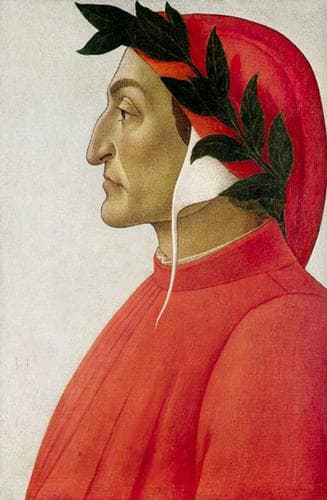
Dante Alighieri, most likely baptized Durante di Alighiero degli Alighieri and often referred to as Dante, was an Italian poet, writer and philosopher. His Divine Comedy, originally called Comedìa and later christened Divina by Giovanni Boccaccio, is widely considered one of the most important poems of the Middle Ages and the greatest literary work in the Italian language.
Similar books
- Paradise Lost
John Milton
4.1 (6k) average on GoodreadsMysteryEpic poem exploring good vs. evil, divine justice, and the fall of man.
- The Aeneid
Virgil
3.8 (107k) average on GoodreadsFantasyClassical epic poem with a journey through the underworld and a focus on destiny and duty.
- Harry Potter and the Sorcerer's Stone
J.K. Rowling
4.5 (7M) average on GoodreadsFantasyRescued from a miserable life under the stairs, an orphaned boy discovers he's a wizard destined for a magical school, where he uncovers a dangerous secret tied to the dark wizard who murdered his parents.
- The Hunger Games
Suzanne Collins
4.3 (6.4M) average on GoodreadsFantasyIn a future where children fight to the death on live television, Katniss Everdeen volunteers for the arena, turning a death sentence into a fight for survival and a spark of rebellion.
- 1984
George Orwell
4.2 (3.1M) average on GoodreadsPoliticsIn a future where surveillance and thought control are absolute, a man's search for truth clashes with the Party, showing that hope can be a form of rebellion.
- Divergent
Veronica Roth
4.2 (2.9M) average on GoodreadsFantasyIn a society divided by virtues, a sixteen-year-old's difference from the norm starts a rebellion that threatens her world.





Enjoyed the summary?
A summary gives you the shape of the book. The book itself has the detail, the examples and the voice.
Find The Portable Dante on AmazonAs an Amazon Associate, BookBrief earns from qualifying purchases. How we're funded