
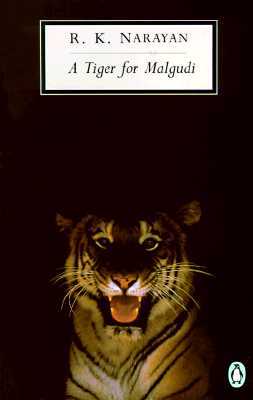
Synopsis
Covers the whole plot, including the ending.
- Difficulty
- Easy
- Pacing
- Moderate
- Mood
- Philosophical, Humorous, Reflective, Serene
- Read it if
- You enjoy unique perspectives, fables with philosophical undertones, or stories that blend humor with spiritual reflection.
- Skip it if
- You prefer fast-paced thrillers or stories with complex human characters as the primary focus.
A Tiger for Malgudi Plot Summary
Covers the whole plot, including the ending.
Cubhood and Early Life
The story begins with Raja, an old tiger, thinking about his life. He describes his youth in the deep jungle with his family. His early days were about learning to hunt, the excitement of the chase, and the strict order in his tiger family. He remembers the rich environment of the Mempi Hills, the sounds and smells of the forest, and his parents' constant survival lessons. This part establishes Raja's basic nature as a wild animal, driven by instinct and nature's rhythm, before he is forced to interact with humans.
A Life of Solitude and Apex Predation
As Raja grows, he becomes a respected and feared predator. He describes his solitary life as a grown tiger, marked by successful hunts of deer, wild boar, and sometimes buffalo from nearby villages. He recalls the respect and fear he commanded from other animals, and the thrill of the chase. His territory was wide, and he saw himself as its king. This period shows his raw power and independence, as he lives purely by jungle laws, free from human problems. He notices humans moving into his territory, becoming cautiously aware of them.
Encountering Humans and the Village Raid
One day, driven by hunger and growing boldness, Raja goes near a human village. He watches the villagers and their cattle, and eventually, he raids them. This causes fear among the humans, who start organizing hunting parties to find him. Raja finds himself increasingly against human civilization, viewing their actions with disdain and a growing sense of threat. This starts his direct conflict with humanity, moving from just watching to active involvement, which eventually seals his fate for a time.
Capture and the Circus Life
After his raids, Raja is captured by Captain, the owner of a traveling circus. The capture is a terrible experience for Raja, involving nets and a cage, a complete loss of his freedom. He is renamed 'Raja the Magnificent' and forced to learn humiliating tricks under Captain's cruel teaching. Circus life is very different from his wild existence, filled with loud noises, small spaces, and the constant threat of Captain's whip. He performs for audiences, doing tricks against his tiger nature, living a life of disrespect and control.
The Brutality of Captain
Life with Captain is one of constant fear and physical abuse for Raja. Captain is a harsh master, using whips and hunger to break Raja's spirit. Raja sees other circus animals suffer, including a bear, an elephant, and a monkey, all similarly controlled. He also watches the human performers, noting their own worries and obedience to Captain. This period deepens Raja's understanding of human cruelty and the power structures in their world, strengthening his dislike for his captor and his desire for freedom.
Escape from the Circus
During a chaotic performance in Malgudi, Raja, unable to stand Captain's cruelty, snaps. He breaks free from his chains and escapes the circus tent, causing panic in the town. The sight of a wild tiger in the streets makes everyone frantic, with people running in terror. Raja enjoys his new freedom, feeling a temporary return to his basic instincts as he causes chaos, knocking over stalls and scaring everyone. This escape is a turning point, moving Raja from captivity back to a semblance of his wild state, but in a human-dominated place.
Encounter with the Master
Amid his escape, Raja meets a Sanyasi, a spiritual master, who is meditating peacefully. Unlike the scared villagers, the Master shows no fear. Instead, he speaks to Raja calmly and kindly, looking at him with compassion. To Raja's surprise, he feels an unexplained peace with the Master. The Master gently leads Raja away from town, guiding him to a quiet spot where he can rest without causing more alarm. This meeting is life-changing, starting Raja's spiritual awakening and his first experience of true kindness from a human.
Life with the Master
Raja begins a new life with the Master. The Master treats him not as an animal to be tamed, but as a thinking being capable of spiritual growth. He teaches Raja to control his hunting instincts, encouraging him to eat vegetarian food and live in peace. Raja spends his days quietly reflecting with the Master, watching his meditation and listening to his philosophical lessons. This period changes Raja deeply, as he sheds his predatory nature and embraces a life of peace and non-violence, finding a deeper connection to the world under the Master's gentle guidance.
The Master's Teachings and Raja's Transformation
The Master teaches Raja important lessons about the illusions of the material world, self-control, and how all living things are connected. Raja, at first confused, slowly understands these ideas through the Master's patient explanations and his own experiences. He learns to stop his natural urges for aggression and hunting, finding contentment in a simple, peaceful life. This change is not just in behavior but spiritual, as Raja's inner world shifts from basic instinct to enlightened awareness, guided by the Master's wisdom.
Final Days and Legacy
As Raja ages, his teeth wear down, and his strength lessens, but his spirit stays calm and content. He lives his final days peacefully with the Master, thinking about his journey from a fierce jungle predator to a spiritually awakened friend. The Master eventually decides to enter 'jiva samadhi' – a conscious departure from the body – and arranges for Raja to live at a zoo, ensuring his comfort in old age. Raja accepts this final change calmly, having found his true purpose and peace through his bond with the Master, leaving a legacy of spiritual change.
A Tiger for Malgudi Characters
Raja
Protagonist
A majestic tiger whose life journey takes him from the wild jungle to spiritual enlightenment.
Raja is a powerful and intelligent Bengal tiger. Initially driven by instinct, hunger, and the desire for dominance in his jungle territory, he embodies the untamed spirit of nature. His experiences with humans, from the terror of capture to the indignity of circus life, force him to confront his wildness. He possesses a deep capacity for observation and, eventually, for profound transformation, demonstrating an unexpected openness to spiritual guidance. His inner monologue reveals a thoughtful, if initially bewildered, perspective on the human world.
Relationships: Captain (Captor and abuser, representing human cruelty and control.); The Master (Spiritual guide, companion, and catalyst for Raja's enlightenment.)
The Master (Sanyasi)
Supporting
A wise and compassionate spiritual ascetic who guides Raja towards peace and enlightenment.
The Master is a benevolent Sanyasi, a spiritual ascetic characterized by his profound wisdom, unwavering calm, and deep empathy for all living creatures. He possesses an extraordinary ability to communicate with and soothe Raja, seeing beyond the tiger's fearsome exterior to his inner being. His teachings emphasize non-violence, self-control, and the interconnectedness of life, providing the philosophical framework for Raja's transformation. He represents spiritual purity and the potential for harmony between humans and nature.
Relationships: Raja (Spiritual student and beloved companion.)
Captain
Antagonist
The cruel and opportunistic owner of the Grand Malgudi Circus.
Captain is a tyrannical and ambitious man driven by profit and control. He is Raja's captor and tormentor, embodying human greed, cruelty, and the desire to dominate nature. He uses whips, starvation, and intimidation to force Raja and other animals into performing humiliating tricks. His character highlights the negative aspects of human interaction with the animal kingdom, and his actions serve as a catalyst for Raja's suffering and eventual escape. He is ultimately a symbol of the brutish, unenlightened human world that Raja must transcend.
Relationships: Raja (Abusive master and unwilling performer.)
Jaggu
Supporting
The circus strongman, a kind human who shows Raja moments of understanding.
Jaggu is the strongman of Captain's circus, a burly but surprisingly gentle man. Unlike Captain, he occasionally shows Raja small acts of kindness, such as offering extra food or a comforting touch. He represents a glimmer of humanity's better nature within the otherwise harsh circus environment. Though he cannot openly defy Captain, his quiet empathy provides a contrast to the prevalent cruelty and offers Raja fleeting moments of solace, suggesting that not all humans are inherently malicious.
Relationships: Raja (Caretaker and occasional source of comfort.)
The Film Producer
Mentioned
An ambitious and somewhat unscrupulous figure in the film industry.
The Film Producer is a character briefly mentioned when Raja is sold into the film industry after his circus career. He represents the commercial exploitation of animals for entertainment, driven by profit motives similar to Captain's, but in a different arena. He is primarily concerned with creating sensational scenes, such as pitting Raja against a human 'Tarzan,' without regard for the animal's welfare or natural instincts. His role underscores the pervasive human tendency to commodify and control nature.
A Tiger for Malgudi Themes
The Conflict Between Nature and Civilization
The novel shows the conflict between the wild and the human world. Raja's journey from the free jungle to the circus and then to Malgudi's streets shows how human development disturbs natural homes and forces wild animals into unnatural lives. Circus life, in particular, symbolizes humanity's desire to control and use nature for fun, while Raja's escape and the panic in Malgudi show the wildness that civilization struggles to contain. This theme is central to Raja's early suffering and his later search for a peaceful life.
“I was accustomed to the jungle, where I was king, but here I was a slave.”
Spiritual Transformation and Enlightenment
At its core, the book is a story about spiritual awakening. Raja's change from a basic predator to a peaceful, thoughtful being under the Master's guidance is the main part of this theme. The Master teaches Raja about self-control, non-violence, and the illusion of worldly desires, leading Raja to go beyond his animal instincts. This journey reflects Hindu ideas of karma, dharma, and the chance for freedom (moksha) through spiritual practice, suggesting that enlightenment is possible for all beings, no matter their form. Raja's ability to overcome his natural tendencies symbolizes the power of spiritual practice.
“The Master told me that I was not my body, but something beyond it, eternal and indestructible.”
Compassion and Empathy for All Beings
An important theme is the value of compassion and the ability to feel empathy across species. The Master's interaction with Raja contrasts sharply with Captain's cruelty and the villagers' fear. The Master sees Raja not as a dangerous animal but as a thinking being capable of spiritual growth, treating him with respect and kindness. This compassionate approach leads to Raja's deep change and highlights the power of understanding and non-violence. The book criticizes the human tendency to treat animals as objects and use them, suggesting a more empathetic relationship with nature.
“He looked at me without fear, without anger, but with a profound understanding that pierced through my tiger heart.”
The Nature of Freedom and Captivity
The novel explores different forms of freedom and captivity. Raja's early freedom in the jungle is physical, but he is also 'bound' by his instincts. His capture by Captain represents actual physical captivity and the loss of dignity. His escape from the circus is a return to physical freedom, but still within human society. True freedom is found not just in physical liberty but in spiritual release, as Raja finds inner peace and self-mastery with the Master. This suggests that freedom is ultimately an internal state, regardless of outside conditions.
“I had been free in the jungle, but I was also a slave to my hunger. Now, I was truly free.”
Plot Devices & Literary Techniques
First-Person Animal Narration
The story is told entirely from the perspective of Raja, the tiger.
This device allows the reader to experience the world through the senses and understanding of an animal. It provides a unique, often humorous, and insightful commentary on human behavior, societal norms, and spiritual concepts from an 'outsider's' perspective. Raja's observations, initially instinctual and later increasingly philosophical, offer a fresh lens through which to examine themes of nature vs. civilization and the meaning of existence. It creates empathy for the animal protagonist and enables the allegorical nature of the story.
Allegory
The story of Raja's life serves as a symbolic representation of a spiritual journey.
Raja's transformation from a wild beast to a peaceful, enlightened being is an allegory for the human spiritual path. His initial existence in the jungle represents a state of primal ignorance and attachment to worldly desires (hunting, dominance). His captivity and suffering symbolize the trials and tribulations one faces on the path to self-realization. His eventual guidance by the Master and subsequent inner peace represent the attainment of spiritual enlightenment and liberation from the cycle of suffering. The entire narrative can be read as a parable for Hindu philosophy.
Foil Characters
Captain and The Master serve as direct contrasts to highlight different human approaches.
Captain, with his cruelty, greed, and desire for control, acts as a foil to The Master, who embodies compassion, wisdom, and selfless guidance. Their contrasting interactions with Raja illuminate the central themes of the novel: the destructive potential of humanity versus its capacity for spiritual harmony. Captain represents the unenlightened, materialistic world, while The Master represents spiritual enlightenment and a compassionate relationship with nature. This juxtaposition emphasizes the choices available to humanity and the profound impact of each path.
Irony
Situational irony is used to subvert expectations about a tiger's nature and human behavior.
The novel employs irony in several ways. For instance, a wild, feared tiger eventually becomes a peaceful, vegetarian companion, subverting expectations of its inherent ferocity. Conversely, humans, who perceive themselves as superior, often display more brutish and less 'civilized' behavior than the 'beast' they try to tame. The irony lies in Raja finding true freedom and enlightenment not in his wild state, but through human spiritual guidance, while many humans remain 'caged' by their own desires and ignorance. This device adds depth and often subtle humor to the narrative.
A Tiger for Malgudi Quotes
“The human being, if you look at him closely, is a much wilder animal than we.”
“All creatures in the world, however great or small, are there for a purpose.”
“Freedom, after all, is a matter of the mind.”
“What is life if not a series of challenges to be met and overcome?”
“The greatest education is to learn to live with what you have.”
“Fear is a great master, but love is a greater one.”
“Every animal has its place, and every place its animal.”
“The world is full of wonders, if only one has the eyes to see them.”
“To be truly free, one must first be free of oneself.”
“Silence has its own language, and it speaks volumes.”
“Even a tiger can learn humility.”
“The past is a cage, and the future is a dream. Only the present is real.”
“There is no true happiness in isolation.”
“A good master does not tame; he understands.”
“Life is a journey, not a destination.”
Quiz
10 questions on the plot and the characters. Each answer comes with a short explanation.
Question 1
What is the tiger's name given to him by the circus master?
- Sher Khan
- Raja
- Bagheera
- Mowgli
Show answer
B. Raja The circus master, Captain, names the tiger Raja the magnificent.
Question 2
What is the tiger's initial reaction to seeing humans in his wild days?
- Curiosity and a desire to play
- Fear and a need to hide
- Indifference, as they were not prey
- A desire to hunt and kill them
Show answer
D. A desire to hunt and kill them In his early life, the tiger viewed humans as potential prey, recalling an instance where he stalked a human walking through the jungle.
Question 3
Who is the human character that eventually befriends Raja and guides him towards a spiritual path?
- The Circus Captain
- The film director
- The Master
- The village headman
Show answer
C. The Master Raja finds sweet companionship and peace with the Master, a sannyasi, who helps him transcend his animal instincts.
Question 4
What specific event marks Raja's dramatic bid for freedom from human society?
- He escapes from his cage during a circus performance.
- He breaks free from the film set and wanders into Malgudi.
- He kills his abusive trainer and flees into the jungle.
- He is released by the Master after a period of training.
Show answer
B. He breaks free from the film set and wanders into Malgudi. After his film career, Raja finds the human world too brutish and bewildering, leading him to escape and wander into the town of Malgudi.
Question 5
What is the primary theme explored through Raja's interactions with human society before meeting the Master?
- The superiority of human intellect over animal instinct.
- The simple joys of life in a structured environment.
- The absurdity and cruelty of human civilization from an animal's perspective.
- The inevitable clash between nature and technology.
Show answer
C. The absurdity and cruelty of human civilization from an animal's perspective. The story views human absurdities through the eyes of a wild animal, highlighting the brutish and bewildering aspects of human society for Raja.
Question 6
What kind of 'Tarzan' co-stars with Raja in the film industry?
- A lithe and agile acrobat
- A beefy man in a leopard skin
- A young, inexperienced actor
- An actual wild man captured from the jungle
Show answer
B. A beefy man in a leopard skin The book specifically mentions Raja co-starring with a 'beefy Tarzan in a leopard skin' during his film career.
Question 7
How does the Master communicate with Raja and understand his thoughts?
- Through a translator who understands animal sounds.
- Through a mystical, telepathic connection.
- By observing his body language and reactions.
- He teaches Raja to understand human language.
Show answer
B. Through a mystical, telepathic connection. The Master possesses a spiritual understanding that allows him to communicate telepathically with Raja, understanding his past and guiding his future.
Question 8
What is the ultimate fate of Raja at the end of the story?
- He returns to the jungle to live out his days as a wild animal.
- He remains with the Master, living a life of peace and spiritual contemplation.
- He becomes a protected exhibit in a wildlife sanctuary.
- He is captured again and forced back into entertainment.
Show answer
B. He remains with the Master, living a life of peace and spiritual contemplation. Raja, old and toothless, finds sweet companionship and peace with the Master, eventually retiring to an ashram.
Question 9
Which aspect of Hindu mysticism is most strongly represented in the tiger's transformation under the Master's guidance?
- The concept of Maya (illusion).
- The pursuit of Moksha (liberation) from the cycle of rebirth.
- The importance of Dharma (righteous conduct) in everyday life.
- The worship of multiple deities.
Show answer
B. The pursuit of Moksha (liberation) from the cycle of rebirth. Raja's journey with the Master, transcending his animalistic nature and finding inner peace, reflects the Hindu concept of Moksha, or liberation from worldly attachments and instincts.
Question 10
What is the Master's primary method for controlling Raja and preventing him from harming others?
- He uses a whip and a chair, like a circus trainer.
- He drugs Raja to keep him docile.
- He uses a calm voice and a spiritual presence to soothe and guide him.
- He keeps Raja chained and caged at all times.
Show answer
C. He uses a calm voice and a spiritual presence to soothe and guide him. The Master uses his spiritual aura and calm presence to pacify Raja, demonstrating control through inner peace rather than physical force.
A Tiger for Malgudi FAQ
What is the central premise of "A Tiger for Malgudi"?
The novel follows the life story of Raja, a tiger, from his birth in the jungle, through his capture and experiences in a circus and film studio, to his eventual spiritual awakening and peaceful companionship with a Master. It explores themes of freedom, captivity, and the search for meaning from an animal's perspective.
Who is Raja, and what is his initial life like?
Raja is the protagonist, a powerful and majestic tiger who initially lives a free, predatory life in the Indian jungle. He experiences the thrill of the hunt, territorial disputes, and the natural rhythms of the wild before his fateful encounter with humans.
How does Raja transition from the wild to human captivity?
Raja is lured and trapped by Captain, a circus owner, after causing a disturbance near human settlements. He is then rigorously trained and forced into a life of performance as 'Raja the Magnificent' in the Grand Malgudi Circus, where he experiences the harsh realities of human control.
Describe Raja's experiences in the film industry.
After the circus, Raja is sold to a film producer and co-stars with a 'Tarzan'-like actor in a jungle adventure film. He finds this experience even more bewildering and brutal than the circus, characterized by confusing sets, loud noises, and the constant pressure to perform unnatural acts for the camera.
What prompts Raja's dramatic bid for freedom from human society?
Raja's escape is triggered by the overwhelming chaos, noise, and sheer absurdity of human life, particularly the film set. The constant prodding, the artificiality, and the confinement become unbearable, leading him to break free and wander into Malgudi town.
What is the significance of the Master's arrival in Raja's life?
The Master, a renunciate sage, represents a turning point for Raja, offering him a path to peace and understanding beyond the brutish human world. He is the first human to connect with Raja on a spiritual level, guiding him towards a life of contemplation and non-violence, and ultimately companionship.
Are there any symbolic parallels between Raja's journey and human spiritual seeking?
Yes, Raja's journey from wild instinct to forced performance, then to confusion and ultimate spiritual enlightenment with the Master, mirrors the human spiritual quest. His initial wildness represents an unawakened state, while his time in captivity can be seen as the struggles and illusions of worldly life, leading to the eventual search for higher truth.
How does the setting of Malgudi influence the narrative?
Malgudi, a fictional South Indian town, serves as a microcosm of human society, showcasing its absurdities, commercialism, and inherent chaos through Raja's eyes. It provides a familiar yet detached backdrop for Narayan's commentary on human nature and the contrast with the natural world.
What role does Hindu mysticism play in the story's resolution?
Hindu mysticism, particularly the concept of moksha (liberation) and the guru-disciple relationship, is central to the resolution. The Master embodies the spiritual guide, leading Raja away from the cycle of suffering and confusion towards a state of inner peace and understanding, reflecting the tenets of asceticism and spiritual renunciation.
How does Raja's perspective challenge anthropocentric views?
By narrating the story through Raja's eyes, Narayan forces readers to view human actions, institutions, and values from an animal's bewildered and often critical perspective. This challenges the assumption of human superiority and rationality, highlighting the cruelty and absurdity inherent in human-dominated systems.
Analyze Captain's psychological motivations for training Raja.
Captain is driven by a desire for control, profit, and spectacle. His psychological motivation stems from a need to dominate nature and exploit it for entertainment and personal gain, seeing Raja not as a living being but as a tool to be broken and molded to his will, reflecting a common human tendency to subjugate.
How does Raja's initial aggression transform into docility and eventually peace?
Raja's aggression is initially a natural instinct, then suppressed by Captain's brutal training, leading to a forced docility. With the Master, this docility transforms into genuine peace and understanding, stemming from a spiritual connection rather than fear. This shows a progression from instinct to subjugation to enlightened acceptance.
What psychological impact does captivity have on Raja?
Captivity profoundly affects Raja, causing confusion, frustration, and a sense of alienation. He struggles to understand human motives and actions, leading to a deep psychological disorientation. His natural instincts are thwarted, replaced by learned behaviors and a dependence on his captors, until his eventual escape and spiritual rebirth.
Is Raja's ability to communicate with the Master to be taken literally or metaphorically?
While the narrative presents their communication as direct, it's often interpreted metaphorically. The Master's ability to 'understand' Raja can symbolize a deep empathic and spiritual connection that transcends verbal language, representing a profound bond achieved through meditation and spiritual insight rather than literal speech.
Does the novel suggest that animals possess a soul or spiritual capacity?
The novel strongly implies that animals, or at least Raja, possess a spiritual capacity similar to humans. Raja's journey towards enlightenment and peace with the Master suggests an inherent ability to seek and achieve spiritual liberation, challenging speciesist notions about consciousness and the soul.
How does Narayan use humor to temper the more serious themes of the book?
Narayan employs his characteristic Malgudi comedy to inject lightness into the narrative, particularly when depicting human absurdities through Raja's bewildered eyes. The humorous observations of human behavior, such as the film set chaos or the villagers' reactions to Raja, prevent the story from becoming overly didactic or melancholic, making the serious themes more palatable.
What is the ultimate message about the relationship between humanity and nature?
The novel suggests a complex and often fraught relationship where humanity frequently exploits and misunderstands nature. However, it also offers a hopeful message through the Master, demonstrating that a harmonious, respectful, and spiritually aligned co-existence is possible when humans shed their arrogance and embrace compassion and understanding towards the natural world.
Could Raja's story be seen as an allegory for human societal confinement?
Yes, Raja's journey can be interpreted as an allegory for the human condition within societal structures. His various forms of captivity (circus, film) represent the ways humans can feel trapped by societal expectations, materialism, and the pursuit of superficial goals, while his eventual liberation with the Master signifies the escape from these confines through spiritual awakening.
About the author

R.K. Narayan was an Indian author known for his works set in the fictional town of Malgudi. His notable books include "Malgudi Days," "Swami and Friends," "The Guide," "The English Teacher," "The Bachelor of Arts," and "A Tiger for Malgudi," which explore themes of everyday life and human relationships. Narayan's writing is characterized by its simplicity and humor, reflecting Indian culture and society.
Similar books
- Life of Pi
Yann Martel
3.9 (1.3M) average on GoodreadsFantasyFeatures an animal companion and explores themes of spirituality and survival from an unusual perspective.
- Jonathan Livingston Seagull
Richard Bach
3.8 (202k) average on GoodreadsFantasyA fable about an animal's quest for higher purpose and enlightenment.
- The Jungle Book
Rudyard Kipling
3.9 (104k) average on GoodreadsFantasyExplores the relationship between animals and humans in the Indian jungle setting.
- Watership Down
Richard Adams
4.1 (434k) average on GoodreadsFantasyWhile both feature animal protagonists and explore survival, A Tiger for Malgudi delves much deeper into individual consciousness and spiritual transformation, whereas Watership Down focuses more on social structures, instinct, and a community's struggle against external threats. Narayan's anthropomorphism serves a more philosophical purpose.
- Harry Potter and the Sorcerer's Stone
J.K. Rowling
4.5 (7M) average on GoodreadsFantasyRescued from a miserable life under the stairs, an orphaned boy discovers he's a wizard destined for a magical school, where he uncovers a dangerous secret tied to the dark wizard who murdered his parents.
- The Hunger Games
Suzanne Collins
4.3 (6.4M) average on GoodreadsFantasyIn a future where children fight to the death on live television, Katniss Everdeen volunteers for the arena, turning a death sentence into a fight for survival and a spark of rebellion.






Enjoyed the summary?
A summary gives you the shape of the book. The book itself has the detail, the examples and the voice.
Find A Tiger for Malgudi on AmazonAs an Amazon Associate, BookBrief earns from qualifying purchases. How we're funded