
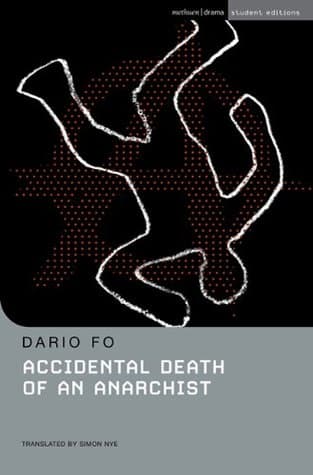
Synopsis
Covers the whole plot, including the ending.
- Difficulty
- Medium
- Read it if
- You are interested in political satire, absurdism, or plays that challenge authority and expose institutional corruption through humor. Also, if you want a sharp critique of how power manipulates truth and controls narratives.
- Skip it if
- You prefer straightforward drama without meta-theatrical elements or heavy political commentary, or if you are sensitive to cynical portrayals of state institutions.
Accidental Death of an Anarchist Quotes
“Of course, the police are the people who defend the law, but not just the law as it exists, but the law as it is going to be.”
“If you want to know what the truth is, you must first invent it.”
“The police are always right, even when they’re wrong. Especially when they’re wrong.”
“A good anarchist is a dead anarchist. A good policeman is a dead anarchist.”
“We are here to discover the truth, not to create it.”
“The only way to be truly free is to be mad.”
“Justice is like a bus. It always comes, but sometimes you have to wait a very long time, and sometimes it's the wrong bus.”
“We are not dealing with a simple suicide, but a complex act of ideological self-elimination.”
“In Italy, there are two kinds of people: those who believe in justice, and those who know what it is.”
“If you don't use your head, you'll end up losing it.”
“The state is a machine designed to make the powerful more powerful.”
“The truth is a dangerous weapon, especially when it's aimed at the powerful.”
“We live in a time where the absurd is the only logical response to reality.”
“To govern is to make people believe that they are governing themselves.”
“The only thing worse than a lie is a truth that nobody believes.”
Quiz
10 questions on the plot and the characters. Each answer comes with a short explanation.
Question 1
What real-life event, occurring in 1969, serves as the direct inspiration for the plot of 'Accidental Death of an Anarchist'?
- The Piazza Fontana bombing in Milan
- The death of anarchist railway worker Giuseppe Pinelli in police custody
- The student protests and uprisings across Italy
- The assassination attempt on Italian politician Aldo Moro
Show answer
B. The death of anarchist railway worker Giuseppe Pinelli in police custody The play is a satirical take on the real-life death of Giuseppe Pinelli, an anarchist railway worker who 'fell' from a police headquarters window in Milan in 1969 while being interrogated.
Question 2
Who is the central character in 'Accidental Death of an Anarchist' who impersonates various officials to expose police corruption?
- The Chief of Police
- Inspector Bertozzo
- The Maniac
- Maria Feletti
Show answer
C. The Maniac The Maniac is the protagonist, a master of disguise and deception, who infiltrates the police station under various guises.
Question 3
Which theatrical genre is 'Accidental Death of an Anarchist' primarily categorized as, given its use of exaggerated situations, physical comedy, and sharp social commentary?
- Tragedy
- Absurdist drama
- Farce
- Realism
Show answer
C. Farce The play is explicitly described as a 'farce' in the book's description, characterized by its hilarious satire and exaggerated situations.
Question 4
What is the primary motive of the Maniac in his elaborate scheme to expose the police?
- To seek personal revenge against the police
- To prove his superior intellect and cunning
- To reveal the truth behind the anarchist's death and expose institutional corruption
- To gain political power within the anarchist movement
Show answer
C. To reveal the truth behind the anarchist's death and expose institutional corruption The Maniac's actions are driven by a desire to expose the lies and corruption surrounding the anarchist's death, not personal gain or revenge.
Question 5
The play satirizes the concept of 'accidental death' as presented by the authorities. What does this 'accident' typically signify in the context of the play's political critique?
- A genuine mishap without external blame
- A cover-up for state-sanctioned violence or negligence
- The unpredictable nature of life in a chaotic society
- A suicide committed under duress
Show answer
B. A cover-up for state-sanctioned violence or negligence The 'accidental death' is presented by the police as an excuse to avoid accountability for what is implied to be murder or severe mishandling, highlighting state corruption.
Question 6
Which theatrical technique, often associated with Dario Fo, involves actors directly addressing the audience and breaking the 'fourth wall'?
- Method acting
- Verbatim theatre
- Brechtian alienation effect (Verfremdungseffekt)
- Naturalism
Show answer
C. Brechtian alienation effect (Verfremdungseffekt) Dario Fo, like Brecht, often uses techniques to distance the audience from the action, encouraging critical thought rather than passive emotional engagement. This includes directly addressing the audience and exposing the theatricality.
Question 7
The character of Maria Feletti, the journalist, plays a crucial role by representing what aspect of society in the face of institutional deceit?
- The complicity of the media with state power
- The naive public easily swayed by official narratives
- The investigative press seeking truth and accountability
- The voice of the anarchist movement itself
Show answer
C. The investigative press seeking truth and accountability Maria Feletti represents the potential for the press to uncover truth and challenge official narratives, although she is initially deceived by the Maniac's disguises.
Question 8
How does the play ultimately challenge the audience to consider their own role in political accountability?
- By providing a clear resolution and punishment for the guilty parties
- By presenting a complex historical analysis of Italian politics
- By forcing them to confront the ease with which truth can be manipulated and the importance of questioning authority
- By advocating for specific political reforms within the legal system
Show answer
C. By forcing them to confront the ease with which truth can be manipulated and the importance of questioning authority The play's enduring power lies in its ability to make audiences critically examine the manipulation of truth by those in power and to encourage skepticism towards official accounts, prompting a reflection on civic responsibility.
Question 9
The play often employs 'grotesque realism,' a concept where the serious and the absurd are intertwined. How does this technique contribute to the play's political message?
- It diminishes the seriousness of the police's actions, making them seem harmless.
- It highlights the absurdity and inherent corruption within the system by presenting horrific truths through a comedic, exaggerated lens.
- It makes the characters more relatable and sympathetic to the audience.
- It serves to confuse the audience, preventing them from forming a clear opinion.
Show answer
B. It highlights the absurdity and inherent corruption within the system by presenting horrific truths through a comedic, exaggerated lens. Grotesque realism allows Fo to expose the horrific realities of police brutality and state deception by framing them within a comedic, exaggerated context, making the critique more potent and memorable.
Question 10
Dario Fo's plays, including this one, are often described as 'agitprop.' What does this term signify in the context of 'Accidental Death of an Anarchist'?
- Plays designed purely for entertainment with no underlying message.
- Theatre that agitates for social or political change through propaganda, often in an accessible and direct manner.
- Plays that strictly adhere to classical dramatic structures and themes.
- Experimental theatre focused solely on abstract artistic expression.
Show answer
B. Theatre that agitates for social or political change through propaganda, often in an accessible and direct manner. Agitprop (agitation propaganda) theatre aims to provoke thought and action regarding social and political issues, often using direct and satirical methods to convey its message, which is characteristic of Fo's work.
Accidental Death of an Anarchist FAQ
What is 'Accidental Death of an Anarchist' about?
'Accidental Death of an Anarchist' is a satirical play by Dario Fo that critiques political corruption and police brutality. It centers on the mysterious death of an anarchist railway worker who 'fell' from a police station window in 1969, with the play humorously exposing the inconsistencies in the official story.
Does 'Accidental Death of an Anarchist' work as a political satire today?
Yes, the play remains highly effective as a political satire due to its timeless themes of state power abuse, manipulation, and the search for truth. Its farcical elements and sharp commentary continue to resonate with contemporary audiences grappling with similar issues.
What is the 'Maniac' in 'Accidental Death of an Anarchist'?
The 'Maniac' is the central character of the play, a highly intelligent and eccentric trickster who impersonates various officials to expose the police's lies surrounding the anarchist's death. He serves as a catalyst for revealing the truth through absurdity and clever deception.
How historically accurate is 'Accidental Death of an Anarchist'?
While a work of fiction and farce, the play is directly inspired by the real-life death of Giuseppe Pinelli, an anarchist who died under suspicious circumstances in police custody in Milan in 1969. Fo uses this historical event as a springboard for his dramatic and political commentary.
How does Dario Fo's style in this play differ from traditional political dramas?
Dario Fo's style in 'Accidental Death of an Anarchist' blends commedia dell'arte traditions, farce, and biting political satire, diverging from traditional political dramas that might adopt a more realistic or didactic tone. He uses humor and absurdity to make profound political statements.
What insights does Joseph Farrell's commentary provide?
Joseph Farrell's commentary and notes offer valuable context on the play's historical background, political significance, and theatrical techniques. He helps readers understand Fo's motivations, the reception of the play, and its enduring relevance in modern drama.
Is 'Accidental Death of an Anarchist' suitable for a high school curriculum?
Yes, 'Accidental Death of an Anarchist' is often studied in high school and university settings due to its rich themes of political corruption, justice, and media manipulation. Its engaging farcical style also makes complex political ideas accessible to younger audiences.
What is the significance of the 2003 London premiere mentioned in the book's description?
The mention of the 2003 London premiere highlights the specific version or translation of the play that this particular edition focuses on. It suggests that Joseph Farrell's commentary and notes might be tailored to this specific production or its impact.
Who was Dario Fo and what was his political stance?
Dario Fo was an Italian playwright, actor, and director, and a Nobel Prize laureate known for his highly political and satirical works. He was a committed leftist, using his theater as a platform to critique capitalism, state power, and social injustice, often through the lens of popular comedic traditions.
About the author
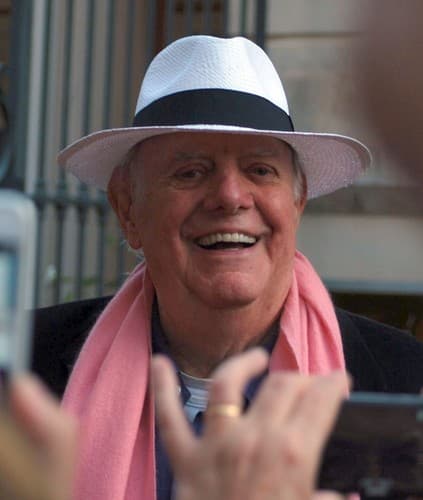
Dario Fo was an Italian actor, playwright, theater director, and satirist whose work often criticized authority and celebrated the downtrodden. A Nobel Prize laureate in Literature, he is best known for his political farces, including the internationally acclaimed "Accidental Death of an Anarchist." His innovative use of commedia dell'arte techniques and sharp political commentary made him a significant figure in 20th-century theater.
Similar books
- Ubu Roi
Alfred Jarry
3.6 (5k) average on GoodreadsFictionShares a similar absurd, satirical approach to critiquing power and authority.
- Animal Farm
George Orwell
4.0 (2.7M) average on GoodreadsPoliticsA political allegory that critiques totalitarianism and the corruption of revolutionary ideals, though in a different genre.
- 1984
George Orwell
4.2 (3.1M) average on GoodreadsPoliticsIn a future where surveillance and thought control are absolute, a man's search for truth clashes with the Party, showing that hope can be a form of rebellion.
- Freakonomics: A Rogue Economist Explores the Hidden Side of Everything
Steven D. Levitt
4.0 (709k) average on GoodreadsBusinessThis book uses economic principles to reveal the surprising incentives behind everything from drug dealing and real estate to cheating teachers and the decline of crime.
- I Am Malala: The Story of the Girl Who Stood Up for Education and Was Shot by the Taliban
Malala Yousafzai
4.1 (419k) average on GoodreadsPoliticsA teenage girl from a Taliban-controlled valley refuses to give up her books, becoming a global voice for education even after an assassination attempt.
- Atlas Shrugged
Ayn Rand
3.7 (354k) average on GoodreadsPoliticsIn a dystopian America where innovators vanish, a brilliant heiress races to uncover the truth behind the disappearing industrialists and the enigmatic John Galt, who vows to stop the world's progress.






Enjoyed the summary?
A summary gives you the shape of the book. The book itself has the detail, the examples and the voice.
Find Accidental Death of an Anarchist on AmazonAs an Amazon Associate, BookBrief earns from qualifying purchases. How we're funded