
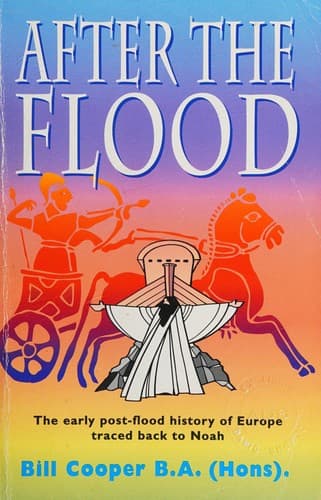
Core Idea
- Difficulty
- Hard
- Read it if
- You are interested in a deep, biblically-literal reinterpretation of ancient history, specifically challenging conventional timelines and seeking to connect biblical genealogies to the origins of world civilizations.
- Skip it if
- You prefer mainstream historical and archaeological consensus, are not open to a literal interpretation of biblical chronology as the primary historical framework, or are looking for light reading.
Key Takeaways from After the Flood
Unbroken Lineage to Noah
European history isn't just ancient; it's a direct, traceable lineage back to the biblical patriarch Noah.
Cooper's main idea differs greatly from mainstream historical thought: the family lines and early histories of European nations are not just myths or stories but accurate historical records. These can be traced back to Noah's son, Japheth. He says that by comparing old records, king lists, and traditional histories from various European cultures, a steady story appears that matches biblical accounts. This is not about vague hints but specific names, generation lengths, and movement patterns that, when put together, form a clear and surprisingly detailed early history of Europe. The book questions the idea that the biblical story is separate. Instead, it places it as a key, foundational part for understanding European origins, suggesting a much deeper and more connected old past than usually thought.
“European history, far from being a collection of disparate tales, reveals a continuous thread, unbroken, leading directly back to the very first generations after the global deluge.”
In the book: Cooper extensively cites sources like the 'Annals of Ulster,' Nennius's 'Historia Brittonum,' Geoffrey of Monmouth's 'History of the Kings of Britain,' and various Irish, Scottish, and Germanic sagas, demonstrating how these independent traditions consistently point to Japhethic ancestors.
Try this: Re-evaluate the concept of 'myth' in ancient histories; consider how foundational narratives, even those seemingly fantastical, might contain kernels of deep historical truth that, when cross-referenced, reveal a coherent past.
Related ideas: japhethic-lineage, biblical-chronology, proto-history
The Japhethic Progenitors
Europe's diverse nations share a common ancestral root in Japheth and his sons, whose names resonate in ancient ethnonyms.
Cooper spends much time finding the specific sons of Japheth and tracing their families into the forming nations of Europe. He says that Gomer led to the Cimmerians and Celts, Magog to the Scythians, Madai to the Medes (and further movements), Javan to the Ionians/Greeks, Tubal to the Tibareni and Iberians, Meshech to the Mushki, and Tiras to the Thracians and Etruscans. This is not a guess but a detailed language and historical argument. It shows how old place names, tribe names, and even later national identities have clear sound and historical links to these biblical ancestors. This gives a clear way to understand the first movements and settlements that eventually came together as the distinct cultural groups of early Europe, suggesting a deep shared background often missed.
“The names of Japheth's sons are not merely biblical curiosities but the very bedrock upon which the ancient ethnonyms and geographical designations of early Europe are built.”
In the book: He links Gomer to the Cimmerians (Gimirru in Assyrian texts) and later Celtic migrations, Javan to the Ionian Greeks, and Tubal to the ancient Iberians, citing classical historians and archaeological findings to support these connections.
Try this: When studying ancient migrations or etymology of place names, consider the potential for deeper, more ancient linguistic and genealogical connections than typically presented in secular historical models.
Related ideas: gomer, magog, javan, cimmerians, scythians, ionians
Beyond the Ice Age Myth
The conventional Ice Age narrative clashes with historical accounts, suggesting a recent global flood as a more fitting explanation for geological features.
Cooper looks closely at the common Ice Age theory. He does not dismiss geological evidence but questions its timeline and power to explain things when compared to old historical stories. He says that the idea of a large, long-lasting ice sheet covering much of Europe for tens of thousands of years creates a problem when put next to the fast repopulation and growth suggested by the family lines he traces. Instead, he suggests that many geological features blamed on ice activity could be better explained by what happened right after a global flood, followed by local environmental changes. This view asks readers to think about other ways to understand geological data, putting historical accounts first as a valid source of scientific study, rather than just relying on common geological ideas.
“The pervasive 'Ice Age' paradigm, while entrenched in modern geology, struggles to reconcile itself with the historical records, which instead point to a far more cataclysmic, recent global event.”
In the book: He discusses the lack of human presence in areas supposedly covered by thick ice sheets for millennia, contrasting it with the relatively swift re-emergence of civilization in these regions according to historical records, and points to evidence of rapid erosion and deposition consistent with catastrophic flooding.
Try this: Approach scientific paradigms with a critical eye, especially when they conflict with historical records. Explore alternative explanations for geological phenomena that integrate historical and biblical accounts.
Related ideas: ice-age-critique, catastrophism, uniformitarianism, post-flood-geology
Synchronizing King Lists
Ancient European king lists, often dismissed as legend, can be harmonized to reveal a consistent, post-Flood chronology.
A large part of Cooper's work involves the hard task of comparing and lining up the king lists from various early European cultures — Irish, Scottish, Anglo-Saxon, Welsh, and others. He shows that despite their different locations and cultures, these lists often have similar names, similar generation lengths, and a steady pattern of ancestors that points back to a common, pre-European origin. This detailed comparison is important to his argument. It gives proof for the history of these 'mythical' figures and sets up a time frame that goes far beyond common historical timelines. It shows that seemingly different historical sources, when looked at without earlier ideas, can show deep, hidden connections.
“By carefully cross-referencing the disparate and often fragmented king lists of ancient Europe, a remarkable pattern of synchronicity emerges, painting a cohesive chronological picture that defies the notion of isolated, mythical tales.”
In the book: Cooper meticulously compares the Irish 'Annals of the Four Masters' with Nennius's 'Historia Brittonum' and other Anglo-Saxon genealogies, highlighting points of convergence and demonstrating how rulers from different regions can be synchronized to a common post-Flood timeline.
Try this: When confronted with seemingly contradictory historical accounts from different cultures, seek commonalities and underlying structures that might reveal a deeper, shared history rather than dismissing them as mere legend.
Related ideas: ancient-genealogies, synchronistic-history, king-lists, comparative-mythology
Giants and the Nephilim Legacy
Accounts of giants in ancient European lore are not mere fantasy but echoes of the pre-Flood and early post-Flood Nephilim.
Cooper looks at the common idea of giants in old European myths and stories, from the Titans of Greek mythology to the Fomorians of Irish lore and the Jotunn of Norse sagas. He says these stories are not made-up but changed memories of the Nephilim, mentioned in Genesis 6, and their families after the Flood. This view connects biblical stories of unusually large people to the wider human experience. It suggests that the memory of these beings stayed in spoken stories and later written histories across various cultures. It questions the purely mythical understanding of these figures, suggesting a historical basis in the early post-Flood world where physical differences and unusual size might have been more common.
“The persistent tales of giants across European folklore are not simply products of imagination, but a cultural memory, albeit distorted, of the Nephilim and their descendants who roamed the earth in the early post-Flood world.”
In the book: He cites Irish legends of the Fomorians, Greek myths of Titans and Cyclops, and even references from classical authors regarding unusually large human remains, linking them to the biblical Nephilim and the Anakim mentioned in the Old Testament.
Try this: Consider how seemingly fantastical elements in ancient myths might be distorted historical records. Look for common archetypes and motifs across cultures that could point to shared, deep-time events or phenomena.
Related ideas: nephilim, giants-in-mythology, fomorians, jotunn, pre-flood-history
The Tower of Babel's Echo
The linguistic diversity of Europe, rather than evolving slowly, reflects a rapid, divinely orchestrated dispersion from Babel.
Cooper sees the Tower of Babel event not as a small, local event but as a key, global turning point that deeply shaped human settlement and language growth. He says that the fast separation of languages, which puzzles secular language experts, makes perfect sense within a biblical framework of a sudden, divinely caused language confusion. This event, he claims, was the main reason for the first movements out of Mesopotamia, leading to the many language families found in Europe. This questions the slow view of language growth, suggesting a sudden origin for language diversity that directly matches the historical and family line spread he traces. It is a strong argument for including biblical stories in the study of historical languages.
“The bewildering tapestry of European languages, with its sudden divergences and distinct families, speaks not of slow evolution, but of a rapid, catastrophic linguistic separation, echoing the event at Babel.”
In the book: He implicitly references the sheer number and distinctness of early Indo-European language families, arguing that their rapid divergence is better explained by a sudden event like Babel rather than gradual evolutionary processes over vast timescales.
Try this: When studying historical linguistics, consider the implications of a sudden, divinely orchestrated language diversification event, and how this might explain patterns of language distribution and relatedness.
Related ideas: tower-of-babel, linguistic-diversity, indo-european-languages, language-origins
Biblical Chronology as a Master Key
Adhering to a biblical timeline provides a more consistent and coherent framework for understanding ancient history than secular models.
A main part of Cooper's method is sticking to a biblical timeline, especially the Ussher/Lightfoot timeline, which places the Flood around 2348 BC and the Creation around 4004 BC. He says this timeline, far from being an old religious belief, gives a very steady and logical framework for understanding when early movements happened, when civilizations grew, and how various old peoples were connected. He argues that secular timelines, with their large and often changing timeframes, often create more problems than they solve. They force historians to invent 'dark ages' or times of unexplained stopping. The biblical timeline, in contrast, offers a short and clear story that allows for a more direct and less guessed-at understanding of old historical records.
“The biblical chronology, often dismissed as archaic, proves to be the master key, unlocking the complex puzzles of ancient European history and providing a consistent framework where secular models often falter.”
In the book: He consistently uses the biblical timeline to anchor his genealogical and historical comparisons, demonstrating how events and figures across different cultures can be placed within a coherent, relatively short post-Flood period, avoiding the need for vast, empty spans of time.
Try this: When analyzing ancient history, consider the implications of different chronological frameworks. Explore how a biblical timeline might offer more direct and less speculative explanations for historical phenomena compared to mainstream secular models.
Related ideas: ussher-chronology, biblical-history, historical-framework, ancient-chronology
The 'Dark Ages' Reimagined
The so-called 'Dark Ages' of early European history are better understood as periods of rapid re-population and cultural formation post-Babel.
Cooper questions the common understanding of Europe's early 'Dark Ages,' especially the time right after the spread from Babel. Instead of seeing this as a mysterious empty space or a time of slow, unconnected growth, he reinterprets it as a fast time of repopulation, tribe formation, and the creation of distinct cultural identities by Japheth's families. Within his biblical timeline, there is no room for large, empty thousands of years; instead, the time is marked by quick movement and the start of early nations. This view adds energy and purpose to a time often marked by academic uncertainty. It suggests that the 'darkness' is more a reflection of our limited understanding through a secular view than an actual historical empty space.
“The 'Dark Ages' of Europe are not a void of history, but a vibrant, albeit challenging, period of rapid re-population, cultural diversification, and the laying of foundational identities in the wake of Babel's dispersion.”
In the book: He highlights the relatively swift appearance of distinct tribal groups and early kingdoms in various parts of Europe according to their own historical records, arguing against the need for vast, empty periods of 'darkness' for their development.
Try this: When encountering 'dark ages' or periods of historical uncertainty, consider how a compressed, biblically informed timeline might offer alternative, more coherent explanations for rapid cultural formation and population growth.
Related ideas: dark-ages-revisited, post-babel-migrations, early-european-settlement, cultural-formation
Myth as Corrupted History
Many ancient European myths are not pure fiction but distorted, embellished accounts of real historical events and figures.
A repeated idea in Cooper's analysis is that old myths, stories, and folklore are not completely baseless made-up tales. Instead, he says they are often highly decorated, symbolic, or changed versions of actual historical events and real people from the early post-Flood time. This approach encourages a careful yet open-minded reading of old stories, looking for the historical 'truth' within the fantasy parts. By removing the layers of poetic freedom and cultural additions, Cooper tries to rebuild the hidden historical realities. He shows how seemingly different myths often come together on common themes and figures that match a biblical understanding of early human history. This view raises the value of spoken stories and old accounts as real historical sources, not just cultural curiosities.
“The myths of ancient Europe, often relegated to the realm of pure fantasy, are in fact valuable, albeit corrupted, historical archives, preserving echoes of real events and the memories of early post-Flood ancestors.”
In the book: He analyzes the story of Noah and the Flood as a pervasive motif in global flood myths, and connects figures like Atlas or Prometheus to early post-Flood leaders or events, showing how their characteristics align with potential historical roles.
Try this: When engaging with ancient myths from any culture, practice 'mythological deconstruction' to identify potential historical anchors, common themes, and shared memories that might point to deep, shared historical events.
Related ideas: myth-and-history, euhemerism, folk-memory, oral-tradition
Reclaiming the Biblical Narrative
Cooper's work asserts the Bible's historical accuracy as a foundational text for understanding not just theology, but global history.
The main point from 'After the Flood' is Cooper's strong defense and confirmation of the Bible's historical accuracy. He is not just using the Bible as a reference; he is saying that it is the main story against which all other historical accounts should be judged and understood. By showing how old European histories, king lists, and myths consistently line up with a biblical timeline and family framework, Cooper presents a strong case for the Bible's reliability as a historical document. This questions the secular tendency to put the Bible into a purely religious category. Instead, he argues for its important role in rebuilding a clear and full understanding of global human history, especially in the post-Flood time. His work is a call to bring together faith and history, showing that they are not separate but deeply connected.
“Ultimately, this research is a testament to the profound historical accuracy of the biblical narrative, positioning it not merely as a book of faith, but as the essential framework for unlocking the true history of our world.”
In the book: The entire book serves as cumulative evidence, with each traced lineage, synchronized king list, and reinterpreted myth contributing to the overall argument for the Bible's historical veracity as the foundational document.
Try this: Adopt a holistic approach to history, considering the biblical narrative as a legitimate and potentially superior framework for understanding ancient events and human origins, rather than solely relying on secular interpretations.
Related ideas: biblical-accuracy, historical-reliability-of-bible, creationist-history, faith-and-history
After the Flood Quotes
“The greatest trick the Devil ever pulled was convincing the world he didn't exist.”
“History is written by the victors, but the truth is often buried with the vanquished.”
“Freedom is not given; it is taken by those who dare to seek the truth.”
“The flood of misinformation drowns out the whispers of reality.”
“In the silence of the archives, the past speaks volumes to those who listen.”
“A society that fears knowledge is a society destined to repeat its mistakes.”
“The chains of conformity are forged in the classrooms of complacency.”
“Every lie has a half-life, decaying under the light of scrutiny.”
“To question authority is not rebellion; it is the duty of the informed.”
“The map of reality is redrawn by those who dare to explore beyond its borders.”
“In the echo chambers of power, dissent is the only true voice.”
“The floodwaters of dogma recede to reveal the bedrock of evidence.”
“A single fact can topple an empire of lies, if placed in the right hands.”
“The past is not a prison, but a key to understanding the present.”
Quiz
10 questions on the main ideas. Each answer comes with a short explanation.
Question 1
What is the primary historical claim made by Bill Cooper in 'After the Flood'?
- That European history began with the Roman Empire
- That European history can be traced back to the biblical flood and Japheth's descendants
- That European history is entirely mythological before the Middle Ages
- That European history originated from ancient Egyptian civilization
Show answer
B. That European history can be traced back to the biblical flood and Japheth's descendants Cooper's central argument, based on 25 years of research, is that European history can be traced back to the biblical flood and specifically to the descendants of Japheth, one of Noah's sons, using contemporary accounts as evidence.
Question 2
According to Cooper's research in 'After the Flood', how many years of investigation does his work represent?
- 10 years
- 15 years
- More than 25 years
- Exactly 30 years
Show answer
C. More than 25 years The book description explicitly states that Cooper's work is 'the fruit of more than 25 years of research,' indicating the extensive time investment in his investigation.
Question 3
What type of sources does Cooper primarily use to support his historical claims in 'After the Flood'?
- Archaeological artifacts
- Contemporary accounts
- Genetic studies
- Modern historical textbooks
Show answer
B. Contemporary accounts Cooper demonstrates his claims 'through contemporary accounts,' meaning he relies on historical documents and records from the periods he discusses rather than other types of evidence.
Question 4
Which biblical figure's descendants does Cooper specifically connect to European history in 'After the Flood'?
- Noah
- Shem
- Ham
- Japheth
Show answer
D. Japheth Cooper focuses on Japheth, one of Noah's three sons, arguing that European peoples are descended from him, which is a specific aspect of his broader flood-to-history framework.
Question 5
What is the main methodological approach Cooper employs in 'After the Flood' to trace European history?
- Comparative mythology analysis
- Linguistic reconstruction
- Genealogical tracing from biblical narratives
- Statistical analysis of population data
Show answer
C. Genealogical tracing from biblical narratives Cooper uses genealogical tracing, starting from the biblical flood and Japheth's lineage, to connect ancient records and contemporary accounts to European history, forming the backbone of his argument.
Question 6
In 'After the Flood', what does Cooper aim to demonstrate about the relationship between the biblical flood and European history?
- That the flood is a metaphor for cultural change
- That European history is completely separate from biblical events
- That European history has a direct, traceable lineage from the flood
- That the flood only impacted Middle Eastern history
Show answer
C. That European history has a direct, traceable lineage from the flood Cooper's core argument is that European history is not isolated but can be directly traced back to the biblical flood, implying a continuous historical lineage rather than a metaphorical or separate development.
Question 7
How does Cooper's work in 'After the Flood' challenge conventional historical perspectives?
- By denying the existence of ancient European civilizations
- By proposing a much shorter timeline for European history
- By linking European origins to a biblical event rather than purely secular or archaeological theories
- By arguing that European history began with Greek philosophy
Show answer
C. By linking European origins to a biblical event rather than purely secular or archaeological theories Cooper challenges mainstream historical views by asserting that European history originates from the biblical flood and Japheth's descendants, offering a faith-based alternative to secular or archaeological origin theories.
Question 8
What practical implication might Cooper's research in 'After the Flood' have for understanding European cultural identity?
- It suggests European cultures developed in complete isolation
- It provides a shared biblical ancestry that could unify European historical narratives
- It implies European history is irrelevant to modern identity
- It advocates for abandoning traditional historical methods
Show answer
B. It provides a shared biblical ancestry that could unify European historical narratives By tracing European peoples back to a common biblical ancestor (Japheth), Cooper's work could be used to frame European cultural identity as rooted in a shared, faith-based heritage, influencing how history is perceived and taught.
Question 9
In 'After the Flood', how does Cooper likely address skepticism about using biblical narratives for historical tracing?
- By ignoring secular criticisms entirely
- By relying solely on theological arguments without evidence
- By cross-referencing biblical accounts with contemporary historical records
- By dismissing all non-biblical sources as unreliable
Show answer
C. By cross-referencing biblical accounts with contemporary historical records Cooper uses 'contemporary accounts' alongside biblical narratives to support his claims, suggesting a method that integrates faith-based sources with external historical records to bolster credibility against skepticism.
Question 10
What is a potential limitation of Cooper's approach in 'After the Flood', based on the book's description?
- It overemphasizes archaeological evidence
- It may rely heavily on the assumption that biblical genealogies are historically accurate
- It ignores European historical records entirely
- It proposes a timeline that is too long for European history
Show answer
B. It may rely heavily on the assumption that biblical genealogies are historically accurate Cooper's framework depends on the historical accuracy of biblical genealogies (e.g., Japheth's lineage), which is a point of contention in secular historical scholarship, potentially limiting its acceptance outside faith-based contexts.
After the Flood FAQ
What is 'After the Flood' by Bill Cooper about?
'After the Flood' is a non-fiction book that presents a historical and genealogical argument tracing European history back to the Biblical flood and the descendants of Japheth, one of Noah's sons. It is based on over 25 years of research using contemporary accounts to support its claims.
Does 'After the Flood' provide evidence for the Biblical flood?
Yes, the book attempts to demonstrate through historical and genealogical research that European history can be linked to the Biblical flood and the lineage of Japheth. It uses contemporary accounts and historical records to build its case.
How is 'After the Flood' different from mainstream historical accounts?
Unlike mainstream historical accounts that rely on conventional archaeological and anthropological methods, 'After the Flood' uses Biblical genealogy and alternative historical sources to trace European origins directly to the flood narrative, challenging established timelines and theories.
What is the significance of Japheth in the book?
Japheth, one of Noah's sons in the Bible, is central to the book's thesis as Cooper argues that European peoples are descended from him. The book traces genealogical lines from Japheth to various European nations and historical figures.
Does 'After the Flood' work as a scholarly historical text?
The book is presented as a scholarly work based on extensive research, but it is controversial and not widely accepted in mainstream academia. It appeals to readers interested in alternative history and Biblical correlations rather than conventional historical scholarship.
How does 'After the Flood' compare to other flood-related theories?
Unlike scientific or geological theories about floods, such as those exploring ancient climate events, 'After the Flood' focuses specifically on Biblical genealogy and historical records to link the flood to European history, making it more theological and genealogical in approach.
What sources does Bill Cooper use in 'After the Flood'?
Cooper uses contemporary accounts, historical documents, and genealogical records to support his arguments. The book emphasizes primary sources and traditional narratives to trace connections between Biblical events and European history.
Is 'After the Flood' suitable for academic study?
While the book is researched and cited, it is generally considered outside mainstream historical academia due to its reliance on Biblical narratives. It may be used in religious or alternative history contexts but is not typically included in standard academic curricula.
What is the main argument of 'After the Flood'?
The main argument is that European history and genealogy can be directly traced back to the Biblical flood through the descendants of Japheth, challenging conventional historical timelines and offering a faith-based perspective on origins.
How does 'After the Flood' address criticism from historians?
The book presents its case through detailed genealogical and historical analysis, but it often faces skepticism from mainstream historians who question its methodology and sources. Cooper's work is more aligned with apologetic and alternative historical traditions.
Similar books
- A Little History of the World
E.H. Gombrich
4.1 (19k) average on GoodreadsReferenceGombrich provides a concise, accessible overview of world history, broadly adhering to conventional historical timelines and archaeological consensus. While he touches on ancient myths and religious narratives, he presents them within their cultural contexts rather than attempting to synchronize them literally with a biblical chronology as Cooper does. Gombrich's approach is to synthesize widely accepted historical facts and interpretations for a general audience, which stands in stark contrast to Cooper's revisionist project that actively challenges these established facts and interpretations in favor of a biblically-derived history.
- The Diary of a Young Girl
Anne Frank
4.2 (2.7M) average on GoodreadsBiographyDuring the Nazi occupation, a teenage girl's diary, written from a secret annex, shares observations on humanity, hope, and the wait for freedom.
- Twisted 1. Twisted love
Ana Huang
3.7 (1.7M) average on GoodreadsA quiet billionaire with a difficult past finds his guarded heart opening to the woman he must protect, but their growing passion uncovers dangerous secrets and a shared, traumatic history.
- Eat, Pray, Love
Elizabeth Gilbert
3.6 (1.5M) average on GoodreadsLifestyleA heartbroken writer leaves her conventional life for a year-long global search for pleasure in Italy, spiritual devotion in India, and unexpected love and balance in Bali.
- Night
Elie Wiesel
4.3 (970k) average on GoodreadsBiographyIn the darkness of Auschwitz and Buchenwald, a teenage Elie Wiesel faces the extermination of his family, the loss of his faith, and the lasting scars of humanity's deepest cruelty.
- Steve Jobs
Walter Isaacson
4.1 (957k) average on GoodreadsBusinessSteve Jobs was a visionary who fused creativity and technology to revolutionize six industries and shape our digital world.






Enjoyed the summary?
A summary gives you the shape of the book. The book itself has the detail, the examples and the voice.
Find After the Flood on AmazonAs an Amazon Associate, BookBrief earns from qualifying purchases. How we're funded