

Synopsis
Covers the whole plot, including the ending.
- Difficulty
- Medium
- Pacing
- Moderate
- Mood
- Thought-provoking, intense, dramatic, critical of society
- Read it if
- You enjoy classic plays that delve into political corruption, the conflict between individual integrity and societal interests, and the danger of mob mentality. You appreciate stories where a principled individual stands against an ignorant or self-serving majority.
- Skip it if
- You prefer light-hearted narratives, fast-paced action, or stories with clear-cut heroic victories. This play is a drama focused on moral and social conflict with a challenging resolution.
An Enemy of the People Plot Summary
Covers the whole plot, including the ending.
A Family Dinner and a Discovery
Dr. Thomas Stockmann, the new public baths' medical officer, dines with his family and friends. He is happy, pleased by the town's new wealth from the baths, which he helped create. His brother, Peter Stockmann, the Mayor, is there too and warns Thomas to be less outspoken. During the evening, Thomas tells his family, Hovstad (the local newspaper editor), and Billing (a sub-editor) that he expects a report. He believes it will confirm his suspicions about the bath water quality and lead to improvements, securing his reputation and the town's future.
The Contamination Revealed
The report arrives. Dr. Stockmann, with his family and newspaper allies, opens it. His excitement turns to horror as he reads the findings: the public bath water is badly contaminated with microscopic organisms from upstream tanneries, seeping into the pipes. He realizes the baths, far from being a health resort, are a source of illness. He is shocked but determined, convinced this discovery, though inconvenient, will be met with thanks and lead to immediate action for the public good. He believes the truth will win, and the town will unite to solve this problem.
Initial Support and the Mayor's Intervention
Initially, Hovstad and Aslaksen, the printer and chairman of the householders' association, strongly support Dr. Stockmann's findings. They see it as a chance to expose corruption and help the 'common man.' They agree to publish his article about the contamination. However, Mayor Peter Stockmann soon arrives, having heard rumors. He is angry and dismisses his brother's report, calling it reckless and a threat to the town's economy. Peter argues that repairs would be too expensive and that the public cannot handle such truths. He tries to suppress the information, putting the town's image and money ahead of public health.
The Mayor's Ultimatum
The Mayor confronts Dr. Stockmann, explaining the terrible financial impact of closing the baths for repairs. He estimates the cost would bankrupt the town and take years to fix. He demands Thomas retract his statements and keep the report secret, suggesting small, cosmetic fixes instead. Peter stresses the importance of community unity and loyalty, calling Thomas's actions an attack on the town itself. He threatens Thomas with professional ruin and social exclusion if he publishes the truth, making it clear that the town's powerful interests oppose him.
Journalistic Betrayal
Despite their first support, Hovstad and Aslaksen give in to the Mayor's pressure and the threat of economic backlash from powerful town figures. Aslaksen, who values moderation and compromise, fears losing subscribers and householders. Hovstad, seeing the political shift, decides supporting Dr. Stockmann is no longer good for his career or the newspaper's finances. They tell Dr. Stockmann they will not publish his article, censoring his findings and leaving him without a way to inform the public. This betrayal leaves Dr. Stockmann feeling alone and furious as his allies abandon him.
A Public Meeting is Planned
Determined to share the truth, Dr. Stockmann decides to hold a public meeting, bypassing the censored press. His daughter, Petra, supports him, but his wife, Katherine, worries more about their family's future. Aslaksen, still wanting to seem 'moderate,' first agrees to let the Householders' Association host the meeting, but then withdraws the offer after more pressure from the Mayor and the town's elite. Undeterred, Dr. Stockmann finds another venue, a captain's house, for the meeting, hoping to speak directly to the citizens about the baths' danger. However, the town's opposition mobilizes against him, spreading rumors and discrediting him.
The Tumultuous Town Meeting
The public meeting is chaotic. Peter Stockmann and his allies have turned public opinion against Thomas, portraying him as a radical, an enemy of the town's prosperity, and a threat to their livelihoods. When Dr. Stockmann tries to present his scientific findings, he is repeatedly interrupted, heckled, and not allowed to speak freely. He grows increasingly frustrated and, in a fit of anger, declares that the 'majority is always wrong' and that the 'most dangerous enemy of truth and freedom among us is the compact majority.' This statement further angers the crowd, who, led by Aslaksen, pass a resolution declaring Dr. Thomas Stockmann an 'enemy of the people.' He is silenced and publicly condemned.
Consequences and Ostracism
After the public meeting, Dr. Stockmann faces immediate and severe consequences. He is fired from his job as medical officer of the baths, and his private medical practice shrinks as people fear associating with the 'enemy of the people.' His landlord, under pressure, serves him an eviction notice. Petra loses her teaching job, and Ejlif and Morten are expelled from school. The family faces financial ruin and social exclusion. Even his father-in-law, Morten Kiil, initially seems to turn against him, investing all his savings in the very shares of the baths that Thomas declared worthless, seemingly to spite him, though his true reason might be more complex.
The Mayor's Offer and Kiil's 'Gift'
Mayor Peter Stockmann visits his brother, offering a 'compromise': if Thomas writes a public apology and retracts his statements, he might get his job back at the baths in a limited way. Thomas strongly refuses, unwilling to compromise his integrity or the truth. Meanwhile, Morten Kiil, Dr. Stockmann's father-in-law, reveals he bought many shares in the contaminated baths using the inheritance he meant for Katherine and her children. He claims he did this to 'punish' Thomas for trying to ruin the family's good name, effectively turning their inheritance into worthless stock unless Thomas retracts his findings and 'saves' the baths, thereby saving the family's money.
Unwavering Resolve
Despite financial ruin, social isolation, and Kiil's manipulation of the inheritance, Dr. Stockmann remains firm. He refuses to take back his findings or apologize. He understands that Kiil's act is a desperate attempt to force him, but he cannot betray the truth. His family, though suffering, begins to support him, recognizing the injustice he faces. He declares that he will not leave town and will continue to fight for the truth, even if it means standing alone against the whole community. He sees this as a moral battle for individual integrity against the corrupting influence of the majority.
A New Beginning
In the play's final scene, Dr. Stockmann, stripped of his profession and public standing, gathers his family. He states his intention to stay in town and start a 'school' for young people, especially his sons, to teach them independent thought and moral courage. He believes that the strongest person is 'he who stands most alone' and that the fight against ignorance and corruption must continue. He rejects leaving town or giving in to pressure. He sees himself as a pioneer, preparing the next generation to challenge the 'compact majority' and uphold truth and justice.
An Enemy of the People Characters
Dr. Thomas Stockmann
Protagonist
The idealistic medical officer who uncovers a public health scandal.
Dr. Thomas Stockmann is an honest, enthusiastic, and somewhat naive physician who genuinely believes in progress and the public good. He is initially optimistic about the baths, which he helped establish, and assumes his discovery of their contamination will be met with gratitude and swift action. He possesses a strong moral compass and an unwavering commitment to truth, which he values above all else, including personal reputation or financial security. His passion can sometimes lead to impulsiveness and a lack of political astuteness, making him vulnerable to manipulation.
Relationships: Peter Stockmann (brotherly rivalry/antagonism); Katherine Stockmann (wife/supportive but worried); Petra Stockmann (daughter/loyal supporter); Hovstad (initial ally, later betrayer); Aslaksen (initial ally, later betrayer); Morten Kiil (father-in-law/manipulative antagonist)
Peter Stockmann
Antagonist
The pragmatic Mayor who prioritizes economic stability over public health.
Peter Stockmann is Dr. Thomas Stockmann's older brother and the Mayor of the town. He is a shrewd, calculating politician who is deeply concerned with maintaining public order, the town's image, and its economic prosperity. He views his brother's discovery as a catastrophic threat to these interests, rather than a public health crisis. He is a master manipulator of public opinion and wields his authority to suppress dissenting voices. Peter embodies the forces of status quo and the corrupting influence of power, believing that the 'common good' justifies suppressing inconvenient truths.
Relationships: Dr. Thomas Stockmann (brotherly rivalry/antagonism); Hovstad (political ally/manipulator); Aslaksen (political ally/manipulator)
Katherine Stockmann
Supporting
Dr. Stockmann's devoted but practical wife.
Katherine Stockmann is Dr. Thomas Stockmann's wife. She is loving and supportive of her husband but also deeply practical and concerned about the family's financial security and social standing. She tries to temper Thomas's radical impulses and often worries about the consequences of his actions, fearing poverty and ostracism for their children. While she ultimately stands by her husband, her anxieties highlight the immense personal cost of challenging societal norms and powerful interests.
Relationships: Dr. Thomas Stockmann (wife/supportive but worried); Petra Stockmann (mother/confidante)
Petra Stockmann
Supporting
Dr. Stockmann's principled and intelligent daughter.
Petra is Dr. Thomas Stockmann's eldest child and a schoolteacher. She shares her father's idealism and strong moral compass, often acting as his most steadfast and articulate supporter. She is intelligent, independent-minded, and believes in the importance of truth and integrity. Unlike her mother, she is less concerned with social standing or financial security and more with principles. She is willing to sacrifice her own comfort and career for what she believes is right, embodying a younger generation's potential for moral courage.
Relationships: Dr. Thomas Stockmann (daughter/loyal supporter); Katherine Stockmann (daughter/confidante)
Hovstad
Supporting
The opportunistic newspaper editor.
Hovstad is the editor of the 'People's Messenger,' the local newspaper. He initially presents himself as a champion of the common people and progressive ideas, eager to expose corruption. However, his idealism is superficial and easily swayed by self-interest and political expediency. He quickly abandons Dr. Stockmann when he realizes that publishing the truth about the baths would harm the newspaper's financial interests and his own career, aligning himself instead with the Mayor. He represents the compromised media that prioritizes profit and power over truth.
Relationships: Dr. Thomas Stockmann (initial ally, later betrayer); Peter Stockmann (political ally); Aslaksen (colleague/fellow opportunist)
Aslaksen
Supporting
The cautious printer and chairman of the householders' association.
Aslaksen is the printer of the 'People's Messenger' and the chairman of the Householders' Association. He prides himself on being a 'man of moderation' and a representative of the 'compact majority.' His primary concern is maintaining peace, order, and avoiding controversy, which makes him highly susceptible to pressure from the powerful. He initially offers cautious support to Dr. Stockmann but quickly withdraws it, becoming instrumental in turning public opinion against him. He embodies the complacent, easily manipulated middle class who prioritize stability over justice.
Relationships: Dr. Thomas Stockmann (initial ally, later betrayer); Hovstad (colleague/fellow opportunist); Peter Stockmann (political ally)
Morten Kiil
Supporting
Dr. Stockmann's wealthy and manipulative father-in-law.
Morten Kiil is Katherine Stockmann's father, a wealthy old tanner who is indirectly responsible for some of the contamination in the baths. He is a shrewd, somewhat vengeful character who uses his money to manipulate Dr. Stockmann. He buys up shares in the contaminated baths with the family's inheritance, putting Thomas in an impossible position: either retract his findings and 'save' the family money, or maintain his integrity and condemn his family to poverty. He represents the entrenched, self-serving interests that resist change and truth.
Relationships: Dr. Thomas Stockmann (father-in-law/manipulative antagonist); Katherine Stockmann (father)
Billing
Supporting
A sub-editor at the 'People's Messenger' and a minor opportunist.
Billing is a sub-editor at the 'People's Messenger' and initially aligns himself with Hovstad's 'liberal' stance. He is less developed than Hovstad but mirrors his opportunistic tendencies. He is part of the crowd that initially supports Dr. Stockmann but quickly falls in line with the prevailing opinion once the Mayor exerts pressure. He represents the easily swayed masses who follow the loudest voice or the path of least resistance.
Relationships: Hovstad (colleague)
Ejlif and Morten
Supporting
Dr. Stockmann's young sons, representing the future.
Ejlif and Morten are Dr. Stockmann's young sons. They are largely passive characters, but their presence underscores the personal stakes for Dr. Stockmann and his family. Their expulsion from school due to their father's actions highlights the societal ostracism faced by dissenters. In the end, they become the symbolic students of Dr. Stockmann's 'school,' representing the hope for a future generation that will value truth and independent thought.
Relationships: Dr. Thomas Stockmann (sons); Katherine Stockmann (sons)
An Enemy of the People Themes
The Individual vs. Society
This is the main theme, exploring the clash between an individual's moral conviction and the group's demands or pressures. Dr. Stockmann, an enlightened individual, stands alone against the 'compact majority' which prioritizes money and social conformity over difficult truths. The play questions if society can handle truth, especially when it challenges established interests, and celebrates the strength of someone who dares to defy the crowd.
“The strongest man in the world is he who stands most alone.”
Truth vs. Expediency
The play sharply contrasts the search for scientific and moral truth with the desire for political and economic convenience. Dr. Stockmann champions an absolute, uncompromised truth about the contaminated baths. In contrast, Mayor Peter Stockmann, Hovstad, and Aslaksen prioritize the town's financial health, public image, and their own careers, leading them to hide the truth and discredit its messenger. This theme examines the societal cost of putting comfort and profit before uncomfortable realities.
“A community is like a ship; everyone ought to be prepared to take the helm.”
Corruption of Power and Public Opinion
Ibsen shows how power, whether political or economic, can corrupt people and manipulate public opinion. Mayor Peter Stockmann uses his authority to control information and turn townspeople against his brother. The press, Hovstad and Aslaksen, quickly abandon their journalistic ethics when faced with financial and political pressure. The play illustrates how easily a 'democratic' majority can be swayed by fear, self-interest, and propaganda, leading to the persecution of those who challenge the status quo.
“The most dangerous enemy of truth and freedom among us is the compact majority.”
The Nature of Progress and Enlightenment
Dr. Stockmann initially believes that scientific discovery and truth will naturally lead to progress and societal improvement. However, he learns that 'progress' is often resisted, especially when it requires sacrifice or challenges old beliefs. The play questions whether society is truly enlightened or if it prefers comfortable illusions. Stockmann's decision to educate the young reflects a belief that true progress requires teaching independent thought and moral courage in future generations.
“I mean that the common people are nothing but the raw material for progress.”
The Hypocrisy of Society
The play reveals the widespread hypocrisy within the town's society. Those who first praised the baths as a symbol of progress and wealth are the first to deny its flaws. The 'free press' proves to be anything but, giving in to pressure and financial incentives. Characters like Aslaksen, who preach moderation and civic duty, quickly condemn the honest man. This theme highlights the gap between public statements of virtue and the private, often selfish, actions of individuals and institutions.
“It's simply incredible how little people care about truth and justice nowadays!”
Plot Devices & Literary Techniques
The Contaminated Baths
The central symbol and catalyst for conflict.
The public baths serve as the primary plot device. Initially hailed as a symbol of the town's progress and prosperity, their contamination becomes the catalyst for the entire conflict. They represent the superficiality of societal 'progress' when built on unsound foundations. The baths are not just a physical location but a metaphor for the moral decay and corruption underlying the town's apparent well-being. Their fate directly impacts the town's economy, the Stockmann family's livelihood, and the moral integrity of all characters involved.
The Newspaper ('The People's Messenger')
A device for manipulating public opinion.
The local newspaper, 'The People's Messenger,' acts as a crucial plot device, initially appearing to be a platform for truth and progressive ideas. However, it quickly becomes a tool for manipulating public opinion and suppressing dissent. Its editors, Hovstad and Aslaksen, demonstrate how media can be co-opted by powerful interests, transforming from a supposed guardian of public information into an instrument of propaganda. The newspaper's refusal to print Dr. Stockmann's article highlights the dangers of a compromised press and its role in silencing inconvenient truths.
The Town Meeting
A public forum that devolves into mob rule.
The town meeting is a pivotal plot device that dramatically illustrates the power of manipulated public opinion and the descent into mob mentality. Intended by Dr. Stockmann as a democratic forum to present his findings, it is skillfully hijacked by the Mayor and his allies. The meeting becomes a chaotic display of intolerance, where rational discourse is abandoned in favor of emotional appeals and personal attacks. It serves as the climax of Dr. Stockmann's public persecution, culminating in his declaration as an 'enemy of the people' and solidifying the play's central themes.
Morten Kiil's Inheritance Scheme
A manipulative financial pressure point.
Morten Kiil's decision to invest Katherine's inheritance in the worthless shares of the contaminated baths is a key plot device. It introduces a direct financial threat to the Stockmann family, forcing Dr. Stockmann to choose between his moral integrity and his family's economic survival. This act intensifies the personal stakes of the conflict and highlights the insidious ways in which self-interest and family ties can be used to pressure an individual into compromising their principles. It is a final, desperate attempt to break Dr. Stockmann's resolve.
An Enemy of the People Quotes
“The strongest man in the world is he who stands most alone.”
“A truth that's told for the first time is always a frightful thing.”
“The majority is always wrong.”
“I have a great many things to do, and I have no time to be in the right.”
“The people must be educated up to the point where they can understand and appreciate the things that are for their own good.”
“It is the spirit of the age that matters.”
“I will not be a party to this conspiracy of silence.”
“Do you think I am going to let myself be trodden down by the rabble?”
“The people are not yet enlightened enough to understand the truth.”
“We must have the courage to destroy the old order before we can build up a new one.”
“The liberal party is the one that makes the most noise, but it doesn't do the most work.”
“What is the use of a free press if it is not free to tell the truth?”
“The common man is a destructive force.”
“I have been a fool to imagine that I could make these people understand.”
Quiz
10 questions on the plot and the characters. Each answer comes with a short explanation.
Question 1
What is the central conflict in Henrik Ibsen's "An Enemy of the People"?
- A struggle between two rival businesses.
- A doctor's insistence on closing contaminated baths versus the town's financial interests.
- A political debate over a new law.
- A family feud over an inheritance.
Show answer
B. A doctor's insistence on closing contaminated baths versus the town's financial interests. Dr. Stockman discovers the town's popular baths are contaminated and insists they be closed for repairs, which conflicts with the town's economic interests.
Question 2
What is Dr. Thomas Stockman declared by the townspeople for his honesty?
- A hero
- A visionary
- An enemy of the people
- A savior
Show answer
C. An enemy of the people Despite his honest intentions and the validity of his findings, Dr. Stockman is ostracized and labeled an "enemy of the people" by the community.
Question 3
Henrik Ibsen is widely regarded as a prominent figure in which literary movement?
- Romanticism
- Gothic Literature
- Realism
- Modernism
Show answer
C. Realism Ibsen is known for his realistic plays that focused on contemporary social issues and psychological depth, making him a key figure in the Realism movement.
Question 4
What financial aspect makes the town hesitant to close the baths?
- The baths are a major tourist attraction.
- The baths are the town's primary source of employment.
- The baths are financially successful and attract investors.
- The baths are funded by a wealthy benefactor who opposes closure.
Show answer
C. The baths are financially successful and attract investors. The text states that the baths are "famous and financially successful," implying that closing them for repairs would have significant economic repercussions for the town.
Question 5
Ibsen's dramas often emphasized the importance of:
- The collective will over individual conscience.
- The individual over the group.
- Supernatural elements and fantasy.
- Complex, intricate plots.
Show answer
B. The individual over the group. The provided text explicitly states that Ibsen's dramas "deemed the individual more important than the group," which often led to criticism.
Question 6
What is the primary reason Dr. Stockman is persecuted?
- He is accused of falsifying the test results.
- He is seen as a threat to the town's prosperity and reputation.
- He has a personal vendetta against the town council.
- He is advocating for a radical political change.
Show answer
B. He is seen as a threat to the town's prosperity and reputation. Dr. Stockman's insistence on closing the baths, despite the financial success they bring, makes him a threat to the town's economic well-being and reputation, leading to his persecution.
Question 7
The description of Dr. Stockman's role as an "enlightened and persecuted minority of one" suggests a theme of:
- The triumph of democracy.
- The suppression of truth by popular opinion.
- The benefits of conformity.
- The power of collective action.
Show answer
B. The suppression of truth by popular opinion. This description highlights how an individual with knowledge and integrity can be ostracized and attacked by the majority when their truth challenges the status quo and popular beliefs.
Question 8
When was "An Enemy of the People" first staged?
- 1828
- 1906
- 1883
- 1800
Show answer
C. 1883 The text explicitly states, "First staged in 1883, An Enemy of the People remains one of the most frequently performed plays."
Question 9
The play's enduring relevance is suggested by its frequent performance and its status as a major work by the "father of modern drama." What does this imply about the play's themes?
- Its themes are outdated and only of historical interest.
- Its themes of integrity, societal pressure, and truth-telling remain relevant.
- Its focus on scientific discovery is now obsolete.
- Its political commentary is specific to 19th-century Norwegian politics.
Show answer
B. Its themes of integrity, societal pressure, and truth-telling remain relevant. The fact that the play is still frequently performed and considered a "major work" by a "father of modern drama" indicates that its core themes, such as the conflict between individual conscience and societal pressure, continue to resonate with contemporary audiences.
Question 10
Which of the following best describes Ibsen's approach to playwriting, as indicated by the text?
- He prioritized intricate plotting and suspenseful twists.
- He focused on character development and psychological conflict within realistic settings.
- He relied on allegorical characters and fantastical scenarios.
- He aimed to create escapist entertainment for the masses.
Show answer
B. He focused on character development and psychological conflict within realistic settings. The text states that Ibsen created "realistic plays of psychological conflict that emphasized character over cunning plots," which aligns with the description in option B.
An Enemy of the People FAQ
What is the main conflict in An Enemy of the People?
The central conflict revolves around Dr. Thomas Stockmann's discovery that the town's profitable baths are contaminated and his subsequent struggle to convince the townspeople to close them for repairs, despite the economic and social backlash he faces.
Who is considered the 'enemy of the people' in the play?
Ironically, Dr. Thomas Stockmann is labeled the 'enemy of the people' by the townspeople, including his own brother, the mayor. This is because his pursuit of truth and public health threatens their economic interests and the town's reputation.
What are the main themes explored in An Enemy of the People?
The play explores themes of truth versus majority opinion, the corruption of power, the role of the individual against the collective, and the responsibility of citizens to their community, even when it's unpopular.
What is the historical context of An Enemy of the People?
Written in 1883, the play reflects the social and political issues of the late 19th century, a time of rapid industrialization and growing public discourse. Ibsen used the play to critique the conformity and hypocrisy he observed in society.
Is An Enemy of the People still relevant today?
Yes, the play remains highly relevant. Its examination of how truth can be suppressed for economic gain, the dangers of blind conformity, and the courage required to stand against the majority continues to resonate in contemporary political and social discussions.
What is the significance of the baths in the play?
The baths are the economic heart of the town, representing prosperity and the town's modern advancement. Their contamination, and the subsequent conflict over whether to reveal it, highlights the clash between financial self-interest and public well-being.
How does Ibsen portray the 'majority' in the play?
Ibsen depicts the majority as often ignorant, self-serving, and easily swayed by popular opinion or economic pressure. They are quick to condemn Dr. Stockmann when his discoveries threaten their comfort and stability.
What does the play suggest about the nature of 'truth'?
The play suggests that truth is often unpopular and can be inconvenient, especially when it challenges established norms or economic interests. Dr. Stockmann's experience shows that the 'truth' can be distorted or rejected by those who benefit from ignorance.
Why is Henrik Ibsen considered the 'father of modern drama'?
Ibsen is considered the father of modern drama for his pioneering use of realism, his focus on psychological depth and character development, and his willingness to tackle controversial social and political issues, moving away from melodrama and romanticism.
What is the message about leadership and responsibility in An Enemy of the People?
The play critiques leadership that prioritizes popular opinion and economic stability over ethical responsibility and the welfare of its citizens. Dr. Stockmann, though ostracized, embodies a form of responsible leadership by prioritizing truth and public health.
About the author
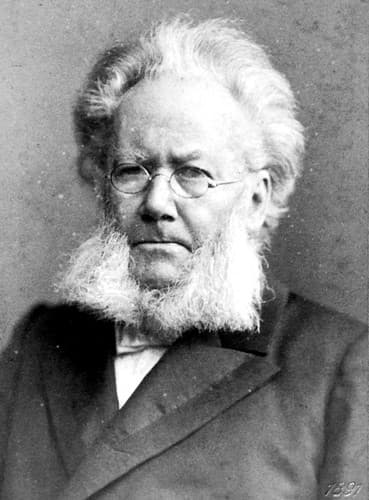
Henrik Johan Ibsen was a Norwegian playwright and theatre director. As one of the founders of modernism in theatre, Ibsen is often referred to as "the father of realism" and one of the most influential playwrights of his time. His major works include Brand, Peer Gynt, An Enemy of the People, Emperor and Galilean, A Doll's House, Hedda Gabler, Ghosts, The Wild Duck, When We Dead Awaken, Rosmersholm, and The Master Builder. Ibsen is the most frequently performed dramatist in the world after Shakespeare, and A Doll's House was the world's most performed play in 2006.
Similar books
- Death of a Salesman
Arthur Miller
3.5 (186k) average on GoodreadsFictionExplores the disillusionment of an individual against societal pressures and false promises.
- 1984
George Orwell
4.2 (3.1M) average on GoodreadsPoliticsFeatures a protagonist who challenges an oppressive system and faces severe consequences.
- The Crucible
Arthur Miller
3.6 (323k) average on GoodreadsHistorical FictionDepicts a community succumbing to mass hysteria and the persecution of an innocent individual.
- Animal Farm
George Orwell
4.0 (2.7M) average on GoodreadsPoliticsA farm animals' rebellion against humans turns into a pig-led dictatorship, showing how power corrupts and revolutionary ideals are betrayed.
- Freakonomics: A Rogue Economist Explores the Hidden Side of Everything
Steven D. Levitt
4.0 (709k) average on GoodreadsBusinessThis book uses economic principles to reveal the surprising incentives behind everything from drug dealing and real estate to cheating teachers and the decline of crime.
- I Am Malala: The Story of the Girl Who Stood Up for Education and Was Shot by the Taliban
Malala Yousafzai
4.1 (419k) average on GoodreadsPoliticsA teenage girl from a Taliban-controlled valley refuses to give up her books, becoming a global voice for education even after an assassination attempt.






Enjoyed the summary?
A summary gives you the shape of the book. The book itself has the detail, the examples and the voice.
Find An Enemy of the People on AmazonAs an Amazon Associate, BookBrief earns from qualifying purchases. How we're funded