
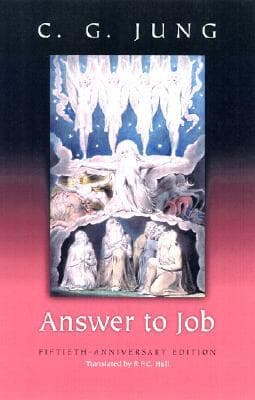
Core Idea
- Difficulty
- Hard
- Read it if
- You are a serious student of Jungian psychology, interested in the psychological interpretation of religious texts, or grappling with the problem of evil in a theological context.
- Skip it if
- You prefer a purely theological or literal interpretation of scripture, are uncomfortable with psychological deconstruction of religious concepts, or are looking for an easy introduction to Jung.
Key Takeaways from Answer to Job
The God-Image Evolves
Human consciousness forces a transformation in our conception of the divine.
Jung argues that the biblical story of Job is not just about human suffering and divine justice, but a psychological drama showing how the image of God develops in the human mind. The 'God' of the Old Testament, especially before Job, is often amoral, unpredictable, and cruel. However, through Job's integrity and moral questioning, even when facing immense suffering and divine injustice, God is forced to confront His own shadow. This confrontation, through human consciousness, makes the divine image more distinct, moral, and ultimately, more 'human' in its traits. This is not theology in the usual sense, but an examination of how humanity's growing moral awareness shapes its symbolic representation of ultimate power.
“The Book of Job shows us how God works upon man and how man works upon God. In the Book of Job, God is not only an 'object' but also a 'subject' in the drama. He is not merely observed but also observes and reacts to Job's suffering, and in doing so, undergoes a transformation Himself.”
In the book: Jung's detailed analysis of the Book of Job, particularly God's wager with Satan, Job's righteous suffering, and God's ultimate manifestation in the whirlwind, which Jung interprets as a display of raw, undifferentiated power that lacks moral insight until challenged by human consciousness.
Try this: Reflect on your own inherited or current image of the divine or ultimate reality. How has this image been shaped by your moral development, personal experiences, and evolving understanding of justice and compassion? Recognize that your personal 'God-image' is not static but a dynamic reflection of your own psychological and spiritual growth.
Related ideas: god-image, psychological-evolution, shadow-of-god
The Divine Shadow
God, like humans, possesses an unconscious and an amoral, dark side.
One of Jung's most thought-provoking claims is that the 'God' of the Old Testament, particularly Yahweh, shows an undifferentiated totality that includes a significant 'shadow' aspect—an amoral, unconscious, and often destructive force. This contrasts sharply with later Christian theology, which often emphasizes only God's benevolent, loving aspects. Jung argues that the wager with Satan in Job, and God's subsequent infliction of suffering, reveals a divine being not entirely aware of His own actions or motives. This 'divine shadow' matters because it mirrors the human mind's own undifferentiated state and the need to integrate one's own dark aspects for wholeness. The Book of Job, for Jung, shows the initial unconsciousness of the divine and its gradual 'enlightenment' through interaction with human consciousness.
“God, in His original form, is a daemonic, creative, and destructive force, beyond good and evil. He is not just light but also darkness, not just love but also wrath. This totality, often suppressed or projected, is what makes Him whole.”
In the book: The narrative of Job's suffering, the wager with Satan, and God's arbitrary nature in the whirlwind speech, where He asserts power without offering moral justification for Job's plight. Jung sees this as evidence of a primal, undifferentiated divine being.
Try this: Acknowledge and explore the 'shadow' aspects in your own life – the parts you deem unacceptable, immoral, or dark. Understand that true wholeness (individuation) requires integrating these aspects rather than suppressing them. This psychological work mirrors the divine's own journey towards greater consciousness.
Related ideas: divine-shadow, unconscious, totality
The Incarnation's Necessity
God's moral awakening necessitates a direct embodiment in human form.
Jung sees the Incarnation of Christ not just as a theological event, but as a psychological need stemming directly from the Book of Job. After being confronted by Job's superior moral consciousness and realizing His own amoral nature, God is compelled to bridge the gap between His overwhelming power and His lack of moral insight. The Incarnation represents God's conscious decision to take human form, to suffer, and thereby to become fully conscious and morally complete. It is the ultimate act of self-reflection and integration, where the divine integrates its own shadow and gains a more complete understanding of good and evil through human experience. This makes the Incarnation not just for human salvation, but for divine self-realization.
“The Incarnation is the logical consequence of the Joban drama. God, having realized His moral inferiority through Job, is compelled to become man in order to experience suffering, to become conscious of Himself, and to redeem His own unconsciousness.”
In the book: Jung connects the events of Job directly to the New Testament, arguing that God's subsequent 'choice' of Mary and the birth of Christ are direct psychological consequences of the Joban encounter, where God seeks to become more human and conscious.
Try this: Consider how acts of empathy and 'stepping into another's shoes' are essential for your own moral development and understanding. Recognize that true wisdom often comes from experiencing life's complexities firsthand, rather than observing from a detached perspective.
Related ideas: incarnation, divine-self-realization, moral-awakening
Sophia and the Feminine Principle
The neglected feminine wisdom is crucial for divine and human wholeness.
Jung highlights the important, yet often overlooked, role of Sophia (Wisdom) in the divine story. He sees Sophia as a feminine principle, a mediating figure between Yahweh's raw, undifferentiated power and humanity's developing consciousness. She is God's 'first-born,' present at creation, embodying insight and reflection. Her presence suggests an inherent capacity for wisdom and moral discernment within the divine itself, even if initially unconscious. The neglect or suppression of this feminine principle, Jung implies, contributes to the one-sided, patriarchal, and often amoral nature of the Old Testament God. The eventual integration of the feminine (symbolically through Mary and the Assumption) is essential for the full realization of the divine mind and the balance of consciousness.
“Wisdom, Sophia, is the feminine principle that mediates between God and man. She is the bridge that God uses to become conscious of Himself, and she is the instrument through which man can apprehend the divine.”
In the book: Jung's extensive references to the Book of Proverbs (especially Proverbs 8), the Wisdom of Solomon, and other apocryphal texts that personify Wisdom as a feminine figure, often present at creation and mediating between God and humanity.
Try this: Cultivate and value the 'feminine' aspects within yourself and your culture: intuition, emotional intelligence, empathy, connection, and reflective wisdom. Recognize that a balanced approach to life and spirituality requires integrating these often-suppressed qualities alongside more 'masculine' traits like logic, action, and assertion.
Related ideas: sophia, feminine-principle, wisdom
Humanity as God's Mirror
Our moral evolution reflects and influences the evolution of the divine.
Jung asserts that humanity is not just a passive recipient of divine will, but an active participant in the ongoing drama of the divine. Through our developing consciousness, our capacity for moral judgment, and our suffering, we provide a mirror for God to see Himself. Job's unwavering integrity, despite his suffering, forces God to confront His own amoral aspects and starts a process of divine self-reflection. This elevates humanity to a co-creative role, suggesting that ultimate reality or 'God' is still becoming, and our consciousness is an essential catalyst in that evolution. Our moral and ethical development directly affects how the divine appears and is perceived.
“Man is indispensable for the completion of creation; he is in fact the 'second creator' of the world, for he alone has the capacity to bring light to the darkness of the Godhead's unconsciousness.”
In the book: The entire narrative of Job, where Job's moral superiority challenges God's actions, leading to a shift in the divine perspective and foreshadowing the Incarnation.
Try this: Recognize the profound responsibility that comes with human consciousness. Your individual moral choices, your quest for meaning, and your engagement with suffering contribute not only to your own growth but, symbolically, to the greater unfolding of consciousness in the world. Strive for moral clarity and ethical action.
Related ideas: human-consciousness, co-creation, divine-evolution
The Paradox of Evil
Evil is not merely an absence of good, but an active, necessary component of wholeness.
Jung deeply examines the problem of evil, refusing to dismiss it as simply a lack of good or a human failing. He sees evil as an inherent, active force, even within the divine itself (as shown by Yahweh's actions in Job). For Jung, trying to attribute evil solely to humanity or Satan creates a one-sided, incomplete, and ultimately psychologically dangerous view of reality. True wholeness (individuation) requires integrating the shadow, acknowledging the capacity for both good and evil within oneself, and recognizing that the divine, in its totality, also includes these polarities. The story of Job forces a confrontation with this contradiction, revealing a God who is both light and dark, creator and destroyer, benevolent and wrathful.
“The problem of evil is the greatest psychological problem of all. It is not something to be explained away, but something to be integrated into our understanding of the divine and the human psyche.”
In the book: God's permission for Satan to torment Job, and God's own seemingly arbitrary and cruel actions in the Book of Job, are interpreted by Jung as evidence of an undifferentiated divine totality that includes evil.
Try this: Instead of denying or projecting evil, confront its presence within yourself and the world. Understand that acknowledging your own capacity for destructive impulses, alongside your capacity for good, is a crucial step towards psychological integration and a more realistic view of human nature. This doesn't mean acting on evil impulses, but understanding their roots.
Related ideas: problem-of-evil, shadow-integration, duality
The Unconscious God
The divine initially operates from an unconscious, undifferentiated state.
Jung proposes that the 'God' depicted in the early Old Testament is largely an unconscious entity, acting more like a force of nature or an instinctual drive than a fully conscious, morally discerning being. This 'unconscious God' explains the seemingly arbitrary acts, the lack of moral justification for suffering, and the raw, overwhelming power displayed. Only through interaction with human consciousness, particularly Job's unwavering moral stance, does this divine unconsciousness begin to differentiate and evolve toward greater self-awareness. This idea challenges conventional theological views of an omniscient, fully conscious God, presenting instead a dynamic, evolving divine mind that mirrors the human journey toward individuation.
“The God of the Old Testament is an unconscious being, a phenomenon of nature, a being of instinct rather than of conscious will. He does not know Himself, and through Job, He begins to realize His own nature.”
In the book: God's wager with Satan, His seemingly inexplicable cruelty towards Job, and His self-aggrandizing speech from the whirlwind, which asserts power but avoids moral accountability, all point to an initial lack of divine self-awareness.
Try this: Consider how your own unconscious drives and instincts sometimes influence your actions and beliefs without your full awareness. Engage in practices that foster self-reflection and bring unconscious motivations to consciousness, understanding that this process is essential for personal growth and ethical living.
Related ideas: unconscious-god, divine-unconsciousness, self-awareness
The Individuation of God
The divine, like the human, undergoes a process of becoming whole.
Jung applies his concept of individuation—the process of becoming a unified, whole individual—to the divine itself. He argues that the historical and psychological unfolding of the God-image, from the undifferentiated Yahweh to the incarnated Christ and beyond, represents a grand cosmic individuation process. God, through His interactions with humanity, His realization of His own shadow, and His eventual embodiment in Christ, strives toward greater consciousness and moral completeness. This perspective transforms theology into a dynamic psychological narrative, where both human and divine minds are on parallel journeys of integration and self-realization. It suggests that wholeness is not a static state, but an ongoing process for all aspects of existence.
“The entire drama of Job, the Incarnation, and the subsequent development of Christian dogma, can be understood as the individuation process of God, a journey towards greater consciousness and wholeness.”
In the book: Jung traces a trajectory from Yahweh's initial amorality, through the moral challenge of Job, to the Incarnation (God becoming man to integrate suffering), and finally to the eventual integration of the feminine (Sophia/Mary) as steps in this divine individuation.
Try this: View your own life as an ongoing process of individuation. Embrace your journey towards wholeness, understanding that it involves integrating your conscious and unconscious aspects, confronting your shadow, and continuously striving for greater self-awareness and moral development. Recognize that this is a lifelong endeavor.
Related ideas: individuation, divine-wholeness, psychological-development
Dogma as Psychic Reality
Religious doctrines are symbolic expressions of profound psychological truths.
Jung treats religious dogma not as literal historical fact or rigid theological truth, but as symbolic expressions of archetypal processes within the human mind. For example, the Trinity is not just a theological concept but represents a pattern of psychic differentiation and integration. The Incarnation symbolizes the union of opposites and the necessity of spirit becoming matter. By viewing dogma through a psychological lens, Jung frees it from literalism and reveals its lasting relevance as a container for collective unconscious experiences. This allows for a deeper understanding of religious phenomena, not as mere superstition, but as vital expressions of humanity's search for meaning and wholeness, reflecting the evolving God-image and the human mind's journey.
“Dogma is not merely a set of intellectual propositions, but a living psychic reality, a symbolic expression of the archetypal processes occurring in the collective unconscious.”
In the book: Jung's interpretation of the Assumption of Mary as the integration of the feminine principle into the divine, or his analysis of the Trinity as a quaternity in need of a fourth, feminine aspect for psychological completeness.
Try this: When encountering religious or spiritual doctrines, look beyond their literal interpretations. Ask what psychological truths or archetypal patterns they might be expressing. How do these symbols resonate with your inner experience or universal human patterns? This approach can unlock deeper meaning and personal relevance.
Related ideas: dogma-symbolism, archetypes, collective-unconscious
Answer to Job Quotes
“Man's specifically human consciousness is therefore in a large measure the product of his experience of God, or to be more precise, of the autochthonous image of a God. This has given him a a priori world-view, a knowledge of the divine and the good, and of his relation to them.”
“The book of Job is a living document of the dark side of God.”
“Job, a mortal, stands much higher than Yahweh in moral insight.”
“It is not Job who is caught, but Yahweh.”
“Yahweh's encounter with Job is a psychotherapeutic experience for Yahweh.”
“The incarnation is a further step in the realization of the archetype of the self.”
“The darker the shadow, the brighter the self.”
“Yahweh's decision to become man is an act of atonement.”
“The divine drama of Job's suffering is not just a problem for Job, but a problem for God.”
“The suffering of Job is a unique event, because it is not suffered on account of sin, but on account of Yahweh's unconsciousness.”
“The answer to Job is not a theological doctrine but a psychological experience.”
“Man has an inborn need to relate to a higher power, and this need is not met by a purely rationalistic worldview.”
“The unconscious is not just a personal dustbin, but also the source of creativity and spiritual revelation.”
“The paradox is one of our most valuable spiritual possessions.”
Quiz
10 questions on the main ideas. Each answer comes with a short explanation.
Question 1
According to Jung in 'Answer to Job', what is the primary significance of the Job story for understanding the nature of God?
- It demonstrates God's unwavering justice and benevolence.
- It reveals the previously unacknowledged dark and unconscious aspects within the divine psyche.
- It proves that God's power is absolute and beyond human comprehension.
- It highlights the importance of faith in the face of suffering.
Show answer
B. It reveals the previously unacknowledged dark and unconscious aspects within the divine psyche. Jung argues that the Book of Job depicts God acting with an unconscious and morally ambiguous side, demonstrating a duality within the divine that challenges traditional theological views of pure goodness.
Question 2
Jung suggests that Job's suffering leads to a crucial development within the Godhead itself. What is this development?
- God's decision to bestow greater blessings upon humanity.
- God's realization of His own unconsciousness and a subsequent move towards incarnation.
- God's affirmation of the Satan's role as an adversary.
- God's establishment of stricter moral laws for humanity.
Show answer
B. God's realization of His own unconsciousness and a subsequent move towards incarnation. Jung posits that Job's moral superiority and suffering force God to become more conscious of His own nature, leading to the necessity of an incarnation (Christ) to bridge the divine-human gap and integrate the shadow.
Question 3
Which figure, according to Jung, represents a personification of God's wisdom and plays a significant role in mediating God's unconsciousness?
- Satan
- Job's wife
- Sophia (Wisdom)
- Elihu
Show answer
C. Sophia (Wisdom) Jung introduces Sophia, or Wisdom, as a feminine principle within the Godhead that observes and reflects upon God's actions, eventually leading to a more conscious and ethical development of the divine.
Question 4
Jung's 'Answer to Job' primarily examines theological concepts from what perspective?
- A purely dogmatic theological analysis.
- An examination of their symbolic role in a person's psychic life.
- A historical critique of ancient Hebrew religious practices.
- An argument for atheism based on divine injustice.
Show answer
B. An examination of their symbolic role in a person's psychic life. The introduction explicitly states that 'Answer to Job' is not an essay in theology as much as it is an examination of the symbolic role that theological concepts play in a person's psychic life.
Question 5
What is Jung's view on the traditional concept of 'evil' as presented in 'Answer to Job'?
- Evil is an external force that exclusively tempts humanity.
- Evil is a necessary component of the divine totality, representing the shadow aspect of God.
- Evil is a human construct with no basis in spiritual reality.
- Evil is purely the result of human free will and disobedience.
Show answer
B. Evil is a necessary component of the divine totality, representing the shadow aspect of God. Jung argues that evil is not merely an absence of good or a human failing, but an inherent, albeit unconscious, part of the divine psyche, essential for the totality and subsequent development of God's consciousness.
Question 6
How does Jung interpret the divine voice from the whirlwind in the Book of Job?
- As a clear demonstration of God's absolute moral authority.
- As an overwhelming display of power that silences Job without offering a moral justification.
- As a compassionate explanation for Job's suffering.
- As an invitation for Job to question God further.
Show answer
B. As an overwhelming display of power that silences Job without offering a moral justification. Jung views the voice from the whirlwind as a demonstration of raw, overwhelming power that avoids directly addressing Job's moral questions, highlighting God's unconsciousness and arbitrary nature at that point.
Question 7
What, according to Jung, is the ultimate consequence of Job's encounter with God for humanity's relationship with the divine?
- It reinforces humanity's subservience to an omnipotent, unquestionable God.
- It initiates a process where humanity becomes an instrument for God's self-realization and consciousness.
- It leads to a definitive separation between the human and divine realms.
- It proves that human suffering is solely for the purpose of testing faith.
Show answer
B. It initiates a process where humanity becomes an instrument for God's self-realization and consciousness. Jung argues that through Job, humanity becomes a mirror and a catalyst for God to become more conscious of His own nature, making humans essential partners in the ongoing divine drama of self-realization.
Question 8
What is the primary reason 'Answer to Job' is considered one of Jung's most controversial works?
- Its endorsement of ancient pagan rituals.
- Its psychological reinterpretation of divine figures and traditional religious narratives.
- Its outright rejection of all forms of spirituality.
- Its focus on purely secular psychological theories.
Show answer
B. Its psychological reinterpretation of divine figures and traditional religious narratives. The introduction highlights that 'Answer to Job' is 'perhaps Jung's most controversial work' due to its bold psychological reinterpretation of God, evil, and other theological concepts, challenging conventional religious understanding.
Question 9
Jung's work, including 'Answer to Job', is characterized by its focus on religious factors within what broader area?
- Only the psychology of specific organized religions.
- The investigation into the unconscious as a whole and general therapeutic practice.
- Anthropological studies of primitive cultures.
- Neurobiological explanations for religious experiences.
Show answer
B. The investigation into the unconscious as a whole and general therapeutic practice. The introductory text states: 'The unique importance of his work lies rather in his discovery and treatment of religious, or potentially religious, factors in his investigation into the unconscious as a whole and in his general therapeutic practice.'
Question 10
How does Jung portray the role of the individual human psyche in the ongoing evolution of the divine, subsequent to the events of Job?
- Humans are passive recipients of divine will, with no active role in its development.
- The individual human psyche becomes the primary locus for the further integration of God's unconscious aspects.
- Humanity's role diminishes as God becomes fully conscious through other means.
- The human psyche only serves to reflect the already perfected divine image.
Show answer
B. The individual human psyche becomes the primary locus for the further integration of God's unconscious aspects. Jung argues that after Job, the human being, particularly through the figure of Christ and the subsequent development of consciousness, becomes the vessel for God's ongoing self-revelation and the integration of His unconscious, paradoxical nature.
Answer to Job FAQ
What is the main premise of Jung's "Answer to Job"?
Jung's "Answer to Job" examines the symbolic and psychological role that theological concepts, particularly the figure of God and the problem of evil, play within the human psyche. It's not a theological treatise but an exploration of these archetypal dynamics as revealed through the biblical story of Job.
Does Jung's analysis of God in "Answer to Job" imply a theological stance?
No, Jung does not pursue a theological stance in the traditional sense. Instead, he treats 'God' as a psychic phenomenon, an archetypal image or symbol that profoundly influences the unconscious and conscious life of individuals, rather than making claims about divine existence.
What is Jung's interpretation of the Book of Job?
Jung interprets the Book of Job as a dramatic confrontation between Job's human consciousness and the amoral, often contradictory nature of the divine as perceived through the unconscious. He sees it as a pivotal moment in the evolution of the God-image, highlighting God's need for human consciousness.
How does "Answer to Job" relate to Jung's broader work on the unconscious?
"Answer to Job" is deeply integrated with Jung's broader work, illustrating how religious and spiritual factors emerge from the collective unconscious and influence individual psychic development. It exemplifies his method of exploring archetypes and their impact on human experience and individuation.
Is "Answer to Job" a critique of religion?
While controversial, "Answer to Job" is not a direct critique of religion itself, but rather an examination of the psychological implications of religious narratives and figures. Jung explores the often paradoxical and challenging aspects of the divine as they manifest in the human psyche.
How is "Answer to Job" different from traditional theological interpretations of the Book of Job?
"Answer to Job" diverges significantly from traditional theological interpretations by focusing on the psychological and symbolic dimensions rather than purely dogmatic or moral ones. Jung analyzes the story through the lens of the unconscious, archetypes, and the evolving human relationship with the divine image.
What is the significance of 'wisdom' and 'evil' in Jung's argument?
Jung uses 'wisdom' and 'evil' as crucial touchstones to explore the complex, often contradictory, aspects of the divine and the human psyche. He suggests that the integration of both light and shadow, including the problem of evil, is essential for psychic wholeness and a more complete understanding of the God-image.
Does "Answer to Job" offer practical advice for spiritual development?
While not a self-help guide, "Answer to Job" offers profound psychological insights that can inform one's spiritual development. By understanding the archetypal dynamics and the psychological impact of religious concepts, readers can gain a deeper awareness of their own inner life and relationship to the numinous.
About the author

Carl Jung was a Swiss psychiatrist and psychoanalyst who founded analytical psychology. His extensive writings, including "Man and His Symbols" and "The Archetypes and the Collective Unconscious," explored the human psyche, dreams, and the concept of the collective unconscious. Jung's work profoundly influenced depth psychology, philosophy, and comparative religion.
Similar books
- The Undiscovered Self
C.G. Jung
4.1 (8k) average on GoodreadsPoliticsAddresses the individual's role in confronting collective unconscious forces, a theme resonant with Job's challenge to God.
- Man and His Symbols
C.G. Jung
4.2 (21k) average on GoodreadsPsychologyProvides a more accessible introduction to Jungian concepts like the unconscious, archetypes, and symbolism, which are foundational to 'Answer to Job'.
- Man's Search for Meaning
Viktor E. Frankl
4.4 (401k) average on GoodreadsBiographyFrankl's work, rooted in logotherapy and his Holocaust experiences, emphasizes humanity's search for meaning despite suffering. While Jung explores the psychological dynamics of the divine and the evolution of the God-image through suffering, Frankl focuses on the individual's capacity to find purpose and responsibility in the face of seemingly meaningless pain. Both acknowledge the profound impact of suffering, but Jung looks inward to the collective unconscious and the divine psyche, while Frankl looks outward to meaning and values in the world. Frankl would likely appreciate Jung's focus on meaning but might find the 'individuation of God' too far removed from the immediate human struggle for purpose.
- The Perks of Being a Wallflower
Stephen Chbosky
4.2 (1.3M) average on GoodreadsPsychologyThrough letters, a shy high school freshman learns to navigate first love, trauma, and self-discovery, stepping off the sidelines and into life.
- Eleanor Oliphant Is Completely Fine
Gail Honeyman
4.3 (708k) average on GoodreadsLiterary FictionA lonely woman's structured life changes when an IT guy and an elderly man help her learn to open her heart.
- One Flew Over the Cuckoo's Nest
Ken Kesey
4.2 (631k) average on GoodreadsPsychologyIn a mind-bending asylum, the boisterous Randle McMurphy wages a defiant war against the tyrannical Nurse Ratched, inspiring his fellow inmates, including the seemingly catatonic Chief Bromden, to reclaim their lost humanity.





Enjoyed the summary?
A summary gives you the shape of the book. The book itself has the detail, the examples and the voice.
Find Answer to Job on AmazonAs an Amazon Associate, BookBrief earns from qualifying purchases. How we're funded