
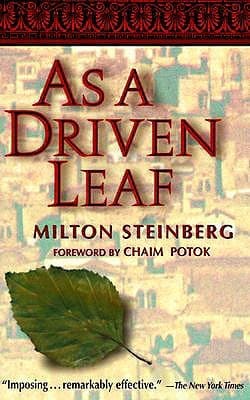
Synopsis
Covers the whole plot, including the ending.
- Difficulty
- Medium
- Pacing
- Moderate
- Mood
- Thought-provoking, Philosophical, Reflective, Intense
- Read it if
- You enjoy intellectual historical fiction that delves into profound philosophical and spiritual questions, particularly the tension between faith and reason, set in ancient times.
- Skip it if
- You prefer fast-paced action or a straightforward narrative without extensive philosophical discourse.
As a Driven Leaf Plot Summary
Covers the whole plot, including the ending.
The Young Elisha and the Call of Reason
The novel introduces Elisha ben Abuyah, a brilliant and devout young student in Tiberias, already recognized for his exceptional intellect and piety. He studies under Rabbi Joshua ben Hananiah and Rabbi Akiba, two of the greatest sages of his time. Elisha, however, finds himself restless within the confines of traditional Jewish law and interpretation. He is drawn to the logic and beauty of Greek philosophy, which he secretly studies. This intellectual curiosity, initially a supplement to his Torah studies, begins to challenge the foundations of his faith. He questions the anthropomorphic descriptions of God, the literal interpretation of miracles, and the perceived irrationality of certain mitzvot (commandments), setting him apart from his peers.
Early Doubts and the Sanhedrin
Elisha's reputation as a scholar grows, and he is appointed to the Sanhedrin, the supreme Jewish judicial and legislative body. Here, he engages in debates with other sages, often subtly introducing Hellenistic philosophical concepts or questioning traditional interpretations from a rationalist perspective. While his brilliance is undeniable, his colleagues, particularly Rabbi Akiba, sense a growing divergence in his thinking. Elisha struggles, torn between his deep love for his people and their traditions, and his quest for logical truth. He tries to reconcile these two worlds, believing that reason can enhance, rather than undermine, faith, but finds the gap widening.
The Persecutions and Elisha's Disillusionment
The political climate in Roman Palestine deteriorates, leading to harsh persecutions of the Jews under Emperor Hadrian. The Romans forbid the study of Torah, observance of the Sabbath, and performance of circumcisions, leading to widespread suffering and martyrdom. These events, culminating in the disastrous Bar Kochba Revolt, impact Elisha. He witnesses the brutal suppression of his people and the deaths of many righteous individuals, including Rabbi Akiba. For Elisha, this suffering, seemingly unredeemed by divine intervention, further fuels his doubts about God's justice and providence, pushing him closer to a complete rejection of traditional faith.
Embracing Hellenism and the Break with Tradition
Unable to reconcile the suffering of his people with the God of traditional Judaism, Elisha makes a decisive break. He openly embraces Hellenistic culture, shedding his rabbinic garb and adopting the lifestyle of a Greek philosopher. He frequents gymnasiums, engages in philosophical discussions with Gentiles, and reads forbidden texts. His former colleagues are shocked and saddened by his apostasy. He is no longer referred to as 'Rabbi Elisha' but as 'Acher,' meaning 'the Other,' a symbol of his alienation. He believes he has found intellectual freedom and truth outside the confines of Jewish law, but also experiences loneliness and loss.
Elisha's Philosophical Journey and Ethical Dilemmas
As Acher, Elisha explores various Greek philosophical schools, including Stoicism and Epicureanism. He seeks a universal ethical framework based purely on reason, independent of divine command. However, he finds that these philosophies, while intellectually stimulating, often lack the moral imperative and communal solidarity he had known in Judaism. He grapples with the implications of a world without a transcendent God, where moral values might be relative or purely human constructs. This intellectual journey, while liberating in some respects, also leaves him with a sense of moral ambiguity and a longing for absolute truth that seems perpetually out of reach.
Encounter with the Roman Governor and Political Involvement
Elisha's reputation as a philosopher reaches the Roman authorities. He is consulted by the Roman governor, Tinneius Rufus, who seeks his counsel on various matters, including the nature of Jewish resistance. This collaboration further alienates him from his former community, who view him as a traitor. Elisha, however, sees it as an opportunity to influence policy and perhaps alleviate some suffering, even as he knows he is walking a dangerous line. He finds himself caught between the world of his ancestors and the powerful, alluring world of Roman-Hellenistic culture, unable to fully belong to either.
The Student and the Master: Rabbi Meir's Loyalty
Despite Elisha's apostasy, his most brilliant student, Rabbi Meir, remains devoted to him. Rabbi Meir continues to seek out Elisha, engaging him in philosophical and halakhic discussions, hoping to draw him back to Judaism. He believes that Elisha's knowledge of Torah, even if currently rejected, still holds the key to his redemption. These encounters are poignant, showing the deep bond between teacher and student, and Rabbi Meir's unwavering loyalty and love. Elisha, though touched by Meir's persistence, remains steadfast in his new path, yet the dialogues stir old memories and internal conflicts.
The Lingering Shadow of Faith
Despite his outward rejection of Judaism, Elisha finds that the traditions and teachings of his youth are deeply ingrained. He often quotes Torah verses and rabbinic sayings in his philosophical arguments, sometimes unconsciously. Moments of doubt about his chosen path arise, particularly when he witnesses the unwavering faith and resilience of the Jewish people, even under persecution. He recognizes the ethical framework and communal strength that Judaism provides, something he struggles to find in the detached intellectualism of Hellenism. This internal struggle reveals that his apostasy is not a simple abandonment, but a complex, agonizing search for truth.
The Confrontation with Rabbi Judah ben Baba
In a powerful scene, Rabbi Judah ben Baba, one of the last surviving sages of the old generation, confronts Elisha, now Acher, about his choices. Rabbi Judah, a symbol of unwavering tradition and martyrdom, expresses his sorrow and condemnation. He reminds Elisha of his sacred past and the suffering he has brought upon his people. This encounter is a stark reminder of the social and spiritual cost of Elisha's rebellion, and the pain it has caused his community. Elisha, though outwardly defiant, is visibly shaken by the encounter, confronting the judgment of his former world.
The Final Years and Reflection
As Elisha ages, he becomes increasingly isolated. The intellectual freedom he sought does not bring him the ultimate peace or truth he craved. He reflects on his life, his choices, and the paths not taken. While he never formally repents or returns to Judaism, there are hints that his intellectual quest, while leading him away from tradition, also deepened his understanding of the human condition and the complexities of faith. His death is marked by ambiguity, a sign of the unresolved tension between his reason and the spiritual heritage he abandoned, leaving his ultimate fate in the hands of divine mercy and rabbinic lore.
As a Driven Leaf Characters
Elisha ben Abuyah (Acher)
Protagonist
A brilliant Talmudic sage who abandons traditional Judaism for Hellenistic philosophy.
Elisha is an exceptionally gifted scholar, renowned for his intellect and piety from a young age. He possesses an insatiable curiosity and a profound need for logical consistency, which drives him to question the anthropocentric nature of Jewish law and the literal interpretations of scripture. His journey is one of intellectual honesty, a relentless pursuit of truth that ultimately leads him to reject the faith of his ancestors in favor of Greek philosophy. He is torn between his love for his people and his commitment to reason, experiencing profound internal conflict and loneliness.
Relationships: Rabbi Akiba (Teacher and mentor, later a figure of traditional authority Elisha rejects.); Rabbi Joshua ben Hananiah (Teacher who initially fostered Elisha's intellectual curiosity.); Rabbi Meir (Devoted student who attempts to reconcile Elisha with Judaism.); Tinneius Rufus (Roman governor who consults Elisha, highlighting his integration into Roman society.)
Rabbi Akiba
Supporting
A revered and steadfast Talmudic sage, Elisha's primary teacher and a symbol of unwavering faith.
Rabbi Akiba is depicted as one of the greatest sages of his era, a paragon of piety, wisdom, and unwavering faith. He represents the traditional, mystical, and resilient spirit of Rabbinic Judaism. Despite his profound love for Elisha, he senses the dangerous trajectory of his student's intellectual explorations. He becomes a symbol of martyrdom and the enduring strength of Torah in the face of Roman persecution. His teachings and ultimate sacrifice serve as a powerful counterpoint to Elisha's intellectual doubts, embodying the steadfastness Elisha ultimately lacks.
Relationships: Elisha ben Abuyah (Teacher and mentor to Elisha, later a figure of profound disappointment.); Rabbi Joshua ben Hananiah (Colleague and fellow sage.)
Rabbi Meir
Supporting
Elisha's most devoted student, who persistently tries to bring his master back to Judaism.
Rabbi Meir is a brilliant and loyal student of Elisha, whose intellectual prowess is almost on par with his teacher's. Despite Elisha's apostasy, Meir's devotion never wavers. He sees the inherent goodness and profound knowledge within Elisha and believes in his potential for repentance. He embodies the principle of honoring one's teacher, even when the teacher errs, and represents the hope for reconciliation between tradition and intellectual pursuit. His persistent dialogues with Elisha are central to exploring the depth of Elisha's internal conflict and the enduring power of human connection.
Relationships: Elisha ben Abuyah (Devoted student, later attempting to redeem his former master.)
Rabbi Joshua ben Hananiah
Supporting
An older, wise sage who initially encourages Elisha's intellectual curiosity but later warns of its dangers.
Rabbi Joshua is an elder statesman of the Sanhedrin, known for his wisdom, pragmatism, and ability to navigate complex issues. He is initially open to intellectual inquiry and even encourages Elisha's early philosophical leanings, seeing the potential for a richer understanding of Torah. However, he becomes increasingly concerned as Elisha's pursuit of reason leads him away from the core tenets of faith. He represents a more moderate rabbinic voice, one that values both intellect and tradition but understands the boundaries that must be maintained for the sake of communal integrity.
Relationships: Elisha ben Abuyah (Early teacher and mentor, who later laments Elisha's apostasy.)
Tinneius Rufus
Mentioned
The Roman governor of Judea, representing the oppressive Roman authority and the allure of power.
Tinneius Rufus is the historical Roman governor responsible for much of the persecution of the Jews during Hadrian's reign. In the novel, he embodies the cruel, unyielding power of the Roman Empire and the Hellenistic culture it imposed. He represents the external force that both oppresses the Jewish people and offers Elisha an alternative intellectual and social environment. Elisha's interaction with him highlights the protagonist's precarious position between two worlds and his attempt to find influence and perhaps alleviate suffering through collaboration.
Relationships: Elisha ben Abuyah (A Roman authority figure who consults Elisha, acknowledging his philosophical stature.)
Rabbi Judah ben Baba
Supporting
An aged sage and martyr, who represents the unyielding spirit of Jewish tradition and suffering.
Rabbi Judah ben Baba appears as a symbol of the old guard of sages, steadfast in his faith and willing to suffer martyrdom for the sake of Torah. His confrontation with Elisha (Acher) is a powerful moment, representing the direct judgment of the traditional Jewish world upon Elisha's apostasy. He embodies the spiritual and moral authority that Elisha has abandoned, and his presence underscores the profound cost of Elisha's intellectual journey, both for himself and for his community.
Relationships: Elisha ben Abuyah (Former colleague who confronts Elisha about his apostasy.)
As a Driven Leaf Themes
Faith vs. Reason
This is the central conflict of the novel, explored through Elisha's agonizing journey. He initially believes reason can enhance faith, but his relentless pursuit of logical truth ultimately leads him to reject traditional Jewish beliefs, which he perceives as irrational or anthropomorphic. The novel shows how the pursuit of pure reason can lead to a loss of spiritual meaning and communal belonging. Elisha's struggle highlights the tension between intellectual integrity and the comfort and conviction of inherited belief, a tension that remains unresolved for him. For example, his questioning of God's justice during the Roman persecutions directly pits his rational observations against the tenets of divine providence.
“There are two roads, Elisha, two roads and no more. Either a man bows to the Torah and the Sages and accepts, or he sets out on his own and questions and doubts and searches. There is no middle way.”
The Allure and Peril of Assimilation
The novel portrays the seductive power of Hellenistic culture and the dangers it poses to Jewish identity. Elisha is drawn to Greek philosophy, art, and lifestyle, seeing in it a universal truth and beauty that transcends the particularism of Judaism. His embrace of Hellenism is not merely intellectual; it leads to a complete severance from his people and their traditions, marking him as 'Acher.' This theme is poignant in the context of Roman rule, where assimilation offers a path to social acceptance and intellectual freedom, but at the cost of spiritual and communal alienation. Elisha's interactions with Roman officials and his adoption of Greek customs exemplify this.
“I have chosen to walk in the light of reason, not in the shadows of ancient tales.”
The Nature of Truth
Elisha's entire quest is a search for truth, but the novel presents different forms of truth. For Elisha, truth is primarily logical, demonstrable, and universal, found in philosophical inquiry. For the rabbis, truth is revealed, transcendent, and found in Torah and tradition, often requiring faith beyond pure reason. The novel explores whether truth can be singular or multifaceted, and whether a purely rational truth can provide meaning and moral guidance. Elisha's ultimate dissatisfaction, despite his intellectual freedom, suggests that a purely intellectual truth may be insufficient for the human spirit, especially when divorced from community and shared heritage.
“Is truth only in what the eye sees and the mind proves? Or is there a truth that the heart knows, though the mind may stumble?”
Suffering and Divine Justice
The brutal Roman persecutions and the devastating Bar Kochba Revolt are a crucible for Elisha's faith. He struggles to reconcile the immense suffering of his righteous people, including the martyrdom of Rabbi Akiba, with the concept of a just and benevolent God. This problem of evil is a major catalyst for his apostasy. The novel explores how individual and collective suffering can challenge deeply held religious beliefs, especially when divine intervention seems absent. Elisha's inability to find a rational explanation for the suffering ultimately drives him away from a God who permits such injustice.
“Where was God when His children were butchered? Where was His justice when the righteous were consumed by fire?”
Plot Devices & Literary Techniques
The 'Acher' Epithet
A symbolic renaming that signifies Elisha's complete alienation from his community.
The transformation of 'Rabbi Elisha' into 'Acher' (meaning 'the Other' or 'another one') is a powerful symbolic device. It represents not only his excommunication from the rabbinic community but also his profound spiritual and intellectual alienation. This epithet marks him as an outsider, highlighting the irreversible nature of his choices and the deep sorrow and judgment of his former colleagues. It underscores the theme of assimilation's cost and the communal identity lost when one deviates from tradition, becoming a label of both condemnation and poignant separation.
Philosophical Dialogues
Extended discussions between characters that serve to expound and debate the novel's central themes.
The novel heavily utilizes philosophical dialogues, particularly between Elisha and his teachers (Rabbi Akiba, Rabbi Joshua) and later with his student (Rabbi Meir). These dialogues are not merely conversations but structured debates where the characters articulate and challenge different perspectives on faith, reason, truth, and morality. They allow Steinberg to explore complex theological and philosophical ideas in depth, showcasing the intellectual rigor of both rabbinic Judaism and Hellenistic thought. These exchanges are crucial for understanding Elisha's internal struggles and the intellectual landscape of the era.
The Bar Kochba Revolt and Roman Persecutions
Historical events that serve as a catalyst for Elisha's disillusionment and a backdrop for communal suffering.
These historical events are not just background but crucial plot devices that directly impact Elisha's character arc. The brutal Roman persecutions and the devastating failure of the Bar Kochba Revolt challenge Elisha's faith in divine justice and providence. Witnessing the suffering and martyrdom of righteous individuals, including his beloved teacher Rabbi Akiba, provides a concrete, visceral reason for his intellectual doubts to solidify into apostasy. These events externalize Elisha's internal struggle, showing how real-world tragedies can shake the foundations of even the most devout faith.
Biblical and Talmudic Allusions
References to Jewish texts and stories that enrich the narrative and highlight Elisha's internal conflict.
The novel is rich with allusions to biblical narratives, Talmudic discussions, and midrashic interpretations. These references serve multiple purposes: they ground the story in its historical and religious context, demonstrate Elisha's profound knowledge of Jewish tradition even as he questions it, and often foreshadow or parallel his own experiences. For instance, the story of the 'four who entered Pardes' (mystical study) is frequently referenced, directly linking Elisha's intellectual journey to a foundational narrative about the dangers of excessive inquiry, ultimately framing his personal tragedy within a larger Jewish mystical tradition.
As a Driven Leaf Quotes
“The mind is its own place, and in itself can make a heaven of hell, a hell of heaven.”
“There are times when a man must choose between his God and his conscience.”
“To be a Jew is to know the ache of eternity.”
“Better to be a human being and a heretic than a stone and a saint.”
“The greatest good is the pursuit of truth, wherever it may lead.”
“Man is a driven leaf, blown by the winds of circumstance and passion.”
“Doubt is not the enemy of faith, but its crucible.”
“The world is full of wonders, but the greatest wonder is man himself.”
“There is no peace for the seeker of truth, only an endless journey.”
“To know God is to know the limits of human knowledge.”
“Love is the only law that transcends all others.”
“The past is never dead; it is not even past.”
“A man's worth is measured not by his beliefs, but by his actions.”
“The greatest tragedy is not to die, but to live without ever truly living.”
Quiz
10 questions on the plot and the characters. Each answer comes with a short explanation.
Question 1
What is the primary internal conflict faced by Elisha ben Abuyah in 'As a Driven Leaf'?
- His desire to become the Nasi (president) of the Sanhedrin versus his humility.
- His struggle to reconcile his Jewish faith and tradition with the allure of Hellenistic culture and philosophy.
- His loyalty to Rome versus his support for Jewish rebellion.
- His personal ambition versus his commitment to his family.
Show answer
B. His struggle to reconcile his Jewish faith and tradition with the allure of Hellenistic culture and philosophy. Elisha's central struggle throughout the novel is his intellectual and spiritual wrestling with the tenets of Rabbinic Judaism and the compelling rationalism and aesthetics of Hellenistic thought.
Question 2
In what historical period and geographical location is 'As a Driven Leaf' primarily set?
- Medieval Spain
- First-century Alexandria
- Roman Palestine during the age of the Talmud
- Babylonian exile
Show answer
C. Roman Palestine during the age of the Talmud The book is explicitly described as being set in Roman Palestine, bringing to life the era of Rabbinic Judaism during the age of the Talmud.
Question 3
What significant Jewish institution is depicted in the novel, where great Talmudic sages engage in theological arguments?
- The Temple in Jerusalem
- The Sanhedrin
- The Great Synagogue
- The Academy of Pumbedita
Show answer
B. The Sanhedrin The novel invites readers to 'watch the great Talmudic sages at work in the Sanhedrin,' where they debate theology and Torah.
Question 4
Which prominent figure is Elisha ben Abuyah's teacher and initially a strong influence on his early studies?
- Rabbi Akiva
- Rabbi Meir
- Rabbi Tarfon
- Rabbi Ishmael
Show answer
A. Rabbi Akiva Rabbi Akiva is Elisha's primary teacher, whose influence is profound early in Elisha's intellectual development, despite their later divergence.
Question 5
What is the 'timeless, perennial feature of the Jewish experience' that the novel transcends its historical setting to depict?
- The struggle for political independence from foreign rule.
- The importance of communal prayer and study.
- The inevitable conflict between the call of tradition and the glamour of the surrounding culture.
- The pursuit of mystical knowledge and Kabbalah.
Show answer
C. The inevitable conflict between the call of tradition and the glamour of the surrounding culture. The foreword explicitly states that the novel 'transcends its historical setting with its depiction of a timeless, perennial feature of the Jewish experience: the inevitable conflict between the call of tradition and the glamour of the surrounding culture.'
Question 6
Elisha's intellectual journey leads him to question core tenets of Judaism. Which specific concept does he increasingly struggle with and eventually reject?
- The importance of charity (tzedakah).
- The concept of divine providence and God's active involvement in the world.
- The validity of oral law (Torah Sheb'al Peh).
- The necessity of observing Shabbat.
Show answer
B. The concept of divine providence and God's active involvement in the world. Elisha's intellectual inquiries, particularly influenced by Greek philosophy, lead him to doubt and ultimately reject the idea of a personal, benevolent God who actively intervenes in human affairs, struggling with the problem of evil and suffering.
Question 7
What is the significance of the title 'As a Driven Leaf'?
- It symbolizes the resilience of the Jewish people against Roman oppression.
- It refers to the fragile nature of ancient scrolls and texts.
- It reflects Elisha's feeling of being buffeted by intellectual currents and lacking a firm grounding in either tradition or philosophy.
- It alludes to the agricultural practices of ancient Palestine.
Show answer
C. It reflects Elisha's feeling of being buffeted by intellectual currents and lacking a firm grounding in either tradition or philosophy. The title metaphorically represents Elisha's intellectual and spiritual wanderings, feeling rootless and driven by various philosophical winds, unable to find a stable intellectual or spiritual home.
Question 8
Which of the following is NOT a consequence of Elisha's intellectual apostasy?
- He is excommunicated from the Jewish community and branded 'Acher' (the Other).
- His students universally abandon him, and he loses all influence.
- He experiences profound loneliness and alienation.
- He forms intellectual relationships with Greek philosophers and Roman officials.
Show answer
B. His students universally abandon him, and he loses all influence. While many students abandon him, his most devoted student, Rabbi Meir, famously continues to learn from him, even after his apostasy, illustrating the complexity of their relationship and Meir's dedication to learning from his teacher.
Question 9
The novel explores the nature of truth. What is Elisha's ultimate realization about the pursuit of absolute, purely rational truth, particularly in contrast to the Rabbinic understanding?
- That absolute truth can only be found through strict adherence to Jewish law.
- That philosophical inquiry is inherently superior to religious faith in discovering truth.
- That the human mind is limited, and a purely rational approach can lead to a barren, unsatisfying existence, devoid of meaning and connection.
- That truth is entirely subjective and relative, with no objective reality.
Show answer
C. That the human mind is limited, and a purely rational approach can lead to a barren, unsatisfying existence, devoid of meaning and connection. Elisha's journey, though driven by a search for rational truth, ultimately leads him to a profound sense of emptiness and isolation, suggesting that a purely intellectual pursuit without spiritual or communal grounding is insufficient for a meaningful life. He finds the 'truth' he sought to be cold and unfulfilling.
Question 10
What is the primary philosophical school within Hellenistic culture that most strongly attracts Elisha and challenges his traditional beliefs?
- Epicureanism, with its focus on pleasure and avoidance of pain.
- Stoicism, with its emphasis on virtue, reason, and living in harmony with the divine order.
- Skepticism, which questions the possibility of certain knowledge.
- Neoplatonism and other forms of rational inquiry that prioritize human reason and question traditional divine intervention.
Show answer
D. Neoplatonism and other forms of rational inquiry that prioritize human reason and question traditional divine intervention. Elisha is drawn to the rational inquiries and philosophical systems of Hellenism, particularly those that prioritize human reason and a more abstract, less interventionist understanding of the divine, which broadly encompasses Neoplatonic influences and other rationalist schools of thought that were prevalent and challenged traditional religious views.
As a Driven Leaf FAQ
What is the central conflict Elisha ben Abuyah faces throughout the novel?
Elisha ben Abuyah grapples with the profound tension between his inherited Rabbinic Jewish tradition and the intellectual, philosophical, and aesthetic appeal of Hellenistic culture. He is torn between the rigorous demands of Torah study and the logical consistency and worldly beauty he perceives in Greek thought, leading him to question fundamental tenets of his faith.
Who are some of the key historical figures Elisha interacts with in the Sanhedrin?
Elisha interacts with many prominent Talmudic sages, including Rabbi Akiva, Rabbi Meir (his most devoted student), and Rabbi Ishmael. These figures represent the established Rabbinic authority and often challenge Elisha's burgeoning heterodox views, creating intellectual and theological debates within the Sanhedrin.
What role does Roman rule play in the backdrop of Elisha's personal struggle?
The oppressive Roman occupation of Palestine provides a constant external pressure on the Jewish community, influencing their daily lives, laws, and even theological discussions. The threat of rebellion and the practicalities of living under foreign dominion often intertwine with the sages' spiritual debates, highlighting the precariousness of their existence and the challenges to maintaining Jewish identity.
How does the novel portray the allure of Hellenism for Elisha?
Hellenism captivates Elisha through its emphasis on reason, logic, philosophy, and the pursuit of knowledge beyond religious dogma. He is drawn to Greek literature, scientific inquiry, and the beauty of its artistic expressions, finding in them a freedom and intellectual satisfaction that he feels is constrained by the strictures of Rabbinic Judaism.
What ultimately leads Elisha to completely abandon his faith and become 'Acher'?
Elisha's eventual abandonment stems from a cumulative series of intellectual disillusionments, unresolved theological questions, and a growing sense of alienation from the Rabbinic world. His inability to reconcile divine justice with suffering, his rejection of anthropomorphic descriptions of God, and his embrace of a purely rational worldview ultimately lead him to forsake his past and be known as 'Acher' (the Other One).
Are there specific philosophical arguments or debates from the Talmud that are subtly referenced or reinterpreted in Elisha's journey?
Yes, many of Elisha's arguments echo actual Talmudic debates, particularly those concerning divine omniscience versus free will, the nature of evil, and the interpretation of mystical texts like the Pardes. Steinberg weaves these historical discussions into Elisha's personal intellectual struggles, giving his internal conflict a deeper historical and theological resonance.
What is the significance of the 'Pardes' (orchard) in Elisha's intellectual and spiritual downfall?
The Pardes represents mystical speculation, a realm of esoteric knowledge that, according to tradition, only a select few could enter safely. Elisha's attempt to 'enter the Pardes' and understand its secrets through pure reason, without the necessary spiritual grounding, is depicted as a pivotal moment where he 'cut down the shoots' – rejecting fundamental tenets and losing his way.
How does the author use the character of Rabbi Meir to highlight Elisha's internal struggle even after his apostasy?
Rabbi Meir, Elisha's devoted student, continues to seek out and learn from Elisha even after he becomes Acher, demonstrating the enduring intellectual respect Elisha commanded. Meir's loyalty and his willingness to glean wisdom from his former teacher, despite Elisha's apostasy, underscore the tragedy of Elisha's choice and the lingering influence of his brilliant mind.
What psychological factors contribute to Elisha's intellectual restlessness and inability to find peace within Rabbinic Judaism?
Elisha possesses an intensely analytical and questioning mind, coupled with a deep-seated need for logical consistency and empirical evidence. His inability to accept paradoxes or mysteries of faith, combined with a profound intellectual pride and perhaps a subtle fear of emotional vulnerability, drives his constant search for absolute truth outside traditional frameworks.
How does Elisha's relationship with his family, particularly his father, shape his personality and later choices?
Elisha's father, a devout but somewhat rigid figure, initially pushes Elisha towards rigorous Torah study, perhaps instilling a sense of duty but also a subtle rebellion against enforced piety. His early experiences, including a strict upbringing, may contribute to his later intellectual defiance and his search for an alternative path that offers greater personal freedom.
Does Elisha ever experience regret or doubt about his choices as 'Acher'?
While Elisha outwardly maintains his conviction, there are subtle hints of regret and a pervasive sense of loneliness. His continued engagement with Rabbi Meir, his occasional yearning for the intellectual camaraderie of the Sanhedrin, and his ultimate inability to find complete fulfillment in Hellenism suggest an underlying melancholic awareness of what he lost, even as he intellectually defends his path.
How does the novel explore the concept of intellectual pride as a potential pitfall in the pursuit of truth?
Elisha's journey exemplifies how intellectual pride can lead to isolation and spiritual downfall. His unwavering reliance on his own reason, his inability to submit to communal wisdom or the mysteries of faith, and his conviction that he alone possesses the correct answers ultimately separate him from his community and from a holistic understanding of truth that encompasses both intellect and spirit.
Is Elisha ben Abuyah presented as a tragic hero or a cautionary figure?
Elisha is largely presented as a tragic hero, a brilliant mind undone by his own intellectual honesty and relentless pursuit of truth, even at the cost of his faith and community. While his story serves as a cautionary tale against intellectual hubris and the dangers of unbridled skepticism, the novel evokes sympathy for his profound struggles and the genuine nature of his quest.
What is the novel's ultimate message regarding the conflict between tradition and modernity?
The novel suggests that the conflict between tradition and surrounding culture is an enduring and often painful aspect of human experience, particularly for Jews. While it doesn't offer easy answers, it implies that a meaningful life requires finding a balance, a way to engage with the world's wisdom without abandoning one's spiritual roots, or perhaps, a recognition that some tensions are inherent and unresolved.
Does the novel endorse Elisha's final philosophical position, or does it implicitly critique it?
The novel implicitly critiques Elisha's final position. While it acknowledges the validity of his intellectual questions and the allure of his rationalism, his ultimate isolation, his lack of peace, and the tragic consequences of his choices suggest that a purely rational, unmoored philosophy is ultimately insufficient for a fulfilling human or spiritual existence.
How does Chaim Potok's foreword illuminate the contemporary relevance of the novel?
Potok emphasizes that the novel's central theme—the conflict between tradition and modernity, faith and reason—remains profoundly relevant for contemporary individuals and communities. He highlights how it speaks to the ongoing struggles of those navigating their religious heritage in a secular or pluralistic world, making it a timeless exploration of identity and belief.
What is the significance of the title, 'As a Driven Leaf'?
The title, drawn from Job 13:25, 'Will You harass a driven leaf?', symbolizes Elisha's restless, rootless existence after he abandons his faith. He is like a leaf tossed by the winds of intellectual inquiry and doubt, lacking the firm grounding of tradition, ultimately finding himself adrift and without true belonging or peace.
How does the novel handle the historical accuracy of Elisha ben Abuyah's story, given the limited Talmudic sources?
Steinberg masterfully extrapolates from the sparse Talmudic accounts of Elisha ben Abuyah (Acher), creating a rich, psychologically complex narrative that fills in the gaps with plausible motivations and intellectual journeys. While fictionalized, it remains deeply respectful of the historical context and the spirit of the Rabbinic era, offering a compelling interpretation rather than a strict historical recounting.
About the author

Milton Steinberg was an American author known for his works of fiction that explore themes of faith and philosophy. His notable book, "As a Driven Leaf," delves into the struggles of a Jewish scholar in ancient times grappling with the conflict between reason and belief. Steinberg's writing often reflects his deep interest in Jewish thought and history.
Similar books
- The Name of the Rose
Umberto Eco
4.1 (301k) average on GoodreadsHistorical FictionExplores intellectual and theological debates within a historical setting, with deep philosophical underpinnings.
- Siddhartha
Hermann Hesse
4.0 (583k) average on GoodreadsHistorical FictionFollows a protagonist's spiritual and philosophical journey of self-discovery and disillusionment with established paths.
- The Source
James A. Michener
4.0 (11k) average on GoodreadsFantasyWhile both As a Driven Leaf and The Source are historical fictions exploring Jewish history, Steinberg's novel is far more focused and intensely philosophical. Michener's The Source offers a sweeping, multi-generational saga across millennia, providing a broader historical panorama but with less individual psychological depth. Steinberg delves deeply into one man's intellectual and spiritual crisis, whereas Michener presents a wider sociological and archaeological tapestry. As a Driven Leaf is a concentrated philosophical novel; The Source is an expansive historical epic.
- My Name Is Asher Lev
Chaim Potok
4.2 (36k) average on GoodreadsHistorical FictionBoth Steinberg and Potok explore the tension between individual calling and religious tradition, but they approach it from different angles. Potok's My Name Is Asher Lev focuses on the conflict between artistic expression and Hasidic Judaism in 20th-century New York, an internal struggle within a deeply observant context. Steinberg's Elisha, however, grapples with the very foundations of his faith and reason itself, leading to an external break with tradition. Potok's novel is about finding a way to reconcile seemingly irreconcilable parts of oneself within a community; Steinberg's is about the profound, sometimes tragic, consequences of choosing an entirely different intellectual path.
- To Kill a Mockingbird
Harper Lee
4.3 (4.5M) average on GoodreadsHistorical FictionIn the 1930s Jim Crow South, Harper Lee writes about racial injustice, moral growth, and the quiet courage of a lawyer father, Atticus Finch, as seen through his young daughter's eyes.
- The Great Gatsby
F. Scott Fitzgerald
3.9 (3.8M) average on GoodreadsHistorical FictionIn the opulent Roaring Twenties, a mysterious millionaire's lavish parties hide his desperate, tragic pursuit of a lost love, exposing the emptiness within the American Dream.





Enjoyed the summary?
A summary gives you the shape of the book. The book itself has the detail, the examples and the voice.
Find As a Driven Leaf on AmazonAs an Amazon Associate, BookBrief earns from qualifying purchases. How we're funded