
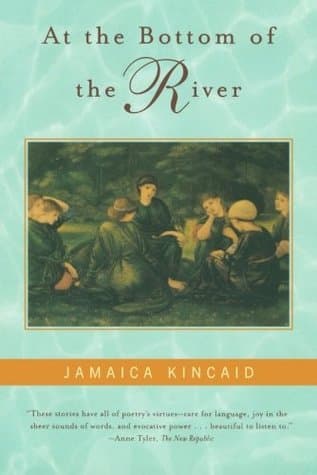
Synopsis
Covers the whole plot, including the ending.
- Difficulty
- Medium
- Pacing
- Slow
- Mood
- Atmospheric, Lyrical, Reflective, Dreamlike, Introspective
- Read it if
- You appreciate experimental, poetic prose that prioritizes mood and imagery over traditional plot, and enjoy exploring themes of childhood, mother-daughter relationships, and identity in a Caribbean setting.
- Skip it if
- You prefer linear narratives, clear character arcs, or a strong, conventional plot, or if you find highly abstract and symbolic language frustrating.
At the Bottom of the River Plot Summary
Covers the whole plot, including the ending.
Girl
The story 'Girl' is a single, continuous sentence of instructions from a mother to her daughter. The mother dictates how to do household chores, from washing and ironing clothes to preparing food. She gives advice on proper behavior, how to walk, how to speak to men, and how to avoid becoming 'the slut I know you are becoming.' The instructions are practical, cultural, and personal, showing the expectations placed on young women. The daughter speaks only twice, questioning an instruction and protesting the 'slut' accusation, both quickly dismissed by the mother's firm authority.
In the Night
The narrator, a young child, describes the world transforming at night. She talks about stars, the moon, and sounds of crickets and bats. There is wonder and slight unease as she considers the night's vastness and mystery. She imagines the earth as a giant spinning top and her own smallness within it. The child's view is innocent yet thoughtful, observing nature's delicate balance and how darkness changes familiar things, making them both beautiful and slightly frightening. She thinks about how even small things, like a blade of grass, have purpose.
At Last
The narrator describes the detailed process of preparing for a journey, packing belongings, and the physical feelings of leaving. She speaks of shedding her skin, a metaphor for leaving her past self and experiences. There is a sense of detachment from her surroundings and even her own body. She observes her hands and feet as if they belong to someone else, showing a deep sense of alienation. The journey seems to be not just physical, but an internal change, an attempt to escape or redefine herself, leaving the familiar for an unknown future, possibly to a place where she can be truly alone.
The Long Rain
The story describes a world of constant rain, a 'long rain' that has become nature's dominant force. The inhabitants, including the narrator, have adapted to this downpour, and their lives are shaped by it. The rain is both destructive and cleansing. It washes away the old, causing decay, but also brings renewal and a different beauty. People learn to live with the dampness, the constant sound, and the transformed landscape. The story focuses on the sensory experience of the rain—its smell, feel, sound—and how it affects every part of existence, blurring lines between familiar and alien.
A True Short Story
The narrator recounts her deep and changing relationship with a specific house. It is not just a dwelling but a living thing she connects with. She describes its features, sounds, and how it responds to her. Over time, her feelings for the house change; it becomes a place of memories, a witness to her life, and a reflection of her inner state. The house represents stability and continuity, but also the passage of time and inevitable change. She considers leaving it, the pain of separation, and how the house itself seems to hold onto her, making departure a deep emotional struggle.
The Letter
The narrator thinks about writing a letter, but the focus is less on the letter's content and more on the inner process. She struggles with what to say, how to express her feelings, and language's limits. Writing becomes a metaphor for her desire to connect, to show her inner world, and perhaps to bridge a gap with another person. She reflects on words' power, their ability to reveal and hide, and the vulnerability of putting thoughts on paper. The letter seems for someone important, perhaps a lover or parent, and her thoughts reveal her complex emotions and longing for understanding.
The Circling Hand
The narrator describes a 'circling hand' that represents a strong, often unclear, influence in her life. This hand is a source of comfort and security, always there, always offering guidance or solace. But it also feels restrictive, perhaps suffocating, preventing true independence. The hand could symbolize a parent, a lover, or a societal expectation that keeps the narrator within certain limits. She longs to break free from its embrace, to experience life without its constant presence, but also fears losing its protection. The image shows the complex dynamics of dependence and autonomy, and the conflict between safety and freedom.
My Mother
The narrator reflects on her mother, not in a story sequence, but through observations and feelings. Her mother is a strong, almost mythical figure whose presence is all-encompassing. The narrator describes her mother's physical traits, actions, and deep effect on her daughter's identity. There is admiration, fear, and a deep, complex bond. The mother is both a source of love and a force that shapes and sometimes limits the daughter's individuality. The reflections show the lasting influence of the mother, even when absent, and how this relationship forms the core of the daughter's understanding of herself and the world.
The Red Girl
The narrator observes and describes 'the red girl,' a character who stands out because of her unusual appearance, specifically her red skin or hair. This girl is an anomaly, someone who does not quite fit in. The description focuses on her distinct physical traits and how they set her apart. There is fascination and perhaps a touch of alienation in the narrator's gaze. The 'red girl' symbolizes otherness, being different in a captivating and isolating way. Her presence prompts thoughts on beauty, individuality, and the often unspoken judgments or curiosities that arise when someone deviates from the norm.
The Day-Picture
The narrator considers a 'day-picture,' a photograph, and its relationship with time and memory. She questions whether a photograph truly captures a moment or just offers a static, often misleading, representation of it. Looking at the picture brings up thoughts of the past, the people in it, and the emotions of that time. She thinks about how a photograph can both preserve and distort reality, freezing a moment while leaving out the context and feelings around it. The 'day-picture' prompts deeper thoughts on memory's subjective nature, time's passage, and truth's elusive quality.
Blackness
The narrator explores 'blackness' not just as an absence of light, but as a tangible, pervasive force. Blackness is described as something that can be felt, worn, and that permeates everything. It is linked with night, mystery, and a deep sense of depth. The narrator speaks of black skin, black clothes, and how blackness can both hide and reveal. There is pride and power in this description, but also an acknowledgment of its ability to absorb and transform. Blackness becomes a basic element of existence, shaping perception and identity, and carrying meaning beyond its literal definition.
The Sea-Net
The story focuses on the image of a 'sea-net,' likely used by a fisherman. The net is described in detail: its construction, purpose, and interaction with the sea. It symbolizes the effort and labor in sustaining life, the constant struggle against elements, and the hope for a catch. The sea is both generous and unpredictable, a source of life and a place of danger. The net is a metaphor for human effort, the tools we use to navigate our world, and the risks and rewards involved. There is a sense of cyclical existence, of casting out and drawing in, reflecting life's rhythm and reliance on nature.
Principal Figures
The Narrator (various personas)
Protagonist
The evolving female voice experiencing and reflecting on her world.
The narrator in 'At the Bottom of the River' is not a single, fixed character but rather a fluid, often unnamed female voice that shifts across the various pieces. She embodies different stages of life, from a young girl receiving instructions ('Girl') to a more mature woman reflecting on complex relationships and existential themes ('My Mother', 'At Last'). Her perspective is deeply internal, characterized by intense observation, poetic language, and a profound engagement with her inner world and immediate surroundings. She is sensitive, introspective, and often struggles with themes of identity, belonging, and the nature of memory.
Relationships: Mother (Complex and powerful, a source of guidance, love, and perceived entrapment.); The World/Nature (An intimate, often overwhelming, and deeply influential presence.)
The Mother
Supporting
A dominant, authoritative, and deeply influential maternal figure.
The Mother appears most prominently in 'Girl' and 'My Mother.' She is presented as a formidable figure, a fount of wisdom, rules, and expectations. In 'Girl,' her voice is a relentless stream of instructions, shaping her daughter's behavior and moral compass. In 'My Mother,' she is depicted as an almost mythical presence, all-encompassing and fundamental to the narrator's existence. While her influence can feel restrictive, she is also a source of deep connection and cultural transmission. She embodies the traditional roles and responsibilities of women within her society, and her presence is foundational to the narrator's identity.
Relationships: Daughter (Narrator) (Authoritative and shaping, a bond of love, expectation, and occasional tension.)
The House
Supporting
A living entity representing memory, stability, and the self.
Though inanimate, the house in 'A True Short Story' takes on the characteristics of a living character. It is a repository of memories, a witness to the narrator's life, and a physical manifestation of her emotional landscape. The narrator has an intimate, almost symbiotic relationship with it, describing its sounds, its presence, and the way it seems to hold onto her. It represents roots, belonging, and the struggle to move on. The house is imbued with personality and significance, reflecting the deep emotional ties humans form with their physical environments.
Relationships: Narrator (An intimate, almost sentient connection, a source of comfort and emotional tether.)
The Red Girl
Mentioned
A figure of otherness and distinctiveness.
Appearing in the story 'The Red Girl,' this character is defined solely by her unusual, striking appearance, likely her red skin or hair. She serves as a focal point for the narrator's observations on difference, beauty, and the way physical traits can set individuals apart. She is a symbol rather than a developed character, representing the captivating yet isolating experience of being an 'other' in a community. Her presence evokes themes of individuality and the subjective nature of perception.
Relationships: Narrator (Object of observation and fascination.)
The Circling Hand
Symbolic/Antagonistic
A pervasive, controlling, yet comforting influence.
This symbolic character, featured in 'The Circling Hand,' represents a powerful, ambiguous force in the narrator's life. It could be interpreted as a parent, a lover, or even societal expectations. While it offers protection and guidance, it also feels restrictive, preventing true independence. Its presence evokes the complex push and pull between dependence and autonomy, and the internal conflict of wanting both security and freedom. It's a manifestation of the forces that shape and sometimes constrain an individual's path.
Relationships: Narrator (A complex, encompassing presence offering both solace and perceived entrapment.)
The Earth/Nature
Supporting
A powerful, sentient, and all-encompassing force.
Nature, particularly the earth, the sea, and the rain, functions almost as a character throughout the collection. In 'In the Night,' the earth is a spinning top; in 'The Long Rain,' the rain itself is a dominant, transformative force; in 'The Sea-Net,' the sea is a provider and a challenge. Nature is depicted as both beautiful and destructive, a source of wonder and a harsh reality. It shapes the lives of the characters, dictates their rhythms, and provides a backdrop for their internal reflections. It is a powerful, ever-present entity that demands respect and adaptation.
Relationships: Narrator/Humanity (A fundamental, shaping, and often overwhelming relationship of dependence and awe.)
Themes & Insights
The Complexities of Mother-Daughter Relationships
This theme is key to the collection, especially in 'Girl' and 'My Mother.' Kincaid explores the deep, often stifling, bond between a mother and daughter. The mother's love appears as a flood of instructions and expectations, shaping the daughter's identity while also threatening to consume it. There is a deep, almost primal connection, but also tension between the daughter's wish for independence and the mother's strong influence. The mother is both a source of knowledge and a symbol of entrapment, showing the lasting impact of this foundational relationship.
“This is how to behave in the presence of men who don't know you very well, and this is how to behave in the presence of men who know you very well.”
Identity and Self-Definition
Many pieces explore the narrator's struggle to define herself amid outside pressures and inner thoughts. In 'At Last,' the narrator speaks of 'shedding her skin' to become someone new, showing a desire to escape past identities. The constant instructions in 'Girl' show a young woman whose identity is molded by another, while 'My Mother' reveals how deeply one's sense of self is tied to parents. The search for an authentic self, separate from family or societal expectations, is a recurring internal journey.
“I was not myself, I was someone else, and I was not afraid.”
The Power and Mystery of Nature
Nature is not just a setting but an active force and a source of deep thought. In 'In the Night,' the child marvels at the universe's vastness and the earth's movements. 'The Long Rain' shows nature as an overwhelming, transformative power that dictates human life, both destroying and renewing. The sea in 'The Sea-Net' symbolizes both bounty and challenge. Kincaid gives natural elements a spiritual or sentient quality, highlighting humanity's deep connection to, and vulnerability before, the natural world.
“The earth is a place of many things, but it is not a thing to be played with.”
Memory, Time, and Perception
The collection often looks at how memories form, are recalled, and shape perception. 'A True Short Story' examines the house as a place of memories, while 'The Day-Picture' directly questions photographs' ability to capture truth, suggesting they can distort as much as they preserve. The lyrical, often fragmented style itself mirrors memory's subjective and fluid nature. Kincaid explores how the past informs the present and how our understanding of events is constantly reinterpreted through time and personal experience.
“And the picture, after it is taken, is not the thing itself, but a memory of the thing.”
Alienation and Otherness
A subtle but constant theme is the feeling of being an outsider or different from others. The 'red girl' is defined by her difference, prompting thoughts on how physical traits can isolate. The narrator's feeling of 'not being myself' in 'At Last' speaks to a sense of detachment from her own identity. This alienation can come from family dynamics, societal expectations, or a deeper existential sense of being apart, creating a longing for connection while also embracing one's unique perspective.
“And the red girl, she was not like the others.”
Plot Devices & Literary Techniques
Stream of Consciousness
A narrative style mimicking unfiltered thought processes.
Kincaid frequently employs stream of consciousness, most notably in 'Girl,' where the entire story is a single, uninterrupted sentence representing the mother's continuous flow of instructions. This device immerses the reader directly into the character's mind, conveying the intensity and immediacy of their thoughts and feelings. It blurs the line between internal monologue and external dialogue, creating a raw and intimate reading experience that reflects the subjective nature of perception and memory.
Metaphor and Symbolism
The use of abstract ideas or objects to represent deeper meanings.
The collection is rich in metaphor and symbolism. The 'shedding of skin' in 'At Last' symbolizes transformation and letting go of a past self. The 'circling hand' represents a powerful, ambiguous influence—comforting yet restrictive. The house in 'A True Short Story' symbolizes memory and identity. These devices allow Kincaid to explore complex emotional and philosophical ideas without explicit exposition, inviting the reader to engage with the text on multiple layers of meaning and interpret the deeper significance of seemingly simple images.
Lyrical Prose
Poetic language characterized by rhythm, imagery, and emotional intensity.
Kincaid's writing is highly lyrical, employing evocative imagery, sensory details, and a distinct rhythmic quality that borders on poetry. This is evident in descriptions of nature ('In the Night,' 'The Long Rain') and internal states. The language often has a repetitive, incantatory quality, creating a hypnotic effect that draws the reader into the narrator's emotional landscape. This poetic style elevates the ordinary to the profound, making the mundane feel sacred and the internal world vibrantly alive.
Lack of Conventional Plot
Focus on internal states and atmosphere over traditional narrative progression.
Many of the pieces eschew a traditional plot structure with a clear beginning, middle, and end, or a defined conflict and resolution. Instead, they function more as meditations, vignettes, or extended reflections on a particular theme, image, or feeling. This narrative choice emphasizes atmosphere, psychological depth, and the exploration of internal states over external action. It allows Kincaid to delve into the nuances of human experience and emotion, creating a sense of timelessness and universal resonance rather than a specific story arc.
At the Bottom of the River Quotes
“I used to wonder if I would be able to love anyone. I used to wonder if I would be able to make anyone happy. I used to wonder if I would be able to make anyone laugh. I used to wonder if I would be able to make anyone feel good. I used to wonder.”
“This is how to make a good pumpkin fritter; this is how to make a good pumpkin fritter for a child; this is how to make a good pumpkin fritter for a man; this is how to make a good pumpkin fritter for yourself.”
“But what if the baker won't let you feel the bread to see if it's fresh? You just have to walk on by.”
“I would like to be the wave, to rise and fall, to disappear and reappear, to be the sea.”
“I was walking along a road when I saw a woman sitting by the side of the road. She was a very old woman, and she was crying.”
“And then I saw a man walking toward me. He was a very tall man, and he was carrying a very large jar.”
“I did not know what to do. I did not know what to say. I did not know what to think. I just stood there.”
“My mother is a beautiful woman. She has long black hair and her skin is the color of caramel.”
“And then I saw my father. He was sitting in a chair, and he was reading a book.”
“I could not sleep. I could not eat. I could not think. I could only remember.”
“The trees were very tall, and their leaves were very green. The sky was very blue, and the sun was very bright.”
“I was tired of being me. I was tired of being here. I was tired of everything.”
“I wanted to be a bird. I wanted to fly away. I wanted to be free.”
“And then I saw a house. It was a very small house, and it was made of wood.”
Quiz
10 questions on the plot and the characters. Each answer comes with a short explanation.
Question 1
In the story 'Girl,' what is the mother primarily instructing her daughter on?
- How to read and write
- How to behave and perform domestic duties
- How to navigate the local political landscape
- How to weave intricate baskets
Show answer
B. How to behave and perform domestic duties The story 'Girl' is a long, single-sentence monologue where the mother gives her daughter a barrage of instructions on household chores, social conduct, and how to maintain her reputation.
Question 2
What recurring natural element often appears in Kincaid's descriptions of the Caribbean landscape?
- Snow-capped mountains
- Vast desert plains
- Lush vegetation and the sea
- Dense urban jungles
Show answer
C. Lush vegetation and the sea Kincaid's stories frequently evoke the vibrant, often overwhelming, natural beauty of the Caribbean, including its abundant plant life and the omnipresent sea.
Question 3
Which of the following best describes the narrative voice often employed in 'At the Bottom of the River'?
- Detached and objective third-person
- A lyrical, often first-person, stream-of-consciousness style
- A fast-paced, dialogue-heavy, omniscient narrator
- A formal, academic, analytical tone
Show answer
B. A lyrical, often first-person, stream-of-consciousness style Kincaid is known for her distinctive lyrical, often first-person, voice that delves into the inner world of her characters, frequently using stream-of-consciousness.
Question 4
In the story 'The Circling Hand,' what is the significance of the narrator's repeated observation of the 'circling hand'?
- It represents a specific, comforting gesture from a loved one.
- It symbolizes the cyclical nature of life, memory, and perhaps colonial influence.
- It is a literal hand belonging to a giant creature in the landscape.
- It refers to the hands of a clock, emphasizing the passage of time.
Show answer
B. It symbolizes the cyclical nature of life, memory, and perhaps colonial influence. The 'circling hand' in the story is an abstract, symbolic image that evokes themes of repetition, the inescapable past, and perhaps the lingering presence of historical forces.
Question 5
A prominent theme in Kincaid's work, particularly evident in the relationship between the mother and daughter, is:
- The celebration of unbridled independence and rebellion.
- The complex, often fraught, dynamics of familial love and control.
- The pursuit of material wealth and social status.
- The importance of formal education above all else.
Show answer
B. The complex, often fraught, dynamics of familial love and control. The powerful and often ambivalent ties between mother and child, marked by both love and a struggle for autonomy, are central to many of Kincaid's stories, especially 'Girl'.
Question 6
How does Kincaid often portray the concept of 'home' or a 'place' in her stories?
- As a consistently safe and unchanging haven.
- As a complex entity, imbued with memory, history, and sometimes a sense of confinement or loss.
- As merely a backdrop, with no inherent meaning.
- As a utopian ideal always attainable.
Show answer
B. As a complex entity, imbued with memory, history, and sometimes a sense of confinement or loss. Kincaid's depiction of places, particularly the Caribbean, is rich with personal and collective memory, often showing it as a site of both beauty and complicated emotions, including a sense of being trapped or of having left something behind.
Question 7
In the story 'At the Bottom of the River,' what does the narrator describe seeing beneath the water?
- A bustling underwater city.
- The clear reflection of the sky and clouds.
- Every object and creature that has ever existed.
- Only mud and rocks.
Show answer
C. Every object and creature that has ever existed. The title story presents a fantastical and philosophical vision where the narrator perceives the entirety of existence, past and present, 'at the bottom of the river,' including 'every single thing that has ever been born and every single thing that has ever died.'
Question 8
Kincaid's prose is often characterized by its use of:
- Short, declarative sentences and minimal description.
- Long, winding sentences with repetitive structures and sensory details.
- Extensive use of technical jargon and scientific terminology.
- Dialogue-heavy scenes with little to no narration.
Show answer
B. Long, winding sentences with repetitive structures and sensory details. Kincaid's distinctive style often employs long, hypnotic sentences, sometimes with an almost incantatory repetition, rich in sensory detail and internal monologue.
Question 9
The collection often explores the transition from childhood innocence to a more complex, often disillusioned, understanding of the world. This is a key aspect of which literary concept?
- Bildungsroman
- Magical Realism
- Postmodernism
- Absurdist Fiction
Show answer
A. Bildungsroman While Kincaid's work shares elements with other concepts, the journey from childhood to adulthood and the formation of identity is a central theme, aligning with the concept of a Bildungsroman, even if presented in fragmented, lyrical forms.
Question 10
What is a recurring tension explored between the 'masculine' and the 'feminine' in Kincaid's stories?
- The competition for physical strength in manual labor.
- The differing expectations, roles, and power dynamics in society and relationships.
- The preference for specific types of clothing and adornment.
- The debate over which gender is more adept at storytelling.
Show answer
B. The differing expectations, roles, and power dynamics in society and relationships. The provided description highlights 'the gulf between the masculine and the feminine' as a key theme, referring to the societal roles, expectations, and power imbalances that often define gender relationships in Kincaid's narratives.
At the Bottom of the River FAQ
What is the overarching theme or style of 'At the Bottom of the River'?
'At the Bottom of the River' is characterized by its lyrical, almost poetic prose and stream-of-consciousness narratives. It explores themes of childhood, memory, nature, and the intricate relationships within families, particularly between mothers and children, often set against a Caribbean backdrop.
Who is the primary narrator or perspective character throughout most of the stories?
The primary narrator is often an unnamed young girl, or a voice reminiscent of a child's perspective, who observes and reflects on her surroundings and experiences. This perspective allows for a blend of innocent wonder, keen observation, and profound, almost biblical, pronouncements.
How does the Caribbean setting influence the stories in the collection?
The Caribbean setting is integral, not merely a backdrop, but an active presence with its distinct flora, fauna, and cultural nuances. It shapes the protagonist's understanding of nature's beauty and destructiveness, and subtly influences the social dynamics and family structures depicted in the narratives.
What role do 'familiar things' like a house or a cup play in Kincaid's narratives?
Familiar objects are often imbued with profound significance, acting as anchors for memory, symbols of domesticity, or even extensions of character. Kincaid's prose elevates these mundane items, making them central to the characters' perceptions and emotional landscapes, revealing their hidden meanings.
Are the stories in 'At the Bottom of the River' interconnected, or are they standalone pieces?
While each piece can be read as a standalone story, there's a strong thematic and stylistic coherence that links them. They often feature a similar narrative voice and recurring motifs, creating a cumulative effect that feels like different facets of a single, evolving consciousness or memory.
How does the story 'Girl' fit into the collection's themes, and what is its unique structure?
'Girl' is a single, continuous sentence of instructions from a mother to her daughter, covering everything from domestic chores to social conduct. It powerfully illustrates the overwhelming pressure of maternal expectation and the transmission of cultural norms, highlighting the restrictive yet guiding nature of these lessons.
What is the significance of the recurring motif of 'shedding skin' or 'darkening an afternoon'?
These phrases suggest a transformation or an altering of perception, indicating a shift in reality or self. 'Shedding skin' can symbolize growth, renewal, or even a painful casting off of an old self, while 'darkening an afternoon' might represent a mood change, a looming threat, or a deepening of understanding.
In stories like 'The Circling Hand,' how does Kincaid use nature imagery to reflect internal states?
In 'The Circling Hand' and others, natural elements like rivers, trees, and weather are not just descriptive but deeply metaphorical, mirroring the protagonist's emotional turmoil, longing, or sense of displacement. The external world often becomes an extension of the internal psychological landscape.
What is implied by the title 'At the Bottom of the River'?
The title suggests a plunge into deep, subconscious memory, perhaps a return to origins or a state of profound introspection. It evokes a place of hidden truths, forgotten experiences, or the very source of life and emotion, where things are submerged yet still exist.
How does the mother-child relationship, particularly with the unnamed narrator, evolve throughout the collection?
The mother-child relationship is central and complex, often portrayed as a powerful, sometimes suffocating bond. It shifts from the child's initial dependence and awe to a growing awareness of the mother's limitations, culminating in a nuanced understanding of love, control, and separation.
What psychological impact does the 'biblical in its assurance' narrative voice have on the reader?
The biblical tone imbues the narrator's observations with a sense of undeniable truth and weight, making even simple statements feel profound and authoritative. It lends a mythic quality to ordinary events, suggesting an ancient wisdom or an inherent rightness to the child's perspective.
How does Kincaid explore the 'gulf between the masculine and the feminine' psychologically?
Kincaid often subtly highlights the differing societal roles and expectations placed on men and women, often through the mother's instructions or the narrator's observations of adult relationships. This creates a psychological chasm, revealing the distinct pressures and identities forged by gender.
In what ways do the characters grapple with identity and self-discovery in a world seemingly defined by others?
The unnamed narrator's journey is often one of internal self-definition against the backdrop of external influences, particularly the mother's expectations. Her observations and reflections are attempts to understand her place and carve out an individual identity within a pre-established world.
Is the narrator's 'naively whimsical' voice truly naive, or is it a deliberate artistic choice?
The 'naively whimsical' voice is a deliberate artistic choice, allowing Kincaid to present profound insights through a seemingly simple lens. It enables the exploration of complex themes without didacticism, inviting readers to engage with the text's deeper meanings beneath the surface innocence.
How can one interpret the 'transfiguring our human form and our surroundings' aspect of the stories?
This can be interpreted as a magical realist element where reality is fluid and subjective, reflecting the power of perception and imagination. It suggests that the characters' inner states literally reshape their external world, blurring the lines between objective reality and subjective experience.
What is the intended effect of Kincaid's often repetitive or circular sentence structures?
The repetitive structures create a hypnotic, incantatory rhythm, drawing the reader into the narrator's stream of consciousness and mimicking the cyclical nature of memory or thought. It can also emphasize certain ideas or emotions, making them resonate more deeply.
Does the book offer a definitive resolution or closure to its themes, or is it more about the ongoing process of understanding?
The book leans more towards exploring the ongoing process of understanding and memory rather than offering definitive resolutions. Its open-endedness reflects the continuous nature of human experience and the elusive quality of truth, leaving readers with lingering questions and reflections.
How does Kincaid's use of language challenge conventional storytelling?
Kincaid challenges conventional storytelling by prioritizing lyrical prose and sensory detail over linear plot or traditional character development. Her fragmented narratives and unique syntax force readers to engage with the text on an emotional and interpretive level, rather than simply following a storyline.
About the author

Jamaica Kincaid is an Antiguan-American novelist, essayist, gardener, and gardening writer. She was born in St. John's, Antigua. She lives in North Bennington, Vermont and is Professor of African and African American Studies in Residence at Harvard University during the academic year.
Similar books
- Annie John
Jamaica Kincaid
3.7 (7k) average on GoodreadsLiterary FictionExplores similar themes of childhood, mother-daughter relationships, and identity in a Caribbean setting with a comparable lyrical style.
- Bluets
Maggie Nelson
4.3 (19k) average on GoodreadsBiographyFeatures fragmented, poetic prose exploring a central theme with intense introspection and emotional depth.
- The House on Mango Street
Sandra Cisneros
3.6 (126k) average on GoodreadsYoung AdultUses vignettes to depict a young girl's coming-of-age and her observations of her community and identity.
- The Old Man and the Sea
Ernest Hemingway
3.8 (831k) average on GoodreadsLiterary FictionA Cuban fisherman's long struggle with a giant marlin becomes a story of endurance and dignity, now retold for young adults with illustrations, phonetic guides, and writing prompts in Traditional Chinese.
- One Hundred Years of Solitude
Gabriel García Márquez
4.1 (753k) average on GoodreadsLiterary FictionThrough the multi-generational story of the Buendía family, a mythical town deals with the repeating patterns of time, love, and solitude, as the extraordinary mixes with the ordinary.
- The Goldfinch
Donna Tartt
3.9 (720k) average on GoodreadsLiterary FictionHaunted by a tragic explosion and clutching a stolen Dutch masterpiece, a young orphan navigates the opulent drawing rooms of New York and the gritty underbelly of the art world, desperately seeking connection and redemption amidst a life spiraling into crime and obsession.





Enjoyed the summary?
A summary gives you the shape of the book. The book itself has the detail, the examples and the voice.
Find At the Bottom of the River on AmazonAs an Amazon Associate, BookBrief earns from qualifying purchases. How we're funded